Design Leap!
Developing a divergent tool through film for use within the architectural
design process
Matthew Hynam1, Dr Rachel Sara2, Jonathan Mosley3, Professor Bill Gething4. 1,2,3,4The University of the West of England, Bristol, England. www.uwe.ac.uk
1[email protected], 2[email protected],
3[email protected], 4[email protected].
Abstract.
This paper and accompanying short films (www.designleap.org/478/) have been produced to inform the development of a wider design research based PhD. The aim of the PhD is to develop a divergent tool to help designers be more creative within the early stages of the architectural design process. The paper and films are a snapshot of the tool’s development to date and comprise the examination of a series of design process tests by the researcher, who is an architect and architectural students from the University of the West of England. The selection of testers for this stage of the research was based on availability sampling.
The paper is structured into four distinct sections, which emerged whilst analysing the short films. These sections are fixate, diverge, leap and verify and are mapped onto Wallas’ 4 stage creativity model (1926).
The analysis of the films identifies the importance of divergent activities in supporting emergence (as opposed to a singular ‘creative leap’), in which new, previously unrecognised properties become apparent through the design process. The research has highlighted the importance of a balance between divergent and convergent activities within successful creative processes and has developed a filmic framework for exploring the architectural design process. This is particularly pertinent at a time when the architecture industry, driven by efficiency, is moving towards convergent step-by-step processes and away from divergent processes and creative possibilities.
[image:1.595.127.512.511.718.2]Keywords. Divergent; Tool; Film; Creativity; Practice.
Figure 1
Introduction
A key part of generating creative ideas is through the use of divergent thinking, which allows designers to explore multiple solutions to design problems. Divergent thinking and its opposite convergent thinking were terms coined by the psychologist J.P. Guilford in ‘The Nature of Human Intelligence’ (1967). Divergent thinking sees a designer start with a question and then use multiple approaches to explore multiple answers, and can be seen in contrast to convergent thinking, which sees a designer take an initial question and then use logical steps to come to an answer. It is the careful balance between divergent thinking and convergent thinking that characterises a successful architectural design process (Lawson, B. 2006). However, current architectural design tools are found to be increasingly good at promoting a convergent approach within the design process, at the possible expense of divergent thinking. In particular the introduction of Building Information Modelling (BIM) software has led to designers working in an increasingly linear fashion in a single software environment to develop a project (Pitcher, G. 2012; Park, H. 2008; Gu, N. & London, K. 2010).
In order to tackle this imbalance, designers need to embrace change and actively look for opportunities to assert a creative direction (Garber, R. 2014 p.222). Creativity is a key part of the design process and fundamental to developing innovative design solutions. (Goldschmidt, G. & Smolkov, M. 2006). Within creativity divergent thinking is a core component and essential to a designer’s ability to test and challenge multiple solutions (Lawson, B. 2006). This paper and the accompanying films present a snapshot in the development of a divergent tool to help designers be more creative within the early stages of the architectural design process.
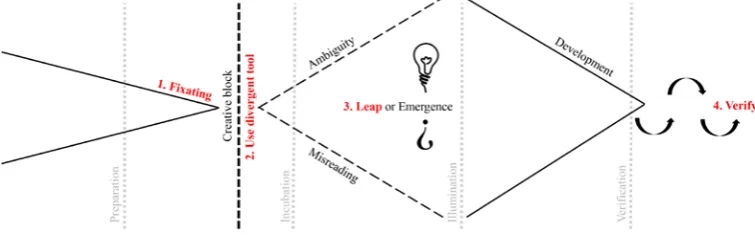
[image:2.595.131.509.508.627.2]The paper is structured into four distinct sections, which present the key themes that emerged from the analysis of the short films (found at the following link: (www.designleap.org/478/). These section themes are fixate, diverge, leap and verify, which are all understood as aspects of the design process. These sections are mapped onto the Wallas’ 4 stage creativity model (1926). Whilst this model has been criticised for its linear nature and lack of switching back and forth between stages it still provides a useful framework from which to discuss creative processes (Lawson, B. 2006) (Cross, N. 2006).
Figure 2
Paper sections mapped onto Wallas’ 4 stage creativity model
Research Methods
The development of the divergent tool has been undertaken through an iterative design research process where the researcher has switched between testing and developing the tool with students in the design process. Films were used as the principle way of recording, presenting and analysing the use of the tool in action. This is a form of visual ethnography (Pink, S. 2007) through which we endeavour to understand the relationships between the designers, the design process and the divergent tool. The films comprise the examination of a series of design process tests undertaken by the researcher, who is an architect, and by architectural students from the University of the West of England. The current iteration of the tool has seen 10 designers test the cards on a variety of architectural processes resulting in 15 short films. The films were recorded using digital cameras mounted either on a tripod or the user in order to follow the design process. Testers were provided with simple instructions on how to structure a short film. The selection of testers for this stage of the research was based on availability sampling and involved 31 university students and 6 professionals.
[image:3.595.125.509.399.636.2]The current iteration of the divergent tool takes the form of a deck of cards containing short prompts which designers are asked to pull at random and perform when faced with a creative block in the design process. The idea for the cards comes from Brian Eno and Peter Schmidt’s Oblique Strategies (1975), which contain prompts that help musicians and artist overcome creative blocks (Taylor, G. 1997). The divergent deck is currently made up of 50 prompts which have been developed through previous design research, carried out by the author and other designers: www.designleap.org (Hynam, M. 2016). The prompts fall into one of six categories in figure 3.
Figure 3
Categories divergent deck
Film analysis
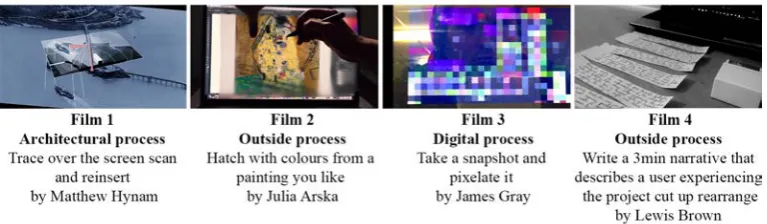
[image:4.595.128.512.175.287.2]The 4 short films (figure 4) within this analysis characterise the varying degrees of success found by testers whilst using the divergent deck. The process of analysing the films saw the researcher watch back the films and start to extract key moments and stills. This analysis will now be discussed within the context of the sections; fixate, diverge, leap and verify.
Figure 4
Diagram showing analysed films
Fixate
The instructions given to the testers for making films started by asking them to describe how they were creatively blocked and why they were about to use the divergent deck. Creative blocks within this research are the point at which a designer is unable to think past a problem. The reason for asking designers to describe this was to better understand the type of problem they were facing.
Within film 1 the tester is blocked by the amount of information and is struggling to develop an idea to go forward. The tester talks about the problem within his project being whether to develop the pier, the island or both. In film 2 the tester is similarly unable to move forward but more carefully frames the problem as a question “How to make the site more engaging / interactive for its users?” In film 3 it is unclear what the creative block is and the tester seems to be using the cards to look for new meaning within their project. In film 4 the tester is blocked but seems to have predetermined the output suggesting that the “…long and narrow teaching space which has been arrived at is not ideal but could be improved by introducing a squarer format”.
The block within films 1,2 and 4 could be more accurately described as a moment of fixation where the designer fixates on an initial idea and keeps producing the same information failing to get past this and generate new concepts (Jansson & Smith, 1991). Fixation has been linked by Jansson and Smith to designers being presented with too much information. In a group based study of how designers tackle simple design brief problems they found that groups provided with additional illustrative information on existing solutions became fixated with this material. The result of this was that they generated less novel concepts than the groups without illustrations (Jansson & Smith, 1991). Within film 3 where there is no apparent block the tester appears to be attempting to extract further information rather than overcome a specific problem. Interestingly this is similar to the way that the writer William Burrough’s used the cut-up technique as a means to decode existing material and discover its true meaning (Judkins, R. 2015).
a key component within Schon’s reflective practice where “Problem setting is a process in which, interactively, we name the things to which we will attend and frame the context in which we will attend to them” (Schon 1983 p.39-40). Within the analysis presented here, framing the problem is a step to moving onto the next stage of using the cards and diverging.
Diverge
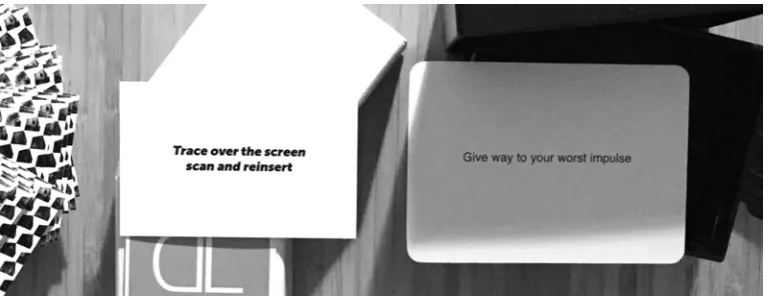
[image:5.595.128.513.313.464.2]The divergent deck was designed to introduce a random prompt into a designer’s workflow in order to help them explore alternative options. In developing the prompts careful consideration of the balance between convergent and divergent thinking was taken into account. In earlier tests the researcher used Brian Eno’s and Peter Schmidt’s Oblique strategies within the design process, however, it was found that the card prompts were often too vague and unspecific for them to be translated (figure 5) (Hynam, M. 2016). In order to overcome this within the divergent deck, verbs commonly used within the design process were used to help testers connect the prompt to their design process. Examples include; sketching, modelling, mirroring, tracing, overlaying and detailing.
Figure 5
Example of Divergent Deck next to example of Oblique Strategies
The prompts also looked to promote switching between digital and physical mediums, altering the tempo of the design process and shifting drawing scales all of which had been found to aid the exploration of new ideas within the design process (Banks, J. 2014) (Pressman, A. 2012). The prompts also aimed to maintain a level of ambiguity where the designer could connect with elements of the prompt but also allow for a degree of interpretation. Within the four short films this ambiguity leads to the testers performing actions beyond the prompt as they interpret them within their own processes.
Within film 1 the tester initially struggles to understand the relevance of the prompt ‘Trace over the screen scan and reinsert.’ By re-reading the example within the deck’s instructions the tester latches onto the verb ‘mirror’ (figure 6).
“For instance a card that contains the word mirror may see you horizontally flip an object. However you can be more divergent in your translation and perhaps look into a mirror whilst designing”.
Figure 6
Film 1, Mirroring sequence, by Matthew Hynam
Reflecting back on the process the inclusion of the additional action can be seen as an element of misreading where a process set out as an example becomes part of the prompt. The misreading in this instance is critical to the translation of the prompt and leads to a period of the tester getting lost and abandoning logical steps before a breakthrough is made.
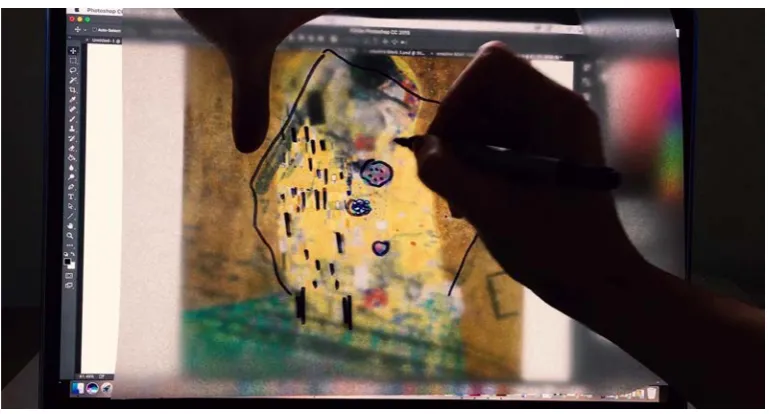
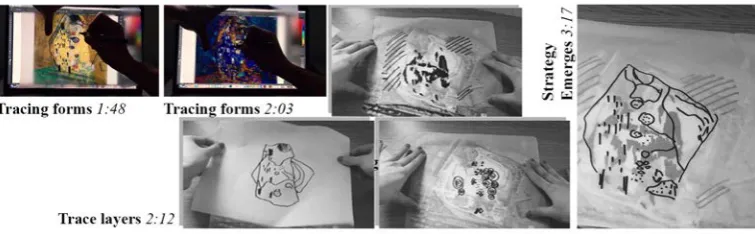
Within film 2 the tester quickly decides on how to carry out the prompt through the insertion of Gustav Klimt’s ‘The Kiss’ into their site strategy. However once again ambiguity over what is important within the prompt emerges. Rather than block hatching the site forms, as proposed in the card, the tester plays with blending the painting with the site through Photoshop trying to find an interesting juxtaposition between the two mediums. Out of nowhere the tester then inverts the image changing the gold leaf to a midnight blue. Instead of hatching, the tester floods the context with the painting through digital image manipulation and generating multiple versions. Following this the new composite drawings are mined, by tracing over the screen and then overlaying the tracing paper to find new forms. The tracing is something that does not appear within the card description and at first could be seen as the tester contaminating the process with the prompt from another card. Talking to the tester after seeing the video it transpires to be a process within their regular repertoire.
Figure 7
Film 2, Image manipulation and ambiguity, by Julia Arska
Within film 3 the tester states that the process of writing the narratives helps them make design decisions regarding circulation and view paths. The act of cutting up the narratives makes the tester less precious about their project. However it is not clear what the tester found, as they do not read the new narrative aloud within the film.
[image:6.595.124.514.483.560.2]Within films 1&2 ambiguity in translation and misreading are important steps in adapting the prompt for use within the testers specific design process. They also play a significant role in how the translation of the prompt unfolds. In films 3&4 the testers directly translate the cards with little to no ambiguity. This could potentially be down to the testers not being able to bridge between the prompt and their unique design process. In order to understand whether this is the case further analysis of the films needs to be undertaken potentially with the tester reflecting back on this.
Leap
The divergent deck testers were asked within the instructions to film the process of interpreting the prompt until complete, whether it was a success or not (success being where they managed to overcome the creative block and move forward). The analysis of the films starts to reveal a pattern of emergence rather than sudden illumination and a ‘creative leap’. Emergence is the process by which new, previously unrecognised properties are perceived as lying within an existing design. (Cross, N. (2006 p.76)
[image:7.595.130.508.388.505.2]The creative process within film 2 has the characteristics of emergence where the idea starts to develop as the tester examines traces created by combining Gustav Klimt’s ‘The Kiss’ and their site information. Through a process of re-ordering these layers the tester perceives that combining layer 3 with layer 1 produces a composition that appear to show solids, voids with and movement between them. The process of emergence completes at this point when the tester recognises this information and is able to move forward.
Figure 8
Film 2, Tracing and emergence, by Julia Arska
Figure 9
Film 1, Breakthrough arraying projection, by Matthew Hynam
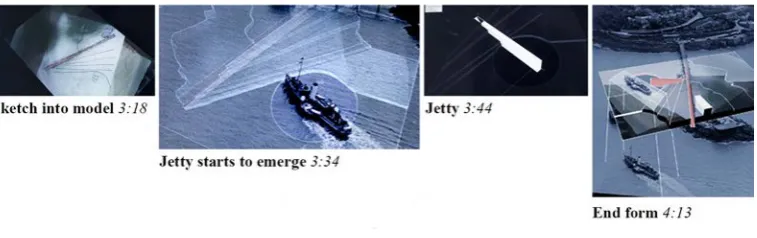
This emerging pattern can be interpreted as conceptual bridging where a user makes a connection between two areas of a project that have not been previously linked before. Nigel Cross describes how bridging can involve a subtle articulation of an idea which allows previously partial information to be joined together Cross, N. (2006 p.78). From this point forward the tester develops the concept into a new approach for a North Jetty from which ferries can moor and drop off passengers at all tide levels. The North Jetty had been a prominent feature in the past but had been destroyed by a storm surge. Carrying out the prompt triggered the tester to reconsider this previously discarded information as a viable means of getting people to and from the island.
Figure 10
Film 1, North Jetty sequence, by Matthew Hynam
Within Film 3 the tester does not think that the order of the cutup technique was useful stating that “…my preconceived notion of it delivering an outcome was not applicable.” The result confirms that as identified earlier the tester was trying to search for a particular answer for the output of the process and was therefore less willing to diverge.
[image:8.595.132.511.371.490.2]Figure 11
Film 4, Pixilation alternative reading, by James Gray
The analysis of this small sample of films has shown that where a creative breakthrough is made there are patterns of emergence and conceptual bridging rather than creative leaps and sudden illumination as described by Graham Wallas. This appears to be due to the testers having to develop and interpret the prompt into their own particular process. Where the prompts fail to produce a creative leap, films 3 & 4, the issue can be linked back to the fixation and diverge sections. Following fixation, the ability to frame and reflect on the problem is critical to utilizing the divergent prompt and consequently successfully overcoming the block. Factors beyond the current research scope of developing a divergent tool, such as the natural design aptitude of the tester and even their attitude towards the process will no doubt play a significant role in the success of the prompts. What is also not known from analysing the films is the long-term impact of the prompts on the testers design process, which will be discussed in the following section.
Verify
Within Graham Wallas’ 1926 four stage model the final stage verification sees the creative idea repeatedly tested and developed into its final form. Within the architectural design process this might see an idea reviewed and refined in collaboration with others and then at the end of the process reflected upon as a key moment.
At present the films within the research conclude with the testers immediately reflecting on the usefulness of the divergent deck. This was for practical reasons of limiting the length of the test and the amount of work for the testers so that the researcher could quickly gather data. The limitation of this approach however is that the longer-term impact of the prompts on the testers design process is unknown. This means that it is not possible to identify whether the creative idea becomes a key part of the testers design process and is continually iterated, or whether it simply acted as a means to overcome fixation and move forward at a single point in the design process.
Conclusion
The filmic analysis of the divergent deck within this paper has produced a number of interesting findings. The first being that the stages of fixate, diverge, leap and verify, which emerged from analysing the films, align well with the established 4 stage creativity model proposed by Graham Wallas. Within these stages themes emerged, specific to the divergent deck, concerning how testers developed the prompts. Problem framing, ambiguity / misreading and conceptual bridging were found to be key to successful tests of the deck. The key finding overarching these themes was that the creative moment could be more accurately described as emergence rather than sudden illumination or a creative leap.
This analysis has progressed the research beyond the development of a divergent tool and has started to provide a filmic framework and syntax for exploring, reflecting on and critiquing the early stages of the architectural design process. This opens up the opportunity for the wider PhD to become a divergent tool supported by a filmic web based repository for designers to turn to when creatively blocked.
The study will continue to develop the current divergent deck and also look to reflect back on the previous tests and verify their longer term impact. This will help develop future iterations of the cards which could see a smaller number tested based on a sub category such as architectural processes see fig 2 or a cross section of the categories where successful cards are brought together.
References
Banks, J.: 2014, Making BIM the best Tool for Design, Available from: http://
www.aia.org/akr/Resources/Documents/AIAB103830 [Accessed 1 January 2017]. Cross, N.: 2006, Designerly ways of knowing, London: Springer.
Garber, R.: 2014, AD Smart: BIM Design: Realising the creative potential of building information management, London: Wiley.
Gibbs, P.: 2015, Transdisciplinary Professional Learning and Practice, Springer, New York.
Goldschmidt, G. & Smolkov, M. 2006, Variances in the impact of visual stimuli on design problem solving performance, Design Studies, vol. 27, no. 5, pp. 549-569.
Hynam, M.: 2016, ‘Design Leap’, Available from: http://www.designleap.org/about/ [Accessed 14st February 2017].
Jansson, D.G. & Smith, S.M. (1991, Design fixation. Design studies, 12(1), p. 3-11. Judkins, R.: 2015, The art creative thinking, Hodder & Stoughton Ltd.
Kolb. D.A.: 1984, Experiential learning: Experience as the source of learning and development, New Jersey, Prentice Hall. Krueger, R.
Lawson, B.: 2006, How designers think: the design process demystified, 4th ED. Oxford: Architectural Press.
Park, H.: 2008, Evolution BIM: The utilization of building information modelling at an early design stage, CAADRIA 2008 [Proceedings of the 13th International Conference on Computer Aided Architectural Design Research in Asia] Chiang Mai (Thailand), p. 552.
Pink, S.: 2007, Doing visual ethnography: images, media and representation in research, 2nd ED, SAGE, London.
Pitcher, G.: 2012, Incoming RIBA president backs pay-as-you-go BIM, Architects Journal. Available from: http://www.architectsjournal.co.uk, [Accessed 12 January 2017].
Pressman, A.: 2012, Designing Architecture; The Elements of Process, New York: Routledge. Schon, D.A.: 1983, The Reflective practitioner: how professionals think in action, Basic Books.
Taylor, G.: 1997, ‘Oblique Strategies: Introduction’, Available from: http://www.