“Three times is enemy action” – flood
experiences and flood perceptions
C.B.Rose
1, D.G.Proverbs
1, C.A.Booth
1, K.I.Manktelow
2 1University of the West of England, UK.
2
University of Wolverhampton, UK.
Abstract
In the context of anticipated climate change, particularly the frequency and intensity of rainfall events likely to affect the UK in future, it is becoming increasingly important to understand the ways in which people perceive, and therefore respond to, natural hazards such as flood risk. Behavioural models, incorporating key predictive factors, are sought by the policy-making bodies, in order to develop effective interventions for improving community resilience to extreme weather events. An examination of factors relevant to flood risk perception is presented, including the degree of exposure to the threat; concepts such as ‘controllability’ and ‘dread’ associated with different hazards; and the wider issues of perceived responsibility, blame-shifting and ontological security. The complex interactions between the factors, together with some UK-specific issues, pose challenges for the development and testing of any model seeking to explain and predict the behaviour of people in the UK exposed to flood risks. Some innovative techniques, capable of modifying aspects of the perception of risk, which can be incorporated into community engagement initiatives, are also discussed.
Keywords: Risk perception; flood preparedness; natural disasters; ontological security; community engagement.
1
Introduction
The UK, amongst other nations, has a problem in respect of the population known to be at flood risk:
This essentially represents a mismatch between the perceptions of the general public and the evidence-based risk perceptions of officials, professionals and technical experts. In the context of nuclear power plants, this perception gap has been attributed by the industry’s proponents to ‘public ignorance and irrationality’[2] but this is an overly simplistic view. The oft-proposed remedies, of education and awareness-raising, fail to address the complexities of the human thought processes, emotions and other factors that contribute to our perceptions of risk.
More recently, policy-makers have sought a deeper understanding of how misperceptions can be corrected and behavioural changes brought about [3] but no ‘magic bullet’ exists, as the realities of human behaviour, and techniques for modifying it, are complex issues. In the context of flood warning responses, for example, the public’s assessment of risks has been found to combine the probability estimates provided by a warning authority with a wide variety of other information: this can include beliefs, recent experiences and perceptions of the credibility of authorities, amongst other factors [4].
It has also been observed that people have a marked predilection for viewing themselves as personally immune to hazards, as illustrated by the following finding:
“The great majority of individuals believe themselves to be better than average drivers”[2]
This perception is, in statistical terms, an impossibility but there is an experiential explanation: behaviours such as contravening speed limits or following too close behind another vehicle will lead to an accident (or other adverse consequences) on relatively few occasions, thereby creating a body of personal experience that supports the individual’s belief in their competence [2].
To explain this, some researchers have adopted a ‘mental models’ approach to explain risk-related behaviours; this posits that people develop conceptual structures to make sense of their world, which may well be inaccurate, or include misunderstandings [5]. The models adopted by a member of the public are, therefore, likely to differ from those of a professional working in the relevant field. Furthermore, such mental models are not limited to an individual’s perceptions, but may also be shared amongst a community, leading to what might be termed ‘myths and legends’ pertaining to hazards: for example, in a US study, local residents asserted that a flood event had been ‘man-made’, because of a commonly held, but erroneous, belief that an upstream hydro-electric dam
was a flood-control structure and that this had ‘failed’[6]. Such
question is, in fact, a water supply reservoir with extremely limited, localised flood alleviation capability [8].
Attempts to conceptually model human behaviour in risk contexts, therefore, face a dual challenge: not only are there multiple factors involved, but also there is interaction between factors. A generic framework for social psychological analysis, designed to aid experimental work in this field, has been developed by
Breakwell [9]: this offers ten broad factor-groupings ranging from
physical/environmental contexts to ideology/social representations. Of particular interest in the present context, however, are two groups which have been implicated in the perception of flood risk: the first encompasses factors arising from thoughts or feelings; the second, termed ‘past action’, subsumes both prior experience and previous behaviours These factor groups contribute to some of the phenomena that have been observed in the context of natural hazards including flooding: the misattribution of blame; the concept of ‘dread risk’; and the interactions of flood experiences and preparedness. The following sections examine these issues in depth, with the intention of synthesising the extant literature on preparedness to hazards, in order to develop a framework specific to flood risk preparedness behaviours in UK citizens.
2
Thoughts and feelings: blame and controllability
‘ ... flood victims blame engineers for holding back water to protect London, just as Point Marion residents said about Pittsburgh ...’[6]
The blame discourse is widely recognised as an issue amongst researchers in the field of flooding: based upon the mistaken belief that flooding is an entirely controllable phenomenon, people will invoke human incompetence (or malice) as being the causes of a flood event [10] yet, by contrast, seismic or volcanic hazards are perceived as natural and uncontrollable phenomena. If it is believed that some preventative actions have not been carried out, anger and frustration have been noted as common responses in affected communities [6, 11]. By seeking to shift blame onto others (typically local or national authorities) denial of personal responsibility can be maintained, not only in the context of natural hazards [12] but also in issues such as engagement with initiatives to address climate change [13].
As well as the degree of controllability associated with a given threat, factors such as the level of familiarity with a hazard have also been found to contribute to the way in which different risks are perceived: known hazards, for example, are judged to be of less concern than unknown, or novel, threats [15].
3
Thoughts and feeling: the unknown and the dreaded
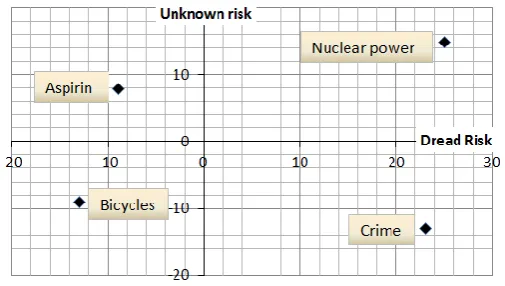
In a major study on the perception of 30 different hazard types, ranging from nuclear power to home appliances, four contrasting groups of subjects were asked to rate all the activities on a list of characteristics hypothesised to be of relevance [16]. The results indicated that these could be consistently grouped into just two underlying factors as follows:
1. The 'dread risk' factor comprised degree of controllability, dread, catastrophic potential, fatal consequences, and the inequitable distribution of risks and benefits
2. The ‘unknown risk’ factor was characterized as unknown, new, delayed
manifestation of harm and unobservable consequences.
[image:4.595.178.431.456.599.2]The relative positions of four hazards on these two factor scales are illustrated in Figure 1. In this representation, nuclear power scores high on both factor groups and so appears in the upper right quadrant; crime, though seen as familiar is also relatively uncontrollable and potentially fatal and so falls in the lower right
Figure 1: Location of hazards
quadrant. Neither aspirin nor bicycles are perceived as a dreaded risk, but the risks arising from the drug are felt to be less well known than those associated with the means of transport.
The two contrasting approaches were compared in a meta-analysis of studies on the relevance of trust to the perception of risk [21]; neither approach was strongly supported, the conclusion being that the relationship hinges on contextual factors. The Psychometric Paradigm has been more widely utilised by other researchers, however, with the ‘dread risk’ factor group being found to be of particular salience to natural hazards perception. Examples include an increased likelihood of preparing for hurricanes when the individual engages with institutions that communicated urgency and dread [22] and evidence of strong correlations between dread levels and previous flood experiences [23]. The thoughts and feelings of individuals, therefore, constitute relevant factors in their perception of risk; these are derived, at least in part, from both direct and vicarious experiences of hazards. The effects of personal hazard experience on protective behaviour have been the subject of many studies, and this topic will now be explored.
4
Past action: hazard experience and preparedness
‘Experience leads people to think about the risk more often, and with greater clarity.’[24]
Past exposure to a given hazard might seem, intuitively, to provide an obvious driver for future mitigation actions, yet research shows this to be an overly simplistic expectation. Experience with volcanic hazards, for example, did not necessarily motivate individuals to make preparations for future crises of the same nature [25], whilst a study of evacuation behaviour during Hurricane Katrina found that the influence of friends and family members was more important than prior experience [26]. Having survived a major storm (hurricane or cyclone, depending upon the geographical location) was, however, a contributory factor in households having prepared evacuation plans [27], emergency supply kits (such as bottled water and portable radios)[27, 28] and practices such as deploying shutters on windows and doors [22].
possible that the small minority of people reported as having taken anticipatory actions in the absence of any personal experience may, therefore, have been prompted by vicarious experiences. The latter is a factor identified as contributing to the cognitive processing of self-efficacy (perception of the competency to act) [32] which, in itself, has been implicated in some explanatory models of preparedness [33, 34]. This would suggest that work towards a UK-specific preparedness framework could usefully include questions on both types of experience to tease out any such effects, as well as clearly distinguishing between different preparedness categories.
5
Past action: ‘three times is enemy action’
The frequency of exposure has been found to be of relevance as a predictor of protective behaviour in the UK: when the number of experiences of household flooding rises above two or three, the frequency of mitigation behaviours is found to increase greatly [35]. Although one incident of flooding may be dismissed by householders in many cultures as the workings of ‘chance’ or fate, repeated floods have an additional complexity for UK householders, owing to the practice of flood insurance cover being ‘bundled in’ with building and contents cover [36]. For a first claim, the resultant repair and renovation costs are likely to be met, but insurance companies may well raise both the premium and the excess in respect of any future flood claims [37]; the implication is clear, once may be an accident, but a second claim is not simply ‘coincidence’ from the insurers’ standpoint. If further flood incidents occur, even those who have been vociferous in denying the existence of flood-risk in the past may come to the acceptance that ‘enemy action’ is indeed taking place, and investment in flood resistance or resilience measures is required. In models of flood hazard from other cultures, flood insurance is more usually purchased as a separate policy; future research on UK-specific flood-risk populations would, therefore, benefit from incorporating this aspect within the conceptual model adopted.
As we have seen, the overall picture is indeed complex, yet policy-makers must still attempt to manage down the risks posed by flooding, and to achieve this by demonstrating ‘greater empathy’[38]: one approach that is being increasingly adopted is that of direct engagement with the people at risk, in order to improve resilience.
6
Community engagement programmes
communities, such as participation in decision-making, and supporting community-led initiatives, the policy-making institutions create an opportunity to address the ‘thoughts and feelings’ issues discussed above such that problems can be articulated and misconceptions corrected. This approach, therefore, far exceeds the simple provision of information: by understanding the needs of communities and providing meaningful assistance to aid their decision-making, sustained preparedness can be facilitated [40]. Such an initiative has been developed in Wales, for example, with Flood Awareness Officers working with residents on a one-to-one basis, advising on flood risks and assisting in the preparation of personal flood plans [41]. Similarly, a study in Germany employed a series of interactive workshops, bringing together the residents and the authorities around a discussion table; an observable shift from a blame discourse to an acceptance of responsibility by the community members was reported [42].
Although direct experience of flooding itself cannot, of course, be delivered to a community in order to influence perception, differing kinds of vicarious experience can be provided: for example, a project in the UK to engage local communities with historic flood events in their area, included oral histories, photographs and a presentation on a tsunami that occurred in the seventeenth century [43]. Another method, developed in Germany, makes use of a transparent water-tight box containing items of furniture to resemble a domestic lounge; a volunteer enters the room and water is introduced mimicking the flooding process, including the reactions of the volunteer as the depth increases [44]. This contributes to a more vivid visualisation of the flood experience by the spectators. By means of innovative approaches such as these, the ‘past actions’ components discussed earlier can be modified to some degree, by creating a personalised experience for those involved.
7
Conclusion
For the time being, therefore, the issue of primary importance to policy-makers, namely to enable those at flood-risk to make appropriate preparations before flooding occurs, is being addressed: community engagement programmes, particularly those incorporating vicarious experience techniques, are able to bring about improvements in the preparedness behaviours of individuals, and thus increase the resilience of communities. Discussions regarding the scientific underpinnings of the process may continue indefinitely, but science has provided at least one means by which lives and property are better protected.
References
[1] Slovic, P., B. Fischhoff, and S. Lichtenstein, Perceived risk: psychological factors and social implications. Proceedings of the Royal Society of London: Series A, Mathematical and Physical Sciences, 376: p. 17-34, 1981.
[2] Defra, Changing behaviour through policy making. Defra: London, 2005.
Available from:
http://www.defra.gov.uk/sustainable/government/documents/change-behaviour-model.pdf.
[3] Parker, D.J., S.J. Priest, and S.M. Tapsell, Understanding and enhancing the public's behavioural response to flood warning information. Meteorological Applications, 16: p. 103-114, 2009.
[4] Fischhoff, B., Risk Perception and Communication Unplugged: Twenty
Years of Process. Risk Analysis, 15(2): p. 137-145, 1995.
[5] Lave, T.R. and L.B. Lave, Public perception of the Risks of Floods: Implications for Communication. Risk Analysis, 11(2): p. 255-267, 1991. [6] Oldershaw, C. The Earth in our hands: how geoscientists protect the public.
2001. Available from:
http://www.geolsoc.org.uk/webdav/site/GSL/shared/pdfs/education%20and %20careers/floods.pdf.
[7] Environment Agency. River Severn - regulation fact sheet 2. (nd) Available from:
http://www.environment-agency.gov.uk/static/documents/Leisure/MIDS_Severn_Fact_sheet_2.pdf.
[8] Breakwell, P.G.M., The Psychology of Risk. Cambridge: Cambridge
University Press, 2007.
[9] Harries, T., Householder responses to flood risk; the consequences of the search for ontological security. Middlesex University: London, p. 255, 2007. [10]Brilly, M. and M. Polic, Public perception of flood risks, flood forecasting
and mitigation. Natural Hazards and Earth System Sciences, 5: p. 345-355, 2005.
[11]Norwich Union, Homeowners fear future flooding but fail to take measures to protect their properties. 2008. Available from:
[12]Lorenzoni, I., S. Nicholson-Cole, and L. Whitmarsh, Barriers perceived to engaging with climate change among the UK public and their policy implications. Global Environmental Change, 17(3-4): p. 445-459, 2007.
[13]Dupuis, A. and D.C. Thorns, Home, Home Ownership and the Search for
Ontological Security. The Sociological Review, 46(1): p. 24-47, 1998. [14]Harries, T., Feeling secure or being secure? Why it can seem better not to
protect yourself against a natural hazard. Health, Risk & Society, 10(5): p. 479-490, 2008.
[15]Slovic, P. and E.U. Weber, Perception of Risk Posed by Extreme Events, in Risk Management strategies in an Uncertain World. Palisades, New York, 2002.
[16]Slovic, P., B. Fischhoff, and S. Lichtenstein, Why study risk perception? Risk Analysis, 1982. 2(2): p. 83-93.
[17]Slovic, P., Perception of Risk. Science, 1987. 236: p. 280-285.
[18]Slovic, P., The Perception of Risk. Risk, Society and Policy, ed. R. Lofstedt, London: Earthscan, p 473, 2007.
[19]Sjöberg, L. Risk perception is not what it seems: The psychometric paradigm revisited, in VALDOR Conference 11 March 2003. Stockholm: VALDOR, 2003.
[20]Siegrist, M., T.C. Earle, and H. Gutscher, eds. Trust in Risk Management: Uncertainty and Scepticism in the Public Mind. Earthscan: London, 2007. [21]Tompkins, E.L., L.-A. Hurlston, and W. Poortinga, Disaster Resilience:
Fear, Friends and Foreignness as Determinants of Risk Mitigating Behaviour in Small Islands. in SRI PAPERS, Sustainability Research Institute, School of Earth and Environment, University of Leeds, 2009.
[22]Terpstra, T., M.K. Lindell, and J.M. Gutteling, Does communicating (flood) risk affect (flood) risk perceptions? Results of a quasi-experimental study. Risk Analysis, 29(8): p. 1141-1155, 2009.
[23]Weinstein, N.D., Effects of Personal Experience on Self-Protective Behavior. Psychological Bulletin, 105(1): p. 31-50, 1989.
[24]Paton, D., Houghton, B.F., Gregg, C.E., Gill, D.A., Ritchie, L.A., McIvor, D., Larin, P., Meinhold, S., Horan, J. and Johnston, D.M. Managing tsunami risk in coastal communities: identifying predictors of preparedness. The Australian Journal of Emergency Management, 23(1): p. 4-9, 2008.
[25]Adeola, F.O., Katrina Cataclysm - Does Duration of Residency and Prior
Experience Affect Impacts, Evacuation, and Adaptation Behavior Among Survivors? Environment and Behavior, 41(4): p. 459 – 489, 2009.
[26]Horney, J.A., Snider, C., Malone, S., Gammons, L. and Ramsey, S. Factors Associated with Hurricane Preparedness: Results of a Pre-Hurricane Assessment. Journal of Disaster Research, 3 (2): p. 1-7, 2008. [27]Sattler, D.N., C.F. Kaiser, and J.B. Hittner, Disaster Preparedness:
Relationships Among Prior Experience, Personal Characteristics, and Distress. Journal of Applied Social Psychology, 30(7): p. 1396-1420, 2000. [28]Spittal, M.J., McClure, P.J., Siegert, R.J. and Walkey, F.H. Predictors of two
[29]Lindell, M.K. and C. Prater, Risk area residents' perceptions and adoption of seismic hazard adjustments. Applied Social Psychology, 32: p. 2377-2392, 2002.
[30]Knocke, E.T. and K.N. Kolivras, Flash Flood Awareness in Southwest
Virginia. Risk Analysis, 27(1): p. 155-169, 2007.
[31]Bandura, A., Self-efficacy: Toward a unifying theory of behavioral change. Psychological Review, 84(2): p. 191-215, 1977.
[32]Ajzen, I., Perceived behavioral control, self-efficacy, locus of control and the theory of planned behaviour. J of Applied Social Psychology, 32(4): p. 665-683, 2002.
[33]Paton, D., Disaster preparedness: a social-cognitive perspective. Disaster Prevention and Management, 12(3): p. 210-216, 2003.
[34]Harries, T., Review of the Pilot Flood Protection Grant Scheme in a Recently Flooded Area (R&D Technical Report FD2651/TR), in Delivering benefits through evidence, Department for Environment Food and Rural Affairs (Flood Management Division), Department for Environment, Food and Rural Affairs: London, 2009.
[35]Huber, M., Reforming the UK Flood Insurance Regime - The Breakdown of
a Gentlemen's Agreement. ESRC Centre for Analysis of Risk and Regulation: London. p. 6, 2004.
[36]National Flood Forum, Insurance industry flouting agreement with government. Newsletter - National Flood Forum, 9, 2009.
[37]Speller, G., Improving community and citizen engagement in flood risk management decision making, delivery and flood response - R&D Technical Report SC040033/SR3, Environment Agency: Bristol. 2005.
[38]Paton, D. and D. Johnston, eds. Disaster resilience - an integrated approach. Charles C Thomas: Springfield, USA, 2006.
[39]Mc Ivor, D., D. Paton, and D. Johnston, Modelling Community Preparation
for Natural Hazards: Understanding Hazard Cognitions. Journal of Pacific Rim Psychology, 3(2): p. 39-46, 2009.
[40]Environment Agency (Wales). Flood Awareness Wales. (nd) Available
from: http://www.environment-agency.gov.uk/113810.aspx.
[41]Pasche, E., Lawson, N., Douglas, I., Ashley, R., Garvin, S. and Schertzer, D. Flood Risk Management in Small Urban Catchments. in ERA-NET CRUE Funding Initiative: Mid-term seminar. Lyon, 17 October 2007.
[42]McEwen, L., Community engagement with its flood history: understanding
risk (Lower Severn Community Flood Information Network Final Report to the Royal Society – October 2006). Royal Society: London, 2006.
[43]Manojlovic, N. Hamburg flood animation box. (nd) Available from: