The Brain and Learned Behavior
... Dr. Harry F. Harlow
Automatic Programming: The A 2 Compiler System - Part 2
Who Are Manning the New Computers?
Mathematical Analyst Keith Kersery loads jet transport flutter problem into one of Lockheed's two 701's. On order: two 704's to help keep Lockheed in fore-front of numerical analysis and pro-duction control data pro~essing.
704's and 701's speed
Lockheed research in
numerical analysis·
LOCKHEED
BURBANK
With two 701 digital computers already in operation, Lockheed has ordered two 704's to permit greater application of numerical analysis to complex aeronautical problems now being
approached. Scheduled for delivery early next year, the 704's will replace the 701 'so
Much of the work scheduled or in progress is classified.
However, two significant features are significant to career-minded Mathematical Analysts: 1) the wide variety of assignments created by Lockheed's diversified development program and 2) the advanced nature of the work, which falls largely into unexplored areas of numerical analysis.
Career pOSitions for Mathematical Analysts
Lockheed's expanding development program in nuclear energy, turbo-prop and jet transports, radar search planes, extremely high-speed aircraft and other classified projects has created a number of openings for Mathematical An~;tlysts to work on the 704's.Lockheed offers you attractive salaries, generous travel and moving allowances which enable you and your family to move to Southern California at virtually no expense; and an extremely wide range of employe benefits which add approximately 14% to each engineer's salary in the form of insurance, retirement pension, etc.
Those interested in advanced work in this field are invited to write E. W. Des Lauriers, Dept. MA-31-10.
AI RCRAFT CORPORATION • CALI FORN IA DIVISION_
-COMPUTERS
AND
CYBERNETICS
ROBOTS
•
AUTOMATION
AUTOMATIC CONTROL
Vo 1. 4, ~o. 10
ESTABLISHED SEPTEMBER, 1951
AnTICLES
lhe Brain and Learned Behavior
•••• Harry F. Harlow
Who are Manning the New Computers?
•••• John M. Breen
PAPERS
Automatic Programming:
The A 2 Compiler System -- Part II
REFERENCE INFORMATION
Who's Who in the Computer Field -- Supplement 2
FORUM
The Address of MAPI
Automatic Data Processing Forum, New York
Computer Applications
The Editor's Notes
Index of No tices
Advertising Index
.•.• w.
K. Tarrant
•••• Bill Danch
OctoiJer, 1955
6
~ 28
15
29
38
38
40
4 4
50
Editor: Edmund C. Berkeley
Assistant Editors: Eva niStefano, Jewell Bown, Neil Macdonald, F. L. Walker
Advisory Committee: SalIluel B. Williams, Herbert F. Mitchell, Jr., Justin Oppenheim
Contributing Edi tors: Andrew D. Booth, John M. Breen, John W. Carr, III, Al-ston S. Householder, Fletcher Pratt
Publisher: Berkeley Enterprises, Inc.
~6 West 11 St., New York 11, N. Y. - Algonquin 4 7675
R15 Washington St., Newtonville 60, Mass. - Decatur 2 545~ or 2 3928 Advertising Representatives: San Francisco - W. A. Babcock 605 Market St., San Francisco 5, Calif'.
Los Angeles - Wentworth F. Green, 439 So. Western Ave., Los Angeles 5 Calif
elsewhere - the Publisher '
COMPUTERS AND AUTOMATION is published monthly. Copyright, 1955 by Berkeley Enterprises, Inc. Subscription rates: $4 50 for one year, ~8. 50 for two years, in the Uni ted States: $5.00 for one year, ~9. 50 for two years, in Canada; $5.50 for one year, $10.50 for two years elsewhere. Bulk subscription rates: see page 36. Advertis-ing rates: see page 48.
THE EDITOR'S NOTES
ANIMAL AND MACIIINE DRAIl'S
Everyone tvho has come into contact wi th automatic computers has also come into contact wi th the argument about whether or not machines "think", whether or not machines "have intelli-gence". Many investigators of human and animal brains have also wondered whether and to what extent different human and animal brains "th:ink".
Now if we as computer engineers are ever to make useful computers that require Ii ttl e explicit instruction from human beings, butin-stead have a facul ty for rapid and effective learning buil t into them, then we shall nee d to be interested in similar intelligent behav-ior of various animals and human beings, and the objective tests for measuring that intelli-gence.
But the inves tigators of animals can not use words to question animals, nor dothey have an instrument that will directly measure "in-telligence". So they have devised a number of objective tests of behavior in problem situa-tions. From these tests, the invest i g a to rs draw conclusions about the extent to which the individuals they measure "act intelligently": how they learn, how much they can learn, how quickly they can learn.
Do these tests have bearing on machines? Certainly, many of these tests require only a moderate amount of adaptation (translation) to fit them to be given to machines -- mostly be-cause machines so far are blind and cannot see and recognize. Furthermore, the pat terns 0 f
these tests sugges t types of learning cap a c-i tc-ies to be buc-il t c-into machc-ines. Fc-inalry) tV' e)
as computer people rather than psychologists, have the very great advantage that we do not have to guess at the s truc ture of the e n ti t Y which is carrying out the intelligent or learn-ing behavior: we know the structure - h a r d-ware.
Along this path of inquiry,' we· publish in this tissue of "Computers and Automation" a n article by Dr. Harry F. Harlow, "The Brain and Learned Behavior". It is full of illuminating suggestions for persons interested in "intelli-gent behavior" by computers, animals, or human beings.
VARIATION IN INTELLIGENCE
D. A. Laird and E. C. Laird in their book "Sizing Up People" (McGraw IIill, 1951) say that, although the variation in height of men isfrom 1 to 1.28, (based on 998 out of 1000 persons,
(continued on page 23)
PAPERS AND ARTICLES ON COMPUTERS
At the meeting of the Association for Com-puting Machinery, September 14-16, 1 C)55, in Philadelphia, "of approximately 175 papers sub-mi tted, 129 were chosen for presentation." They were presented in three parallel sessions; the top limit that a single person could actually listen to was about 50. Of these 129 papers presented, probably about two dozen may be pub-lished in the Journal of the Association fo r Computing Machinery, during the next t wei v e months, at the rate of about 6 per qua rt e r. There remains a considerable number of unpub-lished papers.
We are eager to publish many papers and articles on computers, although we have no de-sire to divert to us any papers that willact~
ally be published in the Journal of the Assoc-iation. We can ordinarily publish papers with-in a month or two; we can provide authors with reprints if they desire them; and we believe that a technical paper can often be understood better when published, and thus able to be rea::I and studied, than wh~n only presented orally in an audi torium to an audience of over 200 people.
We shall be glad to consider for publi-cation in "Computers and Automation" any papers not accepted by the Association for presenta-tion, and any papers accepted for presentation at the meeting but not able to be published in the Journal of the Association.
CORRECTIONS - See Page 35
~:<---*---*
INDEX OF NOTICES
For information on:
Advertising Index Advprtising Rates
Advertising Specifications Back Copies
Bulk Subscription Rates Man uscr ipts
Roster Entry Forms Special Issues
See Page:
50 48 48 46 36 36 42 14
\
Novv ... Univac Tells Itself What To Do!
Univac no longer asks for the detailed instruction codes required by other com-puters. Univac now automatically produces complex coded routines when given a simple instruction.
• This truly remarkable new Remington
Rand development cuts months from pro-gramming time ... is easily adaptable to your individual requirements.
If you would like more information about Univac automatic programming, write to the address below for EL264.
THE BRAIN AND LEARNED BEHAVIOR
Dr. Harry F. Harlow Director, Priruate Laboratory
University of Wisconsin \Jadison, Wise.
The human brain is anatomically analyzable into a vas t number of neuro nes, which are joined and interrelated by a complexitym fiber pro-cesses that baffle comprehension. But the es-sential structural element, the neurones, differ primarily in diversi ty and to some exte n t i n quanti tati ve complexity from the neurones that characterize the brains of all vertebrates and many invertebrates 4 Structural deve lop me n t
strongly suggests that only quantitative chang-es have taken place for almost countlchang-ess mil-lions of years.
Likewise, the arrangement and patterning of the neurones, and the plexuses of ax ones and dendrites which they form in the bra i n, show evidence of progressive and orderly dif-ferentiation, but the changes a pp ear to be continuous and quantitative rather than dis-continuous and qualitative. The b,rains of rats, monkeys, and men differ in the n u m be r of subdivisions that may be identified in the six basic neocortical layers, the prof us ion of short vertical chains and tangential fibers, and the wealth of dendritic and axonic process-es, but again these anatomical differentiae appear to have developed in a continuous and quanti tative manner. Detailed physiolog ic a 1 studies indicate that the percentage of the brain's cortical mantle, which mediates simple sensory and motor processes, progressively de-creases as we ascend within the class of mam-mals from rats to man, and there is reason to think that these changes result from the con-tinuous differentiation and expansion of the associated areas.
In contrast to the apparent continuityin development of the brain as measured by an a-tomical and physiological tests, are the chang-es in behavioral capacitichang-es, which increase so dramatically even within the class of mammals as to lead many men to believe that the d i f-ferences are not quantitative but qualitative. In this regard we should recognize that super-ficial examination of the brain of the f ish or even the rat would suggest that qualitative differences exist between these brains and those of man 4 The essential similari ties are on I y
disclosed by careful and detailed analysis. The same conditions may hold when we analy z e in detail behavioral capacities 0 f ani mal s
throughout the phyletic sc ale -- see min g I y
qualitative differences may upon careful anal-ysis prove amenable to description in quanti-tative terms.
It is, of course, proper for the scientist to feel equal concern for the differences i n behavior between roonkey and man and between monkey and rat; the role of the comp a rat i ve psychologist is to amass all possible behav-ioral data and relate them in terms of the most logical theoretical system.
Unfortunately, comparative psychologists have made detailed and comprehensive studi e s on the learning and thinking processes of only four animals, man, the chimpanzee, the rhesus monkey, and the white rat. The beha vo ria 1 capabilities of even the domestic dog and cat have been subjected to only limited and incom-plete scientific analysis.
The author's researches have been largely limited to the analysis of the behavior of the rhesus mnkey. In many ways this choice now appears to be fortunate. The difference s i n behavior of man and rat show such diversity that only superficial analogies are immediate-lyobvious. But the behavior of the monkey is of enough complexity to suggest strik i ng analogies to that of man, and of eno ug h sim-plicity to indicate clear-cut continuity with that of the rat.
There is a conunon conception th at mere speed of learning differentiates animals in-tellectually. Actually, there is no eyidence that such a principle holds for simple problems. at least insofar as mammals are concerned, and very likely other classes within the chordate phylum. Men, chimpanzees, monkeys, dogs, cats, rats, probably pigeons, and possibly fro g s, can learn some conditioned re s po n s e s in a single trial -- not all conditioned responses, but some -- and there is no reason to believe that conditioning per se is more rapid in man than it is in a score of other animals 4 Nor
does man appear to be more efficient i n the learning of simple position habits -- the lo-cation of positions or sequences of positions in space. One eminent investigator compare d the learning ability of college students and rats on mazes of identical patterns and found an amazing amount of overlapping between the
-1l1~ BRAIN ANn L F.AHNEn Br.:IlAVIOH
forward opaque screen
WISCONSIN GENERAL TEST APPARATUS
Showing: Stimulus tray
One -way vision screen in lowered position
Forward opaque screen in raised position
Figure I -- General test apparatus for monkeys
' ; :}
"
[image:7.612.61.557.451.646.2]THE BRAIN ANn LFARNEn BFJIAVIOR
two groups -- and it is rumored that an occas- primate and the subprimate orders are quanti-ional cockroach has surpassed some colI e g e tative and graded, rather than qualitative and freshmen on maze-learning tests. saltatory. Furthermore, there is every reason
A more complex problem than position dis-crimination is that of disdis-crimination between objects. In this type of problem, the animal must, if it is to receive a reward, cons~tent
ly choose a particular obj ect regardless of the position that it occupies. It is doubtful if the completely naive man, chimpanzee, ormonkey would surpass the completely naive rat or pigeon in speed of solution of the first prob 1 e m of this kind that he ever encountered -- indee d, some data indicate that the rat might surpas s any of the primates. But, as we shall see later, if the primates are presented long series of problems of this difficulty level, they event-ually attain nearly perfect perform a n c e, an achievement that has not been demonstrate din any subprimate form.
As we pass from object discrimin a t ion problems, we come to another class of problems whose solution involves response to a gene r al principle. On strictly logical grounds these problems are to be regarded as more com pIe x. At this stage of problem difficulty,weapproach a separation of primate and nonprimate. In the oddi ty problem, which is representative of this class, two different pairs of identical stimuli are used, but only three stimuli are presented on any given trial. The odd stimulus, thestim-ulus singly represented, is rewarded, and trial sequences are so arranged that a member fr 0 m
each pair of stimuli is odd on half the t est trials. To solve this problem the animal must frequently disregard not only the position 0 f the stimulus last correct, but also the actual object last rewarded. Neither position nor object is consistently correct, and the animal must respond to the general principle of d i s-similari ty.
Monkeys learn oddity with difficulty. They take from 500 to 1500 trials to master the i r first problem. But lest we assuroo that abill ty to solve this problem sharply differe nti ate s monkey and man it may be noted that we test e d a group of nursery school children from thr e e to five years of age. All the children except . one failed -- and he solved the prob 1 e m b y cheating. I do not mean to imply that monkeys are smarter than fi ve-year-old children for the monkeys were more highly motivated, bet t e r trained in laboratory discipline, and bet t e r mannered. It is significant, however, that on this problem involving the use of a logic all y abstract principle', we cannot differentiate all men from all subhuman primates. No subh u man primate has ever been reported to have sol v e d problems of this type wi th any facility, but limited solutions by rats and even by pigeons strongly support the view that the fundamental differences in intellectual ability between the
for believing that some subprimate animals --perhaps the dog, the cat, the raccoon -- could solve problems of this level of complexity.
The oddi ty problem is by no means the mos t difficult intellectual task that can be solved by the monkey or the chimpanzee. A problem of striking difficulty, described as the Weighl-type test and adapted from a test used clink-ally to measure organic brain injury in human beings, has been solved by subhuman primates. One form of this test is a complication of the oddi ty tes t. Three unl ike obj ec ts are present-ed on each trial,. of which two have the sam e color and two the same form. When such objects are presented on an orange tray, the mo n key must choose the object odd in respect to color. When the obj ec ts are presented on aye 11 0 W board, the subjects must choose the ob j e c t odd in respect to form.
Solution of this problem is difficult for both monkeys and chimpanzees. SOIOO mo n ke y s and some chimpanzees never learn it -- and some human beings never would either. But most monkeys and probably mos t chimpan~ees -- i f they do not lose their motivation --wililearn to solve this problem after a few tho usa n d training trials. Furthermore, they will come to general ize the problem and appropri ate 1 y choose odd color or odd form when combinations of new and previously unseen objects are pre-sented to them. We have never tested you n g children on this problem, since we have never found a kindergarten teacher who was willi n g to alter the school schedule radically enough to make the study feasible.
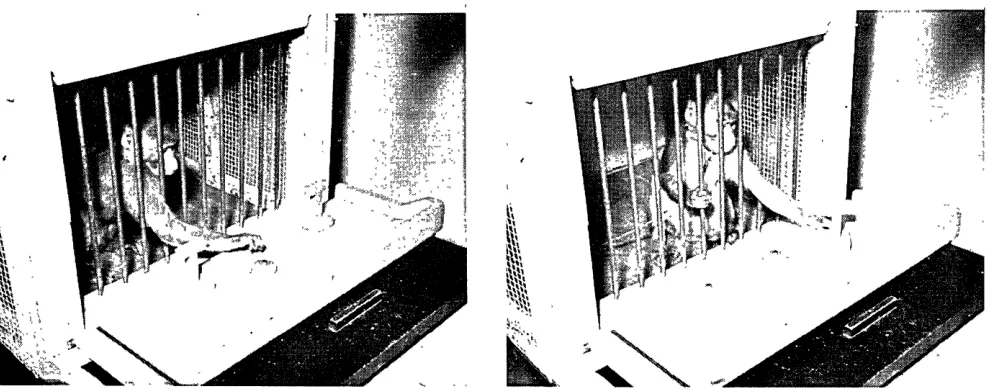
A task of the same general type as oddity is matching-from-sample because, like oddity, it involves a relationship, the relationshi p of similarity. In the basic problem, the test tray is divided into two compartments, a sample compartment and a choice compartment. The monkey is trained first to displace the single object in the sample compartment, whe re he finds a food reward. lIe must then choose the identical members from the choice compartroont, to obtain a second reward. His problem is to match the choice s timul us wi th the sam pIe s timul us regardless of the pos i tion 0 f the
choice stimulus, and regardless of the nature of the sample stimulus, which frequen t 1 Y changes from trial to trial. At Wisconsi n some years ago we trained a group 0 f f 0 u r
monkeys to solve the matching proble man d went on from there to see how complex a prob-lem they could solve. In the phase 0 f the
problem next learned there is no food und e r the sample, and when the monkey discovers this, he must select the choice object which does not match the sample in order to get food. In other
-THE BRAIN ANn LEARNED HEHAVIOn
Figure 4
Figure 5
Figure 6
Figure 7
Figures 4, 5, 6, 7 -- The matching and nonmatching problems: "In the basic problem the test
tray is divided into two compartments, a sample compartment and a choice compartment.
The
monkey is trained first to displace the single object in the sample compartment, where h e
finds a food reward.
He must then choose the identical member from the choice compartment,
to obtain a second ret'IJard.
His problem is to match the choice stimulus toJi th the sample
[image:9.615.71.559.67.552.2] [image:9.615.338.557.67.529.2]TIlE BR,\!"'< ANf' LFARNEn I~FJ{AVIOR
word~, his choice must now be made on tlle basis of difference, not similarity. This is followed by two absolutely arbitrary problems in which the choice objects are identical and neithe r one matches the sample. If food is under the sample now, the monkey mus t go to the m 0 r e
distant choice object. If food is not under the sample, the monkey mus t now go to the closer choice obj ec t. Sol ution of these problems was followed by training on two addi tional arb i -trary problems. Sample and choice objects are now identical. If there is food under the sam-ple object, the monkey must choose the closer choice object. If there is no food under the sample object, the monkey must choose the far-ther object. Step by step these problems are learned and combined until in the endthe sit-uations appropriate to all problems are being presented in a predetermined, irregular order. This results in a performance of ra the r be-wildering complexity even by human standards, yet all four of our monkeys learned this to the the point of practically errorless performance. We used to shOt\' movies of monkeys doing these problems, but we never do any more since many members of the audience find that the monkeys are doing better than are they, a fact need-lessly leading to the formation of feelings of inferiori ty.
The next test to be described is 0 n e
de-vised by Dr. Winsten at the Wisconsin La bo r-atory. It also involves the matching technique. It is a kind of test that might appropriately be described as involving concept fo r m a tio n, since in its final stage the monkey respond s to a sign that has no physical resemblance to the stimuli to be subsequently selec ted. In early training, as many as eight obj e c t s were pI aced on a tray, the monkey was han de d one object, the sample, and his problem was to pick out all identical objects, leavingunchosen all objects which were different. In the most complicated form of the test the mon key wa s given an unpainted circle, as a sign to pic k out all blue objects, and an unpainted triangle, as a sign to select all red objects. Several monkeys have learned to do this problem wit h a high degree of success. One m 0 n key eve n learned to respond almost perfectly. Given a circle, he tvould pick every object with any blue on it, ignoring all other stimuli; given a triangle, he selected all objects with any red coloration, leaving all other objects un-touched. After he made his choices he would frequently push the tray away and turn his back to the whole situation.
We neither know nor particularly care to know the minimal mental age that childrenwadd have to attain before they could learn te s t s of the type we have just described. Certainly they appear to be ~\lell beyond the diffic u 1 t Y of mental test items measuring mental ages 0 f
four and five, and the problems might well try
the patience of seven-and eight-year-o 1 d s • Again, we are not trying to prove tha t 't h e rhesus monkey is a kind of misunderstood low-or middle-grade imbecile. The data intere s t us because they suggest that proper test con-di tions reveal intellectual capaci ties i n a monkey far beyond those that anyone would have predic ted fifteen years ago. Certainly s u c h data can be interpreted, and very p r d b ably would have been interpreted by Darwin and Hux-ley, as indicating that no inseparable g u 1 f
exists between the "minds of men and monkeys" -- and that such intellectual differences as exist are quantitative, not qualitative.
These tests are also of interest for com-paring monkey and rat. The rat is as incapable of solving the Weigl problem, the com pIe x matching-from-sample sequence, or the complex color concept problem as the monkey is incap-able of solving differenti al equations, p e r-forming piano sight-reading, or writing "The Descent of Man." From the point of vie w 0 f
maximal complexity of performance a qualitative difference exists between men and monkeys and also between monkeys and rats; from the point of view of process and mechanism, the differ-ences in performance among the three specie s appear quantitative and the development prob-ably continuous.
So far, we have described the comparison of the abilities of animals with varying com-plexities of brain structure to solve problems of varying degrees of complexity. Another ex-tremely interesting type of/comparison is that of the ability of various animals 1 yin g a t different levels along the phyletic series to profit from the solution of multiple problems of a single, basic type, i.e., the ability of animals to transfer from problem to pro b 1 e m of a particular type and to form general i ze d problem solutions.
Detailed, sys tematic researches 0 n thi s
process were initiated at the Wisconsin L a b-oratory about five years ago, the orig ina 1 studies being made on the ability of monke y s to learn series of obj ect discrim ina t i o n problems - problems whose solution require s the animals to select consistently one of two objects regardless of position. In this ex-periment eight monkeys were trained on a series of 344 problems utilizing a different stimulus pair for every discrimination. Each 0 f the first 32 problems was 50 trials long; the next 200 problems, 6 trials; and the last 112 prob-lems, an average of 9 trials. Learning curves, showing the percentages of correct response s on the first six trials of these discrimi n a-tions, were constructed. The curves demon-strate progressive improvement in the ability of the monkeys to solve discriminations; from problem to problem the animals learned how to learn discriminations wi th progressively greater
-TIlE BRAIN ANt1 LEARNEn BEHAVIOR
facility, a process designated by 'the t e r m learning set. TIle very form of the learn i n 9 curve changes for successive blocks of pro b-lems. TIle initial curves are S-shaped -- the type described in psychological literature as typical "trial-and-error" curves. The fin a I curves are discontinuous at Trial 2 -- t h· e type frequently referred to as "i n s i g h t " curves. For the monkeys the discrimi nat io n learning sets changed a problem which co u I d
!:~ solved only after many errors, into one which was usually solved with no unnecessary errors.
Recently at Wisconsin a similar proble m was tried using cats as subjects. The cat s
also shot ... ed evidence of forming discrimination learning sets -- but the cats never attaine d or even closely approached immediate, insight-ful discrimination learning. In terms of pro-cess, cats and monkeys differed onlyquantita-tively, since both formed learning sets; but in terms of performance, cats and monkeys dif-fered qualitatively, since cats failed to learn insightfully. Again and again, we see this principle illustrated, namely: qualitatively different performances are produced by under-lying processes which differ only qu anti t a-tively, i.e., differ only in degree.
Detailed studies have shown that monkeys form highly efficient learning sets for man y problems, including the oddity problem already described, and a very interesting t y p e 0 f
problem called discrimination reversal. Each discrimination-reversal problem starts a s a discrimination problem wi th one of a pai r 0 f
stimuli consistently rewarded· regardles s of pos i tion. After a predetermined num b e r 0 f tri als, in our experiments, 7, 9, or 11, the reward values of the stimuli are reve rs ed, wi th no cue being given to the ani mal other than that of the reversed reward values. Dis-crimination-reversal learning-set cur v e s were determined on the data from eight monkeys. The phenomena demonstrated in the forma t ion of discrimination learning-set cur v e s were again demons trated here. The firs t desc r i m-ination-reversal learning problems are acquired gradually; but eventually the monkey comes to make practically no errors after the f i r s t "informing" trial at the point of reversal.
Recently North has reported data on rats trained on a long series of discrim ina tion-reversal problems. The rats gave evidence of the formation of learning sets, since improve-ment was noted from problem to problem, b u t the rats -- like the cats and unlike the mon-keys -- never attained or even ap pro a c h e d perfect, insightful reversal in a single trial.
Nine nursery school children at the Wis-consin Laboratory were tested on discrimina-tion-reversal learning-set formation un d e r conditions almost identical to those for the
monkeys, except that the children we r e r e-warded with macaroni beads instead of peanuts,
and missed test days because of col d s a n d measles -- and temper tantrums. l1leir composite discrimination learning curves were determined and the!Je data suggest that even the innnature human primate "learns how to learn" with great efficiency.
TIle newness of this technique and·its pres-ent limited application to subhuman spe c i e s necessi tates caution of interpretation. But . the' limi ted extant data indicate that it will prove to be a powerful tool enabling us to as-say the nature of both similari ties and differ-ences in intellectual abili ties of va r i ou s genera, families, and probably orders.
Man in his infinite wisdom and even more infini te anthropocentrism has prided hims elf on being the "thinking" animal and has ascribed to himself a process "reason" which he has de-nied to animals. Reason has always be en re-garded as an ability to see through problems, independently or relatively independen t 1 y of experience.
The psychologist, Hebb, has recently sug-gested that the completely naive primate may well be inferior to many lower animals in his abili ty to solve problems -- perhaps any pro b-lem. It is only through prolonged experience, or, in terms of our theoretical position, it is
only after he has formed efficient Ie ar n i n g sets, that man's rational powers at t a in and then gradually but progressively far surpas s those of any other animal. If, as is not un-likely, reason and thought can be efficiently described in terms of an extension of relative-ly simple learning phenomena, additional evi-dence will be obtained to indicate the essen-tial continuity of evolutionary developm e n t of the human being's higher mental processes.
Hebb noted that rats deprived of all visu-al experience early in life show little evi-dence of any defici t when first prese n ted a visual discrimination problem. M u c h m 0 r e
serious visual learning deficit has been found by Riesen in monkeys and chimpanzees g i ve n their first problems following prolonged dep~
rivation of visual experience. These subhuman data find confirmation in the clinical descrip-tions by Senden of human beings whose fir s t opportunity for detail vision followed opera-tions for congeni tal cataracts after many years of visual deprivation.
TIfE mAIN AND LEAR"lED BEI'AVIOR
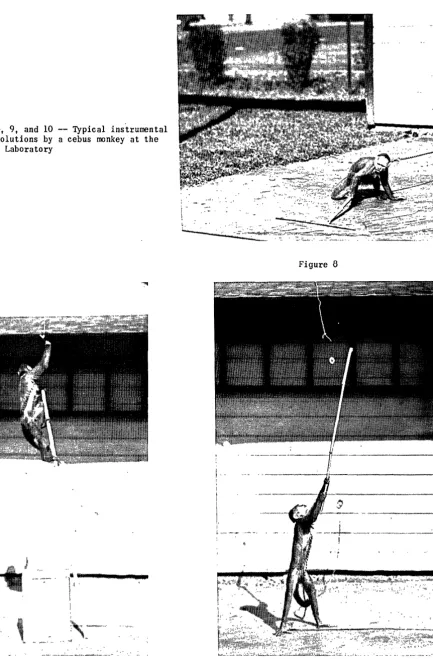
Figures 8, 9, and 10 -- Typical instrumental problem solutions by a cebus monkey at the Wisconsin Laboratory
T
Figure 9
Figure 8
[image:12.615.114.547.66.725.2]1lJE BRAIN AND LEAJlNED BEHAVIOR
detailed, psychological test has ever g i v e n ' Essentially similar resul ts have been ob-any indication of intellec tual disconti n ui ty tained by every investigator who has wor ked at any adequately tested point in too phyle tic wi th children two to four years of age. Such
series. solutions as occur usually follow extens i v e
There was a time when man thought of him-self as the tool-using animal, and the advent
of tool-using was regarded by some as a great sal tatory step in intellectual achieve me n t. The human being's instrumental in te 11 ec t u a 1 isolation had to be discarded after Kohl e r IS
brilliantly integrated series of observations proved that the chimpanzee was capable of util-izing tools in a wide variety of ways. Through the assumption that these problems were solved by insight learning -- defined as a sud den perceptual reorganization of a complex situa-tion - the chimpanzee was almost humanizedj but within the last 15 years it has been dem-onstrated by Kluver, deHaan, and others, that the cebus monkey was allDOs t as fa c i 1 e wi th tools as was the chimpanzee. Limited t y pes of instrumental problem solutions have als 0
been described in subprimates -- and noon e would now suggest that tool-using abilities separate man from the lower animals.
But of far greater theoretical intere s t than the fact of tool utilization by subhuman animals is the manner in which all anim a 1 s , including man, attain the ability to effe c t instrumental problem solutions. Kohler's as-sumptions that the chimpanzee's initial solu-tions were sudden and insightful are, without question, incorrect, and he was misled through lack of knowledge of the life histories of his subjects.
An intensive investigation of instrumental problem solving in 25 chimpanzees of 0 n e t 0
fifteen years of age was conducted by Schiller, using a series of 12 stick problems of gradu-ated difficulty. All the subjects, including the oldest, learned gradually and by "specific experience. " The one- to two-year-o 1 d s re-quired several hundred trials to master e ac h of the easiest problems, and they never solved problems of even intermediate difficulty. Their performance appeared to Schiller to resemb I e condi tioning. The three- to four-year-o 1 d s learned in the same manner, requiring abo u t 100 trials to master each of the simple prob-lems and probprob-lems of intermediate difficulty, and they never mastered problems beyon d this level. Even the nine- to fifteen-year-o 1 d s failed on initial presentation to solve their first problem -- the straight stick with food behind it. All reached for the food bey 0 n d the stick and picked up the stick only after hesitation. At first, they pulled the stic k without reference to the food, lick e d i t, smelled it, and chewed it. Only much I ate r did they put the s tick out and push tow a r d the food.
manipulation and exploration, and even w hen very simple tool situations are pres en ted, less than five per cent of the solutions are sudden or immediate. Since most of the chil-dren tested had undoubtedly had exte n s i v e previous play experience with blocks, chairs, boxes, and sticks, and probably had us e d at least some of these objects as tools to obtain treasures beyond arm's reach - the similari ty of the Children's, the chimpanzees', and th e monkeys' behavior is obvious.
The history of research into instrumental abili ties in animals thus resembles the history of many problems that have been subjected to analytical investigation. The more precis e and better controlled the studies, the m 0 r e
conclusive becomes the evidence for continuhy of process -- rather than discont in u i t Y 0 f
process -- \vi thin the phylogenetic s cal e • Tool-learning behavior becomes strik i n g 1 Y similar to object discrimination learni ng. When first faced with a problem of ei ther kind, the individual -- human or subhuman -- learns slowly, ineffectively, and by trial and error. Sudden, insightful, rational learning 0 n 1 y
appears after many problems of a par tic ula r type have been mastered -- after the solution of many related problems has made tills origin-ally difficult learning 'simple.
At the start of this paper we emphasized that the differentiation of the cortex appears to have resul ted from a continuous pro c e s s. The "so-called" associative areas gradual 1 y expanded and differentiated from the so-called sensory and motor areas. Throughout the paper we have reiterated the gradual and continuous differentiation of the learning-thinking pro-cess and have emphasized that this continuity could be properly comprehended only if stress were laid upon the importance of the role 0 f
the learning variable.
Experiments on the effect of cor tic a I lesions provide evidence on evolutionary the-ory. At the same time the effect of cortical lesions on intellectual processes can only be properly evaluated if the three basic princi-ples of gradual differentiationof'associative areas, continuity of the learning-th ink i n g process, and progressive importance of the role of learning, are always kept in mind.
on-THE BRAIN AND LEARNED BEHAVIOR
troIs and eight operated subj ec ts, and the learning experiences of all 12 have been kept constant throughout the five years of experi-mentation thus far completed.
The first operation was carried 0 u t on
all eight experiroontal subj ects and invol ve d destruction of all the neocortical associative areas of one hemisphere.' Shortly after t his operation the monkeys showed some loss on de- . layed reaction tests, on discrimination tests, and on discrimination-reversal tests. But the really striking data are those .which indicate the vas t amount of recovery by the oper ate d monkeys on discrimination and discrimination-reversal retests following a year of conthwal postoperative education on other laboratory problems. The same results obtain for delayed response.
Two years after the first operation, the experimental monkeys were divided in t o t w 0 equally matched groups. In one group the lat-'eral surface of the contralateral frontal as-sociative areas was, destroyed, and inthe other, a vast lesion in the contralateral posteri 0 r association areas was produced. The Front a 1 group a few months after operation showed very serious loss on delayed reaction tests --which may measure memory and/or attention. The r e was little loss on discrimination tests. The Posterior group showed slight loss on delayed reaction tests but very serious loss on d i s-crimination tests shortly after the operation. But, again, the striking data are thos e ob-tained during the course of testing 0 v e r a two-year period. During this time, the Frontal group performed with reasonable efficiency on some delayed reaction tests, and the Postermr group showed complete, or almost complete, recovery on s-imple discrimination tests. Res-idual discrimination defici t could, however, still be shown by the introduction of new and more difficult discrimination tests.
Approximately four years after the orig-inal operation the four Frontal animals we re subj ec ted to the pos terior cortic aIle s ion. and the Four Posterior animals to the frontal lesion. Since less than a year of continuous testing has intervened after operation, 0 u r
analysis must be regarded as tentative and in-complete, but the results are striking and, even to us, somewhat unexpec ted. Thes e an i-mals, with only islands of associative cortex remaining, showed amazing ability to solve in-tellectual problems. Their performance on discrimination tests was highly eff i c i e nt, even though it was inferior to the performance of the normal controls at the five pe r c e n t confidence level. The same results were found on the more complex discrimination-reve r s a l test. Three out of 6 surviving operate d ani-mals performed efficiently on delayed reaction tests, and the performance of one animal, which
made only five per cent errors, over 1 a p p e d that of the normal monkeys! Such data suggest that we should rename the "associative areas." Furthermore, the results provide strik i ng 1 y suggestive support to LaShley's brilliant hy-pothesis that sensory and motor cortical areas also mediate associative functions.
It still remains for us to test monkeys following total destruction of the neocortical associative areas. We believe that when this is done there will be even more conclus i v e evidence supporting the position that the as-sociati ve areas have gradually evolved fro m the sensory-motor areas, that there is contin-uity of the learning-thinking intellectu a 1 processes, and that the key to understanding mental evolution and cortical functioning lies in the detailed analysis of the learning pro-cess.
- END
-~:;---
*---*
SPECIAL ISSUES OF
'~~C.OMPUTERS
AND AUTOMATION"
The issue of "Computers and Automation" in June, 1955, Was a special issue: "The Com-puter Directory, 1955", 164 pages, containing: Part I, Who's Who in the Computer Field; Part 2, Roster of Organizations in the Computer Field; and Part 3, The Computer Field: Products and Services for Sale. It is expected that the next Computer Directory issue will be June, 1956.
The next two special issues will be De-cember, 1955, and January, 1956. The Decem-ber issue will be mainly devoted to useful
in-formation for people who have been in the com-puter field for some time: a "Glossary of Terms'~ and also cumulative editions of other piecesof reference information.
Automatic Programming: The A 2 Compiler System -
Part 2
Programming Research Section Eckert Mauchly Division, Remington Rand
Phil allelphia, Pa.
(Part 1 was pu'blished in the September, 1955 issue of "Computers and Automation"
~ detailed description of the running memory layout follows:
Index of Figures
ABSOLUTE MEMORY
ADDRESSES UTILIZATION
000 to 059 CONTROL BLOC K These memory locati 0 ns
are teS('rved for Univac instructions produced by the compiler. These instructions
auto-1000 WORD MEMORY LAYOUT OUR I NG PROBLEM RUN
ABSOLUTE RELATIVE
ADDRESS 000 CONTROL ADDRESS
~ B L 0 C K 000
060
--'..!.!
WORKING ~
120 060 BIN PU 1
BLOCK
179 STORAGE -.!..!.!.
180 - - 120
A I N PUT
239 1-- ~ BLOCK
2~0 9 BLOCKS
FOR
CaMP I LED PROGRAM 780
2 BLOCKS OF FLOATING
DECIMAL 899 ARITHMETIC 900 2/3rds BLOCK
POOL OF CONSTANTS
9~0 OUTPUT BLOCK
999
TOTAL - 16 2/3 BLOCKS
Figure 1
RELATI VE ADDRESS
000
002
OQIJ
006
008
010
012
[image:15.612.50.553.124.664.2]Ol~
Figure 1
Figure 2 Figure 3
Figure 4 Figure 5
I Figure 6
-99
000
010
-00
010
000
020
000
050
000
0~3
000
WORKING STORAGE
000 000 000
000 000 000
000 000 000
000 000 001
000 000 000
000 000 001
000 000 000
000 000 001
000 000 000
000 000 001
~29 ~~8 190 000 000 000
Figure 3
page 15 24 15 26-27 25 25
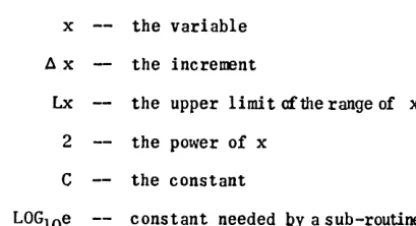
STARTI NG VALUES
X = -.99
t:.X = .01
Lx = 1.0
Power of x =2.0
C = 5.0
AUIDMATTC PROGRAMMING
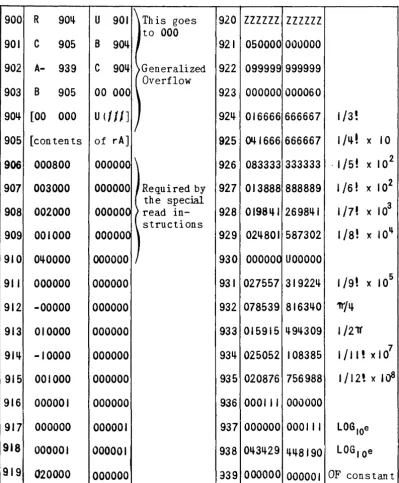
matically read computational instruc-' 900 to 939 POOL OF CONSTANTS. Corruoon constant s frequently required by the v ar i 0 u s
operations in the finished ru n n in g program produced by the compiler a re stored here. Fig. 2 cont'ains a corn-' plete .list ~f thes~ consta~ts. tions into the melOOry as required.
The writer of pseudo- instructions need not be concerned with this area of the memory.
060 to 119 WORKING STORAGE. These 60 location s in the Univac memory are used for stor-age of constants and intermediate re-sults during executionm the program. The person utilizing the compile r is responsible for the layout of~ area of memory.
120 to 179
180 to 239
INPUT DATA BLOCK B. This group of stor-age locations is set aside for problem data read in from tape. In use, a block
(60-words) of problem data is brought into an input block. As the raw data is processed, it is removed from th e input block in successive gro ups of , words called items. In Fig. 1, i t
will be noted that the melOOry layo u t contains space for two input blocks. This permi ts information to be brought into the calculation from more than one reel of magnetic. tape. Input block B is normally considered a second 0 r auxiliary input data storage b 10 c k • If only one input block is require d, block A (see Fig. 1 ) should be used in preference to block B; b 10 c k B under this circumstance can serve as additional working storage.
INPUT DATA BLOCK A. The function 0 f input block A is described abo v e • This block may be used for w 0 r kin g storage as well.
240 to 779 RUNNING PROGRAM. Instructionsproduced by the compiler system occupy this area of the memory, and these 10 cat ion s contain instructions necessary to ex-ecute the solution of the problem. It will be noted that this area contains space for nine blocks (nine 60 w 0 r d
uni ts) of instructions. If the solu-tion of a problem requires more th an this number of instructions the co m-piler automatically provides fo r re-tention of the excess instructions on tape until summoned into the memo r y by the Control Block instruction s • These nine (or less) blocks of instruc-tions are called one segment.
780 to 899 FLOATING DECIMAL ARITHMETIC. T h i s area contains all the C-IO instructions necessary to perform the mst common 1 y used floating decimal operati 0 n s 0 f addition, subtraction, multiplication, and division. Storage of th e s e i n-s truc tionn-s eliminaten-s the nec e n-s n-sit y for repeating them in the finis he d C-lO instructions produced by the com-piler. The wri ter of pseudo-c 0 d e instructions will seldom be concerned wi th the specific contents of this area of the memory.
16
-940 to 999 OUTPUT BLOCK. Final results are stored here. As mentioned previously, Univac reads and writes in blocks of six t y words each. When 60 Univac words of final results have been accumulated in this area of the melOOry the blo c k is automatically written on magneti c tape.
SAMPLE PROBLEM
A sample problem at this point will best il-lustrate how the A-2 Compiler System may be utilized to prepare a program for solution by Univac.
Statement of the Problem. Tabulate yr- e-x2 sin cx, where x ranges between -.99 and+.99 in increments of _A x
=
.01 It is required- tha t y be determined for each of the 199 val u e s 0 f x throughout the given range. Finally it is desired to print in tabular form the values of x in on e column and the corresponding values of y in th e next column.Analysis and Method of Solution. Analys i s of the problem for solution consists of sett i n g down a series of operations according to the method of solution.
OPERATION NO. DESCRIPTION
Starting Values
o
1 2 3 Intermed-iate Re- 4suIts 5
6
7
Input It must be decided atthis time what initial values are nec-essary for the computationm this operation. Provision is made for reading these values into the com-puter.
Calculate x2
Obtain
-x2
• _x2 Calculate eCalculate cx
Calculate sin cx
Calculate e-x2 sin cx
AUTOMATIC ProGRAMMING 8 In order that the results may be
printed out in desired form an ed-iting operation must be performed.
9 Each x and its corresponding y must be stored for subsequent recording on the result tape. When a suffic-ient number of these values h a v e been accumulated, (one block) they 'will automatically be wri t ten on
tape.
10 The first value of y has now be en calculated. Operations 1 through 10 must be repeated with a new value of x obtained by adding the incre-ment of (~x:: .01) to the previous value of x. This cycle (an itera-tion) must be repeated unti 1 the last value of x has been calculated. When this occurs, operation No. 11, should be performed.
11 The last output block may be 0 n 1 y partially filled with the values of x and y. Operation 11 will f i l l the rest of the block with non-nu-meric characters and wri te t h i s last block on tape.
12 This operation will terminate the program by rewinding the magnet i c tapes and stopping the computer.
Layout of Working Storage. When w r i t i n g pseudo-code in the sequence dictated by the anal-ysis and method of solution it is customary to proceed just as though the computation were taking place at the time. Hence, before the actual com-putational steps can be written in pseudo-c 0 de, the initial or starting values must be located in working storage and relative addresses ass i g n ed to them. All floating decimal values (two-w 0 r d units) are stored and transferred in pairs. When referring to any values in the working storage, only the relative address of the first word of the pair need be indicated since the second w 0 r d
al-ways travels along wi th it. The val ues requi red to begin this computation are:
x -- the variable
Ax the increment
Lx the upper limit afthe range of x
2 the power of x
C the constant
LOGIOe constant needed ~y a sub-routine to calculate e-x
These are written in floating decimal fo r m and located in the working storage block as shown (Fig. 3). The order and location of these values in working storage is arbi trary and 1 eft t o t h e discretion of the coder.
17
-The six starting values must be re ~ 0 r d e d
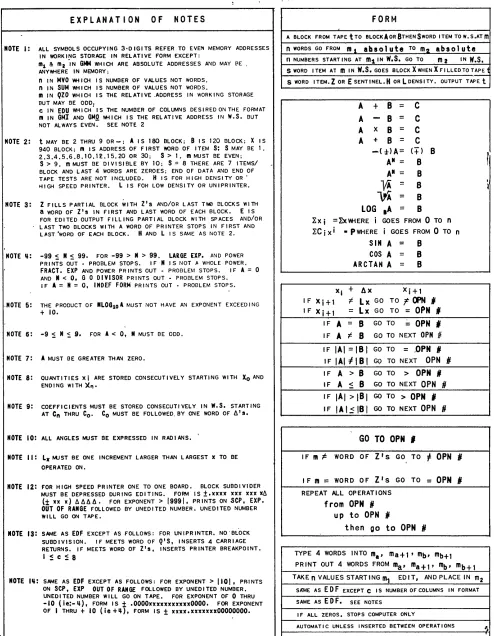
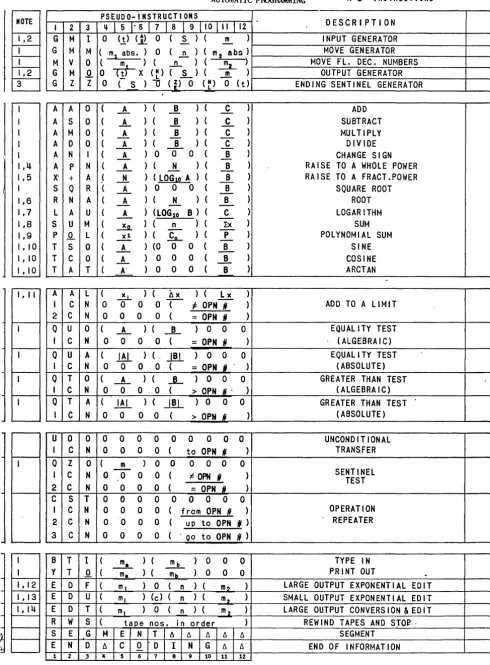
(unityped) on tape in the arrangement shown (Fig. 3) before they can be brought into the computer. When the data is "read" into the computer fro m tape it is deposited in an input block. Then', as many values as are needed are transferred into the working storage in the locations desired b y th e coder. In order for the computer to perform this operation it requires instructions in its 0 w n language. OrdinnriJy, the coder would have to write 84 C-IO ins tructions and be certain that the logic of the relationship of one instruction to another would cause the computer to correctly perform the desired operation. With compiler pseudo-code only one instruction need be written. This one pseudo-instruction directs the compiler to prod u c e (in C-IO code) the 84 logically related instructions. The pseudo-instruction must be in a prescrib e d form. All the pseudo-instructions currently avail-able with the compiler are shown in Figure 4. In Figure 4, the variables (in the pseudo- ins tructiOls) to be supplied by the coder have been underlined (in the original manual they are printed in red ink); but note also that capital letter 0 (oh) is d i s-tinguished from cipher 0 (zero) in that capital 0 is underlined. Figure 4 is a master key to codinq with pseudo-instructions; continual reference w it is needed to understand this discussion.
In the analysis Operation 0 is an input 0 p-eration. Under the column titled "Descrip tion" look for the word input. In the first line fin d "Input Generator". To the left of this under "In-structions" is the pseudo-instruction coveri n g this operation, namely:
1 1 2 3 4 5 6 7 8 9 10 11 12
IGIMI~ 101(t)I(~)lol{ ~ )I(_:~:
)1
Copy everything "black" (not underlined) 0 n the first line of the coding sheet in the corres-ponding digit positions:
2 3 4 10 11 12
It is the coder's responsibility to supply the variables noted In underlining~
The coder is first required to fill ~n a tape or Uniservo number for "t". This (t) is the num-ber of the tape-handling unit which will hold the data tape when solution of ,the problem is be i ng done after compilation.
Uniservo 1 is always reserved for the c 0 m-piled program during solution. Therefore, U n i-servos 2 through 9 and -- (uniservo number 10 ) are available for data and result tapes. Sin c e number 2 is the next unused "servo" it will be as-signed to hold the data. So in place of t write 2:
I 1 2 3 4 5 10 11 12
[image:17.623.88.296.541.654.2]AUTOMATIC PROGRAMMING
A or B (digit position 6) is to be filled in next. This designates what input block in ther~
ning memory is to be used to store the data block when it is read from Uniservo number 2. When one input block is needed use block A. This probl e m has only one data tape so only one input block is required. In the sixth digit position fill in A:
1 2 3 4 5 6 7 10 II 12
The next thing to be supplied is a two digit value for "s" (digit positions 8 and 9). The block of data has been read from Uniservo #2 into input block A. Now "s" number of words are to be trans-ferred from the beginning of this block into wor k-ing storage. It was decided previously that six values were needed immediately. Since each value is expressed by two words there are then 12 words to be transferred. Consult note 2 to see if an "item size" of 12 is allowable: It is, therefore the coder writes 12 in the appropriate spaces:
I 2 3 4 5 b 7 8 9 10 II 12
I
G / M
/ I /0 /2/ A /0 /,1 / 2/
The last piece of information concerns "m " (digit positions 10,11,12). Since m covers an area of 3 spaces, a relative working storage a d-dress is required (see note 1) • It was decid e d to have the six values in working storage starting at relative add,ress 000. For "m" fill in 000:
I 2 3 4 5 6 7 8 9 10 II 12
(GIMIIIOI2IAloI112Iololol·
The pseudo-instruction for the input is now completed. When the compiler interprets t h i s
pscudo-instru~tion,it will "call" the Input Gen-erator (a subroutine) from the Library and supply the pSEtudo-instruction to it. The generator, 0 n
the basis of the variables supplied, will generate 84 C-IO instructions (a subroutine) which will be-come the first part of the compiled program.
It will be capable of reading a data bloc k from Uniservo #2 (t) into input block A or B (i n this case A) then transfer "s" words (12) from th e beginning of the input block to the working stor-age starting at relative address 000 (m). In the event that more data would be needed from the in-put block, (not the case in this problem) control is transferred back to the GMI operation number and it would transfer the next 12 words to the same place as working storage. Each time the GMI sub-routine is executed it transfers the next success-ive "s" words to working storage. When the inpu t block is exhausted GMI will read another data block from tape into the same input block and transfe r
18
-the first "s" words in the block to working stor-age.
The beginning values are now in working stor-age in the arrangement decided on in the la you t of Working Storage. Operation 1 -- Calculate x2• This operation requires that the variable "x" be raised to the second power. Under Description, look for the proper routine. In the "eleventnline find "Raise to a Whole Power". To the left the pseudo-instruction is:
I 2 3 4 5 6 8 9 10 11 12
: 8:
)1
Copy the black characters in the second line of the coding sheet. The relationship of A, N, and B are explained in the column to the left labeled "FORM". It shows An=
B. Since each 0 f the s ecovers three digits, relative working storage ad-dresses are to be supplied (see note 1). An i n-spection of the working storage shows t hat the variable X is in relative location 000. Since A represents the address for X write 000:
I 2 3 4 5 6 10 11 12
N is the notation for the address of the power to which the variable is to be raised. In this prob-lem, the value of the power is 2. It is contained in the working storage. The relative address of 2 is 006. For N, fill in 006. See note 4 concern-ing limits of values A and N. The values used in this problem are allowable.
I 2 3 4 5 6 7 8 9 10 11 12
lAl
p
iNI oioioiolo.l.61
B is the relative address of the location i n which the result (x2 ) of this operation is to b e stored. Since the first open location is 012, the result (x2) is assigned relative address 012. This instructs the routine to place the result in 012 of the working storage.
I 2 3 4 5 6 7 8 9 10 II 12
I
A
I
p
I N.I
0
I
0
I
0
I
0
I
0
1.61
0
III
2
J
AUIDMATIC rnoGRA\'MING Operation 2: 'Obtain _x2• Operation 2, ( i n
this case Change, ~os iti ve quantity to neg a t i ve) , under DescriptIon Ibok for change sign. Cop y characters in black:
7 8 9 10 11 1 <
1010
Ia
1For A, the coder supplies the address of the value to have its sign changed. It is the value just calculated and placed in 012. 'Write 012 for
"A" on the third line of the coding sheet~
1 2 3 4 5 6 7 8 9 10 11 12
I
A/ N.l1
1
~.I
I
1210 10
!
010
/1
14/
Now, the location in which the value is to be stored after having its sign changed is wanted. The next open location is 014; fill this address in for B. Address 012 could have been used for B since the value x2 was not needed after tile rrutine removed it from 012 to change its sign. However, since there are many locations left in working storage to more than cover the needs of the prob-lem, the coder can use them rather liberally.
Operation 3: Calculate e-x2 • The constant e is to be raised to the -x2 power. APN may not be used since
-x2
is a fractional number. So und e r Description look for a routine to fit this opera-tion. To the left of "Raise to a Fractional Pooer" find the pseudo-instruction:1 2 3 4 5 6 7 8 9 10 11 12
Copy
X+ A in the fourth line of the cod i n g
sheet. The first address wanted is that of N. It is the power to which e is to be raised. The value -x2 has been pI aced back in 014. For N fi I I i n 014., 1 2 3 4 5 6 10 II 12
[ X
1
+1
Ala
11 1 41
In the column labeled FORM to the 1 eft 0 f
X+
A the mathematical operation is noted. An is equi valent to e-x2 • The subroutine that i s t 0calculate An requires that A be given in its loga-rithmic form. Since in our problem e is equiva-lent to A, the 10glOe must be supplied. This was done in the layout of the working storage. Th e address of this value is 010.
For 10910A fill in 010: (see note 5)
1 2 3 4 5 6 7 8 9 10 II 12
I
~
1+1
A
10 11 1.410 11 10
I
-x2
For B fill in the location in which e is to be stored in the working storage. The n ext open location is 016. Fill in 016:
I 2 3 4 5 6 7 8 9 10 11 12
Ixl+IAI
0
111410 11101011161
Operation 4 -- Calculate ex. This operation is clearly a multiplication. The pseudo-instruc-tion is:
8 9 10 11 12
Again, according to note 1 relative worki n g storage addresses for A, B, and C are needed. The value for C is stored in 008. The value x is still 000, of course. Fill in A and B:
1~1~1~1~1~181~1~1~1"
11 12The product will be placed back in worki n g storage in the next open location, 018:
I 2 3 4 !! 6 7 8 9 10 II 12
I
~
.1
M
fa ,
0
lois
1
a ,
0
I
a
1
a
11
I
8_1
Operation 5 -- Calculate sin ex. Look for pseudo-instruction for sin. Fill in black char-acters on coding sheet:
7 8 9 10 11 12
10 10
10
I
Note 10 cautions that the angle must be ex-pressed in radians. The quantity ex is certainly in a decimal form. For A, the address of ex i s required. It is in location 018. Fill in 018 for A:
AUTOMATIC PROGRMIMING
Since this routine needs only one input quan-titY,digits 7, 8, and 9 are just filled in wit h zeros. The last three digits are again for the location of the result. Fill in 020:
I 2 3 4 5 6 7, 8 II 10 11 12
Irlslolol1 18101 0 10 1012101
Operation 6 - Calculate e-x.2 sin ex. Bo t h parts of the product are stored in working storage in 016 and 020. A mUltiply operation is required. Since this operation was written previously, the coder should remember the form and be able to write the pseudo-instruction required at this time with no further explanation:
1 2 3 4 !I 6 7 8 II 10 11 12
I
A
I
M
I
0
I
0 11
I
'61 a
I
2
I
0 1 0 1 214
I
The product of the multiplication is the first y result.' This result has been placed in 024 in-stead of 022 because if x and yare to be together when they are collected in the output block, xllien must be moved next to "y". ' 022 has been reserved for this purpose.
Operation 7 -- Move x next to y. Under "De-scription" look for a routine that will move float-ing decimal quantities. Find "Move FL.· Dec. Num-bers". To the left the pseudo-instruction is
1 2 3 6 7 8 9 10 11 12
ml is the location from which the number i s to be taken. n as described in Note 1 ~the num-ber of values, not words, to be moved. ~ is the location to which it is to be moved. It i s r e-quired that x be moved next to y. Since x is in location 000 write 000 for m:
1 2 3 4 5 6 10 11 12
IMlvlolololol
Only one value (x) is to be moved, therefore, fill in 001 for n:
1 2 3 4 5 6 7 8 9 10 11 12
[Mlvlolololololol11
x is to be moved to 022; for ffi2 fill in 022;
29
-1 2 3 4 5 6 7 8 9 10 11 12
IMlvioioioioiolol11012121
Remember that the value x is not erased when transferred.
Opet..<!tion 8 -- Editing. It is desired to edit x, and y and have them printed in two col u m n s • There will be 198 x's and y's. This number 0 f
resul ts is considered a small amount of "output". There is only one 'small volume' editing routine. The pseudo-instruction is found near llie bottom of the Instruction sheet:
1
E
I
Diu
Ie'
:~1: '*~>Ic' ~
·
lie"
:~~:
")1
C is the number of columns the coder desires converted to printed form. n is the numb e r 0 f values to be edited at one time starting at loca-tion m]. Dl2 is the starting location to which n values ·are to be returned after editing. Values are to be in successive locations beginning with ml and will be put back successively starting with location 1I12.
In this problem c
=
2 since 2 C olu mns are desired. n=
2 because there are two val u e s , x and y, to be edited. ml=
022 because this is the address of x, and III2=
022 because the edited numbers are to be returned to same locations. The unedited'values are no longer desired or needed. The pseudo-instructions should be filled i n a s follows:1 2 3 4 5 6 7 8 9 10 11 12
JElolulol2121210121012121
Operation 9 -- transfer of results to "out-put block". The edited values x and y should now be transferred to the output block. A total of 4 words will be transferred since x and v are e x-pressed by 2 words each. In Figure 4 look for
oulPUT GENERATOR. The pseudo-instruction is:
1 2 3 4 5 6 7 8 9 10 11 12
IGI~IQIOI(t)lxl(~*
$ )\(
:m:
)1
On the coding sheet, copy the chara c t e r s which are in black print: