January, 1964
CDm~uter&
and automation
The Anatomy of an
Assembly System
8RM
8RR
til
8M
~10
8 0000 41 0024
8 0411 40 0017
8 0000 10 0020
8 0000 24 0022
8 0000 40 0024
0300
8 0000 11 0021
0301
8 0000 24 0023
3 0341
8 0000 22 0024
1
45 0000
o 0000 40 9999
00 08 0000
8 0000 10 0020
1000
40 3300
8 0000 24 0023
LOP
LGF
LOG
MOP
SOP
SIN
SND
8000 42 00
8 9999 21 0004
o 0000 44 0000
1 0000 30 0000
8 0009 33 0010
8 0000 40 0012
8 0010 09 0012
8 0000 30 0004
8 0000 42 0000
1 0000 30 0000
ADC
STA
ADM
LOB
MIN
STB
SU8
lOX
sue
STX
MUL
XMA
OIV
CLA
CBA
Cl8
o
0000 44 9999
o 0000 30 9999
8 0009 33 0011
8 0412 40 0005
o
0001 45 0000
o 0000 08 0000
8
0000 30 0005
8 0000 42 0000
1 0000 30 0000
ATN
EXf
80
1:
EXP
FFL
810
FLA
FLD
cos
SKR
FLF
CSD
CSF
FLM
080
SKM
00
2 00
a
10
1 0000 30 0000
o
0000 al
9999
4 0000 00 0005
8 0000 42 0000
4 0000 99 0000
1 0000 30 0000
8 0000 10 0132
4 0000 99 0000
8 0000 14 0130
o 0000 01 9999
00000
o 0001 49 0010
6 0000 40 2147
8 0000 12 0133
6 0000 11 2147
8 0410
8 0000 14 0131
6 0000 44 2100
00007
4 WAYS TO IMPROVE COMPUTER TAPE
Exercise greater quality control.
The Memorex-designed Vibrating-Sample Magnetom-eter (VSM) tests basic characteristics of oxide raw material and precise concentration of oxide particles in the tape coating_ Extra tests of this kind guaran-tee the improved performance and reel-to-reel uni-formity of Memorex computer tape.
Use a superior production facility.
A conspicuous aspect of the Memorex plant is the complex system of air filtration, humidification, dehumidification, heating and cooling. The unusual high-purity system, equal to that used in pharma-ceutical processing, provides a contaminant-free environment - prerequisite to production of ini-proved error-free tape.
Memorex tape is premium tape. No need to pre-check
it.
You can place Memorex computer tape directly in service-reel after service-reel.Memorex certification means what it says: Memorex com-puter tape
i§.
error-free. Extra care, extra steps and scrupu-lous attention to every detail make it that way. We know the importance to you of having a tape you can depend on.Circle No. 5 on Readers Service Card
Employ advanced production techniques.
Specially constructed equipment - used to slit Memorex computer tape from jumbo rolls - pro-auces tape with clean, straight edges free from rip-ples and ridges. A new slitting technique is but one of seventeen manufacturing improvements made to insure superior performance of Memorex tape.
Apply research in depth.
Re!jearch in oxide, coating materials, and tape-making processes has equipped Memorex with a fund of new technology. Combined with manufac-turing competence, this fundamental knowledge is manifest in Memorex computer tape by freedom from dropouts, longer life, and improved uniformity and reliability of performance.
Are you on our mailing list to receive the Memorex Monograph Series of informative technical literature? Write 1176 Shulman Road, Santa Clara, California.
MEMOREX
PRECISION MAGNETIC TAPE
cuI.
ent.
im-,min
ogic
Ither the •
:uits ~ory. ices. leals - til· onal
dling utors ed to
~udl •
~UII"(l' , with whill'
,cK.
y G.
hn
What
makes AS'I's
2100today'~
outstanding
CODlPut~J:'buy?
ASl's new 2100 is designed to satisfy both small
program attention for initiation only . . . centr(:lI
andmedium scale computerne'eds, combining high ,processor may communicate directly with external
operational speeq, expanded input/output capa-, 'devices without using buffered channels.
~ilities
and low
cost-to-an~werratio~in
aconven-
. SIZE AND POWERREQUIREMENTS-A>single
up~
lent to use, compact unit. Check
·Just,~few.of
'right
cabine.t.i~clu.des
aU
electronicspow~rsupp'y
the 2100's features:
aDd op,erator,control>ar'lddisplay
pan~L
.••. over-all
MEMORY 7"7".2 microsecond total. mel110ry cycletirne
,height671nches,deptb25.5 inch.es,width72
... 21 bitwon;i .... 4096 word core memory ex-
inch~s;powerconsumptio'nislessthan
1.8KW ...
pandable in modules of 2,048 words.
,·standarcil~OI12QvQlt60cycleAC.No
special
ARITHMETICANl)CONTROL7"7"Threeinde)(>:re~i~~ temper~tureor
humidityc0r'ltrolsrequired,
ters ...
dou.pl~>precisionhardware
....
!~stindir~~t
PERleHERAL EQUIPMENT
~Availablewiththe
addressing.> ..
~Qnver1ier1tsubIo~ti.~~.'apce~~
..
~
210(lis a complete line of proven peripheral
equip-instructionstofacmtatefloatingpointoperation,.~~
rt1~nt
... high and low density magnetiptapeunits
rapid instruction execution.
;.; 800,200 and 100 cpm card reader ..
~250and
.
Add- 4 usec.
'100 card punches ... incremental plotter systems
Multiply-.;.30 usec,
... 500 character per second papertape reader- ..
Double Add-12 usec;
100
characterp~rs~c9r1dpapertapepqnch
.. , •. in*
, ... Unconditional Transfer- .. 2
lJ~e¢~
'put/outp~t.typ.~.VJrjt~r··
.• 400anc:l200. 1Prl} line
INPU.T/OUTPUT-Up ..
toeightcompl~te,bJff~r~d, 'pril)ters.·'·i··A~to·D···.arl.d.iD-to.A.conversi0r'l.yr1its.
bid i rectional .. i n put-outpyt. chan nels,;.,.500KQ
SOrrW~RE-.;.A
com p lete ...•
packag~ot.
progra
ms~
total word input·outputrate. '.' cpannelswiHac;
?ompil~r?(lnd
routines ...
fielcite.st~.clf()RTRA(\jIJ
cept informationin6to 48 bitfields as specified by
'\'<~Yl'l1bolic assembler.~
.. rt1athematlcalsu9;,.
the program·. '.' any channel
maYgeconn~cted.to r9u3ip~s
... available at
delix~rYi()!i210()<systert1.
as many as32externaldevices ..
~.eachextern(:ll .···~~I~t<AND
DELIVERY
-Th~priS~~?tthe·.
210Q.
device has its .. own ••
uniqueinterruptaddr~~s.t()
begin at $87 ,800 ...
monthly.,I~asepr.ic~$f'P~O
which·.program can.be
automaticallytransferr~.cl
..
t ' •.E.fir?td~liveries
in
Decem.b~rI963
... .
multiple priority interrupts, each with its
own()rc1er;,.~()rq0rt1pl~teclescriptive
data
on.~$I's2100,calr
of priority .... external device
operationsr~quir~()rVJrit~.togay~·
ADVANCED SCIENTIFIC INSTRUMENTS / DIVISION OF ELECTRO MECHANICAL RESEARCH, INC.
'8001 Bloomington Freeway, Minneapolis, Minnesota 55420
Circle No. 6 on Readers Sorvice Card
only
OFLUSCA
moves fast
enough for
EAI,
Flexibility ... speerl . . . extreme accuracy ...
these have been the watchwords of progress at
ELECTRONIC ASSOCIATES, INC .••• one of the
most talked-about companies in the field of
elec-troni' data reduction and scientific computing
equipment.
For its Payroll and Accounts Payable checks EAI
selected FORMSCARDS, the ONLY continuous
tabu-lating cards with NO medial waste strips.
This unique characteristic, which permits trouble-free opera·
tion of FORMSCARDS on any speed equipment, can easily
point the way to increased efficiency in your data
processing system. May we demonstrate
FORMSCARD superiority to you?
FORMSCARDS are available PRE-PUNCHED,
with vouchers of any length, side, top or
bottom. They separate easily, manual
call, write or wire
Y;msinc
or on any burster, and can be
part of a multiple parts set.
WILLOW GROVE, PA. Phone: Oldfield 9·4000
Manufacturers of Line Hole Continuous Business Forms
Call or write for the name and address of our Sales Representative in your area
Circle No. 7 on Readers Service CardThe segmented pyramid on our cover this month
represents three phases of automatic programming,
i. e., from top to base,
(1) source language statement of the problem,
(2) translation to symbolic imtruction codes, and
(3) assembly of actllal machine instrllctiom.
J.
Worthington discusses these phases in
lIThe Anatomy of an Assembly System" starting on page 18.
-" ~J 11.111
.www,", ••• '.
©CQ)U1FUCQ)Q}J~~~~
mo-Ll@
mQl]'L0(Q)[['LruGJ\~D
@[[1)
JANUARY, 1964 Vol. XII', No.1
editor and publisher
EDMUND C. BERKELEY
assistant editors
MOSES M. BERLIN NEIL D. MACDONALD LINDA LADD LOVETT
contributing editors
ANDREW D. BOOTH NED CHAPIN JOHN W. CARR, III ALSTON S. HOUSEHOLDER PETER KUGEL
computers and data processors:
the design, applications,
and implications of
information processing systems.
l1z This Issue
8
18
NEW DIRECTIONS FOR COMPUTER TECHNOLOGY AND
APPLICATIONS - A LONG RANGE PREDICTION
by Donald F. BlumbergTHE ANATOMY OF AN ASSEMBLY SYSTEM
by John H. Worthington'" '"
..
on'" '" '" ""
."
advisory committee
T. E. CHEATHAM, JR. GEORGE E. FORSYTHE RICHARD W. HAMMING ALSTON S. HOUSEHOLDER HERBERT F. MITCHELL, JR.
22
CONSIDERATIONS IN COMPUTER DESIGN - LEADING UP TO THE
CONTROL DATA 6600 (Part 3 - Conclusion)
associate publisher
PATRICK J. MCGOVERN
production manager
ANN B. BAKER
circulation manager
VIRGINIA A. NELSON, 815 Washington st. Newtonville, Mass. 02160, DEcatur 2-5453
advertising representatives
New York 18, BERNARD LANE 37 West 39 St., BRyant 9-7281 Chicago 11, COLE, MASON AND DEMING 737 N. Michigan Ave., SU 7-6558
Los Angeles 5, WENTWORTH F. GREEN 300 S. Kenmore Ave., DUnkirk 7-8135
San Francisco 5, A. S. BABCOCK 605 Market St., YUkon 2-3954
Elsewhere, THE PUBLISHER 815 Washington St., DEcatur 2-5453 Newtonville, Mass. 02160
by James E. Thornton
Bl
1963 ANNUAL INDEX (inserted between pages 20 and 21)
111 Every Issue
27
6
17
36
26
across the editor's desk
COMPUTING AND DATA PROCESSING NEWSLETTER
editorial
Programming: Science, Art or Language?
reference
informatio11-Calendar of Coming Events
Monthly Computer Census
indc.\' of noticcs
Advertising Index
COMPUTERS AND AUTOMATION IS PUBLISHED MONTHLY AT 815 WASHINGTON ST., NEWTONVILLE 60, MASS., BY BERKELEY ENTERPRISES, INC. PRINTED IN U.S.A. SUBSCRIPTION RATES: UNITED STATES, $15.00 FOR 1 YEAR, $29.00 FOR 2 YEARS, INCLUDING THE JUNE DIRECTORY ISSUE; CANADA, ADD SOc A YEAR FOR POSTAGE; FOREIGN, ADD $1.50 A YEAR FOR POSTAGE. ADDRESS ALL EDITORIAL AND SUBSCRIPTION MAIL TO BERKELEY ENTERPRISES, INC., 815 WASHINGTON ST., NEWTONVILLE, MASS., 02160. SECOND CLASS POSTAGE PAID AT BOSTON, MASS.
POSTMASTER: PLEASE SEND ALL FORMS 3579 TO BERKELEY ENTERPRISES, INC., 815 WASHINGTON ST., NEWTONVILLE, MASS., 02160. © COPYRIGHT, 1964, BY BERKELEY ENTERPRISES, INC. CHANGE OF ADDRESS: IF YOUR ADDRESS CHANGES, PLEASE SEND US BOTH YOUR NEW ADDRESS AND YOUR OLD ADDRESS (AS IT APPEARS ON THE MAGAZINE ADDRESS IMPRINT), AND ALLOW THREE WEEKS FOR THE CHANGE TO BE MADE.
c&a
EDITORIAL
Programming:
Science, Art or Languag.e?
Programming interests many computer people,
and fascinates a large segment of those interested.
Part of the reason certainly is the feeling of power and
satisfaction acquired by the successful programmer when
his problem runs and the solution unfolds before his
eyes. Archimedes shouted "Eureka!" and we can too.
What manner of thing
i~programming? is it a
science? is it an art? is it a language? or more
be-sides? In fact, programming is all of these things.
A science according to the dictionary is a "branch
of knowledge or study dealing with a body of facts or
truths systematically arranged and showing the
opera~tion of general laws. " Programming is the science which
deals with the methods of instructing computers to solve
problems.
An art is "an area of skilled performance."
Pro-gramming is the art of skilfully guiding the computer's
processes in order to solve a problem.
Itrequires art
to find a good way through the maze of possible
proces-ses that can happen inside a computer.
Finally, programming consists of a class of
ar-tificiallanguages - those adapted to expressing ideas so
that a computer "understands" and can solve a problem.
In
fact, expressions such as "machine words" and
"machine language" have been in current use since the
first digital computer began to operate in 1944.
Programming has even a fourth aspect: it
con-~titutes
the education of a computer. :Anybody who
en-joys explaining and teaching is. likely to relish many
aspects of programming, because the, "idiot computer"
can be taught so extraordinarily well.
This thesis has several implicfltions. First,
people of differing backgrounds and various leanings may
all become good programmers:
scientists~mathema-ticians, linguists, teachers, and more besides. In fact,
many diverse occupatiops have
gradu~ted
members into
the programming field.
Second, the many-faceted field of programming
will have much
to
contribute to the mental life of those
who work
in
it.
Itis likely to be always stimulating and
never dull.
Third, there has been some discussion as to
whether or not programmers will be superseded 20 or 30
years from now. On the contrary, the diversity of the
field will make programmers necessary for a long time
6
to come. Their work may change in some ways, but
their services in general will be indispensable. The
choice between methods for solution will continue to
call for programming experts. And the understanding
of problems in the real world in order to put them on
computers will continue to require good programmers.
c:-~c:=.
..
~
EDITOR
PROGRAMMERS
IMMEDIATE POSITIONS
At Our 3 Maior Data Centers
for key personnel with business or scientific degrees. Vacancies exist in the following areas:
SOFTWARE SYSTEMS
&
SOFTWARE DEVELOPMENT
REAL-TIME APPLICATIONS
DATA REDUCTION
NUMERICAL CONTROL PROGRAMS
PROGRAMMING INSTRUCTORS
DIAGNOSTIC PROGRAMMERS
SYSTEMS ANALYSTS
Salaries range from $10,500 - $21,000
AN EQUAL OPPORTUNITY EMPLOYER
For interviews in your area write
J.
GERALD McELROY
- Management Consultant
-530 Baltimore Pike
Springfield, Penna.
Circle No. 8 on Readers Service Card
IN JUST THREE MINUTES
THIS PAYROLL CAN TRAVEL
FROM PHILADELPHIA TO
CHICAGO. FARE: $1.54
Circle No. 9 on Readers Service Card
COMPUTERS .and AUTOMATION for January, 1964
This is what
DATA- PHONE
service has
done for business communications.
It gives computers an electronic "voice"
that travels via regular telephone lines,
at regular telephone rates.
. .
At speeds up to 2500 words per minute,
DATA- PHONE
service can send anything
that can be punched on cards or
tape-or-ders, technical data, waybills, inventories.
Talk with our Communications
Con-sultant about it. Just call your Bell
Tele-phone Business Office-and they'll gladly
have him contact you.
BELL
TEL~PHONE
SYSTEM
Serving you
NEW DIRECTIONS FOR COMPUTER
TECHNOLOGY AND APPLICATIONS .
A LONG RANGE PREDICTION
Where do we stand today in the application of data
processing systems? What is the future direction of the new
technology of information processing?
These and other questions are often raised by
th~prac-tical executive
,!She tries to obtain an over-view of the
impact of computers and automation in today's economy.
From the stream of announcements, claims, literature, and
press releases one can be easily overwhelmed by the
com-puter "revolution." The real facts are much less alarming.
By and large, computers have been applied in a fairly
evolutionary manner. Although there are now over 11,000
data processing systems installed in the United States, the
great majority are operating on standard tasks of
account-ing and financial information processaccount-ing. Most of these
applications are not particularly advanced or sophisticated,
and are functionally similar to the punch card tabulating
(unit record) equipment which the larger electronic data
processing systems replaced. Of course, some extremely
advanced applications of data processing have- happened,
but these have generally been limited to applications in
the government, scientific organizations, and large
manu-facturing firms. The great majority of smaller firms are
just beginning to <.:onsider the use of EDP.
In fact, the last ten years have only served to
demon-strate that computers can be built reliably and for just
about any price.
It
has also been conclusively
demon-strated that (throughpr<5per planning; careful analysis,
and adequate implementation of the application) the data
processing system can be an efficient, useful device. Just
where do we stand today, and what can we expect
tomor-row? We hope to answer these questions in this article.
Ceneral Trends in Computer Applications
The United States computer, industry has been
expand-ing rapidly since the introduction of commercially
avail-able equipment in the latter half of 1952. Some idea of
the extent of this growth can be obtained by examining
the market for data processing equipment and services
8
Donald F. Blumberg
Director, Planning and Inf01-mation Systems
Pennsylvania Research Associates, Inc.
Philadelphia, Ea.
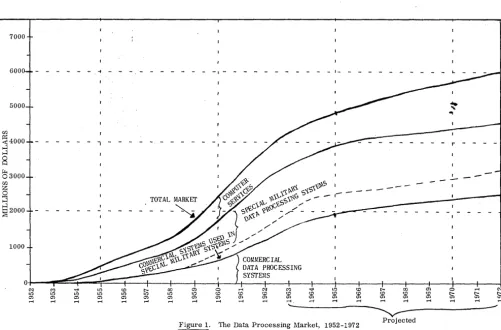
during the period from 1953 to 1963 (Figure 1). Three
historical trends deserve specific comment: (1) the
inter-relationship between the special military systems and
stan-dard computer systems market, (2) the growing market for
data processing services, and (3) the underlying- reasons
for the apparently high rate of installation.
- The military systems market has always been a keystone
Iof the data processing industry's technological
develop-ment. For example, military expenditure for research and
development of advanced computer hardware and
"soft-ware" to meet emerging military requiremen.ts has given
a tremendous degree of technical impetus to the field
through the years. Military requirements have also led to
the development and implementation of a wide range of
new applications for information processing. In addition,
the Department of Defense (and other agencies of the
Federal Government) are major users of commercial data
processing equipment. Military procurement of complex
weapons and supporting equipment has also led to growth
in the utilization of computers in other sectors of the
Donald F. Blumberg
is Director, Planning
and Information
Systems, for
Pennsylvania Research
Associates. He holds
the M. S. degree
inManagement and
Operations Research
from the Univ. of
Pennsylvania.
5000
U1
~4000
...:l ...:l
8
t)
3000U1
z
.9
...:l- - - -
....
-- -- -- -- -- -- ,
~
2000 - - --1000
0
~ M '<:!' If) <.0 t- oo en
If) If) If) If) If) If) If) If)
en en en en en en en en
... ... ... ... ... ... ... ... - I
-0 ... ~
<.0 <.0 <.0
en en en
... ... ...
r
I
--
---M '<:!' If) <.0 t- oo en 0 ... ~
<.0 <.0 <.0 <.0 <.0 <.0 <.0 t- t-
[image:9.621.70.571.45.374.2]t-en en en en en en en en en en
... ... ... ... ... ... ... ... ... ... ...
~
-Figure 1. The Data Processing Market, 1952-1972 Projected
economy. For example, the large aero-space and electronic
manufacturing concerns working on major government
contracts have widely applied computing equipment in
support of these government programs. Both directly and
indirectly, the Federal Government's expenditures for
goods and services
form~dthe basis for a large number of
data processing applications during the last ten years.
A second major trend which has occurred in the last
decade has been the rapid rise in the development of
com-puter services. In the initial stages, the data processing
in-dustry was concerned with the design, development, and
production of reliable, efficient processing systems.
It
was
believed that the user would easily develop and program
his own applications once the machine was made available.
With the appearance of a wide range of equipment, it
be-came quite clear that problems involved in the
develop-ment and programming of the application, and even the
operation, of the data processing system could not be passed
over lightly. The result was the creation of the new field
of computer supporting and consulting services including:
• A.
pplications analysis
• D.evelopment of computer programs
• Operation of the computer system, providing
avail-able processing as needed (e.g., EDP service
bu-reaus)
This new field has grown to the point where the
avail-ability of these services can exert influence on the
develop-ment of new applications.
It
is
tothe advantage of these
newly created service organizations to col1tinue to push
forward the state-of-the-art, as well as the numher of
ap-plications of computers. For example, man)' smallcr firms
have begun to apply data processing techniqucs in· their
operations using the local EDP service center. This avoids
a major investment in a machine installation.
Finally, it is important to understand the underlying
sta-COMPUTERS and AUTOMATION for January, 1964
tlStlCS in the installation rate of small, medium, and large
systcms over the last ten years. The major growth in the
number of units installcd since the 1956-1957 period has
been due to small-to·mcdium (omputer systems.
Large-scale systems installations have also incrcased, but at a much
more stahlc rate. Small systems to datc have been largely
a pplied to accounting and administrative operations. A
significant percentage of these applications have been
up-gr;.lded
repl{/(,(:II/(~nlsof existing punched card and
tabula-tioll illstallations, a fan which has not hcen widely
pub-licized.
tThe Present Str'ucture
o,f
Computer Use
in the United States
Although computers are to be found in almost every
sector of the economy, their applications in specific
sec-tors vary, depending on the nature of the problems to be
found, the array of technological equipments available at
any particular point in time, and the existence of
applica-tion concepts which have been proved feasible. At
pres-ent, thc
l\fanu/acturing sector and the Federal
Govern-me1lt sector
of the U. S. economy are the largcst single
computcr users among the ten major sectors of the U. S.
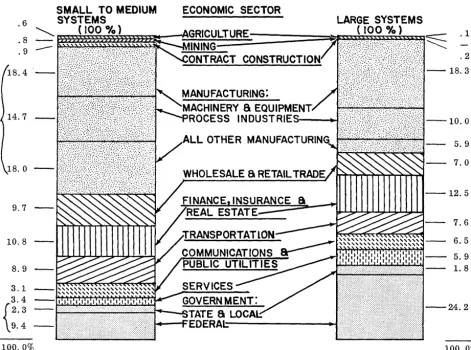
cconollly. I-Iowever, there is a dillen'JuT in the degree of
utilization of slIIall·nlcdilllll
VCl'SIlSlarge systellis in these
and other senors of the
C(()1I01ll),(Figurl'
!!). Thcse
dif-ferellces arc caused
bythc variatiolls ill c()Jllputer
applica-tions ill each of the sectors, as well as thc sizc alld structure
of each of the industrial segments. For example, certain
segments of the economy are so split up that very few
firms are big enough to support a large-scale computing
1 This has been especially true in 1963 when thousands of IBM 1401 and UNIVAC 1004 systems were installed. replacing existing equipmellt installations.
SMALL TO MEDIUM
.6
SYSTEMS
'--....
( 100
0/0)
.8
.9 - - ,
... ..
ECONOMIC SECTOR
CULTURE
CONSTRUCTIO
.1
.2
7.0
7.6
6.5
5.9
8.9
_-2:::\
3.1
{
;:!
9.4
100.0%
Figure 2. Present use of small-medium and large computer
systems in the United states economy.
100.0%
center. In certain sectors, the lack of appropriate, proved,
~Over 800 such systems are now in use for virtually all
computer-processing techniques or suitable equipment, has
types of machine tools.
prevented the development of applications. For example,
There are two types of numerical control systems:
Agriculture, Mining
and Contract Construction use data
• Positioning or point-to-poi"nt control, in which the
processing systems to only a limited extent. In these in-
tool, such as a drill, can be moved in a location or
dustries, most of the work is done in the field; and the lack
area, but cannot be angularly displaced: the path
of rugged, mobile computer systems that can operate un-
taken by the tool between successive points and the
der the usual field conditions have hindered the develop-
work piece is not a consideration.
ment of applications for these sectors. These industries
• Contour continuous-path control, in which the
cut-also have a limited number of extremely large firms or or-
ting axis of the tool itself can be changed, under the
ganization units which can make effective use of large-
direction of the tool's controller: the path taken
scale processing systems.
It
is of interest, however, that
across the work piece is subject to continuous
pre-the Agriculture, Mining, and Contract Construction fields
cise control.
have all been marked by extensive use of materials-handling
Although point-to-point numerical control systems can
.aut<?mation.
be manually programmed, in a significant number of
ap-The M(l1Il1farfllring segment of the economy is the
plications the programs are prepared by an off-line
com-largest siJlgle industrial user of data processing equipment.
puter. Numerically controlled contouring, however, does
Computers are utilized in a wide range of standard func-
require a digital computer to provide for the preparation
tional areas such as production planning, financial and
and coding of machine tool commands. Program-controlled,
account processing, warehouse and inventory control, and
multi-operation machines may also require computers to
support of research and development data analysis and
coordinate their operations on a real-time basis. The
ap-calculations. Computers are also being applied to real-
plication of numerical machine-tool control has increased
time process control and numerical machine tool control.
with the development of standard automatic programs,
Machinery and Equipment manufacturing
forms a ma-
such as APT and Autoprompt.
jor sub-section of the manufacturing sector of the economy.
Process manufacturing industries
are also large users of
This industry is composed of over 20,000 companies manu-
data processing equipment. For example, petroleum
manu-facturing a wide variety of mechanical and electrical sys-
facturers were one of the first industrial groups to
de-terns. sub-systems and components, ranging from carbon re-
velop computer techniques for determining optimal blend
sistm:.. to huge hydroelectric turbines and airplanes. Com-
ratios and to mechanize their billing and sales analysis
op-puter use in this sector is extremely heavy for scientific
erations. One of the most significant computer application
engineering calculations, as well as for the standard busi-
areas in the process manufacturing industries at present is
ness functions. This industry is also beginning to apply
the development of computers for real-time process
con-computer-assisted numerical machine-tool-control systems.
trol. This application has been developing at a slower rate
[image:10.626.49.520.36.386.2]than was originally predicted, but the number of units
installed is significant.
Process-control systems perform one or more of the
fol-lowing functions in the operation of a complete process:
• Data Reduction
• Data Logging
• Complete Data Control
If
the system performs all three functions, it is termed a
dosed-loop operation. More than 50 closed-loop systems
have been installed in the process industries, primarily for
petro-chemical control applications.
The
Transportation Industry as a whole has generally
not been a major user of data processing equipment. Some
of the larger railroads originally installed digital computers
for accounting and financial operations, as well as for
proc-essing of freight traffic and rate calculations, in the late
1950's, but this application was never completely developed
by the smaller railroad systems. More recently, railroads
have been experimenting with digital data-transmission
op-erations. However, the present unfavorable state of
rail-road finances has prevented any substantial development
of this application.
The largest segment of computer users within the
trans-portation industry today consists of the airline companies.
Almost every major airline firm is developing, or has
al-ready installed, a mechanized airline reservation system
to maintain automatic count of seat inventories and
avail-ability. Some of these systems are also used for processing
flight forecasts, weather information, manifest and
pas-senger lists, schedules of operations, and management
con-trol reports. Approximately 11 major airline reservation
systems are installed as of the end of 1963.
The
Communication and Public Utilities sector of the
economy has also not made significant use of data
process-ing equipment. Most of the larger public power utilities
have ap'plied data-processing equipment for accounting and
billing. Some of these organizations are now either
install-ing, or considering the installation of, systems for real-time
control of load assignment and dispatching. The major
communication firm in this country, American Telephone
and Telegraph, has always made extensive use of
special-purpose data-processing systems for switching and network
control. These applications have generally been specially
engineered devices, more often considered to be telephone
switching and support gear than data processing equipment
as such.
The
Wholesale and Retail Trade Sector has been a fairly
substantial, but not overly aggressive, user of
small-to-medium-size computer systems. Most of these units have
been installed in the wholesale segment of the industry,
for inventory control and accounting operations. The
au-tomation of retail operations has been under consideration
for several years, but most of these applications have been
limited to the use of punched cards, punched tags and
punched paper tape activated by Cash registers as
mecha-nized input/output devices. Larger department stores, as
well as major mail order houses, are users of data
process-ing equipment for a wide variety of functions, includprocess-ing
billing and accounting, integrated order processing and
warehousing inventory control. However, a wide range
of retail organizations in this country have not been
af-fected by
~heapplication of data
p~ocessingequipment.
Some consideration has been given to the mechanization
of the check-out operations in supermarkets with complete
sal~s
information prepared at the check-out station and
transmitted directly to a control data processing system;
but this did not prove to be an economical application.
The application of a digital computer system to maintain
credit references on all individuals in a regional area has
been recently tested on the West Coast.
The wholesale and retail industries have been slow to
COMPUTERS and AUTOMATION for January, 1964
apply data processing techniques primarily because of the
unavailability of equipment geared specifically to their
economic and operational requirements. Those
organiza-tions large enough to support punched card tabulating
equipment for their operations have recently turned
to-ward the application of small-scale computer systems (such
as the IBM 1401 and the Remington Rand 1004), but the
wholesale and retail field remains an area where computers
have not been applied rapidly.
The
Finance, Insurance and Real Estate Field has been
steadily applying the concepts of data processing
technol-ogy·to their operations. The
Insurance field has been one
of the most prolific users of data processing, with industry
interest in computers, starting with· the original UNIVAC
development after World War II. The industry is a larger
user of medium and large tape-oriented computers.
Banks
I
have also been stepping up their application of computers,
primarily for real-time systems in support of savings
ac-count operations. The applications of computers in the'
banks have been spurred by the development of Magnetic
Ink Character Recognition (MICR) as a standard method
of identifying and processing checks. Stock and commodity
brokers have also been utilizirig data processing equipment.
Recently the major stock markets have begun to install
large-scale data processing equipment to handle stock price
changes and transactions.
The
Service Industries have also begun to increase their
application of data processing equipment in the last two
to five years. An entirely new service of providing data
processing facilities on call, has emerged. Mechanized
credit bureaus and credit card operations have already been
mentioned as an application area which has just started to
develop. Hospitals have also begun to turn to the use of
small-scale computers for accounting and billing operations,
as well as for mechanized information retrieval and
proc-essing of clinical information. Information service centers
are also now appearing, based on the application of digital
computers and large capacity memories to provide efficient
processing and retrieval of information of a specialized
nature, for a fee.
The
Government Sector has always been an extremely
large user of data processing equipment, although state
and local government utilization has been negligible. The
Federal Government has applied computers to a very wide
range of functional areas, from standard accounting to
ex-tremely complex systems for the processing of intelligence.
The range of ·applications of computers and the extent
5>f their penetration in the U. S. economy is surprising.
An estimate of the present proportion of computer
ap-plicat~ons
in the ten major economic sectors of the United
States, is shown in Figure 3.
Basis for Long-Range Prediction
In the following predictions, we assume that existing
gen-eral trends in the data processing industry as discussed above
will continue. We also assume that there will be a
con-tinuation of the existing world conflict without any
sub-stantial lessening in tension. Therefore, we conclude that
large military expenditures for technological development
in the information technology
field
will he maintained. The
Federal Government will remain a large supporter of the
data processing industry, in terms of hoth research and
development expenditures and investments in commercial
data processing equipment in standard applications. We
also assume that the basic structure of the United States
economy will riot substantially change in the next ten
years. Methods of doing business will generally remain
the same. Finally, we assume that data processing
services
will continue to expand, resulting in still greater pressure
to develop new applications and software.
The computer industry will continue to grow in
12
MANU-SECTOR
AGRICULTURE MINING AND
CONTRACT CONSTRUCTION
..LV.LI""1',"J.L.L . .L.L
ERY AND
MENT
FACTURING
PROCESS
OTHER
WHOLESALE AND
RE TAIL TRADE
FINANCE, INSURANC E,
AND REAL ESTA TE
TRANSPOR TA TION
COMMUNICATION AND
PUBLIC UTILITIES
SERVICES
STATE AND LOCAL
GOVERNMENT
1
-FEDERAL
~
Z
~O
~2:i
;:5~
u
Z
Z:::>
~O
~g
~~~
Z
~ ~ ~
~
0
0
~
~ ~
0
~ ~ ~0
~
0
z
~
Z
~ ~
0
w.
~ ~
u
~
0
Z
Z~O~
zO
0
Zo
O~~~
2:i~
oZ
u
gz
~>E=:~
~~~~
O;>-t
w.~w.
u
Z
~~~~
w.
~~
~~ ~~ ~
:::>Z
Z~ u~ ~o
u
~~ ~~~Z
00<3
~~
0
O~ o~>~ ~ ~Z ~ ~P-t ~~
~0<3
2:i0<3
P-t~ w.~P-t
P-t0<3
NOTATION:
WIDE USE OF APPLICATION
(MORE THAN 35% OF FIRMS)
MEDIUM USE OF APPLICATION
(10% - 35% OF FIRMS)
LITTLE USE OF APPLICA TION
(LESS THAN 10% OF FIRMS)
APPLICATION AREAS WHERE
GREATER USE OF COMPUTERS
COULD BE MADE
O~
~@
Z~
zZ
~O
~u ~
P-tu
U~~
zo
~S
~~Ow.
~~ ~w.
:::>~ ~~
u~ ~u
~~ ~O
><:w.
~~~0<3
2:iP-t
Figure 3. Computer Applications in Various Sectors of the Economy
[image:12.615.41.551.49.665.2]We predict that the latter half .of this
deca~ew!ll 'also se.e
standardization of general eqUIpment specIficatIOns. TIllS
has already taken place in some limited areas such as
magnetic tape devices, where the desire for format and
density to be "IBM compatible" has made it the accepted
industry standard by default. For no better reason than
weight of numbers, IBM equipment will
probab~ybecome
the guide line for general equipment standards m the
in-dustry over the next ten years.
A second major trend will be a continued de-emphasis
of the main frame of the computer as the central design
problem. Hardware has been continually decreasing in
im-portance in comparison with software over the
las~ten
years. With a slight excursion back to hardware
consIdera-tions, due to the introduction of micro-electronic circuits in
the mid 1960's this trend will continue. By the earlY1
1970's we predict that most of the medium-to-Iarge data
processing systems will be generalized, being built up from
several standard types of modules, including logic
proces-sors, input/output devices, and data storage devices, all
connected by a central bus or matrix switching system.
The third major trend appears to be a continuing
at-tack on problems of a qualitative n,ature, involving Some
degree of judgment. Those application areas were once
thought not susceptible to automation; but we predict
they will continue to be investigated as the industry searches
deeper for new concepts, and to maintain its rate of growth.
In addition to these general remarks, we put forward
some more specific predictions about new developments of
interest, both in hardware and applications.
New Developments in Hardware and Devices
We, can expect substantial technological improvements
and developments in both computer systems and devices
in the years 1964-1973. A host of new components and
technologies will assist in making these developments
pos-sible. Among these are micro-electronics, lasers, and many
electronic and electro-optical techniques for storing,
scan-ning, retrieving, and extracting information from i,mages.
and pictorial data .. In fact, we predict that the very
organ-ization and structure of computer systems will change over
the next ten year period, wiping out the
prese~tdistinc-tions between small, medium, and large-size systems and
creating two new classes of computers:
. /
• Special-purpose direct digital-control computers
• "Very" low cost computing devices
~The trend towards generalized modular-parallel
com-puter systems will place an increased emphasis on input/
output devices which can be tied to the system. Among
these which will most affect the future of the computer
field are:
• Data collection and transmission equipment
• Large screen and console displays
• Printing and copying units
• Optical character recognition and pattern
recogni-tion devices
Paralleling these trends in input/output,will be the
development of much more efficient, very-high-capacity
data and image memories. We are already beginning to
see the introduction of extremely fast
(nanosecond)
random access storage devices, as well as units which can
store and retrieve pictorial and image informatiol!' By the
mid 1960's, content-addressable. memories will become como!
mercially available. By 1970 we predict the introduction of
inexpensive, very-large-capacity, random-access storage
de-vices.
c.omputer Systems
We can expect the following developments in computer
systems design:
COMPUTERS and AUTOMATION for January, 1964
• The physical size of systems will continue to decrease
with the introduction of integrated circuitry, and the
switch from electro-mechanical to electronic I/0
devices associated with the computer.
• Micro-electronic components will probably become
cost-competitive with standard logic circuitry by the
mid 60's, causing substantial repercussions in (he
structural design of medium- and large-scale
com-puters. The first generation micro-logic computers
may lean towards more mechanization of programs
in hardware, and computers with FORTRAN-type
and ALGOL-type logical packages may be an early
development. However, by the late 60's this trend
will be reversed as the applicability of
micro-elec-tronics is better understood and becomes extended
to memory design.
• Parallel, modular computer systems, iteratively built
up from a standard set of logical processor modules,
I/O devices, and memories, will become the basic
system of the late 1960's. The relatively simple
modular logical processor will allow for far more
flexibility on the part of computer manufacture;s,
more homogeneity in the hardware, and the
begm-nings of, a catalog
app~oachto computer purchase.
The distinction between small, medium and large
systems will be largely eliminated, and a.pplications
will be designed primarily on the basis of the
num-ber 6f processors, memories, and I/0 required.
Standardization in the industry will further limit
the number of languages and hardware
configura-tions available.
• There will be continued development of higher-level
programming languages and executive routines,
making the computer more accessible to the user ..
This closer man-machine interface will be further
enhanced by the availability of displays, permitting
continuous discourse and exchange between the
man and the machine. This will also permit the
application of open-ended programs, which
ope~ateon partial data, or incomplete and poorly
~etalledprocedures.
• The mid 1960's will also see the emergence of very
inexpensive computers renting for $150-350 per
month. These units will be general-purpose
stored-program digital units, similar, in many respects, to
the logical-processor module used in the larger
sys-tems. The system will not have to be very fast since
it will be primarily used as a (vastly more efficient)
desk calculator with a stored-program memory. In
most applications, the system would come pre
pro-grammed, with a keyboard for entry of data and for
the call-up of fixed subroutines.
Four-address-in-struction format with floating binary-coded-decimal
capacity will probably be used for simplicity of
pro-gramming at the expense of efficiency.
These systems will be used in such varied
applicatio~sas:.
• Maintenance of accounts and order processing in a
small manufacturing firm or large retail store.
• Production planning and control in a slllall job shop.
• Engineering calculations in a slllall scientific lab,
where a large computer is not economically feasible
or easily accessible.
.
The late 1960's will also see the emergence of dIrect
digital control systems, characterized by small word lengths
(10 to 14 bits) internal analog-digital converters, and
spe-cialized operational cod,es. These devices should prove
eco-nomical and competitive for the control of processes qf 30
loops or
large~,as cdmpared to general-purpose
digi~alor
analog systems. Batch-sequence control systems, applIcable
to normal batch-sequence work, assembly-line control,
matic checkout, etc., will also be developed. These units
will be character oriented, and will have extensive logical
and bit manipulation ability but almost no arithmetic
capability.
These devices will be installed in the process
manufactur-ing industries, and will replace both the general-purpose
process control systems and many of the analog devices now
being used in these areas.
2Data Collection and Transmission Equipment
Only recently have manufacturers begun to make
avail-able standard devices for data collection, transmission, and
automatic control and processing of multiple message
channels. Through the late 1950's most data transmission
was handled over teletype or telephone lines, and the only
reliable standard item for digital data transmission was the
IBM data transceiver. However, new equipment such as
the GE Datanet 15 and 30, RCA's DASPAN, IBM's 1945/
1946, and 7701/7702 series, and Univac's UNISET, coupled
with availability of digitally oriented communication links
such as Dataphone, have made digital data transmission
practical.
We do not see any major technological breakthroughs
in data transmission equipment in the next five years.
However, there will be continued modifications and
im-provements in present equipment. Better error detection
and correction features will be offered; line signaling and
equipment synchronization problems will also be materially
reduced. Digital communications services supplied by'
com-mon carriers will also improve as the number of subscribers
increases, and more efficient switching and
store-and-forward systems are installed.
We also expect a variety of new data-transmission-oriented
remote-collection terminals, including such items as
key-board printers with data buffers, card and stub readers,
paper-tape and document readers, and magnetic-tape input
a.nd output devices. Voice encoders will probably also
ap-pear for limited applications by 1968. Perhaps the most
important new development in data transmission in the
next ten years will be the establishment of a universal
transmission code. The American Standards Association's
X3.2 Subcommittee has proposed such a code, which will
probably be approved in its present or modified form.
There will be three major directions in the application
of data transmission ,equipment:
• Remote-Inquiry Data-Processing Applications, using
a central computing facility, tied by data
transmis-sion links, to remote locations or inquiry stations.
• Computer-to-Computer Data Transmission for load
balancing, information transfer, and more efficient
use of multiple computer facilities.
• Store-and-Forward Communications Processors-to
control the flow of both data and administrative
messages from a central computer processing facility
or remote station, to a large number of other remote
stations.
Large S,creen and Console D'isplays
Large screen and 'console tYP,e displays will come into
their own, in the coming decade. Many of these devices
were built to satisfy military requirements in command
control and intelligence applications but they are equally
applicable in industrial management information systems.
Console displays (generally an alpha-numeric
cathode-ray-tube unit) take alpha-numeric and graphic information
from a digital computer, providing a buffered input/output
link between human operators and a digital processing.
2 These concepts for direct digital control were originally presented by Mr. Boris Biezer, of Penns:lvania Research Associates, Inc., in a recent talk.
14
system. A typical modern console display is Data Display
Inc.'s DD 79 system.
Console-type displays will continue to improve during
the 1960's. Most units 'will offer send and receive modes
with the system, increased capability for generating
com-plex line drawing and other graphic materials on the CRT
face, and large capacity buffer memory associated with the
display device. Some console display systems already
pro-vide direct interrogation through the use of a "light pen"
or other indicating device, by which the display operator
can directly query the EDP system.
We can also predict a trend toward lower-cost display
systems. Most console displays now sell in the $50,000 to
$100,000 range. The major percentage of this cost is
gen-erally due to the special-purpose features of the system.
As the market for displays grows, the special features will
become standard production items and we can expect the
cost of a complete display system to fall to approximately
$20,000 to $30,000.
Large-screen computer-generated display systems fall into
four basic types:
• Elerlromerhanirnl Displays-based on either a
rotat-ing disk, on which a series of symbols has been
pre-programmed to be called up on command, or some
type of stylus inscribing a picture on a semi-opaque
medium through which light is projected.
• SLide Projection Display Systems-in which a slide is
generated through electronic writing techniques,
processed rapidly (from 5 to 30 seconds), and then
projected on a large screen.
• Refraction Display Systems-in this approach,
de-formations or ripples, are formed in a Schlieren
medium by the bombardment of electron beams
from a conventional electron gun. These
deforma-tions produce refracdeforma-tions, causing light to pass
through an optical grating or set of diffraction bars
to a screen. These variations create patterns of light
and dark which are used to create the display.
• Matrix Display Systems-this uses a matrix of X and
Y