;--;'-'
Edmund F Elein, Proj
E~' Natl Cash RegElectronics Di v
;'.1 ;1401 E El Se~o'- '
y )
~-~-=> ~
.... ~
~
~
---:1",' ., " ~"~~"':'<"-"-~ '-~T':--;'-' -'-~~-.~'---"-- .';-- ---;:-.. ..:;---:?~~,--::-:-:~: ~ -_.-:-:::... . .-.
~
-(0
A SMALL, TRANSISTORIZED UNIT FOR SYSTEM COMPATIBILITY IN:
data processing,com-puting and automation systems. Another member of Telemeter Magnetics' growing
-t
I family of coincident current magnetic core storage buffer units, this neatly designedpackage containing storage capacity for 1152 binary digits, switching and driving circuitry to load and unload information and a self-contained power supply, measures only 8% inches high and 14 inches deep in standard relay rack mounting. Like the larger Telemeter Magnetics buffers, it is designed to provide compatibility between two data systems having different operating characteristics. Pioneer work in the development and manufacture of magnetic core storage buffers has made Telemeter Magnetics a specialist in this field. Call them in to solve any me~ory or buffering problem, or for specific information regarding the 144-BQ8 or the 1092 series of buffers, write:
o/i
TELEMETER MAGNETICSInc.
2245 Pontius, Los Angeles 64, CaliforniaFor use as: delay, temporary ~torage or
n
{!::JA~ A~ ~~G~~~
(iJ
C] .buffer, specify the
SPECIFJCATIONS: Number of characters: 144; Number of bits/characters: 8", loaded or unloaded simultaneously; Loading {)r Unloading Speed: 14 I.L sec/character; Solid statG tomponents only; Signal Amplitudes: Input: ZERO-5 Vdc, ONE+5 Vdc, Output: Pulse: ZERO-5V,one +5v. Load Sync: +lOv, Unload Sync. +lOv. Power: 1 amp at 115v, 60 cps.
«Available in 4 bit model, specify 144-BQ4 .
Publisher & President Fra,nk D. Thompson
Vice-President Gardner F. Landon
103 Park Ave. New York 17, N. Y.
LExington 2-0541
•
Editor Charles R. Kluge
Production Manager Martha Knowles
Sales Manager " Earl W. Wilken
•
Representatives
Eastern
Paul S. & Donald C. Weil 39-01 Main St. ' Flushing 54, N. Y. INdependence 3-9098
Midwest
Stuart J. Osten 333 N. Michigan Ave.
Chicago 1, Ill. DEaDborn 2-3507
Western
Earl W. Wilken 10373 W. Pico Blvd. Los Angeles 64, Calif.
BRadshaw 2-5954
•
Over 28,000 Circulation
RESEARCH a ENGINEERING IS CIRCULATED WITHOUT CHARGE BY NAME AND TITLE TO THE MANUFACTURERS AND USERS OF AUTOMATIc' INFORMATION·HANDLING EQUIPMENT IN ALL BRANCHES OF BUSINESS, INDUSTRY, GOVERNMENT AND MILl. TARY INSTALLATIONS. QUALIFIED INDIVIDUALS IN THE UNITED STATES a CANADA "ARE INVITED TO REQUEST THIS PUBLICATION ON THEIR COMPANY LETTERHEAD, STATING POSITION AND THE FIRM'S BUSINESS. AVAILABLE TO OTHERS BY SUBSCRIPTION" AT THE RATE OF $IQ.OO ANNUALLY; SINGLE ISSUE, $1.00 WHEN AVAILABLE. NO SUBSC'RIPTION AGENCY IS AUTHORIZED BY US TO SOLICIT OR TAKE ORDERS " FOR SUBSCRIPTIONS IN THE U.S. OR CANADA.
PUBLISHED MONTHLY BY THE RELYEA PUBLISHING CORP., FRANK D. THOMPSON," PRESIDENT. EXECUTIVE, EDITORIAL, ADVERTISING, AND CIRC"ULATION OFFICE: 103 PARK AVE., NEW YORK 17, N.Y., LEXINGTON 2·0541. UNSOLICITED MANUSCRIPTS MUST BE ACCOMPANIED BY RETURN POSTAGE; ALTHOUGH ALL REASONABLE CARE WILL BE TAKEN, THE EDITOR ASSUMES NO RESPONSIBILITY FOR THEIR SAFETY OR RETURN. PUBLISHED AND ACC"EPTED AS CONTROLLED CIRCU. LATION PUBLICATION AT ORANGE, CONN. COPYRIGHT 1957, THE RELYEA PUBLISHING CORP. THE TRADEMARKS R/E AND RESEARCH a ENGINEERING ARE THE PROPERTY OF THE RELYEA PUBLISHING CORP., REGISTERED WITH THE U.S. PATENT OFFIC"E.
/ i'f1ill2 fM1€~,@r:?n(i1@ (!Ii
// rJf&u
5:1!fJfJ@)aO@[ffJ
¥olume 3, Number 8 November/December 1957
FEATURES
A Central Computer Installation as a Part of an Air Lines
Reservations System ... ... ... ... ... ... ... 9
by R. A. McAvoy, Eastern Air Lines, Inc. Decisive Breakthrough in Computer Economics ... 14
Computers with Deadlines to Meet (Cover Feature) ... 18
E.J.C.C. Technical Sessions Pro gram/ Abstracts Speed New Research in Intelligence Measurement ... 24
Medium Computer Gains Popularity in U.S. Industry... 37
RCA Develops New High-Speed Switching T:vansistor ... 35" An Air-Floating Disk ~agnetic Memory Unit ... 38
by W. A. Farrand, Auto11Jetics Div. IBM's 650 Computer Registers Systems Conference ... 42
FEATURETTES
A Publisher's Vision, by Frank D. Thompson ... 3Fly Missile Designs Off Drawing Board ... ... ... ... 6
New Giant Brain Has Boston Debut ... 6
Ramo-Woold!idge Develops New Airborne Computer ... 16
UCLA Announces New Computer Film ... 35
Belgium Gets Its 1st D /P Machine ... ... ... 41
Air Conditioning Essential to Electronics Growth ... 43
How DIP Service Bureau Serves J-M Customers ... 45
IDIP School for Businessmen ... :.... ... ... ... ... ... 46
DEPARTMENTS
Book Reviews 17 New Products ... 26Current Lite:vature ... 47 News of the Industry... 4
Dates to Remember ... ~... 44 Pictorial Review... ... 36
Guest Editorial... 7 Progress & Promotion ... 22
2
"Our greatest ·challenge ...
thedeveloprnent of men"
Ralph Cordiner, President, General Electric Company
"Few expenditures we can make are more
important than those for education. A
well-educated person produces more and consumes
more, makes wiser decisions at the polls,
mounts a stronger defense against aggression,
a,nd is better able to perform the grave
re-sponsibilities of American citizenship.
"Freedom needs educated people. So do
busi-ness and industry. I earnestly ask you
to
support the college or university of your
choice in its planning for expansion and a
stronger faculty. The returns will be greater
than you think."
If you want more information on the problems faced by higher education, ~te to: Council For Financial Aid To Education, Inc., 6 E. 45th Street, New York 17, New York
KEEP IT BRIGHT
Sponsored as a public service, in cooperation with the Council for Financial Aid to Education
h
A
Publisher's Vision
•
•
•
T
HERE IS A NEW RIVER OF ENERGY flowing through American businessand industry. You've called it automation. Quite broadly, autotion breaks into two main categories: the automatic handling of ma-terials, and the automatic handling of information. It is to the latter that we wish to devote this publication.
All of automation is young . . . and the field of handling informa-tion automatically, even younger. Because this field of endeavor is presently pioneering, it needs a voice-a voice which is responsible, intelligent, and which will assist its people by reporting and interpret-ing the industry's developments. DATAmation intends to be that voice.
All of you involved in data processing know this field is only in the headwater stage. As well as further developing the equipment, the state of the art can only be improved by more imaginative application of the equipment to business and scientific problems. DATAmation
intends to assist you in finding these solutions. .
DATAmation will not bea news magazine. It will be a news report
magazine-reportage in its broadest, deepest, and most complete sense.
DA,TAmation will publish thoughtful articles by leading men in
the data processing field. It will publish abstracts from technical jour-nals. It will report the latest technical achievements, theory develop-ments, and even "blue-sky" experiments made at universities and laboratories.
DATAmation will make a monthly study of work being done abroad
... of recent developments in Germany, France, England, Sweden, and Russia.
Special issues of DATAmation will be devoted to the Eastern and
Western Joint Computer Conferences. These issues will report the, conference t4emes, present abstracts of the papers read, and interpret conference developments. In addition, DATAmation will also report
on other information-handling conferences, such as the National Tele-metering Conference, the International Conference on Scientific In-formation, and the National Business Show.
With all of the foregoing, we believe DATAmation will fill a present void. Rather than being "just another technical publication," we feel
DATAmation will inspire and provide you with something you've been
wanting and needing.
We invite the confidence of engineers, mathematicians, scientists ... all men concerned with the automatic gathering, storage, retrieval, processing, reducing, computation, and presenting of information . . . "this will be your publication. We've told you how we ,think it should
be; you tell us how you want it to be.
Publisher
NEWS
OF
THE INDUSTRY
Audio Devices '57 Tape Sales Top '56
"Forecasts concerning the future of the magnetic tape business become more and more difficult each quarter," states William Speed, president of Audio Devices, Inc. of New yark. "Our own sales of re-cording tape for the third quarter were 59% ahead of the similar period last year, and were the largest for any quarter in the history of the company.
"This sharp increase is against seasonal trends, and compares with our 40% sales gain in the first half of 1957 over the like period in 1956. Our plant is running' on a 24-hour schedule through a period which in the past used to be slow. It appears that new uses for tape breed still additional new uses. It's better than guinea pigs."
RCA Introduces Advanced-Type Transistor
A junction transistor of the germanium p-n-p alloy type (RCA-2N404) has been introduced by the RCA Semiconductor Div., F. F. Neuner, marketing man-ager, has announced. "The 2N404 was designed for
~se in switching circuits of compact, medium-speed military and industrial electronic computers.
"It will also find wide application in other low-level medium-speed 'on-off' control circuits. Char-acteristics of the device permit the design ofelec-tronic computers having exceptional stability over wide variations in temperature.
"In addition, careful control of the character-istics of the 2N404 with respect to saturation cur-rent, leakage curcur-rent, breakdown voltage, and switching time-achieved by controlling the stored charge in the base- region, contribute to the depend-able performance of the device in critical military and industrial applications."
New System to Simplify Computer Operation
Science is making it possible for the man-on-the-street to operate an electronic computer. A big step in this direction was made recently with the un-veiling of a new system for translating coded in-formation into the data "language" of a medium-size, general purpOSe computer.
Developed and disclosed by Dr. Harry D. Hus-key, assistant professor of mathematics ·at the Uni-versity of California, Berkeley, the system will permit relatively inexperienced personnel to obtain maximum results from a computer. Until now, Dr. Huskey said, systems similar to the one he is intro-ducing were available only for large, high-cost data processing machines and computers.
4
Attractive to industry because of its inherent man-hour economy and higher rate of productivity, the system was perfected through the combined.. efforts of Dr. Huskey and Bendix Computer Div. staff engineers and users who pooled their research findings. The system will become available at the end of the year as part of the Bendix computer, and will be supplied to all existing installations, ranging from research in synthetic fibers to calculation of highway earthwork.
Marquardt Awards Contract
to
CDC
Control
CDC Control Services, Inc. of Hatboro, Pa., has been awarded a $150,.000 contract by Marquardt Aircraft, Van Nuys, Calif., to design and build a dynamic control system for a jet engine test facility. The work will ,involve the design, analog study, and construction of a complete closed-loop system in-cluding a dynamic flight simulation programmer.
Marquardt will use the control system to simu-late widely-varyirig flight conditions in testing jet engine accessories such as fuel pumps and tUI'lbine drives. Accessories will be tested under varying air and fuel temperatures and pressures to determine performance characteristics under various flight climb, dive, and altitude conditions as simulated by the CDC CompuDyne Control System.
EECo Delivers "Quick Look" System to DACo
Delivery of a "Quick Look" magnetic tape data re-duction system to the Douglas Aircraft Co. Missile Test Facility at Sacramento has been announced by Burgess Dempster, president of the Electronic En-gineering Co. of Calif. (Santa Ana). The system, comprising 16 large cabinets of complex electronic equipment, permits Douglas' :engineers to obtain chart records of the performance of rocket engines. The chart records produced by the EECo equip-ment permit study of the data prior to further proc-essing of the test results by digital computers at the Douglas Aircraft Santa Monica Plant. Provision for editing and selection of data to be processed is made in the "Quick Look" system by automatic magnetic tape search equipment which uses one. of the 14 channels on the tape for a time address code.
Consolidated Equipment Ordered by Cook
The DataTape Div. of Consolidated Electrodynamics Corp., Pasadena, Calif., has received ,an order in excess of $150,000 from Cook Electric Co., Skokie, Ill., for magnetic-tape equipment that will become
part of a missile-range instrumentation system which Cook is designing and building for the Navy. Magnetic-tape recorder/reproducers and as-sociated equipment supplied by Consolidated will 'record telemetered data from missiles in flight for
pl~y-back and evaluation by test engineers.'
GE Opens New Computer Applications Lab
Another new section of General Electric's rapidly-expanding Computer Dept. (Phoenix, Ariz.) has recently begun operation. Named the Computer Applications Laboratory, this latest facility has been formed to render business, industry, education, and government a complete, range of computational services capable of proyiding an effective and eco-nomical approach to the solution of an entire prob-lem-regardless of size.
The laboratory, under the direction of Dr. Herbert R. J. Grosch, is engaged in problem analy-sis, mathematical analyanaly-sis, programming, coding, reporting functions, computer techniques, personnel rtraining, ,commercial. and applied science applica-tions. It is staffed by more rthan 70 specialists, and is equipped with an IBM 704 computer.
With the Computer Center located on the cam-pus of Arizona State College at Tempe, an invalu-able relationship with faculty and students exists which .provides a mutually beneficial interchange IOf professional services. In addition, GE maintains regular .classes in computer theory and maintenance which are available for ,credit to the college en-gineering students.
Radiation Counter to Double Plant Size
Radiation Counter Laboratories, Inc., Skokie, Ill., has started an exchange program which will double the size of its present plant, Dr. Ernest H. Wake-field,. president, has announced.
"The present trend toward nuclear data proc-essing using instrumentation typified by RCL's 256-Channel Analyzer, and the augmented demands for radiation-sensing elements, has forced us to expand to meet the present and also the expected future needs for our equipment," Wakefield said.
Fairchild Camera Backs New Transistor Co.
Fairchild Semi-Conductors Corp. has been formed 'in Palo Alto, Calif., for the development and pro-duction of silicon diffused transistors and other semi-conductors, it was announced recently by Fair-child Camera & Instrument Corp., the sponsoring organiza tion.
The new company was organized around a group of senior'scientists and engineers who have been working together in the development of tran-sistors and other semi-conductor devices. "Moving into the semi-conductor field is a logical step for us," commented John Carter, president of Fairchild Camera. "With four of our divisions already as-sociated with missile and satellite instrumentation, these new components will enhance the advances we have made during the last six years."
T~e research group of the new company will headed by Dr. Robert Noyce, formerly of the Re-search Div. of Philco Corp. President of the new corporation will be H. E. Hale, a vice-president of Fairchild Controls Corp. and general manager of. the Components Div.; Richard Hodgson, executive vice-president of Fairchild Camera, will be chair-man of the board.
First products to' be offered will be a high-speed computer transistor to be followed by transis-tors which will serve the applications of vhf power oscillators, vhf amplifiers, and very-high-power ap-plications at lower frequencies.
New Cathode Ray Tube by Westinghouse
Development and production of the first 16"
all-glass radar picture tube for military use has been announced by B. W. Sauter, general manager of the Westinghouse electronic tube div. The new cathode ray tube is intended for new' display equipment used with radar, missiles, and computers, or for replacement of 16" metal cone tubes in existing military equipment.
"Development of this tube," Sauter said, "is especially significant in view of the national need today for increasingly-reliable radar sets that can discern faster-flying objects at ever-greater dis-tances. The new tube, with a 75% greater scr'een area than the previous 12" all-glass tube, enables radar systems to fill this need.
Marquette U to Install IBM Computer in '58
Marquette University's application for a "650" digi-tal computer has been approved by the Interna-tional Business Machines Corp., and the $200,000 machine will be installed on a rental ibasis next August. With installation of the "650," Marquette will open its computing ,center in the college of engineering. Arthur Moeller, assistant professor of electrical engineering, is chairman of the computing center committee.
Aeronutronic Acquires Site in S. Calif.
The acquisition of a large permanent building site in Southern Calif. by Aeronutronic Systems, Inc., Ford Motor Company's new west coast subsidiary, has been announced by Gerald J. Lynch, president of AeronutrOIlic. Organized by Ford in mid-1956 to develop and manufacture systems aI'l;d products for military and commercial application, Aeronu-tronic's major ,emphasis is placed on ,aeronautics, electronics, materials, computers, physics, and nu-cleonics.
For the past year, the company has had its central offices in Glendale, Calif., where the Far Side rocket vehicle announced last month was de-veloped and built. That rocket vehicle currently is awaiting test at Eniwetok. Aeronutronic will c()n-tinue to maintain the Glendale facilities as wel1~ as its computer development laboratory in Van Nuys, California.
Fly missile designs off board
A
new "electronic hr-ain" computer, which vir-tually can "fly" missile designs right off the drawing boa~d, today is speeding early development of the Navy's Polaris ballistic missile.The device, called a P '&CE analog computer, is being used by Lockheed Missile Systems div. sci-entists to weed out unwo~kable designs quickly by accurately simulating the flight characteristics a bird would have if it were actually built; also to find ou t how well a missile will respond to guidance commands and follow a flight path.
"Thus, we can eliminate the so-called bugs in . missile design, and swi£tlycome up with a workable article without wasting valuable months of develop-ment and untold defense dollars in building and . flying p~oposed missile shapes," said Richard P. Castanias, head of the mathematics ,and computer services department.
Now well along in development under techni-cal direction of Lockheed as the missile system manager, Polaris is the Navy's ballistic missile which can be launched from submarines.
"The new $100,000 computing machine installed at the division's Sunnyvale plant," Castanias said, "hrings to nearly $2.5 million the value of computing equipment .employed by the Lockheed missile divi-sion. The division's computing, facilities are among the most extensive on the west coast, ,and include the giant UNIVAC Scientific 1103A,alone worth $1.5 million, and a battery of analog computers."
Because of its extensive installation of elec-tronic brains and the increasing need for rapid solution of industry problems, the missile division makes the equipment aV'ailable to other firms on ,a commercial basis, Castanias said.
Circle 101 on Reader Service Card
New giant brain has boston debut
The first Datamatic 1000, a new $2lJ2,-million giant "brain," successfully completed its first pub-lic demonstration recently.
A 'critical audience of over 100 businessmen, government and municipal officials, and executives watched the large-scale computer system built by Datamatic Corp., Newton Highlands, Mass., whiz through a full day of demonstrations on sample business problems.
It exhibited an elephantine memory, and showed it could "read" and "write" at eye-blinking speeds. The new computer system, which occupies 5,000 square feet is the latest development in the explosive evolution of electronic brains since World War II's Mark I scientific model.
It is said to be the first designed exclusively for business use. Its builder, the two-year-old Datamatic Corp., is a firm originally formed by Minneapolis-Honeywell and Raytheon. Honeywell, senior partner, subsequently bought out Raytheon
for $41h, million and is now sole owner.
The system will be installed at the (Detroit) Michigan Hospital Service, the nation's second largest Blue CrossjBlue Shield service. There it will watch over the personal statistics of 31/2 million_
residents, processing an average of 25,000 record changes per day in less than two hours.
Walter W. Finke, president of Datamatic, an-nounced that the firm has more than doubled its production capacity, moving into an additional 75,000 square feet of floor space. This move is the
6
third physical expansion for the young company. He reported that Datamatic has seven other orders and that they would be shipped in 1958.
Finke cited some of the "ibrain's" vital statistics: It can "read" and "write" simultaneously at the rate of 60,0000 digits a second, at the same time han-dling 4,000 additions, 1,000 multiplications, or 5,000 comparisons. Us central brain can search through the equivalent of 7,500 punched cards a second, or 4 million punched cards in less than ten minutes.
Each reel of its magnetic tape (3" wide, 31 channels of information) can hold data equal to that found on 465,000 punched cards. A full system, incorporating 100 magnetic tape units, can absorb 46thl million punched cards worth of information.
Answers, or reports, are turned out at the rate' of 9000 printed lines a minute or 60,000 punched cards an hour. Finke said that this ability to handle a tremendous amount of data quickly overcomes what ,has been an inherent weakness in the early giant brains.
These brains, he explained, were designed by scientists to handle a limited amount of data, do a lot of complicated calculation, and get a concise answer. "But business has huge amounts of paper-'work which it wap.ts to feed into a computer quickly and get all the answers as fast as possible. Involved is only a minimum amount of computation. That is what this new ,computer system has been expressly designed to do."
Circle 102 on Reader Service Card
GUEST EDITORIAL
Electronics to free human intelligence from tedious
routine:::
T
HE NATION'S industries, arts, and sciences. are on the threshold of an exciting era of systematized ·electronics in which human intel-ligence will enjoy unprecedented freedom for growth, planning, and creativity.
It is becoming increasingly possible with electronics to free human intelligence from the strain and tedium of minute-by-minute direc-tion of each play, and to elevate it to the exclusive role of coa~h or strategy maker. Elec-tronics, too, is engendering the growth of hu-man intelligence . . .
The intelligence which is required to de-sign and to direct today's complex electronic systems is broader and m'ore embracing than at any time in the past. As the science of elec-tronics becomes broader and more encompass-ing, it will require a higher level of human intelligence for both design and application of new developments.
So vast and promising is this magical field of electronics that no one can visualize its full portent. Within the past decade electronics has developed almost unlimited power to duplicate and amplify man's senses and to match, and sometimes outdo, many of his abilities and capabilities.
We have seen, and are progressing in, the development and application of electronic de-vices and systems which can see, hear. feel,
"'Thorn the opening address of the 82nd convention ~f the Society of Motion Picture & Television Engineers, PhiIa., Pa.
measure, control, sort, count, compute, and calculate. Advances are being made in elec-tronic systems which memorize and recall in-formation, which respond to the spoken word, which can schedule and control manufacturing and commercifll processes.
Translated in terms of tomorrow's indus-try, arts, and sciences, this progress gives promise of an era in which our present con-cepts of speed, efficiency, and economy will be so obsolete as to be harmful to those who retain them ... In the immediate tomorrow, it may be impossible to remain competitive with-out systematized electronics.
There can be little doubt that we are in a changing industrial world. The Electronic Revolution is developing faster than any major industrial changes which preceded it. With this changing world, however, comes an inseparable challenge . . . the challenge to seek out, to bring to light, and to direct into constructive channels the new tools and techniques develop-ing out of this increasdevelop-ing knowledge of elec-tronics.
Applied as a means of improving and speeding our industrial, artistic; and scientific pursuits,electronics has the power to strengthen the nation and its economy, and to ease and enrich the lives of each of us to levels almust beyond the scope of imagination.
Theodore A. Smith Executive Vice-President Industrial Electronic Products Radio Corp. of Ame~ica
o
8
COMPUTER OUTPUT
NEED PICTURES TO VISUALIZE DIGITAL INFORMATION?
If your problem is how to graph data from punched cards, punched tape or magnetic tape •..
and your application inc1udes-X -Y symbol plotting - straight line graphing, as used in cross-sections,
profiles or statistical bar-charts-or printing numbers and line segments
at indicated X-Y coordinates ...
Specify one of Benson-Lehner's four ELECTRO PLOTTERS.
Write jor additional information to:
~
~~O'LlS(o)D'Ll
.... OG)[j-UO"'DG)lr corporation11930 Olympic Boulevard, Los Angeles 64, California
OFFICES: LOS ANGELES, CALIF.; SUMMIT, N.J.; WASHINGTON, D.C.;
DAYTON, OHIO; LONDON; PARIS AND OTTAWA
Circle 2 on Reader Sen,ice Card
a central computer installation
as a part of an • . •
Air· Line Reservations· System
"by R. A. McAvoy
Sup't. of Communications, Data Processing
Eastern Air Lines, Inc., Miami, Fla.
,
r-J:':';h~' computer application to be described here
.1
differs considerably from the conventional ap-plication in several ways:(1) The ,computer will not be required to han-dle many of the usual jobs, such as payroll, labor distribution, parts inventory, billing, and engineer-ing problems.
(2) The input to the commut~r will not be via the media of punched cards or magnetic tape.
(3) The ·employees who will operate the input-output devices will have had no training in com-puter programming or comcom-puter operation. Many of them will never see the computer.
These major departures from conventional methods ,can only point to one reasonable con-clusion: the problem to be solved by the computer application must be substantially different from the usual problem.
The air line reservations problem IS different. ,With only superficial examination, it appears to be quite simple. This apparent simplicity has been the real cause over the years for enough lost tempers and enough lost dollars to over-flow
a
12-digit regis-ter.Because an understanding of the application re-quires an understanding of the problem, a fictitious air line-"Armour Air Lines, Inc."-will be de-scribed to acquaint the reader with the elements of the problem.
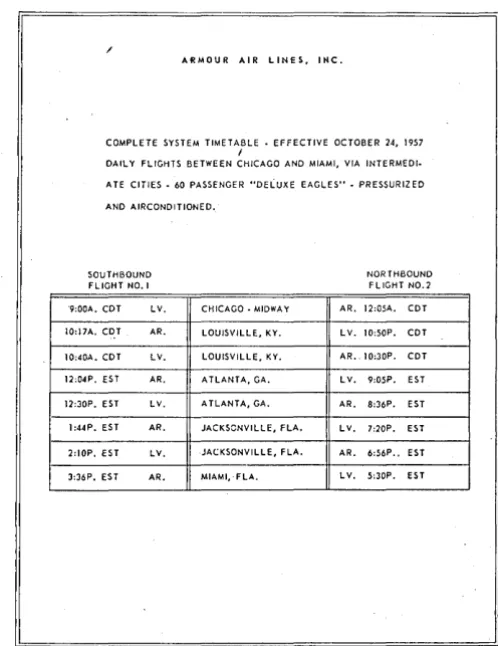
Figure 1 represents the complete system time-table published by "Armour Air Lines." Notice some of the facts obtainable from thIS publication. (1) The operation of an aircraft from one end of the route to the other is named a "flight."
(2) Each flight is identified by a distinctive number.
(3) The same operational pattern is repeated day;a.fter day.
-(4) The seating capacity of the aircraft is 60 passengers.
(5) Each flight operates over four legs-the na1me "leg" being given to portions of a flight be-tween successive take-offs and landings.
As the operation of the air line begins, one quickly learns that customers are not content to come out to the airport on the chance that a seat will be available for them. They prefer, instead, to
From a paper presented at the 4th Computer Applications Symposium, sponsored by Armour Research Foundation of Illinois Institute of Technology, Chicago, October 24-25, 1957.
telephone and have the air line reserve space for them .
To make the case more specific, say that "Ar-mour" agrees to reserve space for Mr. Jones from Chicago to Jacksonville on Flight 1 of October 28. Obviously, it would not be possible to actually go_ out to the airplane and attach a note to one of the seats saying: "Reserved for use of Mr. Jones, etc." In fact, the air line didn't agree to reserve a par-ticular seat for Mr. Jones-they simply agreed to reserve a seat.
Because something is needed to remind the air line of their agreement, a "reservations record" is created. Figure 2 is an example of such a record. Note that it contains various spaces for the pertinent items of info:Dmation.
[image:11.615.315.564.432.755.2]The primary function of this record is to verify
Figure 1. The complete system timetable published by an imaginary air line, "Armour Air lines, Inc."
/
ARMOUR AIR LINES, INC.
COMPLETE SYSTEM TIMETABLE. EFFECTIVE OCTOBER 24, 1957 I
DAILY FLIGHTS BETWEEN CHICAGO AND MIAMI, VIA INTERMEDI.
ATE CITIES. 60 PASSENGER "DELUXE EAGLES"· PRESSURIZED
AND AIRCONDITIONED.
SOUTHBOUND NORTHBOUND FLIGHT NO.1 FLIGHT NO.2
'9:00A. COT LV. CHICAGO· MIDWAY AR. 12:05A. COT
10:17A. COT AR. LOUISVILLE, KY. LV. IO:50P. COT
10:40A. COT LV. LOUISVILLE, KY. AR.,10:30P. COT
12:04P. EST AR. A TLANTA, GA. LV. 9:05P. EST
12:30P. EST LV. ATLANTA, GA. AR. 8:36P. EST
1:44P. EST AR. JACKSONVILLE, FLA. LV. 7:20P. EST
2:IOP. EST LV. JACKSONVILLE, FLA. AR. 6:56P .• EST
3:36P. EST AR. MIAMI,' FLA. LV. S:30P. EST
MSG. TO
T(~~:T~-:~I
FILE~~~ 9:A:ET.l%:::lp:Y.O:D~S:
ARR. IORIG.''I EXt.
..Jli
JONfS
MR.l3H.P./lA07-J/L,~B.P.
C./-6,o¢ol02..","
NAMES REMARKS .
V
Ld-I! J./~v. {! /I J A
V
LA
V
LA
V
LA
~
LACTION BY FL T. DATE PTY.OF DEST, A RQ.-RQRP.- C FMD-CNLD,
SIG/EA. WAS ON TOTAL FARE I FIRMED
FORM T310A NOW OU CNLD. BY AGT. TIME
I d I /O?04-~-;L DATE AGT. TIME DATE
, Figure 2. A "reservations record."
the existence of an agreement with Mr. Jones and the details of that agreement. Closer examination of the record will reveal that no specific seat is men-tioned, such as Seat 3, Row 5-only the quantity of seats involved is recorded.
While "Armour" was busy making a reserva-tion for Jones, other 'agents of the air line in Louis-ville, Atlanta, JacksonLouis-ville, and Miami wer'e also making reservations for Mr. Smith, Mr. Brown, etc. Unless some safeguards a~e established to pre-vent it, there is a very real danger that "Armour" will one day find itself in the position of having agreed to carry 61 passengers, or more, in a 60-passenger airplane. If this occurs, they will have 'caused what is referred to as an "oversale" and
greatly inconvenienced those individuals who were refused passage.
Tool needed to attain three objectives
Fundamentally, the toal which is needed here is same means of coardinating the sales and the
cancellations of the variaus offices so that· three basic abjectives may be attained:
(1) T.o so control sales ,as to render it virtually impossible to' "aversell." ,
(2) To minimize the quantity af space which is "in flow". and, thus, nat available for sale.'
(3) To supply the company agents with an immediate and complete knawledge of what space is available for sale so that all patential custamers may be "signed up" without delay.
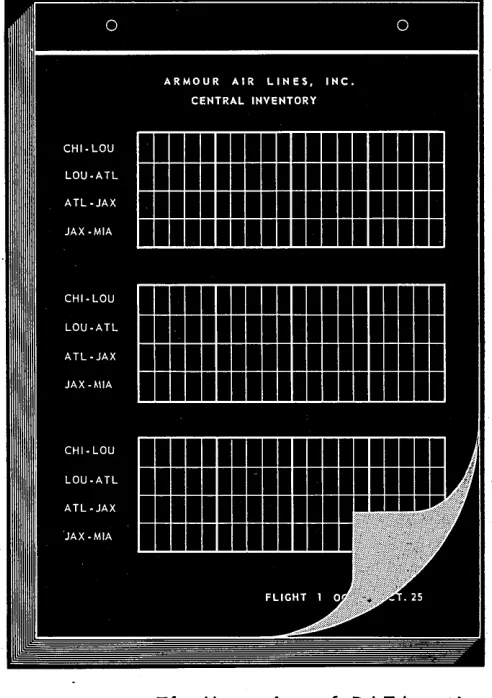
These three abjectives p.oint to the require-ment for a centralized inventary record which might take the form indicated in Figure 3, a form of ledger with each page cantaining the inventory record for one flight for one day. All records concerning a particular flight number are bound in a single ledger, the consecutive pages in each ledger con-taining the rec.ords for c'ansecutive days.
10
The form cansists of three sets of grids, each grid representing a third of the capacity of the air-plane. Within 'each grid, 20 vertical columns repre-sent 20 seats; four harizontal rows reprerepre-sent the f.our legs of the flight-Chicago to Lauisville, Lauis-ville to Atlanta, etc.
In order that the central inventory may be kept up-ta-date, a set of pracedutes is established whereby each ,telephone sales agent who makes a cammitment to a patential custamer will immedi-ately repart this "sale" to the inventory clerk. Up an
receipt of the information, the inventory clerk will first select the proper ledger, flip the pages until the c.orrect date is 'expased, and then make a simple ,mark in an appropriate spaCe (on one of the grids. As the inventory clerk cantinues to make marks and erase them in accardance with the reports he receives regarding sales and cancellatians, he is doing something mare than being a mere puppet: he is also nating, in a general way, the quantity of space remaining available for sale.
. At s.ome time, when the quantity of space avail-able for sale begins to' appraach zero, the inventory clerk must notify ,all the sales agents to stop selling space on this particular "flight-date" (a particular flight on 'a particular day). Perhaps his "stop sales" order is further qualified; far example, it may only stap sales over theChicaga~Lauisville leg, thus can-tinuing permissian to sell space south of Louisville ..
Figure 3. Centralized inventory ledger with each page containing the inventory record for one flight for one day.
[image:12.612.307.553.413.762.2]The inventory clerk also is called upon to exer-cise a degree of control. Consider the following situation: Flight 1 of November 16, a Friday, three weeks in the future, is becoming bottle-necked at Louisville due to heavy sales over the Louisville-Atlanta leg. This situation is graphically indicated in Figure 4.
Although there are 20 seats available from Chicago ,to Louisville, and the same from Atlanta t,o Miami, .the LouisV1ille to Atlanta leg has only five seats remaining available. From his experience, the inv·entory clerk knows that before the three weeks have elapsed there will be suffident demand for Chicago-Miami travel to warrant his holding the five seats open. .
His ,experience also tells him that if he permits these seats to be 'sold for short-haul travel, the flight will operate witli many empty seats over a subStan-tial portion of the route because there is not suffi~ cient demand for the other short-hauls which would complement the first one.
The inventory clerk (now raised to the status of "control agent") issues a qualified "stop-sales" order which prohibits additional short-haul sales over the I Louisville-Atlanta leg, but which permits
long-haul sales which include travel over that leg. As the ~ate of flight approaches, it may become apparent that the long-haul demand will not be as great as anticipated; in this case the control ageI?-t will remove the sales restriction, and he will release
Figure 4. Inventory record for one flight, for one day.
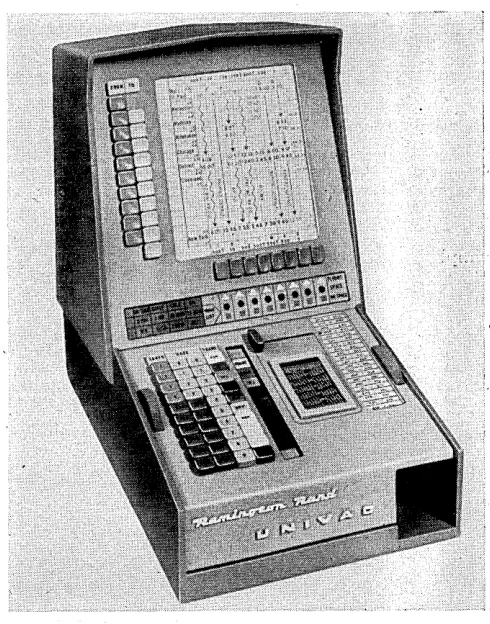
Figure 5. The IIAgent Set," basic input-output device which will be operated by sales agents who will be in direct communication with the computer through this machine.
seats to Louisville for sale to potential customers whose names and telephone numbers have been listed for just such an eventuality.
In the description up to this point, two activities have been taken for granted which cannot be so lightly regarded in real life. The first was the re-quirement that the sales agents report sales and cancellations to the central inventory; the second was the requirement that the control agent at central inventory must sometimes notify all sales agents to stop sales on a certain flight-date ov.er certain legs.
Both of these activities demand very fast com-munications-therefore, very expensive communi-cations-between the sales agents and the control agent if the company is to realiz·e their tl}.ree ob-jectives of preventing oversales, minimizing space "in flow,". and equipping their sales agents with a
full kriowledge.of space availability.
From an imaginary, to a real, air line
Let the reader move now from the imaginary air line to a real air line, and attempt to visualize or to comprehend the degree of complexity which results from multiplication of these simple elements. Instead of having reservations offices in five cities, we have 99 such offices throughout the East-ern half of the United States, including two in Canada, one in Bermuda, one in San Juan, Puerto Rico, and one in Mexico City.
[image:13.612.316.561.31.343.2] [image:13.612.53.303.412.752.2],Instead of two flights. per day, we have' 400 flights per day. Instead of operating 480 "seat-legs" (meaning one seat over one leg of a flight) per day, we operate appr.oximately 80,000 seat-legs per day. Over 100 control agents are entering hundreds of thousands of tally marks per day, and issuing sales restriction messages at the rate of better than one a minute. Availability information must be distributed to 2,OQO sales agents. Hundreds of people are engaged in various communications activities.
The only things which have retained their clear simplicity are the three .objectives: no overs ales, "in flow" space minimized, and full availability.
Univac ~ile-Computer to solve problem
I
Our problem has been stated, I believe, as com-pletely as is practicable. We propose to begin solving this problem through the use. of a medium-size, general purpose, digital computer-the Univac File-' Computer.
Thecompu ter will perform the functions of the control agent. In the magnetic drums of its general , storage' system, there will he contained the equiva-lent of our "central inventory" records. Instead of
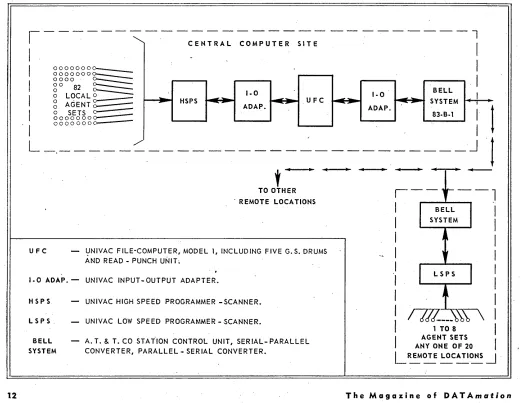
Figure 6. Representation of manner in which various pieces of equipment are interconnected to form
a
completely-integrated data-processing communications network.tally marks, the drums will store digits representing the sum of the marks.
The computer will issue reports to supervisory personnel when the quantity of space remaining reaches a predetermined level. It will rej ect short-haul sales, which would result in inefficient utiliza-tion of space, and will make note of this unsatisfied demand, later reporting to the interested offices the availability .of space to accommodate this demand. The computer will answer thousands of in-quiries per hour regarding the availability of space, handling each such inquiry in less than a second and sometimes as fast as a tenth of a second.
Figure 5 displays a picture of the basic input-output device which will be operated by the sales agents who will be in direct communication with the computer thr.ough this machine which, is called the "Agent Set.'~ The unit pictured is the hand-made, pre-production prototype which was com-pleted three months ago.
In demonstration tests at St. Paul hi August, this set was used to communicate with a Model "0"
File-Computer for querying availability, up-dating ayailability records, asking questions about the arrival time and departure .of flights, and up-dating flight information.'
Operation of the Agent Set is exceedingly simple and substantially fool-proof. By operation' of a knurled wheel, the sales agent will move a film cartridge containing 30 photographic film slides
~---~---l
CENTRAL COMPUTER S I T E '
I
12
I '
, -
,
11
0 0 0 0 0 0 0 0
-1
0 0 0 0 0 0 0 0 - -
I
o 0 0 0
s:--::::::=
go
82 ~ - BELL, 0 L.oCAL 0 ~ _ _ _ 1.0 __ _ 1·0 I
g
AGENT ~ _ ~ HSPS _... ADAP. "... U F C _ ,- - SYSTEM J.+-+--I~, 0 SETS c - - ADAP. 83·B.l
I'
t
0 0 0 0 0 0 0 0
-I oooooooo--~--- 1
L _, ____________________________
J
'1
UFC
,-TO OTHER
. REMOTE LOCATIONS
- I!NIVAC FILE-C.oMPUTER, M.oDEL 1, INCLUDING FIVE G. S. DRUMS AND READ - PUNCH UNIT~
1.0 ADAP. - UNIVAC INPUT - .oUTPUT ADAPTER.
HSPS
LSPS
BELL SYSTEM
- UNIVAC HIGH SPEED PR.oGRAMMER -SCANNER.
- UNIVAC L.oW SPEED PR.oGRAMME'R -SCANNER.
- A. T. & T. C.o STA ll.oN C.oNTR.oL UNIT, SERIAL- PARALLEL C.oNVERTER, PARALLEL - SER IAL C.oNVERTER.
~~-I--"'~--l
I,
I
BELLI
"ISYSTEM
[image:14.612.42.563.369.772.2],
until the desired slide is in position. Continuing the the same hand motion, the agent will operate a lever which turns on a projection lamp and moves the desired slide into the light beam.
The projected, image appears as an air line timetable on the viewing screen' on the upper por- . tion of the set. In another application, the projected . image might contain any of an almost-unlimited number of representations, such as personal signa-tures, images of people, description of machine parts, clothing, groceries, fingerprints.
The projected image is flanked on the left and at the bottom by rows of buttons. In our system, these will be used to select origin and destination of desired travel and, if required, the specific flight intended. On the lower panel, the various keys will
be used to select the month, day of the month, number of seats, and the type of transaction. .
Agent Set to perform following activities:
The sales agent will use the Agent Set to per-form the following activities:
(1) To determine availability of space on as many as eight distinct flights at a time. The number of flight legs involved on any of the. eight flights does not reduce the number of flights for which replies will be received.
(2) To sell space and cancel space, causing the immediate adjustment of the inventory, immediate signal to the agent that the transaction has been completed,and ~utomatical1y initiating the auto-matic preparation of any supervisory reports which are to be prepared if this adjustment should cause the inventory to pass a marked boundary.
(3) To add to and subtract from an "auxiliary central' inventory which records the quantity of unsatisfied demand for travel. .
(4) To determine the current operating status of today's flights in relation to the published sched-' ule. Instantaneous replies will indicate whether a flight is on time, early, late, or cancelled, and when . appropriate. the amount of time and the reason for'
the departure from published schedule.
The Agent Set has been designed to cooperate with an accessory device, now under development, which would cause an electrical interlock and a data interlock between the individual reservations record and the transaction which adjusts inventory. W'e look for the addition of this accessory about 1960. Protective devices in the Agent Set and its associated equipment, as well as in the computer program, provide saf.eguards against operator error and equipment error.
Figure 6 is a'representation of the manner in which the various pieces of equipment are inter-connected to form a completely-integrated, data-processing, communications network.
The box labelled UFC is the Model 1 Univac FHe-Computer which is really housed in several ,cabinets. Our system will use five magnetic drums in the general storage section with a storage capacity for 900,000 alpha-numeric characters. A read-punch uni t will be used to process punched cards for the preparation of future inventory and the shared-time
processing of statistical and management reports. The box labelled HSPS represents three devices called High Speed Programmer-Scanner which link the local Agent Sets to the I-a Adapter and thence to the computer.
To the right, various other boxes show the linkage to the remote locations. Travelling away from the computer, one passes through an I-a Adapter to the data-processing .communications system by way of direct electrical connection.
This is a ten-character-per-second, five-channel code, selective system leased from the A.T.&T. Co.
lt is known .as the "83-B-1 system, modified for use with the Univ·ac FHe-Computer." , . At each of the remote locations, one leaves the Bell System and enters ~ Univac device called the Low-Speed Programmer-Scanner, and from there on into the individual Agent Sets.
System scheduled for service 22 hrs. per day _
The system will be scheduled for service 22 . hours per -day, seven days per week. It will serve approximately 125 Agent Sets including five in Chi- . cago, two in Washington (D.C.), 35 in the various ticket offices in the New York Metropolitan area, and the balance at the central computer location in New York. Service will begin in June 1958.
Expansion is anticipated to a t'otal of nearly 600 Agent Sets distributed among the busier cities on the system 'py 1~59.
567 Hillgrove Avenue, La Grange, Illinois
Circle 3 on Reader Service Card
[image:15.617.317.558.393.752.2]'Datatron 220 marks a . . •
Decisive Breakthrough
-.
Computer Economics
D
espite vaulting technological advances, the eleetronic computer industry has been frus-trated in the past by a major unsolved problem-high cost. "Giant" data processing systems are priced in the millions, requiring that the user ex-tend his payout period over several years or even a decade.Many customers who installed medium-priced computers two and three years ago have outgrown them-yet cannot justify a significantly greater in-vestment than they ·1nade before. Asa result of this economic dilemma, hundreds of business and scientific organizations with a' definite need for automatic data processing have given up their at-tempts to scale the price wall.
Recently, encouraging news both for computer prospects and users came out of Pasadena, Calif. The ElectroData Div. of Burroughs Corp. an-nounced its Datatron 220-~rst .medium-priced digital computing system with full magnetic core memory. Burroughs, world's third largest com-puter producer, claims that the 220 marks a
~'de-Typical layout of new electronic data processing system, includes operator's control console (center) flanked by high-speed paper tape input-output units and, around
per-14
cisive breakthrough in computer economics" by offering for the first time the capabilities
of
large-scale systems at half the price.Now in production, the first Datatron 220's will' be delivered in mid-1958. Average, cost, de-pending upon the magnitude of the system's peripheral equipment, will range from $325,0,00 to $600,000. V.ice ... President James R ... Bradburn commented that ElectrqData expects the Datatron 220 "to accelerate ,the swing to electronic data proc-essing by firms desiring quicker ,cost recovery than has previously been possible."
The new computer joins the Datatron 205 and EIOl computers (of which over 2.00 are installed) in adding momentum to Burroughs' competitive ad-vance in the industry. Much of the system's large- ' scale flexibility is drawn from an exceptional pro .. gramming command structure. A total of 93 com-mands take full advantage of the high-speed core memory and multipiicity of input-output units.
Engineering and logical advances stemming from the proven circuitry of Datatron 205 have
re-imeter of room (from left), Cardatron punch.::card system, magnetic tape system, digital processor, expandable mag-netic core memory unit, and magmag-netic power supply.
The Magazine of. DATAmation
,
•
•
(above) Stacks of core planes are shown in 220's memory cabinet.
(right) Part of Datatron 220's central processor gets check-out from engi-neers at iElectroData.
suIted in greater capabilities. The system combines large-scale' ,computing abilities both for scientific problem-solving-where speed and data manipula-tion are critical-and business data processing, which requires volume capacity for automatic record handling. '
Basic arithmetic speeds are over 300,000 addi-tions or subtracaddi-tions, 30,000 multiplicaaddi-tions, and 15,000 divisions per minute~ Up to 600-million char-acters of information can ,be filed electronically in the system-any record available in seconds for automatic computer processing.
Instrumental in the achievement of large-scale power is the integration into one system of the high-speed core memory, vast magnetic tape storage facilities, large repertoire of programming com-mands, and the full range of input-output "building blocks"-including punched cards, paper tape, supervisory printers, line printers, and keyboards. These subsystem building blocks, together with an expandable memory, permit arrangement of the system to custom-fit any application-whether data reduction, ,equation solving, engineering design, insurance processing, accounting, billing, payroll, inventory control, statistical analysis, management forecasting, etc.
The computer's non-volatile ferromagnetic core memory is the heart of the system. The memory, housed in a separate cabinet from the data proces-sor, is available in units of from 2,000 to 10,,000 computer words (10 digits plus sign), in increments of 1,000. Any record in memory can be locate~ in 10 microseco'nds.
The toroid, or "core," is the memory's basic . element. Its dimensions are 0.080" outside
diame-ter, 0.050" inside diamediame-ter, 0.025" thickness. This diminutive doughnut-shaped magnet provides
stor-I
age space, for the binary information required by Datatron 22,0.
Each of .two memory units contains five groups of 44 planes apiece, with 1,000 computer words per group. tore~ on each plane are interconnected by circuitry which transmits electronic impulses for access and storage. The five groups in each unit make up a miniature skyscraper of planes 22" high, 11" wide, and 7" deep. I
The system's programming design includes 20 branching instructions, to permit a wide variation of conditions under which program control may be changed to new memory locations. Datatron 220 em-ploys floating 'point arithmetic, partial-word opera-tion, built-in index register for tallying and pro-gram modification, and an advance-design console which gives the operator complete control over the full system.
A maximum system consists of the data proces-sor, 10 magnetic 'tape storage units (single-tape units or multiple-tape Datafiles), 10 local or re-mote paper-tape input stations, 10 local or rere-mote typewriter or tape-punch output stations, and 7 punch-card readers, punches, and line printers.
The punched paper tape system provides a ver-satile link between the computer and universal commercial codes. Any of 10 photoreaders, al-lows input of 1,000 alphanumeric characters per second. Output speeds are 60 characters per second by tape punch, or 10 charac,ters per second by supervisory printer from any of 10
stat~ons. A vari~ble n'J,mber 'Of words up to, 100 can be' read at a 'single . command.' An inverse format f.eature permits the automatic transposition of data punched with the sign last. Paper tape code is seven-channel, single-frame alphanumeric design, with a rec'Ording' density ,'Of '10 characters per'inch.
Format control, scaling, editing, and translation between computer 'and data codes are all handled by the input-output subsystems. This design frees the central processor from "housekeeping" operations and allows it to proceed independently on produc-tive work.
Exceptional high-volume file storage is obtained through the ElectroData magnetic tape system. Pro-vided in single-tape reel units or 50-tape Datafiles, the dual-channel tape has a recording density of 208 digits per linear inch for each ,channel.
The tape travel speed, across the reading and writing heads, is 120" per second-enabling infor-mation transfer at the rate of 25,000 digits per sec-Qnd. Records can be of variable length, with many files contained on one tape.
Maximum tape storage capacity, using 10 tape units, is 550-million characters. Reel units have a capacity, of nearly a million words, and the Data-file bins can store 5-million words each. There are two means of tape searching. ,In bi-directional search, the first word of a tape record serves as the sorting key for conventional file maintenance. In uni-directional scanning, anyone of the firsJ 110 digits of a record can be recognized-permitting cross-filing within the established record framework. The CardatrQn input-output system used with Datatron 220 allows simultaneous, buffered opera-tion of up to seven card readers, punches, and print-ers with the computer. By "splitting" the com-puter's D Register for information exchange be-tween the computer and Cardatron units" transfer is extremely fast-up to 28 words of information in 10 milliseconds.
Datatron 220 is the latest in a series of engi-neering "firsts" by'Ele6troData. Its Cardatron input-output system, introduced last year, made possible for the first time the manipulation of punch-cards rapidly enough to take full advantage of the com-puter's speed.
The Datafile multiple magnetic tape system, also announced in 1956, created a new dimension in electronic filing-placing hundreds of millions of
Assembling a section of the 220's memory circuitry.
16
facts on instant computer call. Use of multiple tapes produced far greater file flexibility than was previ-ously attainable with this medium.
The ElectroData Div. of Burroughs Corp. shipped its first computer system in June of 1954. The firm currently produces one Datatr~n system every 5 days at its 250,000-sq. ft. Pasadena plant. Employing some 1,800 persons, ElectroData main-tains sales and service offices in 20 metropolitan centers through. the U.s. and Canada. Burroughs Corp. recently purchased 160 acres in Santa Ana, Calif., for further expansion of the Division.
Circle 103 on Reader Service Card
R-W
develops new
airborne computer
T
he,Ramo-Wooldridge Corp., Los Angeles, Ca~f., has announced that its Computer Systems dlv. has developed a new digital ,airborne computer that is designed to provide a light-weight, compact com-puting-control center for high-performance military aircraft.The completely...,transistorized device, designated the RW-30, employs specially-designed digital com-puting techniques, and will perform all computations for navig.ation, fire control, bombing ,and weapons control with the speed demanded by modern weapon systems.
The RW-30' was designed and buHt by Ramo-Wooldridge Computer Systems div. in a program undertaken in late 1954 under a development con-tract with the Air Arm div.of Westinghouse Elec-tric Corp. at Baltimore.
Objective of this, program, just completed, was to develop a system which would perform reliably in an environment of planned future military air-craft-one which possesses a high degree of flexibil-tiy, and minimize size, weight, and power consump-tion.
The new control computer combines computa-tion speed with reduccomputa-tion in size, weight, and power consumption. The complete computer has a volume of 4.19 cubic feet and weighs only 203 pounds. It ,consists of four separately-packaged units:
mag-netic drum storage unit, arithmetic and control unit, input-output unit, and clock. generator and power supply unit.
Subminiaturized packaging techniques and sil-icon semsil-iconductor circuitry are used throughout. Described as the fastest airborne magnetic drum computer in oper,ation today, the RW -30 can con-duct .4,000 complete arithmetic 'Operations pe'r sec-ond, including access time, and requires only 400 watts of power, permitting a significant saving in aircraft auxiliary power equipment.
Circle 104 on Reader Service Card
The Magazine of DATAmation
,
,
,
•
BOOK
REVIEWS
Office Automation (3rd Edition), and Updating Service, by R. Hunt Brown, Automation Con-sultants, Inc., 155 Fifth Ave., New York City 10" 500
+ .
pp., illus., $37.50 ea."Office Automation," an important time saver . for users or potential users of automated office ma-- chines and systems, is a classified handbook that
clearly describes (1) what every known automated machine will accomplish, (2) where it is most valu-able, (3) why it was developed, (4) how it operates, (5) who manufactures it, and (6) the price.
Compiled in loose-leaf form, it allows for re-visions and additional infonnation provided by its companion, "Updating Service," which: consists of monthly supplements with up-to-date pages describ-ing and illustratdescrib-ing new equipment and systems. Yearly subscriptions to the latter total a minimum of 200 supplementary or revised pages.
b r
-Company Investigations of Automatic Data Proc-essing, by Peter Laubach, 1957, Harvard University,
School of Business Administration, Boston 63, Mass., paperbound, $,3.00.
This book reports the results of one of a series of studies conducted as' part of the data-processing research project of the Harvard Business School. This project was started in 1954 and will continue indefinitely. It is concerned with data-processing . systems used by business organizations, with the management use of information flowing out of these systems, and with automatic equipment developed for use in these systems.
Mr. Laubach's study is a report of what busi-nessmen are doing. It is . limited to a discussion of the approaches taken by various companies in in-vestigating their data-processing needs to determine what, if any, automatic equipment should be ac-quired. Analogous administrative problems might arise in connection with installing new' equipment and new systems and in their operation .
....:...br-Notes on Analog-Digital Conversion Techniques, prepared by staff members of the M.I.T. Servo-mechanisms Laboratory, edited by Alfred K. Suss-kind, .1957, The Technology Press of Massachusetts Institute of Technology, 40 Mass. Ave., Ca1mbridge 39, Mass., 417 pp., illus., bibliographical references, $10.00.
This book is developed from an informal set of notes prepared in 1956 for the first M.LT. Special
Summer Program on Analog-Digital Conversion Techniques, a program which attracted considerable attention outside the Institute. This year's edition, completely rewritten and expanded for the 1957 Summer Program, has been formally published by The Technology Press in order to make it more generally available.
Designed for the practicing engineer, this book provides the necessary background for readers who do not have previous experience in the field. It in-cludes: an introduction to the theory of sampling, quantizing, and coding; detailed analysis and evalua-tion of basic coding and decoding methods for elec-trical and mechanical analog quantities; and a case study showing how basic principles were applied in a digital flight-test instrumentation system.
b r
-Dynamic System Studies (Part 5):, AnalogCompu-tation, by F. W. Brattan, Naval Ordnance Labora-tory for Wright Air Development Center, U.S. Air Force, Sept. 1956 (Order PB-121578 from OTS, U.S. Dept. of Commerce, Washington 25, D.C.), 78 pp.,
$2.00. . .
This report describes recently-developed (to 1956) analog computer components and systems and their characteristics. General purpose computers are considered, and future developments in the systems and their components are anticipated. Sections also cover commercially-availClible analog computing equipment, operating characteristics of the' Reeves analog equipment, measurement techniques, and analysis of an operational amplifier.
b r
-Dynamic System Studies (Part 6): Operation &
Maintenance Procedures for Analog Computers, by W. R. Allen, University of Chicago for Wright Air Development Center, U.S. Air Force (Order PB-121792, from OTS, U.S. Dept. of Commerce, Wash-. ington 25, D.C.), 126 pp., $3.25.
This volume contains" a detailed discussion of analog computers, from basic philosophy of the de-vices to their final useful application. The report is primarily concerned with the electronic differen-,tial analyzer. Information is provided for setting up problems, checking problem setups or solutions, analyzing computer solutions, examining the operat-ing staff, and decidi,ng on maintenance procedure~ Appendices discuss special computer techniques, a mathematical model useful in setting up spare parts inventories, and fast-time computers.