© 2019, IRJET | Impact Factor value: 7.211 | ISO 9001:2008 Certified Journal
| Page 5804
AN EXPERIMENTAL STUDY ON FLEXURAL STRENGTH OF BUBBLE
DECK SLAB
ASHNA THOMAS
1, FEBEENA K K
2, JAHFAR P A
3, ANNA BABY
41,2,3
B.TECH Student, Department of Engineering, ILM College of Engineering and Technology, Kerala, India
4M.TECH, Assistant Professor, ILM College of Engineering and Technology, Kerala, India
---***---Abstract –
Concrete plays a major role in theconstruction field. The usage of concrete is high in slab construction. It leads to loss of concrete because the load transfers from the structure only on the column portion not throughout the slab. As the volume of concrete decreases, the material cost reduces which decreases the labour cost, which in turn minimize the construction cost. So, the aim was to reduce the concrete in centre of the slab by using recycled balls. Plastic hollow spheres balls replace the in-effective concrete in the centre of the slab, thus decreasing the dead weight and increasing the efficiency of the floor this new technology is called Bubble deck slab. Hollow sphere ball is made up of recycled plastic.
The stress and deformation results were observed and compare the bubble deck slab with conventional slab. This project focused on material optimization by introducing hollow HDPE balls in RC slabs. For this, 4 slabs of size 600x300x120 mm is casted with one conventional slab and 3 slabs with hollow HDPE balls of diameter 60mm at various spacings. M20 grade concrete with Fe415 grade steel is to be used. The slab samples will be finally tested after 28 days for flexural strength, under gradually increasing single point loading. By using cheap and light material sustainability can be achieved.
Key Words: RCC Slab, HDPE balls, Reinforcement mesh, Flexural strength test.
1.0 INTRODUCTION
When designing a reinforced concrete structure, a primary design limitation is the span of the slab between columns. Designing large spans between columns often requires the use of support beams and/or very thick slabs, thereby increasing the weight of the structure by requiring the use of large amounts of concrete. Heavier structures are less desirable than lighter structures in seismically active regions because a larger dead load for a building increases the magnitude of inertia forces, thus the structure must resist larger dead load and it contributes to higher seismic weight.
A new solution to reduce the weight of concrete structures and increase the spans of two-way reinforced concrete slab systems was developed in the 1990s in Europe and is gaining popularity and acceptance worldwide. Bubble deck or plastic voided slabs provide similar load carrying
capacity to traditional flat plate concrete slabs but weigh significantly less. This weight reduction creates many benefits that should be considered by engineers in determining the structural system of the building.
Plastic voided slabs remove concrete from non-critical areas and replace the removed concrete with hollow plastic void formers.
Bubble deck can achieve larger spans as compared to a site cast concrete structure without the need for post-tensioning or pre-stressed sections. The total construction time for the structure was reduced.
2.0 OBJECTIVES
To cast conventional slab and 3 bubble deck slab with varying spacing between hollow HDPE ball.
To find out the load carrying capacity of Bubble Deck Slab.
To study the flexural strength of Bubble Deck Slab.
To compare the strength characteristics of bubble deck slabs and conventional slab.
To estimate the amount of concrete saved by using bubble deck slab.
3.0 MATERIALS USED
3.1 Cement
Ordinary Portland cement is the cement used for normal construction. It has adhesive and cohesive properties so that it forms a good bond with other materials. It solidifies when mix water. It is the most active binding medium. Here 43 grade cement is used.
Table -1: physical properties of 43 grade cement
Tests Results
Specific gravity 3.14
Standard consistency 30 %
Initial setting time 30 min
© 2019, IRJET | Impact Factor value: 7.211 | ISO 9001:2008 Certified Journal
| Page 5805
3.2 Steel [image:2.595.44.280.178.327.2]The main purpose of inclusion of steel is to resist tensile stress in particular regions of the concrete that may cause structural failure or cracking. The steel reinforcement is of GradeFe415strength.
Fig.1: Arrangement of balls and reinforcement
3.3 Plastic spheres
The hollow spheres are made from recycled High Density Poly Ethylene (HDPE) or Poly propylene. Hollow plastic balls of 6 mm dia is used in this experiment.
3.4 Fine Aggregate
Fine aggregates are materials less than 4.75mm. M sand confirming to IS 383 - 1970 collected from local sources was used as fine aggregate.
Table -2: Physical properties of Fine aggregate
Tests Results
Specific gravity 2.6
Fineness modulus 3.04
3.5 Coarse Aggregate
[image:2.595.307.566.467.755.2]According to IS 383-1970 coarse aggregate of maximum 20mm size is suitable for concrete work. Aggregate of size of 20 mm confirming to IS 383 – 1970 and collected from local sources was used.
Table -3: Physical properties of Coarse aggregate
Tests Results
Specific gravity 2.63
Fineness modulus 3.24
3.6 Water
Water is an important ingredient of concrete, because hydration takes place only in the presence of water. The
water, which is used for making concrete, should be clean and free from harmful impurities such as oil, alkali, acid etc. In general the potable water is considered satisfactory.
4.0 METHODOLOGY
The various works done are given below: 1. M20 grade concrete is selected 2. Carryout mix design of M20 concrete
3. Conventional slab and slabs with varying numbers of hollow balls are casted.
4. Using Universal testing machine (UTM) single point load test is conducted.
5. Result analysis of conventional slab and bubble deck slabs.
5.0
TEST RESULTS AND DISCUSSIONS
5.1 Discussion on Load Carrying Capacity
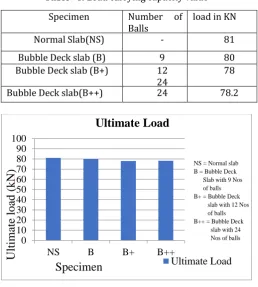
The load carrying capacity of the conventional slab and bubble deck slabs with varying number of HDPE balls is found out by conducting flexural strength test using Universal testing machine (UTM) apparatus. It is found that the load carrying capacity of the bubble deck slabs are in same range that of conventional slab.
Table -4: Load carrying capacity value
Fig.2: Ultimate Load Variation Graph
0 10 20 30 40 50 60 70 80 90 100
NS B B+ B++
Ulti
mate
load (
kN
)
Specimen
Ultimate Load
Ultimate Load
NS = Normal slab B = Bubble Deck Slab with 9 Nos of balls B+ = Bubble Deck slab with 12 Nos of balls B++ = Bubble Deck slab with 24 Nos of balls
Specimen Number of
Balls load in KN
Normal Slab(NS) - 81
Bubble Deck slab (B) 9 80
Bubble Deck slab (B+) 12
24 78
[image:2.595.35.285.667.715.2]© 2019, IRJET | Impact Factor value: 7.211 | ISO 9001:2008 Certified Journal
| Page 5806
5.2 Discussion on
Load vs. Deflection
Table -5: Load deflection test results
Load
kN Deflection (mm)
Normal
slab Bubble deck slab with 9 no’s of balls
Bubble deck slab with 12 no’s of balls
Bubble deck slab with 24 no’s of balls
5 0.205 0.485 0.26 0.37
10 0.20 0.58 0.45 0.735
15 0.19 0.805 0.60 1.007
20 0.16 1.01 0.785 1.305
25 0.88 1.275 1.06 1.3025
30 1.10 1.50 1.285 1.81
35 1.345 1.68 1.53 2.0325
40 1.685 1.87 1.72 2.265
45 1.82 2.075 1.95 2.475
50 2.05 2.305 2.145 2.695
55 2.50 2.53 2.385 2.95
60 3.09 2.74 4.23 3.375
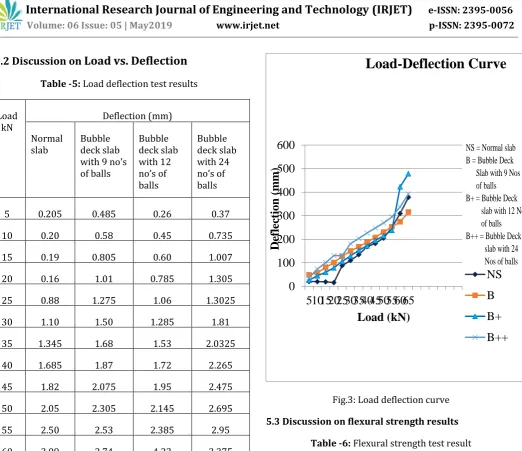
[image:3.595.42.565.46.497.2]The Load deflection analysis helps to analyse the behavious of slabs subjecting to 3 point loading. The load values and corresponding deflection values of conventional slab and bubble deck slabs are shown in table 5.
[image:3.595.295.564.49.445.2]The variation of load and deflection is shown in the fig 2.
Fig.3: Load deflection curve 5.3 Discussion on flexural strength results
Table -6: Flexural strength test result
Flexural strength is measure of the tensile strength of concrete. It is the ability of structural member to resist against bending. The flexural strength of conventional and bubble deck slabs calculated are given in table 6. Results shows that flexural strength of normal slabs and bubble deck slabs with varying number of balls are in same range.
0
100
200
300
400
500
600
5101520253035404550556065
De
flec
tion (m
m
)
Load (kN)
Load-Deflection Curve
NS
B
B+
B++
NS = Normal slab B = Bubble Deck Slab with 9 Nos of balls
B+ = Bubble Deck slab with 12 Nos of balls B++ = Bubble Deck slab with 24 Nos of balls
Specimen Ultimate load
in KN Strength in Flexural N/mm2
Normal Slab(NS) 81 14.06
Bubble deck slab with
9 nos of balls 80 13.88
Bubble deck slab with
12 nos of balls 78 13.54
Bubble deck slab with
[image:3.595.28.296.134.506.2]© 2019, IRJET | Impact Factor value: 7.211 | ISO 9001:2008 Certified Journal
| Page 5807
5.4 Discussion on Crack PatternLoading of slabs are carried by univeral testing machine. As the loading progress cracks are developed on the slabs when the loading reaches the rupture strength of the concrete. As the loading increases intensity of cracking also increases. The crack patterns developed on all slabs are identified. Crack patterns of conventional slab and that of bubble deck slabs are shown in fig 3.
Fig.4: Cracks developed in conventional slab
Fig.5: Cracks developed in bubble deck slab with 9 Nos balls
Fig.6: Cracks developed in bubble deck slab with 12 numbers of balls
Fig.7: Cracks developed in bubble deck slab with 24 numbers of balls
5.5 Concrete saving and self weight reduction
If we consider the slab in this study, the dimensions are of length = 60cm, breadth = 30cm and depth = 12cm with balls having 3 cm radius. By calculating the volume, we can know the percentage reduction in concrete volume. Volume of slab,
V1= l x b x h= 0.60x0.30x0.12= 0.0216 m3
Volume of the ball,
V2= = = 0.0001131 m3
% reduction in concrete for bubble deck slab with 9 numbers of balls = [(V2)/ (V1)] x 100
= [(0.000113x 9)/0.0216] x 100 =4.712 %
% reduction in concrete for bubble deck slab with 12 numbers of balls = [(V2)/ (V1)] x 100
= [(0.00013x 12)/0.0216] x 100 =7.22 % % reduction in concrete for bubble deck slab with 24 numbers of balls= [(V2)/ (V1)] x 100
= [(0.00013x 24)/0.0216] x 100= 14.44%
Since we have assumed a small slab, the percentage reduction is also small. When we assume this for a larger section, the percentage reduction will be larger.
Dead load shall include weight of all structural and architectural components which are permanent in nature. It includes self-weight of the structure. The unit weight of concrete is 25kN/m3. If we can reduce the volume of
concrete then the self-weight of the slab also get reduced. Weight of 1m3 concrete = 2400kg
Considering slab of dimensions: length= 0.60 m; Breadth = 0.30m; depth= 0.12m
Volume of slab, V1 = l × b × h= 0.60x0.30x0.12= 0.0216m3
Weight of slab, W1 = 2500x0.0216= 54kg
Considering HDPE hollow ball of radius 3 cm. Volume of 9 balls,
V2 = 9 x = 9 x = 0.001017m3.
© 2019, IRJET | Impact Factor value: 7.211 | ISO 9001:2008 Certified Journal
| Page 5808
Weight of hollow slabs =W1-W2 = 54-2.54= 51.46 kgVolume of 12 balls,
V2= = = 0.00135m3.
Weight of concrete saved, W2 = 0.00135x 2500 = 3.3925
kg
Weight of hollow slabs=W1-W2 = 54- 3.392= 50.61 kg
Volume of 24 balls,
V2= = 24 × = 0.00271 m3.
Weight of concrete saved, W2 = 0.00271x 2500 = 6.78kg
Weight of hollow slab=W1-W2 = 54-6.78= 47.22kg
Since we have assumed a small slab, the self-weight reduction is also small. When we assume this for a larger section, the weight reduction will be larger.
6.0 CONCLUSIONS
From this study it was evident that though the bubble deck slabs were efficient as the conventional slab, (having similar load bearing capacity), they are very much satisfactory in slab construction considering the negligible difference in load bearing capacity between them and the conventional. It is however interesting to note a weight reduction in the bubble deck slabs compared to the conventional slab which is an added advantage for the bubble deck slabs especially in structures where load is an issue.
1. The Bubble Deck configuration gives comparatively similar flexural capacity comparing to that of conventional slab.
2. The Bubble Deck slab reduces amount of concrete with the same reinforcement as used in the solid slab, realizing an average reduction of 4.712 % concrete mass in bubble deck slab with 9 numbers of balls, an average reduction of 7.22 % concrete mass in bubble deck slab with 12 numbers of balls, an average reduction of 14.44 % concrete mass in bubble deck slab with 24 numbers of balls on comparing with conventional slab.
3. Advantage of Bubble Deck system is the significant selfweight reduction. The weight of concrete saved for Bubble Deck slabs with 9 number of balls, 12 numbers of balls and 24 numbers of balls are 2.54 kg, 3.3925 kg and 6.78 kg respectively, which intern leads to less foundation costs and which allow to creating foundation sizes smaller. 4. Concrete usage is reduced as 1 kg of recycled plastic replaces 100 kg of concrete. This avoids the cement
production and allows reduction in global CO2 emissions.
Hence this technology is environmentally green and sustainable.
REFERENCES
1. K.R.Dheepan et.al,(2017),“Experimental Study on Bubble Deck Slab using Polypropylene balls”,International Journal of Engineering Development and Research, Volume 5, Issue 4, pp.716-721.
2. Mr.MuhammadShafiq Mushfiq
et.al,(2017),“Experimental study on bubble deck slab”,
International Research Journal of Engineering and Technology (IRJET),Vol. 4, Issue 5, pp.1000-1004.
3. P.PrabhuTeja et.al, (2012),“Structural Behavior of Bubble Deck Slab”, IEEE-International Conference On Advances In Engineering, Science And Management
,pp.383-388.
4. Neeraj Tiwari et.al, (2016),“Structural Behaviour of Bubble Deck Slabs and Its Application: Main Paper”,
InternationalJournal for Scientific Research &Development, Vol. 4, Issue 02,pp.433-437.
5. RittikBhowmik et.al,(2017),“Review on bubble deck with spherical hollow balls”,International Journal of Civil Engineering and Technology (IJCIET),Vol. 8, Issue 8, pp. 979–987.
6. Sameer Ali et.al,(2017),“Behavioral Analysis of Conventional Slab and Bubble Deck Slab under various Support and Loading Conditions using ANSYS Workbench 14.0: Review Paper”, IJSRD - International Journal for Scientific Research & Development, Vol. 5, Issue 03,pp.1357-1362.
7. M.Surendar et.al,(2016),“Numerical and Experimental Study on Bubble Deck Slab”,International Journal of Engineering Science andComputing ,Vol. 6 Issue 5,pp. 5959-5962.
8.Shivani Mirajkar et.al,(2017),Conducteda“Study of bubble deck slab”,International Journal of Research In Science &Engineering,issue 7,pp.1-5.
9. Mr. DevyanshuJain et.al,(2017),“Study on a comparative study of bubble deck slab and conventional deck slab”, International Journal of advanced technology in science and engineering,vol. 5, issue 3,pp.563-571.
© 2019, IRJET | Impact Factor value: 7.211 | ISO 9001:2008 Certified Journal
| Page 5809
11. Er.Immanuel Joseph Chacko et.al,(2016),“Study onStructural Behaviour of Bubble Deck Slab using Indian Standards”,International Journal Of Innovative Research In Technology, vol. 3,issue 4,pp.193-199.
12. Devang M. Sarvaiya et.al,(2017), “Experimental study on spherical voided slab”,Journal of Emerging Technologies and Innovative Research, vol. 4,issue 4,pp.226-230.
13. Nagashree B et.al,(2017),“Experimental Studies on Comparison of Conventional Slab and Bubble Deck Slab Based on Strength”, International Journal for Scientific Research &Development,vol. 5,issue 3,pp.1160-1163. 14. M. Bindea et.al, (2015), “Numerical analysis of flat slabs with spherical voids subjected to shear force”,
Journal Of Applied Engineering Sciences, vol. 5,issue 1,pp.7-13.
15. SnehalKitture et.al, (2017), “ExperimentalStudy on Voided Biaxial Slab and its application”, International Journal of Trend in Scientific Research and Development, vol. 2, issue 1, pp.1224-1228.
16. Gore Mahesh Popat et.al, (2018), “a review on reinforced concrete voided slab”,8th National Conference
on Emerging trends in Engineering and Technology, pp. 159-164.
17. David A. Fanella et.al,(2017), “Flat Plate-VoidedConcrete Slab Systems: Design, Serviceability, Fire Resistance, and Construction”, The University of Newcastle,pp.1-12.
18. Mike Mota,(2013), “voided two-way flat slabs”,University of Alberta, pp. 1-10.
19.B. Jonaitis et.al(2015), “The analysis of concreting process impacts on the behaviour of residual liners of cast in situ voided slabs”, Archieves of Civil and Mechanical Engineering,pp. 1-10.