Received February 20, 2019, accepted March 11, 2019, date of publication May 1, 2019, date of current version June 11, 2019. Digital Object Identifier 10.1109/ACCESS.2019.2910862
Delay-Aware Accident Detection and
Response System Using Fog Computing
BILAL KHALID DAR1, MUNAM ALI SHAH 1, SAIF UL ISLAM 2, CASTREN MAPLE 3,
SHAFAQ MUSSADIQ4, AND SULEMAN KHAN 5
1Department of Computer Science, COMSATS University Islamabad, Islamabad 45550, Pakistan
2Department of Computer Science, Dr. A. Q. Khan Institute of Computer Science and Information Technology, Rawalpindi 47320, Pakistan 3WMG, University of Warwick, Coventry CV4 7AL, U.K.
4Institute of Information Technology, Kohat University of Science and Technology, Kohat 26000, Pakistan 5School of IT, Monash University Malaysia, Subang Jaya 47500, Malaysia
Corresponding author: Saif Ul Islam ([email protected])
This work was supported in part by the Alan Turing Institute under EPSRC Grant EP/N510129/1.
ABSTRACT Emergencies, by definition, are unpredictable and rapid response is a key requirement in emergency management. Globally, a significant number of deaths occur each year, caused by excessive delays in rescue activities. Vehicles embedded with sophisticated technologies, along with roads equipped with advanced infrastructure, can play a vital role in the timely identification and notification of roadside incidents. However, such infrastructure and technologically-rich vehicles are rarely available in less devel-oped countries. Hence, in such countries, low-cost solutions are required to address the issue. Systems based on the Internet of Things (IoT) have begun to be used to detect and report roadside incidents. The majority of the systems designed for this purpose involve the use of the cloud to compute, manage, and store information. However, the centralization and remoteness of cloud resources can result in an increased delay that raises serious concerns about its feasibility in emergency situations; in life-threatening situations, all delays should be minimized where feasible. To address the problem of latency, fog computing has emerged as a middleware paradigm that brings the cloud-like resources closer to end devices. In light of this, the research proposed here leverages the advantages of sophisticated features of smartphones and fog computing to propose and develop a low-cost and delay-aware accident detection and response system, which we term Emergency Response and Disaster Management System (ERDMS). An Android application is developed that utilizes smartphone sensors for the detection of incidents. When an accident is detected, a plan of action is devised. Initially, a nearby hospital is located using the Global Positioning System (GPS). The emergency department of the hospital is notified about the accident that directs an ambulance to the accident site. In addition, the family contacts of the victim are also informed about the accident. All the required computation is performed on the nearby available fog nodes. Moreover, the proposed scheme is simulated using iFogSim to evaluate and compare the performance using fog nodes and cloud data centers.
INDEX TERMS Accident detection, fog computing, mobile edge computing, cloud computing, Internet of Things, emergency alerts, disaster management system.
I. INTRODUCTION
Preventing death and serious injury from road traffic acci-dents is becoming an increasingly important goal for gov-ernments around the world. The United Nations General Assembly, on 18 April 2018, stated that ‘‘road traffic deaths and injuries remained a major public health and development
The associate editor coordinating the review of this manuscript and approving it for publication was Mohsen Guizani.
problem with broad social and economic consequences’’, adopting a draft resolution entitled ‘‘Improving global road safety’’. The supporting document recommends Member States ‘‘address road safety holistically; implement a good road safety management system’’ among other initiatives. The provision of timely aid to victims involved in accidents is a key requirement to help minimizing the impact of vehicular accidents. To this end, devising appropriate notification and response is crucial to saving human life. Numerous statistics
VOLUME 7, 2019
2169-35362019 IEEE. Translations and content mining are permitted for academic research only.
FIGURE 1. ERDMS system flow.
indicate that the number of traffic accidents is increasing every year. According to the World Health Organization (WHO) Road Traffic Facts, 1.24 million road accidents occur around the world. According to the statistics, 50% of the acci-dents globally result in fatalities, and 80% of the world traffic deaths occur in middle-income countries [2]. In Pakistan, for example, 15 people lose their life each day to such accidents, on average. Recent information released by the Pakistan Bureau of Statistics shows that of 9,582 accidents over a year (2016-2017), 4,036 (or 55% of the total) have resulted in death [4]. With such fatality rates, it is paramount that road safety is improved, and appropriate strategies and systems are developed, particularly in developing countries. The Internet of Things (IoT) offers promise to address these issues through the development of emerging low-cost intelligent traffic man-agement systems [28].
In a significant number of vehicular accident scenarios, the victims are unable to call for assistance. In such situa-tions, a plan of action is required which includes informing relevant authorities and rapid provision of medical assistance to the victims. Traditionally, such decisions are made by the human which causes unnecessary delays. The delay in communicating emergency information to the emergency ser-vices can increase the possibility of fatalities following a road traffic accident. This requirement has led to many modern vehicles being equipped with built-in emergency response systems to detect accidents and create appropriate notifica-tions. Such technology has not only become a real option around the world, but from April 2018, the automatic emer-gency call system, eCall, is a legally required to be installed in all new cars receiving type approval in the European Union (EU) - regardless of manufacturer, model or price cate-gory. Whilst such regulatory advances will help address fatal-ities from accidents involving new vehicles, these will form a small proportion of vehicles involved in accidents glob-ally, especiglob-ally, accidents in developing countries. A chal-lenge remains how to address the rapid response to accidents involving older vehicles, and in those countries where the installation of such systems is not mandated. Moreover, it is also very complicated to install advanced systems in older vehicles [5].
In this context, technology, especially, that delivered through advances in the IoT can play a significant role. Effec-tive emergency detection and response systems can play a critical role in reducing the loss of life following a road traffic accident. For this reason, there is a growing body of research proposing solutions to challenges arising in emergency sit-uations. Cloud-based accident detection systems are being proposed which utilize cloud resources for the processing, storage, and transmission of data. However, latency remains a major issue of many of the proposed solutions [6], [33]. Some researchers have proposed the use of external sensors, for instance, temperature and humidity sensors, to detect any abnormality and infer information regarding accidents [7]. While many of the systems are extremely useful, the cost of installing such systems can be very high due to the use of these expensive sensors, thereby, making the system inacces-sible to low-income users [8].
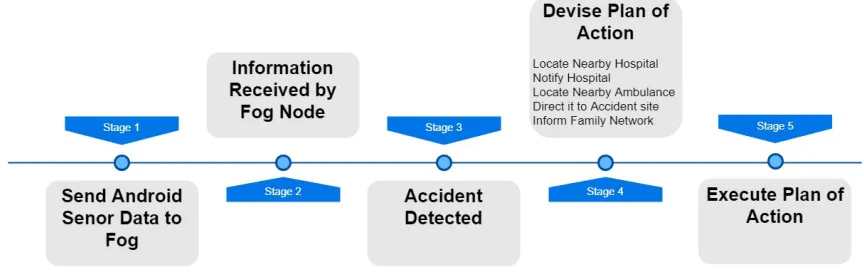
To address the above-mentioned problems, we propose a fog-based delay-aware accident management system (we call it ERDMS). The proposed system aims to decrease response and rescue time. The architecture of the system is based on that presented in [9]. The overall system cost is reduced by using the built-in sensors of a smartphone to detect an accident. A smartphone application is developed that gathers the required data using smartphone sensors. The location information is collected using GPS. The acquired data is sent to the nearest fog nodes for further processing as necessary. If an accident is identified, then a nearby hospital is located, and a plan of the accident is devised to provide immediate assistance to the victims of the accident. The system flow of the ERDMS is shown in Figure1.
FIGURE 2. System architecture of ERDMS.
II. LITERATURE REVIEW
Disasters can be either natural or manmade, and in both cases, one of the most important factors in reducing loss of life is the time taken for response. There is a plethora of research devoted to addressing this problem, given the severity of the issue, including developments in emergency predictive sys-tems [10] and road safety syssys-tems [11]. Recent research in the area includes smartphone-based disaster management system [8], [12]–[25], cloud-based accident detection and disaster management system [1], [7], [25]–[27] and also fog based disaster management systems [6], [10], [26], [29]–[32].
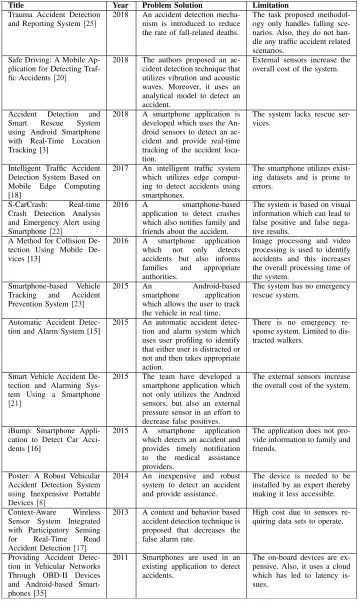
Cloud-based accident detection and disaster management system can face challenges concerning latency and bandwidth given the centralized nature of the service. An emerging concept that can help address these issues is fog computing, which offers the promise of lower latency, mobility support, increased resilience and scalability. Furthermore, by utiliz-ing smartphone sensors, emergency detection and manage-ment systems can be more affordable and easy to deploy in legacy vehicles. A comparison of the research advances in smartphone-based accident detection and response sys-tems is provided in Table 1 that presents brief details of the proposed solutions, along with limitations of the system. The papers are sorted by year of publication, in descending order.
III. PROPOSED METHODOLOGY
This section presents the methodology of the proposed sys-tem (ERDMS). It is a fog-based syssys-tem which leverages the advantages of fog computing to reduce the overall system
latency. To minimize the cost of the solution, it utilizes the sensors readily available in a modern smartphone to detect an accident and process data, thereby replacing the need for an on-board processing unit and external sensors and reducing system cost. The data gathered from the smartphone sensors is sent to the fog servers.
A. ARCHITECTURE OF THE PROPOSED SYSTEM
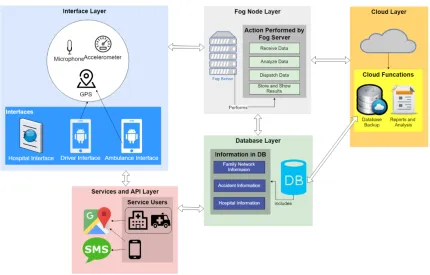
The proposed system is composed of five different layers as presented in Figure 2. The first layer contains the interface and devices. The second layer consists of fog nodes. The next layer holds the database, while the fourth layer is dedicated to the services; finally, the cloud resources are made available at the last layer. The data is collected through the use of smartphones, and an Android interface is provided for drivers of vehicles and ambulances; a web interface is developed for the hospital.
B. SYSTEM IMPLEMENTATION
The proposed system is divided into two major phases -accident detection and emergency response and notification. The details of both phases are as follows:
1) ACCIDENT DETECTION PHASE
TABLE 1. State-of-the-art smartphone-based disaster management systems.
the Gravitational force (a G-Force value) is calculated. Using previous research [34] an accident can be identified if this value is greater than 4. However, using this value in isolation
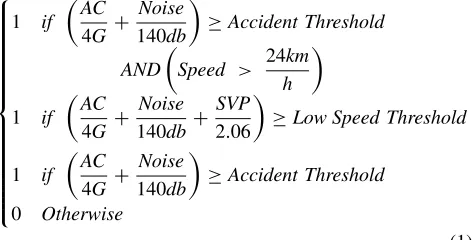
2.06, the vehicle is considered in an accident state. To further enhance the reliability of ERDMS, the microphone is also used to identify an anomalous acoustic event. A value exceed-ing 14dB is considered as the threshold of the sound. While a microphone itself cannot be considered as the primary sensor in accident detection, it can be used as a secondary filter to enhance the reliability of the overall process. The calculations used to determine the identification of an accident scenario are demonstrated in Eq. 1.
1 if AC 4G +
Noise 140db
≥Accident Threshold
AND
Speed > 24km h
1 if AC
4G + Noise 140db+
SVP 2.06
≥Low Speed Threshold
1 if AC
4G + Noise 140db
≥Accident Threshold
0 Otherwise
(1)
where
• AC: Smartphone Acceleration
• Noise: Sound value in dB determined by smartphone
• SVP: Speed variation period
• Speed: Speed value calculated through G-Force
• Low-speed threshold: threshold to detect accident at low speed which is 1
The process of the detection phase is as follows: The vehicle user starts the application before commencing a jour-ney. Every vehicle is identified through a unique identifica-tion (ID) number. The applicaidentifica-tion continuously monitors the sensor data as acquired. If the value of the accident detection value given in the above equation is greater than or equal to 1, then an accident is deemed to have occurred, and a notifica-tion is generated and presented to the user that is displayed for 10 seconds. If the notification is canceled, a false alarm is recorded and stored in the database. If the alarm is not canceled then the notification phase is initiated.
[image:5.576.41.278.188.308.2]2) EMERGENCY RESPONSE AND NOTIFICATION PHASE Once an accident has been detected, the next step is to devise an appropriate plan of action. This involves obtaining the location of the accident and determining the nearest hospi-tal using the Google Maps Application Program Interface (API). Once the location is identified, a nearby ambulance is informed through a notification sent from the Android device of the victim along with necessary information. Moreover, when a user installs the application, they are requested to pro-vide information about at least two family members or friends which will also be notified in case of an accident event. Hence, when an accident occurs, a Short Message Ser-vice (SMS) is generated and information about the affected person and hospital is shared with the two contacts. Once
TABLE 2.Benefits of ERDMS.
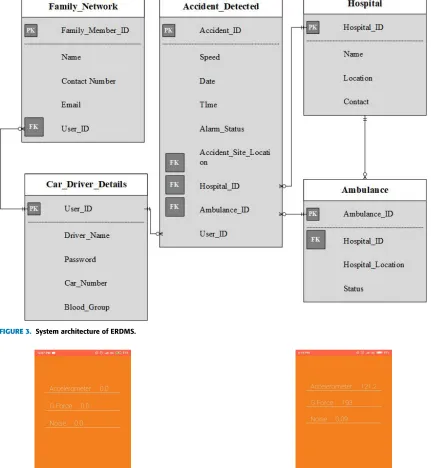
the whole plan of action is executed, the information is saved in a central database. The entity relationship diagram of the system presented in Figure3.
C. ANDROID APPLICATION
The Android application is developed using Android studio and it is compatible with Android Oreo API level 26. When the application is launched, the vehicle user is requested to provide their ID and password. Once the user is logged in, he can start tracking as shown in Figure4. During the tracking, the values are gathered from the Android sensors and sent to the fog server, as shown in Figure5.
Once an accident is detected, a 10-second warning is shown to the user, to identify the case in which this was a false alarm, as presented in Figure6. If the alarm is not cancelled it is determined that an accident has been detected, and the plan of action is executed which includes sending information to the nearest hospital, close contacts and notifying the ambulance. The ambulance notification is shown in Figure7.
The list of activities of the ERDMS application are listed below:
• Launch Activity
• User Activity
• Accident Detection Start and Stop Activity
• Choose Emergency Contact Activity
• Settings Activity
D. WEBSITE AND SERVER-SIDE IMPLEMENTATION
FIGURE 3. System architecture of ERDMS.
FIGURE 4. System before tracking.
IV. EVALUATION SETUP AND RESULTS
[image:6.576.108.207.421.616.2]This section describes the evaluation of the ERDMS. The main purpose of the system is to achieve low cost and decrease the latency when compared to similar solutions utilizing cloud-based environments. To verify the claim, we have performed simulation using iFogSim that provides a discrete event simulation to simulate the IoT, fog and cloud environments. It enables the functionalities of IoT devices,
FIGURE 5. System after tracking.
traffic generation, network management, scheduling policies, fog nodes and cloud data center configurations [36]. More-over, different performance metrics can also be calculated based on the simulations.
A. CLOUD-BASED SCENARIO
FIGURE 6. Accident detected.
FIGURE 7. Ambulance interface.
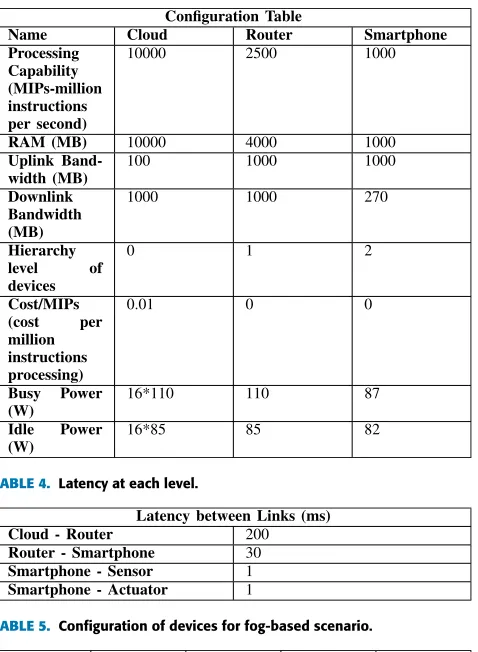
computation. The topology for the cloud scenario is shown in Figure 9. The layer zero contains the actuators and the sensors and the data is sent to the cloud via routers. The configuration of the router, smartphone, and the cloud is shown in Table 3 and the latency between the links at each level is shown in Table 4.
B. FOG-BASED SCENARIO
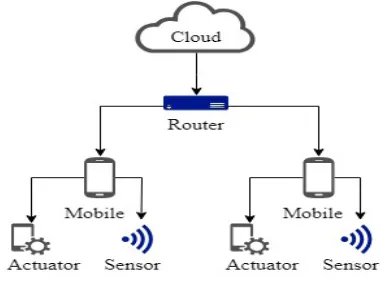
The fog-based scenario for the ERDMS consists of two fog nodes which are connected to the cloud via a proxy server. Again, the actuators and the sensors are at level zero. The fog-based topology is shown in Figure 10. The configuration of all devices is shown in Table 5; whereas, Table 6 presents the latency between the links.
TABLE 3.Configuration of devices in cloud-based scenario.
[image:7.576.96.219.283.521.2]TABLE 4.Latency at each level.
TABLE 5.Configuration of devices for fog-based scenario.
1) CONFIGURATIONS OF PHYSICAL TOPOLOGY
For both scenarios, five different configurations are used. Each configuration varies in the number of smartphones and users. Then all configurations are evaluated to calculate latency and network usage. The details of the configurations are shown in Table 7.
C. RESULTS
1) NETWORK THROUGHPUT
[image:7.576.298.539.399.585.2]FIGURE 8. Accident notification information page.
FIGURE 9. Topology for cloud-based scenario.
FIGURE 10. Topology of fog-based scenario.
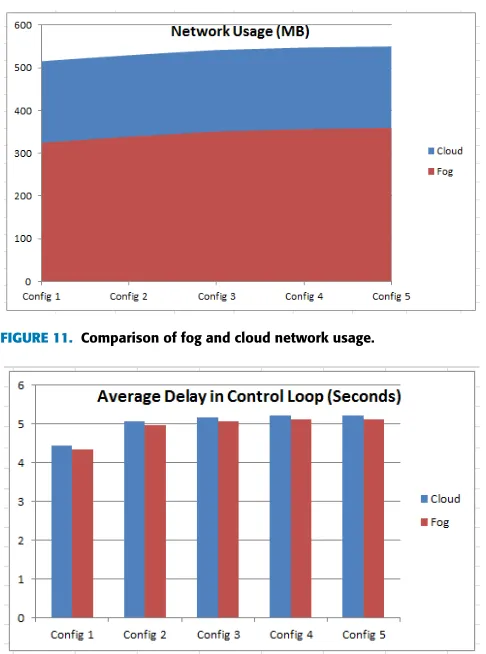
[image:8.576.60.252.310.451.2]fog scenarios. The comparison of the fog and cloud network usage is shown in Figure11. It is evident that the fog com-puting saves bandwidth where cloud utilizes more network data while transmitting the data. In case of using cloud for computing and storage, all the jobs are sent to the cloud data centers. These jobs traverse the whole network from source to
TABLE 6.Latency at each level in fog-based scenario.
[image:8.576.295.538.327.543.2]TABLE 7.Configuration details.
TABLE 8.Network usage in kilobytes.
[image:8.576.37.274.482.616.2]TABLE 9.Execution delay in control loop (in Milliseconds).
TABLE 10.Execution time (in Milliseconds).
FIGURE 11. Comparison of fog and cloud network usage.
[image:9.576.38.278.427.566.2]FIGURE 12. Comparison of fog and cloud latency.
FIGURE 13. Comparison of fog and cloud execution time.
2) LATENCY AND EXECUTION TIME
Latency is a critical parameter in analyzing the performance of emergency management systems, since small delays can lead to increased likelihood of fatality. Table 9 shows the delay for complete execution of the application i.e. delay in control loop (the time is calculated in seconds). It is evident that fog computation provides lower latency than cloud com-puting, due to the geographical proximity of fog resources. Hence, in emergency systems, fog computing can play a vital role. Figure12 shows the delay comparison of the control loop between fog and cloud. Table 10 shows the execution
time of the operation which is again less than the cloud-based system as shown in Figure13. It provides a comparison of the execution time taken by fog node and a cloud server. It can be noted as the number of devices increases, the benefits of the fog-based ERDMS are more visible as computation is performed with lower overall latency and bandwidth usage.
V. CONCLUSION
Fog computing enables efficient, localized processing of data which can be of particular use in time-sensitive applications. It provides benefits of low latency, geographical distribution, and mobility support. Lower response times are considered a particularly important requirement in accident detection and emergency notification systems since delay can result in loss of life. The proposed system overcomes challenges faced by cloud-based systems through utilizing fog com-puting. The system developed in this work makes use of smartphone capabilities to decrease the cost when compared to similar OBU-based solutions. The system also reduces cost and minimizes overall response time by minimizing human intervention through automated emergency manage-ment. To demonstrate the work, an Android application has been developed as a proof of concept. The evaluation results confirm that the fog-based ERDMS has lower latency, net-work usage, and execution time in comparison to cloud-based systems. The limitations of our study include the evaluation of the proposed scheme in a simulated environment. We used a state-of-the-art simulation environment, however it cannot exactly replicate all real-world scenarios. As a consequence the generalization of the overall solution is limited.
In the future, we intend to evaluate a complete ERDMS in a real environment to observe its performance in real time. Moreover, we will also work on enhancing the accuracy of accident detection. Also, we aim to integrate smart traffic signaling for the ambulance to decrease the overall rescue time [37] to enable smart transportation [38]. We also intend to address potential privacy and security concerns that require consideration before any real-world implementation can be built on our system
REFERENCES
[1] Y. Lu, S. Dillon, K. Rastrick, and G. Vossen, ‘‘Assessing the per-ceived value of cloud-based technologies in natural disasters: The case of New Zealand emergency management,’’ inProc. 4th Int. Conf. Inf. Commun. Technol. Disaster Manage. (ICT-DM), Dec. 2017, pp. 1–8. [2] World Heath Organization. (2013).Infographics on Global Road Safety
2013. Accessed: Jan. 10, 2018. [Online]. Available: http://www.who. int/violence_injury_prevention/road_safety_status/2013/facts/en/ [3] A. Khan, F. Bibi, M. Dilshad, S. Ahmed, Z. Ullah, and H. Ali, ‘‘Accident
detection and smart rescue system using Android smartphone with real-time location tracking,’’Int. J. Adv. Comput. Sci. Appl., vol. 9, no. 6, pp. 341–355, 2018.
[4] Pakistan Bureau of Statistics. (2018).Traffic Accidents (Annual) Pak-istan Bureau of Statistics. Accessed: Jan. 30, 2019. [Online]. Available: http://www.pbs.gov.pk/content/traffic-accidents-annual
[5] H. N. Kumar and G. Deepak, ‘‘Accident detection and intelligent naviga-tion system for emergency vehicles in urban areas using IoT,’’Int. J. Eng. Tech., vol. 3, no. 6, pp. 330–334, 2017.
[7] R. K. Kodali and K. S. Mahesh, ‘‘Smart emergency response system,’’
inProc. IEEE Region Conf. (TENCON), Penang, Malaysia, Nov. 2017,
pp. 712–717.
[8] N. Capurso, E. Elsken, D. Payne, and L. Ma, ‘‘Poster: A robust vehicular accident detection system using inexpensive portable devices,’’ inProc. 12th Annu. Int. Conf. Mobile Syst. Appl. Services, 2014, p. 367. [9] B. K. Dar, M. A. Shah, H. Shahid, and A. Naseem, ‘‘Fog computing
based automated accident detection and emergency response system using android smartphone,’’ inProc. 14th Int. Conf. Emerg. Technol. (ICET), 2018, pp. 1–6.
[10] S. Bhowmick, ‘‘A fog-based cloud paradigm for time-sensitive applica-tions,’’ Ph.D. dissertation, Eng. Appl. Sci., Comput. Sci., Univ. Cincinnati, Cincinnati, OH, USA, 2016.
[11] A. Jiménez, V. García-Díaz, and J. Anzola, ‘‘Design of a system for vehicle traffic estimation for applications on IoT,’’ inProc. 4th Multidisciplinary Int. Social Netw. Conf. (MISNC), 2017, Art. no. 15.
[12] C. Aydin, C. Tarhan, A. S. Ozgur, and V. Tecim, ‘‘Improving disaster resilience using mobile based disaster management system,’’Procedia Technol., vol. 22, pp. 382–390, Jan. 2016.
[13] J. Smolka and M. Skublewska-Paszkowska, ‘‘A method for collision detec-tion using mobile devices,’’ inProc. 9th Int. Conf. Hum. Syst. Inter-act. (HSI), Jul. 2016, pp. 126–132.
[14] H. M. Ali and Z. S. Alwan,Car Accident Detection and Notification System
Using Smartphone. Latvia, U.K.: LAP LAMBERT Academic, 2017.
[15] Z. Wei, S.-W. Lo, Y. Liang, T. Li, J. Shen, and R. H. Deng, ‘‘Automatic accident detection and alarm system,’’ inProc. 23rd ACM Int. Conf. Multimedia, 2015, pp. 781–784.
[16] F. Aloul, I. Zualkernan, R. Abu-Salma, H. Al-Ali, and M. Al-Merri, ‘‘iBump: Smartphone application to detect car accidents,’’Comput. Elect. Eng., vol. 43, pp. 66–75, Apr. 2015.
[17] M. V. Ramesh, P. T. Vidya, and P. Pradeep, ‘‘Context aware wireless sensor system integrated with participatory sensing for real time road accident detection,’’ inProc. 10th Int. Conf. Wireless Opt. Commun. Netw. (WOCN), Jul. 2013, pp. 1–5.
[18] C. Liao, G. Shou, Y. Liu, Y. Hu, and Z. Guo, ‘‘Intelligent traffic accident detection system based on mobile edge computing,’’ inProc. 3rd IEEE Int.
Conf. Comput. Commun. (ICCC), Dec. 2017, pp. 2110–2115.
[19] N. Kattukkaran, A. George, and T. P. M. Haridas, ‘‘Intelligent accident detection and alert system for emergency medical assistance,’’ inProc. Int. Conf. Comput. Commun. Inform. (ICCCI), Jan. 2017, pp. 1–6.
[20] S. Jamal, H. Zeid, M. Malli, and E. Yaacoub, ‘‘Safe driving: A mobile application for detecting traffic accidents,’’ inProc. IEEE Middle East
North Africa Commun. Conf. (MENACOMM), Apr. 2018, pp. 1–6.
[21] A. B. Faiz, A. Imteaj, and M. Chowdhury, ‘‘Smart vehicle accident detec-tion and alarming system using a smartphone,’’ inProc. Int. Conf. Comput. Inf. Eng. (ICCIE), Nov. 2015, pp. 66–69.
[22] H. Sharma, R. K. Reddy, and A. Karthik, ‘‘S-CarCrash: Real-time crash detection analysis and emergency alert using smartphone,’’ inProc. Int. Conf. Connected Vehicles Expo (ICCVE), Sep. 2016, pp. 36–42. [23] G. R. Shete, D. A. Shah, A. R. Gaidhani, S. D. Shinde, and S. R. Sharma,
‘‘Smartphone based vehicle tracking and accident prevention system,’’Int. J. Comput. Appl. Inf. Technol., vol. 8, no. 1, p. 172, 2015.
[24] A. Khan, F. Bibi, M. Dilshad, S. Ahmed, Z. Ullah, and H. Ali, ‘‘Accident detection and smart rescue system using android smartphone with real-time location tracking,’’Int. J. Adv. Comput. Sci. Appl., vol. 9, no. 6, pp. 341–355, 2018.
[25] A. F. Pop, A. Puscasiu, S. Folea, and H. Vălean, ‘‘Trauma accident detect-ing and reportdetect-ing system,’’ inProc. IEEE Int. Conf. Automat., Qual. Test., Robot. (AQTR), May 2018, pp. 1–5.
[26] M. Aazam and E.-N. Huh, ‘‘E-HAMC: Leveraging Fog computing for emergency alert service,’’ inProc. IEEE Int. Conf. Pervasive Comput.
Commun. Workshops (PerCom Workshops), Mar. 2015, pp. 518–523.
[27] S. Misbahuddin, J. A. Zubairi, A. Saggaf, J. Basuni, S. A-Wadany, and A. Al-Sofi, ‘‘IoT based dynamic road traffic management for smart cities,’’ inProc. 12th Int. Conf. High-Capacity Opt. Netw. Enabling/Emerg. Tech-nol. (HONET), Dec. 2015, pp. 1–5.
[28] D. Vishal, H. S. Afaque, H. Bhardawaj, and T. K. Ramesh, ‘‘IoT-driven road safety system,’’ inProc. Int. Conf. Elect., Electron., Commun., Com-put., Optim. Techn. (ICEECCOT), Dec. 2017, pp. 1–5.
[29] A. Rauniyar, P. Engelstad, B. Feng, and D. Van Thanh, ‘‘Crowdsourcing-based disaster management using fog computing in Internet of Things paradigm,’’ inProc. IEEE 2nd Int. Conf. Collaboration Internet Com-put. (CIC), Nov. 2016, pp. 490–494.
[30] L. Cerina, S. Notargiacomo, M. G. Paccanit, and M. D. Santambrogio, ‘‘A fog-computing architecture for preventive healthcare and assisted liv-ing in smart ambients,’’ inProc. IEEE 3rd Int. Forum Res. Technol. Soc. Ind. (RTSI), Sep. 2017, pp. 1–6.
[31] H. Wang, J. Gong, Y. Zhuang, H. Shen, and L. Lach, ‘‘Healthedge: Task scheduling for edge computing with health emergency and human behavior consideration in smart homes,’’ inProc. IEEE Int. Conf. Netw., Archit., Storage (NAS), Dec. 2017, pp. 1213–1222.
[32] D. Radu, A. Cretu, B. Parrein, J. Yi, C. Avram, and A. Aştilean, ‘‘Flying ad hoc network for emergency applications connected to a fog system,’’ in
Proc. Int. Conf. Emerg. Internetw., Data Web Technol.Cham, Switzerland: Springer, 2018, pp. 675–686.
[33] O. Osanaiye, S. Chen, Z. Yan, R. Lu, K.-K. R. Choo, and M. Dlodlo, ‘‘From cloud to fog computing: A review and a conceptual live VM migration framework,’’IEEE Access, vol. 5, pp. 8284–8300, 2017.
[34] H. M. Ali and Z. S. Alwan, ‘‘Car accident detection and notification system using smartphone,’’Int. J. Comput. Sci. Mobile Comput., vol. 44, no. 4, pp. 620–635, 2015.
[35] J. Zaldivar, C. T. Calafate, J. C. Cano, and P. Manzoni, ‘‘Providing accident detection in vehicular networks through OBD-II devices and android-based smartphones,’’ inProc. IEEE 36th Conf. Local Comput. Netw. (LCN), Oct. 2011, pp. 813–819.
[36] H. Gupta, A. V. Dastjerdi, S. K. Ghosh, and R. Buyya, ‘‘iFogSim: A toolkit for modeling and simulation of resource management techniques in the Internet of Things, edge and fog computing environments,’’Softw., Pract. Exper., vol. 47, no. 9, pp. 1275–1296, 2017.
[37] A. I. A. Ahmed, A. Gani, S. H. A. Hamid, S. Khan, N. Guizani, and K. Ko, ‘‘Intersection-based distance and traffic-aware routing (IDTAR) protocol for smart vehicular communication,’’ inProc. 13th Int. Wireless Commun. Mobile Comput. Conf. (IWCMC), Jun. 2017, pp. 489–493
[38] Y. R. B. Al-Mayouf, O. A. Mahdi, N. A. Taha, N. F. Abdullah, S. Khan, and M. Alam, ‘‘Accident management system based on vehicular network for an intelligent transportation system in urban environments,’’J. Adv. Transp., vol. 2018, May 2018, Art. no. 6168981.
BILAL KHALID DARreceived the B.S. degree in software engineering from the Comsats Institute of Information Technology, Islamabad, Pakistan, in 2017, and the M.S. degree in software engi-neering from COMSATS University, Islamabad. His research interests include smart grids, smart cities, fog computing, human–computer interac-tion, and software engineering. His awards and honors include Best Final Project in Excite Cup 2016 held at CUST University Islamabad.
SAIF UL ISLAM received the Ph.D. degree in computer science from the University Toulouse III Paul Sabatier, France, in 2015. He is currently an Assistant Professor with the Department of Computer Science, Dr. A. Q. Khan Institute of Computer Science and Information Technology, Rawalpindi, Pakistan. Previously, he has served as an Assistant Professor with the COMSATS Uni-versity, Islamabad, Pakistan, for three years. He has been a part of the European Union-funded research projects during the Ph.D. He was a focal person of the research team at COMSATS, working in O2 project in collaboration with CERN Switzerland. His research interests include resource and energy management in large-scale distributed systems (edge/fog, cloud, content distribution net-works (CDN)), and the Internet of Things (IoT).
CASTREN MAPLE is currently the Director of Research in cyber security and a Professor of cyber systems engineering with the Cyber Security Cen-tre, University of Warwick, where he leads the GCHQ-EPSRC Academic Centre of Excellence in Cyber Security Research. He is the Privacy and Trust Stream Lead in PETRAS, the UK Research Hub for Cyber Security of the Internet of Things, where is also the Lead for transport & mobility. He has published over 200 peer-reviewed papers and has provided evidence and advice to governments and organizations across the world, including being a high-level scientific advisor for cyber security to the European Commission. He is a member of various boards and expert groups, including the ENISA Carsec Group. He is the Principal or Co-Investigator on a number of projects in cyber security and is currently, or has recently been, funded by a range of sponsors, including the EPSRC, EU, DSTL, the South Korean Research Agency, Innovate UK, and private com-panies.
SHAFAQ MUSSADIQreceived the Ph.D. degree from the National Univer-sity of Science and Technology (NUST), Pakistan. She is currently an Assis-tant Professor with the Institute of Information Technology, Kohat University of Science and Technology, Pakistan. Her research interests include machine learning, deep neural networks, and big data in education.
SULEMAN KHAN received the Ph.D. degree (Hons.) from the Faculty of Computer Science and Information Technology, University of Malaya, Malaysia, in 2017. He is currently a Faculty Member of the School of Information Technol-ogy, Monash University Malaysia. He has pub-lished over 45 high-impact research articles in reputed international journals, including the IEEE COMMUNICATIONSSURVEYS ANDTUTORIALS, theACM