© 2019, IRJET | Impact Factor value: 7.211 | ISO 9001:2008 Certified Journal
| Page
2848
PAPR Reduction in UF-OFDM and F-OFDM 5G Systems using ZCT
Precoding Technique
Naziya Begum
1, Dr. Muhieddin Amer
21
Graduate Student, Dept. of Electrical Engineering, Rochester Institute of Technology, Dubai, UAE
2Professor,
Department Chair, Dept. of Electrical Engineering, Rochester Institute of Technology, Dubai, UAE
---***---Abstract –
5G networks employ multicarrier modulations (MCM)s such as filtered-orthogonal frequency division multiplexing (F-OFDM) and universal filtered orthogonal frequency division multiplexing (UF-OFDM) as a solution to overcome the challenges of high data rates and spectral efficiency [1]. However, MCMs have high peak to average power ratio (PAPR) which drives the power amplifier (PA) in the linear region resulting in the reduced efficiency. To overcome this problem PAPR should be reduced [1-4]. In this paper, precoding based PAPR reduction techniques such as Discrete Fourier Transform (DFT), Discrete Cosine Transform DCT) and Zadoff-Chu Transform (ZCT) are implemented using MATLAB for F-OFDM and UF-OFDM systems. Comparison analysis shows that Zadoff-chu Transform precoding technique for PAPR reduction gives better results. Hence, ZCT precoding is proposed for both F-OFDM and UF-F-OFDM systems. Simulation results show that proposed technique lowers down the power spectral density (PSD) tails at the PA output, reduces PAPR and instantaneous to average power ratio (IAPR) and conserves the bit error rate (BER) in the AWGN channel.Key Words: 5G, UF-OFDM, F-OFDM, peak to average power ratio (PAPR), IAPR, precoding, Zadoff-Chu Transform (ZCT), Power Spectral Density (PSD), BER.
1.
INTRODUCTION
For 5G systems, mm-wave communication is envisioned to be the key component to meet the demands of high data rates, high spectral efficiency and low latency [5]. For 5G mm-wave communication, selection of waveform is an important criterion. 4G systems employ OFDM (orthogonal frequency division multiplexing) for downlink and DFTS-OFDM (Discrete Fourier Transform-spread-OFDM) for transmission in uplink. Apart from several important features such as low complex transceiver design, easy integration with MIMO, robustness to frequency selective channel, OFDM comes with the major drawbacks of high PAPR and high OOB (out-of-bound) emissions [5]. To improve OOB emissions, several MCMs have been proposed for 5G systems such as F-OFDM and UF-OFDM [2], [6-7]. Compared to OFDM, these filtered MCMs provide lower OOB emission, lowers power spectral density (PSD) side lobes and preserves the OFDM based transceiver design [2],[6]. However, these
modulation schemes have high PAPR [2]. The high PAPR results in the high design complexity of Analog to Digital (A/D) and Digital to Analog (D/A) converters and drives the operation of PA in the linear region which increases the cost and complexity of PA and reduces the efficiency RF high power amplifier (HPA) [1], [3], [8]. Thus, PAPR reduction techniques are conventionally used which solve the design complexity of A/D and D/A converters and increases the transmit power, improves received SNR for the same range, resulting in the increased efficiency [1], [8].
Several PAPR reduction techniques have been suggested in the literature as presented in papers [1-4], [8-12]. However, the precoding based PAPR reduction techniques seem to be promising as they are linear and simple to implement without requiring the side lobe information [2]. Earlier, several precoding techniques have been proposed as a solution for PAPR reduction in multicarrier modulation systems OFDM, F-OFDM, and UF-OFDM, as supported in papers [2-3],[8], [10-12]. Comparison analysis of some precoding techniques for OFDM is shown in paper [3], ZCT Precoding is implemented earlier on OFDM systems as shown in [8-10], DFT precoding technique is implemented in paper [11-12] for OFDM systems. DCT Precoding Techniques is implemented for OFDM system as shown in paper [13].
This has motivated us to implement ZCT precoding technique for PAPR reduction in F-OFDM and UF-OFDM multicarrier modulations that are the main candidates of 5G cellular communication system.
This paper presents the MATLAB based implementation and comparison analysis of the precoding techniques DFT, DCT and ZCT to minimize the PAPR in both F-OFDM and UF-OFDM 5G systems. Comparison analysis is based on parameters, PAPR, IAPR, PSD and BER. MATLAB simulation results show that PAPR and IAPR of F-OFDM and UF-OFDM are reduced, PSD at the PA output is improved and BER of considered AWGN channel is unaffected.
This paper is presented as follows:
© 2019, IRJET | Impact Factor value: 7.211 | ISO 9001:2008 Certified Journal
| Page
2849
section 4, MATLAB simulation results show thecomparison analysis of ZCT with other precoding techniques like DFT and DCT, based on PAPR, IAPR, PSD and BER. Finally, paper conclusion is given in section 5, which shows that Zadoff-chu precoding proves to be the more efficient technique for PAPR reduction in F-OFDM and UF-OFDM systems compared to other precoding techniques.
2.
PRECODING TECHNIQUES
Main objective of using precoding techniques is to obtain a signal with low PAPR. The precoding-based PAPR reduction techniques are very promising since they are linear and simple to implement without requiring the side lobe information. Precoding-based techniques reduces PAPR without increasing the complexity of the system [3]. There are three different precoding techniques used in this paper: Discrete Cosine Transform DCT), Zadoff-Chu Transform (ZCT) and Discrete Fourier Transform (DFT).
2.1 Zadoff-Chu Transform (ZCT)
The Zadoff-Chu Transform is a matrix formed by the general polyphase sequences having properties of correlation, which is optimum. Important property of Zadoff-Chu code is that, they have ideal auto correlation periodically and magnitude of cross correlation is constant for a sequence length of L [3].
They are defined by the following equation:
(2.1)
Where , is any integer, is the code index, is the length of sequence and prime number √ .
In case of a prime number N, the set of Zadoff-chu codes consist of L-1 number of sequences.
2.2 Discrete Cosine Transform (DCT)
Mathematical expression for the Discrete Cosine Transform of an input data sequence x (n) of length N is given by [3]:
(2.2)
Where k is an integer.
2.3 Discrete Fourier Transform (DFT)
The DFT of a sequence x (n) of length N and IDFT of X (K) can be expressed as [11-12]:
(2.3)
Where k and n are integers.
3.
PAPR REDUCTION IN F-OFDM and
UF-OFDM USING ZCT PRECODING
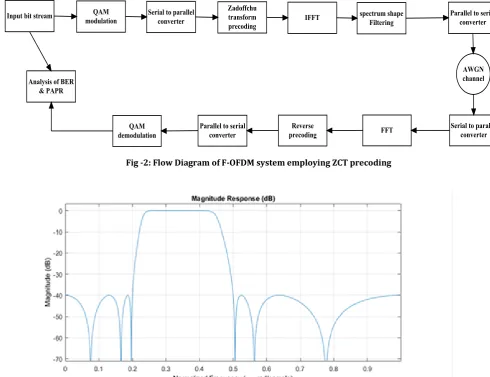
In this proposed system a precoding-based PAPR reduction is implemented by using the Zadoff-chu transform precoding method for F-OFDM and UF-OFDM systems as well. In this method, F-OFDM signal is transformed to single carrier signal and UF-OFDM signal is converted to a lower order summation of signals having single carrier. The flow diagram of the proposed system for UF-OFDM as illustrated in Fig -1 and Fig -2 shows the flow diagram for F-OFDM.
In this system, first the input data sequence is generated randomly and then the generated data symbols are subjected to the modulation process. For that in our proposed system, we use the QAM modulation. After the modulation process, the data is converted from the serial to parallel format for further process. After that, the converted parallel data is subjected to the Fourier transform process and corresponding filters filter the signal. Here Chebyshev filter is used for UF-OFDM precoding, spectrum-shaping filter is used for F-OFDM precoding, and the signal is precoded by the ZCT method after that the signal is passed through the channel then the reversal operations are performed at the receiver as shown in the flow diagrams of Fig-1 and Fig-2. In addition, the performance of the proposed system is evaluated by analyzing the parameters such as BER, PAPR, IAPR, normalized (PSD) responses obtained using MATLAB simulations.
3.1 Description for ZCT Precoded system
© 2019, IRJET | Impact Factor value: 7.211 | ISO 9001:2008 Certified Journal
| Page
2850
In the ZCT precoding based MCMs systems, thebaseband modulated data is passed through serial to parallel converter which generates a complex vector of size N that can be written as X= [X0, X 1, X 2,…X N-1]. Then ZCT precoding is applied to this complex vector, which transforms this complex vector into new vector of same length. After that the precoded data can be represented as time domain signal with the help of an Inverse Fast Fourier Transform (IFFT). Then the time domain data is extended by adding cyclic prefix to each symbol to solve the Inter Symbol Interference (ISI) as well as Inter carrier interference (ICI) problems. These signals are then filtered using Chebyshev filtering for UF-OFDM systems and by spectrum shaping filtering for F-OFDM systems [2].
The ZCT technique for UF-OFDM block consist of precoding matrix before the subset assignment IFFT block. The precoding matrix is of the same size as subcarrier vector that are allocated [2]. The dimension of the ZCT precoding matrix A is N x N which can be obtained by,
[
] (3.1)
Where, amn is obtained by substituting k = mN + n in
equation (2.1) with m rows and n columns.
The precoded constellation symbols can be given as follows
∑ (3.2)
Therefore, the output signal of UF-OFDM can be expressed as follows [2],
∑ ∑ ̃ (3.3)
Where, ̃ is the OFDM signal after applying the precoding scheme and it is given by,
̃ ∑ ∑
(3.4)
The resultant frequency domain of the precoding signal can be converted into time domain signal using IFFT and this can be expressed as
Denoting by , and ̃ can be expressed as
̃ ∑
(3.5)
̃ ( ) (3.6)
Therefore, by replacing ̃ by in (3.3)
∑ ∑ (3.7)
By setting ∑ , the UF-OFDM output signal can be obtained as,
∑ (3.8)
Where, is the single carrier signal (SC) at the output of the pulse-shaping filter. Consequently, the precoded UF-OFDM signal is the summation of B SC signals. Even though UF-OFDM signal is still a multicarrier signal, the number of the subcarriers is reduced from the IFFT size M to the number of the sub-sets B. The UF-OFDM PAPR is reduced, as it is a function of a smaller number of subcarriers [2]. Now the precoding scheme for F-OFDM can be given as,
∑ ∑ [ ]
(3.9)
Where,
∑
(3.10)
The resultant frequency domain of the precoding signal can be converted into time domain signal using IFFT and this can be expressed as follows:
By setting ̃ , we have ( ̃ ) Hence,
∑ [ ]
∑ ( ̃ )
∑ [ ] ( ( ̃ ))
(3.11)
So that ∑ ̃ [ ]
(3.12)
Therefore, is the SC signal at the output of the pulse shaping filter and hence the F-OFDM system becomes equivalent to a SC system [2].
After this for analysis purpose, AWGN channel is considered for transmission of signal. At the receiver section, the reverse processes of transmitter section are employed. i.e., the received serial data is converted to parallel form to apply FFT to convert the time domain signal into a frequency domain signal. Then the frequency domain signal is processed with reverse precoding and demodulated using QAM demodulator. Finally, the demodulated signal is converted back into serial data.
3.2 DCT and DFT based precoded systems
© 2019, IRJET | Impact Factor value: 7.211 | ISO 9001:2008 Certified Journal
| Page
2851
and DFT based precoding is implemented on F-OFDM andF-OFDM systems. The principle of operation is same as explained in except for the precoding matrix used. previous section for ZCT preceded system
Fig -1: Flow Diagram of UF-OFDM system employing ZCT precoding
[image:4.595.54.554.143.304.2]Fig -2: Flow Diagram of F-OFDM system employing ZCT precoding
[image:4.595.61.546.355.511.2] [image:4.595.47.538.360.737.2]© 2019, IRJET | Impact Factor value: 7.211 | ISO 9001:2008 Certified Journal
| Page
2852
The flow diagram of the proposed system for UF- OFDMas illustrated in Fig -1 and Fig -2 shows the flow diagram for F-OFDM. Here, precoding matrix is implemented based on equations for DCT and DFT as presented in section 2.2 and 2.3 respectively. All other blocks and processes remains as ZCT precoded system.
[image:5.595.317.539.268.447.2]In this system, first the input data sequence is generated randomly and then the generated data symbols are subjected to the modulation process. For that in our proposed system, we use the QAM modulation. After the modulation process, the data is converted from the serial to parallel format for further process. After that, the converted parallel data is subjected to the Fourier transform process and the signal is filtered by corresponding filters. Here Chebyshev filter is used for UOFDM precoding and spectrum-shaping filter is used for F-OFDM precoding and the signal is precoded by the DCT and DFT method respectively, after that the signal is passed through the channel then the reversal operations are performed as shown in the flow diagrams of Fig-1 and Fig-2. And the performance of the proposed ZCT system is evaluated by analyzing and comparing the parameters such as BER, PAPR, IAPR, normalized (PSD) values obtained using MATLAB simulations for DFT, DCT and ZCT precoding techniques for F- OFDM and UF-OFDM systems.
4.
SIMULATION RESULTS
In section, analysis of the MATLAB simulation results is presented for F-OFDM and UF-OFDM modulations using precoding techniques ZCT, DFT and DCT. First, simulation analysis of PAPR and IAPR is carried out for both the F-OFDM and UF-F-OFDM and results will be compared for different precoding techniques. Then, Power spectral density function (PSD) of the signal at the input and output of power amplifier (PA) is analyzed for both F-OFDM and UF-OFDM employing the different precoding techniques: ZCT, DCT and DFT with 16 and 64- QAM.
Table -1: Signal Parameters
DFT size: M 1024
Allocated subcarriers: N 480
Constellations 16-QAM, 64-QAM
UF-OFDM: Filter Chebyshev
UF-OFDM: Filter length: L 72
UF-OFDM: Side lobe attenuation 40 dB
UF-OFDM: Sub-set size: NB 12
UF-OFDM: Sub-set number: B 40
F-OFDM: Filter Truncated raised root cosine [2]
Table -1 shows the signal parameters considered for MATLAB simulations. And Fig- 3 shows the output of truncated raised root cosine spectrum shaping filter.
4.1 Analysis of PAPR and IAPR
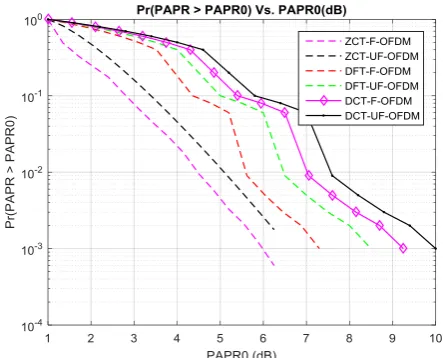
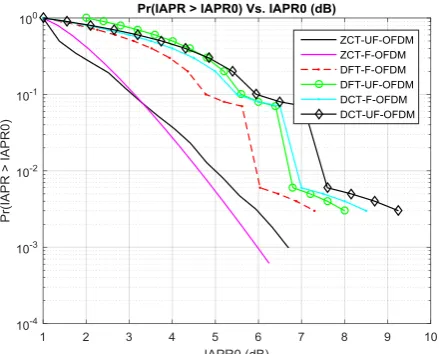
In the MATLAB based simulation results, perform analysis of PAPR and IAPR is expressed in terms of Complementary Cumulative Distribution Function (CCDF) [3]. Fig- 4 and Fig -5 shows PAPR and IAPR performance for different precoding techniques applied to both F-OFDM and UF-OFDM systems.
Fig -4: CCDF PAPRbased comparison of ZCT precoding with other precoding techniques for F-OFDM and UF-OFDM.
Table -2: CCDF PAPR based comparison of ZCT precoding with
other precoding techniques for F-OFDM and UF-OFDM
Table- 2 presents the comparison results at a level of 10-3 on the graph of PAPR of Fig -4. It shows that, when ZCT precoding technique is applied PAPR is reduced to 6 dB and 6.6 dB for F-OFDM and UF-OFDM systems respectively. Which is up to 1 dB less than the DFT precoding and about 3 dB less than DCT precoding technique. Hence, it can be concluded that ZCT precoding has proven to be as predicted better precoding technique than other techniques considered in his paper.
Table- 3 presents the comparison results at a level of 10-2 on the graph of IAPR of Fig -5. It shows that, when ZCT precoding technique is applied IAPR is reduced to 4.5 dB for F-OFDM and 5.1 dB for UF-OFDM systems. Here IAPR
ZCT-F-OFDM
ZCT- UF-OFDM
DFT-F-OFDM
DFT- UF-OFDM
DCT-F-OFDM
DCT-F-OFDM
© 2019, IRJET | Impact Factor value: 7.211 | ISO 9001:2008 Certified Journal
| Page
2853
using ZCT is about 1.5 dB less than that of DFT precodingand about 2.3 dB less than DCT precoding technique. Hence, it is noted that ZCT precoding is a better precoding technique.
Fig- 5: CCDF IAPR based comparison of ZCT precoding with other precoding techniques for F-OFDM and UF-OFDM.
Table -3: CCDF IAPR based comparison of ZCT precoding with other precoding techniques for F-OFDM and UF-OFDM
ZCT-F-OFDM
ZCT-UF-OFDM
DFT-F-OFDM
DFT- UF-OFDM
DCT-F-OFDM
DCT-F-OFDM
4.5 dB 5.1 dB 5.95 dB 6.7 dB 6.8 dB 7.5 dB
4.2 Analysis of PSD and BER
PSD of power amplifier output and Bit error rate of AWGN channel are analyzed here. In the case of 16-QAM and 64-QAM and AWGN channel, the BER is analyzed here.
Fig -6: Normalized PSD-based comparison of ZCT precoding with other precoding techniques for F-OFDM and UF-OFDM.
Table -4: PSD based comparison of ZCT precoding with other precoding techniques for F-OFDM and UF-OFDM at frequency = 15.36 MHz
Fig- 6 and Fig -7 show PSD and BER performance for different precoding techniques applied to both F-OFDM and UF-OFDM systems. Table- 4 presents the comparison results at the frequency of 15.36 MHz on the graph of PSD of Fig -6. It shows that, when ZCT precoding technique is applied PSD performance is improved to -32 dB and -44 dB for F-OFDM and UF-OFDM systems respectively. Which is better than the DFT precoding and DCT precoding techniques. Hence, it can be concluded that ZCT precoding has provided better results than other precoding techniques.
Fig -7: Comparison of BER performance for ZCT-UF-OFDM with
other precoding techniques for 16-QAM and 64-QAM constellations.
Fig -7 shows BER performance of ZCT precoding technique as applied to UF-OFDM of 16-QAM and 64-QAM constellations in comparison to DFT and DCT precoding techniques. It is observed that the PAPR CCDF performance of the system has been improved and bit error rate of the AWGN channel is conserved.
5. CONCLUSIONS
In this paper, a PAPR reduction technique using the Zadoff Chu transform precoding for the UF-OFDM and the
ZCT-F-OFDM
ZCT- UF-OFDM
DFT-F-OFDM
DFT- UF-OFDM
DCT-F-OFDM
DCT-F-OFDM
[image:6.595.47.267.164.341.2] [image:6.595.311.567.175.247.2] [image:6.595.320.538.405.582.2] [image:6.595.24.279.414.491.2]© 2019, IRJET | Impact Factor value: 7.211 | ISO 9001:2008 Certified Journal
| Page
2854
F-OFDM modulation scheme was proposed. The proposedsystem shows better performance for ZCT precoding applied to F-OFDM and UF-OFDM than the system with DCT and DFT as evident in the simulation results. The performance of the proposed system is evaluated by comparing the BER, PAPR, IAPR and normalized PSD values with the DCT and DFT precoded systems. i.e., when ZCT precoding technique is applied PAPR is reduced to 4.5 dB for F-OFDM and 5.1 dB for UF-OFDM systems.
In this system, BER in an AWGN channel is conserved. For further studies, the system could be modeled for Rayleigh fading or multipath fading channel. Further research could be extended to focus on the Discrete Wavelet Transform (DWT) precoding based PAPR reduction for MCM schemes.
In future the problems due to uplink transmission should be considered and need to be solved. In addition, a new technique of Partial transmit sequence will be implemented for reducing the PAPR in 5G systems.
REFERENCES
[1] M. Ben Mabrouk, M. Chafii, Y. Louët and F. Bader, "Low-PAPR condition for 5G-candidate waveforms," 2017 XXXIInd General Assembly and Scientific Symposium of the International Union of Radio Science (URSI GASS), Montreal, QC, 2017, pp. 1-4. [2] M. Ben Mabrouk, M. Chafii, Y. Louet and F. Bader, "A Precoding-based PAPR Reduction Technique for UF-OFDM and Filtered-UF-OFDM Modulations in 5G Systems," European Wireless 2017; 23th European Wireless Conference, Dresden, Germany, 2017, pp. 1-6. [3] J. Mountassir, A. Isar and T. Mountassir, "Precoding
techniques in OFDM systems for PAPR reduction," 2012 16th IEEE Mediterranean Electro technical Conference, Yasmine Hammamet, 2012, pp. 728-731.
[4] Albdran, Saleh. “Clipping and Filtering Technique for Reducing PAPR in OFDM.” IOSR Journal of Engineering, vol. 02, no. 09, 2012, pp. 91–97
[5] H. Wang, A. A. Zaidi, X. Chen, J. Luo and M. Dieudonne, "Evaluation of 5G Waveform Candidates Considering Hardware Impairments and above 6 GHz Operation,"
2017 IEEE 85th Vehicular Technology Conference (VTC Spring), Sydney, NSW, 2017, pp. 1-5.
[6] D. Zhang, M. Matthé, L. L. Mendes and G. Fettweis, "A Study on the Link Level Performance of Advanced Multicarrier Waveforms Under MIMO Wireless Communication Channels," in IEEE Transactions on Wireless Communications, vol. 16, no. 4, pp. 2350-2365, April 2017.
[7] J. Abdoli, M. Jia and J. Ma, "Filtered OFDM: A new waveform for future wireless systems," 2015 IEEE 16th International Workshop on Signal Processing Advances in Wireless Communications (SPAWC), Stockholm, 2015, pp. 66-70.
[8] I. Baig and V. Jeoti, "PAPR Reduction in OFDM Systems: Zadoff-Chu Matrix Transform Based Pre/Post-Coding Techniques," 2010 2nd International
Conference on Computational Intelligence, Communication Systems and Networks, Liverpool, 2010, pp. 373-377.
[9] I. Baig and V. Jeoti, "A new ZCT precoded OFDM system
with pulse shaping: PAPR analysis," 2010 IEEE Asia Pacific Conference on Circuits and Systems, Kuala Lumpur, 2010, pp. 1131-1134.
[10] Mathew, T. and A. Lakshmanasamy Mudaliar. “Alamouti STBC MIMO OFDM System using ZCT Precoded Based SLM Technique for PAPR Reduction.” (2014).
[11] A. S. Lakamana and A. M. Prasad, "An effective
composite PAPR reduction technique of OFDM by using DFT precoding with piecewise linear companding," 2016 International Conference on Communication and Electronics Systems (ICCES), Coimbatore, 2016, pp. 1-6.
[12] Mohamed A. Aboul-Dahab, Esam A. A. A. Hagras, and Ahmad. A. Elhaseeb, "PAPR Reduction Based on DFT Precoding for OFDM Signals," International Journal of Future Computer and Communication vol. 2, no. 4 pp. 325-328, 2013.
[13] Z. Wang, "Combined DCT and Companding for PAPR
Reduction in OFDM Signals," Journal of Signal and Information Processing, Vol. 2 No. 2, 2011, pp. 100-104.
BIOGRAPHIES
Naziya Begum received her B.E. degree in Electronics and Communication Engineering from VTU-Visveswaraya Technology University (2003), India and is currently pursuing her master’s degree M.S. in Electrical Engineering, Communications System specialization, at Rochester Institute of Technology (RIT), Dubai, United Arab Emirates.