arXiv:1601.08152v2 [math.DG] 27 Jul 2016
BETTI NUMBER OF MINIMAL HYPERSURFACES
Lucas Ambrozio, Alessandro Carlotto and Ben Sharp
Abstract
By extending and generalising previous work by Ros and Savo, we describe a method to show that in certain positively curved ambient manifolds the Morse index of every closed minimal hy-persurface is bounded from below by a linear function of its first Betti number. The technique is flexible enough to prove that such a relation between the index and the topology of minimal hypersurfaces holds, for example, on all compact rank one sym-metric spaces, on products of the circle with spheres of arbitrary dimension and on suitably pinched submanifolds of the Euclidean spaces. These results confirm a general conjecture due to Schoen and Marques-Neves for a wide class of ambient spaces.
1. Introduction
Since Lawson [20] constructed closed embedded minimal surfaces of arbitrary genus in the round three-dimensional sphere, many ingenious ways of producing an abundance of closed embedded minimal hypersur-faces in general Riemannian manifolds have been discovered.
A few remarkable examples show how powerful and diverse these methods can be. While Hsiang and Lawson [14] have found all homo-geneous minimal hypersurfaces of the round spheres in all dimensions, Hsiang [12,13] (and Hsiang-Sterling [15]) discovered infinitely many em-bedded non-totally geodesic hyperspheres in round spheres of certain dimensions (in particular, in four dimensions). Kapouleas showed how to construct closed embedded minimal surfaces in three-manifolds with a generic metric by gluing and desingularization methods (see [16] for a survey of these methods). Based on a min-max theory for the area functional developed by Almgren, Pitts [27] and Schoen and Simon [32] proved that every(n+ 1)-dimensional closed Riemannian manifold con-tains at least one embedded minimal hypersurface (containing possibly a singular set of codimension seven). The basic idea is to apply the min-max variational approach to one-parameter families of sweep-outs of the ambient manifold by closed hypersurfaces. More recently, by using k -parameters sweep-outs, Marques and Neves [24] proved that under the assumption of positiveness of the Ricci curvature, these ambient spaces
contain in fact infinitely many embedded minimal hypersurfaces (which are, as in the previous result, smooth in low dimensions). A broad overview of these methods and of many of their intriguing applications are provided in the ICM lectures by Marques [22] and, with more em-phasis on mix-max techniques, by Neves [26].
A different task is to understand the geometric and topological prop-erties of this variety of examples. For instance, the construction by Kapouleas-Yang [17] yields sequences of minimal surfaces with uniformly bounded area and unbounded genus. Simon and Smith [36] (see also Colding and De Lellis [9]) have proven that their min-max method ap-plied to sweep-outs of the three dimensional sphere, endowed with an arbitrary Riemannian metric, by one-parameter families of two dimen-sional spheres produces an embedded minimal two-sphere. Still in three dimensions, Ketover [18] proved that the genus of the min-max surface is controlled in an effective way by the genus of the surfaces in the sweep-outs (see also the previous work by De Lellis and Pellandini [11]).
More generally, one could be interested in understanding the general properties of the set of embedded minimal hypersurfaces in a given man-ifold. For example, it has been shown by Choi and Schoen [7] that in an ambient three-manifold with positive Ricci curvature, the set of all embedded minimal surfaces with genus bounded by a fixed constant is compact in the strongest sense.
cases where closed minimal hypersurfaces can be classified by their in-dex: Urbano [37] proved that the only embedded minimal surfaces of the three-sphere that have index at most five are the totally geodesic equators and the Clifford tori. This contribution turned out to be cru-cial in the proof of the Willmore conjecture by Marques and Neves [23]. In fact, it is expected that the index of a hypersurface obtained by min-max methods is bounded from above by the number of parameters of the family of sweep-outs considered and, under extra assumptions, is equal to such number. A significant contribution to this conjecture has been very recently presented in [25]. As the above examples show, this type of results provide a very important tool to understand the min-max hypersurfaces, especially in higher dimensions.
In this article, we shall be concerned with the general problem of com-paring two different “measures of complexity” of a minimal hypersurface inside a positively curved Riemannian manifold. In this respect, it has been conjectured that the index controls the basic topological invariants of minimal hypersurfaces in an effective way.
Conjecture. [Schoen, Marques-Neves [22, 26]] Let (Nn+1, g) be a closed Riemannian manifold with positive Ricci curvature. There ex-ists a positive constant C such that, for every closed embedded minimal hypersurface Mn, the following inequality holds
index(M)≥Cb1(M).
In fact, we expect a similar conclusion to hold, under the very same assumptions on the ambient manifold, not only for b1(M) but for all Betti numbers of Mn, namely we expect the Morse index of Mn to be bounded from below by a positive constant times the sum of the Betti numbers of the hypersurface in question. However, we remark that this assertion is actually equivalent to the aforementioned conjecture unless the dimension of the ambient manifold is greater or equal than five.
Notice that some positiveness assumption on the curvature is essen-tial, as the manifolds (Σ2
γ×S1, g+dθ2), where (Σ2γ, g) is an orientable
surface of arbitrary genus γ ≥ 2 with a metric of constant Gaussian curvature −1, have non-positive sectional curvature and contain stable minimal surfaces of genus γ.
A particular example of an ambient manifold for which this conjecture has been already verified is the round sphere Sn+1 (of arbitrary dimen-sion). The result is due to Savo (see [30] and Theorem 5 below). Roughly speaking, Savo’s approach to the problem was to use each harmonic one-form on a minimal hypersurface Mn to produce a set of functions that generate variations that decrease the area of the hypersurface (in mean). Then it was argued that if the index ofMn were too small compared to
Savo’s work was preceded by the work of Ros (see [29] and refer-ences therein for partially similar contributions). Considering flat three dimensional tori, Ros observed that, when a harmonic one-form on a closed minimal surface is viewed as a vector field of R3 along the
sur-face, its coordinates have the behaviour described above. In particular, he proved that the index of such surfaces is bounded from below by an affine function (whose coefficients do not depend on the particular surface) of their first Betti numbers (see Theorem 16 in [29]). In [38], Urbano used essentially the same method to prove the analogous result for closed minimal surfaces inside the product of the unit circle with a two-dimensional sphere of radius greater or equal than one.
The aim of the present paper is to extend this approach to other posi-tively curved ambient manifolds, and to give a unified method to address the above conjecture within this framework. We work in the most gen-eral setting: given an ambient manifold(Nn+1, g)that lies isometrically inside some Euclidean space Rd (for some dbig enough) and a minimal
embedded hypersurface Mn inside of it, we consider two kinds of test
functions constructed from a harmonic one-form on Mn, both inspired by the works of Ros and Savo, both dependent on the specific isometric embedding of the ambient manifold in the Euclidean space (see Propo-sition 1 and PropoPropo-sition 2 in Section 3). In particular, we obtain the following result.
Theorem A. Let (Nn+1, g) be a Riemannian manifold that is iso-metrically embedded in some Euclidean space Rd. Let Mn be a closed
embedded minimal hypersurface of (Nn+1, g).
Assume that for every non-zero vector field X on Mn,
(1) Z
M
trM(RmN(·, X,·, X)) +RicN(N, N)|X|2dM
>
Z
M
(|II(·, X)|2− |II(X, N)|2) + (|II(·, N)|2− |II(N, N)2|)|X|2
dM
whereRmN denotes the Riemann curvature tensor ofNn+1,II denotes the second fundamental form ofNn+1 inRdandN is a local unit normal
vector field on Mn.
Then
index(M)≥ 2
d(d−1)b1(M).
See Sections 2 and 3 for more details, and also for the precise geometric meaning of the inequality (1).
Specializing the above result, we were able to check that the conjecture quoted above is true in a number of ambient spaces. In particular, we prove the conjecture for the projective spaces RPn+1,CPm,HPp, CaP2
these spaces comprise all compact rank one symmetric spaces, i.e., all compact symmetric spaces with positive sectional curvature (see [28]).
Theorem B. Any closed, embedded minimal hypersurface of a com-pact rank one symmetric space is such that its first Betti number is bounded from above by a constant times its index. The constant depends only on the dimension of the ambient manifold.
As we shall see in Subsection 5.3 proving the index conjecture for
CPn turns out to be rather subtle, as one needs to handle (in fact: to
rule out) the borderline case when equality holds in (1). This requires a delicate ad hoc argument, which is presented in Appendix A.
Going beyond highly symmetric examples and the positive Ricci cur-vature assumption, we also verified that the same control of the first Betti number by the index also holds for minimal surfaces in sufficiently pinched convex hypersurfaces of the Euclidean spaces (Theorem 12), in three-manifolds that satisfy a pinching condition for the scalar curva-ture (Theorem 13) and in the product of circles with spheres of any dimension (Theorem 10). In fact, our methods also allow to prove the index estimate for products of spheresSp×Sq unless both factors have dimension equal to two (Theorem 11).
Furthermore, we would like to point out that whenn= 2andRicN > 0, the area estimate of Choi-Wang [8] and Choi-Schoen [7] coupled with our upper bound on the first Betti number yields an effective affine area bound on any minimal surface in (N3, g) solely in terms of the index.
We conclude this introduction with a few remarks. Firstly, we ob-serve that if the pinching condition in Proposition 3 holds for certain ambient manifolds (Nn+1, g) inRd, then it will also hold, possibly with
Acknowledgements: The authors wish to express their gratitude to An-dré Neves for the inspiration for this work and a number of enlightening conversations, to Alessandro Savo for useful correspondence concerning some extensions of his results and to Fernando Codá Marques for his interest in this work.
This project started whilst A.C and B.S. were supported by Pro-fessor Neves’ ERC Start Grant agreement number P34897, The Lever-hulme Trust and the EPSRC Programme Grant entitled ‘Singularities of Geometric Partial Differential Equations’, and L.A. was supported by CNPq - Conselho Nacional de Desenvolvimento Científico e Tecnológico - Brazil. Since 1st October 2015, B.S. has held a junior visiting position at the Centro di Ricerca Matematica Ennio De Giorgi and would like to thank the centre for its support and hospitality. Since 1st November 2015, L.A. has held a Research Associate position at Imperial College under the Professor Neves’ ERC Start Grant PSC and LMCF 278940. Lastly, this work was completed while A. C. was an ETH-ITS fellow: the outstanding support of Dr. Max Rössler, of the Walter Haefner Foun-dation and of the ETH Zurich FounFoun-dation are gratefully acknowledged.
2. Basic material
In this section, we set some notations that will be used throughout the paper and recall some relevant definitions and results.
2.1. Two-sided and one-sided hypersurfaces.Let (Nn+1, g) be a complete Riemannian manifold. Let Mn be a closed, immersed
hyper-surface in Nn+1. We can distinguish these immersions by their normal bundles: Mn is called two-sided when this bundle is trivial, and one-sided otherwise.
When Mn is two-sided, we can choose a smooth normal unit vector fieldN alongMn. WhenMnis one-sided, we can construct a two-to-one
cover π : ˆMn → Mn that is a two-sided immersion of Mˆn into Nn+1. More precisely, Mˆn is the set of pairs (x, N), where x belongs to Mn
and N is some unit vector in TxN normal to TxM, π is the obvious
projection, the deck transformation τ sends (x, N) to (x,−N) and the field Nˆ((x, N)) = N gives a trivialization of the normal bundle of the immersion π: ˆMn→Mn⊂ Nn+1.
When Nn+1 is orientable, Mn is one-sided if and only if Mn is
non-orientable, in which case the above construction defines precisely the oriented double cover of Mn.
perform integration by parts whenever needed. In any event, this is only relevant for Subsection 5.2, 5.4 and 5.6 as in all other examples we are about to analyze the manifoldNn+1is simply-connected, which ensures that any closed embedded hypersurface Mn in Nn+1 is automatically two-sided and orientable.
2.2. Isometric embeddings.By Nash’s embedding theorem, we can consider any ambient manifold (Nn+1, g) to be isometrically embedded in some Euclidean space Rd of sufficiently high dimension d. Let D
denote the Levi-Civita connection of the Euclidean space and∇denote the Levi-Civita connection of(Nn+1, g). The relationship between them is given by the formula
DXY =∇XY +II(X, Y),
whereX, Y are vectors fields tangent toNn+1 andII(X, Y)is a section of the normal bundle ofNn+1 inRd. II is the second fundamental form
of Nn+1 inRd.
A useful formula is the Gauss equation for the embedding of(Nn+1, g) inRd: for all vector fields X, Y onNn+1,
(2) RmN(X, Y, X, Y) =hII(X, X), II(Y, Y)i − |II(X, Y)|2,
where RmN denotes the Riemann curvature tensor of (Nn+1, g). Ac-cording to our convention, RmN(X, Y, X, Y) gives the sectional curva-ture of the two-dimensional plane generated by X and Y if X, Y are orthonormal.
Similarly, we have the Gauss equation for Mn inside of (Nn+1, g), (3)
RmM(X, Y, X, Y) =RmN(X, Y, X, Y)+hA(X, X), A(Y, Y)i−|A(X, Y)|2.
where Adenotes the second fundamental form ofMninNn+1. Accord-ing to our conventions, when Mn is two-sided with unit normal field N, A is given by A(X, Y) = −g(∇XN, Y)N for all X, Y on Mn. The
induced Riemannian connection onMn will be denoted by ∇M.
2.3. The Morse index.A closed embedded hypersurfaceMnin(Nn+1, g) is called minimal when the first variation of its n-dimensional volume is zero for all variations generated by flows of vector fields X ∈ X(N). Equivalently, Mn is minimal when the trace of its second fundamental form is identically zero.
bundle of Mn inNn+1 defined by
Q(W, W) =−
Z
M
hJM(W), WidM
=
Z
M
|∇⊥MW|2−(RicN(W, W) +|A|2|W|2)dM,
where JM is the Jacobi operator acting on the normal bundle ofMn,
JMW = ∆⊥MW +RicN(W)⊥+|A|2W.
In the above formulae, ∇⊥M denotes the connection of the normal bundle of Mn, ∆⊥M is the Laplacian of this connection, A denotes the second fundamental form ofMn and the Ricci tensor ofNn+1 is viewed as an endomorphism of the tangent bundle of Nn+1.
In fact, Q(W, W) gives precisely the second variation of the volume ofMnat t= 0under a flowφ
tgenerated by any vector fieldX ∈ X(N)
that coincides withW onMn (see e. g. [10]).
The index of a closed embedded minimal hypersurfaceMnofNn+1 is the maximal dimension of a vector space of sections of its normal bundle restricted to which the index form is negative definite. Geometrically, the index measures how many directions one can deformMnto decrease
its volume.
The index can be more easily computed when Mn is two-sided. In
this case, the sections of the normal bundle can be identified with the set of smooth functions φon Mn, the index form ofMn corresponds to the quadratic form
(4) Q(φ, φ) =
Z
M
|∇Mφ|2−(RicN(N, N) +|A|2)φ2dM,
and the Jacobi operator can be seen as the Schrödinger type operator
(5) JMφ= ∆Mφ+Ric(N, N)φ+|A|2φ.
The index of Mn is then the number of negative eigenvalues of JM. WhenMnis one-sided, the sections of its normal bundle can be iden-tified with theodd functions on the two-sided coverMˆn, i. e. the smooth
functions φ on Mˆn such that φ◦τ =−φ. One can then compute the index of Mn by counting the number of negative eigenvalues of JMˆ re-stricted to the space of odd functions on Mˆn (see [37]).
2.4. Harmonic forms.(see, for example, [28]). In a closed Riemann-ian manifold (Mn, g), the Hodge-Laplace operator is the second order
differential operator ∆p acting on p-forms defined by
where d : Ωp(M) → Ωp+1(M) is the exterior differential and d∗ : Ωp(M)→Ωp−1(M) is the formal adjoint1 of d, defined with respect to the metric g. A p-form ω is called harmonic when∆pω= 0.
AsMnis closed,ω is harmonic if and only if it is closed and co-closed,
i.e., if it satisfies the two equations dω = 0and d∗ω= 0. Hodge’s The-orem asserts that in a closed Riemannian manifold every De Rham co-homology class contains precisely one harmonic representative. Hence, the dimension of the space of harmonic p-forms coincides with the p-th Betti number ofMn.
The Bochner-Weitzenböck formula relates the Hodge-Laplace opera-tor with the usual (rough) Laplacian on forms:
∆pω=−∆ω+Rp(ω),
where Rp is a zero-th order curvature term. Such term, while rather complicated when 1< p < n, has a remarkably simple expression when
p= 1, in which case this formula becomes
(6) ∆1ω=−∆ω+RicM(ω♯,·).
Remark 2.1. Here and in the following we use the usual musical isomorphisms to pass from vectors to one-forms. For example, if ω is a one-form on (Mn, g), ω♯ is the unique vector field on Mn such that ω(Y) =g(ω♯, Y) for all vector fields Y. If X is a vector, ω a one-form and θa two-form, theng(X♭∧ω, θ) =g(ω, iXθ), where iXθ denotes the contraction of the two formθby the vectorX, i.e., the one-form defined by iXθ(Y) =θ(X, Y) for all vector fields Y.
When (Mn, g) is isometrically immersed in (Nn+1, g), it is possible to express the curvature term Rp of Mn in terms of the corresponding operator in (Nn+1, g) and the second fundamental form A (for explicit formulae, see [31]).
3. The computations
We describe two methods for using the harmonic one-forms of a min-imal hypersurface to generate interesting test functions for the index form. The methods were inspired by the work of Ros [29], Urbano [37] and Savo [30].
If Mn is a two-sided minimal hypersurface of Nn+1 ⊂ Rd, the
coor-dinates in ΛpRd of any p-form on Mn can be used to produce globally
defined functions on Mn, which in turn can be used as test functions for the index form of Mn. We perform such computation in two cases:
1It is well-known that the operatord∗satisfies the identityd∗= (
−1)n(p+1)+1∗d∗
the coordinates of a harmonic one-form ω on Mn, and the coordinates of the two-form N♭∧ω, forω a harmonic one-form onMn.
Remark 3.1. Here and in all the following sections, {e1, . . . , en}will
denote an arbitrary local orthonormal frame on the hypersurfaceMn. It
is immediate to check that all quadratic expressions involving summa-tions on such basis are independent of the particular choice of the basis itself, which implies that such quantities are globally defined on Mn.
3.1. First method: coordinates of ω.
Proposition 1. Let (N3, g) be a Riemannian three-manifold isomet-rically embedded in some Euclidean space Rd. Let M2 be a closed
two-sided immersed minimal surface of N3. Given a harmonic one-form ω
on M2, let
ui =hω♯, θii, i= 1, . . . , d,
denote the coordinates of ω♯ in Rd with respect to some orthonormal
basis {θi}d
i=1 of Rd. Then
(7)
d
X
i=1
Q(ui, ui) =
Z
M
" 2 X
k=1
|II(ek, ω♯)|2− RN
2 |ω| 2
#
dM.
Proof. Let {e1, e2} be a local orthonormal frame on M2. The func-tions ui =hω♯, θii are such that
Dekui =hDekω
♯, θii.
Thus, plugging the functions ui =hω♯, θii in the index form (4) and
summing up on i= 1, . . . , dgives
d
X
i=1
Q(ui, ui) =
Z
M
2 X
i=1
|Deiω
♯|2−(|A|2+RicN
(N, N))|ω|2dM.
Since we have the orthogonal decomposition
Dekω
♯=∇M ekω
♯+A(e
k, ω♯) +II(ei, ω♯)
for each k= 1,2, it follows that 2
X
k=1
|Dekω
♯|2 = 2 X
k=1
|∇Mekω♯|2+ 2 X
k=1
|A(ek, ω♯)|2+
2 X
i=1
|II(ek, ω♯)|2.
Thus, we obtain
d
X
i=1
Q(ui, ui) =
Z
M
|∇Mω|2+ 2 X
i=1
|A(ek, ω♯)|2+
2 X
i=1
|II(ek, ω♯)|2dM
−
Z
M
Fixing a point on M2 and choosing {e1, e2} in such way that the second fundamental form of M2 inN3 is diagonalised (i.e., A(e
i, ej) = kiδijN for each i, j= 1,2), it can be checked that
2 X
i=1
|A(ei, ω♯)|2 =k12he1, ω♯i2+k22he2, ω♯i2 = 1 2|A|
2|ω|2,
since M2 is minimal. Hence,
(8)
d
X
i=1
Q(ui, ui) =
Z
M
|∇Mω|2+ 2 X
i=1
|II(ek, ω♯)|2
! dM − Z M 1 2|A|
2+RicN
(N, N)
|ω|2dM.
Contraction of the Gauss formula (3) for the minimal surfaceM2gives the identity
2KM =RN −2RicN(N, N)− |A|2,
where KM is the Gaussian curvature of M2. Moreover, since ω is har-monic, integration of the Bochner-Weitzenböck formula forp= 1 (equa-tion (6)) gives
Z
M
|∇Mω|2dM =−
Z
M
RicM(ω♯, ω♯)dM.
SinceRicM(ω♯, ω♯) =KM|ω|2 asM2 is two-dimensional, formula (7) follows now from substituting the above two identities into (8). q.e.d.
3.2. Second method: coordinates of N♭∧ω.
Proposition 2. Let (Nn+1, g) be a Riemannian manifold isometri-cally embedded in some Euclidean spaceRd. LetMnbe a closed two-sided
immersed minimal hypersurface of Nn+1. Given a harmonic one-form
ω on Mn, let
uij =hN ∧ω♯, θiji, i, j= 1, . . . , d, i < j,
denote the coordinates ofN∧ω♯ inΛ2Rdwith respect to some
orthonor-mal basis {θij}i<j of Λ2Rd. Then
(9)
d
X
i<j
Q(uij, uij) =
Z
M
" n X
k=1
|II(ek, ω♯)|2+ n
X
k=1
|II(ek, N)|2|ω|2
# dM − Z M " n X k=1
RmN(ek, ω♯, ek, ω♯) +RicN(N, N)|ω|2
#
Proof. Let{e1, . . . , en}be a local orthonormal frame onMn. Observe that
|∇Muij|2= n
X
k=1
|Dekuij|
2 =
d
X
k=1
hDek(N∧ω
♯), θiji2.
Hence, summing up the values of the index form (4) on the functions
uij for alli < j, we obtain
d
X
i<j
Q(uij, uij) =
Z
M n
X
k=1
|Dek(N ∧ω
♯)|2−(RicN
(N, N) +|A|2)|N∧ω♯|2dM
(10) = Z M n X k=1
|Dek(N
♭∧ω)|2−(RicN
(N, N) +|A|2)|N♭∧ω|2dM.
Obviously,|N♭∧ω|=|ω|sinceN is a unit vector field that is
orthog-onal toω♯. Moreover,
|Dek(N
♭∧ω)|2 =|(D
ekN)
♭∧ω+N♭∧D ekω|
2
=h(DekN)
♭∧ω,(D ekN)
♭∧ωi
+ 2hDekN
♭∧ω, N♭∧D ekωi
+hN♭∧Dekω, N
♭∧D ekωi
=hω, iDekN((DekN)
♭∧ω)i
+ 2hiN((DekN)
♭∧ω), D ekωi
+hDekω, iN(N
♭∧De
kω)i
=hω,(|DekN|
2ω−(D
ekN)
♭∧i
DekNω)i
+ 2hhDekN, Niω−(DekN)
♭∧i
Nω, Dekωi
+hDekω,(Dekω−N
♭∧i
NDekω)i
=|DekN|
2|ω|2− |i
DekNω|2+|Dekω|
2− |i
NDekω|
2.
The pairing between vectors and one-forms allow us to rewrite the contractions in the above formula as
|Dek(N
♭∧ω)|2=|D
ekN|
2|ω|2− hω♯, D ekNi
2+|D
ekω|
2− hD
ekω
♯, Ni2
=|Dekω|
2−2h∇e
kω
♯, Ni2+|D
ekN|
2|ω|2
=|Dekω|
2−2|A(e
k, ω♯)|2+|DekN|
2|ω|2.
As one has the orthogonal decompositions
Dekω
♯=∇M ekω
♯+A(e
k, ω♯)N +II(ek, ω♯)
and
it follows that
|Dek(N
♭∧ω)|2
=|∇Mekω|2−|A(ek, ω♯)|2+|II(ek, ω♯)|2+|∇ekN|
2|ω|2+|II(e
k, N)|2|ω|2.
Summing up,
n
X
k=1
|Dek(N
♭∧ω)|2=|∇Mω|2−
n
X
k=1
|A(ek, ω♯)|2
+ n
X
k=1
|(II(ek, ω♯)|2+|A|2|ω|2+ n
X
k=1
|II(ek, N)|2|ω|2.
Substituting in equation (10), we obtain
d
X
i<j
Q(uij, uij) =
Z
M
" n X
k=1
|II(ek, ω♯)|2+ n
X
k=1
|II(ek, N)|2|ω|2
# dM + Z M "
(|∇Mω|2− n
X
k=1
|A(ek, ω♯)|2−RicN(N, N)|ω|2
#
dM.
Sinceω is harmonic, integration of the Bochner-Weitzenböck formula (6) and the Gauss equation (3) for the minimal surface Mn in Nn+1
gives Z
M
|∇Mω|2dM
=− Z M n X i=1
RmN(ei, ω♯, ei, ω♯)dM +
Z
M n
X
i=1
|A(ei, ω♯)|2dM.
The result follows. q.e.d.
Remark3.2. Partially analogous computations for harmonicp-forms instead of one-forms also yield formulae similar to (7) and (9). However, there is an important difference. Whereas in the above computations all the terms involving A cancel out in the final expression, forp-forms the final formula will generally contain terms that depend on A. Cor-respondingly, when p 6= 1, n−1 all index estimates one may derive by means of this approach rely on L2-smallness assumptions on the sec-ond fundamental form of Mn, which turn out to be rather restrictive
even in the very special case when the ambient manifold is the (n+ 1) -dimensional round sphere.
4. How the method works
hypersurface for which the sum of the curvature terms we introduced in the previous section is bounded from above by η. We call this “a concentration of the spectrum inequality”.
Proposition 3. Let (Nn+1, g) be a Riemannian manifold isometri-cally embedded in Rd. Let Mn be a two-sided immersed minimal
hy-persurface of Nn+1. Assume there exists a real number η and a q -dimensional vector space V of harmonic one-forms on Mn such that for every ω∈ V \ {0},
(11) Z
M
" n X
k=1
|II(ek, ω♯)|2+ n
X
k=1
|II(ek, N)|2|ω|2
#
dM
−
Z
M
" n X
k=1
RmN(ek, ω♯, ek, ω♯) +RicN(N, N)|ω|2
#
dM < η
Z
M
|ω|2dM.
Then
#{eigenvalues of the Jacobi operator of Mn that are < η} ≥ 2 d(d−1)q.
Proof. (Compare [29] Theorem 16 and [30] Theorem 1.1). Let k be the number of eigenvalues of the Jacobi operator (5) of Mn that are
below η. Denote by φ1, . . . , φk the eigenfunctions associated to the k
eigenvalues λ1 ≤λ2≤λ3. . .≤λk of the Jacobi operator ofMn that are
strictly smaller than η.
Fix some global orthonormal basis {θij}i<j of Λ2Rd and let uij = hN ∧ω♯, θiji be the test functions defined in Proposition 2. The map that assigns to each ω∈ V the vector
Z
M
uijφpdM
,
where i < j range from 1to dandp ranges from1 to k, is a linear map from the q dimensional vector space V to a vector space of dimension
d 2
k= d(d−1)
2 k.
Assume, by contradiction, that q > d(d2−1)k. Then there would exist
ω in V \ {0} such that R
MuijφpdM = 0 for all i < j and all p. Thus,
as each uij is L2-orthogonal to all the first k eigenfunctions φp, from
the Courant-Hilbert variational characterization of eigenvalues it follows that
d
X
i<j
Q(uij, uij)≥λk+1
d
X
i<j
Z
M
u2ijdM =λk+1 Z
M
|ω|2dM ≥η
Z
M
In view of Proposition 2, this is a contradiction with the assumption that inequality (11) holds for allω in V \ {0}. The result follows.
q.e.d.
Remark4.1. The same proof of the above proposition also gives more refined information when the two-sided immersionMnarises as the
two-sided cover of an one-two-sided immersed hypersurface inNn+1 (see sections 2.1 and 2.3). If one moreover assumes that all harmonic one-forms on the subspace V are such that all the corresponding functions uij are
odd with respect to the deck transformation of the cover, then one can repeat the argument considering the restriction of the Jacobi operator of Mn to the space of odd functions. It then follows that the number of eigenvalues of the one-sided hypersurface covered by Mn below the threshold η is bounded from below by 2q/d(d−1).
As a corollary, in the caseη= 0we obtain an estimate on the number of negative values of the Jacobi operator, that is, an index estimate:
Theorem A. Let (Nn+1, g) be a Riemannian manifold that is iso-metrically embedded in some Euclidean space Rd. Let Mn be a closed
embedded minimal hypersurface of (Nn+1, g).
Assume that for every non-zero vector field X on Mn,
Z
M
" n X
k=1
RmN(ek, X, ek, X) +RicN(N, N)|X|2
#
dM
>
Z
M
" n X
k=1
|II(ek, X)|2+ n
X
k=1
|II(ek, N)|2|X|2
#
dM.
Then
(12) index(M)≥ 2
d(d−1)b1(M).
Proof. Assume Mn is two-sided. Under the assumption of the corol-lary, the hypothesis of Proposition 3 is automatically satisfied forη= 0
and V the set of all harmonic one-forms on Mn, whose dimension is
b1(M). Inequality (12) follows.
When Mn is one-sided, let π = ˆMn →Mn⊂ Nn+1 be its two-sided cover and let V be the set of harmonic one-forms on Mˆn that are
in-variant under the deck transformation τ : ˆMn → Mˆn. This space has dimension at least b1(M), as it contains all the forms π∗ω, where ω is harmonic onMn(in fact,π∗
:H1(M;R)→H1( ˆM;R)is injective). The result follows as a consequence of Proposition 3 (see Remark 4.1) once one checks that, by construction of Mˆn, for all ωˆ in V, each function
ˆ
uij =hNˆ ∧ω♯, θiji satisfy
ˆ
for all x in Mˆn, i.e, all functions uij are odd with respect to the deck
transformation τ. q.e.d.
It is possible to show an exactly analogous concentration of the spec-trum inequality under a hypothesis that is compatible with Proposition 1. Instead, by combining formula (8) for both the coordinates of the one-form ω and the coordinates of its Hodge dual ∗ω, we shall prove a slightly better result, in the sense that the pinching assumption is weaker (and thus easier to verify in applications).
Proposition 4. Let (N3, g) be a Riemannian manifold isometrically embedded in Rd. LetM2 be a closed oriented embedded minimal surface
of N3. Assume there exists η and a q-dimensional vector space V of harmonic one-forms on Mn such that for every ω in V \ {0},
(13) Z
M
2 X
k=1
|II(ek, ω♯)|2+|II(ek,∗ω♯)|2
−RN|ω|2dM <2η
Z
M
|ω|2dM.
Then (14)
#{eigenvalues of the Jacobi operator of Mn that are < η} ≥ 1 2dq.
Proof. Letkdenote the number of eigenvalues ofJM that are strictly
less than η. Keeping the notations of the proof of Proposition 3 and fixing an orthonormal basis {θi} of Λ1Rd, consider the linear map that
assigns to each harmonic one-form ω inV the matrix
[
Z
M
uiφjdM,
Z
M
u∗iφjdM],
which belongs to a 2dk-dimensional real vector space, for ui = hω♯, θii
and u∗i =h∗ω♯, θii.
If q > 2dk there would exist some non-trivial harmonic one-form ω
such that the coordinates of both ω and ∗ω inRd would be orthogonal
to all the firstk eigenfunctionsφ1, . . . , φk. But then d
X
i=1
Q(ui, ui) + d
X
i=1
Q(u∗i, u∗i)≥2λk+1 Z
M
|ω|2dM ≥2η
Z
M
|ω|2dM.
In view of Proposition 1, this is a contradiction with hypothesis (13). Therefore q≤2dk, as we wanted to prove. q.e.d.
5. Some applications
the success of the method depends not only on the intrinsic geometry of (Nn, g), but also of the choice of some isometric embedding of it in
some Euclidean space. Our examples are such that there is either an obvious or a “most beautiful” choice for this embedding.
5.1. Round spheres (after Savo).
Theorem 5 (Savo). Let Mn be a closed embedded minimal
hyper-surface of the unit sphere Sn+1 in Rn+2. If Mn is not totally geodesic,
then
index(M)≥ 2
(n+ 2)(n+ 1)b1(M) +n+ 2.
Proof. The unit sphere inRn+2has constant sectional curvature equal
to one and is totally umbilic. In fact, its second fundamental form II
satisfies |II(X, Y)|=|hX, Yi| for all tangent vector fields X and Y. Thus, for any closed embedded minimal hypersurface Mn ofSn+1, it is immediate to check that for any harmonic one-form ω onMn,
n
X
k=1
|II(ek, ω♯)|2+ n
X
k=1
|II(ek, N)|2|ω|2
− n
X
k=1
RmN(ek, ω♯, ek, ω♯)−Ric(N, N)|ω|2
=−(2n−2)|ω|2.
By Proposition 3, we conclude that
#{eigenvalues of JM that are less or equal than −2n+ 2}
≥ 2
(n+ 2)(n+ 1)b1(M).
Moreover, it is possible to check that each coordinate of the unit normal field N = (N1, . . . , Nn+2) of Mn satisfies the equation
JMNi−nNi = ∆MNi+|A|2Ni= 0,
and also to show that, whenMn is not totally geodesic, the multiplicity of −n as an eigenvalue of JM is at least n+ 2 (this dates back to J.
Simons [35], see for example [30], proof of Corollary 2.2). Thus, when
n≥3 we can estimate the index of any embedded minimal non-totally geodesic hypersurface Mn of the round sphereSn+1 by
index(M)≥ 2
(n+ 2)(n+ 1)b1(M) +n+ 2.
Remark 5.1. In ambient dimension three, Savo proved a better es-timate by using formula (13) for the coordinates of harmonic one-forms and by performing a detailed analysis of the dimension of the set of harmonic one-forms whose coordinates all belong to the eigenspace of the Jacobi operator associated to the eigenvalue −2 (see the proof of Theorem 1.3 in [30]).
5.2. Real projective spaces.
Theorem 6. Let Mn be a closed embedded minimal hypersurface of
the real projective space RPn+1 endowed with its metric of constant
sec-tional curvature one. Then
index(M)≥ 2
(n+ 2)(n+ 1)b1(M).
Proof. There is an obvious one-to-one correspondence between im-mersed minimal hypersurfacesMnofRPn+1 and immersed minimal hy-persurfacesM˜nofSn+1 that are invariant under the antipodal map (all embedded minimal hypersurfaces of Sn+1 are connected). M˜n is a two-to-one cover of Mn.
If Mn is a closed embedded two-sided hypersurface in RPn+1 with unit normal fieldN (or is the two-sided cover of a closed embedded one-sided minimal hypersurface), then M˜n is two-sided in Sn+1 with unit normal field N˜ such that
˜
N(−x) =−N˜(x) for all x∈M˜n.
Given any harmonic one-form ω onMn, its pull-backω˜ inM˜n is also
harmonic, and such that ω˜(−x) = −ω˜(x) for all x ∈ M˜n. For these
forms, the coodinate functions
˜
uij =hN˜ ∧ω˜♯, θiji, i, j= 1, . . . n+ 2, i < j,
satisfy
˜
uij(−x) = ˜uij(x).
Therefore there are well-defined functions uij on Mn whose lifts to ˜
Mn are precisely ˜u
ij. Since the projection ofSn+1 on RPn+1 is a local
isometry, when the functions uij are plugged in the index form of Mn
one obtains the same as when the functionsu˜ij are plugged in the index
form of Mˆn, that is
n+2 X
i<j
QM(uij, uij) =−(2n−2)
Z
M
|ω|2dM <0
hypersurface of RPn+1 is such that
index(M)≥ 2
(n+ 2)(n+ 1)b1(M).
q.e.d.
Remark 5.2. It is not possible to obtain an extran+ 2 in the lower bound for the index as in the case of spheres because N˜ is such that
˜
N(−x) =−N˜(x) for all x in M˜n, which means that the coordinates of ˜
N do not descend toMn to produce test functions for the index form. 5.3. Complex and quaternionic projective spaces, and the Cay-ley plane.In this section we want to consider (Nn+1, g) to be one of the projective spaces:
Nn+1 =CPm(2m=n+ 1),HPp(4p=n+ 1), CaP2(16 =n+ 1),
endowed with their standard Riemannian metrics that are symmetric, i.e., whose Riemman curvature tensor is parallel. In the case of CPm
this is just the standard Fubini-Study metric.
Up to normalization, all these metrics have sectional curvatures bounded between 1and 4. Moreover, each of them is Einstein. The following ta-ble summarizes the relevant information about the curvature of these spaces:
Nn+1 RmN
(X, Y, X, Y),X, Y orthonormal RicN
CPm 1 + 3g(X, JY)2 (n+ 3)g
HPp 1 + 3g(X, IY)2+ 3g(X, JY)2+ 3g(X, KY)2 (n+ 9)g
CaP2 bounded between 1 and 4 36g
In the above formulae for the sectional curvatures, J denote the com-patible complex structure of CPm and I, J, K denote the compatible
complex structures of HPm that satisfy the standard operational rules
of the quaternions.
There exists a beautiful family of isometric embeddings of these spaces into an Euclidean space. These embeddings generalise the standard Veronese embeddings of RPn in the space of symmetric(n+ 1)×(n+ 1)
matrices overR. We refer the reader to [6] (and the references threrein)
for a detailed account of these embeddings, which enjoy many other nice geometric properties.
Following [6], let us give a brief description of these embeddings. De-note by Feither the field of complex numbers Cor the division algebra
of quaternions H. Consider the action of the set of unit elements in F on the unit sphere in Fm+1 by multiplication (from the right). The
points in the same orbit of this action.
LetM(m+ 1;F)denote the set of all(m+ 1)×(m+ 1)matrices with
coefficients inF. A Hermitian matrix is a matrixA inM(m+ 1;F)that
coincides with its transpose conjugate, At. The setH(m+ 1;F) of all
Hermitian matrices can be seen as an Euclidean space when endowed with the metric
hA, Bi= 1
2Re(tr(AB)).
This space has dimension (m+ 1)2 if F = C or (2m+ 1)(m+ 1) if F=H.
The map
[z1 :. . .:zm+1]∈FPm7→[zizj]ij ∈H(m+ 1;F)
is well-defined and gives an embedding of FPm into H(m+ 1;F). The
image of this map is the set
{A∈H(m+ 1;F);A2 =A, trA= 1},
and the induced metric is precisely the canonical metric on FPm
de-scribed above.
The case of the Cayley plane CaP2 has a similar algebraic
charac-terisation (see [6]). It can be seen as an embedded hypersurface of an Euclidean space of dimension 27.
For the discussion that follows, the main property we need to know, and that is shared by all of these embeddings, is that the second funda-mental formII satisfies
(15) hII(X, X), II(X, X)i = 4 for all unit X ∈ X(N),
see equations (3.2) and (5.1) in [6]. It follows by polarization of this identity that for every pair of orthogonal unit vectors fields X and Y
that are tangent to Nn+1,
(16) hII(X, X), II(Y, Y)i+ 2|II(X, Y)|2 = 4.
Combining (16) and the Gauss equation (2), one obtains the follow-ing formula, valid for all pairs of orthogonal vectors X and Y that are tangent toNn+1:
(17) |II(X, Y)|2= 1
3(4−Rm
N
(X, Y, X, Y)).
Given ω a harmonic one-form on a given closed embedded oriented minimal hypersurface Mn of Nn+1, it is possible to compute that, at any given point p in Mn, if {ek} is an arbitrary orthonormal basis of TpM,
(18)
n
X
k=1
|II(ek, N)|2−RicN(N, N)
!
|ω|2 = 4
where K is the Einstein constant of (Nn+1, g) given in third column of Table 1. Moreover, at points where ω does not vanish it is possible to choose an orthonormal basis{ek}ofTpM such thate1=ω♯/|ω♯|. Thus, by (15) and (17)
(19)
n
X
k=1
|II(ek, ω♯)|2−RmN(ek, ω♯, ek, ω♯)
= |II(e1, e1)|2+ 4 3
n
X
k=2
(1−RmN(ek, e1, ek, e1) !
|ω|2
= 4
3(n+ 2−K+Rm
N
(N, e1, N, e1))|ω|2.
Since RmN(N, e1, N, e1) is bounded between 1and 4, from (18) and (19) it follows that
n
X
k=1
|II(ek, ω♯)|2+ n
X
k=1
|II(ek, N)|2|ω|2
− n
X
k=1
RmN(ek, ω♯, ek, ω♯)−RicN(N, N)|ω|2
≤ 8
3(n+ 3−K)|ω| 2.
Notice that equality holds if and only if RmN(N, ω♯, N, ω♯) = 4|ω|2
on all points of Mn. Reading the values of K from the above Table, it
is then immediate to check that
Z
M
" n X
k=1
|II(ek, ω♯)|2+ n
X
k=1
|II(ek, N)|2|ω|2
#
dM
−
Z
M
" n X
k=1
RmN(ek, ω♯, ek, ω♯) +RicN(N, N)|ω|2
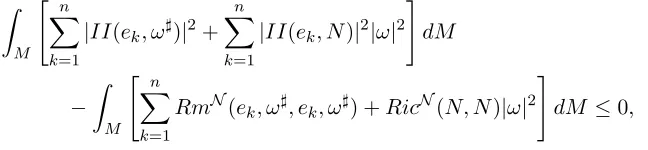
#
dM ≤0,
where equality can only happen when Nn+1 is the complex projective planeCPmand the harmonic formωonMnis such thatRmN(N, ω♯, N, ω♯) = |ω|2+ 3g(ω♯, JN)2 = 4|ω|2. In turn, this implies at once (by virtue of the Cauchy-Schwartz inequality) that there exists a smooth function
f :M → Rsuch that ω♯ = f JN. We shall see in Appendix A that, in
this setting, necessarily f = 0 identically on Mn (see Proposition A.0 for a precise statement), and henceωmust be the trivial one-form. As a result, the inequality in question must be strict for all non-zero harmonic forms.
Theorem 7. Let Mn be a closed embedded minimal hypersurface of the complex projective space CPm, 2m=n+ 1. Then
index(M)≥ 2
m(m+ 2)(m+ 1)2b1(M).
Theorem 8. Let Mn be a closed embedded minimal hypersurface of
the quaternionic projective space HPp, 4p=n+ 1. Then
index(M)≥ 2
(2p+ 3)(2p+ 1)(p+ 1)pb1(M).
Theorem 9. Let Mn be a closed embedded minimal hypersurface of the Cayley plane CaP2. Then
index(M)≥ 1
351b1(M).
5.4. Product of the circle and unit spheres.In this subsection, we consider (Nn+1, g) to be the Riemannian product of the unit circle S1 with the unit round sphereSn. As these spaces have non-negative Ricci
curvature, this case goes beyond the situations described in the conjec-ture stated in the Introduction. However, it is still possible to obtain similar bounds for the Morse index of their embedded hypersurfaces.
The case of closed embedded minimal surfaces inS1×S2 was already studied in detail by Urbano in [38] (see Theorem 4.8 in [38] for the pre-cise statement of his result). We remark that the proof in [38] used the coordinates of harmonic one-forms as test functions for the index form, i.e., the proof used formula (8) specialized to the case of the canonical product embedding of S1×S2 inR5.
Thus, in the sequel we restrict ourselves to higher dimensions.
Theorem 10. Let Mn be a closed embedded minimal hypersurface of
S1×Sn,n≥3. Then
index(M)≥ 2
(n+ 3)(n+ 2)b1(M).
Proof. We consider the standard embedding of Nn+1 =S1×Sn into Rn+3=R2×Rn+1. It is a product embedding of totally umbilic
hyper-surfaces. The tangent space of Nn+1 decomposes as T S1⊕T Sn. Let π1:TN →T S1,π2 :TN →T Sndenote the corresponding projections. Since S1 is one-dimensional andSn has the constant sectional
curva-tures equal to one, the Riemann curvature tensor of (Nn+1, g) is given by
RmN(X, Y, X, Y) =|π2(X)|2||π2(Y)|2− hπ2(X), π2(Y)i2 for all X, Y ∈ X(N). In particular,
The second fundamental form of Nn+1 inRn+3 is given by
|II(X, Y)|2=hπ1(X), π1(Y)i2+hπ2(X), π2(Y)i2 =hX, π1(Y)i2+hX, π2(Y)i2.
LetMnbe an oriented minimal hypersurfaceMnofNn+1(or the two-sided cover of a one-two-sided hypersurface) and ω be a harmonic one-form on Mn. On one hand, we have
n
X
k=1
|II(ek, N)|2 = n
X
k=1
hek, π1(N)i2+
n
X
k=1
hek, π2(N)i2
=|π1(N)|2− hN, π1(N)i2+|π2(N)|2− hN, π2(N)i2
=|π1(N)|2− |π1(N)|4+|π2(N)|2− |π2(N)|4
= 1− |π1(N)|4− |π2(N)|4, (20)
and, analogously,
(21)
n
X
k=1
|II(ek, ω♯)|2 =|ω|2− hN, π1(ω♯)i2− hN, π2(ω♯)i2.
On the other hand, a similar computation gives
n
X
k=1
RmN(ek, ω♯, ek, ω♯) = n
X
k=1
|π1(ek)|2|π1(ω♯)|2+
n
X
k=1
|π2(ek)|2|π2(ω♯)|2
+hN, π1(ω♯)i2+hN, π2(ω♯)i2− |ω♯|2. (22)
In order to proceed with the computation, we choose a convenient orthonormal basis of TpN at some point p = (p1, p2) in S1 ×Sn. Let
w denote the unit vector field on S1. The set of vectors on Tp2Sn that
are orthogonal to N constitute a vector subspace of dimension at least
n−1. Therefore we can choose an orthonormal basis forTpN of the form {T, f1, f2, . . . , fn−1, N}, where {f1, f2, . . . , fn−1, fn} is an orthonormal basis of Tp2Snand the vectors T andN can be written as
T = cos(θ)w+ sin(θ)fn N =−sin(θ)w+ cos(θ)fn.
Furthermore, if we let ϕ∈[0, π]be the angle between the vectors ω♯
andT inTpM we can express (20), (21), (22) andRicN(N, N)in terms
of the angles θand ϕ, since in particular
|π1(ω♯)|2 = cos2(θ) cos2(ϕ)|ω|2, |π2(ω♯)|2 = (sin2(ϕ) + sin2(θ) cos2(ϕ))|ω|2
as well as
Hence, combining these equations we obtain the following formula (for theopposite of the integrand in (9)):
n
X
k=1
RmN(ek, ω♯, ek, ω♯) + n
X
k=1
RmN(ek, N, ek, N)|ω|2
− n
X
k=1
|II(ek, ω♯)|2− n
X
k=1
|II(ek, N)|2|ω|2
= (n−1)|π2(N)|2+|π1(N)|4+|π2(N)|4−3|ω|2
+|π1(ω♯)|2
n
X
k=1
|π1(ek)|2+|π2(ω♯)|2
n
X
k=1
|π2(ek)|2
+ 2hπ1(N), ω♯i2+ 2hπ2(N), ω♯i2
=((n−1) cos2(θ) + cos4(θ) + sin4(θ)−3)|ω|2
+ (cos2(θ))|π1(ω♯)|2+ ((n−1) + sin2(θ))|π2(ω♯)|2
+ 4 cos2(θ) sin2(θ) cos2(ϕ)|ω|2
=((n−1) cos2(θ) + cos4(θ) + sin4(θ)−3)|ω|2
+ (cos2(θ) + 2 sin2(θ))|π1(ω♯)|2+ ((n−1) + sin2(θ))|π2(ω♯)|2
+ 2 cos2(θ) sin2(θ) cos2(ϕ)|ω|2
=((n−2) cos2(θ) + cos4(θ) + sin4(θ)−1 + 2 cos2(θ) sin2(θ) cos2(ϕ))|ω|2
+ (n−2)(sin2(ϕ) + sin2(θ) cos2(ϕ))|ω|2
=(n−2)(cos2(θ) + sin2(θ) cos2(ϕ) + sin2(ϕ))|ω|2
+ (cos4(θ) + sin4(θ)−1 + 2 cos2(θ) sin2(θ) cos2(ϕ))|ω|2.
As a result, using the fact that n ≥ 3 it is sufficient for us to prove that when ϕ, θ ∈[0, π]
q(θ, ϕ) = cos2(θ) + sin2(θ) cos2(ϕ) + sin2(ϕ)
+ cos4(θ) + sin4(θ)−1 + 2 cos2(θ) sin2(θ) cos2(ϕ)>0.
Replacing, in the expression for q,cos2(ϕ) = 1−sin2(ϕ) and making use of basic trigonometric identities we easily see that in fact
q(θ, ϕ) = 1 + sin2(ϕ) cos2(θ)(2 cos2(θ)−1)
so that patentlyq≥1forθ∈[0, π/4]∪[3π/4, π]while forθ∈[π/4,3π/4]
q(θ, ϕ)≥1 + cos2(θ)(2 cos2(θ)−1) = 2 cos4(θ)−cos2(θ) + 1≥ 7 8.
By Theorem A, the proof is complete. q.e.d.
two round spheres of arbitrary dimension (with the sole exception of
S2×S2).
Theorem 11. Let Mn be a closed embedded minimal hypersurface of
Sp×Sq, p, q≥2 and (p, q)6= (2,2). Then
index(M)≥ 2
(p+q+ 2)(p+q+ 1)b1(M).
For the sake of brevity, we decided to omit the somewhat lenghty proof of this assertion, which follows along the very same lines of the ar-gument we presented forS1×Snwith complications of purely notational
character.
5.5. Pinched convex hypersurfaces of the Euclidean space. Theorem 12. Let (Nn+1, g) be a closed embedded hypersurface of
Rn+2 whose principal curvatures k1 ≤ . . . ≤ kn+1 with respect to the
outward pointing unit normal ν are positive and satisfy the following pinching condition:
kn+1
k1
<
r
n+ 1 2 .
Then, every closed embedded minimal hypersurface Mn of Nn+1 is such that
index(M)≥ 2
(n+ 2)(n+ 1)b1(M).
Proof. It is convenient to consider the shape operatorS ofNn+1, i.e., the endomorphism of the tangent bundle ofNn+1 defined by
S:X∈ X(N)7→ −∇Xν ∈ X(N).
S and II are related by II(X, Y) = hS(X), Yiν. Using the Gauss equation (2) forNn+1, we can rewrite the integrand appearing in formula (9) only in terms of S. Thereby, one obtains
n
X
k=1
|II(ek, ω♯)|2+ n
X
k=1
|II(ek, N)|2|ω|2
− n
X
k=1
RmN(ek, ω♯, ek, ω♯)−RicN(N, N)|ω|2
=−hS(ω♯), ω♯i+hS(N), Ni|ω|2 n
X
k=1
hS(ek), eki
+ 2 n
X
k=1
hS(ω♯), eki2+hS(N), eki2|ω|2
Choosing an orthonormal frame{e1, . . . , en, N}onNn+1 and
observ-ing that
k1|X|2≤ hS(X), Xi ≤kn+1|X|2 for all X∈ X(N),
it is possible to derive the following estimates:
n
X
k=1
hS(ω♯), eki2 =|S(ω♯)|2− hS(ω♯), Ni2≤kn2+1|ω|2
n
X
k=1
hS(N), eki2|ω|2= (|S(N)|2− hS(N), Ni2)|ω|2≤(kn2+1−k21)|ω|2
hS(ω♯), ω♯i+hS(N), Ni|ω|2 n
X
k=1
hS(ek), eki ≥2nk12|ω|2.
Therefore
n
X
k=1
|II(ek, ω♯)|2+ n
X
k=1
|II(ek, N)|2|ω|2
− n
X
k=1
RmN(ek, ω♯, ek, ω♯)−RicN(N, N)|ω|2
≤(4kn2+1−2(n+ 1)k12)|ω|2 ≤0,
by our pinching assumption. The result follows since the inequality above is strict over the set where |ω|2 6= 0 which is open (and non-empty since ω is assumed to be non-trivial). Thus we get that (9) is strictly negative and the result follows from Theorem A. q.e.d.
Remark 5.3. In dimension n = 2, by similar manipulations it is possible to obtain from formula (8) a slightly better result in the sense that the weaker pinching condition
k3
k1
<
r
5 3
5.6. Pinched three-manifolds.
Theorem 13. Let (N3, g) be a closed Riemannian three-manifold with positive scalar curvature. Assume there is an isometric embedding of (N3, g) into some Euclidean space Rd such that
RN > 1 2|H~
N
|2.
Then, any closed oriented minimal hypersurface M2 of N3 is such that
index(M)≥ 1
2db1(M).
Proof. The result will follow immediately from Proposition 4 once we verify that
Z
M
2 X
k=1
|II(ek, ω♯)|2+|II(ek,∗ω♯)|2
−RN|ω|2dM <0
for all harmonic one-forms ω on an oriented minimal surface M2 in (N3, g).
The contraction of the Gauss equation for N3 gives
RN =|H|~ 2− |II|2,
where H~ =trII denotes the mean curvature vector of N3 in Rd. Since
at points where ω does not vanish {e1 = ω♯/|ω♯|, e2 = ∗ω♯/|ω♯|} is an orthonormal basis of the tangent space, we have
2 X
k=1
|II(ek, ω♯)|2+|II(ek,∗ω♯)|2
−RN|ω|2
= 2 X
i,j=1
(|II(ei, ej)|2−RN)|ω|2
≤(|II|2−RN)|ω|2 ≤(|H|~ 2−2RN)|ω|2 ≤0,
by the pinching assumption. Once again this inequality is strict when
|ω|2 6= 0which occurs on a non-empty open set. Thus once we integrate
the result follows. q.e.d.
Appendix A. The borderline case in complex projective spaces
Let(Nn+1, g)be the complex projective space of (real) dimension2m endowed with the Fubini-Study metric, namely (CPm, gF S). Let us
exploit in the sequel of this appendix.
If Mn is a closed, embeded minimal hypersurface in such ambient manifold, we have already proven in Subsection 5.3 the inequality
Z
M
" n X
k=1
|II(ek, ω♯)|2+ n
X
k=1
|II(ek, N)|2|ω|2
#
dM
−
Z
M
" n X
k=1
RmN(ek, ω♯, ek, ω♯) +RicN(N, N)|ω|2
#
dM ≤0,
with equality only when the harmonic form ω on Mn is such that
RmN(N, ω♯, N, ω♯) = |ω|2+ 3g(ω♯, JN)2 = 4|ω|2 and (by virtue of the Cauchy-Schwartz inequality) this happens if and only if there exists a smooth functionf :M →Rsuch that ω♯=f JN.
The key point of this appendix, which completes the proof of Theorem 7 is the following assertion:
Proposition A.0. Let Mn be a closed, embedded minimal
hypersur-face in(CPm, gF S). Suppose that a harmonic one-formω is proportional
to (JN)♭ at each point of Mn. Then such form vanishes identically on Mn.
Let us see why. Before getting to the proof, we shall present some preliminary lemmata.
Remark A.1. From now onwards, we shall set JN =U in order to have a distinguished notation for this vector. Also, we let η =U♭.
Fur-thermore, we shall denote here (coherently with the rest of the article) by ∇ the Levi-Civita connection of (Nn+1, g) and by ∇M the induced
connection on the hypersurface Mn. More generally, we shall adopt a superscript/subscript when referring to differential operators onMn.
Lemma A.1. In the setting above, the following assertions are true: a) g(∇Mf, U) = 0;
b) f∇UN =−J∇Mf.
Proof. We shall start by recalling that divM(η) = 0, which is rather
standard (see e. g. pg. 286 of [19]). Once we know this, taking the diver-gence ofω (and recalling the first-order characterization of harmonicity, see Subsection 2.4) gives
0 =divMω=η(∇Mf) =g(U,∇Mf),
For what concerns part b), taking the exterior derivative of ω =f η
and evaluating it for X =JN and an arbitrary Y (a section of T M), we have
0 = dω(JN, Y) =df(JN)η(Y)−df(Y)η(JN) +f dη(JN, Y)
=−df(Y) +f(JN(η(Y))−Y(η(JN))−η([JN, Y]))
=−df(Y) +f((∇MJ Nη)(Y)−(∇MY η)(JN))
=−df(Y) +f g(∇MJ NJN, Y)−f g(∇MY JN, JN) =−df(Y) +f g(∇J NJN, Y)−f g(∇YJN, JN) =−df(Y) +f g(J∇J NN, Y) +f g(J∇YN, JN) =−df(Y)−f g(∇J NN, JY) +f g(∇YN, N) =−df(Y)−f g(∇J NN, JY)
(since: η(JN) = 1identically and g(∇YN, N) = 0 becauseg(N, N) = 1
identically, and we have used that J is a skew-symmetric operator and the ambient manifold is Kähler, which ensures that ∇J = 0). That is, we have obtainedf∇J NN =−J∇Mf, which completes the proof. q.e.d.
Lemma A.2. In the setting above, we have
RicM(ω♯, ω♯) = (2m−2)f2− |∇Mf|2.
Proof. Tracing the Gauss equation (3) gives, when Mn is minimal, the equation
RicM(U, U) =RicN(U, U)−RmN(U, N, U, N)− |A(U,·)|2.
Now, it has been recalled that in our setting
RmN(N, ω♯, N, ω♯) = 4|ω|2
so that, using also the fact that (CPm, gF S) is Einstein with constant n+ 3 = 2m+ 2, we obtain
RicM(U, U) = (2m−2)− |A(U,·)|2
which proves the asserted identity once we make use of part b) of Lemma
A.1. q.e.d.
Lemma A.3. In the setting above,
|∇Mf|2 ≤ |∇Mω|2.
Proof. Differentiating ω♯ = f(JN), we have ∇M
Xω♯ = (∇MXf)JN + f∇M
XJN for every vector field X tangent toMn. Therefore |∇MXω♯|2 =|∇MXf|2+ 2f(∇XMf)g(JN,∇MXJN) +f2|∇MXJN|2.
Since 2g(JN,∇M
XJN) =Xg(JN, JN) =Xg(N, N) = 0, we obtain |∇MXω♯|2 =|∇MXf|2+f2|∇MXJN|2 ≥ |∇MXf|2
Now, let us proceed with the proof of Proposition A.0.
Proof. The standard Bochner identity for one-forms asserts that
∆1α=−∆α+RicM(α♯,·)
for any smooth one-form α. To avoid ambiguities, let us observe that
∆ = ∆M stands for the standard/elementary Laplace-Beltrami operator on M. Hence, ifω is harmonic, as we are assuming, then
∆ω=RicM(ω♯,·).
This is an equation between one-forms so we can choose the vector field to test it with, so let us evaluate both sides onω♯. If we do so and then integrate over the manifold M we get to the identity
(2m−2)
Z
M
|ω|2dM +
Z
M
(|∇Mω|2− |∇Mf|2)dM = 0
where we have used Lemma A.2 for the right-hand side. Since m ≥2, then Lemma A.3 ensures thatωis the trivial one-form and we are done. q.e.d.
References
[1] L. Ambrozio, A. Carlotto, B. Sharp, Compactness of the space of minimal hy-persurfaces with bounded volume and p-th Jacobi eigenvalue, J. Geom. Anal. (to appear).
[2] R. Buzano, B. Sharp,Qualitative and quantitative estimates for minimal hyper-surfaces with bounded index and area, preprint arXiv:1512.01047 [math.DG]. [3] A. Carlotto, Minimal hyperspheres of arbitrarily large Morse index, preprint
arXiv:1504.02066 [math.DG].
[4] A. Carlotto,Generic finiteness of minimal surfaces with bounded Morse index, Ann. Sc. Norm. Super. Pisa Cl. Sci. (to appear).
[5] O. Chodosh, D. Ketover, D. Maximo,Minimal hypersurfaces with bounded index, preprint arXiv:1509.06724 [math.DG].
[6] B.-Y. Chen,On the first eigenvalue of Laplacian of compact minimal subman-ifolds of rank one symmetric spaces, Chinese J. Math. 11(1983), no. 4, 1–15,
MR 0732862, Zbl 0514.53052.
[7] H. I. Choi, R. Schoen, The space of minimal embeddings of a surface into a three-dimensional manifold of positive Ricci curvature, Invent. Math.81(1985),
no. 3, 387–394, MR 0807063, Zbl 0577.53044.
[8] H. I. Choi, A. N. Wang,A first eigenvalue estimate for minimal hypersurfaces, J. Differential Geom.18(1983), no. 3, 559–562, MR 0723817, Zbl 0523.53055.
[9] T. Colding, C. De Lellis,The min-max construction of minimal surfaces. Surveys in differential geometry, Vol. VIII (Boston, MA, 2002), 75–107, Surv. Differ. Geom., VIII, Int. Press, Somerville, MA, 2003, MR 2039986, Zbl 1051.53052. [10] T. Colding, W. Minicozzi II, A Course in Minimal Surfaces, AMS Graduate
[11] C. De Lellis, F. Pellandini,Genus bounds for minimal surfaces arising from min-max constructions, J. Reine Angew. Math.644(2010), 47–99, MR 2671775, Zbl
1201.53009.
[12] W. Y. Hsiang, Minimal cones and the spherical Bernstein problem. I, Ann. of Math. (2)118(1983), no. 1, 61–73, MR 0707161, Zbl 0522.53051.
[13] W. Y. Hsiang, Minimal cones and the spherical Bernstein problem. II, Invent. Math.74(1983), no. 1, 351–369, MR 0724010, Zbl 0532.53045.
[14] W. Hsiang, B. Lawson, Minimal submanifolds of low cohomogeneity, J. Differ-ential Geometry5(1971), 1–38, MR 0298593, Zbl 0219.53045.
[15] W. Y. Hsiang, I. Sterling Minimal cones and the spherical Bernstein problem. III, Invent. Math.85(1986), no. 2, 223–247, MR 0846927, Zbl 0615.53054.
[16] N. Kapouleas, Doubling and desingularization constructions for minimal sur-faces, Surveys in geometric analysis and relativity Adv. Lect. Math. (ALM), Int. Press, Somerville, MA 20 (2011) 281–325, 2011. MR 2906930, Zbl 1268.53007. [17] N. Kapouleas, S.-D. Yang,Minimal surfaces in the three-sphere by doubling the
Clifford torus, Amer. J. Math. 132 (2010), no. 2, 257–295, MR 2654775, Zbl
1198.53060.
[18] D. Ketover, Degeneration of Min-Max Sequences in 3-manifolds, preprint arXiv:1312.2666 [math.DG].
[19] M. Kon,Real minimal hypersurfaces in a complex projective space, Proc. Amer. Math. Soc.79(1980), no. 2, 285–288, MR 0565355, Zbl 0435.53041.
[20] B. Lawson,Complete minimal surfaces inS3, Ann. of Math.92(1970), 335-374,
MR 0270280, Zbl 0205.52001.
[21] J. L. Lee,Introduction to smooth manifoldsGraduate Texts in Mathematics, 218. Springer-Verlag, New York, 2003. xviii+628 pp, MR 1930091, Zbl 1030.53001. [22] F. Marques,Minimal surfaces - variational theory and applications, Proceedings
of the International Congress of Mathematicians, Seoul 2014.
[23] F. Marques, A. Neves, Min-max theory and the Willmore conjecture, Ann. of Math. (2)179(2014), no. 2, 683–782, MR 3152944, Zbl 1297.49079.
[24] F. Marques, A. Neves, Existence of infinitely many minimal hypersurfaces in positive Ricci curvature, preprint arXiv:1311.6501 [math.DG].
[25] F. Marques, A. Neves,Morse index and multiplicity of min-max minimal hyper-surfaces, preprint arXiv: 1512.06460 [math.DG].
[26] A. Neves,New applications of Min-max Theory, Proceedings of the International Congress of Mathematicians, Seoul 2014.
[27] J. Pitts,Existence and regularity of minimal surfaces on Riemannian manifolds, Mathematical Notes, 27. Princeton University Press, Princeton, N.J.; University of Tokyo Press, Tokyo, 1981, MR 062602, Zbl 0462.58003.
[28] P. Petersen, Riemannian geometry. Second edition, Graduate Texts in Math-ematics, 171. Springer, New York, 2006. xvi+401 pp, MR 2243772, Zbl 1220.53002.
[29] A. Ros, One-sided complete stable minimal surfaces, J. Differential Geom. 74
(2006), no. 1, 69–92, MR 2260928, Zbl 1110.53009.
[30] A. Savo, Index bounds for minimal hypersurfaces of the sphere, Indiana Univ. Math. J.59(2010), no. 3, 823–837, MR 2779062, Zbl 1209.53052.
[31] A. Savo,The Bochner formula for isometric immersions, Pacific J. Math.272