A Distributed Caching Approach for Improved
Data Availability in Rural Wireless Mesh
Networks
Ayomide Ajayi, Christopher Edwards, Utz Roedig
School of Computing and Communications, Infolab 21, Lancaster University, Lancaster, LA1 4WA, United Kingdom{a.ajayi, c.edwards, u.roedig}@lancaster.ac.uk
Abstract— The performance of wireless mesh networks (WMNs) deployed for Internet access in rural settings is affected by several factors. Typically, deployments in African domains use cheap and computationally constrained devices with challenges such as power fluctuations, gateway congestion, VSAT communications asymmetry and low bandwidth, which affects throughput under dynamic scenarios. Caching methods can offer improvement for content availability to ensure a reliable quality of experience (QoE) for rural dwellers. Primarily, we integrate a modified multicast technique and overhearing for object caching and cache dissemination. We proposed a Distributed Overheard-object Caching Approach (DOCA) and evaluated the performance employing simulations. The outcome shows significant improvements over the random-path-cache-request (RPCR) strategy with increased data availability and reduced communication cost regarding response time for the outlined rural scenarios. Moreover, the optimization of gateway load helps to conserve network resources such as bandwidth and nodal energy considerably.
Keywords— Data Availability, Resource Conservation, Distributed Caching, Overhearing and Wireless Transmission.
Full paper CSCI-ISMC
I. INTRODUCTION
Rural WMNs (RWMNs) faces many challenges including bandwidth scarcity, battery power constraints, and wireless vulnerabilities [1]. Moreover, they employ VSAT connectivity with information communication asymmetry that prolongs latencies and congested gateways. The degradation of TCP throughput over multi-hops limits data availability and network reliability [2], which makes the need for improved data access mandatory to ensure a reliable quality of experience (QoE) for rural dwellers.
Caching exploit workload locality to cache data items over WMNs to optimize network efficiency. However, the challenge of minimizing the object access cost is more critical in RWMNs than the Internet due to topology variabilities and resource limitations. Consequently, traditional caching strategies such as clustering and proxy servers cannot provide sufficient guarantees for high data accessibility and fast message communication.
As opposed to these approaches, we leverage the ability to provision every mesh router with inexpensive high-capacity storage to serve as potential cache locations while exploiting hybrid techniques, which offers flexibility to topology and
power dynamics. We propose a Distributed Overheard-object Caching Approach (DOCA) that integrates the use of a modified multicast technique based on a minimal spanning tree (MST) semantic and the overhearing ability of nodes. The nodes employ a modified multicast to send transmissions that other nodes overhear based on their degrees (the number of nodes wirelessly connected to it). Further, the caching system incorporates a light-weight cache consistency (content homogeneity) scheme for inter-nodal communication, the semantic of which also employs overhearing.
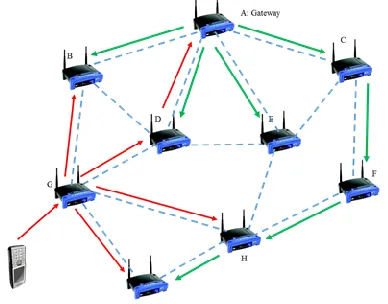
[image:1.612.332.526.463.615.2]Specifically, the objective of DOCA is to minimize the overall network communication cost through the reduction of average hop-count to achieve greater cache hits when accessing user applications over the WMN backbone. It offers improved performance efficiency of RWMNs by surmounting the problems of decreased throughput and increased latency for nodes at the edge of a WMN. Moreover, the modified multicast based on the MST helps to optimize the gateway load whereas the overhearing also enables efficient bandwidth capacity utilization and energy efficiency. Hence, DOCA offers a considerable increase in data availability, accessibility and resource optimization (DAAROP) in a typical RWMN shown in figure 1.
discussions. Section 7 presents the conclusion as well as limitations that motivate future work.
II. NETWORK MODEL AND ASSUMPTIONS
A random wirelessly connected nodes is depicted in Figure 1, which models as an undirected graph G = (V, E), where ‘V’ and ‘E’ denotes the nodes and the wireless communications links between a pair of nodes. However, we assume a restrictive grid topology for the purpose of simulation as well as simplicity of formulation of the problem. Network nodes serve as traffic forwarder as well as cache locations. Each node uses IEEE 802.11 radios to wirelessly connect based on their degree while specialized nodes act as the Internet gateway (IGW). Even, when multi-gateways are in use; only one is operational in rural scenarios due to cost constraints while the other serve as a backup. Nodes employ different non-overlapping interfaces to overhear transmissions from other connected nodes within the local wireless hop. Each node is equipped with unbounded memory using inexpensive high capacity storage devices such as flash and SD-memory. Each client device associated with only one edge mesh router (EMR) even if within the transmission region of others and does not participate in caching due to resource limitations. The choice of routing (in this case OLSR) is subjective given wide preference in RWMN deployment scenarios. Also, the Internet-based TCP protocol is used for data exchange while the need to know the location of objects a priori is not necessary because cache placement is not a consideration. Moreover, the gateway serves as a central store for updates to cached objects.
III. RELATED WORK ON CACHING
Content caching based on traditional clustering offers great improvements in throughput and energy efficiency [3-7]. These mechanisms are impractical for deployments in resource-constrained and dynamic rural settings. MeshCache and CacheRescue enhance throughput for client access by mitigating gateway congestions albeit not attractive in remote domains because of clients’ resource-limitations [8-9]. An RTS-id technique implements a link-layer packet caching to improve bandwidth utilization without exploiting overhearing for the replies of requested objects and cache homogeneity [10]. Also, [11] proposed “Ditto”, which exploits overhearing to improve TCP throughput. However, the utility of a pull-based transport protocol limits the last hop wireless link performance due to incompatibilities with dynamic and short flow contents. Moreover, Ditto lacks functional schemes to select proxies to optimize gateway load and not cost-effective for rural adoption due to design complexity.
Further, Refactor exploit IP-layer redundancy elimination (RE) and network coding methods for content overhearing [12]. However, the lack of piece diffusion mechanisms affects download accelerations while the use of IP-layer content overhearing in a typical resource-constrained (power and memory) rural domains remains challenging if the client must, also, serve as cache locations. [13] examines a random path cache request (RPCR) technique that utilizes any upstream node
other than the one specified in the routing table to reduce access latency and optimize gateway load and network resources over a static WMN. The technique does not provide throughput fairness nor offers flexibility to topology variations.
Gonzalez-Cañete et al. uses a redirection technique based on clustering to minimize access latency in MANETs [14]. However, location-based protocols and devices with GPS capabilities are necessary to ensure efficient redirection of data access requests. Moreover, the intensive computation and energy requirements for geographical-based routing makes the technique computationally complex and cost-ineffective for RWMNs. Also, Wu et al. [15] optimizes cache placement and discovery via an overhearing method to reduce the cost and latency of data access in a wireless ad hoc network. However, it does not consider the use of overhearing for cache consistency while it utilizes client devices. The study in [16] implements a content distribution strategy that combines network coding and overhearing over a single hop ad hoc network. The approach used a quasi-distribution greedy approach, which is inefficient due to pseudo centralization, for selecting a piece and the transmission terminal for the acceleration of downloads. Moreover, combining overhearing and network coding for WMNs in resource-constrained rural domains is not trivial and cost-effective.
Furthermore, VillageShare integrates a time delayed proxy server and content-sharing techniques to localize traffic, optimize bandwidth and minimize gateway congestions for Facebook applications [17]. However, the design redirect file access to a limited number of servers rather than offering the flexibility of data access over the mesh backbone.
IV. OVERVIEW OF DISTRIBUTED OVERHEARD- OBJECT CACHING APPROACH (DOCA) A. DOCA Description
When an EMR receives a data access request from a mobile client (MC), it sends a multicast message that all nodes attached to it overhear based on its degree. If the data object is available (a cache hit), it returns the object to the node for onward delivery to the client requestor. Otherwise (if a cache miss), it performs an MST semantic to access the new object through intermediate nodes through to the destination IGW node (IGWN) “A”. When a target node or the IGWN receives the request message, it forwards the request-reply by sending the data object. However, when sending the data reply; each of the nodes wirelessly connected to the replying node or IGWN utilizes overhearing to cache any data object sent through multicast by the responding node. Moreover, intermediate nodes on the reply path to the requestor nodes also cache the data object.
cache locations. In this case, a reply from the node "A" (IGW) sends the object to nodes B, D, C and E (green lines). The recursive semantics of wireless transmission for both object request and reply continues to ensure cache propagation to all MRs. However, the exceptions are nodes, which detects duplicate transmissions and hence discards such messages. The modified MST multicast affords the accessing of the new object and also robustness to dynamic topologies. Also, it serves as a route discovery mechanism following changes in the candidate path of any underlying routing protocol. B. DOCA Algorithm
1: BEGIN (Object Request)
2: Client request object “x” from an EMR If “cache-hit” then EMR send object to client
Otherwise
3: EMR multicast to nodes based on its degree
If a “cache-hit” return object “x” from any of nodes Else (a cache miss)
If a first/new object “x” request then 4: Compute an MST to GW.
5: End
Object Reply (transfer object to the requesting client) 6: GW node multicast reply for overhearing of nodes that form its degree and nodes on-path reply to requesting EMR.
7: EMR caches Object “x”, passes it to Client X 8: End
Cache Consistency (new objects or old objects
updated)
1: Perform inter-nodal content synchronization using overhearing.
2: Cache Update (coordinated by GDU using unique ID) 3: Multicast and overhearing techniques to reduce the
network homogeneity convergence time. 4: End
C. Benefits and Limitations of DOCA
The DOCA hierarchical design, which hybridized overhearing and a modified multicast technique for content caching provide a significant improvement in network performance via resource optimization and data availability in typical small scale rural WMNs. Overhearing provides for timely distribution of cached objects across the mesh backbone as well as updates to cached objects, which enhance data ubiquity and cache homogeneity. The notion of node valency is employed in the design of DOCA, ensures that each EMR has multiple data sources equivalent to the node degree to service the requests of clients. DOCA support data availability via varied local data repertoire to service client data requests to achieve higher cache hits. Data ubiquity at the immediate proximity of EMR via overhearing offers a drastic reduction of the average hop count for data access. Hence, DOCA offers considerable reductions of data access and communications cost. Moreover, it also ensures throughput fairness for users of the network at disadvantaged positions
from the gateway because of the propagation of cached objects to the entire network nodes.
Also, DOCA offers a cost-effective strategy for the access of new data access via a simple multicast method to use the best route that minimizes response time and resource utilization. Moreover, DOCA support for path redundancy provides continued data access guarantees for remote users and consequently, network reliability. Further, DOCA offers resilience and fault tolerance in response to topology variations via sustainable network reliability since data accessibility, and transfer is not constrained to the usage of the traditional static paths. The ability of DOCA to timely propagate cached objects (and updates) among network nodes steadily via overhearing based on the degree of nodes guarantee throughput fairness and hence solving potential hidden node problem associated with gateway-constrained WMNs. Gateway constraints, as well as VSAT communication asymmetry, induces prolonged latencies over the mesh backbone even when bidirectional satellite connections are employed. However, the construct of DOCA ensures that cache hits are achieved with reduced response times because client-based object access exploits local hops defined by the degree of the edge nodes. An optimal hop count average to attain the cache hit implies minimum frequency of traffic traversals over the network and reduction of the cycles of data request channeled via the uplink. In this manner, the network optimizes the use of deficient resources such as bandwidth and power, which ensures higher throughput and extended network lifetime. Moreover, DOCA uses a gateway update unit (GDU) to detect updates to objects based on specific identifiers (ids) and propagates it as a new response to an object request via overhearing under a time-shifting technique to reduce network traffic at peak periods.
The use of nested overhearing at several design hierarchies of DOCA maximizes the benefit of the caching system while supporting greater network performance. In summary, DOCA improves network performance by enhancing data ubiquity, network reliability, and resilience through cost-effective data request and access methods in RWMNs via effective bandwidth and energy utilization, optimal communication cost and throughput fairness. Moreover, DOCA applies to multi-radio, and gateway scenarios provided the radio communications use different wireless channels, and only one gateway operates at any time albeit, at the sacrifice of higher complexity and intelligent switching between these gateways.
How to implement node functionality to cache and store contents is another problem. The assessment of the practical effectiveness of using sniffer modules and RTS-ID for our design scenario needs investigation. The computational cost for DOCA is far from trivial because it affects the design scalability. However, this cost is considerably lower compared to other state-of-the-art like Ditto, which employed sniffer modules as well as the reconstruction of byte streams, which are bandwidth intensive.
Although, security and privacy requirements in rural domains may be trivial; the caching of web content is challenging due to inability to access and modify encrypted contents [19]. Several approaches exist including the use of security keys entrusted to a representative of providers at the edge of the internet [20]. Similarly, although, not inexpensive for RWMNs, the installation of caching boxes by content providers to intercept encrypted contents are potential solutions [21]. The synergy of exploiting user security and privacy to afford effective network management operations remains crucial for network performance, availability, and reliability. Hence, security concerns remains an important aspect to be further investigated.
V. PERFORMANCE EVALUATION
We compare our proposed DOCA with random path cache request (RPCR) strategy using extensive ns-3 simulations [22]. A. Simulation setup
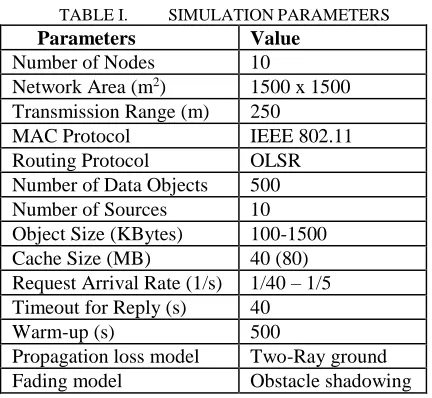
[image:4.612.59.275.443.642.2]We use a network model similar to the simulation setup in [14]. Key ns-3 simulation parameters are as shown in Table I. Moreover, the simulation assumes a confidence interval of 0.95 for the sensitivity of results.
TABLE I. SIMULATIONPARAMETERS Parameters Value
Number of Nodes 10
Network Area (m2) 1500 x 1500 Transmission Range (m) 250
MAC Protocol IEEE 802.11 Routing Protocol OLSR Number of Data Objects 500 Number of Sources 10 Object Size (KBytes) 100-1500 Cache Size (MB) 40 (80) Request Arrival Rate (1/s) 1/40 – 1/5 Timeout for Reply (s) 40
Warm-up (s) 500
Propagation loss model Two-Ray ground Fading model Obstacle shadowing B. Network setup
We simulated a wireless mesh network with ten nodes randomly over a small geographic coverage of 1500 x 1500 m2.
The network nodes employ static IP addresses (since mobility is not under consideration) and communicate using the
MAC IEEE 802. 11 protocol standard at 11 Mbps. It also uses the CSMA and RTS/CTS logic of the MAC layer to deal with contentions due to wireless vulnerabilities. Due to common usage in RWMNs and inclusion in the official version of ns-3; we utilized the OLSR protocol for the simulation. We assume that only a fraction of a total of 500 objects with varying sizes served by all cache locations based on the cache sizes of 40 and 80 MB. The size of the data objects follows a uniform distribution between 100 and 1,500 kbytes.
We also consider background traffic (BT), which normally coexists over internet-based WMNs. Specifically, the traffic consideration emulates typical user application scenarios prevalent in rural case studies such as Macha and the Sengerema networks [1]. Also, we select ten source-destination pairs uniformly at random, which allow constant bit rate (CBR) flow at approximately 100kbps to evaluate the impact of background traffic on the performance of the DOCA.
C. Performance metrics
We measured three (3) parameters in this work namely Hop Count Average (HCA), Average Access latency (AAL) and Cache Hit Ratio (CHR). HCA is the average length of the path between a data requestor and reply node, which can be an on the path or overhearing node. Also, AAL describes the average time delay between an object request and the receipt of the reply. Also, CHR refers to the percentage of the total number of request that receives an answer before the expiration of response timeout. The higher the likelihood of the occurrence of a cache hit, the lower the in-network delay and hence, indicates a fast response time.
D. Data object model
All network nodes act as client access nodes except the GW node. Performance accuracy motivates the use of a predetermined set of files to make object requests to build-up the contents of the cache locations over time. The client access model follows a uniform, distribution. The object arrival demand at each EMR follows a Poisson distribution with rate λ (object per second). While the mean inter-arrival times of each object access is 1/ λ with mean value varied from 5 to 40 seconds. The duration of the timeout for receiving the reply to an object request is set at approximately 40 seconds while the accuracy of the results is evaluated after 10000s and over 10 simulation runs. The simulation begins with approximately 500 data objects uniformly distributed over the network simulation area and object access request by each client follows a Zipf-like distribution [4]. The simulation terminates when all MRs have finished a specified number of file requests - the warm-up time. The number of file requests per EMR and the object request arrival rates is varied to evaluate different scenarios and parameters of interests.
VI. DISCUSSION OF RESULTS
A. Hop Count Average (HCA)
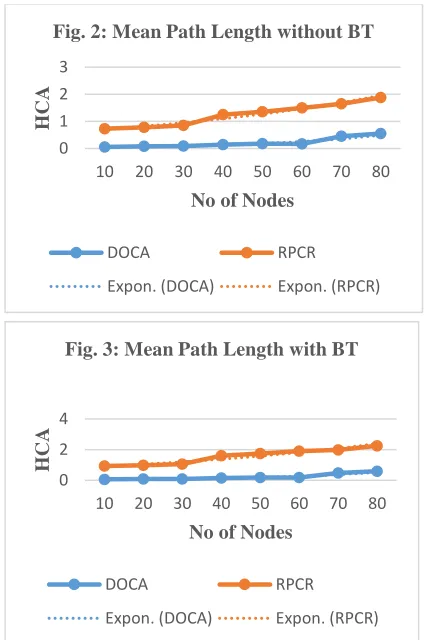
Figure 2 shows the HCA values between a requestor and its supplier. Each requesting node in the DOCA design computes the average path length between themselves and their data object suppliers in response to object access requests. In RPCR, depending on the candidate routing route, each node fetches data objects via any available intermediate nodes depending on the subsisting network topology. DOCA allows data fetching with a probability function dependent on the valency of the accessing node in the worst case scenario. For instance, a node with an out-degree of four (4) offers a worst case likelihood probability function of 0.25 to achieve lower HCA using local nodes when accessing cache objects. However, RPCR experiences a higher HCA compared to DOCA because the likelihood of object access via the local hop can remain intractable due to wireless interference and link variations. Also, the integration of overhearing and MST semantics in DOCA allows for the broad and timely spread of cache objects on the mesh routers, which achieves considerable network homogeneity regarding cache locations.
Even though the ability to cache the data via the reply path in OPC can improve the HCA, DOCA optimizes the HCA much better than the OPC with an average mean path length value of approximately 17.1% and 35.1% of that of the OPC respectively without and with BT. Hence, it shows that the use of overhearing for object request, as well as reply dissemination, offers flexibility to network traffic and congestion, which otherwise limits the performance of the OPC. Consequently, DOCA achieves optimal energy optimization and fast response time
because of the lower value of HCA resulting from minimal traffic and congestion on the network.
Furthermore, the result based on BT in figure 3 indicates that the level of the network load (congestion) has a significant effect on the average hops traversed. Particularly, DOCA shows an increase of about 6.1% for the HCA compared to the scenario without BT while that of the RPCR shows a significant increase of 24.5% under the scenarios under investigation. DOCA offers scalability with increasing node density up to a network size of 60 nodes as demonstrated by the trendline after, which the significant increase in hop count average occurs. The same also applies to the RPCR that where its value increases marginally exponentially until a certain breaking point with a network size of 30. The aforementioned is consequent upon the need to provide alternative routes under dynamic and congestion realities. The inefficiency of the underlying routing protocol remains a potential performance bottleneck; hence, optimizing route selection will further reduce the HCA values just like redirection technique.
B. Average Access Latency (AAL)
[image:5.612.50.262.289.609.2]Figure 4 shows values for the rate of data access responses for varying node densities. The average simulation results reveal an observable rise using the best fit line for AAL in the RPCR with only a marginal increase for DOCA. Specifically, RCPR shows a higher response time than the average of DOCA without BT under the typical scenario investigated. This result stems from the fact that RPCR semantic still utilizes the static path that emanates after network stability as the candidate route towards the uplink for data access. Whereas, DOCA offers a significant reduction of the access latency with a fast response time due to the use of a modified MST strategy to cater for dynamic topology as well as the overhearing ability of the nodes. DOCA shows a considerable reduction in response time of approximately 32.4% compared to that of RPCR. Moreover, as the network scales, the tendencies of a marginal rise in the access latency is expected due to the node density as well as the network size for both DOCA and RPCR. The graph shows that DOCA is more scalable than RPCR, which shows a sharp rise in latency value for a node density above 40.
Figure 5 illustrates the impact of BT on the performance of the caching method on response time for data access. DOCA 0
1 2 3
10 20 30 40 50 60 70 80
H
CA
No of Nodes
Fig. 2: Mean Path Length without BT
DOCA RPCR
Expon. (DOCA) Expon. (RPCR)
0 2 4
10 20 30 40 50 60 70 80
H
CA
No of Nodes Fig. 3: Mean Path Length with BT
DOCA RPCR
[image:5.612.326.549.525.687.2]still shows a faster response time of approximately 24.6% over the RPCR method albeit at a threshold that is lesser than its performance without background traffic.
The impact of BT on the latency of DOCA shows a reduction of the AAL by 38. 35% while the RPCR shows significant reduction of about 86.9%. These values indicate that BT offers significant performance reduction for RPCR for latency in comparison to DOCA with an increase in network size. Hence, DOCA provides greater efficiency for response to requested data than the RPCR. The considerable growth of the AAL for RPCR can be potentially dependent on client access from hidden nodes especially for new objects and as a result of the low rate of propagation of cached objects that prevents uniformity of cache spread, which leads to throughput unfairness.
C. Cumulative Hit Ratio (CHR)
The graph in Figure 6 depicts the ratio of the success of data objects access vis-à-vis the number of requests made within the time frame of the timeouts. DOCA exhibit a considerable value of data availability than over the RPCR method when there are no BT as well as with BT given the degree of data ubiquity and subsequent throughput fairness. In particular, DOCA shows 78.8 % of data availability over the RPCR whose value does not scale beyond 40 nodes with an average value of 41.8%
However, when the rate of object request arrival becomes high, the overall workload regarding traffic and messages can significantly increase thereby leading to congestions. Also,
network congestion makes the network experience longer access latency since it inhibits the timely delivery of a substantial amount of object request replies. This overhead is only marginal in small network scenarios compared to high values that larger and denser networks experience.
Moreover, the CHR for DOCA remains significantly with a value of 74.1% about RPCR that shows only approximately 32.5% data availability under increased network load. That DOCA only shows a reduction of about 7.4% data availability with BT is as result of the joint utilization of overhearing and MST that allows faster access to cache objects using local hop cache locations as revealed in Figure 7. Under relatively stable network conditions, DOCA disseminates cached objects via overhearing using the modified multicast technique that ensures that each node can successfully cache objects on all nodes wirelessly attached to them. Hence, the uniform spread of cached objects in DOCA offers robustness to wireless vulnerabilities and dynamic topologies.
Whereas, the RPCR shows significant reduction of about 27.9% regarding data availability since RPCR only spread the cached objects incrementally without a uniform spread across all network nodes. Hence, the sharp discrepancy to data availability reduction compared to DOCA is because the underlying semantic of the RPCR still largely depends on path caching, which limits the spread of cached objects across the network nodes. Consequently, the problem of throughput unfairness, as well as the hidden node terminal problems, have a significant impact on data ubiquity and access for clients located in far proximity from cached locations and the IGWN. Moreover, the observed reduction of data availability of DOCA may also have been due to increased latency as well as higher HCA that reduces the frequency of cache hits primarily caused by routing inefficiency as well as congestion.
VII. CONCLUSIONS
In this paper, we present the design and evaluation of a Distributed Overheard-object Caching Approach (DOCA) for improved performance in typical RWMNs. The key novelty of DOCA stems from the usage of overhearing for cache request, replies as well as cache synchrony. Specifically, DOCA exploits path redundancy based on node degrees to minimize retransmissions, which reduces its computational overhead and access latency.
0 0.2 0.4 0.6
10 20 30 40 50 60 70 80
L
a
tency
in (
m
icro
sec
s)
No of Nodes Fig.5: Average Delay with BT
DOCA RPCR
Expon. (DOCA) Expon. (RPCR)
0 1 2
10 20 30 40 50 60 70 80
CHR
No of Nodes
Fig.6: Cumulative hit ratio without BT
RPCR DOCA
Expon. (RPCR) Expon. (DOCA)
0 1 2
10 20 30 40 50 60 70 80
CH
R
No of Nodes
Fig.7: Cumulative hit ratio with BT
RPCR DOCA
Moreover, DOCA offers flexibility to inherent dynamic topologies characteristics of RWMNs due to the synergy of the usage of overhearing based on node degrees to facilitate both data request and its’ replies as well as a multicast technique based on a minimal spanning tree (MST) algorithm when accessing new data as well as route. The performance evaluation of DOCA in comparison with RPCR using NS-3 simulation with and without BT, reveals that DOCA exhibits a mean path length value that is lower than that of the RPCR, which affords faster response time geared towards increased data availability under network scenarios investigated.
DOCA delivers a comparatively higher cache hits, throughput, and data availability via the multi-use of overhearing that guarantees reliable quality of experience (QoE) for end-users in typical RWMN deployment scenario. However, the evaluation of DOCA requires further simplification of some few design assumptions to ensure the robustness of the proposed caching architecture. The cache size will be varied to evaluate the effectiveness of the GDU for cache updates and replacements. Apart from investigating the computational cost via mathematical analysis; the synergy of combining efficient routing with DOCA is currently under investigation.
ACKNOWLEDGMENT
The work attracted support in part from TETFUND grant number ETF/ES/AST&D/LAUST/OGBOMOSO/VOL. We also acknowledged the help of proofreaders including Mr. Adesegun Adeyemo.
REFERENCES
[1] Ajayi, Ayomide, Utz Roedig, Christopher Edwards, and Nicholas Race. "A survey of Rural Wireless Mesh Network (WMN) deployments." In Wireless and Mobile, 2014 IEEE Asia Pacific Conference on, pp. 119125. IEEE, 2014.
[2] Johnson, David L., Elizabeth M. Belding, Kevin Almeroth and Gertjan van Stam. “Internet usage and performance analysis of a rural wireless network in macha Zambia. ” In the Proceeding of the 4th ACM Workshop on
Networked Systems for Developing Regions, p.7. ACM, 2010.
[3] T. K.R. Nkwe, M.K. Denko “Self-Optimizing Cooperative Caching in Autonomic Wireless Mesh Networks”, 14th IEEE Symposium on Computers and Communications (ISCC 09)–Sousse, pp. 411- 416 Tunisia, 2009.
[4] J. Zhao, P. Zhang, G. Cao, and C. R. Das, “Cooperative Caching in Wireless p2p networks: Design, implementation, and evaluation,” IEEE Transactions on Parallel and Distributed Systems, vol. 21, no. 7, pp. 229– 241, 2010.
[5] Alasaad A, Gopalakrishnan S, Leung V. Replication schemes for peer‐to‐ peer content in wireless mesh networks with infrastructure support. Wireless Communications and Mobile Computing. 2015 Mar 1; 15(4):699-715.
[6] Weigang Wu and Yifei Huang, Hierarchical Cooperative Data Caching for Wireless Mesh Networks, IEEE/IFIP International Conference on Embedded and Ubiquitous Computing, 2010
[7] Majd, Nahid Ebrahimi, Satyajayant Misra, and Reza Tourani. "Split-Cache: A holistic caching framework for improved network performance in wireless ad hoc networks." In Global Communications Conference (GLOBECOM), 2014 IEEE, pp. 137-142. IEEE, 2014.
[8] S. M. Das, H. Pucha, and Y. C. Hu, “Mitigating the gateway bottleneck via transparent cooperative caching in wireless mesh networks,” Ad Hoc Netw., Elsevier Science Publishers B. V., vol. 5, no. 6, pp. 680–703, 2007.
[9] Nkwe TK, Denko MK, Ernst J. Data ubiquity in autonomic wireless mesh networks. Journal of Ambient Intelligence and Humanized Computing. 2010 Mar 1; 1(1):3-13.
[10] Afanasyev, Mikhail, David G. Andersen, and Alex C. Snoeren. "Efficiency Through Eavesdropping: Link-layer Packet Caching." In NSDI, pp. 105-118. 2008.
[11] F. R. Dogar, A. Phanishayee, H. Pucha, O. Ruwase, D. G. Andersen, “Ditto: a system for opportunistic caching in multi-hop wireless networks,” Proc. of Mobicom‘08, pp. 279–290, 2008.
[12] Shen, Shan-Hsiang, Aaron Gember, Ashok Anand, and Aditya Akella. "REfactor-ing content overhearing to improve wireless performance." In Proceedings of the 17th annual international conference on Mobile computing and networking, pp. 217-228. ACM, 2011.
[13] Sangwongthong, Tanachai; Siripongwutikorn, Peerapon, "Proxy caching in wireless mesh networks," Electrical Engineering/Electronics, Computer, Telecommunications and Information Technology (ECTICON), 2012 9th International Conference on, vol., no., pp.16-18, May 2012 doi: 10.1109/ECTICon.2012.6254224
[14] González-Cañete, Francisco J., and Eduardo Casilari. "Evaluation of a redirection technique in cooperative caching for MANETs." In Proceedings of the 9th ACM Symposium on Performance evaluation of wireless ad hoc, sensor, and ubiquitous networks, pp. 47-52. ACM, 2012. [15] W. Wu, J. Cao, X. Fan, "Design and Performance Evaluation of Overhearing-aided Data Caching in Wireless Ad Hoc Networks," IEEE TRANSACTIONS ON PARALLEL AND DISTRIBUTED SYSTEMS, VOL. 24, NO. 3, MARCH 2013
[16] Yokose H, Nitta K, Ohzahata S, Kato T. A Practical and Efficient Overhearing Strategy for Reliable Content Distribution over a Single Hop Ad Hoc Network. Journal of Information Processing. 2016; 24(2):292-301.
[17] Johnson DL, Pejovic V, Belding EM, Van Stam G. VillageShare: Facilitating content generation and sharing in rural networks. InProceedings of the 2nd ACM Symposium on Computing for Development 2012 Mar 11 (p. 7). ACM.
[18] Barz C, Fuchs C, Kirchhoff J, Niewiejska J, Rogge H. OLSRv2 for Community Networks: Using Directional Airtime Metric with external radios. Computer Networks. 2015 Dec 24; 93:324-41
[19] Paschos G, Baştuğ E, Land I, Caire G, Debbah M. Wireless caching: Technical misconceptions and business barriers. arXiv preprint arXiv: 1602.00173. 2016 Jan 31.
[20] Maisonneuve J, Gurbani VK, Fossati T. The security pendulum. InManaging Radio Networks in an Encrypted World (MaRNEW) Workshop 2015.
[21] The appliansys cachebox. [Online]. Available: http://goo.gl/jbW82d