Base Isolation
1
Ravi Foke
2A. V. Diwalkar
JSPM’S RSCOE IInd Shift Polytechnic, Tathawade, Pune - 33
Department of Civil Engineering, Maharashtra, India
---Abstract:Base isolation is one of a most popular means of protecting a structure against earthquake forces. It is one of a most powerful tools of the earthquake engineering pertaining to the passive structural vibration control technologies. It is easiest to see the principle at work by the referring directly to the most widely used of these advanced techniques, known as base isolation. A base isolated structure is supported by the series of bearing pads, which are placed between the buildings and building foundation. The concept of the base isolation is explained through an example of building resting on frictionless rollers. When a ground shakes, the rollers freely roll, but the building above does not move. Thus, no force is transferred to a building due to the shaking of the ground; simply, the building does not experience the earthquake.
1.
INTRODUCTION [image:1.612.187.427.557.654.2]Most structural of the engineers have at least a little knowledge of what base isolation is, i t ’ s a system of springs installed at the base of a structure to protect against earthquake damage. Then, if a system can be selected from all the choices, there is the final set of how’s – how to design the system, how to connect it to the structure, how to a evaluate its performance and how to specify, test and build it. The term base isolation is uses the word isolation in its meaning of the state of being separated and base as a part that supports from beneath or serves as a foundation for an object or structure. As suggested in the literal sense of the structure (a building, bridge or piece of equipment) is separated from its foundation. The original terminology of the base isolation is more commonly replaced with seismic isolation nowadays, reflecting that in some cases the separation is somewhere above the base – for example, in a bridge the superstructure may be separated from substructure columns. In another sense, the term seismic isolation is of the more accurate anyway in that the structure is separated from the effects of the seism, or earthquake.
2.
RELATED WORK1.
Lin Su et.al.[1] The performed analysis on the new combination performed analysis on a new combination of base isolator obtained after combining the properties of electricity de France (EDF) base isolator and resilient base isolator(R-FB1) device.2.
A.N.Lin et.al.[2] In presented the seismic results of rigid base and base isolated concentrically brace and special moment resistant steel frames. Different codes were referred to the design the base isolation and the fixed base frames.3.
H.W. Shenton III [3] In this paper, compared and analyzed relative results of fix based and base isolated structure. The concrete fix base structure was designed by the referring structural agencies association of California (SEAOC). The base-isolated response was compared with the fixed base response.4.
Todd W Erickson [4] In this paperpresented response of the industrial structure under seismic forces, building was designed according to IBC code. The results of superstructure under dynamic loading was found out for an elastic response. [image:2.612.217.427.416.564.2]5.
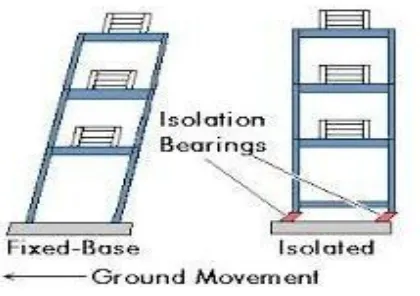
J. Enrique Luco [5] In this paper, determined the soil structure interaction effect on base isolated building. The results showed that the deformation of an inelastic structure is higher when soil effect has been taken into considerationFigure. 2 Effects of base isolation.
3.
METHODOLOGYPROTOTYPE BUILDINGS
However, it is not intended to provide final design displacements and forces for this particular seismic zone.
BUILDINGS ISOLATOR LOCATIONS AND TYPES
The paramount requirement for installation of a base isolation system is that the building be able to move horizontally relative to the ground, usually at least 100 mm and in some instances up to 1 meter. A plane of separation must be selected to permit this movement. Final selection of the location of this plane depends on the structure but there are a few items to consider in the process.
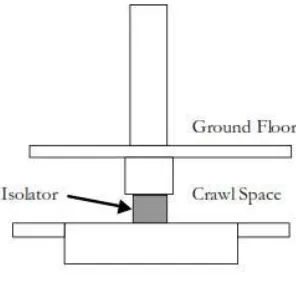
[image:3.612.220.368.303.451.2]The most of the common configuration is to install a diaphragm immediately above the isolators. This permits earthquake loads to be distributed to the isolators according to their stiffness. For a building without a basement, the isolators are mounted on foundation pads and the structure constructed above them, as shown in Figure 3
Figure 3 Building with no basement.
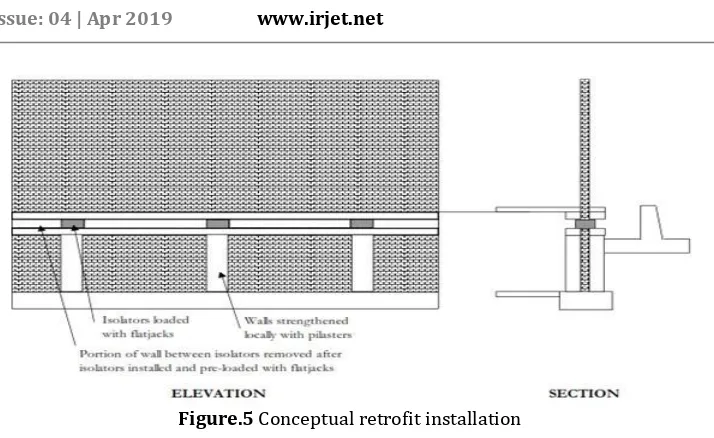
Election of the isolation plane for the retrofit of existing buildings follows the same process as for new buildings but usually there are more constraints. Also, many of the issues which are resolved during design for a new installation.
[image:3.612.185.419.526.653.2]Figure.5 Conceptual retrofit installation
4.
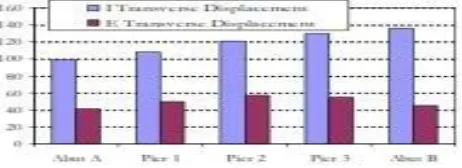
RESULT & DISCUSSION EFFECT OF ISOLATION ON DISPLACEMENTSFigures 6 and 7 compare respectively the longitudinal and transverse deck displacements for the isolation system (I) and the energy dissipation system (E). In the longitudinal direction the displacements at deck level are enforced to be equal by the axial stiffness of the deck. The base isolation displacements of 160 mm are approximately 2½ times as high as the maximum energy dissipation displacements of 60 mm. In the transverse direction the large lead cores at the abutments restrain rotation and there is some deformation due to flexure of the deck.
[image:4.612.188.421.502.623.2]The maximum isolated displacement is 136 mm at Abutment B whereas with the energy dissipation bearings the maximum displacement is 57 mm. The isolated displacements are higher by about 2½ times, the same factor as for the longitudinal displacements.
Figure. 7 Comparison for transverse displacement.
5. CONCLUSION
This bridge example has illustrated how bearings can be used in bridge structures both to reduce seismic forces on the bridge and to alter the distribution of these forces to the different substructure elements. In this example, a typical seismic isolation design is based on a 2 second isolated period and similar isolators at all abutments and piers. This reduces total seismic forces by a factor of 2.8 longitudinally and 4 transversely. Because the forces are approximately equally distributed, the isolation bearings reduce local forces by a greater factor. The longitudinal abutment forces are reduced by a factor of 7, the transverse pier forces are reduced by a factor of 5. The force reductions were associated with maximum deck displacements of 160 mm. The energy dissipation design used stiffer bearings with large lead cores at the abutments to reduce the isolated period to 1 second and concentrate forces in the abutments. This reduced the displacements compared to the isolated design, with deck displacements of 60 mm, 35% of the isolated displacements.
REFERENCE
1.
An Introduction to Seismic Isolation, Skinner, R. I, Robinson, W. H and Mc Verry, G.H. 1993, Wiley and Sons.2.
Design of Seismic Isolated Structures: From Theory to Practice, Farzad Naeim and James M. Kelly, 1999, John Wiley &Sons, Inc.