Manuscript version: Author’s Accepted Manuscript
The version presented in WRAP is the author’s accepted manuscript and may differ from the
published version or Version of Record.
Persistent WRAP URL:
http://wrap.warwick.ac.uk/108975
How to cite:
Please refer to published version for the most recent bibliographic citation information.
If a published version is known of, the repository item page linked to above, will contain
details on accessing it.
Copyright and reuse:
The Warwick Research Archive Portal (WRAP) makes this work by researchers of the
University of Warwick available open access under the following conditions.
© 2018, Elsevier. Licensed under the Creative Commons
Attribution-NonCommercial-NoDerivatives 4.0 International
http://creativecommons.org/licenses/by-nc-nd/4.0/.
Publisher’s statement:
Please refer to the repository item page, publisher’s statement section, for further
information.
Bioinformatics doi.10.1093/bioinformatics/xxxxxx Advance Access Publication Date: Day Month Year Manuscript Category
Subject Section
Position-Aware Deep Multi-Task Learning for
Drug-Drug Interaction Extraction
Lei Miao
1,
, Deyu Zhou
1,
∗
and Yulan He
2
1
School of Computer Science and Engineering, Key Laboratory of Computer Network and Information Integration, Ministry of
Education, Southeast University, Nanjing, China.
2
School of Engineering and Applied Science, Aston University, Birmingham, UK
∗To whom correspondence should be addressed.
Associate Editor:
Received on ; revised on ; accepted on
Abstract
Motivation:
A drug-drug interaction (DDI) is a situation in which a drug affects the activity of another
drug synergistically or antagonistically when being administered together. The information of DDIs is
crucial for healthcare professionals to prevent adverse drug events. Although some known DDIs can
be found in purposely-built databases such as DrugBank, most information is still buried in scientific
publications. Therefore, automatically extracting DDIs from biomedical texts is sorely needed. In this paper,
we propose a novel position-aware deep multi-task learning approach for extracting DDIs from biomedical
texts. In particular, sentences are represented as a sequence of word embeddings. An attention-based
bidirectional long short-term memory (BiLSTM) network is used to encode each sentence. The relative
position information of words with the target drugs in text is combined with the hidden states of BiLSTM to
generate the position-aware attention weights. Moreover, the tasks of predicting whether or not two drugs
interact with each other and further distinguishing the types of interactions are learned jointly in multi-task
learning framework.
Results:
The proposed approach has been evaluated on the DDIExtraction challenge 2013 corpus and the
results show that with the position-aware attention only, our proposed approach outperforms the
state-of-the-art method by 1.16% for binary DDI classification, and with both position-aware attention and multi-task
learning, our approach achieves a micro F-score of 73.14% on interaction type identification, outperforming
the state-of-the-art approach by 1.66%, which demonstrates the effectiveness of the proposed approach.
Availability:
The source code of the proposed approach and the dataset used are freely available for
non-commercial purposes at
http://cse.seu.edu.cn/people/zhoudeyu/
.
Contact:
[email protected]
1 Introduction
A drug-drug interaction (DDI) is a situation in which a drug affects the activity of another drug synergistically or antagonistically when being administered together. Concomitant medications might alter drug transportation abruptly in individuals who have previously taken a particular dose of a drug. Such an abrupt alteration might change the known safety and efficacy of a drug. For example,terfenadine was a common antihistamine intended to block the effects of an allergic rhinitis. Unfortunately several people who tookterfenadineconcomitantly with ketoconazole, an antifungal, suffered cardiac problems which often lead
to death (PKet al., 1993). Therefore, it is crucial to extract the information about DDIs. Although some known DDIs can be found in drug-related databases such as DrugBank1, most information is still buried in scientific articles. Automatic DDI extraction, aiming to automatically discover DDIs from text with high efficiency and accuracy, is becoming an increasingly well understood alternative to manual DDI discovery. Without automated DDI extraction tools, it is hard for doctors, pharmacists and researchers to keep up with the most recent discoveries described in biomedical literature. To tackle the DDI extraction problem, several evaluation tasks, such as DDIExtraction 2011 (Segura Bedmaret al., 2011) and DDIExtraction
2 L. Miao et al
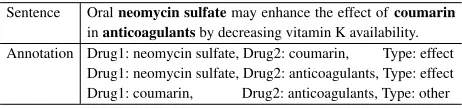
[image:3.709.115.346.365.419.2]2013 (Segura Bedmaret al., 2013) shared tasks, have been proposed in recent years to provide common benchmarking datasets for the evaluation of DDI detection from biomedical text. An example of a sentence and its corresponding DDI annotations selected from DDIExtraction 2013 is presented in Table 1. The sentence contains three drug entities: “neomycin sulfate”, “coumarin” and “anticoagulants”. The DDI with the interaction type “effect" exists betweenneomycin sulfateandcoumarin, and also, neomycin sulfateandanticoagulants. However, for the drug paircoumarin andanticoagulants, there is no interaction between them. As such, its interaction type is annotated as “other”. There are two DDI detection tasks defined, first, given a drug pair, determine whether there exists a DDI between them; second, determine the type of DDI interaction. The former task is essentially a binary classification problem while the latter is a multi-class classification problem since there are more than two interaction types.
Table 1. An example of one sentence and its corresponding DDI annotations selected from DDIExtraction 2013.
Sentence Oralneomycin sulfatemay enhance the effect ofcoumarin
inanticoagulantsby decreasing vitamin K availability. Annotation Drug1: neomycin sulfate, Drug2: coumarin, Type: effect
Drug1: neomycin sulfate, Drug2: anticoagulants, Type: effect Drug1: coumarin, Drug2: anticoagulants, Type: other
Early approaches to automatic extraction of DDIs are mostly based on hand-crafted rules due to the lack of annotated datasets (Segura-Bedmar et al., 2011a). With the introduction of DDIExtraction challenges in 2011 (Segura Bedmaret al., 2011) and 2013 (Segura Bedmaret al., 2013) and the availability of annotated DDI datasets, more and more machine learning based methods have been proposed (Buiet al., 2014). These approaches typically rely on a set of carefully designed features to train supervised classifiers such as support vector machine (SVM). The results of DDI extraction largely depend on the quality of the features used, as evidenced by the submitted systems to the DDIExtraction 2013 challenge. To avoid the tedious process for feature design, in recent years, deep learning techniques have been proposed to automatically learn feature representations from abundant unannotated data (Bengioet al., 2013). Different neural network based methods, such as Convolutional Neural Networks (CNNs) (Liuet al., 2016b) and Recurrent Neural Networks (RNNs) (Sahu and Anand, 2017), have been proposed to automatically extract feature vectors from sentences for DDI extraction.
Nevertheless, we argue that the position that a drug occurs in a sentence could be important for DDI extraction since drug pairs occur in different positions could capture syntactic information to a certain extend and hence gives indications of DDIs. Also, binary (classify whether DDI exists within the given drugs) or not) and multi-class (classify the interaction of a drug pair into one of the DDI types) DDI classifications are related tasks. Hence, by learning the two tasks jointly, we can capture the shared features effectively which might benefit to each other. In this paper, we propose a novel position-aware deep multi-task learning approach which is built upon bidirectional long short-term memory networks, called PM-BLSTM, for extracting DDIs from biomedical texts. Our contributions are summarized below: (1) We incorporate the position-aware attention mechanism by combining position embeddings with the hidden states of BiLSTM to generate the position-aware attention weights. Moreover, the position embedding is employed repeatedly when generating the attention weights to make the attention mechanism more flexible and potent; (2) We propose a multi-task learning framework to tackle jointly the tasks of predicting whether or not two drugs interact with each other and further distinguishing the types of interactions. Jointly learning both tasks allows
the capture of shared features more effectively which could benefit both tasks; (3) The proposed approach has been evaluated on the DDIExtraction challenge 2013 corpus and the results show that with the position-aware attention only, our proposed approach outperforms the state-of-the-art method by 1.16% for binary DDI classification, and with both position-aware attention and multi-task learning, our approach achieves a micro F-score of 73.14% on interaction type identification, outperforming the state-of-the-art approach by 1.66%, which demonstrates the effectiveness of the proposed approach.
The rest of the paper is organized as follows. Section 2 surveys existing approaches for DDI extraction. Section 3 describes the proposed method, which consists of four components: the embedding layer, the BiLSTM layer, the position-aware attention layer and the multi-task output layer. Section 4 presents experimental setup and results. Finally, Section 5 concludes the paper and outlines future research directions.
2 Related Work
Most existing approaches to DDI extraction are based on machine learning. In order to predict the relation between a given pair of drugs, classifiers are typically trained on lexical, syntactic and semantic features extracted from manually labelled corpora. Based on the way of feature construction, approaches can be roughly divided into two categories, feature-based and kernel-based methods (Bui et al., 2014). Feature-based approaches focus on finding potentially discriminative features to represent data characteristics. Apart from the basic bag-of-words features, researchers have explored the use of various types of features including context features (Segura-Bedmaret al., 2011b), a combination of lexical, semantic and domain features (He et al., 2013), and heterogeneous features consisting of lexical, syntactic, semantic and negation features derived from parse trees (Chowdhury and Lavelli, 2013a). Kernel-based approaches employ different kernels to calculate the similarity between two instances by exploiting the structural representations of data instances such as syntactic parse trees or dependency graphs (Tikket al., 2013). In the past DDIextraction challenges, the most commonly used kernels are all-paths graph kernel (Airolaet al., 2008), shallow linguistic kernel (Giuliano et al., 2006) and path-enclose tree kernel (Moschitti, 2004). It is also possible to combine multiple kernels in order to compensate the weakness of each individual kernel. For example, in the work of Faisalet al.(2013), three different kernels were combined to form a hybrid kernel which gives a better performance compared to those using a single kernel. However, these approaches typically rely on feature engineering to generate a list of discriminative features for training supervised classifiers. As observed in DDIExtraction 2013 challenge, different approaches adopted different feature engineering techniques and there is no standard way in generating features. Moreover, features often need to be redesigned when previously developed systems are adapted for the task of DDI extraction. For example, UTurku, a system originally developed for biomedical event extraction was adapted for DDI extraction by redesigning the features specifically for DDI extraction (Jari Björne and Salakoski, 2013).
DDI extraction. Quanet al.(2016) incorporated semantic information of multiple word embeddings with multichannel CNNs. Zhaoet al.(2016) combined CNN with some traditional features. Apart from CNNs, RNNs have also been used for biomedical relation classification. Sahu and Anand (2017) used LSTMs for DDI extraction and Yiet al.(2017) extracted DDI at the corpus level via gated recurrent unit networks (GRUs). In both approaches, the attention mechanism was incorporated.
3 Method
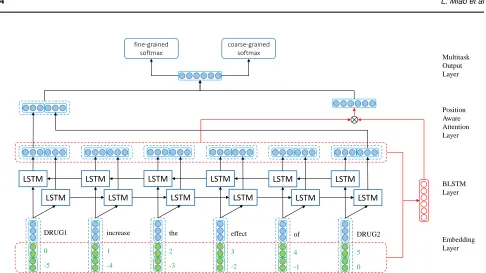
In this section, we present the proposed position-aware multi-task deep learning method built on bidirectional LSTMs (PM-BLSTM), which is illustrated in Figure 3, for DDI extraction. It can be observed that PM-BLSTM is based on a BiLSTM by incorporating position-aware attentions. Different from previous attention-based LSTM based approaches (Zhou et al., 2016), PM-BLSTM utilizes the position information to enhance the effectiveness of the attention mechanism. Moreover, the tasks of predicting whether or not two drugs interact with each other and further distinguishing the types of interactions are tackled jointly in output layer. The proposed approach consists of four main components: the embedding layer, the BiLSTM layer, the position-aware attention layer and the multi-task output layer. In the following, we first discuss how we pre-process the data and then describe each of the four components of PM-BLSTM in details.
3.1 Preprocessing
As the proposed approach is to predict whether there exists an interaction between two drugs and identify the interaction type, the sentence with more than two drug entities needs to be processed to make sure only one drug pair remains in each instance. For the sentence containing more than two drug entities, C2
n instances are generated. Following
the previous method (Kimet al., 2015), we replace the two target drug entities with symbols “DRUG1” and “DRUG2” respectively, and represent other drug entities as “DRUG0”. The drug pairs with interactions are considered as positive training instances and the others are considered as negative training instances. However, such preprocessing might generate some redundant and ambiguous training instances. For example, for the sentence “drug1/drug2: drug3 inhibits the enzymatic oxidation
of drug4 and drug5 to drug6.”, it contains two positive DDIs
hdrug3, drug4iandhdrug3, drug5iwhile the other 13 drug pairs such
ashdrug1, drug2i,hdrug1, drug3i,hdrug1, drug4iare all negative
instances. The number of negative instances is significantly more than that of positive instances. Therefore, we defined two rules below for filtering the generated noisy training instances:
• Rule 1: Instances with two target drugs referring to the same drug should be removed.
• Rule 2: Instances with two target drugs being in coordinate position should be removed.
3.2 Embedding Layer
The input to the embedding layer is DDI instances. Given a sentence
S={w1, w2, ..., wT}in whichwu=“DRUG1” andwv=“DRUG2”,
two position measurespi1andpi2 are defined for each wordwi. Here,
Pi1=i−uandPi2=i−v, representing the relative distance between
wiand the target drugwuandwvrespectively. In this layer, each word
wiis represented by adw-dimensional vectorewi, by looking up a word
embedding dictionary which can be initialized randomly or uses the pre-trained vectors. Position measures are embedded in thedp-dimensional
space which are initialized randomly. The whole process can be described
as follows:
ewi=LTw(wi), epi1 =LTp(pi1), epi2 =LTp(pi2), (1)
whereLT denotes a look-up operation. After that, the word embedding
ewi and the two position embeddingsepi1 andepi2 are concatenated to generate the final embedding xi for the wordwi. Hence, xi ∈ R(dw+2dp):
xi=ewi⊕epi1⊕epi2, (2)
where⊕denotes a concatenation operation. Finally, a sentence withT
words is represented by{x1, x2, ...xT}, which forms the input to the
BiLSTM Layer.
3.3 Bidirectional LSTM Layer
Recurrent neural network (RNN) is a powerful model for processing serialized input with arbitrary length. As a special RNN structure, LSTM was proposed to address the problem of exploding or vanishing gradients (Hochreiter and Schmidhuber, 1997). In general, LSTM possesses a memory cell which is able to store the previous information over long periods of time. An adaptive gating mechanism is utilized for restricting the previous state and the current input information.
The LSTM unit at each time step shares the same structure and parameters. For example, at timet, an LSTM unit receives the previous hidden stateht−1and the current input vectorxt. Based onht−1andxt,
the input gateit, the forget gateftand the output gateotare calculated
accordingly. The memory cellctabsorbs both the current and previous
information restricted byit, ft. The complete neural network can be
calculated by the following formulae:
it = σ(Wixt+Uiht−1+bi), (3)
ft = σ(Wfxt+Ufht−1+bf), (4)
ot = σ(Woxt+Uoht−1+bo), (5)
gt = tanh(Wcxt+Ucht−1+bc), (6)
ct = itgt+ftct−1, (7)
ht = ottanh(ct), (8)
whereσ is the logistic sigmoid function anddenotes element wise multiplication. All of the vectors in the Left-Hand Side of the equations (3)−(8) are inRd.
To consider both directional information of an input sentence, we adopt the bidirectional LSTM (BiLSTM) network with two LSTM layers to process the sequence in forward and backward directions respectively. The hidden states of theith step are are concatenated ashi= [
− →
hi⊕ ←−
hi].
Thus, we get a2d-dimensional vector at each time step.
3.4 Position-Aware Attention Layer
Attention-based models have demonstrated success in a wide range of NLP tasks (Zhouet al., 2016; Bahdanauet al., 2014). The basic idea of the attention mechanism is to assign a weight to each hidden unit in the lower-level of the neural network when computing an upper-lower-level representation. However, for DDI extraction, the biomedical sentences are always long-winded and often contain more than one drug pair. Therefore, we propose a position-aware attention mechanism which considers not only the semantic information of words but also the global position information.
Let H ∈ R2d×T be a matrix consisting of the hidden states
4 L. Miao et al
Embedding Layer BLSTM Layer Position Aware Attention Layer Multitask Output Layer
DRUG1
0
-5
LSTM
LSTM
LSTM
LSTM
LSTM
LSTM
LSTM
LSTM
LSTM
LSTM
LSTM
LSTM
fine-grained softmax
coarse-grained softmax
increase
1
-4
the
2
-3
effect
3
-2
of
4
-1
DRUG2
5
[image:5.709.114.600.138.411.2]0
Fig. 1.The architecture of the position-aware multi-task bidirectional LSTM (PM-BLSTM).
ei= [epi1 |, e
pi2
|]|. The attention weightαand the weighted hidden representationrare calculated based on the following formulae:
M = tanh( "
WhH
WpE #
), (9)
α = sof tmax(wTM), (10)
r = HαT, (11)
whereM ∈R2d+2dp×T,α∈
RT,r∈R2d.Wh∈R2d×2d,Wp∈ R2dp×2dpandw∈R2d+2dpare all transformation matrices need to be
learned.
In order to increase the diversity, the last hidden state of BiLSTM is also used. Let−h→T ∈Rdbe the last hidden state of the forward LSTM, and←h−1∈
Rdbe the last hidden state of the backward LSTM corresponding to the first word.hl∈R2dis the concatenation ofhTandh1which represents the
output of the BiLSTM layer. The final sentence representation is calculated by:
hl = [ −→
hT⊕ ←−
h1], (12)
h∗ = tanh(Wpr+Wxhl), (13)
whereh∗∈ R2d,W
p ∈R2d×2dandWx ∈ R2d×2dare both affine transformation matrices.
3.5 Multi-Task Learning
In DDI extraction, there are two subtasks.Task-1is a binary classification problem which aims to predict whether or not two drugs interact with each other. Task-2is a multi-class or more fine-grained classification problem, which aims to further distinguish the types of interactions. In the DDI extraction 2013 challenge, four types of DDIs are defined including “advice”, “effect”, “mechanism” and “intact”. Previously, the
two subtasks are learned separately. However, the two subtasks are closely related. As such, we explore the use of multi-task learning here. Multi-task learning is an approach to improve generalization by using the domain information contained in the training signals of related tasks as an inductive bias. It achieves this by learning tasks in parallel while using a shared representation; what is learned for each task can help other tasks be learned better (Caruana, 1997).
In the multi-task output layer, twosof tmaxbased classifiers,ycand
yf, are used for coarse-grained (or binary) classification and fine-grained
(or multi-class) classification tasks respectively. The dimensions ofycand
yfcorrespond to the number of the classes in the two classification tasks.
yc = sof tmax(Wsch∗+bsc), (14)
yf = sof tmax(Wsfh∗+bsf), (15)
whereWsc,bsc,Wsf,bsfare all the parameters ofsof tmaxfunctions.
The objective function is the negative log-likelihood of predicted resultsy:
loss=− m X
i=1
tilog(yi) +λkθk2, (16)
wheret∈ Rmis one-hot vector (mis the number of classes),λis anL2
regularization parameter andθis the parameter set.
4 Experiments
In this section, we present the experimental setup and results for the evaluation of the effectiveness of the proposed approach.
4.1 Experimental Setup
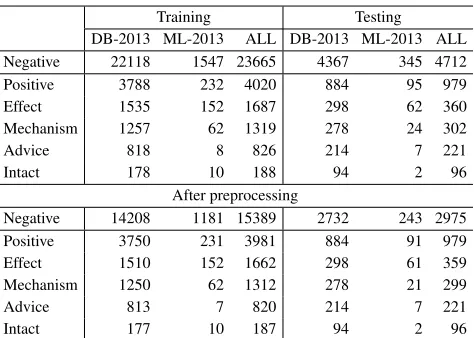
abstracts (ML-2013). DB-2013 and ML-2013 are combined together and the training/testing split follows the same experimental setup in most neural network based approaches (Liuet al., 2016b). The statistics of the datasets are shown in Table 2. The pre-processing rules mentioned in Section 3 are applied on the training and testing data to remove ambiguous or misleading instances. It can be observed from the lower part of Table 2 that more than
[image:6.709.113.350.265.434.2]35%of negative instances are filtered.
Table 2. Statistics of the datasets used in the experiments.
Training Testing
DB-2013 ML-2013 ALL DB-2013 ML-2013 ALL
Negative 22118 1547 23665 4367 345 4712
Positive 3788 232 4020 884 95 979
Effect 1535 152 1687 298 62 360
Mechanism 1257 62 1319 278 24 302
Advice 818 8 826 214 7 221
Intact 178 10 188 94 2 96
After preprocessing
Negative 14208 1181 15389 2732 243 2975
Positive 3750 231 3981 884 91 979
Effect 1510 152 1662 298 61 359
Mechanism 1250 62 1312 278 21 299
Advice 813 7 820 214 7 221
Intact 177 10 187 94 2 96
In our experiments, position embeddings are initialized randomly. The dimension of position embeddings is set to 10. Word embeddings are pre-trained using unlabeled biomedical texts we crawled from PubMed using Word2vec (Mikolovet al., 2013). The dimension of word embeddings is set to 300. The dimension of the BiLSTM hidden layer is set to 150. All models are trained with a batch size of 5 instances and the neural networks are optimized withAdaM ax. To overcome the overfitting problem, the
L2regularization weight is set to10−4in the BiLSTM layer. Dropout is
used in the embedding layer, the BiLSTM layer and the output layer. To evaluate the performance of the propose approach, we use Precision (P), Recall (R) and F-score (F) which are commonly used for the evaluation of classification results. ForTask-2, we calculate the overall micro precision (pmicro-P), recall (micro-R) and F-score (micro-F) defined as follows, which are the standard evaluation metrics used in the DDIExtraction 2013 challenge. micro-P = T P /(T P +F P),
micro-R = T P /(T P +F N), micro-F = 2 ×micro-P ×
micro-R/(micro-P+micro-R), where−denotes the average value calculated across different classes,T Pis the number of true positives,F P
is the number of false positives andF Nis the number of false negatives.
4.2 Overall Comparison
We compare our approach with the baseline models in two categories: traditional methods and neural network based approaches. Traditional methods utilize manually designed features to train supervised classifiers for DDI extraction:
• UTurku (Björne et al., 2013) was adapted from the Turku Event Extraction System (TEES), which used features from dependency parsing and domain dependent resources.
• WBI (Thomaset al., 2013) combined features of a number of DDI approaches.
• FBK-irst (Chowdhury and Lavelli, 2013b) used linear features, path-enclosed tree kernels and shallow linguistic features.
• Kim (Kimet al., 2015) used contextual, lexical, semantic and tree structured features.
Neural network based approaches learn feature representations of instances automatically based on different neural network structures.
• CNN (Liuet al., 2016b) is a shallow convolutional neural network with both word and position embeddings.
• SCNN (Zhaoet al., 2016) is an CNN with manually designed features.
• MCNN (Quanet al., 2016), semantic information is introduced as multichannel word embedding for CNN.
• DCNN (Liu et al., 2016a), a dependency-based CNN for DDI extraction.
• Joint AB-LSTM (Sahu and Anand, 2017), the outputs of a classical LSTM and an attention-based LSTM is jointly learned.
As our approach consists of two key components, position-aware attention mechanism and multi-task learning, we have also implemented two variants of our model, one with only position-aware attention mechanism (called P-BLSTM) and another with only multi-task learning (called M-BLSTM).
Table 3 shows the results of the proposed approach in comparison with the baselines for Task-1 and Task-2. It can be observed that for Task-1, the feature-based approach FBK-irst gives balanced precision and recall values and achieves the F-score of 80%. The recent NN-based approach Joint AB-LSTM improves upon the precision significantly but with worse recall in comparison to FBK-irst, which gives marginally better F-score. Our proposed PM-BLSTM performs slightly better in recall, but worse in precision compared to Joint AB-LSTM, and gives the F-score which is 1.24% lower. However, a variant of our model P-BLSTM without multi-task learning outperforms PM-BLSTM in recall and achieves the best F-score of 81.48% overall, outperforming the state-of-the-art approach Joint AB-LSTM by 1.16%.
For Task-2 which is a more difficult multi-class classification problem, we notice that NN-based approaches in general outperform feature-based approaches. We also observe that among all NN-based approaches, our PM-BLSTM achieves the best recall value and comparable micro-precision value. Overall, PM-BLSTM outperforms the state-of-the-art approach, Joint AB-LSTM, by 1.66% in micro-F-score.
4.3 The Impact of Multi-Task Learning
To further investigate the effectiveness of incorporating multi-task learning, we compare P-BLSTM without multi-task learning with PM-BLSTM in more details in Table 4. It can be observed that the micro F-score of DDI extraction on Task 2 is improved by over 0.7% with multi-task learning. However, for Task 1, incorporating multi-multi-task learning leads to slight degradation of F-score. One possible reason is that multi-task learning can get relevant inductive bias by sharing the related information of different tasks. For Task-2, the number of positive instances for each interaction type is much lower than the negative instances. Learning both Task-1 and Task-2 jointly allows the sharing of low-level features and hence alleviate the imbalanced data problem. However, the class imbalance problem is less severe for Task-1 compared to Task-2. Hence, leveraging features learned in Task-2 for classification in Task-2 does not give any performance gains. As such, we can conclude that multi-task learning helps in the more difficult multi-class classification problem (Task-2), but appears to be less effective for the binary classification Task-1.
4.4 The Impact of Position-Aware Attention
6 L. Miao et al
Table 3. Performance comparison of DDI extraction with other baselines.
Category Methods Task-1 Task-2
P R F micro-P micro-R micro-F
Traditional Methods
UTurku 85.80 58.50 69.60 73.20 49.90 59.40
WBI 80.10 72.20 75.90 64.20 57.90 60.90
FBK-irst 79.40 80.60 80.00 64.60 65.60 65.10
Kim - - 77.50 - - 67.00
Neural Network
CNN - - - 75.70 64.60 69.75
SCNN 77.50 76.90 77.20 72.50 65.10 68.60
MCCNN - - - 75.99 65.25 70.21
DCNN - - - 78.24 64.66 70.81
Joint AB-LSTM 86.36 75.07 80.32 73.41 69.66 71.48
Our approach
PM-BLSTM 82.90 75.59 79.08 75.80 70.67 73.14
P-BLSTM 82.68 80.31 81.48 74.57 70.36 72.40
[image:7.709.121.341.352.435.2]M-BLSTM 83.78 74.15 78.67 71.90 71.90 71.90
Table 4. DDI extraction results with or without multi-task learning.
P-BLSTM PM-BLSTM
P R F P R F
Task-1 Positive 82.68 80.31 81.48 82.90 75.59 79.08 Effect 69.60 72.70 71.12 69.58 73.26 71.37
Mechanism 76.92 66.89 71.56 80.93 69.57 74.82
Task-2 Advice 79.57 84.62 82.02 80.00 83.26 81.60 Intact 76.00 39.58 52.05 77.27 35.42 48.57 Overall (micro) 74.57 70.36 72.40 75.80 70.67 73.14
consistently better results for all interaction types. The results demonstrate the effectiveness of using position-aware attention for DDI extraction.
Table 5. DDI extraction results with or without position-aware attention.
M-BLSTM PM-BLSTM
P R F P R F
Task-1 Positive 83.78 74.15 78.67 82.90 75.59 79.08
Effect 67.43 73.82 70.48 69.58 73.26 71.37
Mechanism 72.55 74.25 73.39 80.93 69.57 74.82
Task-2 Advice 79.20 81.00 80.09 80.00 83.26 81.60
Intact 70.00 36.46 47.95 77.27 35.42 48.57
Overall (micro) 71.90 71.90 71.90 75.80 70.67 73.14
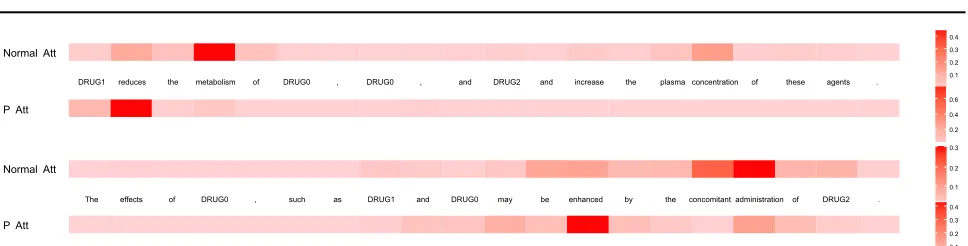
An example of two instances are presented in Figure 2 to illustrate the effect of using position-aware attention comparing with the normal attention mechanism. Here, one word’s attention weight is represented by the intensity of the red color. Darker color denotes higher attention weights while lighter color represents lower attention weights. It can be observed that the proposed position-aware attention can successfully locate the keywords in sentences which indicate the interaction on the specific drug-drug pairs. Compared with the normal attention mechanism, the proposed position-aware attention can identify the location of keywords more accurately by making full use of words’ relative distance with the target drug entities. For example, in the first sentence, the relation between DRUG1 and DRUG2 is expressed in the first clause. The normal attention mechanism generates the largest attention weights on “metabolism" and the second largest weight on “concentration" in the second clause which is irrelevant. But the position-aware attention focuses correctly on the keyword “reduces” which is the key indicator of the DDI.
4.5 The Impact of Preprocessing
The ratio of positive to negative classes in the original training set is 1:5.9. The highly imbalance nature of the corpus makes it difficult to learn classifier for DDI extraction. The problem can be partially alleviated by filtering out some ambiguous negative instances before training. But the preprocessing method would also lose some potentially useful information in the filtered instances. Therefore, the filtering rules should strike a balance between the two factors. Table 6 shows the performance of PM-BLSTM with or without negative instance filtering. It can be observed that preprocessing gives better results on both Task-1 and Task-2. As such, negative instance filtering appears to be useful for DDI classifier learning.
Table 6. DDI extraction results with or without preprocessing.
Task-1 Task-2
P R F micro-P micro-R micro-F without preprocessing 82.41 75.82 78.98 72.98 70.29 71.61 with preprocessing 82.90 75.59 79.08 75.80 70.67 73.14
4.6 Error Analysis
[image:7.709.120.339.536.619.2] [image:7.709.364.599.620.664.2]0.1 0.2 0.3 0.4
0.2 0.4 0.6
DRUG1 reduces the metabolism of DRUG0 , DRUG0 , and DRUG2 and increase the plasma concentration of these agents .
0.1 0.2 0.3
0.1 0.2 0.3 0.4
The effects of DRUG0 , such as DRUG1 and DRUG0 may be enhanced by the concomitant administration of DRUG2 .
Normal Att
Normal Att P Att
[image:8.709.113.597.144.267.2]P Att
Fig. 2.Comparison of normal attention (normal Att) and the proposed position-aware attention (P Att).
between DRUG1 and DRUG2 is described implicitly. Here, “DRUG2” is the appositive of “other agents” which has been directly expressed to have an interaction with “DRUG1”. But there is an attributive clause between “other agents” and “DRUG2”. which makes the detection of DDI between DRUG1 and DRUG2 difficult. (3) lack of training data: it is well known that deep neural network based methods need abundant training instances. The data in the DDIExtraction 2013 challenge is not large enough which makes it difficult to improve the performance of NN-based approaches.
5 Conclusion
In this paper, we have proposed a novel multi-task recurrent neural network architecture with position-aware attentions (PM-LSTM) for DDI extraction. To improve the efficiency of the attention mechanism, PM-LSTM utilizes an additional position embedding to generate the attention weights. Besides, the model takes the advantage of multi-task learning by predicting whether or not two drugs interact with each other and further distinguishing the types of interactions jointly. Experimental results on DDIExtraction 2013 corpus show that with the position-aware attention only, our proposed approach outperforms the state-of-the-art method by 1.16% for binary DDI classification, and with both position-aware attention and multi-task learning, our approach achieves a micro F-score of 73.14% on distinguishing the types of interactions, outperforming the state-of-the-art approach by 1.66%. In the future, we will explore other structures of neural networks for multi-task learning so as to improve the DDI extraction performance of both tasks simultaneously.
Acknowledgements
This work was funded by the National Natural Science Foundation of China (61528302, 61772132), the Natural Science Foundation of Jiangsu Province of China (BK20161430) and the Collaborative Innovation Center of Wireless Communications Technology.
References
Airola, A., Pyysalo, S., Björne, J., Pahikkala, T., Ginter, F., and Salakoski, T. (2008). All-paths graph kernel for protein-protein interaction extraction with evaluation of cross-corpus learning.BMC bioinformatics,9(Suppl 11), S2.
Bahdanau, D., Cho, K., and Bengio, Y. (2014). Neural machine translation by jointly learning to align and translate.Computer Science.
Bengio, Y., Courville, A., and Vincent, P. (2013). Representation learning: A review and new perspectives.IEEE Transactions on Pattern Analysis and Machine Intelligence,35(8), 1798–1828.
Björne, J., Kaewphan, S., and Salakoski, T. (2013). Uturku: Drug named entity recognition and drug-drug interaction extraction using svm classification and domain knowledge. InSemEval@ NAACL-HLT, pages 651–659.
Bui, Q.-C., Sloot, P. M., Van Mulligen, E. M., and Kors, J. A. (2014). A novel feature-based approach to extract drug–drug interactions from biomedical text.
Bioinformatics,30(23), 3365–3371.
Caruana, R. (1997). Multitask learning.Machine Learning,28(1), 41–75. Chowdhury, M. F. M. and Lavelli, A. (2013a). Exploiting the scope of negations
and heterogeneous features for relation extraction: A case study for drug-drug interaction extraction. In2013 Conference of the North American Chapter of the Association for Computational Linguistics: Human Language Technologies.HLT-NAACL, pages 765–771.
Chowdhury, M. F. M. and Lavelli, A. (2013b). Fbk-irst: A multi-phase kernel based approach for drug-drug interaction detection and classification that exploits linguistic information. InSemEval@ NAACL-HLT, pages 351–355.
Faisal, M., Chowdhury, M., and Lavelli, A. (2013). Fbk-irst: a multi-phase kernel based approach for drug-drug interaction detection and classification that exploits linguistic information. InSecond Joint Conference on Lexical and Computational Semantics (*SEM), Volume 2: Proceedings of the Seventh International Workshop on Semantic Evaluation (SemEval 2013), pages 351¨C–355, Atlanta, Georgia, USA. Association for Computational Linguistics.
Giuliano, C., Lavelli, A., and Romano, L. (2006). Exploiting shallow linguistic information for relation extraction from biomedical literature. InConference of the European Chapter of the Association for Computational Linguistics, volume 18, pages 401–408. Citeseer.
He, L., Yang, Z., Zhao, Z., Lin, H., and Li, Y. (2013). Extracting drug-drug interaction from the biomedical literature using a stacked generalization-based approach.PLoS ONE,8(6), e65814.
Hochreiter, S. and Schmidhuber, J. (1997). Lstm can solve hard long time lag problems. InAdvances in neural information processing systems, pages 473–479. Jari Björne, S. K. and Salakoski, T. (2013). Uturku: Drug named entity detection and drug-drug interaction extraction using svm classification and domain knowledge. In
Second Joint Conference on Lexical and Computational Semantics (*SEM), Volume 2: Proceedings of the Seventh International Workshop on Semantic Evaluation (SemEval 2013), pages 651¨C–659, Atlanta, Georgia, USA. Association for Computational Linguistics.
Kim, S., Liu, H., Yeganova, L., and Wilbur, W. J. (2015). Extracting drug–drug interactions from literature using a rich feature-based linear kernel approach.
Journal of biomedical informatics,55, 23–30.
Liu, S., Chen, K., Chen, Q., and Tang, B. (2016a). Dependency-based convolutional neural network for drug-drug interaction extraction. InBioinformatics and Biomedicine (BIBM), 2016 IEEE International Conference on, pages 1074–1080. IEEE.
Liu, S., Tang, B., Chen, Q., and Wang, X. (2016b). Drug-drug interaction extraction via convolutional neural networks.Computational and mathematical methods in medicine,2016.
Mikolov, T., Chen, K., Corrado, G., and Dean, J. (2013). Efficient estimation of word representations in vector space.arXiv preprint arXiv:1301.3781.
Moschitti, A. (2004). A study on convolution kernels for shallow semantic parsing. InProceedings of the 42nd Annual Meeting on Association for Computational Linguistics, page 335. Association for Computational Linguistics.
PK, H., DC, W., K, Z., DP, C., JC, M., and LR, C. (1993). Terfenadine-ketoconazole interaction: Pharmacokinetic and electrocardiographic consequences. JAMA,
269(12), 1513–1518.
Quan, C., Hua, L., Sun, X., and Bai, W. (2016). Multichannel convolutional neural network for biological relation extraction.BioMed research international,2016. Sahu, S. K. and Anand, A. (2017). Drug-drug interaction extraction from biomedical
text using long short term memory network.arXiv preprint arXiv:1701.08303. Segura Bedmar, I., Martinez, P., and Sánchez Cisneros, D. (2011). The 1st
8 L. Miao et al
biomedical texts.
Segura-Bedmar, I., Martínez, P., and de Pablo-Sánchez, C. (2011a). A linguistic rule-based approach to extract drug-drug interactions from pharmacological documents.
BMC bioinformatics,12(2), S1.
Segura-Bedmar, I., Martinez, P., and de Pablo-Sánchez, C. (2011b). Using a shallow linguistic kernel for drug–drug interaction extraction. Journal of biomedical informatics,44(5), 789–804.
Segura Bedmar, I., Martínez, P., and Herrero Zazo, M. (2013). Semeval-2013 task 9: Extraction of drug-drug interactions from biomedical texts (ddiextraction 2013). Association for Computational Linguistics.
Thomas, P. E., Neves, M. L., Rocktäschel, T., and Leser, U. (2013). Wbi-ddi: Drug-drug interaction extraction using majority voting. InSemEval@ NAACL-HLT,
pages 628–635.
Tikk, D., Solt, I., Thomas, P., and Leser, U. (2013). A detailed error analysis of 13 kernel methods for protein–protein interaction extraction. BMC bioinformatics,
14(1), 12.
Yi, Z., Li, S., Yu, J., and Wu, Q. (2017). Drug-drug interaction extraction via recurrent neural network with multiple attention layers.arXiv preprint arXiv:1705.03261. Zhao, Z., Yang, Z., Luo, L., Lin, H., and Wang, J. (2016). Drug drug interaction
extraction from biomedical literature using syntax convolutional neural network.
Bioinformatics,32(22), 3444–3453.