Energy services Directory
A guide for local authorities, housing
associations and community groups
Updated: January 2007
Acknowledgements
This is an updated version of the energy services Directory that was produced in 2001 and previously updated in June 2004. This version was published in January 2007.
Contents
C
ONTENTS
...2
1.0
H
OW TO USE THE
D
IRECTORY
...3
1.1
Assumptions about the audience ...4
1.2
Hyperlinks ...4
2.0
I
NTRODUCTION TO ENERGY SERVICES
...5
2.1
What are energy services? ...6
2.2
Types of energy services schemes ...8
2.3
Benefits of energy services schemes ...20
2.4
How to sell energy services ...24
3.0
D
EVELOPING AN ENERGY SERVICES SCHEME
...30
3.1
Taking action ...31
3.2
Developing a project from start to review...35
3.3
Which approach? ...38
3.4
Developing partnerships ...43
3.5
Funding and support...46
4.0
U
SEFUL CONTACTS
...51
4.1
Energy efficiency improvements ...51
4.2
Energy supply...54
4.3
Information providers ...57
1.0 How to use the Directory
After this initial section, the Directory is divided into three chapters. 2.0 Introduction to energy
services
What are energy services?
This explains what is meant by energy services in more detail.
Types of scheme
Explains the types of scheme that have been identified and the features of each.
Benefits of energy services schemes
Advantages and disadvantages of different schemes summarised in a table for easy reference.
How to sell energy services
Puts energy services into the business context and helps you to identify what benefits they bring to your organisation and residents.
3.0 Developing an energy services scheme
Taking action
How to set up different energy services schemes
Developing a project from start to review
Key steps in developing a scheme.
Which approach?
What do you need to do in order to determine your strategy? This gives tips and worksheets to help you decide.
Developing partnerships
Who do you need to work with? What are the pros and cons of partnerships in energy services schemes? What type of partnership works best for you? Problems and opportunities.
Funding and support
Identifies funds from several initiatives.
1.1 Assumptions about the audience
This Directory is written for local authorities, housing associations and community groups that could provide energy services to public and private sector residents.
The clients of those organisations will vary hugely and will need to be taken into consideration. The authors have aimed to make it accessible to all and to highlight situations common to all types of organisations. A variety of case studies have been used; it is hoped these will also help to guide varied approaches suited to different organisations.
The organisations likely to provide energy services also vary greatly. They cover a variety of types, including profit-making, non-profit making, charitable and trust status, amongst others. Therefore, it should be
accepted that this Directory is not able to cater for every situation.
Some of the legal situations differ between Northern Ireland, Scotland, England and Wales. These have been highlighted but we advise that all legal matters be checked with your own advisors.
1.2 Hyperlinks
This Directory has been designed to be used online and so includes hyperlinks to other relevant documents. For those using a printed version of the Directory, web addresses for the hyperlinks are provided in
2.0 Introduction to energy services
Chapter 2 of the Directory takes you through the key elements of energy services, from what is involved in each type of scheme, to the benefits and costs of each approach and how to sell the idea to your
management and tenants or residents. What are energy
services?
A basic introduction to energy services. Details of what they are and how they can help you meet your objectives.
Types of energy services
schemes
A comprehensive listing of the types of energy services schemes that local authorities, housing associations and community groups can set up, their main characteristics and the advantages and disadvantages of each approach. There are also clear links to relevant case studies and further information. The approaches detailed in this section are:
Preferred supplier partnerships/affinity deals.
Housing energy club.
An energy supply scheme.
At the end of this section there is a summary table showing the key features of each type of energy services approach and a short note on the key legal issues that should be considered when setting up an energy services programme.
Benefits of energy services schemes
The advantages and disadvantages of each approach are compiled in a single table for easy reference.
How to sell energy services
This section shows how energy services can help you deliver your strategies, policies and programmes, for example, affordable warmth. It also provides a step-by-step guide to securing management and resident approval for your scheme, including:
A suggested format for gaining management approval.
Getting the feasibility study accepted.
2.1 What are energy services?
2.1.1 Energy services
Energy services address the fact that people in their homes or places of work need energy to provide particular services – heating, lighting and powering appliances, such as televisions, computers or refrigerators. Consumers are not necessarily interested in the actual energy that they consume. There is no strict definition of the term ‘energy services’. However, it broadly refers to the supply of a specified level of heat, light, motive power or appliances. An ‘energy services package’ would generally include:
The appliance necessary to deliver the service such as a light bulb or heating equipment.
The financing to purchase it.
The expertise needed to maintain the equipment.
Advice to operate it properly.
The energy required to operate it.
Most people unknowingly assemble their own energy services packages. In doing so they might purchase a central heating boiler outright or make other financing arrangements such as taking out a bank loan,
extending their mortgage or entering into a leasing agreement. They may need technical advice to identify the correct type and size of boiler and the technical expertise to connect it to their central heating system. Thereafter they will need to identify the best deal on the competitive gas supply market and transfer their contract to the new supplier. Lastly, they will have to arrange regular maintenance of their boiler, either through a maintenance contract or on a call out basis.
In practice, there may be problems with any one of the actions in this chain. For example, most people are unable to predict when their existing boiler will breakdown irreparably and are therefore forced into
purchasing a replacement when they have a desperate need for heating. As they need to make a quick decision and generally do not have any specialist financial or technical expertise, they may not be able to:
Get the best deal or package in financing and fuel supply.
Select the right type or size of boiler.
Have the confidence to assess and select an appropriate installer.
Furthermore, they may not have the time to continually monitor the competitive energy supply market for the best deal. Also household budget constraints may mean that maintenance contracts are not followed through.
2.1.2 The energy services ideal
In order to overcome the difficulties outlined above, consumers could turn to energy services organisations or companies (ESCos). Such organisations have the expertise to identify the necessary mix of measures, including improvements to thermal insulation, to produce an optimum energy services package and arrange for the installation and maintenance of those measures. They can also identify the best financing package and gas supply deal.
Overall, the customer is able to transfer the risks of assembling, maintaining and delivering the energy services package to the energy services organisation. The organisation, in turn, has the necessary time and expertise to manage that risk. Furthermore, because the customer only pays the organisation for the energy services package and not its individual components, the organisation has an incentive to assemble the package in the most effective and efficient way possible in terms of capital equipment, fuel input and labour. 2.1.3 Social housing energy services
Measures implemented through an energy services scheme can range from services that landlords will offer their tenants (eg installation of loft or cavity wall insulation, replacement of heating systems and energy advice) through to measures that tenants can be encouraged to implement themselves such as installing an energy efficient appliance, and making low or no cost energy improvements. In addition, partner
organisations can be brought in to supply other aspects of an energy services package such as an affinity deal with an energy supplier, an energy advice hotline at the local energy efficiency advice centre (EEAC), or a low interest loan package with a local credit union.
This means that energy services can form a key role in delivering key strategies related to managed housing, such as an affordable warmth strategy and/or community strategy. It will also help social housing providers meet relevant housing standards in each nation.
In addition to assisting in the achievement of social targets, energy services can also assist in reducing overheads and in managing properties more effectively.
2.1.4 Energy services for private sector housing
Private sector households also benefit from becoming part of an energy services scheme. Residents can benefit from energy efficiency advice, may be able to make use of a loan scheme for measures and ideally, can have the cost of energy use and measures detailed on one bill. Local authorities benefit from private sector energy services schemes as increased energy efficiency throughout the area assists the local authority in achieving their HECA targets, as well as working towards affordable warmth and sustainable development strategies in the area.
2.1.5 Components of an energy services scheme
This section gives an overview of the two components that should be included in any energy services scheme: energy advice and the provision of measures to improve energy efficiency.
Energy advice
Energy advice is a necessary part of any energy services scheme and is one of the simplest ways of getting started on an energy services path. Offering energy efficiency advice is a vital component of any energy services scheme because without it, the effectiveness of energy efficient measures and appliances will be much diminished.
The basic concept is to offer residents advice and information on how to take straightforward steps towards improving the energy efficiency of their homes. This can be achieved via simple routes, eg information leaflets that are distributed to all new tenants on low or no-cost methods of improving their energy efficiency, or a regular information slot in a tenants’ newsletter offering seasonal tips for energy efficiency. More complex set-ups could include a hotline number (perhaps, for social housing, in conjunction with maintenance and repair departments) offering advice and help or an official link with the local energy efficiency advice centre1 (National EEAC network – 0800 512 012) again offering a dedicated energy efficiency advice service.
Energy efficiency improvements
Energy efficiency improvements are also a key component of any energy services scheme as they are designed to systematically improve the energy efficiency of properties through the installation of appropriate measures. These can include:
Energy efficient lighting.
Draught stripping.
Thermostatic heating controls.
Cavity wall insulation.
Top-up loft insulation.
Energy efficient boilers. 1
The energy efficiency advice centres: http://www.est.org.uk/myhome/localadvice/
Loft insulation is one of the most
cost effective energy efficiency
The capital investment to carry out these installations can be funded by residents (either immediately or through a low or no interest loan scheme offered by the energy services company) or provided by external funds such as the energy suppliers’ Energy Efficiency Commitment (EEC) schemes. For a briefing note on EEC, please click here2. See the section on funding for further information.
The energy efficiency of properties is measured through energy rating schemes. Details are provided in Box 1.
Box 1: Energy rating schemes
The Standard Assessment Procedure (SAP 2005) is the government’s single national methodology for calculating the energy rating of dwellings as required by the EU Energy Performance of Buildings directive. It gives a rating based on calculated annual carbon dioxide emissions associated with lighting, space and water heating. A SAP rating is required for all new build dwellings and those that are undergoing significant material alteration (such as the addition of an extension to the dwelling). All social landlords are required to submit average SAP figures for their regions so that the Government can monitor the amount of energy used, and associated carbon emissions, from domestic dwellings in the UK. The rating is on a scale of 1 to 100 where 1 is “very poor” and 100 is “excellent”. Dwellings can achieve a rating of up to 120 if they are a net exporter of energy. Reduced Data SAP (RDSAP) and SAP are the means for calculating the energy performance rating to be displayed on energy performance certificates. For more information on SAP and the new Part L1 Building Regulations in England and Wales, please click here3. For more information on energy performance certificates and the EU Energy Performance in Buildings directive, please click here4. EcoHomes is the homes version of BRE's Environmental Assessment Method (BREEAM). EcoHomes assesses the performance of dwellings in a variety of areas including energy use, building materials and transport. Credits are awarded in each area according to performance. A set of environmental weightings then enables the credits to be added together to produce a single overall score. The building is then rated on a scale from ‘pass’ to ‘excellent’, and a certificate awarded that can be used for promotional purposes. The National Home Energy Rating (NHER) is a scheme run by the National Energy Foundation assesses dwellings on a scale of 1 to 10, with half scale increments. A new version of the NHER will be introduced in the near future. It will model lights and appliances more accurately, and its scale will also be extended from 0 to 20.
2.2 Types of energy services schemes
This section gives an overview of the three types of energy services schemes that can be developed:
Preferred supplier arrangement/affinity deal.
Housing energy club.
Energy supply scheme.
The energy supply scheme describes several different types, and all three categories are illustrated in the table below. Examples are included, with full case studies provided in the case study section of the Energy Saving Trust website5.
2
A briefing note on EEC is available here: http://www.est.org.uk/uploads/documents/housingbuildings/eec2_bn.pdf.
3
A briefing note on Part L of the Building Regulations in England and Wales:
http://www.est.org.uk/uploads/documents/housingbuildings/building_regulations_partl1_bn.pdf. 4
A briefing note on the EU Energy Performance in Buildings directive and energy performance certificates: http://www.est.org.uk/uploads/documents/housingbuildings/eu_buildings_directive_bn.pdf.
5
Energy services case studies:
2.2.1 Preferred supplier schemes (also referred to as affinity deals)
Preferred supplier relationships are one of the most popular starting points for developing energy services schemes. The Energy Saving Trust has developed a comprehensive guide to setting up affinity deals, which can be accessed here6.
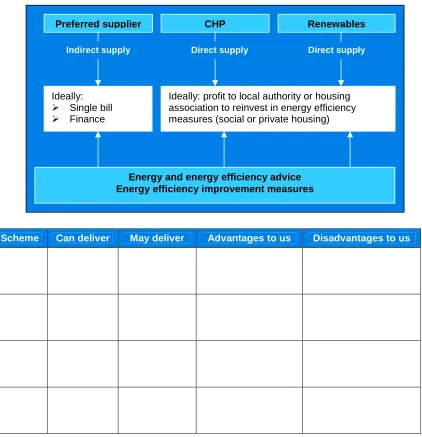
The local authority, housing association or community group can use its position as an “honest broker” to market the preferred supplier to residents. In return it receives a commission from the utility for every new customer that it signs up. The revenue generated from preferred supplier schemes is usually ring fenced and used to fund energy efficiency improvements, either offered as a package to the houses that have signed up to the deal – or in the most vulnerable homes identified. For information on the benefits to the supplier of a preferred supplier agreement, please see Box 2.
6
The Energy Saving Trust’s guide to affinity deals: http://www.est.org.uk/uploads/documents/housingbuildings/agwv.pdf.
Box 2: What are the benefits of a preferred supplier relationship for the supplier?
By understanding what partners will gain from an alliance, organisations setting up energy services schemes will be better placed to sell the scheme to residents. The benefits for the suppliers are:
A good opportunity for recognised, supported promotion in a specific area.
An approach that usually results in customers who are more likely to stay with the supplier (because of the landlords’ endorsement).
A more constructive and effective use of marketing and sales budgets than door-to-door selling, which is not good for the industry’s image.
A more proactive approach to the market, working with partners for the good of the community.
A way to link the sale of energy to energy efficiency activities, which can help suppliers to meet their own social and environmental objectives as well as commercial targets.
It is also worth bearing in mind that with the advent of the new EEC (in 2008) energy suppliers will have larger energy efficiency targets than ever (for further information see the funding section). They will be actively looking for partners who can help them to meet these targets.
Renewables CHP
Preferred
Ideally: profit to local authority or housing association to reinvest in energy efficiency
measures (social or private housing) Ideally:
Single
bill.
Finance.
Energy and energy efficiency advice Energy efficiency improvement measures
Indirect supply Direct Direct
Renewables CHP
Preferred
Ideally: profit to local authority or housing association to reinvest in energy efficiency
measures (social or private housing) Ideally:
Single bill.
Finance.
Energy and energy efficiency advice Energy efficiency improvement measures
A starting point for many preferred supplier schemes is a social landlord automatically signing up all void properties to that supplier. This raises revenue via the commission payments paid by the supplier, which can be used to improve the property. The incoming tenant can change supplier after 28 days (see Box 4 on Ofgem’s trial waiver of the 28-day rule), but many suppliers are still willing to pay a commission, which suggests few new tenants choose to change supplier. Once the scheme has been established in this way, it can then be extended to the private sector.
2.2.2 Home energy club
This type of scheme is an extension of the preferred supplier/affinity deal. A local authority, housing
association or community group appoints an energy supplier that they consider to be offering the best value on overall service (such as price, measures and advice). The organisation works with the supplier to ensure delivery of a ‘package’ of energy supply plus energy saving measures and energy efficiency advice to tenants and/or local residents. The supplier often agrees to offer customers preferential access to grants as well as a dedicated energy efficiency helpline. Ideally, this approach will include a loan or finance to help fund the measures.
The most likely arrangement is that the organisation setting up the preferred supplier partnership administers the arrangement (in some cases through a newly formed company). An ideal set-up would provide the householder with a single bill that details the expenditure per month on energy and efficiency measures. This
7
energywatch database: http://www.energywatch.org.uk/help_and_advice/saving_money/index.asp
8
Briefing note on the 28-day rule: http://www.est.org.uk/uploads/documents/housingbuildings/28_day_rule.pdf
9
Case study on Aberdeen City Council: http://www.est.org.uk/uploads/documents/housingbuildings/ce65.pdf.
Box 3: Tariff optimisation
Since the liberalisation of the domestic energy supply market in 1998/99, domestic customers have been able to select their energy supplier and take advantage of the difference in cost between suppliers. While choosing the cheapest supplier does not contribute to increasing energy efficiency, raising awareness of the deals available can increase residents’ awareness of costs, before moving on to an energy services scheme. When setting up a preferred supplier scheme, it is useful to compare the costs of potential supplier partners, to ensure that the scheme offers the best deal possible. energywatch provides a database that allows consumers to compare supplier costs. Click here7 to access this database.
Box 4: Trial waiver of the ’28-day rule’
The freedom of the individual householder to switch energy supplier at short notice has been cited as a barrier to establishing energy services schemes. Having selected a supplier, a consumer has to give only 28 days notice that they intend to switch suppliers (the ‘28 day rule’). To address this issue, Ofgem is running a pilot to test whether suspending the ‘28 day rule’ results in a boost to energy services take-up and whether consumers can be adequately protected without it. The two-year pilot was launched in May 2004. For more information on the pilot, click here8.
Case study example 1: Preferred supplier scheme in Aberdeen
method of billing demonstrates the impact of energy efficiency measures on reducing fuel costs, and clearly illustrates how the expenditure on measures can be offset against energy savings.
Case study example 2: HELPCO
The Greater London Energy Efficiency Network (GLEEN) operates a community energy club using a preferred supplier arrangement with ScottishPower. The supplier provides ongoing funding by paying a commission for every new customer signed up, plus an ongoing commission based on a percentage of their customers’ total annual bill. GLEEN is responsible for billing the customers and this bill is accompanied by energy efficiency advice. The scheme also offers finance packages for energy efficiency measures. Click
here10 for the full case study.
Summary – advantages and disadvantages of a preferred supplier scheme or home energy club
Advantages:
Income can be generated with each property signed up.
In terms of void properties, it avoids the need to keep a record of the supplier chosen by the tenant for each property and ensures there is no break in the supply when the property is reoccupied. It also avoids liability for the payment of standing charges for short-term voids where there is no consumption of fuel.
If the ideal can be achieved, a separate energy supplier will handle billing of energy efficiency improvements and energy, and residents will get a good combined deal on energy efficiency improvements and energy supply.
Disadvantages:
Householders are tied to one supplier for a set period and during this time the tariff may not stay competitive.
Income from the scheme depends on the number of residents signing up so marketing and promoting the scheme is required.
Currently it is very difficult to find an energy services company ready to handle the billing and potential liability problems on its own.
2.2.3 Energy supply scheme
Through obtaining the relevant license (see Box 5 for more information on licensing) organisations can supply power directly to householders. By offering their services as an energy supply company they can help residents optimise their energy usage by reducing fuel costs (through advice and measures) and offer a single billing system for energy and efficiency measures.
Private companies (eg housing associations) should find it straightforward to become direct energy suppliers; local authorities have historically faced a number of legal obstacles. However, the power of well-being included as part of the Local Government Act 2000 and the Scotland Local Government Act 2003 now makes it easier for local authorities to supply gas and electricity directly to consumers. For information on this, see ‘local authorities and the power of well-being’ in the ‘legal issues’ section below. However, at the time of writing, there are no known examples of local authorities or housing associations taking this approach.
Box 5: Ofgem guidance on licensing
The Electricity Act 1989 as amended by the Utilities Act 2000 requires any company wishing to supply electricity in the UK to obtain a license issued by Ofgem unless the activity is exempt. Ofgem offers a number of resources to assist organisations that wish to apply for a supply licence. They are:
An overall guidance document for gas and electricity licence application. Click here11 to access this resource.
10
Case study on GLEEN:
http://www.est.org.uk/uploads/documents/housingbuildings/Greater_London_Energy_Efficiency_Network.pdf. 11
Ofgem guidance document for gas and electricity licence application:
An information pack for new entrants to the electricity supply market. Click here12 to access this resource.
An electricity supplier licence application handbook. Click here13 to access this resource.
A gas supplier licence application handbook. Click here14 to access this resource.
An application handbook for a generation licence. Click here15 to access this resource. The Ofgem licensing team can be contacted at:
A: 2nd Floor, 9 Millbank, London, SW1P 3GE T: 020 7901 7133
Summary – advantages and disadvantages of direct energy supply
Advantages:
Cost effective purchase of energy for all households supplied.
Depending on the arrangement (eg single bill), there is also the opportunity to offer energy efficiency improvements as part of the direct energy supply service.
Disadvantages:
It requires formal company administration, which can be time consuming to set up. Direct supply – combined heat and power (CHP)
The direct energy supply approach can also be met through the development of a CHP scheme. CHP schemes are a good way of using the energy involved in a combustion process that generates electricity. This is because electricity generation is not particularly efficient and produces heat as a by-product. In many commercial generation arrangements, the heat is wasted, hence the need for the vast cooling towers seen at power stations but if this heat can be used locally, it can be made available to heat buildings and hot water systems.
A CHP scheme is generally designed as a unit that provides district heating plus electrical power to a
number of buildings in close proximity, or a single large block. In the 1960s, district heating systems received very bad publicity. Although some of them did work effectively and still do, bringing benefits to their
neighbourhoods, many were inefficient, unreliable, and unable to be controlled on an individual household basis. Modern CHP systems no longer have these problems.
When developing a CHP scheme, it is necessary to calculate the size of plant needed to provide the level of heat and/or power appropriate to the needs of the system, and to know whether heat or power is the most important driver. The designer of the system then needs to ensure that there is a viable route for any excess heat or electricity, and how to supplement the system when there is greater demand than the system can provide.
CHP systems used in an energy supply scheme will be designed for multiple buildings, or Houses in Multiple Occupation, including hostels, blocks of flats, or sheltered accommodation. Local authorities, housing associations and community groups need to decide whether, in their situation, they need to accommodate the maximum heating requirement, and export additional electricity not used by the buildings attached to the system, or to optimise for the expected electrical load, and add heating capacity with a standard boiler arrangement or by point heating. Community heating – a guide, is available here16. Although it has been 12
Ofgem information packs for new entrants to the electricity supply market:
http://www.ofgem.gov.uk/temp/ofgem/cache/cmsattach/12018_Electricity_New_Entrants_Guide.doc 13
Ofgem electricty supplier licence application handbook:
http://www.ofgem.gov.uk/temp/ofgem/cache/cmsattach/9980_Electricity_Supply_handbook.pdf 14
Ofgem gas supplier licence application handbook:
http://www.ofgem.gov.uk/temp/ofgem/cache/cmsattach/11067_supply_handbook.pdf 15
Ofgem application handbook for a generation licence:
http://www.ofgem.gov.uk/temp/ofgem/cache/cmsattach/9981_Electricity_Generation_handbook.pdf 16
Community heating – a guide:
written for housing professionals, it is a good source of information on CHP for anyone interested in installing and operating a CHP energy services scheme.
Micro-CHP or domestic CHP, a unit of CHP designed for a single house, is in the process of being
developed. The units are being designed to be the same size as a standard domestic gas boiler, and at least as easy to use. Micro-CHP technology is still in development and field trials are underway using natural gas. The two companies that are conducting these trials are Microgen (part of the British Gas group – click here1
for further information) and Powergen (under the brand name 'Whispergen’, click here2 for further information).
Funding for micro-CHP and larger scale CHP projects involving renewable energy may be available through the DTI’s Low Carbon Buildings Programme. For further information, click here3. For information on the regulatory framework that affects direct energy supply using CHP, please see the section on ‘legal issues’ below.
Case study example 3: Electricity generation – CHP: St Pancras Housing Association
The St. Pancras Housing Association established a CHP generator in two of its housing blocks in 1995. It was developed to support two objectives of the Association:
Primarily to reduce the tenants’ costs.
Achieve objectives set down in its environmental policy. The case was presented to tenants as an alternative to simple boiler replacement that would be just as efficient at providing the heating and electricity but have the added benefit of lowering their bills. Some tenants now pay less than £20 per quarter for their electricity. Annual carbon dioxide savings stand at around 275 tonnes.
In addition, the CHP system also supplies commercial premises on the ground floors of both of the blocks. This helps to meet costs and balance the loads on the generator. Click here4 for the full case study. Case study example 4: Electricity generation – CHP: Tower Hamlets and Barkantine
When the heating systems in the Barkantine housing estate needed to be replaced, the flats were initially to be given individual heating systems but these would have had high running costs and a
significant environmental impact. Instead, the London Borough of Towner Hamlets, in consultation with the tenants, decided the best option would be to install a communal heating network fired by a CHP unit. This would enable hot water to be generated as well as electricity and to give the dual benefits of cheaper heating and cheaper electricity supplies.
The community heating and 1.45 Megawatts electric (MWe) CHP unit provides energy services to over 500 homes, the local school and the leisure centre.
The revenue funding for the scheme comes from heat and electricity sales, avoided maintenance costs, refunds on distribution charges, revenue support from the Department of Communities and Local Government (formerly known as the Office of the Deputy Prime Minister) based on a Private Finance Initiative Credit and fees paid by the education and leisure services for the supply of heating and electricity. Click here1 for the full case study.
1
Information on the Microgen micro-CHP trials: http://www.microgen.com/.
2
Information on Powergen’s Whispergen micro CHP trials: http://www.whispergen.com/.
3
Information on the DTI’s Low Carbon Buildings Programme: http://www.lowcarbonbuildings.org.uk/home/.
4
Case study on St Pancras Housing Association:
Summary – advantages and disadvantages of a CHP scheme
Advantages:
CHP delivers the energy services of heat and power to tenants, usually at a reduced rate.
It reduces CO2 emissions and offers the potential for increased income that can be reinvested in energy efficiency measures.
Disadvantages:
It requires significant capital outlay, planning and operational time.
The properties targeted for CHP must be in close proximity.
With such a disruptive change tenants may be difficult to win over, and careful negotiating with all affected parties is required.
Renewable energy
There are two basic types of renewable energy-based energy services companies (ESCos). One generates and sells energy then uses the proceeds to fund energy efficiency measures in the local community, whilst the other produces an energy service and distributes it to the local market.
To fund energy efficiency measures, a renewable energy-based ESCo can either be set up to sell electricity to an energy supplier that then sells it on to its customers, or can sell its output directly to a local source of demand such as a factory, office or group of dwellings. Depending on the local demand for electricity, the renewable energy-based ESCo may also have an agreement with a supplier or other organisation to sell excess electricity to the grid. As well as excess electricity, there will be times when some technologies do not produce very much electricity. Some renewable sources vary the amount of energy they produce and this is termed intermittency. Intermittency of supply could have a financial impact on the company but also could be detrimental to local customers. Appropriate sizing of any development is key to solving the intermittency problem.
The service aspect of this type of renewable energy-based ESCo comes when the profit from the electricity sold is used to improve the energy efficiency of the homes of people who have some connection with the renewable energy-based ESCo. These may be people who live near the renewable energy generator, such as a wind turbine or micro-hydro system, or a group of people who collectively own the renewable energy-based ESCo. These people can then benefit from lower fuel bills and warmer homes.
In most cases, renewable energy-based ESCos that sell an energy service to the local market, will use biomass to generate heat, either for a single large building or for several smaller buildings via a community heating scheme. (The supply of heat is an energy service and because heat cannot be transported long distances it needs to be used locally.) This method of heat supply means that consumers just pay a single charge for a unit of heat rather than paying separately for a boiler, plumbing maintenance, fuel supply and so on.
Biomass can be used to create heat in a boiler but can also produce heat and electricity in a CHP generator. Biomass CHP technology is not yet widely used and the infrastructure is not fully developed so many renewable energy-based ESCos use wood-fired boilers to produce heat only. The supply of both electricity and heat from a single generator takes the concept of energy services one step further because
theoretically, when combined with the supply and maintenance of appliances, it can provide all the energy services that a consumer will demand.
There is clearly scope for biomass to replace natural gas, landfill gas or municipal solid waste as a CHP fuel and therefore allow renewable energy-based ESCos using larger generators to be created. However, because of the nature of the technology available and the embryonic size of the UK’s energy services market, most current renewable energy-based ESCos are relatively small in size, although plans for large scale systems based on biomass CHP are well underway.
1
Summary – advantages and disadvantages of a renewable energy services company
Advantages:
It can combat fuel poverty in households.
The fuel is carbon neutral.
It does not rely on non-indigenous fuel supplies.
Money is kept circulating within the UK and local economy if the company is based in the community.
Disadvantages:
As with CHP schemes, significant outlay, planning and operational time are required. However these commitments can be much smaller than for CHP schemes.
Variable output or intermittency may have an impact on customers and the company’s finances.
Infrastructure may not be in place for technologies such as biomass.
The following table summarises all the case studies. Please click on the case study name to access a copy of the full case study.
Case study
Lead
organisation type
Offerings
Preferred supplier partnership schemes
HelpCo Community
group
Energy supply partnership with ScottishPower.
Supplier pays a commission for every new customer signed up, plus an ongoing commission based on a percentage of customers’ total annual bill.
Direct debit tariff offered to all customers irrespective of payment method chosen.
Single bill detailing energy and measures expenditure sent out from HelpCo.
Financial packages offered for energy efficiency measures.
Ongoing advice and promotion of energy efficiency appliances and practices.
Aberdeen City Council’s preferred supplier scheme
Local authority Energy supply partnership with ScottishPower.
Commission payments to LA used as a loan fund for energy efficiency measures for Aberdeen’s fuel poor, including owner-occupiers, and to fund measures for very low income tenants.
Void council properties signed up.
Same cost of fuel regardless of payment type.
Energy efficiency advice from the EEAC.
Energyextra Ten housing associations and one local authority
Separate energy services company formed.
Energy supply through ScottishPower with a full range of payment methods.
ScottishPower funded measures.
Dedicated energy efficiency advice line for tenants.
A benefits health check advice line.
fenESS – Enabling energy efficiency and energy supply through energy services
Local authority Energy supply partnership with Scottish and Southern.
Commission payments used as a fund for energy efficiency measures (either loan or fully funded).
Energy efficiency advice from the EEAC.
Subsidised energy efficiency products from supplier.
Void social housing properties signed up.
Switch on – Wiltshire Wildlife Trust
Community group
Green energy supply partnership.
An energy club through the EEAC that provides advice and discounted measures to members.
Age Concern and
Powergen: offering energy services to older customers
Community group
Supply of gas and electricity by Powergen – competitive prices and equal rates for each type of payment.
Free energy efficiency advice and energy information.
Basic measures offered including low energy light bulbs.
Cold weather payments.
Customer service helpline to ‘real’ operator.
Flagship housing association
Housing association
Energy supply partnership with Manweb (now part of ScottishPower).
Estimated savings of £50,000. Direct supply -CHP
St Pancras Housing
Association Housing
association
Pre-existing subsidiary company set up the scheme.
Tenants’ costs reduced by 10 per cent.
No standing charge for supply, thus encouraging energy conservation.
London Borough of Tower Hamlets’s Barkantine CHP
project Local authority
Separate energy services company.
Communal heating systems provided via London Electricity Services.
Annual income to LA from different sources.
Woking Borough Council’s Thameswey joint venture
project Local authority
Separate energy services company.
Energy supplied to residents for less than they used to pay.
Energy efficiency advice.
Discounts and loans for measures.
The development of community heating in Southampton
Local authority
Competitively priced energy supplied to a mix of residential, business and community buildings.
2.2.4 Legal Issues
Direct supply – CHP: Regulatory framework
The supply of heat to consumers, either from CHP or renewable sources such as solar thermal, is not subject to regulation by the energy regulator. However, organisations wishing to supply electricity have to comply with the terms of the Electricity Act 1989, as amended by the Utilities Act 2000, and regulations made under that Act. Ofgem enforces compliance with this legislation and licence conditions. This section aims to provide an overview of the legal issues.
Licensing of the generation, distribution or supply of electricity is a complex area requiring tailored legal advice. Whilst Ofgem is responsible for electricity licensing, exemptions from licensing requirements, which are permitted under the Electricity Act 1989, are the responsibility of the Department of Trade and Industry (DTI). These exemptions are designed to free relatively small operations from licensing requirements, whilst being limited to a level that does not adversely affect the total electricity system or large numbers of
domestic consumers. Exemptions are customarily made by class, and the class regime is set out in a Statutory Instrument (2001/3270) that came into force in October 2001. It is for operators to determine whether they meet the terms of this regime. The Electricity Act also permits the Secretary of State to grant individual exemption, and a number of such exemptions has been granted to generators within the 50-100 MW range.
Generation
New generators generating more than 50 MW of electricity must hold a generation licence. Below this level, the generator is exempt from this requirement. Operators of new plant in the 50-100 MW range who wish to be exempt from licensing requirements must apply to the DTI for individual exemption. In Northern Ireland, the threshold is 10 MW.
Supply
The organisation will be exempt from the need to hold a supply licence below a threshold of 5 MW of electricity. However, within this limit there is a further limit of 2.5 MW on supplies to domestic customers. There are restrictions, set out by Ofgem, on the price that may be charged for electricity provided by exempt suppliers to domestic consumers. These link the price to that of the local in-area supplier.
Residential energy services schemes with private wire networks are exempt from the need to hold a distribution licence below a threshold of 2.5 MW. This figure is cumulative across networks owned by the distributor or associated bodies. This is extended to a further 1 MW if the generating source is CHP embedded within the private network.
Information on the requirements for supply, distribution and generation licences is available from Ofgem (see Box 5 above). In practice, most community-based energy services organisations would be below the
exemption threshold or would be operating in partnership with an energy company holding a relevant licence.
The obligations for exempt suppliers are considerably less onerous. These are covered in some detail in the Combined Heat and Power Associations’s ‘New Practice Report 113: Selling CHP electricity to tenants’ (click
here1 to access this document). Briefly, they are as follows:
If the energy services organisation includes local authorities or housing association housing, the tenants must be consulted on the proposals and have their agreement. In doing so, it is valuable to allow tenants access to independent advice so that they can understand and consider the options open to them.
The organisation must register the unique supplier number for each of the premises to be supplied with the Public Electricity Supplier Registration Service.
The organisation must have a top-up and standby agreement with a licensed supplier in order to protect the customers’ security of supply.
There are also a number of other issues to be addressed as follows:
Distribution of electricity.
Meters and billing.
CHP and the Climate Change Levy. Distribution of electricity
There are three options for distributing electricity to customers:
1
Renting the wires:
The local cabling network is the property of a local distribution company, which is usually owned by the local Distribution Network Operator (DNO). You can rent passage for your electricity to reach your customers by paying this company a distribution use of system (DUOS) charge. All distribution companies are obliged to publish their DUOS charges and they are not permitted to discriminate between suppliers. Taking this route also necessitates the installation of metering to provide the basis for the DUOS charges.
Buying the wires:
You may be able to purchase the wires from the DNO. They are not obliged to sell it to you and will usually only consider doing so when the cabling network is wholly contained with a building such as a tower block or estate. The purchase price will be a matter for negotiation.
Installing new wires:
It is also possible to install a new cabling network.
It should also be noted that there is a Maximum Resale Price for re-supplying gas or electricity to a domestic customer that has already been bought from an authorised supplier. Ofgem has set this as being the same price as that paid by the person reselling it, including any standing charges.
Case study example 5: Woking Borough Council’s Thameswey Project
Private wire enables green electricity to be sold directly to the customer and avoids transmission and distribution charges and electrical losses through the national grid/distribution networks. The project comprises 1.46 MWe of CHP, 1.4 MW of heat-fired absorption cooling and 163m3 of thermal storage distributed over 6 building complexes in Woking Town Centre. Buildings are interconnected with heat and chilled mains and high voltage/low voltage private wire networks. The scheme satisfies its own electrical demands and exports surplus power over the public wires to sheltered housing residents and other local authority buildings via an enabling agreement for exempt supplier operation. In the event of a power cut, the system continues to operate in ‘island’ mode via a black start generator. The system is fully exempt from the Climate Change Levy and this benefit will be extended to other local businesses.
Click here23 to access the full case study. Meters and billing
Since changes to metering competition rules, the meter in the customer’s premises is not necessarily the property of the DNO. This will need to be checked as it may belong to the customer, the DNO or an independent Meter Asset Provider. Depending on ownership of the meter, it may be possible to rent or purchase the meter but it may not be suitable for the organisation’s requirements for two reasons:
Firstly, meter reading, processing and revenue collection can be expensive. The organisation may wish to consider other options such as remote metering and data collection, which allows bills to be generated and issued automatically.
Secondly, the organisation may need to install new meters for the DUOS charging process. Whilst doing so, they may wish to install completely new metering to reduce the cost of administering revenue collection from customers.
Ofgem is looking at the innovation within metering, particularly for electricity. They are running studies with the major suppliers into the provision of ‘smart’ meters with a variety of features, including two-way
communication between the customer and the supplier. Ofgem intends to provide a regulatory framework so that suppliers can work with competitor’s meters if a customer switches. However, they expect the suppliers to lead the way in testing and development of ‘smart’ meters. For more information on the future of ‘smart’ meters, please see Ofgem’s ‘Domestic metering innovation – next steps’ here24.
23
Case study on ‘Woking Borough Council’s Thameswey Joint Venture Project’: http://www.est.org.uk/uploads/documents/housingbuildings/Woking.pdf. 24
For Ofgem’s ‘Domestic metering innovation – next steps’:
The energy services organisation will need to develop a policy to cover revenue collection, bad debt and potential disconnection. This need not be as onerous as it may sound. One of the advantages of a locally managed organization is that it allows for interventions, such as debt advice with benefits checks, to be organised. Additionally, prepayment meters can be installed to help with budgeting with ample emergency credit to avoid self-disconnection.
Lastly, regulation allows licensed gas and electricity suppliers to charge for fuel supply and recovery of capital investment in energy efficiency on the same bill. However, fuel supply and other measures must be itemised separately on the bill.
CHP and the Climate Change Levy
Heat generated by, and the fuel input for, ‘good quality’ CHP is exempt from the climate change levy. Qualifying electricity generation from CHP schemes will also be exempt from the Levy, where that electricity is consumed onsite or sold direct to another customer.
To qualify for exemption from the Levy, each ‘good quality’ CHP scheme must be registered. Self-assessment forms must be completed and sent to the Combined Heat and Power
Quality Assurance Programme (CHPQA) by the owners. These forms are available via the CHPQA website (here25) and are supported by guidance notes on how to fill them in correctly. Local authorities and the well-being power
Local authorities have historically faced legal barriers to delivering energy services. However, the
introduction of the ‘well-being’ power in the Local Government Act 2000 (which covers England and Wales) and the Scotland Local Government Act 2003, removes most of these barriers. The following information is taken from the LGA document ‘Powering-up; making the most of the well-being power.’ The full document is available on line here26.
This document includes the following paragraph on generating and supplying energy:
“The well-being power, combined with the new trading power, will support local authorities looking to promote new projects for generating and supplying energy: for example building on an exemption to the Electricity Act 1989 to form companies for small-scale generation of electricity that could then be sold to residents.”
The well-being power is a significant resource and freedom for authorities to use in order to improve public services, and encourages councils to look beyond their immediate service delivery responsibilities to the wider economic, social and environmental well-being of their areas.
It significantly widens local authority powers and gives councils the confidence to improve the quality of life, opportunity and health of communities by undertaking both new and traditional activities in innovative ways. The breadth of the power is such that councils should regard it as a 'power of first resort'. This means that rather than having to search for a specific power elsewhere in statute in order to take a particular action, councils can instead look to the well-being power in the first instance. The key question is no longer, 'do we have the power?' but 'is there anything to prevent us from doing what we want to do?'
There is a need to use the power reasonably, to have regard to the community strategy and fiduciary duty to council taxpayers and to check that there is no prohibition, restriction or limitation in other legislation that will act as a constraint on the council's ability to act. But the overall focus should be on the merits of the decision and its outcome in delivering the council's priorities.
25
CHPQA website: http://www.chpqa.com/
26
Councils can look to the power of well-being in the first instance. Before using the power, councils should consider four tests as set out in government guidance on 'Power to promote or improve economic, social or environmental well-being', which can be found here27:
Is the activity likely to promote or improve well-being in the area? (Yes)
Is the primary purpose to raise money? (No)
Is it explicitly prohibited by other legislation? (No)
Are there any explicit limitations or restrictions in other legislation? (No)
The power can also be used with other local authority powers and the new position on charging and trading under the Local Government Act 2003 will be particularly important.
Local authorities and the power to trade
The Local Government Act 2003 gives the Secretary of State an order-making power to allow local
authorities to trade in relation to any of its ordinary functions (section 95, Local Government Act 2003). This will be in addition to local authorities' current power to trade with other public bodies under the Local Authorities (Goods and Services) Act 1970, and the new trading powers operate in parallel to this.
However, the Secretary of State is able to determine the extent of use of the new trading power by category of local authority. Only those local authorities with a comprehensive performance assessment rating (CPA) of fair, good or excellent comprehensive can use this power to trade. The power enables these authorities to enter into trading agreements or arrangements with any person for the provision of goods, materials, staff, accommodation and services on a commercial basis (ie charges fixed at more than cost recovery), if the purpose is to promote well-being.
Disclaimer
It should be noted that the document states:
“Clearly, this publication can only act as a catalyst for further discussion… it will be important for each authority seeking to use the well-being power to go through the necessary political processes and to seek appropriate advice.”
Further information
The Energy Saving Trust has produced a briefing note on the power of well-being, which can be downloaded
here28. A 2006 report by Impetus Consulting Ltd, funded by the Pilkington Energy Efficiency Trust, demonstrates how local authorities are currently using the power to promote sustainable energy, and it is available here29. A series of case studies illustrate the report, which can be downloaded here30.
2.3 Benefits of energy services schemes
The box below lists the major advantages and disadvantages for the different types of scheme in relation to both the organisation setting up the scheme and residents. Follow the steps in the next section on how to sell energy services to others and use this table to pick out the key points for your management and for your tenants.
27
Guidance on 'Power to promote or improve economic, social or environmental well-being’ can be found here: http://www.communities.gov.uk/index.asp?id=1133748.
28
Briefing note on The well-being power: Using the power to deliver sustainable energy objectives: http://www.est.org.uk/uploads/documents/housingbuildings/wellbeing_england_wales_bn.pdf. 29
http://www.est.org.uk/uploads/documents/housingbuildings/PEET%20-%20final%20report%20-%20final%20version.pdf. 30
Advantages Disadvantages
Preferred supplier partnership/Affinity deal
Organisation setting up the scheme
Straightforward to set up.
No initial outlay other than development time.
Income generated from every sign up.
Easy to benchmark to monitor success.
Easy to manage voids in social housing.
Reasonably easy to get residents to sign-up.
Income can be used to fund other initiatives.
Builds partnerships with suppliers.
Ensures there are no breaks in the supply and no
unnecessary removal of meters.
Tied to one supplier for a set period.
Tariff may not stay competitive.
Income depends on number of residents signing up.
May be difficult to get some residents to sign up.
Needs some monitoring of take-up.
Residents can switch to another supplier.
Could be difficulties handling pre-payment meter residents.
Only one example of an organisation that has managed to provide a single bill for tenants.
Residents Get one of the best deals available at the time in terms of tariffs and measures.
Easy to do.
Save money and/or improve comfort.
Restricted choice.
Possible opposition to preferred supplier.
Home energy club
Organisation setting up the scheme
Easy to benchmark to monitor success.
Separate energy supplier handles billing.
If ideal is achieved, separate energy supplier handles billing.
Cost effective.
Marketing and promoting the scheme is required.
Residents may default on payments.
Energy services company may not be willing to handle billing and potential liability.
Residents Reduced energy bills.
Improvements to property and thermal comfort.
Low or interest free rates on energy efficiency measures.
Could receive a single bill for energy and energy efficiency measures.
Tied to one supplier for a set period.
Tariff may not stay competitive.
Increased debt for energy efficiency measures.
Energy generation – combined heat and power (CHP)
Organisation setting up the scheme
Delivers both heat and power to residents.
Reduces CO2 emissions.
Flexibility of tariff management.
Potential for increased income.
CHP suppliers very keen for partnerships to succeed.
Capital outlay or leasing arrangements needed.
More complicated to set up partnerships and legal arrangements.
Benefits less easy to quantify
Needs a closely arranged group of properties.
means that really good
communications and support of residents needed.
Potential difficulty in some areas with network provider (situation improving).
Reputation of unreliable old systems may lead to resident resistance.
Residents Reduced cost of both heat and electricity.
Very easy.
Possible disruption while system is being installed.
Direct energy supply – non CHP
Organisation setting up the scheme
Cost effective purchase of energy.
Lack of case study examples.
Usually only available for certain types of properties.
If handled for individual properties, administration of metering and billing.
Requires formal company administration which can be time consuming.
Residents Full energy services from a trusted source.
Energy generation – renewables
Organisation setting up the scheme
Reduces CO2 emissions significantly.
Potential for increased income and income stays within the community.
Benefits easy to quantify.
Relies on indigenous fuel supplies.
Outside funding may be available.
If handled for individual properties, administration of metering and billing.
Requires formal company administration which can be time consuming.
Capital outlay or leasing arrangements needed.
More complicated to set up partnerships and legal arrangements.
May be resistance to aesthetics of some technologies (eg wind turbines).
Variable output may cause disturbance to customers and/or finance of the company.
Infrastructure may not be in place for technologies such as biomass.
Residents Cost effective purchase of energy.
Save money and/or improve comfort.
Usually encourages energy efficiency.
There are a number of other benefits from developing ESCos. Social benefits:
Provision of affordable warmth.
Easy access for low-income householders to low-energy appliances and lighting, and reduced heating costs by linking financing charges to reduced energy consumption.
Economic:
Energy efficiency measures without capital investment.
Comprehensive advice and assistance with installation of measures. Political:
For local authorities, energy services could help deliver Home Energy Conservation Act (HECA) targets and fuel poverty objectives at a local level. (For further information on local authorities’ HECA and fuel poverty objectives, see Box 6).
For landlords:
Increased capital (energy efficiency) investment through levering-in from other sources. All residents:
Focus on affordability of using essential services (eg warmth, light, motive power). For utilities:
Meeting EEC obligations at lower cost.
Developing a competitive edge through innovation and added value services.
New opportunity for increasing profit in a competitive supply market.
Opportunity to enhance customer retention and develop a new customer base. For other businesses:
Scope for emergence of new businesses, and consequent job creation in the delivery of energy services.
Potential for integrating other domestic services with energy services.
Box 6: Local authorities’ HECA and fuel poverty objectives
The Home Energy Conservation Act 1995 (HECA) focuses local authorities’ attention on improving the energy efficiency of all homes and, in so doing, seeks to tackle the two very serious problems of fuel poverty and climate change. HECA places a duty on UK energy conservation authorities (local authorities with housing responsibilities) to draw up strategies to improve domestic energy efficiency in all housing – both public and private sector – and to report on progress made in implementing them. Since 2000, English and Welsh authorities have been required to report on their actions to tackle fuel poverty as part of their annual HECA reports, while Scottish authorities are required to produce a fuel poverty strategy.
The Energy Saving Trust has produced a number of briefings with information that will be useful for tackling HECA:
Click on the relevant country for information on affordable warmth: England31, Scotland32, Wales33
and Northern Ireland34.
Click here35 for ‘Energy efficiency briefing: a briefing for local authority chief executives and elected members’.
Click here36 for ‘The Home Energy Conservation Act: information for scrutiny members’.
2.4 How to sell energy services
2.4.1 Energy services in context
This next section identifies how energy services fit into the rest of an organisation’s strategy. The following table lists various strategies, policies and programmes and identifies the potential contribution that energy services can make within that item.
Box 7: How energy services can help deliver strategies and policies
Affordable warmth
Energy services focus on the delivery of adequate heating, lighting and other related services to those who are in need. They are designed to reduce costs for tenants through making the delivery and use of these services more efficient.
Climate change
The energy services chosen can help to reduce the impact of climate change. The key factors are changing the type of fuel supply plus insulation and ventilation measures and use of more energy efficient appliances and lighting to lower energy use, all of which reduce CO2 emissions.
Anti-poverty strategy
Energy services deliver heating, lighting and power to those that are in need, not focusing on the cost to the individual.
Energy efficiency
Energy services deliver the benefits required from energy, not just the energy itself. By concentrating on
31
‘Delivering affordable warmth in England’ is available here:
http://www.est.org.uk/uploads/documents/housingbuildings/04_delivering_affordable_warmth_e.pdf. 32
‘Delivering affordable warmth in Scotland’ is available here:
http://www.est.org.uk/uploads/documents/housingbuildings/04_delivering_affordable_warmth_s.pdf. 33
‘Delivering affordable warmth in Wales’ is available here:
http://www.est.org.uk/uploads/documents/housingbuildings/04_delivering_affordable_warmth_w.pdf. 34
‘Delivering affordable warmth in Northern Ireland’ is available here:
http://www.est.org.uk/uploads/documents/housingbuildings/04_delivering_affordable_warmth_ni.pdf. 35
Energy efficiency briefing: A briefing for local authority chief executives and elected members: http://www.est.org.uk/uploads/documents/housingbuildings/energy_efficiency_chief_exec_bn.pdf. 36
The Home Energy Conservation Act: Information for scrutiny members:
energy services, there is an incentive for energy to be produced and used in the most efficient way possible. Energy policy
Energy services can represent one strand of an energy policy that may address sources of energy as well as efficiency issues.
Environmental management
As well as a contribution to reducing CO2 emissions, some energy services schemes may also contribute to a reduction in resource use, waste/recycling targets and air quality.
New build
Some elements of energy services apply within new build programmes. Some new build activity such as appliance installation may benefit the energy services scheme as a whole.
Planned maintenance
For social housing, energy services and installation of energy efficiency measures is more cost effective when included within a planned maintenance programme; for owner-occupiers, energy services can ensure that planned maintenance actually happens.
Reinvestment strategy
Energy services can improve the quality of housing and therefore raise its asset value. Responsible repair
Taking a life-cycle or whole-life costing approach means that energy services are easy to justify in terms of cost.
Stock condition survey and home energy rating
Energy services can improve the fabric of the building or contribute to an increased SAP rating, depending on the energy services chosen.
Sustainable development
In addition to the environmental aspects of sustainable development (see CO2 emissions, climate change and environmental management, above), energy services contribute towards social sustainability by addressing welfare issues such as debt and poverty, and to economic sustainability such as household maintenance and stock valuation, depending on the scheme selected and the economic benefits arising from the scheme.
Resident health
Energy services contribute towards residents’ health through provision of thermal comfort and indoor air quality, addressing health problems caused by cold and damp.
This shows that an energy services approach can link into a wide range of issues that local authorities, housing associations or community groups are working to resolve. The important thing is to identify and quantify what benefits the organisation wants to gain from introducing energy services. This will help determine what type of approach will help achieve those over-arching goals.
2.4.2 A suggested format for gaining approval to investigate energy services
The following sections have been designed to help establish how energy services can help you meet your objectives. If you need to gain time to do background work (or a feasibility study) on whether and which energy services are right for you then take the time to go through all the following questions and think about the answers with regard to your specific circumstances.
A. What will my management like about energy services?
Energy services will contribute (these things) to (these) specific policies (selecting
from the list in Box 7).
bills which is important to us because…
Energy services have the potential to raise money to finance energy efficiency work.
Energy services have the potential to develop partnerships in the
local/regional/national community, which will help our prestige and reputation.
Energy services are likely to increase public sector tenants satisfaction with the housing provider and private sector residents’ satisfaction with the local authority. B. What problems/issues are we currently facing that energy services can help with? These may include:
The need to deliver an affordable warmth strategy.
The need to have a sustainability strategy.
Problems with residents over... (eg bill payment, complaints over costs of electricity, old appliances giving us electrical problems, damp and other practical problems).
The need to replace old or worn out boilers and other heating systems, etc.
The local authority needs all domestic buildings to contribute to its CO2 emissions reduction target.
C. What will happen if we don’t solve those problems?
List the consequences of not tackling the problems mentioned in section B. These will probably fall under the categories:
o Not delivering our core business.
o Excess cost.
o Excess administration (which translates into cost and time).
o Problems with the local community and our reputation suffering.
o Losing, or not gaining, grant funding. D. What do we want done?
We want approval to work on this project - at this stage to do a feasibility study. The feasibility study will show:
o What type of energy services are right for us (in which group of housing, if appropriate).
o How much it will cost, roughly.
o How much we will gain, roughly.
o Where the shortfall, or start-up funding, will come from.
o How much time it will take.
o What specific objectives and targets (for the first phase at least) it will lead to.
If we also want approval to get a consultant to do some of this work, then how much budget do we want approved?
Box 8: What is a feasibility study?
A feasibility study is a small project to identify the best options for your situation, including potential partners, potential costs, timescales and funding sources. A feasibility study may include a pilot project, to assess the viability of specific ideas but don’t go straight into a pilot project without doing a desk study first. Feasibility and pilot are best viewed as two separate stages.
Feasibility studies should involve residents since, for best results, they need to feel ownership of the scheme. The later sections on ‘Which approach?’ and ‘Developing partnerships’ are part of your feasibility approach. You will also need to establish sources of funding and the work needed to obtain that funding. Preliminary approaches to partners and suppliers are usually perfectly acceptable as part of a feasibility study.
Case study example 6: Developing a feasibility study – Wiltshire Wildlife Trust
Wiltshire Wildlife Trust (WWT) received funding to undertake a feasibility study to investigate raising
The study aimed to identify the potential for developing an energy services company for WWT members and researched attitudes towards energy use and its imp