INTRODUCTION
While there are numerous methods for measuring the energy expenditure of marine mammals in the field, not all are equal in reliability, precision or ease of use. The three most common current methods employ measures of doubly labelled water (DLW) turnover, body acceleration metrics and heart rate (fH). The DLW method provides a mean estimate of field metabolic rate over a finite period that is not activity specific, with individual error estimates in pinnipeds ranging from –39 to +44% (Sparling et al., 2008). Body acceleration metrics, such as overall dynamic body acceleration (ODBA) and flipper stroking, are limited to predicting metabolic rate during active behaviours, and cannot account for changes in physiological state such as digestion (Bevan et al., 1997; Hays et al., 2004; Williams et al., 2004; Fahlman et al., 2008b; Green et al., 2009; Halsey et al., 2009). The fH method estimates oxygen consumption rate (VO2, an indirect measure of energy expenditure) from measured fH(Fick, 1870). fH can therefore provide activity-specific estimates of energy expenditure on a much finer time scale and for longer periods of time than the DLW method (Boyd et al., 2004; Butler et al., 2004; Ponganis, 2007), with comparable error estimates to ODBA under steady-state conditions (Green et al., 2009; Halsey et al., 2009).
The fH method requires deriving species-specific predictive equations between fHand VO2in a controlled environment before the technique can be used to predict VO2in the field (for a review, see Green, 2010). Previous studies in marine mammals and birds have made fH–VO2comparisons while animals were submerged in
a shallow swim mill (Woakes and Butler, 1983; Williams et al., 1991; Butler et al., 1992; Boyd et al., 1995; Ponganis et al., 1997; McPhee et al., 2003), walking on a treadmill (Froget et al., 2001; Green, 2001; Froget et al., 2002; Green et al., 2005), swimming horizontally in open water (Williams et al., 1993) or diving in a shallow tank (Bevan et al., 1992; Webb et al., 1998a). However, the artificial modes of locomotion and environments employed in these studies raise questions of applicability to animals that spend a considerable time diving to depth.
Despite the current use of fH to predict VO2 of diving marine mammals in the wild (i.e. Hindell and Lea, 1998; Boyd et al., 1999), it is not clear whether the fH method is accurate for pinnipeds foraging at natural depths and for realistic dive durations. Accurate estimates of metabolic rate in the wild require fH:VO2relationships that are derived under controlled conditions which encompass dive durations and dive depths that are representative of free-ranging animals. Previous studies that have investigated fHand VO2in diving marine mammals have been limited by maximum tank depth (Webb et al., 1998a; Sparling and Fedak, 2004). Our study derived relationships between fHand VO2in trained Steller sea lions freely diving in the open ocean to depths up to 40m and for durations of 1–6min, which reflect dive characteristics comparable to those of free-ranging animals (Merrick and Loughlin, 1997; Rehberg et al., 2009). Our specific objectives were therefore to (1) simultaneously measure and determine the relationship between fHand VO2while Steller sea lions were foraging and diving to depths of up to 40m and (2) determine whether fH could be used to predict average The Journal of Experimental Biology 214, 2267-2275
© 2011. Published by The Company of Biologists Ltd doi:10.1242/jeb.047340
RESEARCH ARTICLE
Dive behaviour impacts the ability of heart rate to predict oxygen consumption in
Steller sea lions (Eumetopias jubatus) foraging at depth
Beth L. Young
1,*, David A. S. Rosen
1, Allyson G. Hindle
1, Martin Haulena
2and Andrew W. Trites
11Marine Mammal Research Unit, University of British Columbia, Vancouver, BC, Canada, V6T 1Z4 and 2Vancouver Aquarium,
PO Box 3232, Vancouver, BC, Canada, V6B 3X8 *Author for correspondence ([email protected])
Accepted 4 April 2011
SUMMARY
The predictive relationship between heart rate (fH) and oxygen consumption (VO2) has been derived for several species of marine
mammals swimming horizontally or diving in tanks to shallow depths. However, it is unclear how dive activity affects the fH:VO2
relationship and whether the existing equations apply to animals diving to deeper depths. We investigated these questions by simultaneously measuring the fHand VO2of Steller sea lions (Eumetopias jubatus) under different activity states (surface resting
or diving), types of dives (single dives or dive bouts), and depths (10 or 40m). We examined the relationship over dives only and also over dive cycles (dive + surface interval). We found that fHcould only predict VO2over a complete single dive cycle or dive
bout cycle (i.e. surface intervals had to be included). The predictive equation derived for sea lions resting on the surface did not differ from that for single dive cycles. However, the equation derived over dive bout cycles (multiple dives + surface intervals) differed from those for single dive cycles or surface resting, with similar fH for multiple dive bout equations yielding higher
predicted VO2than that for single dive bout cycles (or resting). The fH:VO2relationships were not significantly affected by dive
duration, dive depth, water temperature or cumulative food consumed under the conditions tested. Ultimately, our results demonstrate that fHcan be used to predict activity-specific metabolic rates of diving Steller sea lions, but only over complete dive
cycles that include a post-dive surface recovery period.
metabolic rate (AMR) or diving metabolic rate (DMR) over either a single dive or a series of continuous dives (dive bout).
MATERIALS AND METHODS Data collection
Our study was conducted from August to September, 2008, using three trained female Steller sea lions (Eumetopias jubatus, Schreber 1776) housed at the UBC Open Water Research Laboratory (Port Moody, British Columbia, Canada). Animals were housed in a specially designed floating pen that provided access to seawater and haulout space [for a full description, see Hastie et al. (Hastie et al., 2007)]. Two of the sea lions were 11years old (body mass of F97SI, 218±4.4kg; F97HA, 172±0.6kg) and one was 8 years old (F00BO, 145±5.1kg; total mass range 130–224kg). All sea lions had been raised in captivity and had previously been trained to use all experimental apparatus. On non-trial days, animals were fed a diet of herring (Clupea pallassi) supplemented with vitamin tablets. Sea lions were fasted overnight, and then weighed on a platform scale prior to trials (±0.5kg). All procedures and protocols were conducted in accordance with the guidelines of the Canadian Council on Animal Care (University of British Columbia no. A07-0413), and under permits from the Department of Fisheries and Oceans Canada (no. MML 2007-0001) and the Vancouver Aquarium. All animal work was conducted voluntarily under trainer control.
Measurement of fH
fH was measured using subcutaneous electrodes connected to a wireless transmitter, coupled to a datalogger. fH monitoring equipment composition and placement are detailed elsewhere (Young, 2010; Young et al., 2010). Briefly, animals were outfitted with fHmonitoring equipment while anaesthetized (0–5% isoflurane in O2), and all equipment was removed after each trial while the animals were under trainer control. The fH monitoring system consisted of (1) a fH datalogger (HTR, Wildlife Computers, Redmond, WA, USA) which recorded the R–R interval and (2) a fHtransmitter (HRX, Wildlife Computers) that had two ~80cm leads. To reduce infection risk, we spliced 30gauge, 99.9% pure silver Teflon-coated wire (Grass Technologies, Longueuil, QC, Canada) to the terminal ends of the electrode leads, and these ends were sterilized and inserted subcutaneously prior to each trial. The fH
transmitter and fH datalogger were carried by the sea lions on a custom-fitted harness. The harness also held a time–depth recorder (TDR) that measured dive time, surface time and dive depth (sampling frequency 1Hz, SU-05272, ReefNet Inc., Mississauga, ON, Canada). Animals were allowed to fully recover from anaesthesia in a dry area before the start of the trial. fH was continuously measured immediately after both fHelectrodes were inserted.
Measurement of VO2
We measured VO2using open-circuit gas respirometry as previously described for Steller sea lions (Hastie et al., 2007). Fractional oxygen and carbon dioxide concentrations within a desiccated (viaCaSO4) subsample of the excurrent airstream were measured using Sable System FC-1B and CA-1B analysers, coupled to a 500H mass flow generator and controller (Sable Systems Inc., Las Vegas, NV, USA). Trials were conducted either at a dive site next to the holding pen or after the animals were transported to a nearby dive site in a 7m research boat. A second boat towing a floating barge carried the respirometry equipment to the dive site. The floating barge had an opening in the middle containing a cage (152⫻152⫻250cm) used to contain the animal at the surface before and after dives, and a floating transparent Plexiglas®respirometry dome. Air was drawn through the respirometry dome at a constant rate of 475lmin–1. The excurrent airstream was continuously subsampled, and averaged every 0.5s (Sable Data Acquisition System, Sable Systems Inc.). Fractional gas concentration readings were corrected for electronic drift against ambient air before and after each trial. Barometric pressure and excurrent air temperature were also recorded (Airguide Instruments, Chicago, IL, USA) to correct readings to standard temperature and pressure, dry (STPD). Water temperature ranged between 14.4 and 17.5°C (mean 15.8±1.0°C, N15 trials).
Trial protocol
The sea lions were trained to remain stationary within the floating respirometry dome, and then dive between two feeding tubes positioned at the same set depth (10 or 40m) ~6m apart (mean animal length ~2m). The feeding tubes were used to maintain swimming activity at depth. These trial depths reflect the lower and upper range of dive depths commonly noted for free-ranging
10 or 40 m 0
Depth (m)
Single dive SI Pre-dive (2 min)
fH
fH
fH AMR
DMR MRs
Dive bout
Recovery point
SI
AMR fH
DMR fH
Single dive cycle Dive bout cycle
fH fH fH
Recovery point
Fig.1. Schematic diagram of a Steller sea lion dive trial showing dive depth (0–40m) on the y-axis and time on the x-axis. The figure illustrates the varying intervals over which mean heart rate (fH) and oxygen consumption rate (VO2) were used to calculate different predictive equations during dives (highlighted in
grey) and surface intervals (depth 0m). Surface metabolic rate or pre-dive VO2(MRs) was a mean calculated over 2min prior to the initial dive. Average
metabolic rate (AMR) for a single dive or dive bout used fHand VO2data from the start of the dive up until the post-dive recovery point (set at ±2% of MRs),
females (Merrick and Loughlin, 1997; Rehberg et al., 2009). Each complete dive trial was repeated three times at each depth in random order for each animal (N6 trials per animal), with only one trial per animal per day. Sea lions were not tested on sequential days. In the end it was necessary to discard one entire trial from each animal because of noise in the dataset (N5 trials analysed per animal, N15 bouts, N25 single dives).
A trial consisted of (1) a 6–10min resting period where sea lions were stationed in the respirometry dome that provided the baseline measurements of surface metabolic rate (MRs), (2) a single dive with recovery period (see below), (3) a 4-series dive bout with recovery period at the end of the bout, and (4) a second single dive with recovery period, of longer dive duration than the first dive (40m only, Fig.1). Animals remained at the surface in the respirometry dome during post-dive recovery surface intervals (recovery periods), that ended when measured VO2 returned to within 2% of MRs(Fig.1).
Animals were fed small pieces of herring (20g) during trials to facilitate cooperation. A tube system allowed fish delivery to set depths and into the respiratory dome without altering the integrity of the flow-through measurements. Sea lions were encouraged (via altered underwater fish delivery rates) to execute dives of 0.5–2min duration; field data demonstrate that 45% of free-ranging dives are 0–1min and 33% are 1–2min for female Steller sea lions (Merrick and Loughlin, 1997). For the 40m trials only, an additional, longer single dive was encouraged at the end of the trial by providing food underwater at higher rates, which enabled consideration of the influence of dive duration independent of depth on the fH:VO2 relationship.
The cumulative amount of food consumed from the time the animals were outfitted with the experimental gear until the end of each specific event (i.e. end of dive or end of dive + surface interval) ranged from 0.4 to 2.8kg. The amount of food sea lions were fed during a dive trial was intentionally minimized as previous work has indicated that the consumption of a 4 or 6kg meal changes the fH:VO2relationship in Steller sea lions resting in water (Young et al., 2010). However, the previous study did not account for the potential effects of diving or feeding on smaller amounts of prey at depth on the fH:VO2 relationship. Therefore, in this study we explicitly tested the effect of cumulative food consumption on the fH:VO2relationship.
Data analysis
Calculating metabolic rate
VO2was calculated from fractional O2and CO2concentrations [see eqn3b in Withers (Withers, 1977)] using Datacan Data Analysis software (V 1.0.24; Sable Systems Inc.) and then exported into Microsoft Excel. For resting MRs, VO2was measured for 6–10min after VO2had reached a steady state and averaged over the 2min preceding the first dive of a trial. We analysed underwater O2 consumption in two ways to maximize the comparability of our data to previously published work. First, we calculated AMR across a dive cycle (dive + surface interval). Second, we calculated DMR over solely the underwater time. Both analyses were performed on both single dives and dive bouts. AMR over a single dive cycle or dive bout cycle was calculated by dividing the total integrated volume (l) of O2consumed during the dive and surface interval by the entire dive cycle or dive bout cycle duration. DMR was calculated as the integrated post-dive VO2above the MRsbaseline, divided by time underwater. For single dives, time underwater was the actual dive duration. For dive bouts, time underwater was the cumulative dive duration.
Unfortunately, there is not a consensus on whether VO2should be scaled with body mass and, if so, which exponent to use (Packard and Boardman, 1999; Brown and West, 2005; White and Seymour, 2005; Savage et al., 2007). Overall, model results with non-mass-corrected VO2(l O2min–1) and mass-corrected metabolic VO2(ml O2min–1kg–0.66or ml O2min–1kg–0.75) did not differ from each other (i.e. different equations, but the same factors and models were significant). In addition, mass could not be incorporated into the equations as a covariate because of either convergence errors or a lack of significance as a factor.
Ultimately, we chose the most parsimonious approach and decided to use VO2units that did not assume a scaling exponent VO2 (l O2min–1). Therefore, all equations presented should only be applied to wild Steller sea lions within our experimental mass range (130–224kg). To facilitate comparison with previous studies that did scale metabolic rate with body mass [including Young et al. (Young et al., 2010)], all model equations and figures using VO2 (ml O2min–1kg–0.75) are available elsewhere [see pp.50–71 of Young (Young, 2010)].
fH
fHmeasurements stored in the fHdatalogger were downloaded and analysed with Microsoft Excel and R 2.9.2 (R Core Development Team, 2009). First, R–R intervals were converted to instantaneous fH (fH,instin beats min–1). A series of algorithms were applied to systematically remove any fH,instdata that were artifacts of muscle or wire movement [detailed in Young et al. (Young et al., 2010)]. Finally, fH,instvalues were averaged across appropriate intervals to match the VO2integrations of the same time periods, yielding mean fH(beatsmin–1; Fig.1). Specifically, resting fHwas calculated over the 2min directly preceding the first dive. Mean fHwas calculated over the entire dive and surface period, from the start of the dive (or first dive in a bout) until the end of the surface recovery interval. Diving fHwas calculated over either the underwater portion of a single dive or the cumulative underwater duration for dive bouts (Fig.1).
It has previously been suggested that otariid fH may not scale linearly with body mass (Castellini and Zenteno-Savin, 1997). Furthermore, preliminary analysis of our data showed that there were no significant linear relationships between body mass and mean fH over a single dive cycle (ANOVA F-test, F1,210.44, P0.52 for slope) or over a dive bout cycle (ANOVA F-test, F1,110.90, P0.36 for slope). These results, combined with our goal of consistency between fHand VO2units, contributed to our decision not to scale
fHto body mass.
Statistical analysis
population) and fixed effects explored included: dive duration (1.0–1.99 min, 2.0–3.99 min, >4.0 min), dive depth (10m, 40m), activity (resting at the surface or diving) and cumulative amount of food consumed (0–1.0kg or >1.0kg, max. 2.8kg).
For each analysis, the best model in terms of fixed effect factors was determined using an ANOVA. Execution on a single model generated a conditional F-test to determine the significance of model slope, intercept and fixed effects. As all intercepts proved to be highly significant (P≤0.001), the F-values reported here are for model slopes only. An ANOVA performed on two nested models (the fixed effect model hierarchically nested within the model without fixed effects) produced likelihood ratio tests (LRT) that compared the two models (i.e. whether addition of fixed effect significantly improved null model). All models presented only had one fixed effect applied at a time; therefore, for all LRT tests d.f.1. Within LME analysis, both models must be linear (i.e. significant slope and intercept) as determined with an F-test before being compared with an LRT test. Therefore, unless noted otherwise, all models compared viaLRT tests were linear and statistics reported are for LRT tests. All reported data are presented as means ± s.e.m., and statistical significance was set at a0.05.
Confidence intervals (95% CI) for final predictive equations were calculated using standard bootstrapping methods with 1000 replicates per model (Venables et al., 1999; R Core Development Team, 2009; Whitlock and Schluter, 2009). The ordered 24th and 976th bootstrapped replicates were then plotted to represent the 95% CI for a model.
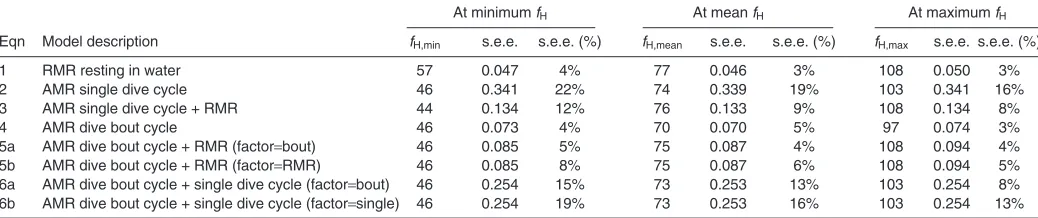
The error associated with the predictive equations is not constant and increases with the distance from the mean fHvalue, but many studies evaluating other techniques to estimate energy expenditure report a single, average error (e.g. Boyd et al., 1995). To facilitate comparison among studies, we estimated model error using both standard error of the estimate (s.e.e.) as well as ‘average percent error’. The s.e.e. for VO2was calculated using the minimum fHfor each model (Zar, 1999) [see eqn10 in Green (Green, 2001)]. It is important to note that the s.e.e. values are maximum estimates because the error at the tails of each model is greater than the error at the mean fHvalue (see Appendix TableA1 for s.e.e. mean and maximum fH values). All s.e.e. equations included the error associated with variation between sea lions in slope and intercept during model optimization. We also derived the average percent error associated with each model, which was a single representative percent of the error based on the standard residuals. We calculated the average percent error by dividing the mean absolute fixed residual by the median predicted VO2value. We then multiplied this by 100 to calculate a percent error. Standard error of the mean (s.e.m.) for the slope and intercept is also presented in Table2.
RESULTS Dive characteristics
Dive duration for all single dives (N25 dives) recorded from the TDR ranged from 1.0 to 6.3min, and cumulative dive time for bouts ranged from 2.6 to 8.0min (N13 bouts, Table1). Maximum dive depth ranged from 11 to 14m (10m trials) or from 41 to 58m (40m trials) as animals occasionally swam below the feeding stations temporarily before feeding. Our dive characteristics were comparable to those observed in free-ranging female Steller sea lions (Merrick and Loughlin, 1997; Rehberg et al., 2009).
Relationship between fHand resting metabolic rate
There was a significant relationship between fHand VO2for animals resting at the surface in open water (MRs). This relationship does not significantly differ from the fH:VO2relationship derived for four other Steller sea lions resting in a swim mill (~16h postprandial) (Young et al., 2010). Further, combining data from these two sets of trials creates a stronger composite predictive equation. This composite equation that described all animals resting in water (fasted in swim mill + MRsin open water) was designated resting metabolic rate (RMR), and was used to make all comparisons to the diving fH:VO2relationships. Mean RMR ranged from 0.81 to 2.30l O2min–1 and the corresponding fHranged from 57 to 108beatsmin–1.
Relationship between fHand DMR
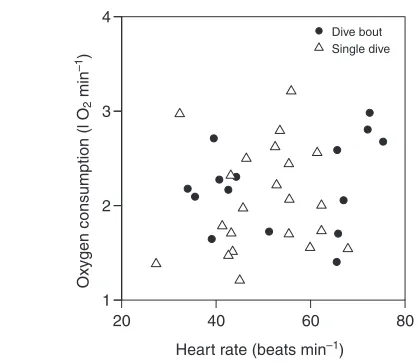
Overall, fHand DMR data were normally distributed, had normally distributed errors, and had homogeneous variance across single dives and dive bouts. Diving fHduring a single dive ranged from 27 to 68beatsmin–1, and DMR ranged from 1.21 to 3.21l O
2min–1. Over dive bouts, diving fHranged from 34 to 75beatsmin–1(subsurface time only), and DMR ranged from 1.40 to 3.00l O2min–1. Bradycardia was notable for both dive types (on average, dive fH was reduced from resting by 64% in single dives and 44% in bouts). However, no significant differences in DMR (2.06±0.56l O2min–1 for single dives, 2.22±0.47l O2min–1for bouts) relative to RMR (1.41±0.35l O2min–1) were noted.
[image:4.612.44.569.630.721.2]None of the predictive fH:VO2 relationships for DMR were significantly linear under any analysis conditions (either without fixed effects or including appropriate fixed effects such as depth, dive duration, cumulative food consumption and dive type, or after log transformation, Fig.2). For example, diving fH:VO2relationships were not linear for dive bout data alone (F1,110.89, P0.365), when combined with data from animals resting in water (F1,770, P1.00) or when combined with single dive data (F1,321.18, P0.283). Given that no predictive equations for DMR were linear, further comparisons (such as DMR vsAMR or RMR) were not undertaken.
Table 1. Summary of dives conducted by three Steller sea lions
Duration (min) Maximum dive depth (m)
Data Mean s.d. Min. Max. Mean s.d. Min. Max.
Single dive (N25) 2.6 1.5 1.0 6.3 35 16.7 11 58
Single SI 3.0 0.9 1.4 4.6
Dive bout (N13) 5.6 1.7 2.6 8.0 31 18.4 11 57
Dive bout cumulative SI 3.3 1.4 0.5 5.3
All dives 3.6 2.2 0.9 8.0 32 17.0 11 58
All SI 4.3 1.2 2.7 6.5
Relationship between fHand AMR
There was a significant relationship between fHand AMR, but this was not significantly affected by dive duration, dive trial depth, maximum dive depth or water temperature across single dive or dive bout cycles (dive + surface recovery interval). Cumulative meal size did not change the fH:AMRsinglerelationship over dive cycles (LRT1.14, P0.89). Animals consumed less food during the first single dive cycle (mean 0.36±0.19kg, 0–0.62kg, N17) compared with the last single dive cycle (mean 1.38±0.38kg; 0.88–2.08kg, N8). Despite this, adding dive cycle order as a fixed factor (i.e. first or last dive bout) did not significantly change the fH:AMRsingle relationship (LRT6.16, P0.19). We therefore combined data from all single dive cycles for both trial depths for analysis.
Over a single dive cycle, average fH ranged from 46 to 103beatsmin–1(mean 75±18.1beatsmin–1), and AMR
singleranged from 1.23 to 2.44l O2min–1 (mean 1.82±0.35l O2min–1). The predictive equations describing the fH:VO2relationships over single dive cycles (Table2: Eqn2) and while animals were resting at the
water surface (Table2: Eqn1) were statistically similar (LRT10.73, P0.030). Therefore, a single equation could be used to describe both data sets (Table2: Eqn3, Fig.3A).
Over a dive bout cycle, average fHranged from 46 to 97beatsmin–1 (mean 71±18.3beatsmin–1) and AMR
boutranged from 1.59 to 2.70l O2min–1(mean 2.03±0.33l O2min–1). During dive bout cycles, sea lions were fed a maximum of 1.8kg herring to facilitate cooperation (cumulative mean 1.0±0.33kg). However, feeding did not affect the significantly linear fH:VO2 relationship over a dive bout cycle (LRT7.93, P0.09; Table2: Eqn4). Combining data sets to test different factors yields slightly different predictive equations with mixed-effects models because of variability in degrees of freedom and replicate datasets from the same individuals across more than one trial type (i.e. Eqns4, 5a and 6a in Table2 for dive bouts are similar but not exactly the same). ThefH:VO2relationship over a dive bout cycle differed from that for both RMR (LRT34.66, P<0.0001; Fig.3B; Table2: Eqns5a and 5b) and a single dive cycle (LRT23.75, P0.0001, Fig.3C; Table2: Eqns6a and 6b). One aspect of these differences was that predicted AMR was often greater for bout cycles than for either single dive cycles or RMR at a givenfH(Fig.3). Model convergence errors prevented direct comparison of the fH:VO2 relationship between dive bout cycles (Table2: Eqn4) and the equation for pooled RMR and AMRsingle data (Table2: Eqn3, Fig.3A). However, given that dive bout equations were distinct from both single dive and RMR equations independently (Fig.3A,B), we suggest that logically dive bouts are also different from the composite RMR + AMRsingleline (Table2: Eqn3, Fig.3A).
DISCUSSION
The predictive relationship between fHand VO2has been explored in several marine mammal species submerged in a shallow swim mill (Woakes and Butler, 1983; Williams et al., 1991; Butler et al., 1992; Boyd et al., 1995; Ponganis et al., 1997; McPhee et al., 2003), swimming horizontally in open water (Williams et al., 1993) or diving in a shallow tank (Webb et al., 1998b; Sparling and Fedak, 2004). The implicit or underlying assumption in applying these equations to animals in the wild is that these relationships remain constant independent of the animals’ specific aquatic behaviour. This is an ambitious assumption given the range of cardiovascular and metabolic adjustments known to be employed by diving pinnipeds.
20 40 60 80
1 2
3
4
Dive bout Single dive
Oxygen con
su
mption (l O
2
min
–1
)
Heart rate (beats min–1)
Fig.2. The relationships between diving fHand DMR for Steller sea lions
[image:5.612.49.258.65.246.2]over a dive bout or over a single dive were not significantly linear.
Table 2. Equations for selected linear models relating heart rate (fH)to oxygen consumption (VO2) for Steller sea lions that were resting or diving
Slope Intercept Food N1 N2data s.e.e.
Eqn Model description a s.e.m. P-value b s.e.m. P-value (kg) animals points at min. fH
1 RMR resting in water 0.009 0.003 0.0026 0.713 0.231 <0.0001 <0.17 7 71 4% 2 AMR single dive cycle 0.010 0.004 0.0262 1.104 0.394 <0.0001 <2.08 3 25 22% 3 AMR single dive cycle + RMR 0.009 0.003 0.0002 0.708 0.212 <0.0001 <2.08 7 96 12% 4 AMR dive bout cycle 0.012 0.002 0.0001 1.104 0.114 <0.0001 <1.82 3 13 4% 5a AMR dive bout cycle + RMR (factorbout) 0.013 0.003 0.0268 1.058 0.316 <0.0001 <1.82 3 13 5% 5b AMR dive bout cycle + RMR (factorRMR) 0.013 0.003 0.0268 0.438 0.223 <0.0001 <0.17 7 71 8% 6a AMR dive bout cycle + single dive cycle (factorbout) 0.011 0.003 0.0001 1.229 0.213 <0.0001 <1.82 3 13 15% 6b AMR dive bout cycle + single dive cycle (factorsingle) 0.011 0.003 0.0001 0.830 0.352 <0.0001 <2.08 3 25 19%
Equations were of the formVO2a⫻fH+b, where a and b are the slope and intercept values, respectively.
Model slopes and intercepts (±s.e.m.) are presented along with associated P-values (ANOVA, F-test), maximum cumulative food provided for any trial within a given dataset, number of animals N1and number of data points N2included in each model. Standard error of the estimated VO2(s.e.e.) at the minimum fH
was calculated with eqn10 from Green et al. (Green, 2001) (see Appendix TableA1 for details). Model description abbreviations (AMR, RMR) are defined in the list of abbreviations. Equations predicting VO2are for resting metabolic rate (RMR) or average metabolic rate (AMR) over a dive cycle or dive bout (dive +
surface interval). Equations were derived using mixed-effects linear models with a repeated measures framework. Models were considered linear if both the slope and intercept were significant (ANOVA, F-test).
[image:5.612.52.568.540.646.2]Our results demonstrate that fHcan be used reliably to predict VO2in diving Steller sea lions, but only when averaged over single dive cycles or dive bout cycles where animals are allowed to recover fully from any potential O2debt incurred during diving. Further, while the predictive equation for single dive cycles did not differ from that for animals resting in water, the relationship for dive bout cycles was significantly different from that for both single dives and resting. In contrast to previous studies that have simply pooled the data for several animals together, our conclusions are strengthened by using mixed-effects models within a repeated measures framework, with each animal treated as a random sample from the population. The statistical strength of our predictive models – despite our sample size – strongly indicates that detectable differences in the fH:VO2 relationships represent a true biological change rather than a statistical artifact.
The results of our study also imply that predictive fH:VO2 relationships must be derived from controlled studies that incorporate representative dive characteristics of free-ranging animals if fH is to accurately estimate the metabolic rates of diving endotherms in the field. While many previous studies investigating the fH:VO2 relationship in diving marine mammals have been limited by tank depth (Webb et al., 1998a; Sparling and Fedak, 2004), our open ocean site allowed sea lions to dive freely with dive characteristics (depths and dive durations) similar to those of sea lions in the wild (Merrick and Loughlin, 1997). The duration of such dives is probably shorter than the estimated aerobic dive limit of adult female Steller sea lions [7.5min (Richmond et al., 2006); mean 7.1–7.6min (Hastie et al., 2007)]. It is also important to collect calibration data from foraging behaviour approximating field conditions, given that locomotion can potentially increase the total energetic costs of diving (Williams et al., 2004; Hastie et al., 2007). Our use of two separated feeding tubes created active feeding and underwater exercise, which appeared to elevate DMR (cf. Hastie et al., 2007) to levels that were comparable to pre-dive values.
Relationship between fHand DMR
We determined that fHcould be used to predict AMR over a dive cycle, for either single dives or dive bouts, but could not predict DMR. The lack of predictive power for DMR could be a function of the temporal disconnect between measurements of VO2(measured as post-dive excess O2consumption above resting levels) and fH (measured directly during submergence) (Fig.1). This comparison assumes that the post-dive increase in VO2is independent of any post-dive tachycardia that can facilitate increased gas exchange upon surfacing (see below). By contrast, the fH:AMR relationship was formulated from data with a greater temporal overlap (Fig.1). Specifically, the fHcomponent encompassed the dive itself and any surface recovery periods, and thus incorporated both diving bradycardia and post-dive tachycardia.
The lack of a linear relationship between fHand DMR supports the concept that the dive cycle is a discrete and fundamental unit for diving that cannot be partitioned physiologically into underwater and surface elements (Fedak et al., 1988; Butler and Jones, 1997). Several similar studies on diving vertebrates concluded that fHand VO2should be measured over complete dive cycles because their relationships over dives alone were inconsistent (Fedak, 1986; Fedak et al., 1988; Bevan et al., 1992; Butler, 1993). Dives and subsequent surface intervals are physiologically linked because gas exchange and removal of metabolic byproducts (i.e. CO2) only occur at the surface (Kramer, 1988). Furthermore, repetitive dives in many species are associated with a progressive O2debt, which is not repaid until the bout is completed (Kooyman et al., 1973; Ponganis et al., 1993; Fahlman et al., 2008a). It is therefore not surprising that mean diving fHwas not useful in predicting DMR for Steller sea lions.
Relationship between fHand AMR
Our study found significant relationships from which AMR can be predicted using fHover periods of rest, single dive or multiple dive bouts. The relationship was similar when the animals were resting at the surface or performing single dive bouts. The similar relationship between single dive cycles and surface resting suggests that the O2debt incurred over a single dive cycle was not sufficient to alter the relationship.
However, a unique equation was needed to describe the relationship during multiple dive bouts (Fig.3). While the range and pattern of fHand VO2across single dive cycles and dive bout cycles overlapped, dive bouts yielded slightly higher VO2 for a given fH
0 1 2 3 4
Resting Single dive
0 1 2 3
Resting Dive bout
40 60 80 100 120
0 1 2 3
Dive bout Single dive
Oxygen con
su
mption (l O
2
min
–1
)
Heart rate (beats min–1)
A
B
C
Fig.3. The relationship between fHand VO2when Steller sea lions were
because of a greater intercept value for the dive bouts (Fig.3C). More detailed analyses of the dive bradycardia data collected here further demonstrated that mean diving fHwas similar across single dives and dive bouts (Hindle et al., 2010), as has been demonstrated in California sea lions (Zalophus californianus, dive durations 1–3min) (Ponganis et al., 1997).
Although single dives and dive bout cycles are subject to similar physiological and environmental effects, dive bouts incur the cumulative effects of multiple dives, most notably a progressive O2 debt (Kooyman et al., 1973; Ponganis et al., 1993; Fahlman et al., 2008a). Unfortunately, the relationship between fHand VO2is not constant across levels of oxygen debt. This is partly because rates of reoxygenation are affected by the PO2gradient (Kramer, 1988), such that oxygen is taken up faster into the bloodstream with greater levels of depletion. Therefore, a greater oxygen debt (as from dive bouts) will result in a greater effective VO2upon resurfacing without similar changes in fH.
Whereas single dive cycles probably incorporate minimal exercise (and limited O2debt), dive bouts often encompass longer cumulative dive time, and more frequent changes in depth and pressure relative to single dives. Although dive depth and dive duration were not significant factors (when averaged over a complete dive cycle or dive bout cycle), it is possible that instantaneous changes in these parameters during the dive bout influenced the overall fH:VO2 relationship. Ultimately, the oxygen debt appears sufficiently pronounced in multiple dive bouts to result in a fH:VO2relationship that is distinguishable from both AMR during surface resting and metabolic rate over a single dive cycle.
Errors associated with using the fHtechnique
The model error for our ‘best’ models over single dive cycles and periods of rest was 17% average percent error (12% s.e.e., Table2, Appendix TableA1), and the model error over all of the dive bout cycles was 9% average percent error (4% s.e.e., Table2, Appendix TableA1). The model error for our recommended predictive equations was greater than the error recorded for equations predicting VO2from fHof submerged swimming California sea lions [mean ~3%, range –28 to +23% (Boyd et al., 1995)], and slightly greater than the estimates derived from ODBA on Steller sea lions [range –4 to +7% (Fahlman et al., 2008b)]. Both of our types of error estimates were also greater than those of the DLW method for Antarctic fur seals [mean ~3%, range –11 to +20% (Costa and Trillmich, 1988)], but considerably less than error estimates for California sea lions using the same technique [mean ~36%, range –10 to +86% (Boyd et al., 1995)]. It is relevant to note that caution should be used when comparing error estimates from different studies as calculation methods vary widely among studies.
Our percent error estimates assume that the appropriate predictive equation will be applied to fHdata collected in the field. Dataloggers can be used to measure fH, dive depth and dive duration and to determine when an animal is resting at the surface of the water, executing a single dive, or executing multiple dives in series (Ponganis, 2007). These data are essential for applying the most appropriate fH:VO2equation from Table2 to estimate metabolic rate in the field.
Given the absence of statistical differences between predictive equations for animals resting in water or completing a single dive cycle, we recommend using the composite equation encompassing all trials for animals resting at the surface or when performing single dives (Table2: Eqn3). Given that statistical differences exist between the resting and dive bout equations, it follows that the impact of using the ‘wrong’ equation to predict AMR of dive bouts should be considered. We therefore calculated the percent error for using the ‘wrong’ equation by comparing the predicted AMRs for a mean resting fHof 100beatsmin–1among appropriate equations in Table2. Incorrectly using the predictive equation for animals resting in water (Table2: Eqn1) to estimate VO2of a free-ranging Steller sea lion performing multiple dives in a series (Table2: Eqn4) would overestimate VO2by ~25% (i.e. 0.90 vs1.20l O2min–1).
Given the large potential error associated with using an inappropriate equation, and knowing that it is reasonably easy to determine dive behaviour viasmall TDRs in situations were fHis already being telemetered, Eqn3 in Table2 should be used when animals are resting at the surface or executing single dives, and Eqn 4 should be used when animals are executing a series of multiple dives (Table2). The errors incurred by applying the wrong equation will only alter calculation of energy expenditure during the time when that specific activity is occurring. Therefore, the cumulative error for estimates of daily energy expenditure will depend directly on the activity budget. That is, if energy expenditure is miscalculated for an infrequent activity, the resulting error on daily expenditure calculations will be small. For example, of the 48% of the time female Steller sea lions spend foraging at sea, only ~22% is spent diving (Rehberg et al., 2009).
[image:7.612.46.565.622.731.2]Logistically, it is not always possible to distinguish single recovery dive cycles from dive bout cycles in free-ranging animals (i.e. Hindell and Lea, 1998; Boyd et al., 1999). Wild female Steller sea lions dive quite frequently and dive behaviour may differ between the declining western Alaska sea lion population (mean of 17.5divesh–1 for approximately 5hday–1(Merrick and Loughlin, 1997) or the slowly increasing eastern Alaska population (mean of 13.5divesh–1 for approximately 3hday–1(Rehberg et al., 2009). Consequently, dive bout cycles are more likely to accompany successful foraging compared with single dive cycles; single isolated
Table A1. Standard error of the estimate (s.e.e.) for mixed-effects linear models
At minimum fH At mean fH At maximum fH
Eqn Model description fH,min s.e.e. s.e.e. (%) fH,mean s.e.e. s.e.e. (%) fH,max s.e.e. s.e.e. (%)
1 RMR resting in water 57 0.047 4% 77 0.046 3% 108 0.050 3%
2 AMR single dive cycle 46 0.341 22% 74 0.339 19% 103 0.341 16%
3 AMR single dive cycle + RMR 44 0.134 12% 76 0.133 9% 108 0.134 8%
4 AMR dive bout cycle 46 0.073 4% 70 0.070 5% 97 0.074 3%
5a AMR dive bout cycle + RMR (factorbout) 46 0.085 5% 75 0.087 4% 108 0.094 4% 5b AMR dive bout cycle + RMR (factorRMR) 46 0.085 8% 75 0.087 6% 108 0.094 5% 6a AMR dive bout cycle + single dive cycle (factorbout) 46 0.254 15% 73 0.253 13% 103 0.254 8% 6b AMR dive bout cycle + single dive cycle (factorsingle) 46 0.254 19% 73 0.253 16% 103 0.254 13%
dives with a full surface recovery of O2stores (AMRsingle) are less likely to occur than dive bouts when sea lions are exploiting a prey patch. We therefore recommend using the predictive equation for AMR over a dive bout cycle (AMRbout, Table2: Eqn4) for any ambiguous diving behaviour when using fHto predict field metabolic rate of diving Steller sea lions.
Prudent application of the appropriate predictive equations will facilitate obtaining reasonable estimates of activity-specific energy expenditure in wild Steller sea lions. This information can then be used to quantify the energetic cost of observed or predicted changes in sea lion behaviour related to changes in their biotic or abiotic environment.
APPENDIX
The s.e.e. made using a mixed-effects linear model (TableA1) can be estimated using the following formula [eqn.10 in Green (Green, 2001); p.339 in Zar (Zar, 1999)]. The formula includes additional error terms incorporating the error associated with random intercepts and random slopes [p.202 in Venables et al. (Venables et al., 1999); p.110 in Zuur et al. (Zuur et al., 2009)]:
In the equation (d1+d2+d3)2is the variance associated with random effects between animals (intercept, slope and fixed factor if appropriate), N1is the number of sea lions in each model, e2is the residual error (scatter around regression line), N2is the number of data points included in each model, fH,iis the heart rate value for
which VO2,iis predicted, fH,mean is the mean heart rate for the entire model and fH2is the sum of all squared fHvalues used in the model. It is important to note that model error is not a single number but, rather, a range that is smallest at the mean fHvalue, and increases towards both tails. We therefore calculated s.e.e. at the minimum, mean and maximum fHvalues for each model to clearly represent the range of error for each model. Standard error of the estimate was also expressed as a percentage of the estimated VO2(example below with minimum fH) such that:
LIST OF SYMBOLS AND ABBREVIATIONS
AMR average metabolic rate (VO2) averaged over the dive cycle
(dive + TMRs)
DLW doubly labelled water
DMR diving metabolic rate (VO2) averaged over dive
fH heart rate (beatsmin–1)
fH,inst instantaneous heart rate (beatsmin–1)
MRs VO2resting at the surface in open water (pre-dive)
ODBA overall dynamic body acceleration
RMR resting metabolic rate (MRs+ resting swim mill trials) (Young
et al., 2010)
SI post-dive surface interval (min)
TMRs SI until returned to ±2% of pre-dive VO2level (MRs)
TDR time–depth recorder
VO2 oxygen consumption rate (l O2min–1)
ACKNOWLEDGEMENTS
We thank the technicians and training staff at the UBC Open Water Research Laboratory and the Vancouver Aquarium for assisting with data collection and training the sea lions. We are also grateful for the assistance of Ruth Joy and Tiphaine Jeanniard du Dot with statistical analyses. Financial support was provided by a grant from the North Pacific Marine Science Foundation to the
s.e.e.%at minfH =
s.e.e.at minfH
Estimated VO2at fH,min
⎛ ⎝⎜
⎞
⎠⎟×100 . (A2)
s.e.e.VO .
2,i=
(
d1+d2+d3)
2 1
N1
⎛ ⎝⎜
⎞
⎠⎟+e2
1
N2
+(fH,i− fH,mean)2
fH2
∑
⎡ ⎣ ⎢ ⎢ ⎤ ⎦ ⎥ ⎥ . (A1)North Pacific Universities Marine Mammal Research Consortium (NA05NMF4391068), with additional financial support from the US National Oceanic and Atmospheric Administration.
REFERENCES
Bevan, R. M., Keijer, E. and Butler, P. J.(1992). A method for controlling the feeding behaviour of aquatic birds: heart rate and oxygen consumption during dives of different duration. J. Exp. Biol. 162, 91-106.
Bevan, R. M., Boyd, I. L., Butler, P. J., Reid, K., Woakes, A. J. and Croxall, J.
(1997). Heart rates and abdominal temperatures of free-ranging South Georgian shags, Phalacrocorax georgianus. J. Exp. Biol. 200, 661-675.
Boyd, I. L., Woakes, A. J., Butler, P. J., Davis, R. W. and Williams, T. M.(1995). Validation of heart rate and doubly labelled water as measures of metabolic rate during swimming in California sea lions. Funct. Ecol.9, 151-160.
Boyd, I. L., Bevan, R. M., Woakes, A. J. and Butler, P. J.(1999). Heart rate and behavior of fur seals: implications for measurement of field energetics. Am. J. Physiol. 276, 844-857.
Boyd, I. L., Kato, A. and Coudert-Ropert, Y.(2004). Bio-logging science: sensing beyond the boundaries. Mem. Natl. Inst. Polar Res. Spec. 58, 1-14.
Brown, J. H. and West, G. B.(2005). The origin of allometric scaling laws in biology from genomes to ecosystems: towards a quantitative unifying theory of biological structure and organization. J. Exp. Biol. 208, 1575-1592.
Butler, P. J.(1993). To what extent can heart rate be used as an indicator of metabolic rate in free-living marine mammals. In Marine Mammals: Advances in Behavioural and Population Biology (ed. I. L. Boyd), pp. 317-332. Clarendon Press.
Butler, P. J. and Jones, D. R.(1997). Physiology of diving of birds and mammals. Physiol. Rev.77, 837-899.
Butler, P. J., Woakes, A. J., Boyd, I. L. and Kanatous, S.(1992). Relationship between heart rate and oxygen consumption during steady-state swimming in California sea lions. J. Exp. Biol. 170, 35-42.
Butler, P. J., Green, J. A., Boyd, I. L. and Speakman, J. R.(2004). Measuring metabolic rate in the field: the pros and cons of the doubly labelled water and heart rate methods. Funct. Ecol.18, 168-183.
Castellini, M. A. and Zenteno-Savin, T.(1997). Heart rate scaling with body mass in pinnipeds. Mar. Mamm. Sci.13, 149-155.
Costa, D. P. and Trillmich, F.(1988). Mass changes and metabolism during the perinatal fast: a comparison between Antarctic (Arctocephalus gazella) and Galapagos fur seals (Arctocephalus galapagoensis). Physiol. Zool. 61, 160-169.
Fahlman, A., Svärd, C., Rosen, D. A. S., Jones, D. R. and Trites, A. W.(2008a). Metabolic costs of foraging and the management of O2and CO2stores in Steller sea lions. J. Exp. Biol. 211, 3573-3580.
Fahlman, A., Wilson, R. P., Svärd, C., Rosen, D. A. S. and Trites, A. W.(2008b). Activity and diving metabolism correlate in Steller sea lion Eumetopias jubatus. Aquat. Biol. 2, 75-84.
Fedak, M. A.(1986). Diving and exercise in seals: a benthic perspective. In Diving in Animals and Man (ed. A. O. Brubakk, J. W. Kanwisher and G. Sundnes), pp. 11-32. Trondheim: Tapir.
Fedak, M. A., Pullen, M. R. and Kanwisher, J.(1988). Circulatory responses of seals to periodic breathing: heart rate and breathing during exercise and diving in the laboratory and open sea. Can. J. Zool.66, 53-60.
Fick, A.(1870). Über die Messung des Blutquantums in der Herzventrikeln. Sitz Physik. Med. Ges.2, 16-17.
Froget, G., Butler, P. J., Handrich, Y. and Woakes, A. J.(2001). Heart rate as an indicator of oxygen consumption: influence of body condition in the king penguin. J. Exp. Biol. 204, 2133-2144.
Froget, G., Handrich, Y., Le Maho, Y., Rouanet, J. L., Woakes, A. J. and Butler, P. J.(2002). The heart rate/oxygen consumption relationship during cold exposure of the king penguin: a comparison with that during exercise. J. Exp. Biol. 205, 2511-2517.
Green, J. A.(2001). Heart rate and rate of oxygen consumption of exercising macaroni penguins. J. Exp. Biol. 204, 673-684.
Green, J. A.(2010). The heart rate method for estimating metabolic rate: review and recommendations. Comp. Biochem. Physiol. 158A, 287-304
Green, J. A., Woakes, A. J., Boyd, I. L. and Butler, P. J.(2005). Cardiovascular adjustments during locomotion in penguins. Can. J. Zool. 83, 445-454.
Green, J. A., Halsey, L. G., Wilson, R. P. and Frappell, P. B.(2009). Estimating energy expenditure of animals using the accelerometry technique: activity, inactivity and comparison with the heart-rate technique. J. Exp. Biol. 212, 471-482.
Halsey, L. G., Shepard, E. L. C., Quintana, F., Gomez Laich, A., Green, J. A. and Wilson, R. P.(2009). The relationship between oxygen consumption and body acceleration in a range of species. J. Comp. Biochem. Physiol. A152, 197-202.
Hastie, G. D., Rosen, D. A. S. and Trites, A. W.(2007). Reductions in oxygen consumption during dives and estimated submergence limitations of Steller sea lions (Eumetopias jubatus). Mar. Mamm. Sci.23, 272-286.
Hays, G. C., Metcalfe, J. D., Walne, A. W. and Wilson, R. P.(2004). First records of flipper beat frequency during sea turtle diving. J. Exp. Mar. Biol. Ecol.303, 243-260.
Hindell, M. A. and Lea, M.(1998). Heart rate, swimming speed, and estimated oxygen consumption of a free-ranging southern elephant seal. Physiol. Zool. 71, 74-84.
Hindle, A. G., Young, B. L., Rosen, D. A. S., Haulena, M. and Trites, A. W.(2010). Dive response differs between shallow-and deep-diving Steller sea lions
(Eumetopias jubatus). J. Exp. Mar. Biol. Ecol. 394, 141-148.
Kooyman, G. L., Kerem, D. H., Campbell, W. B. and Wright, J. J.(1973). Pulmonary gas exchange in freely diving Weddell sealsLeptonychotes weddelli. Respir. Physiol.17, 283-290.
McPhee, J. M., Rosen, D. A. S., Andrews, R. D. and Trites, A. W.(2003). Predicting metabolic rate from heart rate in juvenile Steller sea lions Eumetopias jubatus. J. Exp. Biol. 206, 1941-1951.
Merrick, R. L. and Loughlin, T. R.(1997). Foraging behavior of adult female and young-of-the-year Steller sea lions in Alaskan waters. Can. J. Zool.75, 776-786.
Packard, G. and Boardman, T.(1999). The use of percentages and size-specific indices to normalize physiological data for variation in body size: wasted time, wasted effort? Comp. Biochem. Physiol. 122A, 37-44.
Pinheiro, J. C. and Bates, D. M.(2000). Mixed-Effects Models in S and S-PLUS. New York: Springer-Verlag.
Ponganis, P. J.(2007). Bio-logging of physiological parameters in higher marine vertebrates. Deep Sea Res. II54, 183-192.
Ponganis, P. J., Kooyman, G. L. and Castellini, M. A.(1993). Determinants of the aerobic dive limit of Weddell Seals: analysis of diving metabolic rates, postdive end tidal Po2’s, and blood and muscle oxygen stores. Physiol. Zool. 66, 732-749.
Ponganis, P. J., Kooyman, G. L., Winter, L. M. and Starke, L. N.(1997). Heart rate and plasma lactate responses during submerged swimming and trained diving in California sea lions, Zalophus californianus. J. Comp. Physiol. B167, 9-16.
R Core Development Team(2009). R: A Language and Environment for Statistical Computing. Vienna: R Foundation fo Statistical Computing.
Rehberg, M., Andrews, R., Swain, U. and Calkins, D.(2009). Foraging behavior of adult female Steller sea lions during the breeding season in Southeast Alaska. Mar. Mamm. Sci.25, 588-604.
Richmond, J. P., Burns, J. M. and Rea, L. D.(2006). Ontogeny of total body oxygen stores and aerobic dive potential in Steller sea lions (Eumetopias jubatus). J. Comp. Physiol. B176, 535-545.
Savage, V. M., Allen, A. P., Brown, J. H., Gillooly, J. F., Herman, A. B., Woodruff, W. H. and West, G. B.(2007). Scaling of number, size, and metabolic rate of cells with body size in mammals. Proc. Natl. Acad. Sci. USA104, 4718-4723.
Sparling, C. E. and Fedak, M. A.(2004). Metabolic rates of captive grey seals during voluntary diving. J. Exp. Biol. 207, 1615-1624.
Sparling, C. E., Thompson, D., Fedak, M. A., Gallon, S. L. and Speakman, J. R.
(2008). Estimating field metabolic rates of pinnipeds: doubly labelled water gets the seal of approval. Funct. Ecol.22, 245-254.
Venables, W. N., Ripley, B. D. and Venables, W.(1999). Modern Applied Statistics with S-PLUS. New York: Springer-Verlag.
Webb, P. M., Andrews, R. D., Costa, D. and Le Boeuf, B.(1998a). Heart rate and oxygen consumption of northern elephant seals during diving in the laboratory. Physiol. Zool. 71, 116-125.
Webb, P. M., Andrews, R. D., Costa, D. P. and Le Boeuf, B. J.(1998b). Heart rate and oxygen consumption of northern elephant seals during diving in the laboratory. Physiol. Zool. 71, 116-125.
White, C. R. and Seymour, R. S.(2005). Allometric scaling of mammalian metabolism. J. Exp. Biol. 208, 1611-1619.
Whitlock, M. C. and Schluter, D.(2009). The Analysis of Biological Data. Greenwood Village, CO: Roberts and Company.
Williams, T. M., Kooyman, G. L. and Croll, D. A.(1991). The effect of submergence on heart rate and oxygen consumption of swimming seals and sea lions. J. Comp. Physiol. B160, 637-644.
Williams, T. M., Friedl, W. A. and Haun, J. E.(1993). The physiology of bottlenose dolphins (Tursiops truncatus): heart rate, metabolic rate and plasma lactate concentration during exercise. J. Exp. Biol. 179, 31-46.
Williams, T. M., Fuiman, L. A., Horning, M. and Davis, R. W.(2004). The cost of foraging by a marine predator, the Weddell seal Leptonychotes weddelli: pricing by the stroke. J. Exp. Biol. 207, 973-982.
Withers, P. C.(1977). Measurement of VO2, VCO2, and evaporative water loss with a flow-through mask. J. Appl. Physiol.42, 120-123.
Woakes, A. J. and Butler, P. J.(1983). Swimming and diving in tufted ducks, Aythya Fuligula, with particular reference to heart rate and gas exchange. J. Exp. Biol. 107, 311-329.
Young, B. L.(2010). Influence of environment, feeding, and dive activity on the use of heart rate to predict oxygen consumption in resting and diving Steller sea lions (Eumetopias jubatus), pp. 131. MSc thesis, University of British Columbia, Vancouver, BC, Canada.
Young, B. L., Rosen, D. A. S., Haulena, M., Hindle, A. G. and Trites, A. W.(2010). Environment and digestion change the ability of heart rate to predict metabolism in resting Steller sea lions (Eumetopias jubatus). J. Comp. Physiol. B181, 105-116.
Zar, J. H.(1999). Biostatistical Analysis. Upper Saddle River, NJ: Prentice Hall.