Full Terms & Conditions of access and use can be found at https://tandfonline.com/action/journalInformation?journalCode=tcph20
Contemporary Physics
ISSN: 0010-7514 (Print) 1366-5812 (Online) Journal homepage: https://tandfonline.com/loi/tcph20
Ionic channels in biological
membranes-electrostatic analysis of a natural nanotube
Bob Eisenberg
To cite this article:
Bob Eisenberg (1998) Ionic channels in biological
membranes-electrostatic analysis of a natural nanotube, Contemporary Physics, 39:6, 447-466, DOI:
10.1080/001075198181775
To link to this article:
https://doi.org/10.1080/001075198181775
Published online: 08 Nov 2010.
Submit your article to this journal
Article views: 86
Citing articles: 53 View citing articles
Ionic channels in biological membranes Ð
electrostatic analysis of a
natural nanotube
B
OBE
ISENBERGIonic channels are proteins with holes down their middle that control access to biological cells and thus govern an enormous range of biological functions importan t in health and disease. A substantial fraction of the drugs used in clinical medicine act directly or indirectly on channels. Channels have a simple w ell-de® ned structure, and the fundam ental mechanism of ionic motion is know n to be electrodiŒusion. The current through individual channel m olecules can easily be measured, and is in fact m easured in hundreds if not thousan ds of laboratories everyday. T hus, ionic channels are ideal objects for physical investigation: on the one hand , they are w ell-de® ned structures following simple physics, on the other hand they are of general biological importance.
A simple theory of ion perm eation throug h a channel is presented, in which diŒusion occurs according to Fick’ s law and drift according to O hm ’ s law, in the electric ® eld determined by all the charges present. This theory accounts for permeation in the channels studied to date in a wide range of solutions. Interestingly, the theory works because the shape of the electric ® eld is a sensitive function of experim ental conditions, e.g. ion concentration. R ate constants for ¯ ux are sensitive functions of ionic concentration because the ® xed charge of the channel protein is shielded by the ions in and near it. Such shielding eŒects are not included in traditional theories of ionic channels, or other proteins, for that m atter.
1. Introduction
Ionic channels are hollow proteins with pores down their middle, found in nearly all mem branes of biological cells [1,2]. Channel proteins perforate otherwise insulating mem branes and so act as holes in the walls of cells. The movement of ions (chie¯ y, N a+, K+, Ca+ + and C lÐ
) through these channels carries the electrical charge that produces most of the electrical properties of cells and tissues. E lectrons rarely carry charge m ore than a few angstroms in biological systems.
Ionic channels control access to the interior of cells. They are gatekeepers that govern functions of considerable biological and medical im portance. Channels produce electrical signals in the nervous system ; they coordinate muscle contraction, including the contraction that allow s heart muscle to act as a pum p. C hannels transport ions in the kidneys and intestine. In nearly every cell of the body,
channels control transport of ions and a w ide range of other functions. It is not surprising then that a substantial fraction of the drugs used in clinical medicine act directly or indirectly on channels [3].
The physics of channels is nearly as simple as their structure. W hen open, channels conduct signi® cant quan-tities of ions through a hole some 0.7 nm in diameter and 1 ± 2 nm long. Channels function on the biological tim e scale (
>
10Ð 4s), which is very slow compared to the tim e scale of interatomic collisions (10Ð 1 5
s) or correlated m otions of w ater m olecules (
~
10Ð 1 1s). Thus, the biophy-sics of channels arises from only the slowest, most averaged properties of a sim ple physical process, diŒusion, occurring in one of the simplest geom etries, a `hole in the wall’ that forms a natural nanotube.
If there is any biological system of signi® cance that can be understood as a physical system , it should be an open channel. A s physical scientists, we are indeed fortunate that so sim ple a structure is so important biologically and m edically, and thus is worthy of our eŒorts. Too often, the biological systems that have well-de® ned structures and so are attractive for physical analysis are rather specialized
Author’ s address:D epartm ent of M olecular Biophysics and Physiology, Rush M edical Center, 1750 W est H arrison Street, Chicago, Illinois 60612, U SA; e-m ail: beisenbe@ rush.edu
and have limited general biological signi® cance. Not so with channels.
2. G ating
Channels open and close in a stochastic process called gating and the statistics of this gating process Ð e.g. the mean time or probability that a channel is open Ð are controlled biologically to perform many im portant physio-logical functions. M ost of the experim ental w ork on channels is devoted to the discovery and description of these gating processes, and it is hard to exaggerate their biological and m edical im portance [3 ± 5]. Nonetheless, gating is not a promising subject for physical analysis, at least in my opinion, until the basic structures and mechanism s involved have been discovered. They have not been yet, and I personally do not have the courage to investigate too thoroughly a mechanism we can only guess at [6]. F iner scientists than I have often guessed wrongly in sim ilar circumstances in the past, and so most of my work concerns the simpler, better de® ned, albeit less important problem of the open channel itself, until the three-dimensional structure of a channel (that has typical gating properties) is available to give clues to the underlying mechanism [7].
3. B iology of channels
Channels come in m any distinct types because they are designed and built by evolution, that is to say, by m utation and selection. T he diversity of life and the molecules that do its work is one of biology’ s m ost striking characteristics. Evolution proceeds by mutation of genes, which form the blueprint of life, and the selection of those gene products that create bene® cial adaptations. Bene® cial adaptations increase the number of oŒspring of the ow ner of the gene and so, over time, the bene® cial adaptation appears in a larger and larger fraction of the population, until it becomes `the wild type’ , the typical form. M utation and selection generate a chaotic process, w hich is stochastic as well, because it is repeatedly reset, at random intervals, to new initial conditions, by geophysical or cosmic cata-strophes.
Because genes can only make proteins, and m utations of genes are usually more or less independent events, one mutation is usually much m ore probable than a set of mutations. Thus, it is not surprising that evolution makes its adaptations and modi® es its machines by m aking a single new protein (whenever it can), rather than by making a set of proteins.
W here a hum an engineer might build a new system to create a new function, evolution often leaves the proteins of an old system alone, and creates a new function by linking a new protein to the old system , probably for the sam e
reason that old shared ® les are best left on com puters. It should be no surprise then that living systems contain a staggering diversity of structures and proteins, each resulting from the concatenation of a new protein to an old structure [8,9]. Channel proteins are no exception. Hundreds of types of channels have been discovered in the 18 years that channology has been a m olecular science [10 ± 12]. Hundreds or thousands of types remain to be discovered, I imagine.
Each type of channel has its own characteristics, but they all function by the same physical principles. W e will test the working hypothesis that current ¯ ow through open channels can be understood as the electrodiŒusion of ions in a charged nanotube.
M ore speci® cally, we will analyse the ionic currents that ¯ ow through open channels under more or less natural conditions, in solutions containing from 20 mM to 2 M of all types of perm eant ions, when voltages are in the range
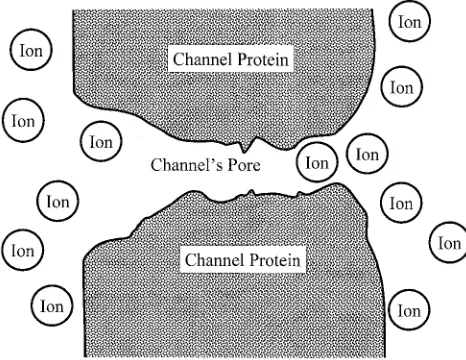
[image:3.555.291.529.417.566.2]6 150 mV . F igures 1 and 2 provide idealized sketches of a channel in an experimental set-up and in a m embrane. W alls 1 and 2 are insulators described by zero-¯ ux boundary conditions. End 0 and End 1 are electrodes described by inhom ogeneous Dirichlet boundary condi-tions. T he m embrane (other than the channel protein itself) is in fact m ade of lipid with substantial surface charge. This charge is described by an inhomogeneous Neum ann condition, but no ions ¯ ow through the lipid membrane aw ay from the channel protein. The electric ® eld exists in
Figure 1. A sketch of a channel in a membrane in an experimental apparatus. Note that the hole in the membrane represents both the channel protein and the pore in the middle of the channel protein, a double meaning that is found very widely in the literature. The ionic solutions are typically composed of Na+, K+, Ca+ + and ClÐ
the lipid membrane; the displacement current associated with the existence of that ® eld is of great im portance in the conduction of electrical signals in nerve and m uscle ® bres [24], although it is only of technological importance for measurem ents of single channels.
W e w ill see how well a mean-® eld theory of electrodiŒu-sion [18,25,26] can account for these currents using these boundary conditions. In this theory, current is carried by ions moving through a charged tube of ® xed structure that does not change (in the m ean, on the biological time scale) with voltage, or as the concentration or type of ion is changed.
W hat has been striking and surprising (to those of us trained as biologists) is how much can be understood using such a spare description of electrodiŒusion. Biological systems of this generality and im portance often require descriptions nearly as diverse as the systems themselves, or at least that often seems to be the case. Here, a single simple description does quite w ell, provided the analysis of electrodiŒusion is done self-consistently, by computing the electric ® eld from all the charges present in the system. The variation in shape of the electric ® eld seems to provide much of the diversity that previously could only be described, when the electric ® eld was assum ed, instead of being computed from all the charges present.
4. Theory of an open channe l
The channel protein is described in this mean-® eld theory as a distribution of ® xed charge. In the early versions of the theory Ð that we still use to ® t experim ental data quite well
[27 ± 30] Ð the channel protein and ¯ ow of current are described by averaged one-dimensional equations.
Deriving these equations from their full three-dim en-sional form (using mathematics alone, without additional physical approxim ations [17,18,31,32]) required us to understand a boundary condition that is scarcely de-scribed in textbooks of electricity and m agnetism , even though it is the main source of the electric ® eld for nearly any substance or m olecule dissolved in w ater, that is to say, in most things of interest to biologists and experi-m ental cheexperi-mists.
Anything that dissolves in w ater is likely to be an ion, or a polar molecule, as the chem ists call molecules w ith large local but no net charge. A polar molecule has ® xed charge that interacts w ith the ® xed charge on the atoms of the w ater molecules. Note that polar molecules are perm a-nently polarized, their charge is not induced polarization charge in the sense introduced by Faraday, rather they are like the electrets described in some textbooks of electricity and m agnetism [33]. W ater is the archetype of the polar m olecule. E ach of its atoms carries substantial ® xed charge, but these partial charges sum to zero net charge, making the water molecule neutral, overall.
The wetted surface of a protein usually has a large surface charge, determined by quantum mechanics
/
chem -istry of the protein molecule. This surface charge is independent of ionic concentration and local electric ® eld (for a wide range of ® eld strengths). It does not change unless covalent bonds change; that is to say, the charge does not change unless a chemical reaction occurs. O f course, covalent bonds do change in proteins, both as m etabolism occurs and when pH changes. It is in fact the change in the electric charge on proteins that make biological systems so exquisitely sensitive to pH. (A change of a few tenths of a pH unit in bodily ¯ uids is lethal.)Some of the surface charge of a protein is also induced by the electric ® eld, and is traditionally described by a dielectric constant, a single num ber, even though the induced charge is nearly always strongly tim e dependent, and is often nonlinearly dependent on the electrical ® eld. Induced charge on the surface of m ost proteins is probably m uch sm aller than ® xed charge; it certainly is m uch smaller than the ® xed charge lining the walls of channels. Induced charge is included (for the sake of com pleteness) in our original papers [17,31] and resulting com puter programs, but so far it does not seem to play an important role.
Interfacial surface charge on dissolved matter produces the electric ® eld according to the boundary condition
u
®
G
2 n
2
u
®
G
1 n
5
2
r 0
®
G
FixedCharge
[image:4.555.29.262.445.625.2]e 0
2
r 2
®
G
2,u
®
G
2
r 1®
G
1,u
®
G
²0
Induced charg e
(
1
)or equivalently, w hen induced charge is strictly propor-tional to the local electric ® eld,
²W all
®
G
u
®
G
n
2
²P oreG
®
u
®
G
n
5
2
r 0
®
G
²0 . (
2
)H ere,
u
(®
G
) is the electric potential on the channel wall, which has a dielectric `constant’ in the range ²W all(G
®
)
$
[10,30] com pared to the dielectric coe cient ²P ore$
[20,80] of the pore. T he induced charge r 2(
®
G
2,u
(®
G
)) ison the channel wall
®
G
(and depends on the local electric ® eld, of course); the induced charger 1(®
G
1,u
(®
G
)) is locatedwith-in the pore, just next to the wall, at
®
G
1;e
0 is thepermittivity of free space.
Interfacial surface charger 2(
®
G
) is the main source of the electric ® eld in most biological and m any chemical system s. This fact is not widely known, unfortunately, and not properly em phasized in textbooks of electricity and magnet-ism , in my opinion, and has led to signi® cant confusion am ong biologists, chem ists and biochem ists (in particular).Biochemists and channologists usually (if not invariably) describe the surface of a protein as a potential pro® le (`potential of mean force’ ) and, forgetting that the potential of mean force is a variable output of the system, they treat the potential of m ean force as a ® xed input or source to the sytem that does not change with experim ental conditions, as if it arose from anunchang ingDirichlet boundary condition. Biochem ists and channologists usually (if not invariably) assum e that the potential of mean force [or a rate constant derived from that potential, see equation (14)] does not vary when the concentration of ions surrounding the protein are varied (as they often are in experiments) [34 ± 36].
In fact, in contrast to traditional assum ptions, the electric ® eld arises (m ainly) from a boundary condition [i.e. equation (1) or (2)] which becomes an unchanging Neumann condition when induced charge is negligible. If a Neumann boundary condition is imposed on a problem, the potential on the boundary w ill change form (as well as value) when almost any change is m ade in the problem. Indeed, so will the potential pro® le change everyw here else. This sensitivity of systems to their boundary conditions is well known to those w ho have actually solved (i.e. made graphs of the solutions to) diŒerential equations, as it is to experim ental scientists w ho actually m easure their proper-ties, but study of boundary conditions is much less glamorous than the study of general properties of diŒerential operators, so their signi® cance is sometimes neglected in treatm ents of theoretical physics and m athe-matics.
Boundary conditions are usually im portant, often domi-nant determidomi-nants of the properties of physical system s because they describe the ¯ ow of m atter, energy and charge into the system. The biochem ical case is no exception: using the incorrect unchanging Dirichlet condition is equivalent to ignoring the shielding (often called screening) of ® xed charge by m obile charge. That is to say, using an unchanging potential of m ean force (or rate constant) to describe the surface of a protein ignores the eŒect of the mobile charge (carried by ions dissolved in w ater) on the surface potential in the solution next to the protein.
For that reason, the traditional treatm ent of the surface of a protein (as an unchanging potential of mean force) is not compatible w ith the generally accepted treatm ent of ionic solutions, e.g. the D ebye ± HuÈckel, Gouy ± C hapman, Poisson ± Boltzmann or mean-spherical-approxim ation (M SA ) theories, which are in large measure an analysis of shielding and its consequences [37 ± 45]. Since these theories are needed to describe the properties of ionic solutions greater than a few micro or even nanom olar concentration, treatments of proteins that neglect shielding are unlikely to be successful in the millimolar salt solutions in which proteins are norm ally found. Indeed, m ost proteins cannot exist (in anything like normal form) in distilled w ater or in solutions with trace am ounts of ions, suggesting that shielding plays a dominant role in the physical processes that govern the structure (i.e. folding) of proteins. It seems unfortunate that many computations (and theories) of protein folding do not include explicit ions at all. M any sim ulations are done w ith no de® nite concentration of ions, even though the structure of the great majority of proteins, and most of their functions (including folding) are sensitive functions of ionic concentration.
In chemical kinetics [46], biochemistry [47] or enzyme kinetics [48], rate constants are rarely if ever allowed to be a function of concentration [34,35]. It came as a shock to realize that the usual treatm ent of rate constants in chemistry and biochemistry is inconsistent with the physics underlying Debye ± H uÈckel, Gouy ± C hapman, Poisson ± Boltzmann and M SA treatm ents and thus with the properties of the ionic solutions found in m ost living systems.
O f course, rate constants cansom etimes be independent of concentration of reactants, in special circumstances, for exam ple, w hen the total ionic strength is held constant, while the substrate concentration itself is not varied enough to shield the ® xed charge of the other reacting species or protein. Nonetheless, these are special circumstances not likely to be present in most experimental or biological systems, and they are certainly not present in open channels.
N onequilibrium properties are at least as sensitive to shielding and the choice of boundary conditions as equilibrium properties. This is not surprising: ¯ ux is often a sensitive, nearly exponential function of potential [see equation (15)] and so rate constants (that are generally used to describe that ¯ ux) must also depend on concentration exponentially.
5. PNP theory
The ¯ ux in channels arises from gradients in the electrical potential and concentration of ions inside the channels’ pore. The potential and concentration are described by two ® eld equations w hose main source are the boundary conditions (1) or (2). One ® eld equation is the Poisson equation that describes how the average charge produces the average potential [see equation (3)]; the other is a transport equation Ð in fact the N ernst ± Planck equation [see equation (7)] Ð that describes how the average potential produces ¯ ux. W e call these the PNP equations to em phasize the im portance of the Poisson equation and the relation to sem iconductor physics, where the sam e equations are called the drift-diŒusion equations. The equations are coupled because ¯ ux moves charge, and thereby changes the concentration and potential pro® le, forcing us always to deal sim ultaneously with both the Poisson and the drift-diŒusion (i.e. N ernst ± Planck) equa-tions and solve them together.
The PNP equations were written and analysed in three dimensions and the one-dimensional approximation was derived, by mathem atics alone, using Taylor expansions singular perturbation theory [17,18], or spatial averaging [32]. A lthough the one-dimensional version of the model seem s su cient to deal with the experim ental data from a wide range of channels under m any conditions [20,27 ± 30,49] Ð probably because channels are so narrow and highly charged [50 ± 53] Ð a three-dimensional theory would be m ore convincing, given the visual orientation of hum an nervous system s, and the tridimensionality of protein structures. A three-dimensional version of the theory is com puting right now (H ollerbach et al. personal communication) and we hope it will be e cient enough to be useful in dealing with the mass of real experim ental data. The narrowest region of a channel is w here m ost short range chem ically speci® c interactions are likely to occur. In
this `selectivity ® lter’ [4], the channel is surely one dimensional, even if the electric ® eld is not, and so one-dimensional ion transport is likely to occur. Permeation through a channel may be better represented as a one-dimensional chemical reaction [49] than traditional enzym e catalysis, because reactants in enzym es actually diŒuse and react in a phase space of very high dimension, through an enorm ously complex energy landscape [54,55]. The m eta-phor I once proposed (`Channels as enzymes’ [56]), m ay be m ore than the am using tautology
/
oxym oron it seem ed to be.The one-dim ensional theory w e use to describe an open channel represents the structure of the channel’ s pore as a cylinder of variable cross-sectional areaA(x)(cm2) along tht reaction path x (cm ) with dielectric coe cient
e
(x) and a density of chargeq
(x)(coul.cmÐ 1). eNA is the charge in 1 m ole of elementary chargese, i.e. the charge in a Faraday. T he charge
q
(x) consists of(1) the charge eNA kzkCk(x) of the ions (that can
diŒuse) in the channel, of species k of charge zk, and m ean concentration Ck(x); typically k= Na+, K+, C a+ +, or C lÐ
and
(2) the permanent charge of the protein P(x) (m ol.cmÐ 1
), w hich is a permanent part of the atom s of the channel protein (i.e. independent of the strength of the electric ® eld at x) and does not depend on the concentration of ions, etc and so is often called the ® xed charge.
P(x) is really quite large (
~
0.1 ± 1e per atom) for m any of the atom s of a protein and w all of a channel. I imagine that the permanent charge lining the channel has an important structural role, allow ing the channel’ s pore to form and to be stably ® lled with w ater, just as the permanent charge of a solute allow s it to dissolve in water. F or this reason, w e should adopt the language of my friend and collaborator W olfgang Nonner [21] and call P(x) the structural charge of the channel;(3) the dielectric charge (i.e. the induced charge which is strictly proportional to the local electric ® eld) is not included in
q
(x) because it is described bye
(x). It is generally very sm all compared to the structural charge.Thus
²o ²(x)
d2
u
dx2
1
d²(x) dx
1
²(x)d
dx
[
logeA(x)]
d
u
dx
5
2
q (x)(
3
)where the average charge is given w ithout including the small dielectric (i.e. induced) charge by the equation
q (x)
º
eNA P(x)1
k
zkCk(x) . (
4
)The boundary conditions for the potential in the real world are set by the experimental conditions: experim ents, since the time of Hodgkin and Huxley [51] are best done under `votag e clamp’ conditions so that complex uncon-trolled eŒects of votage are avoided. Special apparatus is used to control the potentials in the baths surrounding the channel, i.e. the potential on the left is known and maintained at Va p p land that on the right is held at zero
u
(L)5
u
(2
¥
)5
Vappliedu
(R)5
u
(1
¥
)5
0
. (5
)These boundary conditions are m aintained by charge supplied to the system at its boundaries (i.e. by electrodes placed in the bath and
/
or inside a cell or pipette). T he am ount of charge necessary to m aintain the potentials depends on the properties of the system , e.g. of the channels, and the experiment (i.e. whether solutions or transmem -brane potentialVa p p lied are changed) and it is the need forthis charge, m ore than anything else that m akes a channel in a mem brane an open system and guarantees the importance of boundary conditions in determining channel behaviour. Channels are di cult to study if the transmembrane potential
/
(0)Ð/
(d) = Vap p lied varies spontaneously in acomplicated uncontrolled way. Sorting the properties of individual (types of) channels out of the mass of ionic currents ¯ owing through all types of channels and through the interior of cells Ð w hile large capacitive currents ¯ ow through lipid mem branes Ð is hardly ever possible (see [57] and [58] for notable exceptions). Precisely for this reason, Hodgkinet al. [59], follow ing Cole (as described in [60] and [61], developed a feedback am pli® er to supply just the current needed to control the potential to the desired value, allow ing ionic channels to be studied at ® xed potential. Supplying this charge, in the resulting voltage-clamped system is not easy; m any biological channels are designed precisely to supply charge to change the potential, often by changing their ensem ble properties in a com plicated non-linear, time dependent w ay, and so designing a high quality voltage [62] or patch clamp am pli® er is an interesting challenge [63].
Of course, the natural activity of mem branes and channels does not occur when the voltage clam p apparatus is used. Nonetheless, natural voltage changes can easily be
reconstructed by solving the Hodgkin ± Huxley equations [64], which show how the current through a (voltageclam ped) mem brane produces the uncontrolled transm em -brane potentials of a norm ally functioning cell. W eiss [24] is an admirable description of the classical biophysics and physiology w hich arose from the w ork of Hodgkin et al. more than anyone else. All modern system s for studying the current through one channel protein ± e.g. the `patch clamp’ of reference [15] (see also [63,65] Ð use the voltage clam p.
The concentrations of ions m ust also be controlled if the properties of channels are to be easily understood, implying the boundary conditions
Ck(L)
5
Ck(2
¥
), Ck(R)5
Ck(1
¥
) (6
)Special apparatus is not available to maintain this boundary condition, but the large volum e of the baths surrounding channels, and the relatively sm all am ounts of charge transferred through a single channel (in many cases) often guarantees that ionic ¯ ux does not signi® cantly change ionic concentration. Such is not always the case, indeed such may never be the case for Ca+ + channels functioning in their normal mode, because the concentra-tion of calcium inside cells is so small. Certainly, the absence of noticeable concentration changes m ust always be veri® ed experimentally for any channel. N onetheless, checks are easily done and usually satis® ed.
The boundary conditions (5) and (6) (atx= 6
`
of the three-dimensional problem), do not m ap obviously and easily into boundary conditions at the ends of the channelx= 0, x= d. W e have used a particular well-precedented equilibrium m apping called the built-in potential in semiconductor physics or the Donnan potential in parts of biology [17,18,31,32]. O ther treatm ents of the ends of the channel are under active investigation at the present time by H ollerbach, C hen, N onner and Eisenberg.
6. C hannels as nonequilibrium devices
It is obvious, but nonetheless often forgotten, that a channel in a mem brane, a hole in the w all, or a simulation or set of equations describing a channel or hole, describes an open system, a system that does not in itself satisfy conservation of charge, mass or energy, because charge, mass or energy m ust be supplied by the experimental apparatus to m aintain the boundary conditions of constant concentrations and constant transm embrane potential. W hat is also not always realized is that, in the steady state Ð w hich is the case of interest here Ð the boundary conditions that describe a nonequilibrium and
/
or open system m ust be spatially nonuniform : if they w ere uniform, no charge, mass or energy could be supplied across the boundaries and the system would not be open.equilibrium state. Devices are mostly studied by engineers; it would hardly occur to them to study an am pli® er, transistor, or switch `at equilibrium ’ . Indeed, it is di cult to even m outh those w ords without smiling because it is so obvious that alm ost any useful property of a device or transistor involves spatial nonuniformity and thus ¯ ow .
Channels are devices, alm ost never at equilibrium. A channel is nearly an electrochemical wire. It isan electro-chemical resistor, a G aussian tube, a pillbox in an ionic solution, that only has interest w hen it conducts current. Like life itself, and m ost machines of our technology, and semiconductor devices, in particular, channels are dead at equilibrium. In that state, at equilibrium , channels show little sign of their importance or function, particularly after crem ation, w hen they ® nally reach thermodynam ic equili-brium, ashes to ashes, dust to dust.
Thinking about a channel, or an open system, as a device has profound consequences; energetics and thermody-nam ics are not emphasized (however, see [66]), input output relations (i.e. boundary conditions) are. The emphasis on boundary conditions refocuses thoughts and sometimes dramatically simpli® es the analysis, by showing what should be stressed and w hat can be approximated. Theories and simulations that preclude ¯ ux, or that guarantee equilibrium because they use spatially uniform boundary conditions, are not useful descriptions of devices. No one studies resistors or transistors with their leads soldered together, at least not for very long, for the sam e reason that no one studies cadavers or their ashes if anything more lively is available.
U nfortunately, m ost of the simulations of m olecular dynam ics of channels (review ed in [67,68]), and m ost studies of their electrostatics (e.g. [69 ± 71]), assum e equilibrium and spatially uniform boundary conditions. All sim ulations of the molecular dynam ics of proteins and most sim ulations of the molecular dynam ics of ionic solutions make the sam e assumptions as far as I am aware, (for example, 68, 72 ± 89]). Clearly, there is a vast literature of w hich I am unaware and I apologize to those authors (e.g. [90]) whose papers are an exception to my sweeping statem ent.
W hatever their exciting view of atomic detail, simula-tions and theories constrained to equilibrium cannot predict ¯ ow, nor the properties of devices that depend on ¯ ow. Interestingly, these simulations of channels ([67,86,91,92], m any further references in [68]) also do not include ions, so it is not clear how they manage to predict ionic current, e.g. [86]. Calculations of current ¯ ow in sim ulations of equilibrium system s, that do not include ions must, of course, give the conductance of distilled water as a result, if they are correct and converged. That conductance is m any orders of magnitude less than the conductance of open channels, which the cited papers claim to predict (within a factor of 2 or so).
Sim ulations of this type can only provide an autopsy of a dead channel, even if they are done correctly including ions; they cannot predict channel function, or even glimpse its structure when it is functioning as a live wire, conducting current. Indeed, m any channels and proteins cannot exist in anything like their normal state in solutions without ions (many proteins denature in distilled water into a m ass rather like boiled egg w hite).
The eŒects of ions on proteins have been a w ell-known experim ental fact, crucial to the care and handling of proteins in the laboratory, for some 150 years. Sceptics m ight therefore question the relevance of simulations of proteins conducted in distilled water, without ions, or the signi® cance of sim ulations of protein folding done under these conditions. Indeed, one must question whether they, like similar calculations of channels, are converged or correct. If the protein they seek to describe cannot exist in distilled water, how can a calculation of that protein in distilled water give a valid result other than that found experim entally? How can the result be anything except a denatured protein? O r in the less extrem e case, where the structure and function of the protein depends sensitively on ionic strength, how can a correct and converged simulation of the protein give a valid result w hen done in an inde® nite concentration of ions?
Given these questions, those involved in the allocation of scienti® c resources m ight question the enormous resources that are used to sim ulate proteins in solutions w ithout ions.
7. M athem atical model
W e turn from these general issues now to one description of ¯ ux through a channel.
The ¯ ow (i.e. the ¯ ux Jkof ionk) through the channel is described in our mean ® eld theory by the diŒusion equation, the Nernst ± Planck equation (see [38,43]; w e derive this equation below)
Jk
5
2
Dk(x)A(x)dCk(x)
dx
1
Ck(x)RT
d
dx
[
zkFu
(x)1
¹ 0k(x)
]
I
5
k
Ik
5
kzkF Jk.
(
7
)The ¯ ux Jk of ions is driven by the (gradient of) concentration and electrical potential, which together form the electrochem ical potential
l
k= R TlogeCk(x)+ zkF/
(x).Dk(x) is the diŒusion coe cient of ion k in the channel’ s pore.
This chem ical term is not needed, and is in fact quantitatively insigni® cant in m ost (but not all) of the situations w e have studied to date, m uch to our surprise: there are no shortage of reasons that w ater and ions in a channel should have a diŒerent standard state from w ater and ions in bulk solution, and I, like most workers in our ® eld, have always assum ed this would be the case. (Just consider the enorm ous changes in local environment that occur when an ion dehydrates and resolvates as it enters a channel.) N onetheless, this term ¹0k(x) only seem s im por-tant when m ixtures of some ions are studied in some types of channels [20,21,93], probably because the ® xed charge dominates the energetics of m ost channels [94]: even a few charges in the lining of the channel’ s pore product an enorm ous density of ® xed charge. One charge in a cylinder 6 AÊ diameter and 10 AÊ long is a concentration of 6
´
102 1cmÐ 3»
10 M . Interestingly, theories like Pois-son ± Boltzm ann are known to `becom e exact for large electric ® elds, independent of the density of hard spheres’ [53, p.315] `independent of interactions of molecules in the ¯ uid phase’ [50, p. 972]. And some voltage dependent channels are thought to have as many as six charges in half that length or volum e, giving
~
100 M ® xed charge, im plying a concentration of mobile charge in the channel of about the sam e size. As pointed out to me by W olfgang Nonner, such concentrations approach those of solid electrolytes: NaCl in the selectivity ® lter of such a channel may be more like table salt than sea water, or even the water in M ono Lake (an unforgettable sight, a saturated lake, surrounded by salt colum ns and mounds of obsidian, in Ow ens V alley CA, near L eeVining).H igh densities of ® xed charge also help buŒer the concentration of mobile charge (of opposite sign) in the channel’ s pore. T he important part of the channel is not exposed to the wide changes in concentration that are used in most experiments; the channel’ s contents are buŒered by its ® xed charge. Concentration independent errors in the theory can then be absorbed into its eŒective parameters (to som e extent).
Excess chemical potentials can be analysed (rem ember-ing that the excess chem ical potential is likely to be a strong function of concentration and other variables) within the traditions of modern electrochem istry, e.g. with the mean spherical approximation of statistical m echanics [95]. Blum, Nonner and Eisenberg are trying to build a theory of the selectivity of open channels that way.
8. T ransport laws
The diŒusion equation used here [equation (3)] seemed to us at ® rst to be a crude macroscopic approximation. It turned out not to be so. R ather, equation (3) describes the stochastic trajectories of discrete diŒusing particles w ithout much approximation.
Eisenberget al. [19] derive the Nernst ± Planck equation for the ¯ ux of discrete particles m oving over a potential barrier
/
(x) of any size or shape assum ing that the particles diŒuse according to the L angevin equation, i.e. according to the usual laws of B rownian motion. In fact, their derivation can easily be generalized, using the m ethods of Schuss [96,97], to any kind of trajectory for which conditional probabilities can be de® ned. R eference [19] shows that the ¯ ux can be written (here for the special case where Dk is independent ofx: the general case is given in the original paper)Jk
5
Ck(L)Dk
d P rob
{
R|
L}
Unidirec t ional efflux
2
Ck(R)Dk
d P rob
{
L|
R}
Unidirec t ional influx
.
Source Diffusion Conditional
concent ration velocit y probabilit y (
8
)The conditional probability Prob{R |L} describes the probability that a trajectory starting on theLeft reaches an absorbing boundary on the Right, when a re¯ ecting boundary is placed at the left, just behind the source of the trajectories (i.e. just to the left of the source).
It is traditional in chemical kinetics, e.g. [37,98], to write equation (8) as a rate equation, i.e.
Jk
5
d.
kfCk(L) Unidirec t ional efflux2
d.
kbCk(R)Unidirectiona l influx
(
9
)or chemical reaction
kf
L R (
10
)kb
using `the law’ of m ass action. In these equations,d is the channel length, and the rate constantskfandkbare de® ned as
kf
5
k{
R|
L}
5
Dk
d2P rob
{
R|
L}
;
kb5
k{
L|
R}
5
Dk
d2P rob
{ }
L|
R .(
11
)In fact, reference [19] can be view ed as a stochastic derivation of the law of mass action (9), that shows that `the law’ is valid provided bath concentrations and
transm em brane potential are m aintained ® xed, and
/
(x) does not vary as the concentrations Ck(L) or Ck(R) ortransm em brane potential are varied. Surprisingly, if the law is valid at all, the derivation showsit is valid for any shape of the potential barrier. In this way, reference [19] shows (to the considerable surprise of at least one of the authors) that the m etaphor of channel perm eation as a chem ical reaction [56] can be exact Ð indeed it isexact when the transmem -brane potential and bath concentrations are kept ® xed in a voltage clamp experim ent.
®
The conditional probabilities of equation (4) seem vague but in fact are precisely de® ned and discussed in the original publication [19]: most of the paper is devoted to their derivation and determination. The de® nition of the conditional probabilities must include tw o boundary conditions to (doubly) condition the underlying trajec-tories, specifying both where
/
how the trajectories start and where/
how they end. For example, if the trajectories are those of B rownian m otion, they m ust be described by the full, not reduced Langevin equation, to allow the double conditioning: no m atter how large the friction, the Einstein/
Sm oluchowski approxim ation of the L angevin equation cannot be used because it, being a ® rst order diŒerential equation, can accept only one boundary condition. It was the use of the full Langevin equation, employing two boundary conditions that allowed [19] the problem to be speci® ed after m any years of frustration [99]. It w as the techniques and skills of Schuss [96,97] that provided the solution to the problem .The conditional probabilities of equations (8) ± (10) (and thus the rate constants that describe ion permeation) can be evaluated in diŒerent w ays, depending on the degree of approxim ation of interest. If one wishes to calculate the trajectories in full atomic detail, using the techniques of molecular dynam ics, the conditional probabilities can be directly evaluated from the O nsager ± M achlup action formulation of Newton’ s laws, in the presence of therm al agitation ([100]; see E lber’ s m odern application [101]).
If one wishes to describe the friction in more detail, for exam ple, as a linear process but with complex time
/
frequency dependence, one can use a Langevin equation with m emory kernels for the friction [102 ± 104]. If one wishes to describe the normalized frictionb
(x) as a time independent process, described by a function only of position, or even by just one number independent of position, the conditional probabilities become the solutions of partial diŒerential equations [19] as inP rob
{ }
R|
Lº
¥
0 vp(
1
,v|
L) dv¥
0 vp(
0
,v|
L) dv(
12
)where v is the velocity of the particle and the conditional probability satis® es the full forward Fokker ± Planck equation [97,105]
2
v p(x,v|
L) x
1
b
(x)² 2p(x,v
|
L) x2
1
x
b
(x)v1
(x)
x p(x,v
|
L)5
0
(
13
)with absorbing boundary condition p(1,v|L) = 0 for v
<
0, i.e. the boundary is absorbing for just those trajectories leaving the system. (If a reduced Langevin equation was used, as we, and perhaps others, tried to do for som e tim e, hoping to avoid the mathem atical complexity of the full equation, the boundry had to be absorbing for botharriving and leaving trajectories, w hich makes it som ewhat di cult to put a source there, at the boundary, as is actually present in the experimental situation. Describing the experim ental situation requires the full Langevin equation.)
e
is the normalized temperature in the custom -ary, if unfortunate notation [97] of this ® eld of m athe-m atics, and is not sathe-m all.Analytical approximations are particularly neat when friction is large and sim ple in behaviour, described by a single diŒusion coe cient, a single num ber Dk for each species kof ion, using normalized unitsF (x) = F
/
(x)/
R T;V= FVa p p l
/
RTkf
5
k R{ }
|
L5
Dk
d2 Pr ob
{
R|
L}
5
Dkd2
.
exp(zkV)
1
d d
0exp zk (f )df
kb
5
k{
L|
R}
5
Dk
d2 Pr ob
{
L|
R}
5
Dkd2
.
exp(zkV)1
1
d d
0exp zk (f )df
(
14
)and the current through the channel is
Jk
5
DkCk(L) exp(zkVappl) d
0expzk (f ) df Unidirectiona l efflux
2
DkCk(R) d
0exp zk (f )df Unidirec t ional influx
. (
15
)These expressions can be easily generalized ifDkdepends on location [21].
In treating this problem , one must be quite careful in taking the limit of high friction. As is usually the case in problems involving several sm all parameters [106 ± 108], the limits can be taken in diŒerent w ays, and the lim iting process gives diŒerent answers when they are taken in diŒerent ways (i.e. the lim iting process is `nonuniform’ ). U niqueness is achieved by taking the mathematical lim it that preserves the m ain features of the underlying physical system and experiment.
W hen taking the lim it of high friction in these problem s, it is essential to keep the ¯ ux ® xed at a value like that observed experimentally. It is essential that the ¯ ux not be forced to zero. Otherw ise, one is studying an equilibrium or nearly equilibrium system which is dead to the world w e w ant to investigate. The driving force (i.e. the concentra-tion and
/
or electrical potential gradient from one end of the channel to the other) m ust not be kept ® xed in the lim iting process. If the driving force were kept constant, then allow ing the friction to get large forces the ¯ ux to approach zero, and such analysis must yield the equilibrium result, w hich cannot be expected to very useful.surprised then if analyses or simulations that start with the reduced Langevin equation (i.e. that assume the Einstein
/
Sm oluchowski form of the Langevin equation, w ithout the second derivative term, which m eans that the distribution of velocities is strictly M axwellian), or that explicitly assum e a strictly M axwellian distribution of velocites, or that force a strictly M axwellian distribution of velocites (by readjusting the distribution of velocities, as is comm only done in m olecular dynam ics sim ulations of proteins [75,109] and channels [67,68] every 10 ± 100 fs or so have di culties and produce paradoxes (C hapter 7 of [110]; pp. 425 ± 430 and pp. 1 ± 75 of [111], am ongst others; Chapter 8 of [72]; pp. 83 ± 92 of [79]; Chapters 6,7 and 10 of [112]; Chapters 9 and 10 of [81]).On the other hand, if the ¯ ux is held constant while the friction goes to in® nity, the distribution of velocities turns out to assymm etrical, as it must to accom modate the ¯ ux self-consistently, but the distribution is only trivially changed. It is a displaced M axw ellian [19] as has long been known in sem iconductor physics [113]. The displacement is (in suitably normalized units) just the ¯ ux itself.
As simple as this displacement is, itmustbe included in any theory or calculation, or sim ulation of molecular or Langevin dynam ics of a spatially nonuniform system , a nonequilibrium system with ¯ ux across its boundaries. If, for example, a molecular dynamics sim ulation is done in which ¯ ux is sought, but the distribution of velocities is forced to be M axw ellian, the problem is illposed and no mathematical solution exists, and so no solution can be found by approximate methods. Simulations cannot con-verge if they are in fact perform ed this way, because the converged solution does not exist.
The simulations of nonequilibrium transport of charge carriers performed in computational electronics [113 ± 118] have been notably successful in analysis of experim ents and prediction (i.e. design) of new results (i.e. design of new devices: see the DA M OCL ES web page for a landscaped gatew ay to this wonderful literature [119]).
Simulations of nonequilibrium transport of charge carriers in ionic solutions seem to have been less successful (loc. cit). Sim ulations of nonequilibrium transport of charge carriers in proteins or channels seem not to have been carried out, at least as far as I know. Perhaps the diŒerence in success betw een simulations of ionic solutions and semiconductors has more to do with the strikingly diŒerent m ethods of simulation (of the nonuniform boundary conditions, of the nonM axw ellian distribution of velocities) than it has to do w ith the diŒerences in the mechanism of charge transport in ionic solutions and semiconductors.
Of course, the sim ulations of semiconductor physics also treat the electrostatic ® eld quite diŒerently from the way it is treated in physical chemistry. The simulations of semiconductor physics use the G um mel iteration
[114,120 ± 123] to ensure self-consistent treatment of the Poisson equation (w ith spatially nonuniform boundary conditions) and transport law s. It is a surprising fact that the Gum mel iteration seems never to have been used in sim ulations or analysis of charge movement in ionic solutions or proteins, and that fact m ay have something to do with di culties in this ® eld as well. Perhaps, sim ulations of protein molecular dynam ics, including folding, will be easier, will be possible with longer time steps and less num erical di culties, and also w ill be more realistic, if the electric ® eld is computed and included as it is in semiconductor calculations, using the Gumm el iteration to ensure that Poisson’ s equation and far ® eld boundary conditions are always satis® ed.
Sim ulations of the properties of electrolyte solutions possibly will be more successful if they use the Gumm el iteration. This is not the place to discuss this issue in detail; su ce it to say that the electric ® elds found transiently in ionic solutions are very much larger thankT
/
eand so w ill have profound nonlinear eŒects that do not average to zero. T hese eŒects are not easily incorporated into theories of ionic solutions that use linearized versions of the Poisson ± Boltzmann equation, no matter how sophisti-cated the rest of the theory is. These large electric ® elds are likely to produce at least some of the excluded volume eŒects known to occur in ionic solutions, they are also likely to aŒect diŒerent ionic species of the same charge (say in a solution that contains K+, Na+ and ClÐ) in sim ilar ways producing correlated ionic m ovements that would appear m acroscopically as ¯ ux coupling. These electric ® elds would be di cult to include correctly in sim ulations using Ew ald sum s and
/
or periodic boundary conditions. It will be interesting to see how the traditional problems of electrochem istry, that have received exhaustive attention for nearly 100 years, w ill respond to analysis and sim ulation using the Gum mel iteration.Schuss, N adler and Eisenberg (and others as well, no doubt) are currently trying to do a self-consistent treatm ent of brownian motion, i.e. to solve L angevin and Poisson equations simultaneously, and thus to understand how trajectories combine and interact to provide the atom ic basis of the shielding phenom ena of mean ® eld theories.
9. U nidirectional ¯ uxes
all be replaced by the appropriate (pairs of) conditional quantities if these in® nities are to be avoided.
Interestingly, for more than 50 years physiologists have directly m easured these components of ¯ ux using radio-active tracers, thus correctly separating the net ¯ ux across a channel into its (trans) com ponents, although as far as I know, the im portance of the cis components of unidirec-tional ¯ ux w as not recognized in that literature until recently ([124], see citations in that paper). The cis
components in fact contribute a great deal to the variance of the open channel current in many conditions, because so many more trajectories enter, leave and reenter channels than cross them, under m ost conditions.
The trajectories of each type of unidirectional ¯ ux can be described by other statistics besides conditional probabil-ities. The time an ion takes to go from L to R is the (conditional) ® rst passage time T{R|L}; the number of {R|L} trajectories w ithin the channel is the conditional contents of the channel C{R|L}, the unidirectional ¯ ux
J{R|L} is the ¯ ux carried by the {R|L} trajectories, and, not surprisingly, `¯ ux equals contents over ® rst passage time’
J
{
R|
L}
5
C{
R|
L}
T
{
R|
L}
;
J{
L|
R}
5
C
{
L|
R}
T
{
L|
R}
. (16
)Note, however, that total ¯ ux does not equal the total contents over ® rst passage time.
The total ¯ uxJof ions is not simply related to the total contents, because the m ean ® rst passage tim e of all the trajectories is not well de® ned [16,19] in situations like this in which there are two w ays an ion can exit the channel. If even one particle starting on the left cleaves on the left, then that particle takes in® nite time to reach the right (because it never gets there), making the m ean time (of all the particles) to reach the right in® nite!
The m ean ® passage time is the sum of the ® rst-passage times of each particle divided by the num ber of particles. If one of those times is in® nite, the sum is in® nite. In this circumstance, the `mean value operator’ is a highly biased estimator Ð in® nitely biased, in fact Ð of a ® rst passage time of a trajectory that does in fact get to the right. T hosetrans trajectories (i.e. the ones that do in fact get to the right) are the ones we unconsciously select when we say `mean ® rst-passage time’ (having in m ind the exit tim e or transit tim e) in a channel, but in fact the mathematics requires that we consider all trajectories, giving the in® nite result for the unconditional mean ® rst-passage time. W hen we do explicitly condition the trajectories (according to our previously unconscious and thus im plicit thoughts,) we get the explicit and sensible, intuitive and ® nite result cited in equation (16), but w e pay the price of having to evaluate the conditioning explicitly,
cf.equation (12),et seq.
The idea that `Flux = Contents over ® rst-passage time’ is widely, if loosely held, am ong physicists and engineers
interested in ¯ ow (e.g. [125 ± 128]). Evidently, in problems involving two absorbing boundaries, the ¯ ux m ust be separated into components if it is to satisfy this equality.
10. Rate models and transition-state theory
T he analysis of ¯ ux over barriers can be extended to derive the exponential expressions of `E yring’ rate theory, i.e. the transition-state theory widely used to describe how rate constants depend on the height of potential barriers [16,19,96,102 ± 105,12 9 ± 137]. If the (normalized) potential pro® le
U
(x) = F/
(x)/
RT is dominated by a large barrierU
m a x(x0)= F/
m a x(x0)/
RT, and satis® es certain othercriter-ia Ð e.g. if the barrier is asymptotically symm etrical and isolated from the boundary and other m axima Ð expres-sions for rate constants reduce to exponential expresexpres-sions [16]. The standard expression of the Kram ers’ formulation of rate theory [97,105,134] as found in hundreds of papers [133,134], is recovered:
kf high barri er
Dj
d
Ö
2
p zj¢ ¢(x
m ax)
|
1/2
P refact or
exp zjV
2
zj max(xmax) .]
(
17
)T here is no controversy in the chem ical literature about this expression or its prefactor. Exactly this expression is used in the extensive literature (more than 700 papers) that describe the ¯ ux over high barriers, w hether the papers report sim ulations, theory or experiment, w hether the papers are written in the K ram ers’ or Eyring tradition. Indeed, Schuss, Pollak and co-w orkers [137 ± 139] have shown in an elegant way how these traditions can be united rigorously: the subject of one-dim ensional diŒusion over a barrier can be considered closed (when friction is large and sim ple), m ore or less completely reduced to known m athematics, now that the transmission factor has been evaluated by purely m athematical m eans [139 ± 142] and the issue of recrossings has been solved [143,144].
The num erical value of the prefactor of equation (17) can be estim ated easily if the potential pro® le
U
(x) is a sym metrical parabolic barrier spanning the w hole lengthd of the channel, with maxim um size
/
m a x(xm a x), m uchlarger than the applied (i.e. transm embrane) potential
V= FVa p p l
/
RT. Then, for exam ple,kf Par abolic
High bar rie r
2
Djd2
Ö
p|
zkF
u
m ax(xm ax)b
RT
|
1/2P refact or
exp
2
zjFu
m ax(xm ax)RT .
(
18
)A pproximations (17) and (18) can be used when system s satisfy the conditions under which they were derived, e.g. w hen barriers are know n to be large, isolated and
®
asym ptotically symmetrical; when the size of barriers is independent of experimental conditions. Otherwise, they should not be used, as seems obvious to physicists but seem s not be so obvious to biologists, biochemists and (sadly) biophysicists. If a theory assuming high barriers of known ® xed size is used to describe a system with low barriers, or with barriers of variable size, it is unlikely to ® t the data. If such a theory is forced to ® t the data, as w ill happen in some cases given the unhappy reality of som e human behaviours, only worse will happen. Either the parameters will be forced to vary in an arbitrary w ay, without obvious meaning, or data show ing mis® ts w ill be suppressed, or not m easured at all, or even m anipulated. In any case, the search for understanding will be delayed or blocked by the misuse of m athematics.
Approxim ate exponential expressions like (18) were originally derived and used [133,135] before com puters were available to evaluate de® nite integrals. N ow, that they are, now that Gaussian (e.g. Gauss ± Hermite, e.g. p. 217 of [145]) quadrature methods are w ell known that require only a handful of evaluations of the integrand, it is hardly m ore di cult to evaluate the exact expression than the approx-im ate.
Further thought shows that the exact expression is less useful than it seems, however, because it is likely to be used experim entally w ith the (sometim es tacit) assumption that barriers are of a de® nite size that does not change during the experim ents of interest. In m ost experimental situations, however, shielding is involved in determining the barrier height, and experimental conditions change the shielding;
/
(x) and/
m ax are likely to change as experimentalconditions are changed, e.g. as solutions ortransmembrane potentials are changed, or drugs are applied.
Few papers using transition-state theory, or rate-constant m odels for that matter, allow for this eŒect, which can have large consequences because ¯ ux is usually an exponential function of
/
(x). As far as I am aware, no paper using barrier models of channels has ever calculated the height of the barrier and allowed that height to vary with ionic concentration, although in the vast literature of channels, something m ay easily have escaped my attention.11. Rate theory in channo logy
M uch of the previous discussion is made moot in the particular case of channels, because unfortunately, the version of rate theory used in channology [146 ± 148] does not use the expressions (14), (17) or (18) found in the physical literature (e.g. [131,133]). Rather, the traditional prefactor used in barrier theories of channels is
T raditional prefactor
5
(RT/
h NA) . (19
) U sing the traditional prefactor produces qualitative confusion because the resulting physical meaning of therate expression for ¯ ux is inappropriate. The traditional prefactor does not include a parameter to describe frictional interactions.
It is silly to describe ¯ ux in a pore of a protein, or an ionic solution, with an equation that does not include friction. Solutions and proteins are `condensed phases’ because they contain little em pty space. Ions cannot move in such system without hitting other molecules every few femtoseconds, as was apparent som e time ago [149 ± 151]. Friction is involved in every atomic and macroscopic ¯ ux [152], on the femtosecond time scale of atom ic m otion [37,153], as well as on the m icro- to m illiseconds biological time scale. The sm aller the system the more im portant is friction [154,155], and the atom ic interactions that produce the friction. Proteins and channels are very small.
W ithout a parameter for friction, traditional rate theory cannot predict the dependence of ¯ ux on friction found in nearly every experim ent measuring current ¯ ow in con-densed phases, at least the dependence cannot be predicted in any natural w ay [156].
The quantitative problem s produced by using the traditional prefactor are even m ore serious than the qualitative ones. Using the traditional prefactor produces num erical nonsense because the resulting errors in the prediction of the ¯ ux are a factor of about 2
´
104 (see appendix of [27]; see also [99,157]).The w ord `nonsense’ in the previous paragraph may seem harsh, but the num erical error in the prefactor is so large, and has had such consequences on the history of channology, that it seems necessary. Traditional rate models found in hundreds of papers in the channel literature Ð following [146,148], see [47] for references Ð cannot predict currents m ore than 0.1 pA if they use the correct prefactor. M ost currents recorded from open channels are larger than 1 pA, usually m uch larger (say 100 pA). T hus, the model customarily used to describe open channels for some 20 years is not able to predict currents within a factor of 100 or 1000 of those actually measured, if that model is used in the form universally accepted by physical scientists.
are hidden and cannot even be addressed. Little worthwhile can follow such qualitative and quantitative errors.
12. Rate constants and barrier heights depend on concen-tration
Another m ore subtle di culty arises when perm eation, or other processes involving ions or charged species, is described by an equation (e.g. equation (9) or a chemical reaction, e.g. equation (10) involving rate constants.] R ate constants are historically de® ned as independent of concentration. The entire concentration dependence of ¯ ux is supposed to be described explicitly by the concentration variables in equation (9); in a way, that is what the law of mass action means. W e have already seen the tension between this idea, and the ideas of shielding embedded in the Gouy ± Chapman
/
Debye ± HuÈckel/
Poisson ± Boltzmann treatments of potential barriers. Those treatm ents im ply that concentration changes potential barriers and thus rate constants.Potential barriers have profound eŒects on rate con-stants. The rate of a reaction clearly m ust depend on the height of the potential barrier over which reactants m ove, indeed, we have seen that it depends exponentially. T hus, any variable that changes the barrier height must change the rate constant. In particular, if the potential barrier arises from the structural charge of a protein (as it does, at least in large measure, in channels, proteins and enzym es, as well as a w ide range of other chemical reactions), anything that shields the structural charge of the protein will modify the potential barrier and thus the ¯ ux.
Changing the concentration of reactant, or of other charged species, will certainly change the shielding of ® xed charge. Indeed, in the visual view of ionic solutions, captured in the D ebye ± H uÈckel, Gouy ± C hapman and Poisson Boltzmann theories [37,38,40 ± 44,158 ± 162], shielding phenom ena are dom inant determinants of nearly all the properties of ionic solutions, and changes in concentration of mobile ions is the usual way shielding is changed.
Thus, one m ust inevitably conclude that changing the concentration of reactants or other charged species will change the potential barrier across w hich those reactants move. The rate constant must then change. In other words, the rate constant must be a function of concentra-tion. The consequences of this statem ent are large because the rate constant has never been allowed to vary with concentration in the rate models of channology or biochemistry I know of; indeed, it is not usually allowed to vary with concentration in rate models in physical chemistry.
U nfortunately, approximations do not permit easy escape from this trap: the dependence of potential height on the concentration of reactant and ionic species is m ore
likely to be exponential than weak (although of course in certain cases it can be m ade to be weak by using special solutions which buŒer ionic strength, for example). T he dependence of ¯ ux and rate constant on barrier height is in fact usually exponential. W e conclude then that even when barriers are high, barrier models must recom pute the barrier height in each experimental condition of interest, because the barrier height is likely to change as m ental conditions are changed. Indeed, changing experi-m ental conditions is likely to have an exponential eŒect on rate constants.
This issue is stressed here not because I enjoy being awkw ard or critical, but because it is a key to under-standing channels, at least in m y opinion, and it may be a key to understanding other proteins and biological system s as well. The success of the PNP equations in ® tting large am ounts of data measured over wide ranges of ionic strength and transm embrane potentials occurs precisely because the potential pro® les in that theory vary widely as concentration and transmem brane potentials are varied in typical experim ents.
W e m ust conclude then that traditional rate models of ion m ovem ent through channels suŒer from several problems: they use the wrong formulas for ¯ ux; they assum e barriers independent of concentration; they assume high barriers where none need exist. It is no wonder, then, that barrier m odels are unable to ® t experim ental data taken under a wide range of conditions.
13. Rate theory in biophys ical chemistry
It seem s likely that similar errors occur in many areas of biophysical chem istry and molecular biology besides channology: transition states are analysed with the incorrect prefactor in leading texts, (e.g. see p. 188 of [47]), and friction is never mentioned, even in qualitative discussions (see pp. 131 ± 132 of [1], pp. 38 ± 39 of [163]), as far as I can tell. Since the eŒects of ion concentration on barrier height are also absent from these discussions, it seems likely that some revision in traditional enzym e kinetics will be necessary if the w idely held goal of m olecular and structural biology Ð of linking enzym e structure and function Ð is to be reached.
W e try to avoid these di culties by using the com bina-tion of equabina-tions (3) and (15) to describe the current through open channels. In this way, we com bine a description of the trajectories of diŒusing particles with a self-consistent calculation of the m ean electric ® eld. W e call these the Poisson ± Nernst ± Planck or PNP equations to emphasize the importance of the electric ® eld, although they have been known in physics as the drift diŒusion equations for some tim e.
equations like those of other m ean ® eld theories and they depend on the sam e assumptions. But the PNP equations diŒer from many m ean ® eld theories because they explicitly and self-consistently allow ¯ ux. This is very diŒerent from Debye ± HuÈckel (etc.) theories which are con® ned to equilibrium, where no ¯ ux ¯ ows.
The PNP equations describe the rich behaviour of semiconductor devices, such as switches, am pli® ers and mem ory elements, for example, even though they look like ordinary diŒerential equations with m uch simpler beha-viour. The parameters of the PNP equations donothave to be adjusted to describe a transistor behaving as each of these devices. Only the boundary conditions, not the diŒerential equation or its parameters, need to be changed to convert the device from the linear am pli® er to a logarithm ic am pli® er or even a nonlinear switch.
The PN P equations are deceptively simple in this w ay, giving a rich repertoire of well-determ ined behaviour from a simple pair of equations. They are deceptive in other ways as w ell, because they cannot be integrated by the normal numerical recipes widely available in packaged program s. Those integration schemes do not work on these equations, even approximately, for fundam ental reasons that are well understood m athematically [121]. Other methods work well, however.
14. Solving the PN P equations: the Gumm el iteration
Integration of the PNP equations is easy if a particular method called the G ummel iteration, or its equivalent, is used. The Gum mel iteration was discovered som e decades ago by the semiconductor comm unity (and was discovered in my lab independently by Duan C hen, some years later) and is a general method for producing a self-consistent solution of coupled equations closely related to the self-consistent ® eld methods used in quantum mechanics to compute orbitals.
The Gumm el iteration starts with an initial guess of the potential pro® le, often just a linear function of position connecting the boundary values of potential. That initial guess of the potential pro® le is substituted into the right-hand side of an integrated version of the Nernst ± Planck equation (7). This substitution determines the congruent initial guess of the concentration pro® leCj(x; initial guess) and that guess is substituted in the right-hand side of Poisson’ s equation (3), which is then trivially solved. T he resulting estim ate of potential
/
(x; ® rst iterate) identically satis® es the boundary conditions, as do all other estimates of the potential pro® le. T he potential pro® le/
(x; ® rst iterate) is substituted into the integrated Nernst ± Planck equation (7) and so determines a ® rst-iterate of concentra-tion pro® les Cj(x; ® rst iterate). T hese tw o iterates are consistent w ith each other and the boundary conditions. The two ® rst-iterates/
(x; ® rst iterate) and Cj(x; ® rstiterate) are then substituted into the right-hand side of Poisson’ s equation (3), which is again solved, now to determ ine the second-iterate
/
(x; second iterate), a better approxim ation to the potential pro® le. The second-iterate of potential determines a second-iterate of concentration by equation (7); together, the two second-iterates deter-mine the third-iterate of potential, and so on for 10 iterations, (w hich is more than enough for good conver-gence in almost all cases), that take only m illisceonds on a typical personal com puter. Once the iteration has con-verged, both the concentration and potential pro® le are known (for that set of concentrations andtransmem brane potential, and other param eters) and so the ¯ ux and current can be determ ined from the output equations (15). In this way, the PNP equations can be easily solved to predict the current voltage relations observed in experi-ments.15. Comparison with experiments
The PNP equations form a map betw een the structure of the channel protein, represented crudely by the function
P(x) and the current voltage curves m easured experim en-tally. D iŒerent types of channels have diŒerent pores made w ith linings of diŒerent charge. A useful and productive working hypothesis assumes that the only diŒerence between diŒerent types of open channels is their diŒerent distributions of ® xed charge Pi(x), w here the subscript i identi® es the type of channel protein, e.g. a voltage activated Na+ channel, a stretch activated channel and so on [3,5,10 ± 12]. Of course, the working hypothesis cannot always be true: speci® c chem ical interactions, not captured in this simple m ean ® eld theory, will no doubt be im portant in ways w e do not yet understand. N onetheless, as we write these words, the current voltage relati