Generating the Structure of Argument
Chris Reed
Department of IS and Computing Brunel University
Middlesex, Uxbridge UB8 3PH, England Chris .Reed @ brunel, ac .uk
Derek Long
Department of Computer Science University of Durham
South Road, Durham DH1 3LE, England [email protected]
Abstract
This paper demonstrates that generating arguments in natural language requires planning at an abstract level, and that the appropriate abstraction cannot be captured by approaches based solely upon coherence relations. An abstraction based planning
system is presented which employs
operators motivated by empirical study and rhetorical maxims. These operators include a subset of traditional deductive rules of inference, argumentation theoretic rules of refutation, and inductive reasoning patterns. The paper presents a unified system in which t h e various argument forms are employed in generating rich, complex structures for persuasive text.
Introduction
The ability to generate arguments in natural language is attracting wide-ranging research interest, and it is becoming clear that the problem is also stimulating investigation of a number of problems of importance to natural language generation (NLG) as a whole (Reed and Long, 1997a). Argumentation is particularly appropriate as an NLG problem both because it is more highly structured than other forms of natural language, and because there are a variety of established metrics developed in rhetoric and social psychology for judging the resultant quality of a text. These advantages are being exploited in the design and implementation of the ~hetor/ca system, of which the current work forms a part.
1 Problems with RST
A number of limitations of the generative
capacity of Rhetorical Structure Theory (RST) (Mann and Thompson, 1988) have recently been identified - most notably, its inability to adequately handle intention (Moore and Paris, 1994). Through investigation of a particular genre - persuasive text - it has become clear that RST suffers from a much wider catalogue of crippling restrictions, severely limiting its applicability to generation in this genre and questioning its suitability elsewhere.
Mann and Thompson discuss the key role played by the notion of n u c l e a r i t y - that relations hold between one nucleus and one satellite. They do, however, concede (p269) that there are a few cases in which nuclearity breaks down - and these they regard as rather unusual. The two types of multi-nuclear constructs they identify are e n v e l o p i n g s t r u c t u r e s - " t e x t s with conventional openings and closings" and p a r a l l e l s t r u c t u r e s - "texts in which parallelism is the dominant organising pattern". Both of these are not just common in argument, but form key components. Enveloping structures are precisely what are described by, for example, Blair (1838) (citing Cicero), when presenting the dissection of argument into introduction, proposition, division, narration, argumentative, pathetic and conclusion (these are by no means obligatory in every argument, nor is there any
great consensus over this particular
conclusion are the norm (see for example, Cohen (1987), Reed and Long, 1997b), and these necessarily form parallel structures.
Another shortcoming is highlighted by a dissonance between RST and argument analysis (see Eemeren et al. (1996) for a review). A given text may be amenable to multiple RST analyses - not just as a result of ambiguity, but because there are, at a fundamental level, "multiple compatible analyses". This contrasts with the view in argumentation theory, where
one argument has a single, unequivocal
structure. There may, of course, be practical problems in identifying this structure, and two analysts may disagree on the most appropriate analysis (and indeed this latter has a close parallel in RST, since different analysts are at
liberty to make different 'plausibility
judgements' as to the aims of the speaker). The presence of these problems, however, is not equivalent to claiming that arguments may simply have more than one structure, a claim which would pose insurmountable problems to the evaluation process (- argumentation theory aims to determine a means of classifying an argument as either good or bad, and the presence of inherent structural multiplicity would present
the possibility of an argument being
simultaneously good and bad).
Finally, there is a more intuitive problem with RST, highlighted by analysing argument structure. Although there is much debate over the number and range of rhetorical relations (e.g. Hovy, 1993) there seems to be no way of dealing with the idea of argumentative support. In the first place, as Snoeck-Henkemans (1997) points out, Motivation, Evidence, Justification, Cause, Solutionhood and other relations could all be used argumentatively (as well, of course, as being applicable in non-argumentative situations). Elhadad (1992) draws a similar conclusion (though his list of potentially argumentative relations is somewhat shorter).
Thus it is impossible to identify an
argumentative relation on the basis of RST alone. Secondly, RST offers no way of capturing higher level organisational units, such as Modus Ponens, Modus Tollens, and so on. For although their structure (or at least the structure of any one instance) can be represented in RST - and, given Marcu's (1996) elegant extensions, even
their hierarchical use in larger units - adopting this approach necessitates a lower level view. It becomes impossible to represent and employ a Modus Tollens subargument supporting the antecedent of a Modus Ponens - rather, the situation can only be characterised as P supporting through one of the potentially argumentative RST relations Q, and showing that -Q, so -P, and - P then supporting through one of the potentially argumentative RST relations R, therefore R. Apart from being obviously cumbersome, the representation has lost the abstract structure of the argument altogether, and is not generalisable and comparable to other similar argument structures. (It could perhaps be maintained that such structures could be represented as RST schemas, but there are several problems with such an approach: in the first place, schemas cannot abstract from individual relations, so there would need to be a separate 'Modus Ponens' schema for each possible argumentative support relation; furthermore, the optionality and repetition rules of schema application (Mann and Thomson, 1988, p248) are not suited to argument, as they license the creation of incoherent argument structure).
It is for these reasons, and particularly, the last, that although RST plays an important role in the current work, it is subsumed by a layer which explicitly represents argumentative constructs. These constructs can be mapped on to the most appropriate set of RST relations (thus, for example, the implicature in an MP may be realised into any one of the potentially argumentative relations mentioned above). The
approach thus maintains the generative
capabilities of RST (particularly when extended along the lines of Marcu (1996) to ensure coherency through adducement of canonical ordering constraints), whilst embracing the intuitive argumentative relationships at a more abstract level. It is these latter relationships which characterise the structure of the argument (i.e. the structure which argumentation theory strives to determine). The relationships are also unambiguous: a single argument has exactly one structure at this level abstraction (though multiplicity is not thereby prevented at the RST level). Further, parallelism occurs only at the
subarguments contribute to a conclusion, but
each subargument is mononucleaic), and
similarly, enveloping structures are also characterised only at the higher level (thus the
RST is restricted to a predominantly
mononucleaic structure). Finally, complete argument texts are not obliged to have complete RST trees. For although most parts of a text are likely to have unifying RST analyses, and although there must be a single overarching structure at the highest level of abstraction, the refinement to RST need not enforce the introduction of rhetorical relations between parts. This expands the flexibility and generative capacity of the system encompassing a greater proportion of coherent arguments (including, for example, those found in laws and contracts).
2
Abstraction-Based Planning
The structure of argument is thus planned at a level more abstract than RST. To exploit the intrinsic hierarchical structuring of argument, the current work makes use of AbNLP (Fox and Long, 1995), a hierarchical planner based upon the concept of encapsulation, whereby the body of an abstract operator contains goals rather than operators, and further, that the body of an operator is not opened up until an entire abstract plan has been completed (i.e. there are no goals left unfulfilled at that level of abstraction). On completion of an abstract plan (which can be seen, in discourse planning, as a skeletal outline of what is to be communicated), the refinement
operation opens up all the abstract operator bodies, such that the structure and constraints determined at one level of abstraction are propagated to the next level down. As a consequence, many choices which might have been considered during planning of an argument at the detailed level can be pruned as they become inconsistent with the abstract plan. Such an approach has the potential to considerably improve upon the performance of a classical planner, (Bacchus and Yang, 1992). The use of AbNLP in a framework for argumentative discourse planning is discussed in more detail in Reed et al. (1996).
The operators employed by AbNLP utilise a highly parsimonious set of intentional goals. Belief goals are used to build the content
of an argument (as in much other NLG work); saliency goals to express the intention to convey information to the hearer (following a notion of saliency similar to that proposed in Walker, 1996); and topic manipulation goals to control the focus of attention through the discourse. The roles of these goals and their interrelationships are explored in relation to the information- intention-attention model of Grosz and Sidner (1986) in more detail in Reed and Long (1997a).
3
Deductive Operators
The choice of operators implemented in the Rhetorica system has been influenced by a number of factors. The rules of inference are clear candidates for operationalisation: moves such as Modus Ponens are clearly vital components of any argument - though, as noted in Grosz and Sidner (1986), p201, it is inappropriate to view the implication step as one of conventional material implication. The relationship is rather one of support - the hearer must be brought to believe that (given the current context and domain of discourse) the first proposition warrants, in part, concluding the second. Even given this weaker, predicate-based reading of a Modus Ponens argument, it is still unclear that any of the other rules of inference (which are, after all, formally redundant) should be necessary. The answer lies in the second consideration, which is entirely empirical - the reason that the argument planning needs to be able to employ other rules of inference is that such argument forms occur naturally. Modus Tollens, for example, is perfectly common, with
numerous (real world) examples in
argumentation texts such as Fisher (1988). Further, there is a variety of evidence which suggests that Modus Tollens in fact occupies a crucial position in human reasoning (Ohlsson and Robin (1994) cite examples not only from psychology, artificial intelligence and empirical observation, but also by reference to classic examples of Euclid, Galileo, etc.)
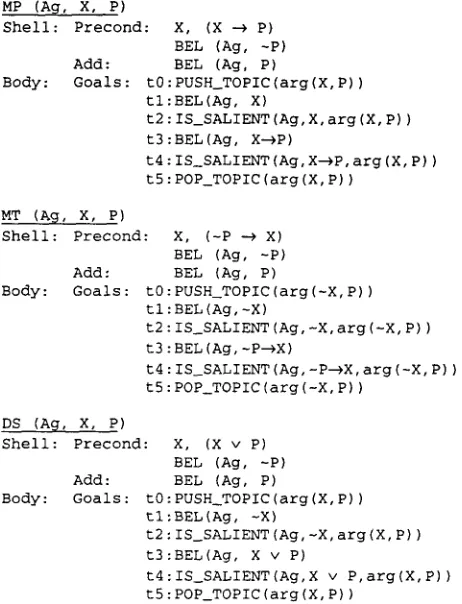
Disjunctive Syllogisms are also found reasonably often, but the remaining rules of inference are found very rarely. For this reason, only the three logical argument forms, MP, MT and DS, are currently implemented.
M P (Ag, X, P) Shell: P r e c o n d :
Add: Body: G o a l s :
M T (Ag, X, P) Shell: P r e c o n d :
Add: Goals: Body:
DS (Ag, X, P) Shell:
Body:
X, (X -~ P) B E L (Ag, ~P) B E L (Ag, P)
t 0 : P U S H T O P I C ( a r g ( X , P ) ) tI:BEL(Ag, X)
t 2 : I S _ S A L I E N T ( A g , X , a r g ( X , P ) ) t3:BEL(Ag, X-)P)
t 4 : I S S A L I E N T ( A g , X - ~ P , a r g ( X , P ) ) t 5 : P O P _ T O P I C ( a r g ( X , P ) )
X, (-P -~ X) B E L (Ag, ~P) B E L (Ag, P)
t 0 : P U S H _ T O P I C ( a r g ( - X , P ) ) t I : B E L ( A g , ~ X )
t 2 : I S _ S A L I E N T ( A g , - X , a r g ( - X , P ) ) t3:BEL(Ag,~P-~X)
t 4 : I S _ S A L I E N T ( A g , - P - + X , a r g (~X, P)) t 5 : P O P _ T O P I C ( a r g ( - X , P ) )
Precond: X, (X v P) B E L (Ag, ~P) Add: B E L (Ag, P)
Goals: t 0 : P U S H _ T O P I C ( a r g ( X , P ) ) tl :BEL (Ag, ~X)
t 2 : I S S A L I E N T ( A g , ~ X , a r g ( X , P ) ) t3:BEL(Ag, X v P)
[image:4.612.71.302.82.384.2]t 4 : I S S A L I E N T ( A g , X v P , a r g ( X , P ) ) t5 : P O P _ T O P I C (arg (X, P) )
Figure 1. The deductive operators
in Figure 1 (the orderings constraining the body goals - enforcing initial and terminal positions for PUSH_TOPIC and POP_TOPIC respectively -
are omitted for clarity). The preconditions on each operator act as filters on their applicability (so that, for example, the version of MP shown is only applicable for the situation in which the hearer believes the negation of the conclusion). The body is bounded by the topic manipulators which take as a parameter the topic for the current argument, of the form a r g ( X , P), a generic expression representing an argument concluding P using a premise X (used to abstract from Modus Ponens, Modus Tollens, etc.). The saliency goals also employ the same context parameter: this is used at a later stage to ensure a basic level of coherency (by placing utterances within the appropriate focus space) - discussion of this mechanism is beyond the scope of this paper. Finally, the operator bodies also include goals of belief which are satisfied (after refinement) by further applications of the operators (e.g. the goal t l in a given MP could be fulfilled by an MT)
4
Refutation operators
In addition to these deductive operators,
5~hetorica
also employs pseudo-deductiveoperators, by means of which counter-
counterargumentation structures can be
developed. The importance of including such refutation in an argument has been conclusively demonstrated in social psychology (Hovland, 1957). The operators required to effect the generation of such structure are closely related to the notions of conflict explored by Haggith (1996), and draw upon the distinction between rebutting and undercutting counterarguments, identified in (Toulmin, 1958). Given the situation portrayed in Figure 2, in which the speaker believes p because of a, and also disbelieves b because of d and e, and the hearer believes - p supported by b and c, a number of options are available to the speaker. The conventional MP operator discussed above can be employed to support p by a - this is rebuttal. In addition, the hearer's belief in - p can be undercut by arguing against one of its supports, namely, b.
- b
/ \
d e a
H - p
/ \
b c
Figure 2. Sample scenario
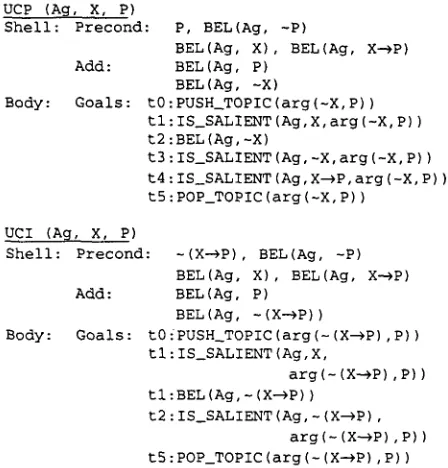
There are thus no new operators for rebutting, since those in Figure 1 already fulfil that role. Undercutting, however, requires two new operators, one which characterises a refutation of a premise (UCP), and one which characterises a refutation of the validity of an inference (UCI). The operator definitions are shown below in Figure 3.
[image:4.612.314.528.395.496.2]UCP (Ag, X, P) Shell: Precond:
Add: Body: Goals: tO
tl t2 t3 t4 t5
P, BEL(Ag, -P)
BEL(Ag, X), BEL(Ag, X-gP) BEL(Ag, P)
BEL(Ag, -X)
:PUSH_TOPIC(arg(-X,P)) :IS_SALIENT(Ag,X,arg(-X,P)) :BEL(Ag,-X)
:IS_SALIENT(Ag,-X,arg(-X,P)) :IS_SALIENT(Ag,X-~P,arg(-X,P)) :POP_TOPIC(arg(-X,P))
UCI (Ag, X, P)
Shell: Precond: -(X-+P), BEL(Ag, -P) BEL(Ag, X), BEL(Ag, X-~P) Add: BEL(Ag, P)
BEL(Ag, -(X-~P))
Body: Goals: t0:PUSH TOPIC(arg(-(X-+P),P)) tI:IS_SALIENT(Ag,X,
arg(-(X-~P),P)) tI:BEL(Ag,-(X-~P))
[image:5.612.75.299.74.308.2]t2:IS_SALIENT(Ag,-(X-~P), arg(-(X-~P),P)) t5:POP_TOPIC(arg(-(X-eP),P))
Figure 3. Refutation operators
any means other than substantial support). Secondly, in the UCP operator, it is necessary to make sure that the hearer is aware that the premise supports his conclusion - but clearly, the speaker doesn't want to offer any further support for the inference, hence the absence of a belief goal corresponding to IS_SALIENT (Ag, X
V, arg (-X, V)). Lastly, a similar issue faces the UCI operator - the t l goal expresses the need to make the premise salient before attacking it. Indeed, stating counterarguments is the key to counter-counterargumentation: just mentioning a counterargument can bolster a claim. The goal is particularly interesting both from a realisation point of view (where information can be exploited that x is being made salient in the context of an argument from ~x), and an ordering point of view (whether or not statement should precede refutation, and then whether or not UCP/I argumentation should precede pro support is a major issue of debate in psychology, Hass and Linder, 1972).
The deductive operators, however, do not offer the full range of argument forms found in natural text. One major omission is the class of inductive operators, including analogy, inductive generalisation, and causal relation. The framework is designed to admit all these operators, but the current work concentrates upon inductive generalisation.
Inductive generalisation (IG) is of
particular interest for a number of reasons. The first is the frequency with which various naively statistical and probabilistic arguments are
employed in natural language. More
importantly, though, are the problems faced in argumentation theoretic analyses of inductive generalisation. Freeman (1991) examines the problems in depth, and, building on Toulmin's work (1958), and its criticisms, comes to a well justified conclusion that IG should be treated as a convergent arrangement. His argument rests largely on the distinction between the 'ground
adequacy' and 'relevance' questions: in
analysing any argument as dialogical, the analyst can look at any two premises and infer that some imaginary opponent had asked a question after the first premise to elicit the second. If that question was 'Can you give me another reason?' (ground adequacy), the resulting structure is convergent, whereas if that question was 'Why does the premise support the conclusion?' (relevance), the resulting structure is linked. An inductive generalisation is thus based on a
number of premises between which an
imaginary opponent continually asks the ground adequacy question. The reason, Freeman claims, that inductive generalisation may be intuitively mistaken for a linked structure is that each premise in itself lends only very weak support to the conclusion, and that this generally results in assumption of linkage. Freeman's work and its relation to other accounts of linked and convergent argumentation is explored more fully in (Reed and Long, 1997b).
In following Freeman's attractive
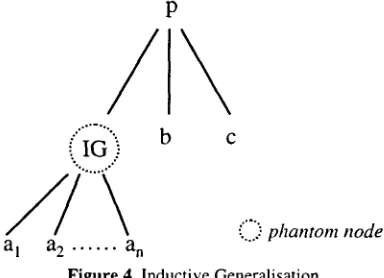
inappropriate for subsequent ordering heuristics to be at liberty to intersperse various deductive premises for a conclusion in the midst of the inductive premises (or further, that if there exist two or more IGs supporting the same conclusion - each employing a different common attribute - it is inappropriate to mix premises from the various arguments). Seeing the whole IG as a unit enables appropriate scoping for reordering: the premises within the unit can be reordered wholly within the unit, and the unit itself can be moved around wholesale with respect to the other premises. An IG is thus viewed in the current work as a premise. This is illustrated in the diagrammatic argument notation as a phantom node, as shown in Figure 4.
/
:... -... " I G )
al a2 . . . a n P
X
b c
<~- phantom node
Figure 4. Inductive Generalisation
Thus the IG premise phantom node is generated along with all the other premises for a given
conclusion. Then, after refinement, the
individual premises within the inductive argument are determined, occurring concurrently with identification of supports for the other premises which are at the level of the inductive generalisation. In the scenario illustrated in Figure 4, for example, the first round of planning identifies that there are three supports for the conclusion p, namely, a Modus Ponens argument from each of b and c, and an inductive generalisation. After an appropriate order is determined for these three, refinement opens up the bodies of the operators, and the supports for b and c are identified, and the inductive generalisation is fleshed out to include a~ through a . The process of building an inductive generalisation thus involves two different operators: the IG operator, which identifies that an inductive generalisation is appropriate, and the ISUP operator, which is used to select each
inductive premise. To prevent an inductive generalisation from being considered at every turn, the precondition list on IG states that there must exist at least one premise which can be used inductively - this is a bare minimum since an inductive generalisation employing a single premise is clearly very weak. Strengthening the notion of inductive generalisation is a trivial task of increasing the minimum number of premises which must exist for the application of IG to be licensed.
The complete definitions for IG and ISUP are given below in Figure 5.
IG (Ag, Shell:
Body:
P, R)
P r e c o n d : H A S _ P R O P E R T Y ( P , R ) HAS P R O P E R T Y ( X , R ) Add: BEL(Ag, P)
Goals: t 0 : P U S H _ T O P I C ( a r g ( R , P ) ) t 2 : B E L ( A g , IG(R,P))
t 3 : I S _ S A L I E N T ( A g , IG(R,P), a r g ( R , P ) ) t 4 : P O P _ T O P I C ( a r g ( R , P ) ) I S U P (Ag, P, R)
Shell: P r e c o n d : Add: Body: Goals:
H A S _ P R O P E R T Y (X, R) BEL(Ag, IG(R,P))
t 0 : P U S H T O P I C ( H A S _ P R O P E R T Y ( X , R ) ) tl : B E L (Ag, X)
t2 : I S _ S A L I E N T (Ag, X,
H A S _ P R O P E R T Y (X, R) ) t 3 : B E L ( A g , H A S P R O P E R T Y ( X , R ) ) t4 : I S _ S A L I E N T (Ag,
[image:6.612.309.540.253.449.2]HAS P R O P E R T Y ( X , R ) , H A S _ P R O P E R T Y ( X , R ) ) t 5 : P O P _ T O P I C ( H A S P R O P E R T Y ( X , R )
Figure 5. Refutation operators
A single new function is required to express the common feature of the premises and conclusion which license the inductive generalisation - this is implemented as a simple function call to r~S_PROPERTY which determines whether or not a given property holds for a given proposition (this functionality is encapsulated in an 'oracle' following [Cohen87]). In both IG and ISUP, the notion of 'support' is thus eschewed altogether and simply remains implicit in the fact that propositions are the same in respect R. It is not necessary to introduce a new notion of support.
Conclusion
This paper has presented a number of features of
the ~(hetorica system, and has introduced the
deductive, refutation and inductive
[image:6.612.87.279.291.430.2]related work, this abstract structure is often lost
- certainly in coherence relation based NLG
(such as operational RST), but also in (Elhadad, 1992) (which captures some, but not all of the commonly found argument structures) and in (Maybury, 1993) (which fails to capture the hierarchical nature of argument).
Evaluation of non-task-oriented NLG is difficult, particularly when the output is not text, but a plan of primitive operators. However, several evaluative observations support the approach. First, though only touched upon here, the planning process produces a partially specified plan in which the underspecification is precisely that licensed by Cohen-like constraints on argument coherency (Reed and Long, 1997a)
appropriated from empirical studies in
argumentation theory. Furthermore, the
approach enables these coherency constraints to be expressed in a tractable way. Finally, a comparison of system output with natural arguments (of equivalent propositional content) in a small corpus suggests that the constraints of coherency discussed here do indeed ensure the generation of coherent argument structures, and that the interplay between them and constraints of persuasive effect facilitate the construction of natural language arguments which are both coherent and effective.
References
Bacchus, F. & Yang, Q. (1992) The Expected Value of Hierarchical Problem-Solving, AAAI-92 pp. 369--374
Blair, H. (1838) Lectures on Rhetoric and Belles Lettres, Charles Daly, London
Cohen, R. (1987) Analyzing the Structure of Argumentative Discourse, Computational Linguistics 13/1, pp. 11--24
Eemeren, F.H. van, Grootendorst, R. & Snoeck-
Henkemans, F. (1996) Fundamentals of
Argumentation Theor)', Lawrence Erlbaum
Elhadad, M. (1992) Generating Coherent Argument Paragraphs, COLING'92, Nantes, pp.638--644 Fisher, A. (1988) The Logic of Real Arguments,
Cambridge University Press, Cambridge, UK Fox, M. & Long., D. (1995) Hierarchical Planning
using Abstraction, IEE Proceedings on Control Theory and Applications 142/3, pp. 197w210 Freeman, J.B. (1991) Dialectics and the
Macrostructure of Arguments, Foris, Dordrecht
Grosz, B.J. & Sidner, C.L. (1986) Attention, Intentions and the Structure of Discourse,
Computational Linguistics 12/3, pp. 175--204 Haggith, M. (1996) "A meta-level argumentation
framework for representing and reasoning about disagreement", PhD Thesis, Univ. of Edinburgh Hass, R.G. & Linder, D.E. (1972) Counterargument
availability and the effects of message structure on persuasion, Journal of Personality and Social Psychology 23/2 pp.219-233
Hovland, C.I. (1957) The Order of Presentation in Persuasion, Yale University Press, New Haven Hovy, E. H. (1993) Automated Discourse Generation
Using Discourse Structure Relations, Artificial Intelligence 63, pp. 341--385
Mann, W.C., Thompson, S.A. (1988) Rhetorical structure theor),, Text 8/3, pp. 243--281
Marcu, D. (1996) Building Up Rhetorical Structure Trees AAAI'96, Portland, Oregon
Maybury, M.T. (1993) Communicative Acts for Generative Natural Language Arguments AAAI- 93 pp.357--364
Moore, J.D. & Paris, C.L. (1994) Planning Text For Advisor), Dialogues, Computational Linguistics
19/4, pp. 651--694
Ohlsson, S. & Robin, N. (1994) The Power of Negative Thinking: The Central Role of Modus
Tollens in Human Cognition in "Proc. of thel6th Conf. of the Cognitive Science Soc.", pp.681--686 Reed, C.A., Long, D.P. & Fox, M. (1996) An Architecture for Argumentative Dialogue Planning,
in Gabbay, D. & Ohibach, H.J. (eds) "Practical Reasoning", Springer Verlag, pp. 555--566 Reed, C.A. & Long, D.P. (1997a) Content Ordering
in the Generation of Persuasive Discourse
IJCAI'97, Nagoya, Japan, pp. 1022--1027
Reed, C.A. & Long, D.P. (1997b) Multiple Subarguments in Logic, Argumentation, Rhetoric and Text Generation in Gabbay, D.M., et al. (eds) "Qualitative and Quantitative Reasoning", Springer Verlag, pp.496-510
Snoeck-Henkemans, F. (1997) Verbal indicators of argumentation and explanation in "Proc. of the OSSA Conf on Argument and Rhetoric", St. Catharines, Ontario
Toulmin, S. E. (1958) The Uses of Argument,
Cambridge University Press, Cambridge, UK Walker, M.A. (1996) The effect of resource limits