Active Learning for Multilingual Statistical Machine Translation
∗Gholamreza Haffari and Anoop Sarkar School of Computing Science, Simon Fraser University
British Columbia, Canada {ghaffar1,anoop}@cs.sfu.ca Abstract
Statistical machine translation (SMT) models require bilingual corpora for train-ing, and these corpora are often multi-lingual with parallel text in multiple lan-guages simultaneously. We introduce an active learningtask of adding a new lan-guage to an existing multilingual set of parallel text and constructing high quality MT systems, from each language in the collection into this new target language. We show that adding a new language using active learning to the EuroParl corpus pro-vides a significant improvement compared to a random sentence selection baseline. We also provide new highly effective sen-tence selection methods that improve AL for phrase-based SMT in the multilingual and single language pair setting.
1 Introduction
The main source of training data for statistical machine translation (SMT) models is a parallel corpus. In many cases, the same information is available in multiple languages simultaneously as a multilingual parallel corpus, e.g., European Par-liament (EuroParl) and U.N. proceedings. In this paper, we consider how to use active learning (AL) in order to add a new language to such a multilin-gual parallel corpus and at the same time we con-struct an MT system from each language in the original corpus into this new target language. We introduce a novel combined measure of translation quality for multiple target language outputs (the same content from multiple source languages).
The multilingual setting provides new opportu-nities for AL over and above a single language pair. This setting is similar to the multi-task AL scenario (Reichart et al., 2008). In our case, the multiple tasks are individual machine translation tasks for several language pairs. The nature of the translation processes vary from any of the source
∗
Thanks to James Peltier for systems support for our ex-periments. This research was partially supported by NSERC, Canada (RGPIN: 264905) and an IBM Faculty Award.
languages to the new language depending on the characteristics of each source-target language pair, hence these tasks are competing for annotating the same resource. However it may be that in a single language pair, AL would pick a particular sentence for annotation, but in a multilingual setting, a dif-ferent source language might be able to provide a good translation, thus saving annotation effort. In this paper, we explore how multiple MT systems can be used to effectively pick instances that are more likely to improve training quality.
Active learning is framed as an iterative learn-ing process. In each iteration new human labeled instances (manual translations) are added to the training data based on their expected training qual-ity. However, if we start with only a small amount of initial parallel data for the new target language, then translation quality is very poor and requires a very large injection of human labeled data to be effective. To deal with this, we use a novel framework for active learning: we assume we are given a small amount of parallel text and a large amount of monolingual source language text; us-ing these resources, we create a large noisy par-allel text which we then iteratively improve using small injections of human translations. When we build multiple MT systems from multiple source languages to the new target language, each MT system can be seen as a different ‘view’ on the de-sired output translation. Thus, we can train our multiple MT systems using eitherself-trainingor co-training (Blum and Mitchell, 1998). In self-training each MT system is re-trained using human labeled data plus its own noisy translation output on the unlabeled data. In co-training each MT sys-tem is re-trained using human labeled data plus noisy translation output from the other MT sys-tems in the ensemble. We use consensus transla-tions (He et al., 2008; Rosti et al., 2007; Matusov et al., 2006) as an effective method for co-training between multiple MT systems.
This paper makes the following contributions:
• We provide a new framework for multilingual MT, in which we build multiple MT systems and add a new language to an existing multi-lingual parallel corpus. The multimulti-lingual
ting allows new features for active learning which we exploit to improve translation qual-ity while reducing annotation effort.
• We introduce new highly effective sentence selection methods that improve phrase-based SMT in the multilingual and single language pair setting.
• We describe a novel co-training based active learning framework that exploits consensus translations to effectively select only those sentences that are difficult to translate for all MT systems, thus sharing annotation cost.
• We show that using active learning to add a new language to the EuroParl corpus pro-vides a significant improvement compared to the strong random sentence selection base-line.
2 AL-SMT: Multilingual Setting
Consider a multilingual parallel corpus, such as EuroParl, which contains parallel sentences for several languages. Our goal is to add a new lan-guage to this corpus,andat the same time to con-struct high quality MT systems from the existing languages (in the multilingual corpus) to the new language. This goal is formalized by the following objective function:
O=
D
X
d=1
αd×TQ(MFd→E) (1)
where Fd’s are the source languages in the mul-tilingual corpus (D is the total number of lan-guages), andE is the new language. The transla-tion quality is measured byTQ for individual sys-temsMFd→E; it can be BLEU score or WER/PER
(Word error rate and position independent WER) which induces a maximization or minimization problem, respectively. The non-negative weights αd reflect the importance of the different
transla-tion tasks andP
dαd = 1. AL-SMT formulation
for single language pair is a special case of this formulation where only one of theαd’s in the
ob-jective function (1) is one and the rest are zero. Moreover the algorithmic framework that we in-troduce in Sec. 2.1 for AL in the multilingual set-ting includes the single language pair setset-ting as a special case (Haffari et al., 2009).
We denote the largeunlabeledmultilingual cor-pus byU := {(fj1, ..,fjD)}, and the smalllabeled
multilingual corpus byL:={(fi1, ..,fiD,ei)}. We
overload the term entryto denote a tuple inL or
inU(it should be clear from the context). For a
single language pair we useU andL.
2.1 The Algorithmic Framework
Algorithm 1 represents our AL approach for the multilingual setting. We train our initial MT sys-tems{MFd→E}Dd=1on the multilingual corpusL,
and use them to translate all monolingual sen-tences inU. We denote sentences in U together
with their multiple translations by U+ (line 4 of
Algorithm 1). Then we retrain the SMT sys-tems on L ∪U+ and use the resulting model to
decode the test set. Afterwards, we select and remove a subset of highly informative sentences from U, and add those sentences together with
their human-provided translations toL. This
pro-cess is continued iteratively until a certain level of translation quality is met (we use the BLEU score, WER and PER) (Papineni et al., 2002). In the baseline, against which we compare our sentence selection methods, the sentences are chosen ran-domly.
When (re-)training the models, two phrase ta-bles are learned for each SMT model: one from the labeled dataLand the other one from
pseudo-labeleddataU+(which we call themainand
aux-iliary phrase tables respectively). (Ueffing et al., 2007; Haffari et al., 2009) show that treatingU+
as a source for a new feature function in a log-linear model for SMT (Och and Ney, 2004) allows us to maximally take advantage of unlabeled data by finding a weight for this feature using minimum error-rate training (MERT) (Och, 2003).
Since each entry in U+ has multiple
transla-tions, there are two options when building the aux-iliary table for a particular language pair(Fd, E): (i) to use the corresponding translationed of the source language in aself-trainingsetting, or (ii) to use theconsensustranslation among all the trans-lation candidates(e1, ..,eD)in a co-training set-ting (sharing information between multiple SMT models).
Algorithm 1AL-SMT-Multiple
1: Given multilingual corporaLandU 2: {MFd→E}dD=1 =multrain(L,∅)
3: fort= 1,2, ...do
4: U+=multranslate(U,{MFd→E}Dd=1)
5: Selectksentences fromU+, and ask a
hu-man for theirtruetranslations.
6: Remove the k sentences from U, and add
theksentence pairs (translated by human) toL
7: {MFd→E}dD=1=multrain(L,U+)
8: Monitor the performance on the test set
9: end for
more details about features which are used in our consensus finding method, and how it is trained. Now let us address the important question of se-lecting highly informative sentences (step 5 in the Algorithm 1) in the following section.
3 Sentence Selection: Multiple Language Pairs
The goal is to optimize the objective function (1) with minimum human effort in providing the translations. This motivates selecting sentences which aremaximallybeneficial forallthe MT sys-tems. In this section, we present several protocols for sentence selection based on the combined in-formation from multiple language pairs.
3.1 Alternating Selection
The simplest selection protocol is to choosek sen-tences (entries) in the first iteration of AL which improve maximally the first modelMF1→E, while
ignoring other models. In the second iteration, the sentences are selected with respect to the second model, and so on (Reichart et al., 2008).
3.2 Combined Ranking
Pick any AL-SMT scoring method for asingle lan-guage pair (see Sec. 4). Using this method, we rank the entries in unlabeled dataUfor each
trans-lation task defined by language pair(Fd, E). This results in several ranking lists, each of which rep-resents the importance of entries with respect to a particular translation task. We combine these rankings using a combined score:
Score (f1, ..,fD)= D
X
d=1
αdRankd(fd)
Rankd(.)is the ranking of a sentence in the list for
thedthtranslation task (Reichart et al., 2008).
3.3 Disagreement Among the Translations
Disagreement among the candidate translations of a particular entry is evidence for the difficulty of that entry for different translation models. The reason is that disagreement increases the possibil-ity that most of the translations are not correct. Therefore it would be beneficial to ask human for the translation of these hard entries.
Now the question is how to quantify the no-tion of disagreement among the candidate trans-lations(e1, ..,eD). We propose two measures of disagreement which are related to the portion of sharedn-grams (n≤4) among the translations:
• Letec be the consensus among all the can-didate translations, then define the disagree-ment asP
dαd 1−BLEU(ec,ed)
.
• Based on the disagreement of every pair of candidate translations: P
dαd
P
d0 1 −
BLEU(ed0,ed).
For the single language pair setting, (Haffari et al., 2009) presents and compares several sentence selection methods for statistical phrase-based ma-chine translation. We introduce novel techniques which outperform those methods in the next sec-tion.
4 Sentence Selection: Single Language Pair
Phrases are basic units of translation in phrase-based SMT models. The phrases which may po-tentially be extracted from a sentence indicate its informativeness. The more new phrases a sen-tence can offer, the more informative it is; since it boosts thegeneralizationof the model. Addition-ally phrase translation probabilities need to be es-timated accurately, which means sentences that of-fer phrases whose occurrences in the corpus were rare are informative. When selecting new sen-tences for human translation, we need to pay atten-tion to this tradeoff between exploration and ex-ploitation, i.e. selecting sentences to discover new phrases v.s. estimating accurately the phrase trans-lation probabilities. Smoothing techniques partly handle accurate estimation of translation probabil-ities when the events occur rarely (indeed it is the main reason for smoothing). So we mainly focus on how to expand effectively the lexicon or set of phrases of the model.
know its translation; since it is more likely to see it in test data (specially when the test data is in-domain with respect to unlabeled data). The more frequent a phrase is in thelabeled data, the more unimportant it is; since probably we have observed most of its translations.
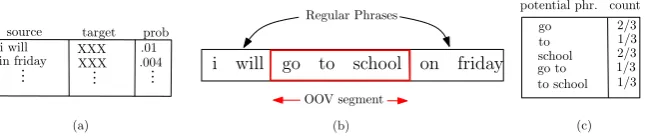
In the labeled dataL, phrases are the ones which are extracted by the SMT models; but what are the candidate phrases in the unlabeled data U? We use the currently trained SMT models to an-swer this question. Each translation in then-best list of translations (generated by the SMT mod-els) corresponds to a particular segmentation of a sentence, which breaks that sentence into sev-eral fragments (see Fig. 1). Some of these frag-ments are the source language part of a phrase pair available in the phrase table, which we callregular phrasesand denote their set byXsregfor a sentence
s. However, there are some fragments in the sen-tence which arenotcovered by the phrase table – possibly because of the OOVs (out-of-vocabulary words) or the constraints imposed by the phrase extraction algorithm – calledXsoov for a sentence s. Each member ofXsoov offers a set ofpotential phrases(also referred to as OOV phrases) which are not observed due to thelatentsegmentation of this fragment. We present two generative models for the phrases and show how to estimate and use them for sentence selection.
4.1 Model 1
In the first model, the generative story is to gen-erate phrases for each sentence based on indepen-dent draws from a multinomial. The sample space of the multinomial consists of both regular and OOV phrases.
We build two models, i.e. two multinomials, one for labeled data and the other one for unla-beled data. Each model is trained by maximizing the log-likelihood of its corresponding data:
LD:=
X
s∈D
˜
P(s) X
x∈Xs
logP(x|θD) (2)
where D is either L or U, P˜(s) is the empiri-cal distribution of the sentences1, and θD is the
parameter vector of the corresponding probability
1P˜(s)is the number of times that the sentencesis seen inDdivided by the number of all sentences inD.
distribution. Whenx∈Xsoov, we will have
P(x|θU) =
X
h∈Hx
P(x, h|θU)
= X
h∈Hx
P(h)P(x|h,θU)
= | 1
Hx| X
h∈Hx
Y
y∈Yh
x
θU(y) (3)
where Hx is the space of all possible
segmenta-tions for the OOV fragment x, Yxh is the result-ing phrases fromxbased on the segmentation h, andθU(y) is the probability of the OOV phrase y in the multinomial associated with U. We let Hx to be all possible segmentations of the
frag-mentxfor which the resulting phrase lengths are not greater than the maximum length constraint for phrase extraction in the underlying SMT model. Since we do not know anything about the segmen-tations a priori, we have put a uniform distribution over such segmentations.
Maximizing (2) to find the maximum likelihood parameters for this model is an extremely diffi-cult problem2. Therefore, we maximize the fol-lowing lower-bound on the log-likelihood which is derived using Jensen’s inequality:
LD ≥
X
s∈D
˜
P(s)
h X
x∈Xsreg
logθD(x)
+ X
x∈Xoov
s
X
h∈Hx
1 |Hx|
X
y∈Yh
x
logθD(y)
i
(4)
Maximizing (4) amounts to set the probability of each regular / potential phrase proportional to its count /expectedcount in the dataD.
Letρk(xi:j)be the number of possible
segmen-tations from position i to position j of an OOV fragmentx, andkis the maximum phrase length;
ρk(x1:|x|) =
0, if|x|= 0
1, if|x|= 1
Pk
i=1ρk(xi+1:|x|), otherwise
which gives us a dynamic programming algorithm to compute the number of segmentation|Hx| =
ρk(x1:|x|)of the OOV fragmentx. The expected
count of a potential phrase y based on an OOV segmentxis (see Fig. 1.c):
E[y|x] =
P
i≤jδ[y=xi:j]ρk(x1:i−1)ρk(xj+1:|x|)
ρk(x)
i will go to school on friday Regular Phrases
OOV segment
go to school go to to school
2/3 2/3 1/3 1/3 1/3 i will
in friday XXXXXX .004.01 ...
... ...
(a)
potential phr. source target prob
count
[image:5.595.141.464.66.134.2](b) (c)
Figure 1: The given sentence in (b) is segmented, based on the source side phrases extracted from the phrase table in (a), to yield regular phrases and OOV segment. The table in (c) shows the potential phrases extracted from the OOV segment “go to school” and their expected counts (denoted by count) where the maximum length for the potential phrases is set to 2. In the example, “go to school” has 3 segmentations with maximum phrase length 2:(go)(to school), (go to)(school), (go)(to)(school).
whereδ[C]is 1 if the conditionCis true, and zero otherwise. We have used the fact that the num-ber of occurrences of a phrase spanning the indices
[i, j]is the product of the number of segmentations of the left and the right sub-fragments, which are ρk(x1:i−1)andρk(xj+1:|x|)respectively.
4.2 Model 2
In the second model, we consider a mixture model of two multinomials responsible for generating phrases in each of the labeled and unlabeled data sets. To generate a phrase, we first toss a coin and depending on the outcome we either generate the phrase from the multinomial associated with regu-lar phrasesθregU or potential phrasesθoovU :
P(x|θU) :=βUθregU (x) + (1−βU)θoovU (x)
where θU includes the mixing weight β and the
parameter vectors of the two multinomials. The mixture model associated withL is written simi-larly. The parameter estimation is based on maxi-mizing a lower-bound on thelog-likelihood which is similar to what was done for the Model 1.
4.3 Sentence Scoring
The sentence score is a linear combination of two terms: one coming from regular phrases and the other from OOV phrases:
φ1(s) := λ
|Xsreg| X
x∈Xsreg
logP(x|θU)
P(x|θL)
+1−λ |Xoov
s | X
x∈Xoov
s
X
h∈Hx
1 |Hx|log
Y
y∈Yh
x
P(y|θU)
P(y|θL)
where we use either Model 1 or Model 2 for P(.|θD). The first term is the logprobability
ra-tio of regular phrases under phrase models corre-sponding to unlabeled and labeled data, and the second term is the expectedlog probability ratio (ELPR) under the two models. Another option for
the contribution of OOV phrases is to takelog of expected probability ratio(LEPR):
φ2(s) := λ
|Xsreg| X
x∈Xsreg
logP(x|θU)
P(x|θL)
+1−λ |Xoov
s | X
x∈Xoov
s
log X
h∈Hx
1 |Hx|
Y
y∈Yh
x
P(y|θU)
P(y|θL)
It is not difficult to prove that there is no difference between Model 1 and Model 2 when ELPR scor-ing is used for sentence selection. However, the situation is different for LEPR scoring: the two models produce different sentence rankings in this case.
5 Experiments
Corpora. We pre-processed the EuroParl corpus (http://www.statmt.org/europarl) (Koehn, 2005) and built a multilingual parallel corpus with 653,513 sentences, excluding the Q4/2000 por-tion of the data (2000-10 to 2000-12) which is reserved as the test set. We subsampled 5,000 sentences as the labeled data L and 20,000
sen-tences asUfor the pool of untranslated sentences
(while hiding the English part). The test set con-sists of 2,000 multi-language sentences and comes from the multilingual parallel corpus built from Q4/2000 portion of the data.
Consensus Finding. LetT be the union of the n-best lists of translations for a particular sentence. The consensus translationtcis
arg max t∈T w1
LM(t)
|t| +w2
Qd(t)
|t| +w3Rd(t)+w4,d
where LM(t)is the score from a 3-gram language model,Qd(t)is the translation score generated by
the decoder for MFd→E if t is produced by the
dth SMT model, Rd(t) is the rank of the
transla-tion in then-best list produced by thedth model, w4,d is a bias term for each translation model to
1000 2000 3000 4000 5000 22.6
22.7 22.8 22.9 23 23.1 23.2 23.3 23.4 23.5 23.6
Added Sentences
BLEU Score
French to English
Model 2 − LEPR Model 1 − ELPR Geom Phrase Random
1000 2000 3000 4000 5000
23.2 23.4 23.6 23.8 24 24.2 24.4 24.6 24.8 25
Added Sentences
BLEU Score
Spanish to English
Model 2 − LEPR Model 1 − ELPR Geom Phrase Random
1000 2000 3000 4000 5000
16.2 16.4 16.6 16.8 17 17.2 17.4 17.6 17.8
Added Sentences
BLEU Score
German to English
[image:6.595.71.520.80.204.2]Model 2 − LEPR Model 1 − ELPR Geom Phrase Random
Figure 2: The performance of different sentence selection strategies as the iteration of AL loop goes on for three translation tasks. Plots show the performance of sentence selection methods for single language pair in Sec. 4 compared to the GeomPhrase (Haffari et al., 2009) and random sentence selection baseline.
of the translation sentence. The number of weights wi is 3 plus the number of source languages, and
they are trained using minimum error-rate training (MERT) to maximize the BLEU score (Och, 2003) on a development set.
Parameters. We use add-smoothing where= .5to smooth the probabilities in Sec. 4; moreover λ=.4for ELPR and LEPR sentence scoring and maximum phrase lengthkis set to 4. For the mul-tilingual experiments (which involve four source languages) we setαd = .25 to make the
impor-tance of individual translation tasks equal.
0 1000 2000 3000 4000 5000 18
18.5 19 19.5 20 20.5
Added Sentences
Avg BLEU Score
Mulilingual da−de−nl−sv to en
Self−Training Co−Training
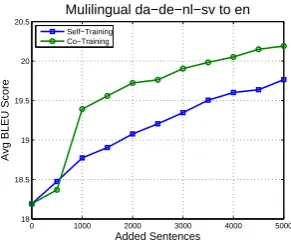
Figure 3: Random sentence selection baseline using self-training and co-self-training (Germanic languages to English).
5.1 Results
First we evaluate the proposed sentence selection methods in Sec. 4 for the single language pair. Then the best method from the single language pair setting is used to evaluate sentence selection methods for AL in multilingual setting. After building the initial MT system for each experi-ment, we select and remove 500 sentences from
Uand add them together with translations toLfor
10 total iterations. The random sentence selection baselines are averaged over 3 independent runs.
mode self-train co-train
Method wer per wer per
Combined Rank 40.2 30.0 40.0 29.6
Alternate 41.0 30.2 40.1 30.1
Disagree-Pairwise 41.9 32.0 40.5 30.9 Disagree-Center 41.8 31.8 40.6 30.7 Random Baseline 41.6 31.0 40.5 30.7
Germanic languages to English
mode self-train co-train
Method wer per wer per
Combined Rank 37.7 27.3 37.3 27.0
Alternate 37.7 27.3 37.3 27.0
Random Baseline 38.6 28.1 38.1 27.6
[image:6.595.319.512.260.421.2]Romance languages to English
Table 1: Comparison of multilingual selection methods with WER (word error rate), PER (position independent WER). 95% confidence interval for WER numbers is 0.7 and for PER numbers is 0.5.Bold:best result,italic:significantly better.
We use three language pairs in our single lan-guage pair experiments: French-English, German-English, and Spanish- English. In addition to ran-dom sentence selection baseline, we also compare the methods proposed in this paper to the best method reported in (Haffari et al., 2009) denoted by GeomPhrase, which differs from our models since it considers each individual OOV segment as a single OOV phrase and does not consider subse-quences. The results are presented in Fig. 2. Se-lecting sentences based on our proposed methods outperform the random sentence selection baseline and GeomPhrase. We suspect for the situations whereLis out-of-domain and the average phrase
length is relatively small, our method will outper-form GeomPhrase even more.
For the multilingual experiments, we use Ger-manic (German, Dutch, Danish, Swedish) and Ro-mance (French, Spanish, Italian, Portuguese3)
[image:6.595.105.251.439.559.2]0 1000 2000 3000 4000 5000 18.2
18.4 18.6 18.8 19 19.2 19.4 19.6 19.8 20
Added Sentences
Avg BLEU Score
Self−Train Mulilingual da−de−nl−sv to en
Alternate CombineRank Disagree−Pairwise Disagree−Center Random
1000 1500 2000 2500 3000 3500 4000 4500 5000
19.3 19.4 19.5 19.6 19.7 19.8 19.9 20 20.1 20.2 20.3
Added Sentences
Avg BLEU Score
Co−Train Mulilingual da−de−nl−sv to en
Alternate CombineRank Disagree−Pairwise Disagree−Center Random
0 1000 2000 3000 4000 5000
21.6 21.8 22 22.2 22.4 22.6 22.8 23 23.2 23.4 23.6
Added Sentences
Avg BLEU Score
Self−Train Mulilingual fr−es−it−pt to en
Alternate CombineRank Random
1000 1500 2000 2500 3000 3500 4000 4500 5000
22.6 22.8 23 23.2 23.4 23.6 23.8
Added Sentences
Avg BLEU Score
Co−Train Mulilingual fr−es−it−pt to en
[image:7.595.146.445.62.308.2]Alternate CombineRank Random
Figure 4: The left/right plot show the performance of our AL methods for multilingual setting combined with self-training/co-training. The sentence selection methods from Sec. 3 are compared with random sentence selection baseline. The top plots cor-respond to Danish-German-Dutch-Swedish to English, and the bottom plots corcor-respond to French-Spanish-Italian-Portuguese to English.
guages as the source and English as the target lan-guage as two sets of experiments.4 Fig. 3 shows the performance of random sentence selection for AL combined with self-training/co-training for the multi-source translation from the four Germanic languages to English. It shows that the co-training mode outperforms the self-training mode by al-most 1 BLEU point. The results of selection strategies in the multilingual setting are presented in Fig. 4 and Tbl. 1. Having noticed that Model 1 with ELPR performs well in the single language pair setting, we use it to rank entries for individual translation tasks. Then these rankings are used by ‘Alternate’ and ‘Combined Rank’ selection strate-gies in the multilingual case. The ‘Combined Rank’ method outperforms all the other methods including the strong random selection baseline in both self-training and co-training modes. The disagreement-based selection methods underper-form the baseline for translation of Germanic lan-guages to English, so we omitted them for the Ro-mance language experiments.
5.2 Analysis
The basis for our proposed methods has been the popularity of regular/OOV phrases inU and their
data is very noisy and future work should omit this pair. 4Choice of Germanic and Romance for our experimental setting is inspired by results in (Cohn and Lapata, 2007)
unpopularity inL, which is measured by P(x|θU)
P(x|θL).
We need P(x|θU), the estimated distribution of
phrases inU, to be as similar as possible toP∗(x), thetruedistribution of phrases inU. We investi-gate this issue for regular/OOV phrases as follows:
•Using the output of the initially trained MT sys-tem onL, we extract the regular/OOV phrases as described in §4. The smoothed relative frequen-cies give us the regular/OOV phrasal distributions.
• Using the true English translation of the sen-tences inU, we extract the true phrases. Separat-ing the phrases into two sets of regular and OOV phrases defined by the previous step, we use the smoothed relative frequencies and form the true OOV/regular phrasal distributions.
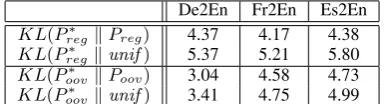
We use the KL-divergence to see how dissim-ilar are a pair of given probability distributions. As Tbl. 2 shows, the KL-divergence between the true and estimated distributions are less than that
De2En Fr2En Es2En
KL(Preg∗ kPreg) 4.37 4.17 4.38
KL(Preg∗ kunif) 5.37 5.21 5.80
KL(Poov∗ kPoov) 3.04 4.58 4.73
KL(Poov∗ kunif) 3.41 4.75 4.99
Table 2: For regular/OOV phrases, the KL-divergence be-tween the true distribution (P∗) and the estimated (P) or uni-form (unif) distributions are shown, where:
KL(P∗kP) :=P
xP
∗
[image:7.595.319.513.665.717.2]100
101
102
103
104
105
10−6
10−5
10−4
10−3
10−2
10−1
100
Rank
Probability
Regular Phrases in U
Estimated Distribution True Distribution
100 101 102 103 104 105
10−6
10−5
10−4
10−3
10−2
10−1
100
Rank
Probability
OOV Phrases in U
[image:8.595.110.244.60.294.2]Estimated Distribution True Distribution
Figure 5: The log-log Zipf plots representing the true and estimated probabilities of a (source)phrase vs the rank of that phrase in the German to English translation task. The plots for the Spanish to English and French to English tasks are also similar to the above plots, and confirm a power law behavior in the true phrasal distributions.
between the true and uniform distributions, in all three language pairs. Since uniform distribution conveys no information, this is evidence that there is some information encoded in the estimated dis-tribution about the true disdis-tribution. However we noticed that the true distributions of regu-lar/OOV phrases exhibit Zipfian (power law) be-havior5 which is not well captured by the esti-mated distributions (see Fig. 5). Enhancing the es-timated distributions to capture this power law be-havior would improve the quality of the proposed sentence selection methods.
6 Related Work
(Haffari et al., 2009) provides results for active learning for MT using a single language pair. Our work generalizes to the use of multilingual corpora using new methods that are not possible with a sin-gle language pair. In this paper, we also introduce new selection methods that outperform the meth-ods in (Haffari et al., 2009) even for MT with a single language pair. In addition in this paper by considering multilingual parallel corpora we were able to introduce co-training for AL, while (Haf-fari et al., 2009) only use self-training since they are using a single language pair.
5This observation is at the
phraselevel and not at theword
(Zipf, 1932) or evenn-gram level (Ha et al., 2002).
(Reichart et al., 2008) introduces multi-task ac-tive learning where unlabeled data require annota-tions for multiple tasks, e.g. they consider named-entities and parse trees, and showed that multi-ple tasks helps selection compared to individual tasks. Our setting is different in that the target lan-guage is the same across multiple MT tasks, which we exploit to use consensus translations and co-training to improve active learning performance.
(Burch and Osborne, 2003b; Callison-Burch and Osborne, 2003a) provide a co-training approach to MT, where one language pair creates data for another language pair. In contrast, our co-training approach uses consensus translations and our setting for active learning is very differ-ent from their semi-supervised setting. A Ph.D. proposal by Chris Callison-Burch (Callison-burch, 2003) lays out the promise of AL for SMT and proposes some algorithms. However, the lack of experimental results means that performance and feasibility of those methods cannot be compared to ours.
While we use consensus translations (He et al., 2008; Rosti et al., 2007; Matusov et al., 2006) as an effective method for co-training in this pa-per, unlike consensus for system combination, the source languages for each of our MT systems are different, which rules out a set of popular methods for obtaining consensus translations which assume translation for a single language pair. Finally, we briefly note that triangulation (see (Cohn and Lap-ata, 2007)) is orthogonal to the use of co-training in our work, since it only enhances each MT sys-tem in our ensemble by exploiting the multilingual data. In future work, we plan to incorporate trian-gulation into our active learning approach.
7 Conclusion
References
Avrim Blum and Tom Mitchell. 1998. Combin-ing Labeled and Unlabeled Data with Co-TrainCombin-ing. In Proceedings of the Eleventh Annual Conference on Computational Learning Theory (COLT 1998), Madison, Wisconsin, USA, July 24-26. ACM.
Chris Callison-Burch and Miles Osborne. 2003a. Bootstrapping parallel corpora. In NAACL work-shop: Building and Using Parallel Texts: Data Driven Machine Translation and Beyond.
Chris Callison-Burch and Miles Osborne. 2003b. Co-training for statistical machine translation. In Pro-ceedings of the 6th Annual CLUK Research Collo-quium.
Chris Callison-burch. 2003. Active learning for statis-tical machine translation. In PhD Proposal, Edin-burgh University.
Trevor Cohn and Mirella Lapata. 2007. Machine translation by triangulation: Making effective use of multi-parallel corpora. InACL.
Le Quan Ha, E. I. Sicilia-Garcia, Ji Ming, and F.J. Smith. 2002. Extension of zipf’s law to words and phrases. In Proceedings of the 19th international conference on Computational linguistics.
Gholamreza Haffari, Maxim Roy, and Anoop Sarkar. 2009. Active learning for statistical phrase-based machine translation. InNAACL.
Xiaodong He, Mei Yang, Jianfeng Gao, Patrick Nguyen, and Robert Moore. 2008. Indirect-hmm-based hypothesis alignment for combining outputs from machine translation systems. InEMNLP.
Philipp Koehn. 2005. Europarl: A parallel corpus for statistical machine translation. InMT Summit.
Evgeny Matusov, Nicola Ueffing, and Hermann Ney. 2006. Computing consensus translation from multi-ple machine translation systems using enhanced hy-potheses alignment. InEACL.
Franz Josef Och and Hermann Ney. 2004. The align-ment template approach to statistical machine trans-lation. Computational Linguistics, 30(4):417–449.
Franz Josef Och. 2003. Minimum error rate training in statistical machine translation. InACL ’03: Pro-ceedings of the 41st Annual Meeting on Association for Computational Linguistics.
Kishore Papineni, Salim Roukos, Todd Ward, and Wei jing Zhu. 2002. Bleu: A method for automatic eval-uation of machine translation. InACL ’02: Proceed-ings of the 41st Annual Meeting on Association for Computational Linguistics.
Roi Reichart, Katrin Tomanek, Udo Hahn, and Ari Rappoport. 2008. Multi-task active learning for lin-guistic annotations. InACL.
Antti-Veikko Rosti, Necip Fazil Ayan, Bing Xiang, Spyros Matsoukas, Richard M. Schwartz, and Bon-nie Jean Dorr. 2007. Combining outputs from mul-tiple machine translation systems. InNAACL.
Nicola Ueffing, Gholamreza Haffari, and Anoop Sarkar. 2007. Transductive learning for statistical machine translation. InACL.