Constraints on strong generative power
David ChiangUniversity of Pennsylvania
Dept of Computer and Information Science 200 S 33rd St
Philadelphia, PA 19104 USA [email protected]
Abstract
We consider the question “How much strong generative power can be squeezed out of a formal system without increasing its weak generative power?” and propose some theoret-ical and practtheoret-ical constraints on this problem. We then introduce a formal-ism which, under these constraints, maximally squeezes strong generative power out of context-free grammar. Finally, we generalize this result to formalisms beyond CFG.
1 Introduction
“How much strong generative power can be squeezed out of a formal system without increas-ing its weak generative power?” This question, posed by Joshi (2000), is important for both lin-guistic description and natural language process-ing. The extension of tree adjoining grammar (TAG) to tree-local multicomponent TAG (Joshi, 1987), or the extension of context free gram-mar (CFG) to tree insertion gramgram-mar (Schabes and Waters, 1993) or regular form TAG (Rogers, 1994) can be seen as steps toward answering this question. But this question is difficult to answer with much finality unless we pin its terms down more precisely.
First, what is meant by strong generative power? In the standard definition (Chomsky, 1965) a grammar G weakly generates a set of sentences L(G) and strongly generates a set of structural descriptions Σ(G); the strong genera-tive capacity of a formalism F is then {Σ(G) | F provides G}. There is some vagueness in the literature, however, over what structural descrip-tions are and how they can reasonably be com-pared across theories (Miller (1999) gives a good synopsis).
(a) X
X
X∗ a X
X∗ b
(b) XNA
a X
[image:1.595.319.513.205.267.2]b X∗ a b
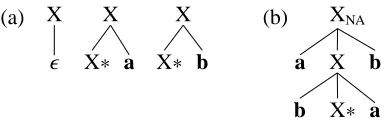
Figure 1: Example of weakly context-free TAG.
The approach that Vijay-Shanker et al. (1987) and Weir (1988) take, elaborated on by Becker et al. (1992), is to identify a very general class of formalisms, which they call linear context-free rewriting systems (CFRSs), and define for this class a large space of structural descriptions which serves as a common ground in which the strong generative capacities of these formalisms can be compared. Similarly, if we want to talk about squeezing strong generative power out of a formal system, we need to do so in the context of some larger space of structural descriptions.
Second, why is preservation of weak generative power important? If we interpret this constraint to the letter, it is almost vacuous. For example, the class of all tree adjoining grammars which gen-erate context-free languages includes the gram-mar shown in Figure 1a (which generates the lan-guage{a,b}∗). We can also add the tree shown in Figure 1b without increasing the grammar’s weak generative capacity; indeed, we can add any trees we please, provided they yield only as and bs. In-tuitively, the constraint of weak context-freeness has little force.
This intuition is verified if we consider that weak context-freeness is desirable for computa-tional efficiency. Though a weakly context-free TAG might be recognizable in cubic time (if we know the equivalent CFG), it need not be parsable in cubic time—that is, given a string, to compute all its possible structural descriptions will take O(n6) time in general. If we are interested in
Derivations Structural descriptions
[image:2.595.314.516.60.197.2]Sentences
Figure 2: Simulation: structural descriptions as derived structures.
we need a tighter constraint than preservation of weak generative power.
In Section 3 below we examine some restric-tions on tree adjoining grammar which are weakly context-free, and observe that their parsers all work in the same way: though given a TAG G, they implicitly parse using a CFG G0 which de-rives the same strings as G, but also their corre-sponding structural descriptions under G, in such a way that preserves the dynamic-programming structure of the parsing algorithm.
Based on this observation, we replace the con-straint of preservation of weak generative power with a constraint of simulability: essentially, a grammar G0 simulates another grammar G if it generates the same strings that G does, as well as their corresponding structural descriptions under G (see Figure 2).
So then, within the class of context-free rewrit-ing systems, how does this constraint of simu-lability limit strong generative power? In Sec-tion 4.1 we define a formalism called multicom-ponent multifoot TAG (MMTAG) which, when restricted to a regular form, characterizes pre-cisely those CFRSs which are simulable by a CFG. Thus, in the sense we have set forth, this formalism can be said to squeeze as much strong generative power out of CFG as is possible. Fi-nally, we generalize this result to formalisms be-yond CFG.
2 Characterizing structural descriptions
First we define context-free rewriting systems. What these formalisms have in common is that their derivation sets are all local sets (that is, gen-erable by a CFG). These derivations are taken as structural descriptions. The following definitions are adapted from Weir (1988).
Definition 1 A generalized context-free gram-mar G is a tuplehV,S,F,Pi, where
1. V is a finite set of variables,
2. S ∈V is a distinguished start symbol, 3. F is a finite set of function symbols, and
X
Y
XNA
a X∗ d
YNA
b Y∗ c
S →α(X,Y) α(hx1,x2i,hy1,y2i)= x1y1y2x2
X →β1(X) β1(hx1,x2i)=hax1,x2di
X→() ()=h, i
Y →β2(Y) β2(hy1,y2i)=hby1,y2ci
[image:2.595.114.245.64.122.2]Y →() ()=h, i
Figure 3: Example of TAG with corresponding GCFG and interpretation. Here adjunction at foot nodes is allowed.
4. P is a finite set of productions of the form
A→ f (A1, . . . ,An) where n≥0, f ∈F, and A,Ai ∈V.
A generalized CFG G generates a set T(G) of terms, which are interpreted as derivations under some formalism. In this paper we require that G be free of spurious ambiguity, that is, that each term be uniquely generated.
Definition 2 We say that a formalism F is a context-free rewriting system (CFRS) if its deriva-tion sets can be characterized by generalized CFGs, and its derived structures are produced by a function~·F from terms to strings such that for each function symbol f , there is a yield function
fF such that
~f (t1, . . . ,tn)F = fF(~t1F, . . . ,~tnF)
(A linear CFRS is subject to further restrictions, which we do not make use of.)
As an example, Figure 3 shows a simple TAG with a corresponding GCFG and interpretation.
A nice property of CFRS is that any formal-ism which can be defined as a CFRS immedi-ately lends itself to several extensions, which arise when we give additional interpretations to the function symbols. For example, we can interpret the functions as ranging over probabilities, cre-ating a stochastic grammar; or we can interpret them as yield functions of another grammar, cre-ating a synchronous grammar.
Now we define strong generative capacity as the relationship between strings and structural de-scriptions.1
1This is similar in spirit, but not the same as, the notion
Definition 3 The strong generative capacity of a grammar G a CFRSF is the relation
{h~tF,ti |t∈ T(G)}.
For example, the strong generative capacity of the grammar of Figure 3 is
{hambncndm, α(βm1(()), βn2(()))i}
whereas any equivalent CFG must have a strong generative capacity of the form
{hambncndm,fm(gn(e()))i}
That is, in a CFG the n bs and cs must appear later in the derivation than the m as and ds, whereas in our example they appear in parallel.
3 Simulating structural descriptions
We now take a closer look at some examples of “squeezed” context-free formalisms to illustrate how a CFG can be used to simulate formalisms with greater strong generative power than CFG.
3.1 Motivation
Tree substitution grammar (TSG), tree insertion grammar (TIG), and regular-form TAG (RF-TAG) are all weakly context free formalisms which can additionally be parsed in cubic time (with a caveat for RF-TAG below). For each of these formalisms a CKY-style parser can be written whose items are of the form [X,i,j] and are combined in various ways, but always according to the schema
[X,i,j] [Y, j,k] [Z,i,k]
just as in the CKY parser for CFG. In effect the parser dynamically converts the TSG, TIG, or RF-TAG into an equivalent CFG—each parser rule of the above form corresponds to the rule schema
Z →XY.
More importantly, given a grammar G and a string w, a parser can reconstruct all possible derivations of w under G by storing inside each chart item how that item was inferred. If we think of the parser as dynamically converting G into a CFG G0, then this CFG is likewise able to com-positionally reconstruct TSG, TIG, or RF-TAG derivations—we say that G0simulates G.
Note that the parser specifies how to convert G into G0, but G0 is not itself a parser. Thus these three formalisms have a special relationship to CFG that is independent of any particular pars-ing algorithm: for any TSG, TIG, or RF-TAG G, there is a CFG that simulates G. We make this no-tion more precise below.
3.2 Excursus: regular form TAG
Strictly speaking, the recognition algorithm Rogers gives cannot be extended to parsing; that is, it generates all possible derived trees for a given string, but not all possible derivations. It is correct, however, as a parser for a further re-stricted subclass of TAGs:
Definition 4 We say that a TAG is in strict reg-ular form if there exists some partial ordering over the nonterminal alphabet such that for ev-ery auxiliary tree β, if the root and foot of βare labeled X, then for every node η alongβ’s spine where adjunction is allowed, X label(η), and X =label(η) only ifηis a foot node. (In this vari-ant adjunction at foot nodes is permitted.)
Thus the only kinds of adjunction which can oc-cur to unbounded depth are off-spine adjunction and adjunction at foot nodes.
This stricter definition still has greater strong generative capacity than CFG. For example, the TAG in Figure 3 is in strict regular form, because the only nodes along spines where adjunction is allowed are foot nodes.
3.3 Simulability
So far we have not placed any restrictions on how these structural descriptions are computed. Even though we might imagine attaching arbi-trary functions to the rules of a parser, an algo-rithm like CKY is only really capable of com-puting values of bounded size, or else structure-sharing in the chart will be lost, increasing the complexity of the algorithm possibly to exponen-tial complexity.
For a parser to compute arbitrary-sized objects, such as the derivations themselves, it must use back-pointers, references to the values of sub-computations but not the values themselves. The only functions on a back-pointer the parser can compute online are the identity function (by copy-ing the back-pointer) and constant functions (by replacing the back-pointer); any other function would have to dereference the back-pointer and destroy the structure of the algorithm. Therefore such functions must be computed offline.
Definition 5 A simulating interpretation ~·is a bijection between two recognizable sets of terms such that
1. For each function symbolφ, there is a func-tion ¯φsuch that
2. Each ¯φis definable as: ¯
φ(hx11, . . . ,x1m1)i), . . . ,hxn1, . . . ,xmnmi) =
hw1, . . . ,wmi
where each wican take one of the following forms:
(a) a variable xi j, or
(b) a function application f (xi1j1, . . .xinjn),
n≥0
3. Furthermore, we require that for any recog-nizable set T ,~Tis also a recognizable set. We say that~·is trivial if every ¯φis definable as
¯
φ(x1, . . .xn)= f (xπ(1), . . .xπ(n))
whereπis a permutation of{1, . . . ,n}.2
The rationale for requirement (3) is that it should not be possible, simply by imposing local constraints on the simulating grammar, to produce a simulated grammar which does not even come from a CFRS.3
Definition 6 We say that a grammar G from a CFRSF is (trivially) simulable by a grammar G’ from another CFRSF if there is a (trivial) simu-lating interpretation ~·s :T(G0) → T(G) which satisfies~tF0 =~~tsF for all t∈ T(G0).
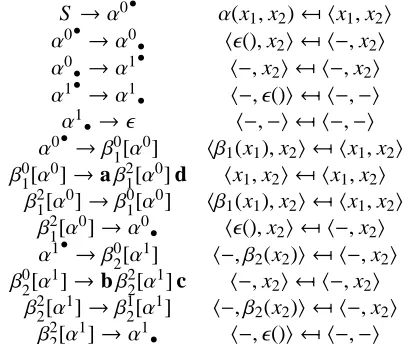
As an example, a CFG which simulates the TAG of Figure 3 is shown in Figure 4. Note that if we give additional interpretations to the simu-lated yield functionsα,β1, and β2, this CFG can compute any probabilities, translations, etc., that the original TAG can.
Note that if G0 trivially simulates G, they are very nearly strongly equivalent, except that the yield functions of G0 might take their arguments in a different order than G, and there might be sev-eral yield functions of G0 which correspond to a single yield function of G used in several different contexts. In fact, for technical reasons we will use this notion instead of strong equivalence for test-ing the strong generative power of a formal sys-tem.
Thus the original problem, which was, given a formalism F, to find a formalism that has as much strong generative power as possible but re-mains weakly equivalent to F, is now recast as
2Simulating interpretations and trivial simulating
inter-pretations are similar to the generalized and “ungeneralized” syntax-directed translations, respectively, of Aho and Ull-man (1969; 1971).
3Without this requirement, there are certain pathological
cases that cause the construction of Section 4.2 to produce infinite MM-TAGs.
S →α0• α(x1,x2)← hx1,x2i α0• →α0
• h(),x2i ← h−,x2i α0
• →α1• h−,x2i ← h−,x2i α1• →α1
• h−, ()i ← h−,−i
α1
•→ h−,−i ← h−,−i α0•→β0
1[α
0] hβ1(x
1),x2i ← hx1,x2i β0
1[α0]→aβ21[α0] d hx1,x2i ← hx1,x2i β2
1[α0]→β01[α0] hβ1(x1),x2i ← hx1,x2i β2
1[α
0]→α0
• h(),x2i ← h−,x2i α1•→β0
2[α
1] h−, β2(x
2)i ← h−,x2i β0
2[α
1]→bβ2 2[α
1] c h−,x
2i ← h−,x2i β2
2[α
1]→β1 2[α
1] h−, β2(x
2)i ← h−,x2i β2
2[α
1]→α1
[image:4.595.311.515.72.244.2]• h−, ()i ← h−,−i
Figure 4: CFG which simulates the grammar of Figure 3. Here we leave the yield functions anonymous; y ← x denotes the function which maps x to y.
the following problem: find a formalism that triv-ially simulates as many grammars as possible but remains simulable byF.
3.4 Results
The following is easy to show:
Proposition 1 Simulability is reflexive and tran-sitive.
Because of transitivity, it is impossible that a for-malism which is simulable by F could simulate a grammar that is not simulable byF. So we are looking for a formalism that can trivially simulate exactly those grammars thatF can.
In Section 4.1 we define a formalism called multicomponent multifoot TAG (MMTAG), and then in Section 4.2 we prove the following result:
Proposition 2 A grammar G from a CFRS is simulable by a CFG if and only if it is trivially simulable by an MMTAG in regular form.
The “if” direction (⇐) implies (because simu-lability is reflexive) that RF-MMTAG is simula-ble by a CFG, and therefore cubic-time parsasimula-ble. (The proof below does give an effective proce-dure for constructing a simulating CFG for any RF-MMTAG.) The “only if” direction (⇒) shows that, in the sense we have defined, RF-MMTAG is the most powerful such formalism.
Definition 7 If F1 and F2 are two CFRSs,F2◦
F1is the CFRS characterized by the interpretation
function~·F2◦F1 =~·F2 ◦~·F1.
F1 is the meta-level formalism, which generates
derivations forF2. ObviouslyF1 must be a
tree-rewriting system.
Proposition 3 For any CFRS F0, a grammar G from a (possibly different) CFRS is simulable by a grammar inF0if and only if it is trivially simu-lable by a grammar inF0◦RF-MMTAG.
The “only if” direction (⇒) follows from the fact that the MMTAG constructed in the proof of Proposition 2 generates the same derived trees as the CFG. The “if” direction (⇐) is a little trickier because the constructed CFG inserts and relabels nodes.
4 Multicomponent multifoot TAG
4.1 Definitions
MMTAG resembles a cross between set-local multicomponent TAG (Joshi, 1987) and ranked node rewriting grammar (Abe, 1988), a variant of TAG in which auxiliary trees may have multiple foot nodes. It also has much in common with d-tree substitution grammar (Rambow et al., 1995).
Definition 8 An elementary tree set ~αis a finite set of trees (called the components of~α) with the following properties:
1. Zero or more frontier nodes are designated foot nodes, which lack labels (following Abe), but are marked with the diacritic∗; 2. Zero or more (non-foot) nodes are
desig-nated adjunction nodes, which are parti-tioned into one or more disjoint sets called adjunction sites. We notate this by assigning an index i to each adjunction site and mark-ing each node of site i with the diacritic i. 3. Each component is associated with a
sym-bol called its type. This is analogous to the left-hand side of a CFG rule (again, follow-ing Abe).
4. The components of ~α are connected by d-edges from foot nodes to root nodes (notated by dotted lines) to form a single tree struc-ture. A single foot node may have multiple d-children, and their order is significant. (See Figure 5 for an example.)
A multicomponent multifoot tree adjoining gram-mar is a tuplehΣ,P,Si, where:
A
∗ X1
Y2 ∗
X1
∗ X1
∗
A
∗ X1
Y3 ∗
X1
∗ X 1
∗ {
A
∗ A
Y3 X1
Y2 ∗
X1
∗ X1
[image:5.595.314.523.67.192.2]∗
Figure 5: Example of MMTAG adjunction. The types of the components, not shown in the figure, are all X.
1. Σis a finite alphabet;
2. P is a finite set of tree sets; and 3. S ∈Σis a distinguished start symbol. Definition 9 A component α is adjoinable at a nodeηifηis an adjunction node and the type of
αequals the label ofη.
The result of adjoining a componentαat a node
η is the tree set formed by separating ηfrom its children, replacing η with the root of α, and re-placing the ith foot node of αwith the ith child of η. (Thus adjunction of a one-foot component is analogous to TAG adjunction, and adjunction of a zero-foot component is analogous to substi-tution.)
A tree set~αis adjoinable at an adjunction site
~ηif there is a way to adjoin each component of~α at a different node of~η(with no nodes left over) such that the dominance and precedence relations within~α are preserved. (See Figure 5 for an ex-ample.)
We now define a regular form for MMTAG that is analogous to strict regular form for TAG. A spine is the path from the root to a foot of a sin-gle component. Whenever adjunction takes place, several spines are inserted inside or concatenated with other spines. To ensure that unbounded in-sertion does not take place, we impose an order-ing on spines, by means of functionsρi that map the type of a component to the rank of that com-ponent’s ith spine.
Definition 10 We say that an adjunction nodeη∈
We say that an MMTAG G is in regular form if there are functions ρi from Σinto the domain of some partial ordering such that for each com-ponent α of type X, for each adjunction node
η ∈α, if the jth child ofηdominates the ith foot node ofα(that is, another component’s jth spine would adjoin into the ith spine), then ρi(X)
ρj(label(η)), and ρi(X) = ρj(label(η)) only if η is safe in the ith spine.
Thus the only kinds of adjunction which can oc-cur to unbounded depth are off-spine adjunction and safe adjunction. The adjunction shown in Fig-ure 5 is an example of safe adjunction.
4.2 Proof of Proposition 2
(⇐) First we describe how to construct a simu-lating CFG for any RF-MMTAG; then this direc-tion of the proof follows from the transitivity of simulability.
When a CFG simulates a regular form TAG, each nonterminal must encapsulate a stack (of bounded depth) to keep track of adjunctions. In the multicomponent case, these stacks must be generalized to trees (again, of bounded size).
So the nonterminals of G0are of the form [η,t], where t is a derivation fragment of G with a dot (·) at exactly one node~α, andηis a node of~α. Let
¯
ηbe the node in the derived tree whereηends up. A fragment t can be put into a normal form as follows:
1. For every ~αabove the dot, if ¯η does not lie along a spine of ~α, delete everything above
~α.
2. For every~αnot above or at the dot, if ¯ηdoes not lie along a d-edge of ~α, delete ~α and everything below and replace it with >if ¯η dominates~α; otherwise replace it with⊥. 3. If there are two nodes ~α1 and ~α2 along a
path which name the same tree set and ¯ηlies along the same spine or same d-edge in both of them, collapse~α1and~α2, deleting every-thing in between.
Basically this process removes all unboundedly long paths, so that the set of normal forms is finite. In the rule schemata below, the terms in the left-hand sides range over normalized terms, and their corresponding right-hand sides are renormalized. Let up(t) denote the tree that results from moving the dot in t up one step.
The value of a subderivation t0of G0under~·s is a tuple of partial derivations of G, one for each
>symbol in the root label of t0, in order. Where we do not define a yield function for a production below, the identity function is understood.
For every set ~α with a single, S -type compo-nent rooted byη, add the rule
S →[η,~α·(>, . . . ,>)]
~α(x1, . . . ,xn)← hx1, . . . ,xni
For every non-adjunction, non-foot node η with childrenη1, . . . , ηn(n≥0),
[η,t]→[η1,t]· · ·[ηn,t]
For every component with root η0 that is adjoin-able atη,
[η,up(t)]→[η0,t]
If η0 is the root of the whole set ~α0, this rule rewrites a > to several > symbols; the corre-sponding yield function is then
h. . . , ~α0(x1, . . . ,xn), . . .i ← h. . . ,x1, . . . ,xn, . . .i
For every component with ith foot η0i that is ad-joinable at a node with ith childηi,
[η0i,t]→[ηi,up(t)]
This last rule skips over deleted parts of the derivation tree, but this is harmless in a regular form MMTAG, because all the skipped adjunc-tions are safe.
(⇒) First we describe how to decompose any given derivation t0 of G0 into a set of elementary tree sets.
Let t =~t0s. (Note the convention that primed variables always pertain to the simulating mar, unprimed variables to the simulated gram-mar.) If, during the computation of t, a node η0 creates the node η, we say that η0 is productive and producesη. Without loss of generality, let us assume that there is a one-to-one correspondence between productive nodes and nodes of t.4
To start, letηbe the root of t, andη1, . . . , ηnits children.
Define the domain of ηi as follows: any node in t0that produces ηi or any of its descendants is in the domain ofηi, and any non-productive node whose parent is in the domain ofηi is also in the domain ofηi.
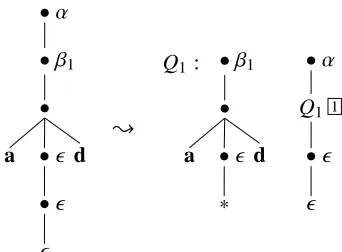
For eachηi, excise each connected component of the domain ofηi. This operation is the reverse of adjunction (see Figure 6): each component gets
4If G0 does not have this property, it can be modified
•α
•β1
•
a • •
d {
Q1: •β1
•
a • ∗
d
•α
Q1 1
[image:7.595.100.271.60.186.2]•
Figure 6: Example derivation (left) of the gram-mar of Figure 4, and first step of decomposition. Non-adjunction nodes are shown with the place-holder•(because the yield functions in the origi-nal grammar were anonymous), the Greek letters indicating what is produced by each node. Ad-junction nodes are shown with labels Qi in place of the (very long) true labels.
S : • Q1 1
Q2 2
Q1: •
•
a Q1 1
∗ d Q1:•
∗
Q2: •
•
b Q2 2 c
Q2:•
Figure 7: MMTAG converted from CFG of Fig-ure 4 (cf. the original TAG in FigFig-ure 3). Each components’ type is written to its left.
foot nodes to replace its lost children, and the components are connected by d-edges according to their original configuration.
Meanwhile an adjunction node is created in place of each component. This node is given a la-bel (which also becomes the type of the excised component) whose job is to make sure the final grammar does not overgenerate; we describe how the label is chosen below. The adjunction nodes are partitioned such that the ith site contains all the adjunction nodes created when removingηi.
The tree set that is left behind is the elementary tree set corresponding to η (rather, the function symbol that labelsη); this process is repeated re-cursively on the children ofη, if any.
Thus any derivation of G0 can be decomposed into elementary tree sets. Let ˆG be the union of the decompositions of all possible derivations of G0(see Figure 7 for an example).
Labeling adjunction nodes For any node η0, and any list of nodes hη01, . . . , η0ni, let the sig-nature of η0 with respect to hη01, . . . , η0ni be hA,a1, . . . ,ami, where A is the left-hand side of the GCFG production that generatedη0, and ai = hj,kiif η0 gets its ith field from the kth field of
η0
j, or∗ifη0produces a function symbol in its ith field.
So when we excise the domain of ηi, the la-bel of the node left behind by a component αis hs,s1, . . . ,sni, where s is the signature of the root ofαwith respect to the foot nodes and s1, . . . ,sn are the signatures of the foot nodes with respect to their d-children. Note that the number of possible adjunction labels is finite, though large.
ˆ
G trivially simulates G. Since each tree of ˆG corresponds to a function symbol (though not necessarily one-to-one), it is easy to write a triv-ial simulating interpretation ~·:T( ˆG)→ T(G). To see that ˆG does not overgenerate, observe that the nonterminal labels inside the signatures en-sure that every derivation of ˆG corresponds to a valid derivation of G0, and therefore G. To see that ~·is one-to-one, observe that the adjunction la-bels keep track of how G0 constructed its simu-lated derivations, ensuring that for any derivation ˆt of ˆG, the decomposition of the derived tree of ˆt is ˆt itself. Therefore two derivations of ˆG cannot correspond to the same derivation of G0, nor of G.
ˆ
G is finite. Briefly, suppose that the number of components per tree set is unbounded. Then it is possible, by intersecting G0 with a recognizable set, to obtain a grammar whose simulated deriva-tion set is non-recognizable. The idea is that mul-ticomponent tree sets give rise to dependent paths in the derivation set, so if there is no bound on the number of components in a tree set, neither is there a bound on the length of dependent paths. This contradicts the requirement that a simulating interpretation map recognizable sets to recogniz-able sets.
[image:7.595.80.287.321.401.2]ˆ
G is in regular form. A component of ˆG corre-sponds to a derivation fragment of G0which takes fields from several subderivations and processes them, combining some into a larger structure and copying some straight through to the root. Let
ρi(X) be the number of fields that a component of type X copies from its ith foot up to its root. This information is encoded in X, in the signa-ture of the root. Then ˆG satisfies the regular form constraint, because when adjunction inserts one spine into another spine, the the inserted spine must copy at least as many fields as the outer one. Furthermore, if the adjunction site is not safe, then the inserted spine must additionally copy the value produced by some lower node.
5 Discussion
We have proposed a more constrained version of Joshi’s question, “How much strong generative power can be squeezed out of a formal system without increasing its weak generative power,” and shown that within these constraints, a vari-ant of TAG called MMTAG characterizes the limit of how much strong generative power can be squeezed out of CFG. Moreover, using the notion of a meta-level grammar, this result is extended to formalisms beyond CFG.
It remains to be seen whether RF-MMTAG, whether used directly or for specifying meta-level grammars, provides further practical benefits on top of existing “squeezed” grammar formalisms like tree-local MCTAG, tree insertion grammar, or regular form TAG.
This way of approaching Joshi’s question is by no means the only way, but we hope that this work will contribute to a better understanding of the strong generative capacity of constrained gram-mar formalisms as well as reveal more powerful formalisms for linguistic analysis and natural lan-guage processing.
Acknowledgments
This research is supported in part by NSF grant SBR-89-20230-15. Thanks to Mark Dras, William Schuler, Anoop Sarkar, Aravind Joshi, and the anonymous reviewers for their valuable help. S. D. G.
References
Naoki Abe. 1988. Feasible learnability of formal
grammars and the theory of natural language
ac-quisition. In Proceedings of the Twelfth
Inter-national Conference on Computational Linguistics (COLING-88), pages 1–6, Budapest.
A. V. Aho and J. D. Ullman. 1969. Syntax directed translations and the pushdown assembler. J. Comp.
Sys. Sci, 3:37–56.
A. V. Aho and J. D. Ullman. 1971. Translations on a context free grammar. Information and Control, 19:439–475.
Tilman Becker, Owen Rambow, and Michael Niv. 1992. The derivational generative power of formal systems, or, Scrambling is beyond LCFRS. Tech-nical Report IRCS-92-38, Institute for Research in Cognitive Science, University of Pennsylvania. Noam Chomsky. 1965. Aspects of the Theory of
Syn-tax. MIT Press, Cambridge, MA.
Mark Dras. 1999. A meta-level grammar: redefining synchronous TAG for translation and paraphrase. In Proceedings of the 37th Annual Meeting of the
Assocation for Computational Linguistics, pages
80–87, College Park, MD.
Aravind K. Joshi. 1987. An introduction to tree ad-joining grammars. In Alexis Manaster-Ramer, ed-itor, Mathematics of Language. John Benjamins, Amsterdam.
Aravind K. Joshi. 2000. Relationship between strong and weak generative power of formal systems. In
Proceedings of the Fifth International Workshop on TAG and Related Formalisms (TAG+5), pages 107–
113.
Philip H. Miller. 1999. Strong Generative Capacity:
The Semantics of Linguistic Formalism. Number
103 in CSLI lecture notes. CSLI Publications, Stan-ford.
Owen Rambow, K. Vijay-Shanker, and David Weir.
1995. D-tree grammars. In Proceedings of the
33rd Annual Meeting of the Assocation for Com-putational Linguistics, pages 151–158, Cambridge,
MA.
James Rogers. 1994. Capturing CFLs with tree ad-joining grammars. In Proceedings of the 32nd
An-nual Meeting of the Assocation for Computational Linguistics, pages 155–162, Las Cruces, NM.
Yves Schabes and Richard C. Waters. 1993. Lexical-ized context-free grammars. In Proceedings of the
31st Annual Meeting of the Association for Com-putational Linguistics, pages 121–129, Columbus,
OH.
K. Vijay-Shanker, David Weir, and Aravind Joshi. 1987. Characterizing structural descriptions pro-duced by various grammatical formalisms. In
Pro-ceedings of the 25th Annual Meeting of the Associa-tion for ComputaAssocia-tional Linguistics, pages 104–111,
Stanford, CA.
David J. Weir. 1988. Characterizing Mildly
Context-Sensitive Grammar Formalisms. Ph.D. thesis, Univ.