M a n a g i n g i n f o r m a t i o n at l i n g u i s t i c interfaces*
Johan Bos and C.J. Rupp
Computerlinguistik
Universit~it des Saarlandes
D-66041
Saarbrticken
{bos, cj }@toll. uni-sb,
deBianka Buschbeck-Wolf and Michael Dorna
Institut ftir Maschinelle Sprachverarbeitung (LMS)
Universit~it Stuttgart
D-70174
Stuttgart
{bianka, michl}@ims, uni-sl;utl;gart,
deAbstract
A large spoken dialogue translation system imposes both engineering and linguistic constraints on the way in which linguistic information is communi- cated between modules. We describe the design and use of interface terms, whose formal, functional and communicative role has been tested in a sequence of integrated systems and which have proven adequate to these constraints.
1 Introduction
This paper describes the development and usage of interface representations for linguistic informa- tion within the Vorbmobil project: a large dis- tributed project for speech-to-speech translation of negotiation dialogues, between English, German and Japanese. We take as our reference point the
Verbmobil Research Prototype (Bub et al., 1997),
but this is only one of a sequence of fully integrated running systems. The functional, formal and com- municative role of interface terms within these sys- tems, once instigated, has already been maintained through changes in the overall architecture and con- stitution of the Ve rbmobil consortium.
There are two aspects to our story:
• the practical and software engineering con- straints imposed by the distributed develop- ment of a large natural language system.
• the linguistic requirements of the translation task at the heart of the system.
° This work was funded by the German Federal Ministry of Education, Science, Research and Technology (BMBF) in the framework of the Vorbmobil project under grant 01 IV 701 R4 and 01 IV 701 N3. The responsibility for this article lies with the authors. Thanks to our many Vorbmobil colleagues who helped to design and develop the results presented here, and also to the anonymous reviewers for giving useful hints to improve this paper.
The prominence of the engineering requirements is further heightened by the fact that we are dealing with a spoken dialogue system which must strive towards real time interactions.
We proceed by describing the requirements of the
Vorbmobi! Research Prototype, the actual contents
of the Verbmobil Interface Term (henceforth VIT), the semantic formalism encoded within VITs and processing aspects. We conclude that VITs fulfill the joint goals of a functional interface term and an adequate linguistic representation within a single data structure.
1.1
Modularity
We are concerned here with the interface represen- tations exchanged between modules that make use of traditional linguistic concepts. Figure 1 shows a simplified form of the Verbmobi! Research Proto- type architecture I , the modules in the grey shaded area make use of VITs as linguistic interface terms and are loosely termed the "linguistic" modules of the system, in contrast to the other modules shown which are chiefly concerned with the processing of acoustic signals. The linguistic design criteria for VITs derive mainly from the syntactic and seman- tic analysis module, labelled SynSem, the generation and the transfer modules.
One point that should be made at the outset is that these linguistic modules really are modules, rather than, say, organisational constructs in some larger constraints system. In practice, these modules are developed at different sites, may be implemented in different programming languages or use differ- ent internal linguistic formalisms, and, indeed, there may be interchangeable modules for the same func- tion. This level of modularity, in itself, provides suf- ficient motivation for a common interface represen-
I R e c o g r t i t i o n l - ~ Prosody " ~ ; SynSem ~ : ~::z ~,!::~ :: : ;:':~" ~ : : : Synthesis
I
I
J
... ~ ; ~ . . . ~ 2 ~ . . . ... ~ .... , ...
Figure 1: A Simplified diagram of the Vorbraobil Research Prototype Architecture
tation among the linguistic modules, allowing the definition of a module's functionality in terms of its I/O behaviour, but also providing a theory in- dependent linguafranca for discussions which may involve both linguists and computer scientists. The Verbraobil community is actually large enough to require such off-line constructs, too.
1.2 Encoding of Linguistic Information
A key question in the design of an interface lan- guage is what information must be carried and to what purpose. The primary definition criterion within the linguistic modules has been the transla- tion task. The actual translation operation is per- formed in the transfer module as a mapping between semantic representations of the source and target languages, see (Dorna and Emele, 1996). However, the information requirements of this process are flexible, since information from various levels of analysis are used in disambiguation within the trans- fer module, including prosody and dialogue struc- ture.
To a large extent the information requirements di- vide into two parts:
• the expressive adequacy of the semantic repre- sentation;
• representing other types of linguistic informa- tion so as to meet the disambiguation require- ments with the minimum of redundancy.
The design of the semantic representations en- coded within VITs has been guided by an ongoing movement in representational semantic formalisms which takes as a starting point the fact that certain key features of a purely logical semantics are not fully defined in natural language utterances and typ- ically play no part in translation operations. This has been most clearly demonstrated for cases where quantifier scope ambiguities are exactly preserved
under translation. The response to these observa- tions is termed underspecification and various such underspecified formalisms have been defined. In one sense underspecification is, in itself, a form of information management, in that only the informa- tion that is actually present in an utterance is repre- sented, further disambiguation being derived from the context. In the absence of such contextual in- formation further specificity can only be based on guesswork.
While the management of information in the VIT semantics consists of leaving unsaid what cannot be adequately specified, the amount of information and also the type of information in the other partitions of the VIT (see Section 2.1) has been determined by the simple principle of providing information on justified demand. The information provided is also quite varied but the unifying property is that the requirements are defined by the specific needs of transfer, in distinguishing cases that are truly am- biguous under translation or need to be resolved. For example:
(1) Geht das bei ihnen?
a. Is it possible for you?
b. Is it possible at your place?
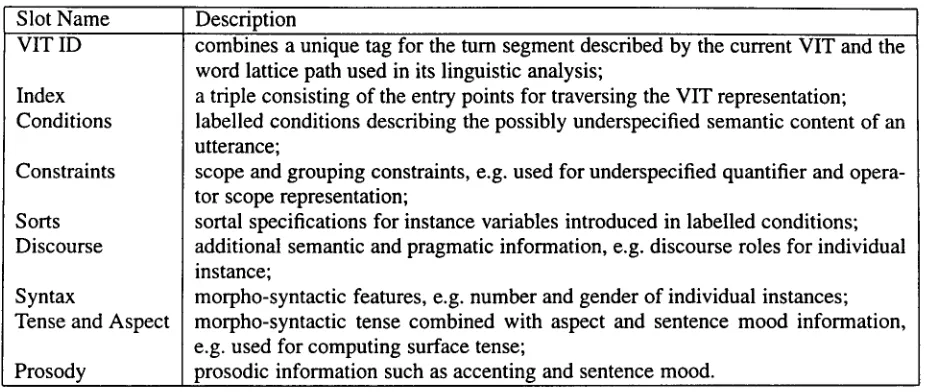
[image:2.612.71.540.52.141.2]Slot Name Description VIT ID
Index Conditions
Constraints
Sorts Discourse
Syntax
Tense and Aspect
Prosody
combines a unique tag for the turn segment described by the current VIT and the word lattice path used in its linguistic analysis;
a triple consisting of the entry points for traversing the VIT representation; labelled conditions describing the possibly underspecified semantic content of an utterance;
scope and grouping constraints, e.g. used for underspecified quantifier and opera- tor scope representation;
sortal specifications for instance variables introduced in labelled conditions; additional semantic and pragmatic information, e.g. discourse roles for individual instance;
morpho-syntactic features, e.g. number and gender of individual instances; morpho-syntactic tense combined with aspect and sentence mood information, e.g. used for computing surface tense;
prosodic information such as accenting and sentence mood.
Table 1: A list of VIT slots.
be sortally specified as a situation, further infor- mation will be required to determine the dialogue stage, i.e. whether the time of appointment is being negotiated or its place. Only in the latter case is the spatial reading (lb) relevant.
(2)
Dann wiirde das doch gehena. Then, it W O U L D be possible, after all.
b. It would be possible, wouldn't it?
Consider the discourse particle doch in (2) which can be disambiguated with prosodic information. When doch is stressed and the utterance has falling intonation, it functions as a pointer to a previous dialogue stage. Something that was impossible be- fore turned out to be feasible at the utterance time. Then, doch is translated into after all and the auxil- iary takes over the accent (2a) 2. If (2) has a rising intonation and the particle is not stressed, it signals the speaker's expectation of the hearer's approving response. In English, this meaning is conveyed by a question tag (2b). Lieske et al. (1997) provide a more detailed account of the use of prosodic infor- mation in Verbmobil.
In addition to the information that is explicitly represented in the specified fields of a VIT, in- cluding the surface word order that can be inferred from the segment identification, and the resolution of underspecified ambiguities in context, transfer might require further information, such as domain- specific world knowledge, speech act or discourse
2We indicate prosodic accent with SMALL CAPITALS.
stage information. This information can be obtained on demand from the resolution component (see Fig- ure 1). This flexible approach to the information required for transfer is termed cascaded disam-
biguation (Buschbeck-Wolf, 1997) and is balanced
against the fact that each level of escalation implies a correspondingly greater share of the permissible runtime.
2 T h e
Verbmobil
Interface TermThe VIT encodes various pieces of information pro- duced and used in the linguistic modules. The con- tent of a VIT corresponds to a single segment (or utterance) in a dialog turn. This partitioning of turns enables the linguistic components to work incre- mentally.
2.1 Multiple Levels of I n f o r m a t i o n
[image:3.612.71.534.49.245.2]for example, to synchronize the processing of anal- yses from different parsers. For processing aspects of VITs see Section 3.
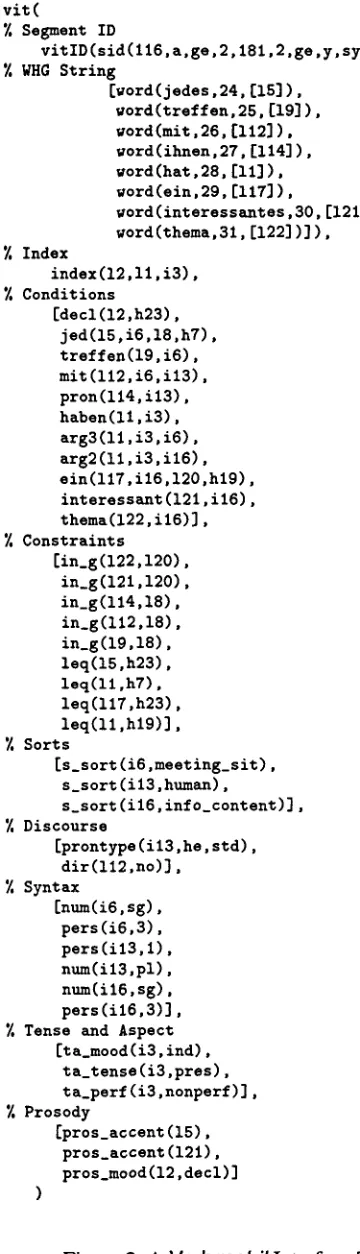
A concrete example of a VIT is given in Figure 2 in a Prolog notation where the slots are also marked. This example is further discussed in Section 2.2.
2.2 VIT Semantics
The core semantic content of the VIT is contained in the two slots: C o n d i t i o n s and C o n s t r a i n t s . The conditions represent the predicates of the se- mantic content and the constraints the semantic dependency structure over those predicates. This partitioning between semantic content and seman- tic structure is modelled on the kind of represen- tational metalanguage employed in UDRS seman- tics (Reyle, 1993) to express underspecification. The semantic representation is, thus, a metalan- guage expression containing metavariables, termed
labels, that may be assigned to object language con-
structs. Moreover, such a metalanguage is minimally
recursive 3, in that recursive structure is expunged
from the surface level by the use of metavariables over the recursive constituents of the object lan- guage.
In UDRSs quantifier dependencies and other scope information are underspecified because the constraints provide incomplete information about the assignment of object language structures to la- bels. However, a constraint set may be monoton- ically extended to provide a complete resolution. VIT semantics follows a similar strategy but some- what extends the expressivity of the metalanguage.
There are two constructs in the VIT semantic metalanguage which provide for an extension in expressivity relative to UDRSs. These have both been adopted from immediate precursors within the project, such as Bos et al. (1996), and further re- fined. The first of these is the mechanism of holes
and plugging which originates in the hole seman-
tics of Bos (1996). This requires a distinction be-
tween two types of metavariable employed: labels and holes. Labels denote the instantiated structures, primarily the individual predicates. Holes, on the other hand, mark the underspecified argument po- sitions of propositional arguments and scope do- mains. Resolution consists of an assignment of la-
3We owe the term minimal recursion to Copestake et al. (1995), but the mechanism they describe was already in use in UDRSs.
v i t (
X Segment ID
vitID(sid(ll6.a.ge.2.181.2.ge.y.syntaxger).
X WHG Strin E
[word(jedes.24.[i5]). word(treffen.25.[19]). word(mit.26.[112]). word(ihnen.27.[114]). word(hat.28.[ll]). ,ord(ein.29.[117]).
word(interessantes.30.[121]). word(thema°31.[122])]). X Index
index(12.11.i3). Conditions
[decl(12.h23).
j e d ( 1 S , i 6 , 1 8 , h 7 ) , t r e f f e n ( 1 9 , i 6 ) , m i t ( 1 1 2 , i 6 , i 1 3 ) ,
pron(l14.i13). haben(11.i3).
a r g 3 ( l l , i 3 , i 6 ) , a r g 2 ( l l , i 3 , i 1 6 ) ,
ein(llT.il6.120.hl9). interessant(121.i16). thema(122.i16)]. Constraints
[in_g(122.120). in_g(121.120). in_g(114.18). in_g(112.18). in_g(19.18). leq(15,h23), leq(ll.h7). leq(117.h23). leq(11.h19)].
Z S o r t s
[ s _ s o r t ( i 6 , m e e t i n g _ s i t ) , s _ s o r t ( i 1 3 , h u m a n ) , s _ s o r r ( i l 6 , i n f o _ c o n t e n t ) ] , X D i s c o u r s e
[ p r o n t y p e ( i 1 3 , h e , s t d ) ,
dir(112.no)]. Syntax
[num(i6.sg). pers(i6,3), pers(il3.1). num(i13.pl). num(i16.sg). pets(J16.3)]. Tense and Aspect
[ta_mood(i3.ind). ta_tense(i3.pres). ta_perf(i3.nonperf)]. Prosody
[pros_accent(15). pros_accent(121). pros_mood(12.decl)] )
[image:4.612.312.492.59.686.2]bels to holes, a plugging. In general, the constraint set contains partial constraints on such a plugging, expressed by the "less than or equal" relation ( l e q ) but no actual equations, l e q ( L ,H) should be inter- preted as a disjunction that the label is either subor- dinate to the hole or equal to it. Alternatively, this relation can be seen as imposing a partial ordering. A valid plugging must observe all such constraints.
The other extension in expressivity was the in- troduction of additional constraints between labels. These form another type of abstraction away from logical structure, in that conjunctive structure is also represented by constraints. The purpose of this fur- ther abstraction is to allow lexical predicates to be linked into additional structures, beyond that re- quired for a logical semantics. For example, focus structure may group predicates that belong to dif- ferent scope domains. More immediately, prosodic information, expressed at the lexical level, can be linked into the VIT via lexical predicates. The con- straints expressing conjunctive structure relate basic predicate labels and group labels which correspond to a conjunctive structure in the object language, such as a DRS, intuitively a single box. Grouping constraints take the form in_g (L, G), where the "in group" relation (in_g) denotes that the label L is a member of the group G. The content of a group is, thus, defined by the set of such grouping constraints.
n
g = A li such t h a t in_g(//, g)
6
C o n s t r a i n t si = 1
These two forms of abstraction from logical struc- ture have a tendency to expand the printed form of a VIT, relative to a recursive term structure, but in one respect this is clearly a more compact represen- tation, since lexical predicates occur only once but may engage in various types of structure.
2.3 An Example
Figure 2 shows the VIT produced by the analysis of the German sentence: Jedes Treffen mit lhnen hat
ein interessantes Thema ("Every meeting with you
has an interesting topic"). The instances which cor- respond to object language variables are represented by the sequence { i l , i 2 , . . . } , holes by { h i , h 2 , . . . } and labels, including group and predi- cate labels, by { l l , 12 . . . . }. The base label of a predicate appears in its first argument position. The predicates h a b e n , a r g 2 and a r g 3 share the same label because they form the representation of a sin- gle predication, in so-called neo-Davidsonian nota-
decl(12,h23)
jed(1f,i6,18,h7) ein(llT,il6,120,hl9)
haben(ll,i3)
arg3(ll,i3,i6)
arg2(ll,i3,il6)
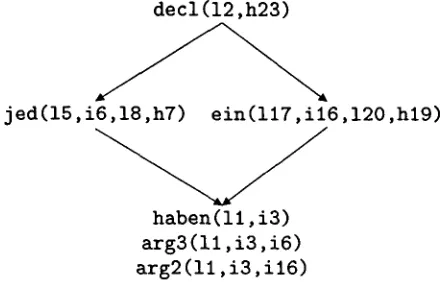
Figure 3: A Graphical Representation of the Scop- ing Constraints
[image:5.612.321.544.60.201.2]tion (e.g. (Parsons, 1991)). The two groups 120 and 18 form the restrictions of the existential quantifier, e i n , and the universal, j ed, respectively. Two of the scoping constraints place the quantifiers' labels be- low the top hole, the argument of the mood operator ( d e c l ) . The other two link the quantifiers respec- tive scopes to the bottom label, in this case the main verb, but no constraints are imposed on the relative scope of the quantifiers. The whole structure is best viewed as a (partial) subordination hierarchy, as in Figure 3.
A complete resolution would result from an as- signment of the labels {11, 15, 117} to the three holes {h23, h i 9 , h7}. Taking into account the implicit constraint that any argument to a predicate is automatically subordinate to its label, there are in fact only two possibilities: the pluggings p l and p2 given below,
II
I h231h191 h7 II
p2 117
15
11corresponding to the two relative scopings of the quantifiers:
VX(TREFFEN(X)&MIT(X,Z)-+ 3y(THEMA(y) &INTERESSANT(y)&HAB EN(X,y)))
3 y ( T H E M A ( y ) & I N T E R E S S A N T ( y ) & Vx(TREFFEN(X)&M IT(X,Z)-+ HABEN(X,y)))
A full resolution is, however, rarely necessary. Where transfer requires more specific scoping con- straints these can be provided in a pairwise fash- ion, based on default heuristics from word order or prosodic cues, or at the cost of an additional call to the resolution component.
3 V I T P r o c e s s i n g
3.1 Lists as Data Structures
Almost all fields in a VIT record are represented as lists. 4 In general, list elements do not introduce any further recursive embedding, i.e. the elements are like fixed records with fields containing con- stants. The non-recursive nature of these list ele- ments makes the access and manipulation of in- formation (e.g. addition, deletion, refinement, etc.) very convenient. Moreover, the number of list el- ements can be kept small by distributing informa- tion over different slots according to its linguistic nature (see Section 3.2 below) or the producer of the specific kind of data (see Section 2.1). The kind of structuring adopted and the relative shortness of the lists make for rapid access to and operations on VITs.
It is significant that efficient information access is dependent not only on an appropriate data structure, but also on the representational formalism imple- mented in the individual data items. This property has been presented as an independent motivation for minimally recursive representations from the Ma- chine Translation point of view (Copestake et al., 1995), and has been most thoroughly explored in the context of the substitution operations required for transfer. We believe we have taken this argu- ment to its logical conclusion, in implementing a non-recursive semantic metalanguage in an appro- priate data structure. This, in itself, provides suf- ficient motivation for opting for such representa- tions rather than, say, feature structures or the recur- sive QLFs (Alshawi et al., 1991) of CLE (Alshawi, 1992).
3.2 A D T Package
In general, linguistic analysis components are very sensitive to changes in input data caused by modifi-
4In typical AI languages, such as Lisp and Prolog, lists are built-in, and they can be ported easily to other programming languages.
cations of analyses or by increasing coverage. Ob- viously, there is a need for some kind of robust- ness at the interface level, especially in large dis- tributed software projects like Verbmobil with par- allel development of different components. There- fore, components that communicate with each other should abstract over data types used at their inter- faces. This is really a further projection of standard software engineering practice into the implementa- tion of linguistic modules.
In this spirit, all access to and manipulation of the information in a VIT is mediated by an abstract data type (ADT) package (Doma, 1996). The ADT package can be used to build a new VIT, to fill it with information, to copy and delete information within a VIT, to check the contents (see Section 3.3 below), to get specific information, to print a VIT, etc. To give an example of abstraction, there is no need to know where specific information is stored for later lookup. This is done by the ADT package that manages the adding of a piece of information to the appropriate slot. This means that the external treatment of the VIT as an interface term is entirely independent of the internal implementation and data structure within any of the modules and vice versa. 5
3.3 Consistency Checking
As a side effect of adopting an extensive ADT pack- age we were able to provide a variety of check- ing and quality control functions. They are espe- cially useful at interfaces between linguistic mod- ules to check format and content errors. At the for- mat checking level language-specific on-line dic- tionaries are used to ensure compatibility between the components. A content checker is used to test language-independent structural properties, such as missing or wrongly bound variables, missing or in- consistent information, and cyclicity.
As far as we are aware, this is the first time that the results of linguistic components dealing with se- mantics can be systematically checked at module interfaces. It has been shown that this form of test- ing is well-suited for error detection in components with rapidly growing linguistic coverage. It is worth noting that the source language lexical coverage in the Verbmobil Research Prototype is around 2500 words, rising to 10K at the end of the second phase 6. Furthermore, the complex information produced by
5The kind of data structure used by the communication ar- chitecture (Amtrup and Benra, 1996) is, similarly, transparent to the modules.
linguistic components even makes automatic output control necessary.
The same checking can be used to define a quality rating, e.g. for correctness, interpretability, etc. of the content of a VIT. Such results are much better and more productive in improving a system than common, purely quantitative, measures based on failure or success rates.
4 Conclusion
We have described the interface terms used to carry linguistic information in the Verbmobil system. The amount and type of information that they carry are adapted to the various constraints that arose dur- ing the distributed development of such a large sys- tem over a periods of several years. The VIT format has been integrated into several running systems, including the most successful, the Verbmobil Re- search Prototype. Subsequent modifications in the second phase of Verbmobil have been possible in a systematic and monotonic fashion. Similarly, the adaption of several new syntactic and semantic anal- ysis modules has not presented any major or un- seen problems. Among the tasks currently under de- velopment is the use of VIT representations in the generation of dialogue protocols, in the language of each participant.
We feel that VITs have proved themselves ad- equate to the considerable system requirements through their continued, efffective use. We also find it reassuring that, despite the priority given to the engineering requirement, we have been able to em- bed within this interface language representations that are, at least, equivalent to the state of the art in Computational Semantics.
References
Hiyan Alshawi, David M. Carter, Bj6ru Gamback, and Manny Rayner. 1991. Translation by Quasi Logical Form Transfer. In Proceedings of the 29th Annual Meeting of the Association for Com- putational Linguistics (ACL'91), pages 161-168, Berkeley, CA.
Hiyan Alshawi, editor. 1992. The Core Language Engine. ACL-MIT Press Series in Natural Lan- guages Processing. MIT Press, Cambridge, MA. Jan W. Amtrup and J6rg Benra. 1996. Communica-
tion in Large distributed AI Systems for Natural Language Processing. In Proceedings of the 16th International Conference on Computational Lin-
guistics (Coling'96), pages 35-40, Copenhagen, Denmark.
J. Bos, B. Gamb~ick, C. Lieske, Y. Mori, M. Pinkal, and K. Worm. 1996. Compositional Semantics in Verbmobil. In Proceedings of the 16th Interna- tional Conference on Computational Linguistics (Coling'96), pages 131-136, Copenhagen, Den- mark.
Johan Bos. 1996. Predicate Logic Unplugged. In Paul Dekker and Martin Stokhof, editors, Pro- ceedings of the Tenth Amsterdam Colloquium, pages 133-143, ILLC/Department of Philosophy, University of Amsterdam.
T. Bub, W. Wahlster, and A. Waibel. 1997. Vorbmobil: The Combination of Deep and Shal- low Processing for Spontaneous Speech Trans- lation. In Proceedings of the 22nd Interna- tional Conference on Acoustics, Speech, and Sig- nal Processing (ICASSP'97), Munich, Germany, April.
Bianka Buschbeck-Wolf. 1997. Resolution on De- mand. Verbmobil Report 196, IMS, Universit~it Stuttgart, Germany.
A. Copestake, D. Flickinger, R. Malouf, S. Riehe- mann, and I. Sag. 1995. Translation using Mini- mal Recursion Semantics. In Proceedings of the 6th International Conference on Theoretical and Methodological Issues in Machine Translation (TMI'95), Leuven, Belgium.
Michael Dorna and Martin C. Emele. 1996. Semantic-based Transfer. In Proceedings of the 16th International Conference on Computational Linguistics (Coling'96), Copenhagen, Denmark. Michael Doma. 1996. The ADT-Package for the
Verbmobil Interface Term. Verbmobil Report 104, IMS, Universitat Stuttgart, Germany. C. Lieske, J. Bos, B. Gamb~ick M. Emele, and
C.J. Rupp. 1997. Giving prosody a meaning. In Proceedings of the 5th European Conference on Speech Communication alut Technology (Eu- roSpeech'97), Rhodes, Greece, September. T. Parsons. 1991. Events in the Semantics of En-
glish. MIT Press, Cambridge, Mass.
Uwe Reyle. 1993. Dealing with Ambiguities by Underspecification: Construction, Represen- tation and Deduction. Journal of Semantics,