Exploiting Syntactic Structure for Language Modeling
Ciprian
C h e l b a a n d F r e d e r i c k J e l i n e k C e n t e r f o r L a n g u a g e a n d S p e e c h P r o c e s s i n g T h e J o h n s H o p k i n s U n i v e r s i t y , B a r t o n H a l l 3 2 0 3 4 0 0 N. C h a r l e s S t . , B a l t i m o r e , M D - 2 1 2 1 8 , U S A{ c h e l b a , j e l i n e k } @ j h u . e d u
A b s t r a c t
The paper presents a language model that devel- ops syntactic structure and uses it to extract mean- ingful information from the word history, thus en- abling the use of long distance dependencies. The model assigns probability to every joint sequence of words-binary-parse-structure with headword an- notation and operates in a left-to-right manner - - therefore usable for automatic speech recognition. The model, its probabilistic parameterization, and a set of experiments meant to evaluate its predictive power are presented; an improvement over standard trigram modeling is achieved.
1 Introduction
The main goal of the present work is to develop a lan- guage model that uses syntactic structure to model long-distance dependencies. During the summer96 DoD Workshop a similar a t t e m p t was made by the dependency modeling group. The model we present is closely related to the one investigated in (Chelba et al., 1997), however different in a few important aspects:
• our model operates in a left-to-right manner, al- lowing the decoding of word lattices, as opposed to the one referred to previously, where only whole sen- tences could be processed, thus reducing its applica- bility to n-best list re-scoring; the syntactic structure is developed as a model component;
• our model is a factored version of the one in (Chelba et al., 1997), thus enabling the calculation of the joint probability of words and parse structure; this was not possible in the previous case due to the huge computational complexity of the model.
Our model develops syntactic structure incremen- tally while traversing the sentence from left to right. This is the main difference between our approach and other approaches to statistical natural language parsing. Our parsing strategy is similar to the in- cremental syntax ones proposed relatively recently in the linguistic community (Philips, 1996). The probabilistic model, its parameterization and a few experiments that are meant to evaluate its potential for speech recognition are presented.
/ / /
/ ~ t r a c t NP
the_DT contract NN ~,dc,l VBI)with INa DT Ioss_NN of_IN 7_CD ~: ~::, X~,'~ after
Figure 1: Partial parse
2 T h e B a s i c I d e a
and Terminology
Consider predicting the word a f t e r in the sentence:t h e c o n t r a c t e n d e d w i t h a l o s s of 7 c e n t s
after trading as l o w a s 8 9 cents.
A 3-gram approach would predict after from (7, c e n t s ) whereas it is intuitively clear that the strongest predictor would be ended which is outside the reach of even 7-grams. Our assumption is that what enables humans to make a good prediction of a f t e r is the syntactic structure in the past. The linguistically correct partial parse of the word his- tory when predicting a f t e r is shown in Figure 1. The word ended is called the headword of the con- stituent (ended ( w i t h ( . . . ) ) ) and ended is an ex- posed headword when predicting a f t e r - - topmost headword in the largest constituent that contains it. The syntactic structure in the past filters out irrel- evant words and points to the important ones, thus enabling the use of long distance information when predicting the next word.
Our model will a t t e m p t to build the syntactic structure incrementally while traversing the sen- tence left-to-right. The model will assign a probabil- ity P(W, T) to every sentence W with every possible P O S t a g assignment, binary branching parse, non- terminal label and headword annotation for every constituent of T.
" i
. . . . "°''
(¢:s>. S B ) ... ( w p . t p) ( w {p÷l }. L_( I~-I }) ... ( w k . t_k) w _ ( k*l }.... </s.~
T [ - r a }
< s >
h _ ( - 2 } h ( - ! } h_O
. . .
Figure 2: A word-parse k-prefix Figure 4: Before an adjoin operation
_ (<,'s>, TOP)
(<s>, SB) (w_l, ~_1) ... ('*'_n, t_n) ( < / ~ , SE)
Figure 3: Complete parse
the word-parse k-prefix. To stress this point, a word-parse k-prefix contains - - for a given parse - - only those binary subtrees whose span is com- pletely included in the word k-prefix, excluding w0 =<s>. Single words along with their P O S t a g can be regarded as root-only trees. Figure 2 shows a word-parse k-prefix; h_0 . . h_{-m} are the ex- posed heads, each head being a pair(headword, non- terminal label), or (word, POStag) in the case of a root-only tree. A complete parse - - Figure 3 - - is any binary parse of the
( w l , t l ) . . . ( w n , t , ) ( < / s > , SE) sequence with the restriction t h a t ( < / s > , TOP') is the only allowed head. Note t h a t ( ( w l , t l ) . . . ( w , , t , ) ) needn't be a constituent, but for the parses where it is, there is no restriction on which of its words is the headword or what is the non-terminal label t h a t accompanies the headword.
T h e model will o p e r a t e by means of three mod- ules:
• W O R D - P R E D I C T O R predicts the next word wk+l given the word-parse k-prefix and then passes control to the T A G G E R ;
• T A G G E R predicts the P O S t a g of the next word tk+l given the word-parse k-prefix and the newly predicted word and then passes control to the PARSER;
• P A R S E R grows the already existing binary branching structure by repeatedly generating the transitions:
(unary, NTlabel), (adjoin-left, NTlabel) or (adjoin-right, NTlabel) until it passes control
to the P R E D I C T O R by taking a null transition.
NTlabel is the non-terminal label assigned to the newly built constituent and {left ,right} specifies where the n e w headword is inherited from.
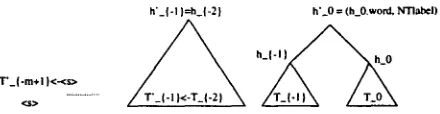
T h e operations performed by the P A R S E R are
illustrated in Figures 4-6 and they ensure that all possible binary branching parses with all possible
T'_{.m÷l l <-<s.~.
<s>
h ' { - I } = h_(-2 } h'_0= (h_{-I }.word, NTlabel)
Figure 5: Result of adjoin-left under NTlabel
headword and non-terminal label assignments for the wl . . . wk word sequence can be generated. T h e following algorithm formalizes the above description of the sequential generation of a sentence with a complete parse.
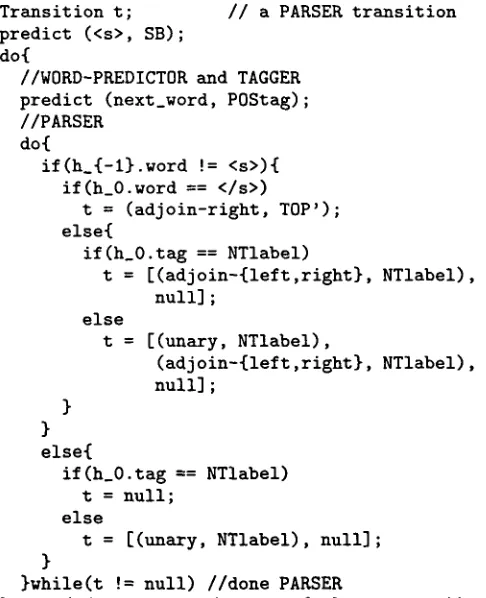
Transition t; // a PARSER transition
predict (<s>, SB); do{
/ / W O R D - P R E D I C T O R a n d TAGGER predict (next_word, POStag); //PARSER
do{
if(h_{-l}.word != <s>){ if(h_O.word == </s>)
t = (adjoin-right, TOP'); else{
i f ( h _ O . t a g = = NTlabel)
t = [(adjoin-{left,right}, NTlabel), null];
else
t = [(unary, NTlabel),
(adjoin-{left,right}, NTlabel), null];
} }
else{
if (h_O.tag == NTlabel) t = null;
else
t = [(unary, NTlabel), null] ;
}
}while(t != null) //done PARSER
}while ( ! (h_0. word==</s> && h_{- 1 }. word==<s>) )
t = (adjoin-right, TOP); //adjoin <s>_SB; DONE;
[image:2.612.313.556.346.645.2]T'_l.m+l } <-<s>
h' {- I }=h {-2} h'_0 = (h_0.word, NTlab¢l)
Figure 6: Result of adjoin-right under NTlabel
input word string. The second subtree in Figure 2 provides an example of a unary transition followed by a null transition.
It is easy to see that any given word sequence with a possible parse and headword annotation is generated by a unique sequence of model actions. This will prove very useful in initializing our model parameters from a treebank - - see section 3.5.
3 P r o b a b i l i s t i c M o d e l
The probability P(W, T) of a word sequence W and a complete parse T can be broken into:
P(W, T) =
1-I "+xr P(wk/Wk-aTk-x) " P ( t k / W k - l T k - x , w k ) " k=X I. N~
~ I P(Pki /Wk-xTk-a' Wk, tk,pkx ... pLX)](1) i=X
where:
• Wk-lTk-x is the word-parse (k - 1)-prefix • wk is the word predicted by W O R D - P R E D I C T O R * tk is the tag assigned to wk by the T A G G E R • Nk -- 1 is the number of operations the PARSER executes before passing control to the WORD- P R E D I C T O R (the Nk-th operation at position k is the n u l l transition); Nk is a function of T
• pi k denotes the i-th PARSER operation carried out at position k in the word string;
p~ 6 {(unary, NTlabel), (adjoin-left, NTlabel),
(adjoin-right, NTlabel), null}, pk 6 { (adjoin-left, NTlabel),
(adjoin-right, NTlabel)}, 1 < i < Nk ,
p~ =null, i = N k
Our model is based on three probabilities:
P ( w k / W k - l T k - 1 ) (2) P(tk/wk, Wk-lTk-x) (3)
P(p~/wk,tk,Wk--xTk--l,p~..
"Pi--X)
k
C a)As can be seen, (wk, tk, Wk-xTk-x,p~...pki_x) is one of the Nk word-parse k-prefixes WkTk at position k in the sentence, i = 1, Nk.
To ensure a proper probabilistic model (1) we have to make sure that (2), (3) and (4) are well de- fined conditional probabilities and that the model
halts with probability one. Consequently, certain PARSER and W O R D - P R E D I C T O R probabilities must be given specific values:
• P ( n u l l / W k T k ) = 1, if h _ { - 1 } . w o r d = <s> and h_{0} ~ ( < / s > , TOP') - - that is, before predicting < / s > - - ensures that (<s>, SB) is adjoined in the last step of the parsing process;
• P ( ( a d j o i n - r i g h t , TOP)/WkTk) = 1, if
h_O = (</s>, TOP') and h_{-l}.word = <s> and
P ( ( a d j o i n - r i g h t , TOP')/WkTk) = 1, if h_0 = ( < / s > , TOP') and h _ { - 1 } . w o r d ~ <s> ensure that the parse generated by our model is con- sistent with the definition of a complete parse; • P ( ( u n a r y , NWlabel)/WkTk) = 0, if h _ 0 . t a g POStag ensures correct treatment of unary produc- tions;
• 3e > O, VWk-lTk-l,P(wk=</s>/Wk-xTk-1) >_ e ensures that the model halts with probability one. The word-predictor model (2) predicts the next word based on the preceding 2 exposed heads, thus making the following equivalence classification:
P ( w k / W k - l T k - 1 ) = P(wk/ho, h - l )
After experimenting with several equivalence clas- sifications of the word-parse prefix for the tagger model, the conditioning part of model (3) was re- duced to using the word to be tagged and the tags of the two most recent exposed heads:
P(tk/Wk, W k - l T k - 1 ) = P(tk/wk, ho.tag, h-l.tag)
Model (4) assigns probability to different parses of the word k-prefix by chaining the elementary oper- ations described above. The workings of the parser module are similar to those of Spatter (Jelinek et al., 1994). The equivalence classification of the WkTk word-parse we used for the parser model (4) was the same as the one used in (Collins, 1996):
p (pk / Wk Tk ) = p (pk / ho , h-x)
It is worth noting that if the binary branching structure developed by the parser were always right- branching and we mapped the P O S t a g and non- terminal label vocabularies to a single type then our model would be equivalent to a trigram language model.
3.1 M o d e l i n g T o o l s
[image:3.612.78.298.90.147.2]recursive mixing scheme:
P ( y / x l , . . . ,xn) =
A ( x l , . . . , x , ) - P ( y / x l , . . . , x , _ x ) +
( 1 - - ~ ( X l , . . . , X n ) ) " f n ( y / X l , . . . , X n ) , ( 5 )
f - l (Y) = uniform(vocabulary(y)) (6)
As can be seen, the context mixing scheme dis- cards items in the context in right-to-left order. The A coefficients are tied based on the range of the count C ( x x , . . . , X n ) . The approach is a standard one which doesn't require an extensive description given the literature available on it (Jelinek and Mer- cer, 1980).
3 . 2 S e a r c h S t r a t e g y
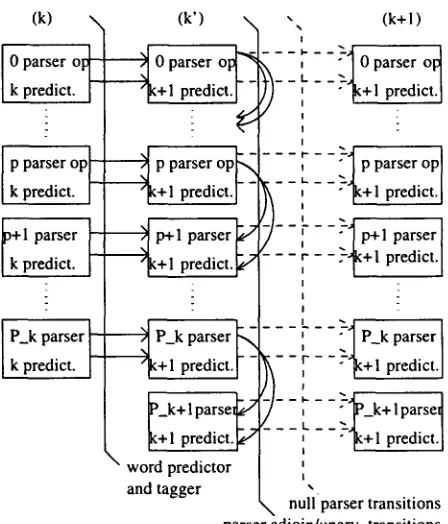
Since the number of parses for a given word prefix Wt grows exponentially with k, I{Tk}l ,,. O(2k), the state space of our model is huge even for relatively short sentences so we had to use a search strategy that prunes it. Our choice was a synchronous multi- stack search algorithm which is very similar to a beam search.
Each stack contains hypotheses - - partial parses - - that have been constructed by the same number of predictor and the same number of parser operations. The hypotheses in each stack are ranked according to the ln(P(W, T)) score, highest on top. The width of the search is controlled by two parameters: • the maximum stack depth - - the maximum num- ber of hypotheses the stack can contain at any given state;
• log-probability threshold - - the difference between the log-probability score of the top-most hypothesis and the bottom-most hypothesis at any given state of the stack cannot be larger than a given threshold. Figure 7 shows schematically the operations asso- ciated with the scanning of a new word Wk+l. The above pruning strategy proved to be insufficient so we chose to also discard all hypotheses whose score is more than the log-probability threshold below the score of the topmost hypothesis. This additional pruning step is performed after all hypotheses in stage k' have been extended with the null parser transition and thus prepared for scanning a new word.
3.3 W o r d L e v e l P e r p l e x i t y
The conditional perplexity calculated by assigning to a whole sentence the probability:
P ( W / T * ) = f i P ( w k + l / W k T ~ ) , (7) k=O
where T* = argrnaxTP(W, T), is not valid because it is not causal: when predicting wk+l we use T* which was determined by looking at the entire sen- tence. To be able to compare the perplexity of our
(k) \
0 parser ot~ k predict. [
p parser o p k predict.
p+l parser
k predict.
P_k parser
k predict.
(k') \
~ 0 parser opt_ "~+1 predict. [" -
1
k+l predict.p+ 1 parser ~
+1 predict]z/
~ P_k parser ~ _
predict V -
_k+ 1 parse~e~ 1 predict.~"
word predictor
and tagger
- (k+l)
oq
I I I
) ~ _ - ~ - - ) ] p p a r s e r op
I
- - =-~+1 predict. I
! - - ~ + 1 parser]
- - 7 - - >~+..} p r e d i c [ . I
i i i
- - - ! - - ~ l P kparser!
---:
, - :-~+ 1 predict.
I
nullparser transitions parser adjoin/unary transitions
Figure 7: One search extension cycle
model with that resulting from the standard tri- gram approach, we need to factor in the entropy of guessing the correct parse T~ before predicting wk+l, based solely on the word prefix Wk.
The probability assignment for the word at posi- tion k + 1 in the input sentence is made using:
P(Wk+l/Wk) =
~TheS~ P(Wk+x/WkTk) " p(Wk,Tk), (8)
p(Wk,Tk) = P(W Tk)/ P(WkTk) (9)
TkESk
which ensures a proper probability over strings W*, where Sk is the set of all parses present in our stacks at the current stage k.
Another possibility for evaluating the word level perplexity of our model is to approximate the prob- ability of a whole sentence:
N
P ( W ) = Z P ( W , T (k)) (10) k=l
where T (k) is one of the "N-best" - - in the sense defined by our search - - parses for W. This is a deficient probability assignment, however useful for justifying the model parameter re-estimation.
[image:4.612.311.535.89.351.2]possible parses we get the correct value for the word level perplexity of our model.
3.4 P a r a m e t e r R e - e s t i m a t i o n
T h e m a j o r problem we face when trying to reesti- m a t e the model p a r a m e t e r s is the huge state space of the model and the fact t h a t dynamic p r o g r a m m i n g techniques similar to those used in HMM p a r a m e - ter re-estimation cannot be used with our model. Our solution is inspired by an HMM re-estimation technique t h a t works on pruned - - N-best - - trel- lises(Byrne et al., 1998).
Let (W, T(k)), k = 1 . . . N be the set of hypothe- ses t h a t survived our pruning strategy until the end of the parsing process for sentence W. Each of them was produced by a sequence of model actions, chained together as described in section 2; let us call the sequence of model actions t h a t produced a given (W, T) the
derivation(W, T).
Let
an elementary event
in thederivation(W, T)
be :, (m,) .~(m,)~ where:
* l is the index of the current model action; * ml is the model component - - W O R D - P R E D I C T O R , T A G G E R , P A R S E R - - t h a t takes action number l in the
derivation(W,
T);,
y~mt)
is the action taken at position I in the deriva- tion:if mt = W O R D - P R E D I C T O R , then y~m,) is a word; if mt -- T A G G E R , then y~m~) is a POStag;
if
mt =
PARSER, then y~m~) is a parser-action; • ~m~) is the context in which the above action was taken:if rat = W O R D - P R E D I C T O R or PARSER, then
_~,na) = (ho.tag, ho.word, h-1 .tag, h-l.word);
if
rat =
T A G G E R , then~ m t ) = (word-to-tag,
ho.tag, h-l.tag).
T h e probability associated with each model ac- tion is determined as described in section 3.1, based on counts C (m) (y(m), x_("0), one set for each model component.
Assuming t h a t the deleted interpolation coeffi- cients and the count ranges used for tying them stay fixed, these counts are the only parameters to be re-estimated in an eventual re-estimation procedure; indeed, once a set of counts C (m) (y(m), x_(m)) is spec- ified for a given model ra, we can easily calculate: • the relative frequency estimates
fn(m)/,,(m) Ix(m) ~
kY I _ n / for all context ordersn = 0...maximum-order(model(m));
• the count
c(m)(x_ (m))
used for determining the A(x_ (m)) value to be used with the order-n context x(m)"This is all we need for calculating the probability of an
elementary event
and then the probability of an entire derivation.One training iteration of the re-estimation proce- dure we propose is described by the following algo- rithm:
N-best parse development data; // counts.El // prepare counts.E(i+l)
for each model component c{
gather_counts development model_c;
}
In the parsing stage we retain for each "N-best" hy- pothesis (W, T(k)), k = 1 . . . N, only the quantity ¢(W, T(k))
=
p(W,T(k))/
~-~k=l P(W, T(k))
Nand its
derivation(W,T(k)).
We then scan all the derivations in the "development set" and, for each occurrence of the elementary e v e n t(y(m), x_(m))
in
derivation(W,T(k))
we accumulate the value ¢ ( W , T (k)) in the C(m)(y(m),x__ (m)) counter to be used in the next iteration.T h e intuition behind this procedure is t h a t ¢ ( W , T (k)) is an approximation to the
P(T(k)/w)
probability which places all its mass on the parses t h a t survived the parsing process; the above proce- dure simply accumulates the expected values of the
c o u n t s
c(m)(y(m),x (m))
under t h e¢(W,T (k))
con- ditional distribution. As explained previously, theC(m) (y(m), X_(m))
counts are the p a r a m e t e r s defining our model, making our procedure similar to a rigor- ous EM approach (Dempster et al., 1977).A particular - - and very interesting - - case is t h a t of events which had count zero but get a non-zero count in the next iteration, caused by the "N-best" nature of the re-estimation process. Consider a given sentence in our "development" set. The "N-best" derivations for this sentence are trajectories through the state space of our model. T h e y will change from one iteration to the other due to the smooth- ing involved in the probability estimation and the change of the p a r a m e t e r s - - event counts - - defin- ing our model, thus allowing new events to a p p e a r and discarding others through purging low probabil- ity events from the stacks. The higher the number of trajectories per sentence, the more dynamic this change is expected to be.
Y_! Y_k Y_n Y l Y_k Y_n
Figure 8: Binarization schemes
3 . 5 I n i t i a l P a r a m e t e r s
Each model component - - W O R D - P R E D I C T O R , T A G G E R , P A R S E R - - is trained initially from a set of parsed sentences, after each parse tree (W, T) undergoes:
• headword percolation and binarization - - see sec- tion 4;
• decomposition into its
derivation(W, T).
Then, separately for each m model component, we: • gather joint counts
cCm)(y(m),x (m))
from the derivations t h a t make up the "development data" using ¢ ( W , T ) = 1;• estimate the deleted interpolation coefficients on joint counts gathered from "check data" using the EM algorithm.
These are the initial p a r a m e t e r s used with the re- estimation procedure described in the previous sec- tion.
4
H e a d w o r d P e r c o l a t i o n a n d
B i n a r i z a t i o n
In order to get initial statistics for our model com- ponents we needed to binarize the UPenn Tree- b a n k (Marcus et al., 1995) parse trees and perco- late headwords. T h e procedure we used was to first percolate headwords using a context-free (CF) rule- based approach and then binarize the parses by us- ing a rule-based approach again.
T h e headword of a phrase is the word t h a t best represents the phrase, all the other words in the phrase being modifiers of the headword. Statisti- cally speaking, we were satisfied with the o u t p u t of an enhanced version of the procedure described in (Collins, 1996) - - also known under the n a m e "Magerman & Black Headword Percolation Rules". Once the position of the headword within a con- stituent - - equivalent with a CF production of the t y p e Z --~ Y1.--Yn , where Z, Y1,...Yn are non- terminal labels or P O S t a g s (only for Y/) - - is iden- tified to be k, we binarize the constituent as follows: depending on the Z identity, a fixed rule is used to decide which of the two binarization schemes in Figure 8 to apply. T h e intermediate nodes created by the above binarization schemes receive the non- terminal label Z ~.
5
E x p e r i m e n t s
Due to the low speed of the parser - - 200 w d s / m i n for stack depth 10 and log-probability threshold 6.91 nats (1/1000) - - we could carry out the re- estimation technique described in section 3.4 on only 1 Mwds of training data. For convenience we chose to work on the UPenn Treebank corpus. T h e vocab- ulary sizes were:
* word vocabulary: 10k, open - - all words outside the vocabulary are m a p p e d to the <unk> token; • P O S tag vocabulary: 40, closed;
• non-terminal tag vocabulary: 52, closed; • parser operation vocabulary: 107, closed;
T h e training d a t a was split into "development" set - - 929,564wds (sections 00-20) - - and "check set"
- - 73,760wds (sections 21-22); the test set size was
82,430wds (sections 23-24). T h e "check" set has been used for estimating the interpolation weights and tuning the search parameters; the "develop- ment" set has been used for g a t h e r i n g / e s t i m a t i n g counts; the test set has been used strictly for evalu- ating model performance.
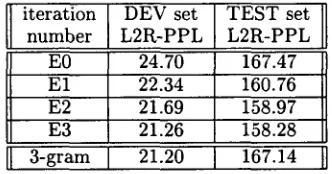
Table 1 shows the results of the re-estimation tech- nique presented in section 3.4. We achieved a reduc- tion in t e s t - d a t a perplexity bringing an improvement over a deleted interpolation t r i g r a m model whose perplexity was 167.14 on the same training-test data; the reduction is statistically significant according to a sign test.
iteration DEV set T E S T set n u m b e r L 2 R - P P L L 2 R - P P L
E0 24.70 167.47
E1 22.34 160.76
E2 21.69 158.97
E3 21.26 158.28
3-gram 21.20 167.14
Table 1: P a r a m e t e r re-estimation results
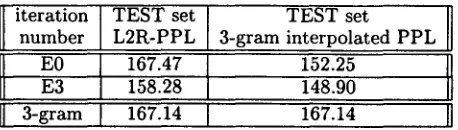
Simple linear interpolation between our model and the t r i g r a m model:
Q ( w k + l / W k ) =
)~" P(Wk+I/Wk-I,Wk) +
(1 -- A)"P(wk+l/Wk)
yielded a further improvement in P P L , as shown in Table 2. T h e interpolation weight was estimated on check d a t a to be )~ = 0.36.
An overall relative reduction of 11% over the trigram model has been achieved.
[image:6.612.96.277.89.155.2] [image:6.612.339.505.422.509.2]II iteration number
II Eo
E3 [l 3-gram
TEST set L2R-PPL 167.47 158.28 167.14
TEST set 3-gram interpolated PPL
152.25 II
148.90
167.14 II
Table 2: Interpolation with trigram results
for model parameter estimation - - and "test" set - - unseen data - - shows that the initial point we choose for the parameter values has already captured a lot of information from the training data. The same problem is encountered in standard n-gram language modeling; however, our approach has more flexibility in dealing with it due to the possibility of reestimat- ing the model parameters.
We believe that the above experiments show the potential of our approach for improved language models. Our future plans include:
• experiment with other parameterizations than the two most recent exposed heads in the word predictor model and parser;
• estimate a separate word predictor for left-to- right language modeling. Note that the correspond- ing model predictor was obtained via re-estimation aimed at increasing the probability of the "N-best" parses of the entire sentence;
• reduce vocabulary of parser operations; extreme case: no non-terminal labels/POS tags, word only model; this will increase the speed of the parser thus rendering it usable on larger amounts of train- ing data and allowing the use of deeper stacks - - resulting in more "N-best" derivations per sentence during re-estimation;
• relax - - flatten - - the initial statistics in the re- estimation of model parameters; this would allow the model parameters to converge to a different point that might yield a lower word-level perplexity; • evaluate model performance on n-best sentences output by an automatic speech recognizer.
7 A c k n o w l e d g m e n t s
This research has been funded by the NSF IRI-19618874 grant (STIMULATE).
The authors would like to thank Sanjeev Khu- danpur for his insightful suggestions. Also to Harry Printz, Eric Ristad, Andreas Stolcke, Dekai Wu and all the other members of the dependency model- ing group at the summer96 DoD Workshop for use- ful comments on the model, programming support and an extremely creative environment. Also thanks to Eric Brill, Sanjeev Khudanpur, David Yarowsky, Radu Florian, Lidia Mangu and Jun Wu for useful input during the meetings of the people working on our STIMULATE grant.
R e f e r e n c e s
w . Byrne, A. Gunawardana, and S. Khudanpur. 1998. Information geometry and EM variants. Technical Report CLSP Research Note 17, De- partment of Electical and Computer Engineering, The Johns Hopkins University, Baltimore, MD. C. Chelba, D. Engle, F. Jelinek, V. Jimenez, S. Khu-
danpur, L. Mangu, H. Printz, E. S. Ristad, R. Rosenfeld, A. Stolcke, and D. Wu. 1997. Struc- ture and performance of a dependency language model. In Proceedings of Eurospeech, volume 5, pages 2775-2778. Rhodes, Greece.
Michael John Collins. 1996. A new statistical parser based on bigram lexical dependencies. In Proceed- ings of the 34th Annual Meeting of the Associ- ation for Computational Linguistics, pages 184- 191. Santa Cruz, CA.
A. P. Dempster, N. M. Laird, and D. B. Rubin. 1977. Maximum likelihood from incomplete data via the EM algorithm. In Journal of the Royal Statistical Society, volume 39 of B, pages 1-38.
Frederick Jelinek and Robert Mercer. 1980. Inter- polated estimation of markov source parameters from sparse data. In E. Gelsema and L. Kanal, ed- itors, Pattern Recognition in Practice, pages 381- 397.
F. Jelinek, J. Lafferty, D. M. Magerman, R. Mercer, A. Ratnaparkhi, and S. Roukos. 1994. Decision tree parsing using a hidden derivational model. In ARPA, editor, Proceedings of the Human Lan- guage Technology Workshop, pages 272-277. M. Marcus, B. Santorini, and M. Marcinkiewicz.
1995. Building a large annotated corpus of En- glish: the Penn Treebank. Computational Lin- guistics, 19(2):313-330.
[image:7.612.77.306.80.145.2]