A M e t a - L e v e l Grammar:
Redefining Synchronous T A G for Translation and Paraphrase
M a r k D r a sMicrosoft Research I n s t i t u t e D e p a r t m e n t of C o m p u t e r Science
M a c q u a r i e University, A u s t r a l i a markd@±cs, mq. e d u . au
A b s t r a c t
In applications such as translation and paraphrase, operations are carried out on grammars at the meta level. This pa- per shows how a meta-grammar, defining structure at the meta level, is useful in the case of such operations; in particu- lar, how it solves problems in the current definition of Synchronous TAG (Shieber, 1994) caused by ignoring such structure in mapping between grammars, for appli- cations such as translation. Moreover, es- sential properties of the formalism remain unchanged.
1 I n t r o d u c t i o n
A g r a m m a r is, among other things, a device by which it is possible to express structure in a set of entities; a grammar formalism, the con- straints on how a grammar is allowed to ex- press this. Once a grammar has been used to express structural relationships, in many ap- plications there are operations which act at a 'meta level' on the structures expressed by the grammar: for example, lifting rules on a depen- dency g r a m m a r to achieve pseudo-projectivity (Kahane et al, 1998), and mapping between synchronised Tree Adjoining Grammars (TAGs) (Shieber and Schabes, 1990; Shieber 1994) as in machine translation or syntax-to-semantics transfer. At this meta level, however, the oper- ations do not themselves exploit any structure. This paper explores how, in the TAG case, us- ing a meta-level grammar to define meta-level structure resolves the flaws in the ability of Syn- chronous TAG (S-TAG) to be a representation for applications such as machine translation or paraphrase.
This paper is set out as follows. It describes the expressivity problems of S-TAG as noted
in Shieber (1994), and shows how these occur also in syntactic paraphrasing. It then demon- strates, illustrated by the relative structural complexity which occurs at the meta level in syntactic paraphrase, how a meta-level gram- mar resolves the representational problems; and it further shows that this has no effect on the generative capacity of S-TAG.
2 S - T A G a n d M a c h i n e T r a n s l a t i o n Synchronous TAG, the mapping between two Tree Adjoining Grammars, was first proposed by Shieber and Schabes (1990). An applica- tion proposed concurrently with the definition of S-TAG was that of machine translation, map- ping between English and French (Abeill~ et al,
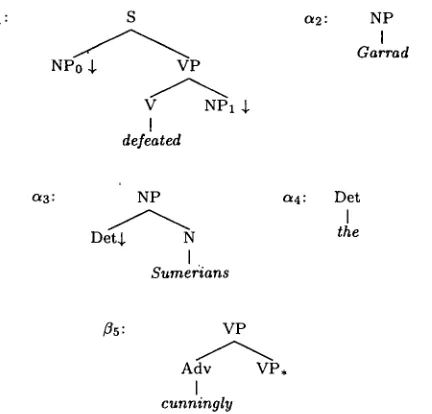
1990); work continues in the area, for example using S-TAG for English-Korean machine trans- lation in a practical system (Palmer et al, 1998). In mapping between, say, English and French, there is a lexicalised TAG for each language (see XTAG, 1995, for an overview of such a gram- mar). Under the definition of TAG, a grammar contains elementary trees, rather than flat rules, which combine together via the operations of substitution and adjunction (composition oper- ations) to form composite structures--derived trees--which will ultimately provide structural representations for an input string if this string is grammatical. An overview of TAGs is given in Joshi and Schabes (1996).
( ~ 1 : S
NP0 $ VP
V NP1 j.
I defeated
a2: NP
I Garrad
NP
I Garrad
a4: Det
I the
( ~ 3 : NP
Det$ N
I Sumer~ans
;35: VP
Adv V P ,
I cunningly
Figure 1: E l e m e n t a r y TAG trees
tics of TAG t h a t make it well suited to describ- ing n a t u r a l language are the e x t e n d e d d o m a i n of locality (EDL) and factoring recursion from the d o m a i n of dependencies (FRD). In TAG, for in- stance, information concerning dependencies is given in one tree (EDL): for example, in Fig- ure 1,1 t h e information t h a t the verb
defeated
has subject and object a r g u m e n t s is contained in t h e tree a l . In a CFG, with rules of the form S --+ N P V P and V P --+ V N P , it is not possible to have information a b o u t b o t h ar- g u m e n t s in the same rule unless the V P node is lost. TAG keeps dependencies together, or local, no m a t t e r how far apart the correspond- ing lexicM items are. F R D means t h a t recursive i n f o r m a t i o n - - f o r example, a sequence of adjec- tives modifying t h e object n o u n of
defeated--are
factored out into separate trees, leaving depen- dencies together.
A consequence of t h e TAG definition is that, un- like CFG, a TAG derived tree is not a record of its own derivation. In CFG, each tree given as a s t r u c t u r a l description to a string enables the rules applied to be recovered. In a TAG, this is not possible, so each derived tree has an asso- ciated derivation tree. If the trees in Figure 1 were composed to give a s t r u c t u r a l description for
Garrad cunningly defeated the Sumerians,
the derived tree a n d its corresponding deriva- 1The figures use s t a n d a r d T A G n o t a t i o n : $ for nodes r e q u i r i n g s u b s t i t u t i o n , • for foot nodes of auxiliary trees.
S
v P
Adv VP
cunningly
V NP
defeated Det N
J I
the Sumerians
or2 (1) ;35 (2) or3 ( 2 . 2 )
i p
~4(1)
Figure 2: Derived and derivation trees, respec- tively, for Figure 1
tion tree would be as in Figure 2. 2
Weir (1988) t e r m s the derived tree, and its component e l e m e n t a r y trees, OBJECT-LEVEL TREES; the derivation tree is t e r m e d a META- LEVEL T R E E , since it describes t h e object-level trees. T h e derivation trees are context free (Weir, 1988), t h a t is, t h e y can be expressed by a CFG; Weir showed t h a t applying a TAG yield function to a context free derivation tree (that is, reading the labels off t h e tree, a n d substi- tuting or adjoining t h e corresponding object- level trees as appropriate) will uniquely specify a TAG tree. Schabes and Shieber (1994) charac- terise this as a function 7) from derivation trees to derived trees.
T h e idea b e h i n d S-TAG is to take two TAGs and link t h e m in an a p p r o p r i a t e way so t h a t when substitution or a d j u n c t i o n occurs in a tree in one g r a m m a r , t h e n a corresponding compo- sition operation occurs in a tree in the other g r a m m a r . Because of the way TAG's EDL cap- tures dependencies, it is not problematic to have translations more complex t h a n word-for-word mappings (Abeill~
et al,
1990). For example, from the Abeill~et al
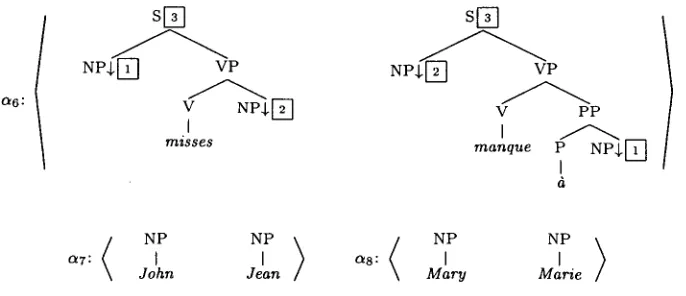
paper, handling a r g u m e n t swap, as in (1), is straightforward. These would be represented by tree pairs as in Figure 3. [image:2.612.73.289.62.269.2] [image:2.612.303.525.63.263.2]o~6:
sg]
N p $ ~ ~ V P
N p $ ~ ~ ~ V p
V
NP$ [~]
V
PP
m i s s e s m a n q u e
P NP$[-~
I
d
o r 7 : I ] as: ] I
J o h n J e a n M a r y M a r i e
Figure 3: S-TAG with argument swap
(1)
a. John misses Mary. b. Marie manque g Jean.In these tree pairs, a diacritic ([-/7) represents a link between the trees, such that if a substi- tution or adjunction occurs at one end of the link, a corresponding operation must occur at the other end, which is situated in the other tree of the same tree pair. Thus if the tree for
John in a7 is substituted at E] in the left tree of a6, the tree for Jean must be substituted at [-~ in the right tree. The diacritic E] allows a sentential modifier for both trees (e.g. unfortu- nately / malheureusement).
The original definition of S-TAG (Shieber and Schabes, 1990), however, had a greater genera- tive capacity than that of its component TAG grammars: even though each component gram- mar could only generate Tree Adjoining Lan- guages (TALs), an S-TAG pairing two TAG grammars could generate non-TALs. Hence, a redefinition was proposed (Shieber, 1994). Un- der this new definition, the mapping between grammars occurs at the meta level: there is an isomorphism between derivation trees, preserv- ing structure at the meta level, which estab- lishes the translation. For example, the deriva- • tion trees for (1) using the elementary trees of Figure 3 is given in Figure 4; there is a clear isomorphism, with a bijection between nodes, and parent-child relationships preserved in the mapping.
In translation, it is not always possible to have a bijection between nodes. Take, for example, (2).
a[misses]
a[man.que ~]
s
a[John] a[Mary] a[Jean] a[Marie]
/
Figure 4: Derivation tree pair for Fig 3
(2)
a. Hopefully John misses Mary.b. On esp~re que Marie manque Jean.
In English, hopefully would be represented by a single tree; in French, on esp~re que typically by two. Shieber (1994) proposed the idea of bounded subderivation to deal with such aber- rant cases--treating the two nodes in the deriva- tion tree representing on esp~re que as singular, and basing the isomorphism on this. This idea of bounded subderivation solves several difficul- ties with the isomorphism requirement, but not all. An example by Shieber demonstrates that translation involving clitics causes problems un- der this definition, as in (3). The partial deriva- tion trees containing the clitic lui and its English parallel are as in Figure 5.
[image:3.612.144.487.66.214.2]o~[treats]
a[s~gne]
c~[teeth I a[lui] a[dents]a[his]
Figure 5: Clitic derivation trees
b u t intuitively, it seems reasonable t h a t w h a t occurs in one g r a m m a r should be mirrored in the other in some way, and this reflected in the derivation history.
Section 3 looks at representing syntactic para- phrase in S-TAG, where similar problems are encountered; in doing this, it can be seen more clearly t h a n in translation t h a t the difficulty is caused not by the isomorphism requirement it- self b u t by the fact t h a t the isomorphism does not exploit any of the s t r u c t u r e inherent in the derivation trees.
3 S - T A G a n d P a r a p h r a s e
Syntactic p a r a p h r a s e can also be described with S-TAG (Dras, 1997; Dras, forthcoming). T h e manner of representing p a r a p h r a s e in S-TAG is similar to the translation representation de- scribed in Section 2. The reason for illustrating b o t h is t h a t syntactic paraphrase, because of its s t r u c t u r a l complexity, is able to illuminate the n a t u r e of the p r o b l e m with S-TAG. In a specific parallel, a difficulty like t h a t of the clitics oc- curs here also, for example in p a r a p h r a s e s such as (4).
(4) a. T h e jacket which collected the d u s t was tweed.
b. T h e jacket collected the dust. It was tweed.
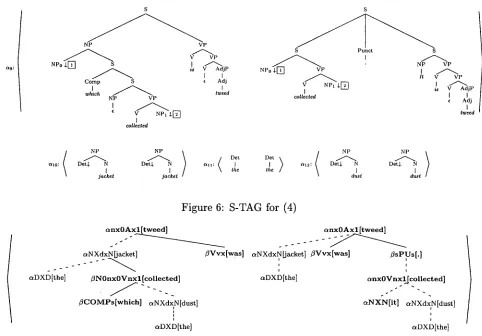
Tree pairs which could represent the elements in the m a p p i n g b e t w e e n (4a) and (4b) are given in Figure 6. It is clearly the case t h a t the trees in the tree pair c~9 are not elementary trees, in the same way that on esp~re que is not represented by a single elementary tree: in b o t h cases, such single elementary trees would violate the Con- dition on E l e m e n t a r y Tree Minimality (Frank, 1992). T h e tree pair a0 is the one t h a t captures the syntactic rearrangement in this paraphrase;
such a tree pair will b e t e r m e d the STRUCTURAL MAPPING PAIR (SMP). Taking as a basic set of trees the X T A G s t a n d a r d g r a m m a r of English (XTAG, 1995), the derivation tree pair for (4) would be as in Figure 7. 3 A p a r t from c~9, each tree in Figure 6 corresponds to an elementary object-level tree, as indicated by its label; the remaining labels, indicated in bold in the meta- level' derivation tree in Figure 7, correspond to the elementary object-level trees forming (~9, in much the same way t h a t on esp~re que is repre- sented by a s u b d e r i v a t i o n comprising an on tree s u b s t i t u t e d into an esp~re que tree.
Note that the nodes corresponding to the left tree of the S M P form two discontinuous groups, b u t these discontinuous groups are clearly re- lated. Dras (forthcoming) describes the condi- tions under which these discontinuous groupings are acceptable in paraphrase; these discontinu- ous groupings are t r e a t e d as a single block with
S L O T S connecting the groupings, whose fillers
must be of particular types. Fundamentally, however, the s t r u c t u r e is the same as for clitics: in one derivation tree the g r o u p e d elements are in one branch of the tree, and in the other they are in two separate branches with the possibility of an u n b o u n d e d a m o u n t of intervening mate- rial, as described below in Section 4.
4 M e t a - L e v e l S t r u c t u r e
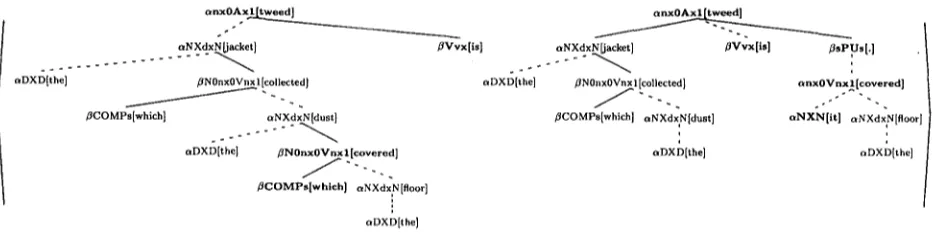
Example (5) illustrates w h y the paraphrase in (4) has the same difficulty as the clitic example in (3) when represented in S-TAG: because un- b o u n d e d intervening material can occur when p r o m o t i n g arbitrarily deeply e m b e d d e d relative clauses to sentence level, as indicated by Fig- ure 8, an isomorphism is not possible between derivation trees representing paraphrases such as (4) and (5). Again, the c o m p o n e n t trees of the S M P are in b o l d in Figure 8.
[image:4.612.99.251.66.134.2]S
NP
NPo ~ ' ~ ' ~ S
C o m p S
'
which
NP VP
,
I collected
VP
A
V vP
is V AdjP
I I
e Adj
I
tweed
S
S
NPo ~ ~ V P
V NP1 $['~
I collected
P u n c t
I S
NP VP
It V V P
is V AdjP
I I
Adj
I tweed
N P N P >
a l o : Det$ N Det$ N
I I
jacket jacket
D e t
a l l : t~e
NP D e t >
I C~12: Det$ N
the ]
dust
NP
A
Det$ N
t
d u s t
Figure 6: S-TAG for (4)
ocnxOAxl [tweed]
~DXD[the] /3N0nx0Vnxl[collected]
~COMPs[which] c~NXdxN[dust]
i
c~DXD[the]
3Vvx[was] ~NXdxN[jacket] ~Vvx[was] ~sPUs[.]
* i
t i
~ D X D [ t h e ] cmx0Vnxl^[collected]
s
c~NXN[it] aNXdx,N[dust]
t J
c~DXD[the]
Figure 7: Derivation tree pair for example (4) was tweed. The dust covered the
floor. 4
The paraphrase in (4) and in Figures 6 and 7, and other paraphrase examples, strongly sug- gest that these more complex mappings are not an aberration that can be dealt with by patch- ing measures such as bounded subderivation. It is clear that the meta level is fundamentally not just for establishing a one-to-one onto mapping between nodes; rather, it is also about defin- ing structures representing, for example, the
4The referring expression that is t h e subject of this second sentence has c h a n g e d from it in (4) to the dust
so t h e antecedent is clear. E n s u r i n g it is appropriately coreferent, by using t w o occurrences of the s a m e diacritic in t h e s a m e tree, necessitates a change in t h e properties of t h e f o r m a l i s m unrelated to t h e one discussed in this paper; see Dras (forthcoming). A s s u m e , for the purpose of this e x a m p l e , that t h e referring expression is fixed and given, as is the case w i t h it, rather than d e t e r m i n e d by c o i n d e x e d diacritics.
SMP at this meta level: in an isomorphism be- tween trees in Figure 8, it is necessary to re- gard the SMP components of each tree as a uni- tary substructure and map them to each other. The discontinuous groupings should form these substructures regardless of intervening material, and this is suggestive of TAG's EDL.
[image:5.612.73.555.67.403.2]...
y Nx¢~]
~DXDI, h0] ~ l [ : o ~ I ~ d J
/~COMPs[which] aNXdxN[dust]
aDXD[the] /~N0nx0Vnxl [covered]
aDXD[t he]
flVvx[~s] .. _ %~xdx~lNf~c~ ~Vvx[is] /~sPUs[.]
~DXD[the] ~N0nx0Vnx l[coliect ed] a n x O V n x l [covered]
~COMPs[which] aNXdxN[dust] aNXN[it] oNXdxN[floor]
~DXD[the] aDXD[the]
Figure 8: Derivation tree for example (5)
tively) single nodes.
To solve the problem with isomorphism, a meta- level grammar can be defined to specify the necessary substructures prior to mapping, with minimality conditions on what can be consid- ered acceptable discontinuity. Specifically, in this case, a TAG meta-level grammar can be defined, rather than the implicit CFG, because this captures the EDL well. The TAG yield function of Weir (1988) can then be applied to these derivation trees to get derived trees. This, of course, raises questions about effects on gen- erative capacity and other properties; these are dealt with in Section 5.
A procedure for automatically constructing a TAG meta-grammar is as follows in Construc- tion 1. The basic idea is that where the node bijection is still appropriate, the grammar re- tains its context free nature (by using single- level TAG trees composed by substitution, mim- icking CFG tree concatenation), but where EDL is required, multi-level TAG initial trees are defined, with TAG auxiliary trees for describ- ing the intervening material. These meta-level trees are then mapped appropriately; this cor- responds to a bijection of nodes at the meta- meta level. For (5), the meta-level grammar for the left projection then looks as in Figure 9, and for the right projection as in Figure 10. • Figure 11 contains the meta-meta-level trees, the tree pair that is the derivation of the meta level, where the mapping is a bijection between nodes. Adding unbounded material would then just be reflected in the meta-meta-level as a list of/3 nodes depending from the j315/j31s nodes in these trees.
The question may be asked, Why isn't it the case that the same effect will occur at the meta- meta level that required the meta-grammar in the first place, leading perhaps to an infinite (and useless) sequence? The intuition is that it is the meta-level, rather than anywhere 'higher', which is fundamentally the place to specify structure: the object level specifies the trees, and the meta level specifies the grouping or structure of these trees. Then the mapping takes place on these structures, rather than the object-level trees; hence the need for a grammar at the meta-level but not beyond.
C o n s t r u c t i o n 1 To build a TAG metagram- mar:
1. A n initial tree in the metagrammar is formed for each part of the derivation tree corresponding to the substructure repre- senting an SMP, including the slots so that a contiguous tree is formed. Any node that links these parts of the derivation tree to other subtrees in the derivation tree is also included, and becomes a substitution node in the metagrammar tree.
2. Auxiliary trees are formed corresponding to the parts of the derivation trees that are slot fillers along with the nodes in the discon- tinuous regions adjacent to the slots; one contiguous auxiliary tree is formed for each bounded sequence of slot fillers within each substructure. These trees also satisfy cer- tain minimality conditions.
Ot13: a n x 0 A x l
~NXdxN ~Vvx
a D X D ~N0nx0Vnxl
~ C O M P s aNXdxN$
a14: c~NXdxN I a D X D
J315: aNXdxN
a D X D ~N0nx0Vnxl
~ C O M P s a N X d x N ,
Figure 9: M e t a - g r a m m a r for (5a)
these single-level trees in the metagrammar marked for substitution if the corresponding nodes in the derivation tree have subtrees.
The minimality conditions in Step 2 of Con- struction 1 are in keeping with the idea of min- imality elsewhere in TAG (for example, Frank, 1992). T h e key condition is t h a t meta-level auxiliary trees are rooted in c~-labelled nodes, and have only ~-labelled nodes along the spine. The intuition here is t h a t slots (the nodes which meta-level auxiliary trees adjoin into) must be c~-labelled: fl-labelled trees would not need slots, as the substructure could instead be con- tinuous and the j3-1abelled trees would just ad- join in. So the meta-level auxiliary trees are rooted in c~-labelled trees; b u t they have only ~- labelled trees in the spine, as they aim to repre- sent the minimal a m o u n t of recursive material. Notwithstanding these conditions, the construc- tion is quite straightforward.
5 G e n e r a t i v e C a p a c i t y
Weir (1988) showed t h a t there is an infinite pro- gression of TAG-related formalisms, in genera- tive capacity between CFGs and indexed gram- mars. A formalism ~-i in the progression is de- fined by applying the TAG yield function to a derivation tree defined by a g r a m m a r formalism
~16; cmx0Axl
~NXdxN ~Vvx /~sPUs
I I
c~DXD aNXdxN
c~NXdxN c~NXdxN$
cqT: aNXdxN I a D X D
aNXdxN
c~DXD ~N0nx0Vnxl
~ C O M P s c~NXdxN,
Figure 10: Meta-grammar for (5b)
0t14 ~15 a17 ~ 1 8 /
Figure 11: Derivation tree pair for Fig 3
5~i_1; the generative capacity of ~i is a superset of ~'i-1- T h u s using a TAG meta-grammar, as described in Section 4, would suggest t h a t the generative capacity of the object-level formal- ism would necessarily have been increased over that of TAG.
However, there is a regular form for TAGs (Rogers, 1994), such that the trees of TAGs in this regular form are local sets; t h a t is, they are context free. T h e meta-level TAG built by Construction 1 with the appropriate conditions on slots is in this regular form. A proof of this is in Dras (forthcoming); a sketch is as follows. If adjunction may not occur along the spine of another auxiliary tree, the g r a m m a r is in regu- lar form. This kind of adjunction does not oc- cur under Construction 1 because all meta-level auxiliary trees are rooted in c~-labelled trees (object-level auxiliary trees), while their spines consist only of p-labelled trees (object-level ini- tial trees).
[image:7.612.334.555.61.368.2] [image:7.612.111.287.63.298.2]a TAG.
6 C o n c l u s i o n
In principle, a meta-grammar is desirable, as it specifies substructures at a meta level, which is necessary when operations are carried out that are applied at this meta level. In a practical ap- plication, it solves problems in one such formal- ism, S-TAG, when used for paraphrase or trans- lation, as outlined by Shieber (1994). Moreover, the formalism remains fundamentally the same, in specifying mappings between two grammars of restricted generative capacity; and in cases where this is important, it is possible to avoid changing the generative capacity of the S-TAG formalism in applying this meta-grammar. Currently this revised version of the S-TAG for- malism is used as the low-level representation in the Reluctant Paraphrasing framework of Dras (1998; forthcoming). It is likely to also be use- ful in representations for machine translation between languages that are structurally more dissimilar than English and French, and hence more in need of structural definition of object- level constructs; exploring this is future work.
R e f e r e n c e s
Abeill@, Anne, Yves Schabes and Aravind Joshi. 1990. Using Lexicalized TAGs for Machine Trans- lation. Proceedings of the 13th International Con-
ference on Computational Linguistics, 1-6.
Dras, Mark. 1997. Representing Paraphrases Using S-TAGs. Proceedings of the 35th Meeting of the As-
sociation for Computational Linguistics, 516-518.
Dras, Mark. 1998. Search in Constraint-Based Paraphrasing. Natural Language Processing and In-
dustrial Applications (NLPq-IA98), 213-219.
Dras, Mark. forthcoming. Tree Adjoining Grammar
and the Reluctant Paraphrasing of Text. PhD thesis,
Macquarie University, Australia.
Joshi, Aravind and Yves Schabes. 1996. Tree- Adjoining Grammars. In Grzegorz Rozenberg and • Arto Salomaa (eds.), Handbook of Formal Lan-
guages, Vol 3, 69-123. Springer-Verlag. New York,
NY.
Kahane, Sylvain, Alexis Nasr and Owen Ram- bow. 1998. Pseudo-Projectivity: A Polynomi- ally Parsable Non-Projective Dependency Gram- mar. Proceedings of the 36th Annual Meeting of the
Association for Computational Linguistics, 646-652.
Palmer, Martha, Owen Rainbow and Alexis Nasr. 1998. Rapid Prototyping of Domain-Specific Ma-
chine Translation Systems. AMTA-98, Langhorne, PA.
Rogers, James. 1994. Capturing CFLs with Tree Adjoining Grammars. Proceedings of the 32nd Meet- ing of the Association for Computational Linguis-
tics, 155-162.
Schabes, Yves and Stuart Shieber. 1994. An Al- ternative Conception of Tree-Adjoining Derivation.
Computational Linguistics, 20(1): 91-124.
Shieber, Stuart. 1985. Evidence against the context- freeness of natural language. Linguistics and Philos-
ophy, 8, 333-343.
Shieber, Stuart and Yves Schabes. 1990. Syn- chronous Tree-Adjoining Grammars. Proceedings of the 13th International Conference on Computational
Linguistics, 253-258.
Shieber, Stuart. 1994. Restricting the Weak- Generative Capacity of Synchronous Tree-Adjoining Grammars. Computational Intelligence, 10(4), 371- 386.
Weir, David. 1988. Characterizing Mildly Context-
Sensitive Grammar Formalisms. PhD thesis, Uni-
versity of Pennsylvania.
XTAG. 1995. A Lexicalized Tree Adjoining Gram-
mar for English. Technical Report IRCS95-03, Uni-