Munich Personal RePEc Archive
Dynamic Externalities and Regional
Development: The case of Tunisia
DRIDI, Manel
University of Tunis El Manar, Tunisia, Faculty of Economics and
Management, Tunis, Tunisia, UAQUAP Research Unit
1 March 2015
Online at
https://mpra.ub.uni-muenchen.de/66988/
1
Dynamic Externalities and Regional Development: The case of Tunisia
Dridi Manel
1[email protected]
Faculty of Economics and Management, Tunis, Tunisia.
Abstract - In this paper we seek to estimate the impact of local economic structure on the
regional employment growth of 8 mainstream industry sectors in 24 local areas of Tunisia
between 2000 and 2009. By referring to new economic geography and the empirical
approaches dealing with agglomeration economies and dynamic externalities, we show that
regional employment growth in industrial sector in Tunisia is driven mainly by externalities
related to specialization while diversity do not seem to be important determinants of
regional employment growth. Moreover we find that local competition have a positive
significant effect on local employment growth.
Keywords: regional growth, dynamic externalities, industrial structure, regional integration,
JEL Classification: R11, R12, O47.
1
2
Dynamic Externalities and Regional Development: The case of Tunisia
Introduction
Over the last decade, Tunisia has achieved a 5% average annual growth thanks to improved
total factor productivity (TFP), despite a relatively low diversification of the economic basis, the
relatively rapid pace of growth in external demand, and the crucial role played by domestic
demand, especially consumption. However, investment in Tunisia remains at a relatively low
level of nearly 22% of GDP in 2013 against nearly 25% in 2003 and its contribution to economic
growth is limited. Moreover, despite the economic reforms implemented in the 80s
accompanied by the business climate cleansing policies, the level of private investment remains
insufficient does not exceed 14% of GDP and the share of private investment in total investment
did not go beyond 60% over the past two decades. In addition to the relatively low level of
investment in Tunisia, the regional distribution shows a wide disparity between the coastal and
the inland areas. The coastal regions (Northeast and Central East) which create the most jobs
provide most of the public and private investment while the northwestern, the midwestern
and the southwestern regions with higher unemployment rates, have the lowest private and
public investment shares. The high level of public investment in the areas of the Northeast and
the Central East seems to explain, albeit partially, the attraction of private investments in these
regions and thus the ability of the latter to create more jobs than the rest of the country. An
inherent and obvious relationship seems to enclave some areas in underdevelopment and
inequality.
Yet, since the country's independence in 1956, the issue of reducing inequalities, including the
coast-inland regional inequalities, was considered as one of the key objectives of economic
growth and national development. Henceforth, the economic strategies implemented by the
Tunisian authorities were supposed to establish and boost the economy of the whole country,
and drive effective integrated development by fostering public investment in the productive
activities in parts of the inland areas. The sugar-processing plant in Beja in the northwest and
the paper-unit in Kasserine in the central west dating from the 60’s decade reflect the will of the
government to shrink the disparities between the coast and the inland regions. However, these
initiatives have not yielded the expected outcome and the regional imbalance has even
worsened. Thus the government was compelled to rethink its development programs so as to
hammer out a genuine regional policy to create an economic environment likely to bring about
3
development in areas but without concrete results2. Thus, the inventory of regional
development in Tunisia highlights acute structural imbalances inherited by the previous
development policies, and the long-term regional inequalities that account for the current
economic and social situation of the country. The regional disparities due to the social
instability factors have caused ever-increasing migration to the large urban areas and it seems
that the dynamic externalities have not yielded the desired effect on the development of the
inland regions that have remained isolated in their traditional economic role. In contrast, they
have been deepened by rising unemployment that particularly affects the youth, the graduates
as well as the women. Thus, the14 January 2011 Revolution, expressing the need for freedom
and democracy bore the expectations of the majority of the Tunisian people in terms of
mitigating regional and social inequalities and improving their living standard.
This research seeks to examine the importance of dynamic externalities in order to account for
the economic growth achieved in the different regions in Tunisia over the 2001- 2009 period
while retaining a level of spatial and sectoral disaggregation (24 governorates and 8 industrial
sectors). Indeed we propose to study the relationship occurring between, the dynamic
externalities and the local economic growth in the different regions in Tunisia with reference to
the pioneering work of Glaeser et al. (1992) and Henderson et al. (1995). The growth of the
economic sectors within a locality is partly accounted for by the externalities’ indicators
stemming from specialization (MAR- Marshall, Arrow, Romer type externality ), diversity
(Jacobs type externality) and those generated by the local competition (Porter - type
externality). The objective is to find out which type of externalities has benefited the various
regions in Tunisia. Because of the absence of a growth indicator of regional GDP in Tunisia, we
have retained, as many empirical studies, the growth rate of the regional employment as a
proxy for the regional growth.
The paper is outlined in four main parts. In the first part, we review the main
theoretical and empirical works underlining the relationship between the dynamic
externalities and local economic growth. In the second part, we briefly present the state
of the regional disparities in Tunisia. While, in the third part of the article we shall
specify the model to be estimated and present the selected variables and indicators.
Eventually, the fourth part is dedicated to the presentation of the main findings.
2
4
1. Dynamic Externalities and local economic growth: theoretical and empirical facts
Local or regional economic development emerged, as a concept in the 60s following the Great
Practical Plan aiming at upgrading the regions left behind. This process is explained through
various indexes and variables characterizing the local economic structure used also to
investigate the evolution of spatial distribution patterns of the economic activities. The
increasing inequalities in the living conditions and access to resources show the importance of
mobility factor in the agglomeration process. As a matter of fact, developed areas attract the
business organizations seeking new investment opportunities; indeed, the companies are ready
to pool their activities, forming a "spatial cluster". We have already revealed a relationship
between the location of firms and the average size of plants. This spatial concentration is
bolstered by scale returns allowing companies to reduce their production costs. Besides, the
firms established in these areas take advantage of clustering with other firms in the same sector
which raising a positive effect of localization economies. Furthermore, this leads to an
inter-sectoral positive effect of urbanization economies which promotes economic growth.
This urban dynamic is ensured by the optimal use of local resources in a more efficient
productive system. New approaches based on economic geography and an international
trade theory put forward by Krugman (1991), have been well developed, to further account
for the interdependence between the size of plants and concentration of firms. These models
provide an analytical framework for the description of a regional or local economy in a
situation of integration and help to clarify the causes of local development. They particularly
emphasize the importance of the intensity of agglomeration forces, also influenced by both
the size of the local economy and the scale of competition. They explained the location
choices of firms and agglomeration process by the coexistence of increasing- returns and
transportation costs in an imperfect competition (monopolistic competition). The spatial
polarization of the economic activities is due to the positive externalities’ effect based upon
the market interactions.
A. Marshall, 1920 distinguish between two types of scale. If the scale returns are internal to
the firms, the increasing returns generate productivity gains and are therefore linked to the
firms’ development. The second type refers to the external economies that benefit all firms from clustering in the same sector. These external economies, generating inter-sectoral
positive effects are perceived as a geographical phenomenon connected to urbanization and
promotes the economic growth. These localization and urbanization economies are related
to specialization and diversity, and having a significant effect on the local economic
5
Drawing on the work of Arrow (1962) who lays down through "The involvement of learning by
doing", the notion of productivity- gains associated with the accumulation of physical capital
and learning through experience, and Romer’s work (1986) conducted on endogenous growth
which emphasizes the importance of increasing returns generated by the externalities
associated with the accumulation of capital and its impact on long-term growth. These
externalities show several features and reflect the benefits associated with increasing returns not
only of the accumulation of human capital, the physical capital gain in productivity, innovation,
research and development (R & D) but also of the spatial dynamics’ externalities either at the
local (inter and intra-industry) or international level via foreign trade, FDI flows or the
globalization of R & D activities3.
Inspired by the pioneering theoretical work of (Marshall (1890), Arrow (1962) and Romer
(1986)), Gleaser E. et al. (1992) seek to analyze the causal relationships between the local
economic structure and local employment growth, called M.A.R type with reference to
Marshall, Arrow and Romer. The latter refer to localization economies derived from the
exchange of knowledge and learning from specialization. These agglomeration economies are
intra-sectoral; by definition they are "external economies to the firm but internal to the industry
located in a given metropolitan area" (M. CATIN 1994). By contrast, Jacobs (1969) underlines the
evidence of the diversity effect in the process of local economic development; thus reflecting the
urbanization economies. These inter-sectoral economies (of Jacobs’ type) are defined as
"external to the firm and outside the industry to which the firm belongs" (M. CATIN 1994), and
they are also related to the average plants’ size. They imply the presence of a high number of
firms in the same environment and an inter-sectoral positive agglomeration effect resulting
from the concentration of populations which are likely to boost the suppliers’ business in the
area.
Beside the specialization and diversification effects, Porter (1990) show that local growth also
depends on the local competition. Glaeser et al. (1992), ascertain that the presence of a large
number of companies allows productivity gains. These intra-sectoral agglomeration economies
called "Porter type externalities" depend on the size of the local market and the number of firms
operating in the industrial sector.
Although several academic studies have investigated the determinants of local economic
growth, the issue of dynamic externalities has drawn little attention despite its significant
implications on the regional growth. Some authors tried to explain the spatial location of
activities through the impact of the localization and urbanization economies on local economic
3
6
development. Mainly drawing on the work of Glaeser et al. (1992), they raised the issue of the
nature of local externalities through a MAR type specialization, a Jacobs type industrial
diversity index, and an index of local competition which provides data on the market structure.
Glaeser et al. (1992), while measuring the employment growth in US cities, showed that the
sectoral diversity and local competition are growth drivers, while specialization inhibits
growth. This corroborates the hypothesis laid down by Jacobs and Porter and rejects that of
MAR. The same assumption was extended, and was taken over by Henderson et al. (1995), who
in turn found that specialization allows growth in the low added-value activities and traditional
industries, while industrial diversity, promotes employment growth in the high-tech industries.
Glaeser et al. (1992) and Henderson et al. (1995) also allowed the application of their methods in
other countries. By reproducing the same methodology to assess the employment growth in the
industrial sectors of the French regions, Combes (2000) found moderate unfavorable results.
Indeed, the local competition negatively affects the growth of the industrial sectors as it has a
positive impact on some service sectors. Specialization such as diversity is significant, but has a
negative effect on the growth of employment for most of the industrial sectors subject to an
extensive restructuring as they have a positive impact on the service sectors.
By measuring the local employment growth in the Spanish industrial sectors, De Lucio and al.
(1996) found results matching those of Glaeser et al. (1992). Nevertheless, De Lucio and al.
(2002) tried a more adapted approach using labor productivity and value-added growth instead
of employment growth as a measurement. Their findings therefore reveal that high
specialization promotes productivity growth.
Henceforth, the MAR externalities have a positive effect, while those of Jacobs and Porter did
not occur. This same method is reproduced by Henderson (2003). The latter uses the total factor
productivity (TFP) as growth measurement in the US metropolitan cities. The results show that
the geographic concentration of firms belonging to the high-tech sector is more likely to boost
productivity, and the average size of the plants is involved only with a minor role. This same
method is reproduced by Catin (1991), who seeks to explain the TFP growth in the French
regional industries. He was able to show that the decomposition of regional productivity in
terms of productivity gains induced by the scale economies and autonomous productivity gains
are particularly significant and have very different disparities. The agglomeration economies
that provide the urban areas drive large plants to cluster within narrow geographical areas such
as labor systems. However, the low –labor- cost, the low-added value industries, and the search
for scale economies drive small firms to relocate within wider areas. Batisse (2002a, b) tests the
7
provinces. However when a variable discriminating the regions is introduced into the
regression, results are thereby well-balanced showing that diversity implies an inter-sectoral
positive effect on the growth of sectors that are located in the more developed coastal provinces
rather than in the inland provinces, unlike the high initial specialization which has no effect.
The survey carried out by Maurice Catin et al. (2007) on Morocco, reveals that the dynamic
externalities are characterized by sectoral specificities. Some sectors in a given period are more
sensitive to the specialization and the local competition effects than others. The empirical
studies failed to establish a general explanatory framework. The heterogeneous results are
mainly due to the different specificity of the cases studied and the different assessment
techniques used as well as the difficulty in using data series at the micro-spatial level. We may
retain Bun and Makhloufi’s study (2002) applied on the Moroccan case in a very limited spatial
area. As a matter of fact, the interactions between the activities are exercised at the level of the
province leading to external economies effects, thus indicating the importance of space
dimension. A too small territory implies the consideration of the spillover effects, mainly the
externalities’ effects on the neighboring regions.
Despite the fact that the research dealing with the relationship between the industrial structure
and the sectoral growth in the developing countries are relatively scarce, the empirical literature
allowed us to note that the countries rated at a certain level of development are more sensitive
to externalities (Jacobs and Porter).However, the economies of the less developed countries are
more sensitive to the MAR externalities .Besides, the local concentration of industries is often
linked to a specialization in the low added- value industries. Therefore, an economic growth in
the region might lead to a diversification of the industrial sector. Indeed, an urban maturity and
even a specific stage of development, as well as some phenomena occur in the urban
mainstream industrial poles, leading to the relocation of the low-value-added industries
towards the less populated regions. Nonetheless, the high-tech industries which are less
sensitive to the production costs and which benefit from the physical capital accumulation
thrive in the less developed areas.
2. Spatial disparity and regional inequalities in Tunisia.
A simple analysis of the economic geography of Tunisia highlights a contrast between the
coastal Tunisia thriving with industry, services and tourism and the deeply rural inland of
Tunisia (Dlala, 1999; Belhedi, 1996). The coastal regions account for 90% of the overall
employment and more than 80% of jobs in urban regions. Moreover, the most dynamic centers
are located in the northern and central coastal regions. In fact, the coastal regions which
8
latter increases with a rate that is higher than the national average as more than 63% of the
additional population dwell on the shoreline regions. This coastal space clusters almost half of
the farming population of the country. It accounts for 80.4% of the fruit-production, 72.6% of
the vegetables’ production, 30%of cereals, 80% of the citrus and grapes’ output, and more than 55% of the livestock value and the third of the olive production.
Likewise, the coastal areas account for 85% of the business companies operating in all the
sectors. Indeed 99% of the companies operate in the, mechanical, electrical, and chemical
sectors, along with 83% of the building materials’ plants and more than 80% of the companies
specialized in textile and clothing are established in the coastal regions.
Also, it should be noted that the imbalances between the regions are obvious in terms of public
investment. Indeed, the regional distribution shows a strong disparity between the coast and
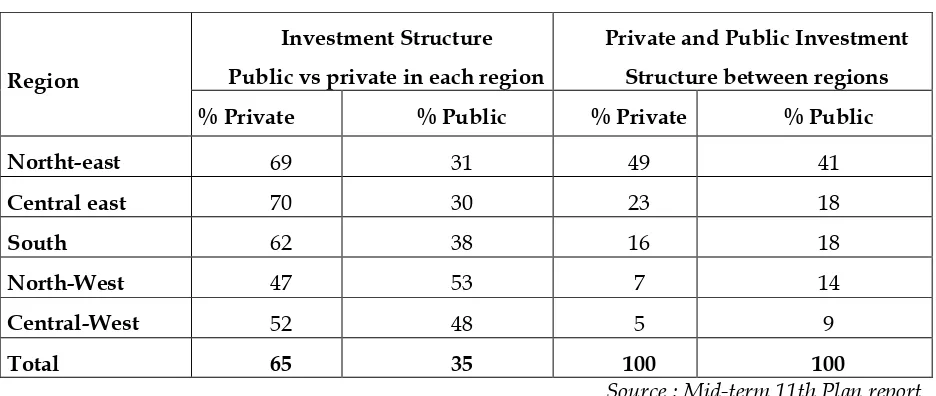
the inland areas of the country (Table 1) as the coastal regions (Northeast and Central East)
which create the most jobs, hold the biggest public and private investment share while the
Northwest and the Central West regions where the unemployment rates are the highest, have
[image:9.595.70.538.396.594.2]the lowest private and public investment shares.
Table 1: Private and public Investment Structure in the regions
Region
Investment Structure
Public vs private in each region
Private and Public Investment
Structure between regions
% Private % Public % Private % Public
Northt-east 69 31 49 41
Central east 70 30 23 18
South 62 38 16 18
North-West 47 53 7 14
Central-West 52 48 5 9
Total 65 35 100 100
Source : Mid-term 11th Plan report
Thus, the relative lagging of the regions of the inland areas compared to the coastal ones is
accounted for by the spatial inequalities in terms of infrastructure, healthcare and education
despite being provided free of charge in all the regions. For example, the number of hospital
beds and the number of physicians per 1,000 inhabitants is significantly lower in the west and
the south of the country compared to the major urban centers of the East. The high level of
public investment in the areas of the Northeast and the Central East seems to explain, albeit
partially, the attraction of private investments in these regions and thus the ability of the latter
to create more jobs than the rest of the country. These disparities made the underprivileged
9
Henceforth, the great West does not benefit from sufficient public investment, which severely
hampers private investment in the absence of a public economic drive. The effect is immediate
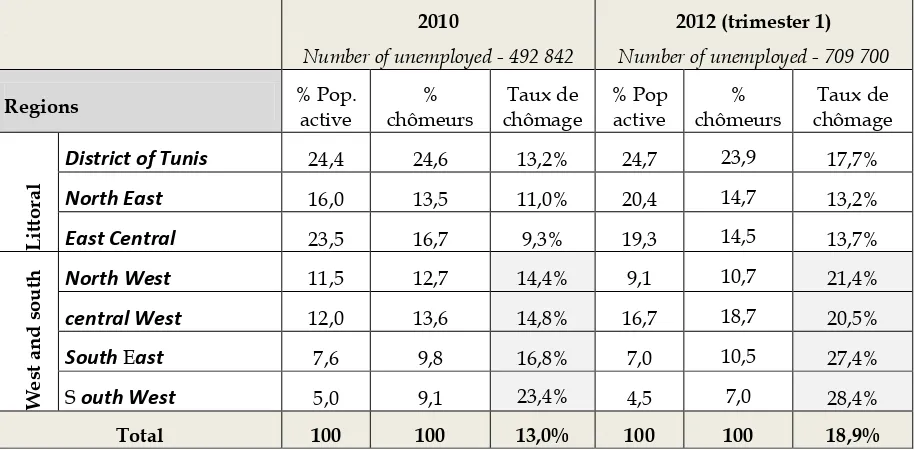
on employment, as the unemployment rates are well above the average (Appendix 1, Table 1
and 2) and a mass exodus occurs mainly on the coast.
So, in Tunisia the economic development generated increasing spatial inequalities between the
developed and rich coast and the impoverished inland and entire regions in Tunisia were even
excluded from the national development process which is built mainly on the coast. All the
spillovers and all the expected and promised positive forms of external economies have only
widened this gap between the regions. Indeed, whole territories of the inland remain locked in
their traditional economic vocation.
3. Estimation of the effects of dynamic externalities on regional growth in Tunisia.
Our research focuses on the regional growth of the industrial sector in Tunisia between 2001
and 2009 and seeks to estimate the impact of dynamic externalities on regional employment
growth in Tunisia The objective is to find out which type of externalities
(MAR-JACOB-PORTER) have benefited the different regions in Tunisia and to what extent the regional
agglomeration economies and the initial industrial structure helped explain the regional growth
in Tunisia.
In the absence of a of regional GDP measurement in Tunisia, and referring to Combes (2000),
we use the growth of employment as a proxy for regional growth. The data are picked out from
the INS statistics of the (The National Statistics Institute) and APII (The Industry Promotion and
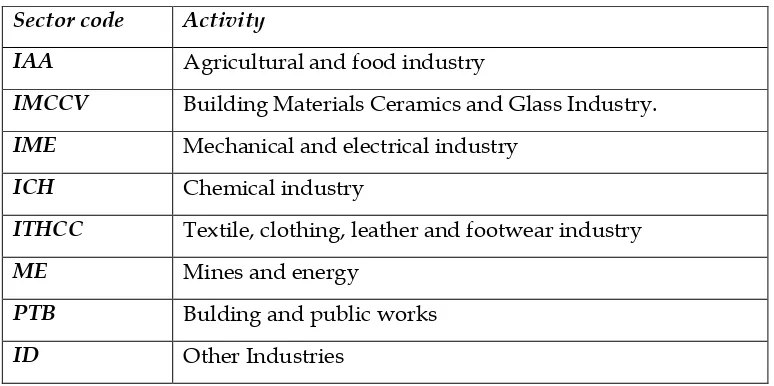
Innovation Agency) and cover eight major sectors of the industry in the 24 governorates of
Tunisia (Appendix 2). The sample includes a total of 192 observations.
3.1. The model
The model that we seek to estimate should reflect the sectoral heterogeneity variables in the
context of a relationship between the local industrial structure and the employment growth. To
do so, we propose to specify a heterogeneous model parameters, which exploits the whole
dimension of our data. Thus, the model used to test the effect of the characteristics of the local
economy on the regional employment growth of a sector s of region r is given by:
Ln
=
10
The explained variable is the growth of employment over the period 2001-2009 and the
explanatory variables express the different types of externalities of MAR- Jacob Porter type,
and, respectively related to specialization (Spe), diversity (Div) and competition (Conc ) at the
beginning of the period (year 2001). In addition to the externalities’ indicators, we introduce the
control variables expressing certain regional characteristics such as the density variable (den)
which expresses the concentration of employment in a given region and the regional sectoral
specificities such as the initial conditions of a sector in a given region that draws the industry's
ability to grow given its initial position and which are expressed by the variable (Condin).
3.2. The variables and indicators used
For setting all the dependent and explanatory variables for each sector and in each area, and in
order to avoid heterogeneity and selectivity problems, we apply the Combes Standardization
Approach (2000) by dividing, for each sector, the values they take at the aggregate level. This
process is likely to make the variables comparable from one sector to another.
The index of the sector's employment growth:
The explained variable is expressed by the index of the sector's employment growth in region r
(governorate) reported to the index of employment growth in the same sector at the national
level. Employment in the sector s, in region r in year t is stated as . The dependent
variable is thus standardized by its value taken at the aggregate level of Tunisia that is:
= ; s = 1....8 and r = 1....24
The specialization index (SPE):
This is the type of indicator which enables to keep the MAR -type externalities. It is measured
for each sector s by a specialization index of the region (governorate) r in this sector. It is
approximated by the classic ratio of the share of the sector in local employment in the region r
standardized by the share of that sector in the national employment
SPE
s,r =; s = 1....8 and r = 1....24
The sectoral diversity indicator (DIV):
This is the indicator that provides information on the JACOB type of externalities expressing the
11
Generally, the diversity index is measured by the inverse of the index of industry concentration.
The more the industry is concentrated, the less it is diversified. Thus, the sectoral diversity
faced on average by a firm is measured by the inverse of the Herfindahl index (Hr) related to
the sectoral employment concentration calculated on all the sectors except the sector involved,
which is standardized by the same indicator gauged at the national level. The Herfindhal index
for each sector s in each region (governorate) r is yielded by:
whereas the index Herfindhal for a sector s at the national level is given by.
=
; s = 1....8After reversing this index at the regional and national level, we obtain the standardized
diversity indicator:
=
; s = 1....8 and r = 1....24
The local competition indicator (CONCU):
To measure the sectoral concentration, we often recommended to use the Herfindahl index
which implies calculating the market share of each company in the sector considered with
reference to its turnover or employment provision as proxies of the size. However, we do not
have data on individual companies operating in the different sectors and regions involved
making it impossible to retain this indicator. We opted for an approximate index provided by
the ratio of the number of firms in a given sector related to employment in the sector. Therefore,
for a given region, an average high ratio compared to the national average ration expresses a
relatively high level of competition in the sector of the region studied.
=
; s = 1....8 and r = 1....24Other variables that reflect the local features of the industrial sector have been introduced in the
assessment study as control variables. These include indicators that reflect the initial conditions
12 Initial conditions Index (Condin):
With reference to the research conducted by Glaeser et al. (1992) and Henderson et al. (1995), we
use the initial level of the dependent variable, i.e., employment at the beginning of the period.
This indicator can provide information on the existence or no-existence of a regional
convergence process in this area in the period of analysis; This indicator is calculated as the
ratio of the initial level of employment in the sector s in region r compared to the population of
the region surveyed:
; s = 1....8 and r = 1....24
Urbanization economies’ Indicator (Den):
Under the new economic geography theory, growth would tend to be higher where production
is already concentrated; i.e., where demand stemming from the consumer-workforce is already
initially concentrated. To keep these effects, we use an employment density index as the local
economy size indicator
; r = 1....24
Where is the area of the district in square kilometers.
4. The results.
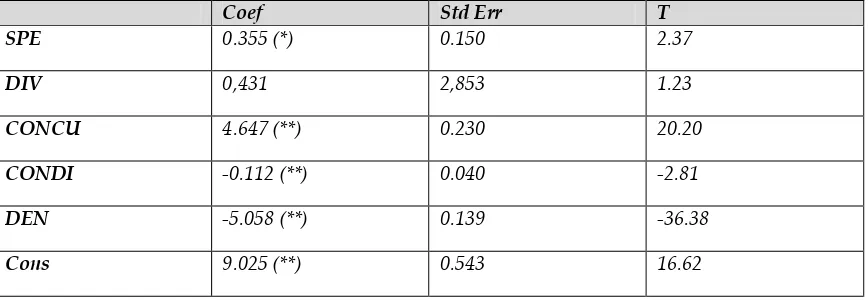
The estimation results (Table 2) show a significant effect of all the variables except the diversity
indicator. This corroborates the importance of the MAR and Porter type externalities for the
regional growth in Tunisia while the Jacob type externalities related to industrial diversification
[image:13.595.83.517.597.747.2]are not significant.
Table 2: Estimation Results - Industrial Structure and Regional Growth
Coef Std Err T
SPE 0.355 (*) 0.150 2.37
DIV 0,431 2,853 1.23
CONCU 4.647 (**) 0.230 20.20
CONDI -0.112 (**) 0.040 -2.81
DEN -5.058 (**) 0.139 -36.38
Cons 9.025 (**) 0.543 16.62
13
Unlike the results yielded by Karray Z. and Driss S. (2009), the specialization of the industrial
sector is a key factor for the regional growth in Tunisia and the intra-industrial externalities,
mainly on the coastal regions have boosted the growth of employment as in the case of
Morocco (Catin et al. (2007))
These externalities are accounted for by primarily a common-data base in some industries,
concentration and the availability of skilled labor in the region, etc .Also, it is worth noting that
these intra-industrial externalities are strengthened by the competitive effects between the small
firms established in low added value sectors where competitiveness is driven mainly by low
prices through - wage –cost cutting.
However, unlike the results yieded by Karray Z. and Driss S. (2009) for the Tunisian case and
those of Catin et al. (2007), for the case of Morocco, the Jacobs type externalities associated with
the diversification of the economic activities in industrial sector in the regions are not
significant. This difference in our findings particularly with respect to those of Karray Z. and
Driss S. (2009), both regarding the effect of specialization as well as the effect of the
diversification may be explained on the one hand, by the lapse of time of the retained period
for the estimation of the externalities’ effects on the regional growth in Tunisia and the
difference of the indicators used to measure diversification, on the other. Indeed, Karray Z. and
Driss S. (2009), consider a 5 year- period for gauging the external effects on the regional
growth between 2000 and 2005 and retain the year 2000 as reference year which we think is a
too short period to assess the importance of externalities that usually occur in the medium- long
term, while we retain a relatively longer period.
Furthermore, for setting the externalities indicators, the authors use the (2000) Combes’
approach by standardizing the indicators for each sector by the values they take at the national
level and to avoid the problems of selectivity and heterogeneity. However, the authors have not
applied this method for the Jacobs-type externalities associated with diversification which
explains a priori the difference with our results since we completed the standardization of all
the indicators including the endogenous variable which expresses employment growth.
Thus, it seems that the MAR type externalities are the most significant variables for the growth
of employment in Tunisia. This growth is mainly driven by foreign direct investment in the
manufacturing sector that is geared primarily towards exports, and which is heavily
concentrated on the coast in the sub-contracting activities or low-value and low-cost
14
Indeed, the dynamic of industrial -job creation in Tunisia over the last twenty years is the result
of the productive restructuring policies since the free trade agreement with Europe in 1995. The
upgrading strategy on the one hand and the pricing policy on the other aimed at improving the
competitiveness of the traditional sectors and fostered the emergence of new sectors so as to
meet the European demand and have transformed the industrial structure.
The data show (Table 2) that it is rather the exporting companies that perform best in job
creation. In fact, the totally -exporting companies account for nearly 50% of the manufacturing
companies, which are mainly characterized by a significant participation of the foreign capital
and which overwhelmingly contribute up to 65% in the creation of industrial jobs most of
which are created in the textile and clothing sector (ITHC 35.6%) and the sector of electrical and
electronic industry (EEI 13.3%).
Besides, these off-shore enterprises are weakly integrated into the local economy as they are
positioned in lower -cost assembly operations and outsourcing . The inter-sectoral externalities’
effects associated with the Jacobs type externalities are almost naught since these companies are
not supplied by the local businesses. The raw materials and the semi-end products are imported
under the temporary import regulations to be re-exported after assembly in the subcontracting
factories and offshore companies operating in Tunisia.
Tableau 3 Off-shoring and job creation in Tunisia
SECTORE Off- shore entreprises Off-shore employment Average employment in total industry in the sector in total industry in the sector Off shore On
shore Total
IAA 3,1% 17,3% 3,3% 24,2% 280 71 206
ITH 29,3% 84,1% 35,6% 91,0% 106 55 98
ICC 3,8% 75,0% 5,6% 92,0% 66 53 55
ICH 2,1% 23,6% 3,5% 45,4% 148 55 77
IMCCV 0,5% 6,2% 0,2% 3,6% 71 56 61
IM M 3,1% 30,2% 2,6% 35,2% 92 60 66
IEE 4,1% 64,5% 13,3% 87,7% 129 33 105
ID 1,6% 18,4% 1,1% 20,1% 40 50 46
TOTAL 47,6% 65,2% 119 58 87
15
Likewise , although the policy of openness has helped improve productivity, it did not result in
greater export diversification . Figure 1 shows that the index of diversification in Tunisia
remains relatively high and reflects a product-exporting structure which is still divergent
compared to that of the developed countries. Furthermore, the exports structure in Tunisia is
characterized by a relatively high concentration level (Figure 2).
As a matter of fact, although the concentration index4 recorded a steady decline since l995, it
remains at a higher level than that of Turkey and the developed countries. This is mainly due to
the specialization of foreign direct investment and the industrial sectors in outsourcing low-
cost business diverted to the European market.
Author’s processing - UNCTAD DATABASE2012
Finally, we note that the effects of the selected control variables, both the density of
employment in the region and the initial conditions are significant and negative. In Tunisia, the
high density of industrial employment often results in urban infrastructure congestion and the
saturation of the industrial areas generate congestion effects limiting employment growth.
Moreover, for the effect of the initial conditions, approximated by the level of employment at
the beginning of the period, it seems that the governorates which initially had a low level of
employment have witnessed in the considered period the highest growth rates. The hypothesis
4
The concentration index, also called Herfindal-Hirshman Index Measures the market-concentration degree.
16
of convergence in employment levels seems to be confirmed for the case of the governorates in
Tunisia between 2001 and 2009 but the coefficient is relatively low as in the case of Morocco
(Catin et al. (2007).
Indeed, the imbalances between the coast and the inland areas are so deep that they could not
be significantly reduced over the period although the model can highlight convergence effects
bearing in mind that unemployment in Tunisia hides a regional disparity reflecting the role that
space plays in increasing the inequality between the jobless categories. To illustrate the
difference of nearly 14.7 points between the region with the lowest unemployment rate (Central
13.7% in 2012) and the region with the highest unemployment rate (South West 28.4% in 2012)
plainly proves the scale of the regional imbalance.
These disparities are more striking by comparing the unemployment rates according to the
residential environment showing that in the rural areas the job-opportunities are more scarce
than in the urban areas. Beside the regional disparities and the overall unemployment rate, the
inland regions are characterized by a very low youth-employability in general and especially
among the university graduates. Indeed, the issue of unemployment affects the young people
aged between (20-30ans) and particularly those of the inland regions.
Indeed, the graduates’ unemployment rate exceeds 30% in the inland regions with a 42% ceiling in the Governorate of Gafsa followed by Jendouba (36.3%), Kasserine (35.9%) and Siliana
(35.1%), while it is only 13.8% in the district of Tunis and nearly 20% in the north east and east
centre. These inequalities are accuentuated in the rural areas and reach alarming figures in the
governorates of Siliana (50.8%) and Kasserine (49.7%).
CONCLUSION.
The empirical model that we estimated in the framework of the research conducted on
dynamic externalities and regional development and initiated by Glaeser et al. (1992) shows
that the industrial development in the regions in Tunisia has been fostered by their initial
productive specializations (MAR externalities) while the externalities associated with the
diversification of the industrial sectors (Jacobs externalities) are not significant for the growth
of industrial employment. Indeed, the firms which are mostly small- size and specialized
mainly in the low value-added activities in the field of low- cost outsourcing and geared
towards exports to Europe have generated employment in the specialized industrial areas
which are concentrated on the coastal regions. In some activities, industrial development,
notwithstanding its low value, could be promoted through local competition (Porter- type
17
reflects the dualistic model between the offshore system mainly focused on the coastline
which is very dynamic in exporting to Europe and driven by foreign capital and the on-shore
system which id disconnected from the dynamic of international markets that characterizes
the majority of the companies operating in the inland areas. In addition, the positioning of
the off shore in the low-cost outsourcing offers no opportunity to integrate into the local
economy. However, the integration of the on-shore and off-shore sectors especially in the
18
BIBLIOGRAPHY
AMARA M ; 2010. "Inégalités spatiales et développement local en Tunisie", Thèse de Doctorat, Paris I
Panthéon – Sorbonne, 2010.
BATISSE C., 2002a, "Dynamic Externalities and Local Growth: A Panel Data Analysis Applied to
Chinese Provinces", China Economic Review, n°13, pp. 231–251.
BATISSE C., 2002b, "Structure industrielle et croissance locale en République Populaire de Chine",
Région et Développement, n° 16, pp85-110.
BELHEDI A, 1996. "Développement régional, rural, local", Cahiers du CERES, TUNIS, 1996.
BELHEDI A, 1998. "Quelques aspects du développement régional et local en Tunisie", Cahiers du CERES,
TUNIS, 1998.
BUN J.G., MAKHLOUFI A., 2002, "Dynamic Externalities, Local Industrial Structure and Economic
Development: Panel Data Evidence for Morocco", 10th International Conference on Panel Data, Berlin,
July 5-6.
CATIN M., 1991, "Economies d'agglomération et gains de productivité", Revue d'Economie Régionale et
Urbaine, n° 5, 565-598.
CATIN M., GHIO S., 2004, "Stages of Regional Development and Spatial Concentration", Région et
Développement, n° 19, 185-221.
CATIN M., VAN HUFFEL C., 2003, "Concentration urbaine et industrialisation", Mondes en
Développement, Vol. 31, n° 121, pp 87-111.
CATIN M., HANCHANE S., KAMAL A, 2007, ‘’structure industrielle, externalités dynamiques et
croissance locale au Maroc’’, Région et Développement n° 25, pp 45-63.
COMBES P.P., 2000, ‘’Economic Structure and Local Growth: France, 1984–1993’’, Journal of Urban
Economics, 47, pp 329-355.
DE LUCIO J.J., HERCE J.A., GOICOLEA A., 1996, "Externalities and Industrial Growth: Spain 1978–
1992", FEDEA, Documento de Trabajo, 96,14.
DE LUCIO J.J., HERCE J.A., GOICOLEA A., 2002, ‘The Effects of Externalities on Value Added and
19
DLALA, H. 1999. Nouvelle littoralite industrielle en Tunisie, mondialisation et aménagement du
territoire. Espace Geographique.
GLAESER E.L., KALLAL H.D., SCHEINKMAN J.A., SHLEIFER A., 1992, "Growth in Cities", Journal of
Political Economy, 100 (6), pp 1126-1152.
GLAESER E.L., 2000, "The New Economics of Urban and Regional Growth", Chapter 5, in Clark
HENDERSON J.V., KUNCORO A., TURNER M., 1995, "Industrial Development in Cities", Journal of
Political Economy, 103 (5), pp 1067–1090.
HSIAO C., 1994, "Random Coefficients Models", Chap. 5, in Matyas L., Sevestre P. (editors), The
Econometrics of Panel Data, Kluwer Academic Publishers.
JACOBS J., 1969, ‘’the Economy of Cities”, Vintage, New York.
KARRAY Z., et DRISS S, 2009. ‘Structure industrielle, économies d’agglomération, ouverture et
croissance régionale en Tunisie’, Région et Développement n° 29-2009
KRUGMAN P., ANTHONY J. VENABLES B, 1996 “Integration, specialization, and adjustment”,
EUROPEAN Economic Review, 40, pp 959-967
KRUGMAN P., “Increasing Returns and Economic Geography”, JOURNAL OF POLITICAL
ECONOMY, Massachusetts Institute of Technology, 1991.
Maftei A. 2010, "Les externalités de connaissances localisées – aspects théoriques et empiriques,
"Université ―Alexandru Ioan Cuza‖, Iaşi, ces workiing papers,, iiii,,(1),,2010
PESARAN M.H., SMITH R.P., 1995, "Estimating Long-Run Relationships from Dynamic
Heterogeneous Panels", Journal of Econometrics, 68, pp70-113.
PORTER M.E., 1990, The Competitive Advantage of Nations, Free Press, New York.
REPUBLIQUE TUNISIENNE, Ministère du Développement régional, octobre 2011, Livre blanc du
développement régional, “Une vision du développement régional”,
ROMER P.M.,1986, "Increasing Returns and Long-run Growth", Journal of Political Economy, 94, pp
20
APPENDIX 1
[image:21.595.70.527.131.356.2]UNEMPLOYMENT RATE IN INDUSTRY AND REGIONAL LEVEL
Table 1 : Unemployment rate by region
2010
Number of unemployed - 492 842
2012 (trimester 1)
Number of unemployed - 709 700
Regions % Pop.
active % chômeurs Taux de chômage % Pop active % chômeurs Taux de chômage L it tor a l
District of Tunis 24,4 24,6 13,2% 24,7 23,9 17,7%
North East 16,0 13,5 11,0% 20,4 14,7 13,2%
East Central 23,5 16,7 9,3% 19,3 14,5 13,7%
We st a n d sou
th North West 11,5 12,7 14,4% 9,1 10,7 21,4%
central West 12,0 13,6 14,8% 16,7 18,7 20,5%
South East 7,6 9,8 16,8% 7,0 10,5 27,4%
S outhWest 5,0 9,1 23,4% 4,5 7,0 28,4%
Total 100 100 13,0% 100 100 18,9%
Source ; Author'sProcessing from INS Data
Table 2 : Unemployment rate by region and level of education
Regions Illetrate Primary Secondary High education Total L it tor a
l District de Tunis 7.4 13.8 15.1 13.8 14.1
North East 3.8 6.4 9.6 20.6 8.9
East Central 6.7 12.2 12 19.9 13
We st a n d sou
th North West 6.7 17.8 24.5 32.6 18.8
central West 6.1 11.9 19.1 33.6 14.9
South East 4.6 10.8 17.1 29 15.5
SouthWest 5.5 18.4 24.7 38.9 23.4
TOTAL 6 12.3 15.3 21.6 14.2
[image:21.595.67.521.412.604.2]21
APPENDIX 2
[image:22.595.98.498.164.282.2]LIST OF REGIONS AND INDUSTRIAL SECTORS
Table 1 – Regions in Tunisia
Regions Governorates
District of Tunis Ariana, Ben Arous, Manouba, Tunis North East Bizerte, Nabeul, Zaghouan
North West Béja, Jendouba, Le kef, Siliana East Central Mahdia, Monastir, Sfax, Sousse central West Kairouan, Kasserine, Sidi-Bouzid
South Gabes, Gafsa, Kebili, Medenine, Tataouine, Tozeur
Table 2 – List of industrial sectors
Sector code Activity
IAA Agricultural and food industry
IMCCV Building Materials Ceramics and Glass Industry.
IME Mechanical and electrical industry
ICH Chemical industry
ITHCC Textile, clothing, leather and footwear industry
ME Mines and energy
PTB Bulding and public works
[image:22.595.105.492.328.521.2]