Proceedings of the 45th Annual Meeting of the Association of Computational Linguistics, pages 65–72,
A Bayesian Model for Discovering Typological Implications
Hal Daum´e III School of Computing
University of Utah [email protected]
Lyle Campbell Department of Linguistics
University of Utah [email protected]
Abstract
A standard form of analysis for linguis-tic typology is the universal implication. These implications state facts about the range of extant languages, such as “if ob-jects come after verbs, then adjectives come after nouns.” Such implications are typi-cally discovered by painstaking hand anal-ysis over a small sample of languages. We propose a computational model for assist-ing at this process. Our model is able to discover both well-known implications as well as some novel implications that deserve further study. Moreover, through a careful application of hierarchical analysis, we are able to cope with the well-known sampling problem: languages are not independent.
1 Introduction
Linguistic typology aims to distinguish between log-ically possible languages and actually observed lan-guages. A fundamental building block for such an understanding is the universal implication (Green-berg, 1963). These are short statements that restrict the space of languages in a concrete way (for in-stance “object-verb ordering implies adjective-noun ordering”); Croft (2003), Hawkins (1983) and Song (2001) provide excellent introductions to linguistic typology. We present a statistical model for auto-matically discovering such implications from a large typological database (Haspelmath et al., 2005).
Analyses of universal implications are typically performed by linguists, inspecting an array of 30
-100languages and a few pairs of features. Looking
at all pairs of features (typically several hundred) is virtually impossible by hand. Moreover, it is insuf-ficient to simply look at counts. For instance, results presented in the form “verb precedes object implies prepositions in 16/19 languages” are nonconclusive. While compelling, this is not enough evidence to de-cide if this is a statistically well-founded implica-tion. For one, maybe99%of languages have prepo-sitions: then the fact that we’ve achieved a rate of
84%actually seems really bad. Moreover, if the 16
languages are highly related historically or areally (geographically), and the other 3 are not, then we may have only learned something about geography.
In this work, we propose a statistical model that deals cleanly with these difficulties. By building a computational model, it is possible to apply it to a very large typological database and search over many thousands of pairs of features. Our model hinges on two novel components: a statistical noise model a hierarchical inference over language fam-ilies. To our knowledge, there is no prior work directly in this area. The closest work is repre-sented by the books Possible and Probable
Lan-guages (Newmeyer, 2005) and Language Classifica-tion by Numbers (McMahon and McMahon, 2005),
but the focus of these books is on automatically dis-covering phylogenetic trees for languages based on Indo-European cognate sets (Dyen et al., 1992). 2 Data
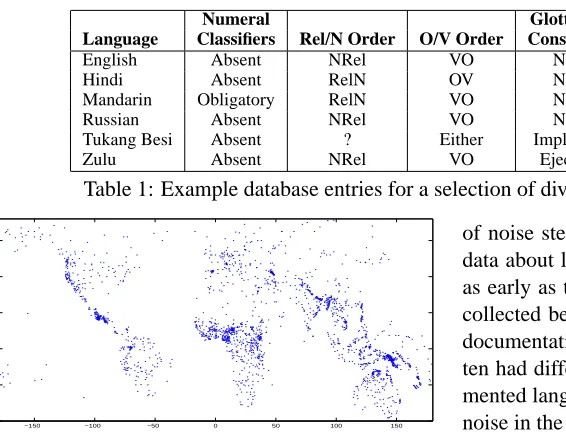
The database on which we perform our analysis is the World Atlas of Language Structures (Haspel-math et al., 2005). This database contains infor-mation about2150languages (sampled from across the world; Figure 1 depicts the locations of
Numeral Glottalized Number of Language Classifiers Rel/N Order O/V Order Consonants Tone Genders
English Absent NRel VO None None Three
Hindi Absent RelN OV None None Two
Mandarin Obligatory RelN VO None Complex None
Russian Absent NRel VO None None Three
Tukang Besi Absent ? Either Implosives None Three
[image:2.612.82.365.67.285.2]Zulu Absent NRel VO Ejectives Simple Five+
Table 1: Example database entries for a selection of diverse languages and features.
−150 −100 −50 0 50 100 150 −40
[image:2.612.108.497.70.154.2]−20 0 20 40 60
Figure 1: Map of the2150languages in the database.
guages). There are 139 features in this database,
broken down into categories such as “Nominal Cate-gories,” “Simple Clauses,” “Phonology,” “Word Or-der,” etc. The database is sparse: for many lan-guage/feature pairs, the feature value is unknown. In fact, only about16%of all possible language/feature pairs are known. A sample of five languages and six features from the database are shown in Table 1.
Importantly, the density of samples is not random. For certain languages (eg., English, Chinese, Rus-sian), nearly all features are known, whereas other languages (eg., Asturian, Omagua, Frisian) that have fewer than five feature values known. Furthermore, some features are known for many languages. This is due to the fact that certain features take less effort to identify than others. Identifying, for instance, if a language has a particular set of phonological fea-tures (such as glottalized consonants) requires only listening to speakers. Other features, such as deter-mining the order of relative clauses and nouns re-quire understanding much more of the language. 3 Models
In this section, we propose two models for automat-ically uncovering universal implications from noisy, sparse data. First, note that even well attested impli-cations are not always exceptionless. A common ex-ample is that verbs preceding objects (“VO”) implies adjectives following nouns (“NA”). This implication (VO ⊃ NA) has one glaring exception: English. This is one particular form of noise. Another source
of noise stems from transcription. WALS contains data about languages documented by field linguists as early as the 1900s. Much of this older data was collected before there was significant agreement in documentation style. Different field linguists of-ten had different dimensions along which they seg-mented language features into classes. This leads to noise in the properties of individual languages.
Another difficulty stems from the sampling
prob-lem. This is a well-documented issue (see, eg., (Croft, 2003)) stemming from the fact that any set of languages is not sampled uniformly from the space of all probable languages. Politically interesting languages (eg., Indo-European) and typologically unusual languages (eg., Dyirbal) are better docu-mented than others. Moreover, languages are not in-dependent: German and Dutch are more similar than German and Hindi due to history and geography.
The first model, FLAT, treats each language as in-dependent. It is thus susceptible to sampling prob-lems. For instance, the WALS database contains a half dozen versions of German. The FLAT model considers these versions of German just as statisti-cally independent as, say, German and Hindi. To cope with this problem, we then augment the FLAT
model into a HIERarchical model that takes
advan-tage of known hierarchies in linguistic phylogenet-ics. The HIERmodel explicitly models the fact that individual languages are not independent and exhibit strong familial dependencies. In both models, we initially restrict our attention to pairs of features. We will describe our models as if all features are binary. We expand any multi-valued feature withK values intoKbinary features in a “one versus rest” manner.
3.1 The FLATModel
two features is important: f1 impliesf2is logically different fromf2impliesf1. Some of the entries in the matrix will be unknown. We may safely remove all languages from consideration for which both are unknown, but we do not remove languages for which only one is unknown. We do so because our model needs to capture the fact that if f2 is always true, thenf1 ⊃f2is uninteresting.
The statistical model is set up as follows. There is a single variable (we will denote this variable “m”) corresponding to whether the implication holds. Thus,m = 1means thatf1 impliesf2 andm = 0 means that it does not. Independent ofm, we specify two feature priors, π1 andπ2 forf1 andf2 respec-tively. π1specifies the prior probability thatf1 will be true, andπ2specifies the prior probability thatf2 will be true. One can then put the model together na¨ıvely as follows. Ifm = 0(i.e., the implication does not hold), then the entire data matrix is gener-ated by choosing values forf1 (resp., f2) indepen-dently according to the prior probability π1 (resp.,
π2). On the other hand, if m = 1 (i.e., the impli-cation does hold), then the first column of the data matrix is generated by choosing values forf1 inde-pendently byπ1, but the second column is generated differently. In particular, if for a particular language, we have thatf1is true, then the fact that the implica-tion holds means thatf2must be true. On the other hand, iff1is false for a particular language, then we may generate f2 according to the prior probability
π2. Thus, having m = 1 means that the model is significantly more constrained. In equations:
p(f1|π1) =π
f1
1 (1−π1)1−
f1
p(f2|f1, π2, m) =
f2 m=f1= 1
πf2
2 (1−π2)1−f2 otherwise
The problem with this na¨ıve model is that it does not take into account the fact that there is “noise” in the data. (By noise, we refer either to mis-annotations, or to “strange” languages like English.) To account for this, we introduce a simple noise model. There are several options for parameteriz-ing the noise, dependparameteriz-ing on what independence as-sumptions we wish to make. One could simply spec-ify a noise rate for the entire data set. One could alternatively specify a language-specific noise rate. Or one could specify a feature-specific noise rate. We opt for a blend between the first and second
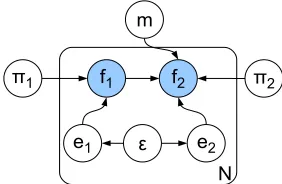
op-Figure 2: Graphical model for the FLATmodel.
tion. We assume an underlying noise rate for the en-tire data set, but that, conditioned on this underlying rate, there is a language-specific noise level. We be-lieve this to be an appropriate noise model because it models the fact that the majority of information for a single language is from a single source. Thus, if there is an error in the database, it is more likely that other errors will be for the same languages.
In order to model this statistically, we assume that there are latent variablese1,n ande2,n for each lan-guagen. Ife1,n = 1, then the first feature for lan-guagenis wrong. Similarly, if e2,n = 1, then the second feature for languagenis wrong. Given this model, the probabilities are exactly as in the na¨ıve model, with the exception that instead of using f1 (resp.,f2), we use the exclusive-or1 f1⊗e1 (resp.,
f2⊗e2) so that the feature values are flipped when-ever the noise model suggests an error.
The graphical model for the FLATmodel is shown in Figure 2. Circular nodes denote random variables and arrows denote conditional dependencies. The rectangular plate denotes the fact that the elements contained within it are replicatedN times (N is the number of languages). In this model, there are four “root” nodes: the implication valuem; the two fea-ture prior probabilitiesπ1andπ2; and the language-specific error rateǫ. On all of these nodes we place Bayesian priors. Sincem is a binary random vari-able, we place a Bernoulli prior on it. The πs are Bernoulli random variables, so they are given inde-pendent Beta priors. Finally, the noise rateǫis also given a Beta prior. For the two Beta parameters gov-erning the error rate (i.e.,aǫ andbǫ) we set these by hand so that the mean expected error rate is5%and the probability of the error rate being between0%
and10%is50%(this number is based on an expert opinion of the noise-rate in the data). For the rest of
1
[image:3.612.357.498.72.164.2]the parameters we use uniform priors.
3.2 The HIERModel
A significant difficulty in working with any large ty-pological database is that the languages will be sam-pled nonuniformly. In our case, this means that im-plications that seem true in the FLAT model may only be true for, say, Indo-European, and the remain-ing languages are considered noise. While this may be interesting in its own right, we are more interested in discovering implications that are truly universal.
We model this using a hierarchical Bayesian model. In essence, we take the FLAT model and build a notion of language relatedness into it. In particular, we enforce a hierarchy on the m impli-cation variables. For simplicity, suppose that our “hierarchy” of languages is nearly flat. Of the N
languages, half of them are Indo-European and the other half are Austronesian. We will use a nearly identical model to the FLAT model, but instead of having a singlem variable, we have three: one for IE, one for Austronesian and one for “all languages.” For a general tree, we assign one implication vari-able for each node (including the root and leaves). The goal of the inference is to infer the value of the
mvariable corresponding to the root of the tree. All that is left to specify the full HIER model is to specify the probability distribution of the m
random variables. We do this as follows. We place a zero mean Gaussian prior with (unknown) variance σ2
on the root m. Then, for a non-root node, we use a Gaussian with mean equal to the “m” value of the parent and tied variance σ2
. In our three-node example, this means that the root is distributedNor(0, σ2
)and each child is distributed
Nor(mroot, σ2), wheremroot is the random variable
corresponding to the root. Finally, the leaves (cor-responding to the languages themselves) are dis-tributed logistic-binomial. Thus, themrandom vari-able corresponding to a leaf (language) is distributed
Bin(s(mpar)), wheremparis themvalue for the
par-ent (internal) node and s is the sigmoid function
s(x) = [1 +exp(−x)]−1.
The intuition behind this model is that themvalue at each node in the tree (where a node is either “all languages” or a specific language family or an in-dividual language) specifies the extent to which the implication under consideration holds for that node.
A large positivemmeans that the implication is very likely to hold. A large negative value means it is very likely to not hold. The normal distributions across edges in the tree indicate that we expect the
mvalues not to change too much across the tree. At the leaves (i.e., individual languages), the logistic-binomial simply transforms the real-valuedms into the range[0,1]so as to make an appropriate input to the binomial distribution.
4 Statistical Inference
In this section, we describe how we use Markov chain Monte Carlo methods to perform inference in the statistical models described in the previous section; Andrieu et al. (2003) provide an excel-lent introduction to MCMC techniques. The key idea behind MCMC techniques is to approximate in-tractable expectations by drawing random samples from the probability distribution of interest. The ex-pectation can then be approximated by an empirical expectation over these sample.
For the FLAT model, we use a combination of Gibbs sampling with rejection sampling as a sub-routine. Essentially, all sampling steps are standard Gibbs steps, except for sampling the error ratese. The Gibbs step is not available analytically for these. Hence, we use rejection sampling (drawing from the Beta prior and accepting according to the posterior). The sampling procedure for the HIER model is only slightly more complicated. Instead of perform-ing a simple Gibbs sample for m in Step (4), we first sample themvalues for the internal nodes us-ing simple Gibbs updates. For the leaf nodes, we use rejection sampling. For this rejection, we draw proposal values from the Gaussian specified by the parentm, and compute acceptance probabilities.
In all cases, we run the outer Gibbs sampler for
1000iterations and each rejection sampler for20 it-erations. We compute the marginal values for them
implication variables by averaging the sampled val-ues after dropping200“burn-in” iterations.
5 Data Preprocessing and Search
After extracting the raw data from the WALS elec-tronic database (Haspelmath et al., 2005)2, we per-form a minor amount of preprocessing. Essen-tially, we have manually removed certain feature
2
values from the database because they are underrep-resented. For instance, the “Glottalized Consonants” feature has eight possible values (one for “none” and seven for different varieties of glottalized conso-nants). We reduce this to simply two values “has” or “has not.” 313languages have no glottalized conso-nants and139have some variety of glottalized con-sonant. We have done something similar with ap-proximately twenty of the features.
For the HIER model, we obtain the hierarchy in one of two ways. The first hierarchy we use is the “linguistic hierarchy” specified as part of the WALS data. This hierarchy divides languages into families and subfamilies. This leads to a tree with the leaves at depth four. The root has 38 immediate children (corresponding to the major families), and there are a total of 314 internal nodes. The second hierar-chy we use is an areal hierarhierar-chy obtained by clus-tering languages according to their latitude and lon-gitude. For the clustering we first cluster all the lan-guages into6“macro-clusters.” We then cluster each macro-cluster individually into25“micro-clusters.” These micro-clusters then have the languages at their leaves. This yields a tree with31internal nodes.
Given the database (which contains approxi-mately140features), performing a raw search even over all possible pairs of features would lead to over
19,000computations. In order to reduce this space to a more manageable number, we filter:
• There must be at least250languages for which both fea-tures are known.
• There must be at least15languages for which both fea-ture values hold simultaneously.
• Wheneverf1 is true, at least half of the languages also
havef2true.
Performing all these filtration steps reduces the number of pairs under consideration to3442. While this remains a computationally expensive procedure, we were able to perform all the implication compu-tations for these3442possible pairs in about a week on a single modern machine (in Matlab).
6 Results
The task of discovering universal implications is, at its heart, a data-mining task. As such, it is difficult to evaluate, since we often do not know the correct answers! If our model only found well-documented implications, this would be interesting but useless from the perspective of aiding linguists focus their
energies on new, plausible implications. In this sec-tion, we present the results of our method, together with both a quantitative and qualitative evaluation.
6.1 Quantitative Evaluation
In this section, we perform a quantitative evaluation of the results based on predictive power. That is, one generally would prefer a system that finds im-plications that hold with high probability across the data. The word “generally” is important: this qual-ity is neither necessary nor sufficient for the model to be good. For instance, finding1000implications of the formA1 ⊃ X, A2 ⊃ X, . . . , A1000 ⊃ X is completely uninteresting ifX is true in99%of the cases. Similarly, suppose that a model can find1000
implications of the formX ⊃A1, . . . , X ⊃A1000, butXis only true in five languages. In both of these cases, according to a “predictive power” measure, these would be ideal systems. But they are both somewhat uninteresting.
Despite these difficulties with a predictive power-based evaluation, we feel that it is a good way to un-derstand the relative merits of our different models. Thus, we compare the following systems: FLAT(our proposed flat model), LINGHIER (our model using the phylogenetic hierarchy), DISTHIER(our model
using the areal hierarchy) and RANDOM (a model that ranks implications—that meet the three qualifi-cations from the previous section—randomly).
The models are scored as follows. We take the entire WALS data set and “hide” a random 10%
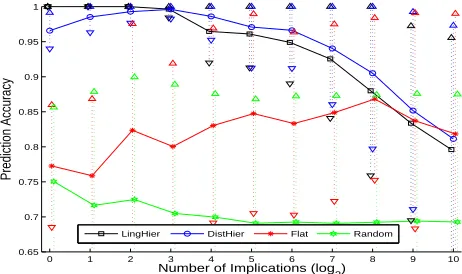
of the entries. We then perform full inference and ask the inferred model to predict the missing val-ues. The accuracy of the model is the accuracy of its predictions. To obtain a sense of the quality of the ranking, we perform this computation on the topkranked implications provided by each model;
k∈ {2,4,8, . . . ,512,1024}.
0 1 2 3 4 5 6 7 8 9 10 0.65
0.7 0.75 0.8 0.85 0.9 0.95 1
Number of Implications (log 2)
Prediction Accuracy
[image:6.612.70.301.71.208.2]LingHier DistHier Flat Random
Figure 3: Results of quantitative (predictive) evalua-tion. Top curves are the hierarchical models; middle is the flat model; bottom is the random baseline.
information performs marginally better; at the bot-tom of the ranking, the order flips. Comparing the hierarchical models to the flat model, we see that adequately modeling the a priori similarity between languages is quite important.
6.2 Cross-model Comparison
The results in the previous section support the con-clusion that the two hierarchical models are doing something significantly different (and better) than the flat model. This clearly must be the case. The results, however, do not say whether the two hierar-chies are substantially different. Moreover, are the results that they produce substantially different. The answer to these two questions is “yes.”
We first address the issue of tree similarity. We consider all pairs of languages which are at distance
0 in the areal tree (i.e., have the same parent). We then look at the mean tree-distance between those languages in the phylogenetic tree. We do this for all distances in the areal tree (because of its construc-tion, there are only three: 0, 2 and 4). The mean distances in the phylogenetic tree corresponding to these three distances in the areal tree are: 2.9, 3.5
and4.0, respectively. This means that languages that are “nearby” in the areal tree are quite often very far apart in the phylogenetic tree.
To answer the issue of whether the results ob-tained by the two trees are similar, we employ Kendall’s τ statistic. Given two ordered lists, the
τ statistic computes how correlated they are. τ is always between0and1, with1indicating identical ordering and0indicated completely reversed
order-ing. The results are as follows. Comparing FLAT
to LINGHIERyieldτ = 0.4144, a very low correla-tion. Between FLAT and DISTHIER, τ = 0.5213, also very low. These two are as expected. Fi-nally, between LINGHIER and DISTHIER, we ob-tainτ = 0.5369, a very low correlation, considering that both perform well predictively.
6.3 Qualitative Analysis
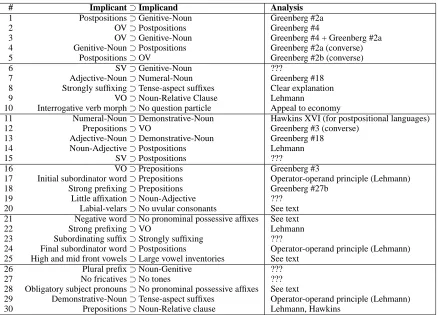
For the purpose of a qualitative analysis, we re-produce the top 30 implications discovered by the LINGHIER model in Table 2 (see the final page).3 Each implication is numbered, then the actual im-plication is presented. For instance, #7 says that any language that has adjectives preceding their governing nouns also has numerals preceding their nouns. We additionally provide an “analysis” of many of these discovered implications. Many of them (eg., #7) are well known in the typological lit-erature. These are simply numbered according to well-known references. For instance our #7 is im-plication #18 from Greenberg, reproduced by Song (2001). Those that reference Hawkins (eg., #11) are based on implications described by Hawkins (1983); those that reference Lehmann are references to the principles decided by Lehmann (1981) in Ch 4 & 8. Some of the implications our model discovers are obtained by composition of well-known implica-tions. For instance, our #3 (namely, OV⊃ Genitive-Noun) can be obtained by combining Greenberg #4 (OV ⊃Postpositions) and Greenberg #2a (Postpo-sitions ⊃ Genitive-Noun). It is quite encouraging that 14 of our top 21 discovered implications are well-known in the literature (and this, not even con-sidering the tautalogically true implications)! This strongly suggests that our model is doing something reasonable and that there is true structure in the data. In addition to many of the known implications found by our model, there are many that are “un-known.” Space precludes attempting explanations of them all, so we focus on a few. Some are easy. Consider #8 (Strongly suffixing⊃Tense-aspect suf-fixes): this is quite plausible—if you have a
lan-3
In truth, our model discovers several tautalogical implica-tions that we have removed by hand before presentation. These
are examples like “SVO⊃VO” or “No unusual consonants⊃
guage that tends to have suffixes, it will probably have suffixes for tense/aspect. Similarly, #10 states that languages with verb morphology for questions lack question particles; again, this can be easily ex-plained by an appeal to economy.
Some of the discovered implications require a more involved explanation. One such example is #20: labial-velars implies no uvulars.4 It turns out that labial-velars are most common in Africa just north of the equator, which is also a place that has very few uvulars (there are a handful of other ex-amples, mostly in Papua New Guinea). While this implication has not been previously investigated, it makes some sense: if a language has one form of rare consonant, it is unlikely to have another.
As another example, consider #28: Obligatory suffix pronouns implies no possessive affixes. This means is that in languages (like English) for which pro-drop is impossible, possession is not marked morphologically on the head noun (like English, “book” appears the same regarless of if it is “his book” or “the book”). This also makes sense: if you cannot drop pronouns, then one usually will mark possession on the pronoun, not the head noun. Thus, you do not need marking on the head noun.
Finally, consider #25: High and mid front vowels (i.e., / u/, etc.) implies large vowel inventory (≥ 7
vowels). This is supported by typological evidence that high and mid front vowels are the “last” vowels to be added to a language’s repertoire. Thus, in order to get them, you must also have many other types of vowels already, leading to a large vowel inventory.
Not all examples admit a simple explanation and are worthy of further thought. Some of which (like the ones predicated on “SV”) may just be peculiar-ities of the annotation style: the subject verb order changes frequently between transitive and intransi-tive usages in many languages, and the annotation reflects just one. Some others are bizzarre: why not having fricatives should mean that you don’t have tones (#27) is not a priori clear.
6.4 Multi-conditional Implications
Many implications in the literature have multiple implicants. For instance, much research has gone
4
Labial-velars and uvulars are rare consonants (order 100 languages). Labial-velars are joined sounds like /kp/ and /gb/ (to English speakers, sounding like chicken noises); uvulars sounds are made in the back of the throat, like snoring.
Implicants Implicand
Postpositions
⊃Demonstrative-Noun
Adjective-Noun Posessive prefixes
⊃Genitive-Noun
Tense-aspect suffixes Case suffixes
⊃Genitive-Noun
Plural suffix Adjective-Noun
⊃OV Genitive-Noun High cons/vowel ratio
⊃No tones
No front-rounded vowels Negative affix
⊃OV Genitive-Noun No front-rounded vowels
⊃Large vowel quality inventory Labial velars
Subordinating suffix
⊃Postpositions Tense-aspect suffixes
No case affixes
⊃Initial subordinator word Prepositions
Strongly suffixing
⊃Genitive-Noun
[image:7.612.315.539.67.282.2]Plural suffix
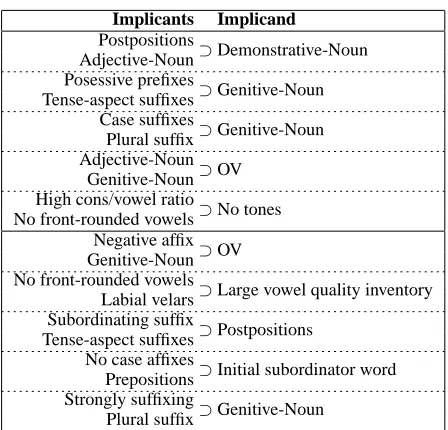
Table 3: Top implications discovered by the LINGHIERmulti-conditional model.
into looking at which implications hold, considering only “VO” languages, or considering only languages with prepositions. It is straightforward to modify our model so that it searches over triples of features, conditioning on two and predicting the third. Space precludes an in-depth discussion of these results, but we present the top examples in Table 3 (after remov-ing the tautalogically true examples, which are more numerous in this case, as well as examples that are directly obtainable from Table 2). It is encouraging that in the top1000 multi-conditional implications found, the most frequently used were “OV” (176
times) “Postpositions” (157 times) and “Adjective-Noun” (89times). This result agrees with intuition.
7 Discussion
suf-# Implicant⊃Implicand Analysis
1 Postpositions⊃Genitive-Noun Greenberg #2a
2 OV⊃Postpositions Greenberg #4
3 OV⊃Genitive-Noun Greenberg #4 + Greenberg #2a
4 Genitive-Noun⊃Postpositions Greenberg #2a (converse)
5 Postpositions⊃OV Greenberg #2b (converse)
6 SV⊃Genitive-Noun ???
7 Adjective-Noun⊃Numeral-Noun Greenberg #18
8 Strongly suffixing⊃Tense-aspect suffixes Clear explanation
9 VO⊃Noun-Relative Clause Lehmann
10 Interrogative verb morph⊃No question particle Appeal to economy
11 Numeral-Noun⊃Demonstrative-Noun Hawkins XVI (for postpositional languages)
12 Prepositions⊃VO Greenberg #3 (converse)
13 Adjective-Noun⊃Demonstrative-Noun Greenberg #18
14 Noun-Adjective⊃Postpositions Lehmann
15 SV⊃Postpositions ???
16 VO⊃Prepositions Greenberg #3
17 Initial subordinator word⊃Prepositions Operator-operand principle (Lehmann)
18 Strong prefixing⊃Prepositions Greenberg #27b
19 Little affixation⊃Noun-Adjective ???
20 Labial-velars⊃No uvular consonants See text
21 Negative word⊃No pronominal possessive affixes See text
22 Strong prefixing⊃VO Lehmann
23 Subordinating suffix⊃Strongly suffixing ???
24 Final subordinator word⊃Postpositions Operator-operand principle (Lehmann)
25 High and mid front vowels⊃Large vowel inventories See text
26 Plural prefix⊃Noun-Genitive ???
27 No fricatives⊃No tones ???
28 Obligatory subject pronouns⊃No pronominal possessive affixes See text
29 Demonstrative-Noun⊃Tense-aspect suffixes Operator-operand principle (Lehmann)
[image:8.612.88.526.69.384.2]30 Prepositions⊃Noun-Relative clause Lehmann, Hawkins
Table 2: Top30implications discovered by the LINGHIERmodel.
ficiently general that it could be applied to many different typological databases — we attempted not to “overfit” it to WALS. Our hope is that the au-tomatic discovery of such implications not only aid typologically-inclined linguists, but also other groups. For instance, well-attested universal impli-cations have the potential to reduce the amount of data field linguists need to collect. They have also been used computationally to aid in the learning of unsupervised part of speech taggers (Schone and Ju-rafsky, 2001). Many extensions are possible to this model; for instance attempting to uncover typolog-ically hierarchies and other higher-order structures. We have made the full output of all models available athttp://hal3.name/WALS.
Acknowledgments. We are grateful to Yee Whye
Teh, Eric Xing and three anonymous reviewers for their feedback on this work.
References
Christophe Andrieu, Nando de Freitas, Arnaud Doucet, and Michael I. Jordan. 2003. An introduction to MCMC for machine learning. Machine Learning (ML), 50:5–43.
William Croft. 2003. Typology and Univerals. Cambridge University Press.
Isidore Dyen, Joseph Kurskal, and Paul Black. 1992. An
Indoeuropean classification: A lexicostatistical experiment. Transactions of the American Philosophical Society, 82(5). American Philosophical Society.
Joseph Greenberg, editor. 1963. Universals of Languages.
MIT Press.
Martin Haspelmath, Matthew Dryer, David Gil, and Bernard Comrie, editors. 2005. The World Atlas of Language Struc-tures. Oxford University Press.
John A. Hawkins. 1983. Word Order Universals: Quantitative analyses of linguistic structure. Academic Press.
Winfred Lehmann, editor. 1981. Syntactic Typology, volume xiv. University of Texas Press.
April McMahon and Robert McMahon. 2005. Language Clas-sification by Numbers. Oxford University Press.
Frederick J. Newmeyer. 2005. Possible and Probable Lan-guages: A Generative Perspective on Linguistic Typology. Oxford University Press.
Patrick Schone and Dan Jurafsky. 2001 Language Independent Induction of Part of Speech Class Labels Using only Lan-guage Universals. Machine Learning: Beyond Supervision.