Munich Personal RePEc Archive
Contours of Internal Migration in India:
Certain Experiences from Kerala
Kumar, Dr.B.Pradeep
Government Arts and Science College, Ambalapuzha, Alappuzha,
Kerala, India
7 June 2016
Contours of Internal Migration in India:
Certain Experiences from Kerala
---
Dr.B.Pradeep Kumar Assistant Professor of Economics
Govt.College, Ambalappuzha, Alappuzha, Kerala Abstract
In recent times, internal migration has intensified in different parts of the world. In tune with this, migration issues in Kerala have assumed different dimensions thanks to the inflow of a large number of migrants from the far away states like Assam and West Bengal. This has made Kerala a destination which attracts internal migrants besides being a state sending its own people to the Middle East and Europe. The large influx of migrants has caused precarious socio-economic issues in Kerala society. At the same time, Kerala’s dying productive sectors find resurrection only on the ride of the present wave of migrant workers to the State. Set in this background, this paper intends to look into these issues and try to bring out policy interventions by the government to improve the living conditions of migrant workers.
Key Words: Migration, foreign remittances, Labor Market, Discrimination, Intervention --- Heeding to the call of goodness, people leave behind their place of birth and cross their boundaries
with the expectation that they can land in an illusionary world where honey and milk flow in
abundance. Migration thus has brought in new avenues in the life of migrants in their new place
of promises. The economic advancement of European countries owing much to their migratory
nature stands testimony to this. Of course, it is true that when one speaks about migration, mostly
international migration comes into the scene. However in recent times, internal migration has
assumed indomitable importance in literature owing to its increase in volume and the amount of
remittances emanating out of such migration (Bell & Muhidin, 2009).
Evidently, it is hard to emphasize that poverty and economic deprivation force people to migrate
in search of better living environment and job opportunities. It is hardly heard that destitute from
the poverty ridden countries in African continent move to developed regions of the world whereas
“most wealthy, developed countries still have higher levels of emigration than developing countries” (Terraza, 2011). In developed countries like US, the pace of emigration and immigration has reached such a zenith that it is going to be irrelevant to ask someone: “where are
immigration from other parts of the country has skyrocketed without commensurate subsiding
emigration, both internal and international. In the context of this new trend in migration which
Kerala has been experiencing, it is worthwhile to examine the nature of this migration, and the
socio-economic hardship that the migrants face in the place of destination, and the interventions
that the State has been undertaking to uplift the living conditions of migrants in Kerala. This paper
mainly makes use of secondary data from various sources to look into the issues of migrant workers
in the state of Kerala.
Kerala has perceptibly witnessed a turnaround in the origin of destination of its internal immigrants
as well as their sector of occupation. The crossover of people to neighboring states has been quite
natural elsewhere. In Kerala, too, earlier, strictly speaking in 1980s and 1990s, workers from
neighboring Tamil Nadu, Karnataka and Andra Pradesh used to crisscross boundaries to reach
Kerala in search of gainful employment and better living conditions, and they were accommodated
in the construction and other unskilled employments mainly ironing clothes. These workers from
these boundary states moved mainly to urban and suburban areas where they could find more
rewarding jobs, and the domestic workers continued to rule the rural casual labor market. But,
today, quite distinct from this, the origin of destination of immigrants has changed to far away
states like West Bengal, Orissa, Assam and Uttar Pradesh, and even people from Nepalii are
reported to have been seen in Kerala (Kumar, 2011). The nature of spreading of migrants in Kerala
has now extended to remote places besides urban and suburban parts. Unlike the earlier migrants
from neighboring states, these migrants from far away sates are blessed with a widened horizon of
job avenues spanning across construction sector, cashew processing, plywood industries, slaughter
houses, oil pumps, brick making units, hotel and restaurants, malls and private securities, and even
it has been reported recently that they have started performing certain skilled jobs in the
construction sector replacing the domestic skilled workers whose bargaining power seems to have
become unaffordable to employers. Nevertheless, it needs to be mentioned here that the informal
nature of work and living status of migrant workers have made it difficult to estimate their actual
number in Kerala. Official documents bear no accurate figure about this barring an estimate by the
Department of Labor, Govt. of Kerala, which estimates that Kerala has 25 lakhsiii of migrant
The factors which work behind migration to Kerala from other states of origin need to be
highlighted. The push factors encompass the relatively better economic and social circumstances
prevailing in the Sate. Kerala ranks better in many of the indicators compared to these states of
origin of migrant people. For instance, among the states in India, Kerala has the highest HDI index
[image:4.612.93.524.208.353.2]and the per capita income of the State is comparably high (Table No.1).
Table 1 Selected Indicators of Kerala v/s Other States of Origin
Indicator Kerala West
Bengal
Orissa Bihar Assam Tamil
Nadu
HDI Rank 1 15 26 28 19 9
Literacy Rate 93.91 77.08 73.45 63.82 78.81 86.81 Rural Poverty Ratio (2004-05) 20.2 38.2 60.8 55.7 36.4 37.5 Per capita Income (2008-09) 49316 36322 29464 13663 23993 45058 Life Expectancy at Birth
Percentage of Households With access to toilet (2005-06)
74 96.0 64.9 59.5 59.6 19.3 61.6 25.2 58.9 76.4 66.2 42.9
Source: Kumar, 2011
Unsurprisingly, it is pretty natural that given the differences in the socio-economic conditions
prevailing in the States of origin and the state of destination, that is Kerala, workers get attracted
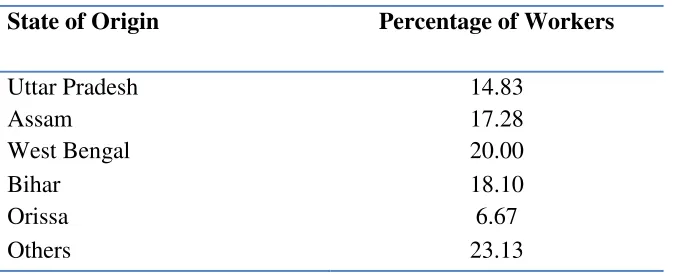
to Kerala. A look at the state wise origin of migrant workers in Kerala reveal that most of the
migrants hail from West Bengal followed by Bihar and Assam (Table No.2). The people of West
Bengal have been quite interested in migrating to other countries in pursuit of higher education
and better employment prospects. And now that the unskilled and undereducated Bengali workers
naturally find Kerala as a destination to migrate which may be because of ideological similarity of
people in both states.
Table 2 Distribution of Migrant Workers by States of Origin
State of Origin Percentage of Workers
Uttar Pradesh 14.83
Assam 17.28
West Bengal 20.00
Bihar 18.10
Orissa 6.67
[image:4.612.141.479.579.716.2]Total 100.00
Source: Report by GIFT on Domestic Migrant Workers in Kerala published in 2011
Main pull factors of migration to Kerala encompass the boom in the construction sector and the
reluctance of native workers to handle menial and casual work. Now the pertinent question is what
could be the immediate force which pursues migrant workers to choose Kerala as a destination to
work for livelihood. Studies have shown that since the migrant workers have been engaged in
informal sector of occupation, many informal methods have been used for their entry into Kerala
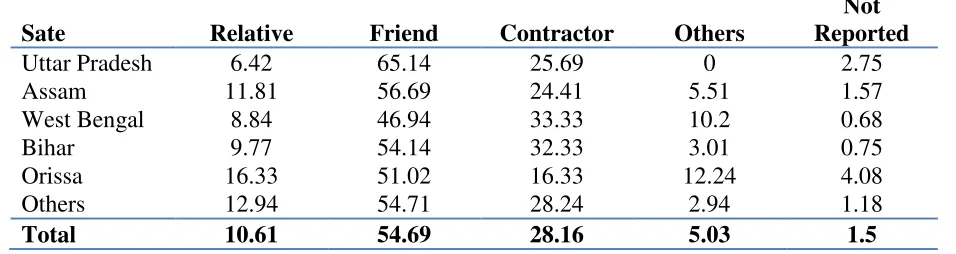
(Narayana & Venkiteswran, 2013). One important channel through which they get attracted to
Kerala is the friendship (54.69), one of the informal ways of recruitment and it is interesting to
note that only the second position goes to the involvement of contractor in bringing them to the
Sate of destination (Table No.3). Precisely, it could be argued that urbanization and the growth of
informal sectors have led to the growing presence of migrant workers in Kerala. Added to this
might be the reluctance among the youths in Kerala to engage in casual workers requiring more
[image:5.612.69.547.423.550.2]physical labor.
Table 3 Distribution of Migrant Workers by Channels of Migration
Sate Relative Friend Contractor Others
Not Reported
Uttar Pradesh 6.42 65.14 25.69 0 2.75 Assam 11.81 56.69 24.41 5.51 1.57 West Bengal 8.84 46.94 33.33 10.2 0.68 Bihar 9.77 54.14 32.33 3.01 0.75 Orissa 16.33 51.02 16.33 12.24 4.08 Others 12.94 54.71 28.24 2.94 1.18
Total 10.61 54.69 28.16 5.03 1.5
Source: Report by GIFT on Domestic Migrant Workers in Kerala published in 2011
Economic and social hardships that migrants encounter with:
Migrants are always looked down by the natives as alien people to be treated as second citizen,
and they are inherently vulnerable in many respects (Bustamante, 2011). This has been the mindset
elsewhere and many historical anecdotesiv stand testimony to this. Migrants are self uprooted
people moving to places which they deem fit to fulfill their aspirations. Enhanced income is the
increase in income. Migrants, deprived of entitlements which they enjoy at the origin states, subject
themselves to social, political and economic marginalization in the host states. Migrants become
people unattended or unheard of by both their states of origin and the host states. So long as natives
of host states consider migrants as outsiders, their vulnerability gets aggravated. Studies have
unearthed the plight of migrants in the host states on account of the loss of entitlements which they
could have enjoyed had they not ventured into the host state in search of better avenues. In Kerala,
although Public Distribution System serves her people graciously, when it comes to the migrants,
they do not have access to PDS shops as they do not posses ration cards, which they had before
moving into the host state (Kumar, 2011). Similarly, migrants in Kerala do not have access to
CHISv which are accessed by poor people in the state. This calls for evolving policies responsive
to the needs of migrants in the Sate. The living conditions of the migrants are deplorable and entail
opportunities to outbreak it as social and health menace in the near future. Another economic
hurdle they face at the hands of employers is the discriminatory treatment in respect of wage
determination. It has been understood that migrants are paid less compared to their native
counterparts. For instance, studies have brought to light the fact that most of the migrants in Kerala
receive only Rs.300-399 per day (Narayana & Venkiteswran, 2013) which is lower by Rs.100
compared to the wages of local workers and this wage which the mgrants receive is three to four
times more than what they are likely to receive at their states of origin(Kumar,2011). The flip side
of the story is that migrants receive this money only occasionally, studies have shown in the
context of Kerala (Narayana & Venkiteswran, 2013). One encouraging thing is that most of the
migrants (nearly 60 percent) transact their money using their own personal bank accounts.
Language barrier appears to be another hurdle before the migrant workers in Kerala. Difficulty in
using the vernacular language of the host state stands in the way of their process of socialization
with the local community. English could have been a link language but for the absolute lack of
English knowledge with the migrant workers.
Living conditions of Migrant workers in Kerala
Two things shrink the living space of migrants. First is their reluctance to pay more for better
housing as they strive to save more money to be sent to their kiths and kin’s in the state of origin.
migrants stay in deplorable living conditions devoid of water and sanitation amenities. The shelters
of migrant workers can turn out to be cradles of communicable diseases in Kerala. Most of the
migrants, in a survey, opined that in a little less than half of the cases seven workers crowed
together in one room, sharing common toilets, eating from a common mess and consuming other
facilities (Narayana & Venkiteswran, 2013). Interestingly, migrants speaking common language
flock together in a specific labor camp, which happens to be convenient for the owners of the camp
to manage them. Migrants live in pathetic conditions, and studies have shown that their settlement
is often littered with waste, creating a threat to public hygiene. The unrestricted inflow of migrants
even from Nepal is reported to have raised law and order problems in the State.
Employment
Why is the demand for migrant labor increasing in Kerala? The increase in the demand for migrant
labor is inversely related to their wage rate, of course. Wage rate is practically at least Rs.100 low
compared to the native workers (Kumar, 2011). Even if wage rate is at par with the local workers,
then also the demand for migrants would continue to rise because it is quite easy to manage and
supervise the migrants and they seem to be engaging in their work silently and without any
protection. As they are not unionized, labor hazardous hardly matters. But the productivity and
perfection of work done by the migrants are found to be poor, but it does not reduce their demand
as they contribute to output even by doing overtime work. It needs to be mentioned here that
migrant workers are bracketed as casualized or informalized to fit to the interest of local employers,
which is dangerous and can hardly be digested by a community like Kerala.
Policy Interventions
It is obvious that given the shortage of domestic workers and the growing demand for manual
workers especially in the construction sector, Kerala badly requires the relentless service of
migrant workers how so poor the quality of work is. Their supply on tap actually fuels the State
economy in many respects. Recognizing this, the State led policy interventions have been
implemented to uplift the employment and living conditions of migrant workers in Kerala
including certain social security schemes. As early as in 1979, Inter-State Migrant Work Men Act
was enacted to regulate the work of migrants and to protect their interests. If implemented in tooth
migrants in Kerala. Besides this, there are Companies Act, Minimum Wage Act, Equal
Remuneration Act, Building and other Construction Worker’s Act which provide for the
betterment of workers including the migrants. What is noteworthy is a brave step which the
government of Kerala has taken by bringing in Interstate Migrant Workers Welfare Scheme that
commenced on May Day of 2010. This scheme makes every migrant entitled to a membership
card that enables them to get Rs.25, 000 as health care assistance if they are hospitalized, besides
a package of other welfare showers. But, the reach out of this scheme has been very dismal which
is evident from the fact the in the first one and half years since the scheme was started, only less
than 20,000 migrants got registered out of the lakhs of migrants living in the State. The main reason
for this under enrollment of ‘invisible’ migrants is cited to be the lack of trade union among the migrants which created a communication vacuum with the implementing authority of this scheme,
the Kerala Construction Workers Welfare Board.
Concluding Observations
Internal migration has become a reality today, and its intensity has grown with the growing
urbanization and in-formalization of the labor market in Kerala. With the inflow of migrants from
the rest of the country, Kerala has added another feature which makes it tantamount to the
conditions of the developed countries. That is like the developed world, Kerala has also become a
state that attracts migrant workers and at the same time sending its own skilled and semi-skilled
man power to the outer world enhancing its ability to garner more foreign remittances. But on the
contrary, it seems that Kerala is at crossroads in respect of dealing with the issues of migrant
workers. The present condition of Kerala’s labor market, characterized by the shortage of domestic labor coupled with their reluctance to take up physical work and their continuing migration to other
countries including Middle East, necessitates the involvement of migrant workers in her economic
process. Therefore the progress of the State may be jeopardized without the presence of migrant
workers. At the same time migrant workers have started posing certain socio-economic issues
which need to be tackled by a progressive community like Kerala.
i
international as well as internal migration. It is quite interesting to observe now that such a state has started witnessing an unprecedented inflow of migrant workers from elsewhere in the country. Other two states which are in foray are Punjab and Goa, and three states together, viz. Kerala, Punjab and Goa account for high out-migrants from India (Czaika, 2011).
ii Labor mobility from Nepal to India remains unrestricted as visa requirements for Nepalese to
come to India have been either eased or a non-existent one. This has caused migration of Nepalese to India, and to Kerala.
iii This estimation is based on a train-based survey executed by the Gulati Institute of Finance and
Taxation, not on the basis of Census Based survey. And therefore, naturally its accuracy stands questioned to some extent, but for the lack of other reliable information on the number of migrant workers, the estimate by GIFT has to be reckoned with.
iv M.K.Gandhi had to encounter insurmountable hardships when he was a law professional in South
Africa which made a sea change in his life, and finally ended up in the historical struggle against the British in India.
v Comprehensive Health Insurance System (CHIS), a programme commenced by the government
of Kerala to benefit those which are not covered by RSBY (Rashriya Swastya Bima Yojana).
References
1. Bell, M., & Muhidin, S. (2009). Cross National Comparisons of Internal Migration. Human Development Research Paper. New York: UNDP.
2. Bustamante, J. A. (2011). Extreme Vulnerability of Migrants: The Cases of the United States and Mexico. Migration Internacionales, 20-97.
3. Czaika, M. (2011). Internal and International Migration as Response of Double Deprivation: Some Evidence from India. German Development Economics Conference. Berlin.
4. Kumar, N. A. (November, 2011). Vulnerability of Migrants and Responsiveness of the State:The Case of Unskilled Workers in Kerala, India. Kochi: Centre for Socio Economic Studies (CSES).
5. Narayana, D., & Venkiteswran, C. S. (2013). Domestic Migrant Labor in Kerala. Thiruvananthapuram: Gulati Institute of Finance and Taxation.
6. Nigel, H. (1999). The Freedom to Move. In G. Dale, & M. Cole, The European Union and Migrant Labour. Berg: Oxford.