Topic Analysis for Psychiatric Document Retrieval
Liang-Chih Yu
*‡, Chung-Hsien Wu
*, Chin-Yew Lin
†, Eduard Hovy
‡and Chia-Ling Lin
**
Department of CSIE, National Cheng Kung University, Tainan, Taiwan, R.O.C.
†
Microsoft Research Asia, Beijing, China
‡
Information Sciences Institute, University of Southern California, Marina del Rey, CA, USA
[email protected],{chwu,totalwhite}@csie.ncku.edu.tw,[email protected],[email protected]
Abstract
Psychiatric document retrieval attempts to help people to efficiently and effectively locate the consultation documents relevant to their depressive problems. Individuals can understand how to alleviate their symp-toms according to recommendations in the relevant documents. This work proposes the use of high-level topic information ex-tracted from consultation documents to im-prove the precision of retrieval results. The topic information adopted herein includes
negative life events, depressive symptoms
and semantic relations between symptoms, which are beneficial for better understand-ing of users' queries. Experimental results show that the proposed approach achieves higher precision than the word-based re-trieval models, namely the vector space model (VSM) and Okapi model, adopting word-level information alone.
1
Introduction
Individuals may suffer from negative or stressful life events, such as death of a family member, ar-gument with a spouse and loss of a job. Such events play an important role in triggering depres-sive symptoms, such as depressed moods, suicide attempts and anxiety. Individuals under these cir-cumstances can consult health professionals using message boards and other services. Health profes-sionals respond with suggestions as soon as possi-ble. However, the response time is generally sev-eral days, depending on both the processing time required by health professionals and the number of
problems to be processed. Such a long response time is unacceptable, especially for patients suffer-ing from psychiatric emergencies such as suicide attempts. A potential solution considers the prob-lems that have been processed and the correspond-ing suggestions, called consultation documents, as the psychiatry web resources. These resources gen-erally contain thousands of consultation documents (problem-response pairs), making them a useful information resource for mental health care and prevention. By referring to the relevant documents, individuals can become aware that they are not alone because many people have suffered from the same or similar problems. Additionally, they can understand how to alleviate their symptoms ac-cording to recommendations. However, browsing and searching all consultation documents to iden-tify the relevant documents is time consuming and tends to become overwhelming. Individuals need to be able to retrieve the relevant consultation documents efficiently and effectively. Therefore, this work presents a novel mechanism to automati-cally retrieve the relevant consultation documents with respect to users' problems.
Traditional information retrieval systems repre-sent queries and documents using a bag-of-words approach. Retrieval models, such as the vector space model (VSM) (Baeza-Yates and Ribeiro-Neto, 1999) and Okapi model (Robertson et al., 1995; Robertson et al., 1996; Okabe et al., 2005), are then adopted to estimate the relevance between queries and documents. The VSM represents each query and document as a vector of words, and adopts the cosine measure to estimate their rele-vance. The Okapi model, which has been used on the Text REtrieval Conference (TREC) collections, developed a family of word-weighting functions
for relevance estimation. These functions consider word frequencies and document lengths for word weighting. Both the VSM and Okapi models esti-mate the relevance by matching the words in a query with the words in a document. Additionally, query words can further be expanded by the con-cept hierarchy within general-purpose ontologies such as WordNet (Fellbaum, 1998), or automati-cally constructed ontologies (Yeh et al., 2004).
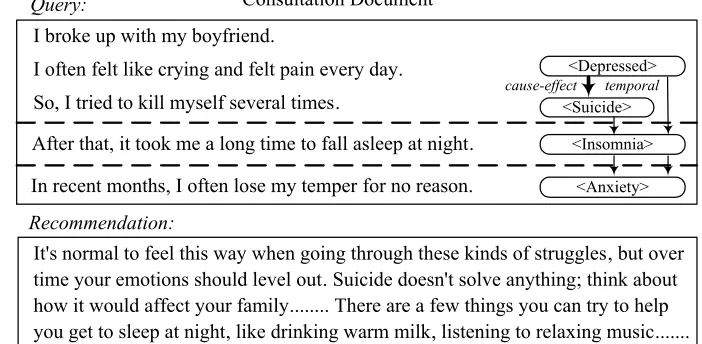
However, such word-based approaches only consider the word-level information in queries and documents, ignoring the high-level topic informa-tion that can help improve understanding of users' queries. Consider the example consultation docu-ment in Figure 1. A consultation docudocu-ment com-prises two parts: the query part and recommenda-tion part. The query part is a natural language text, containing rich topic information related to users' depressive problems. The topic information in-cludes negative life events, depressive symptoms, and semantic relations between symptoms. As in-dicated in Figure 1, the subject suffered from a love-related event, and several depressive symp-toms, such as <Depressed>, <Suicide>, <Insom-nia> and <Anxiety>. Moreover, there is a cause-effect relation holding between <Depressed> and <Suicide>, and a temporal relation holding be-tween <Depressed> and <Insomnia>. Different topics may lead to different suggestions decided by experts. Therefore, an ideal retrieval system for
consultation documents should consider such topic information so as to improve the retrieval precision.
Natural language processing (NLP) techniques can be used to extract more precise information from natural language texts (Wu et al., 2005a; Wu et al., 2005b; Wu et al., 2006; Yu et al., 2007). This work adopts the methodology presented in (Wu et al. 2005a) to extract depressive symptoms and their relations, and adopts the pattern-based method presented in (Yu et al., 2007) to extract negative life events from both queries and consul-tation documents. This work also proposes a re-trieval model to calculate the similarity between a query and a document by combining the similari-ties of the extracted topic information.
The rest of this work is organized as follows. Section 2 briefly describes the extraction of topic information. Section 3 presents the retrieval model. Section 4 summarizes the experimental results. Conclusions are finally drawn in Section 5.
2
Framework of Consultation Document
Retrieval
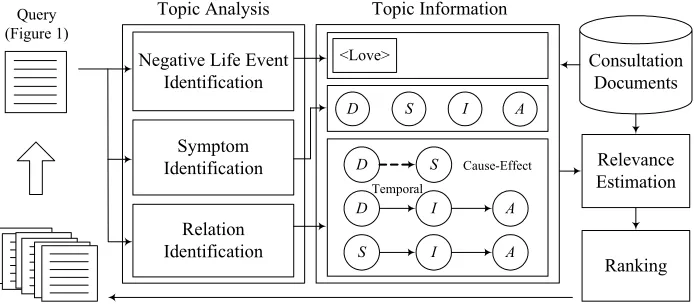
Figure 2 shows the framework of consultation document retrieval. The retrieval process begins with receiving a user’s query about his depressive problems in natural language. The example query is shown in Figure 1. The topic information is then extracted from the query, as shown in the center of Figure 2. The extracted topic information is
repre-Consultation Document
Query:
It's normal to feel this way when going through these kinds of struggles, but over time your emotions should level out. Suicide doesn't solve anything; think about how it would affect your family... There are a few things you can try to help you get to sleep at night, like drinking warm milk, listening to relaxing music...
Recommendation:
After that, it took me a long time to fall asleep at night.
<Depressed> <Suicide>
<Insomnia> <Anxiety>
cause-effect temporal I broke up with my boyfriend.
I often felt like crying and felt pain every day. So, I tried to kill myself several times.
[image:2.612.123.474.82.254.2]In recent months, I often lose my temper for no reason.
sented by the sets of negative life events, depres-sive symptoms, and semantic relations. Each ele-ment in the event set and symptom set denotes an individual event and symptom, respectively, while each element in the relation set denotes a symptom chain to retain the order of symptoms. Similarly, the query parts of consultation documents are rep-resented in the same manner. The relevance esti-mation then calculates the similarity between the input query and the query part of each consultation document by combining the similarities of the sets of events, symptoms, and relations within them. Finally, a list of consultation documents ranked in the descending order of similarities is returned to the user.
In the following, the extraction of topic informa-tion is described briefly. The detailed process is described in (Wu et al. 2005a) for symptom and relation identification, and in (Yu et al., 2007) for event identification.
1) Symptom identification: A total of 17 symp-toms are defined based on the Hamilton De-pression Rating Scale (HDRS) (Hamilton, 1960). The identification of symptoms is sen-tence-based. For each sentence, its structure is first analyzed by a probabilistic context free grammar (PCFG), built from the Sinica Tree-bank corpus developed by Academia Sinica, Taiwan (http://treebank.sinica.edu.tw), to gen-erate a set of dependencies between word to-kens. Each dependency has the format ( modi-fier, head, relmodifier,head). For instance, the
de-pendency (matters, worry about, goal) means that "matters" is the goal to the head of the
sen-tence "worry about". Each sensen-tence can then be associated with a symptom based on the probabilities that dependencies occur in all symptoms, which are obtained from a set of training sentences.
2) Relation Identification: The semantic rela-tions of interest include cause-effect and tem-poral relations. After the symptoms are ob-tained, the relations holding between symp-toms (sentences) are identified by a set of dis-course markers. For instance, the disdis-course markers "because" and "therefore" may signal cause-effect relations, and "before" and "after" may signal temporal relations.
3) Negative life event identification: A total of 5 types of events, namely <Family>, <Love>, <School>, <Work> and <Social> are defined based on Pagano et al’s (2004) research. The identification of events is a pattern-based ap-proach. A pattern denotes a semantically plau-sible combination of words, such as <parents, divorce> and <exam, fail>. First, a set of pat-terns is acquired from psychiatry web corpora by using an evolutionary inference algorithm. The event of each sentence is then identified by using an SVM classifier with the acquired patterns as features.
3
Retrieval Model
The similarity between a query and a document, ( , )
Sim q d , is calculated by combining the similari-ties of the sets of events, symptoms and relations within them, as shown in (1).
Consultation Documents
Ranking Relevance Estimation
Query (Figure 1)
Topic Information
Symptom Identification Negative Life Event
Identification
Relation Identification
D S A
D S Cause-Effect
D I A
Temporal
I
S I A
<Love>
[image:3.612.134.481.74.226.2]Topic Analysis
( , )
( , ) ( , ) (1 ) ( , ),
Evn Sym Rel
Sim q d
Sim q d Sim q d Sim q d
α β α β
=
+ + − − (1)
where SimEvn( , )q d , SimSym( , )q d and SimRel( , )q d , denote the similarities of the sets of events, symp-toms and relations, respectively, between a query and a document, and α and β denote the combi-nation factors.
3.1 Similarity of events and symptoms
The similarities of the sets of events and symptoms are calculated in the same method. The similarity of the event set (or symptom set) is calculated by comparing the events (or symptoms) in a query with those in a document. Additionally, only the events (or symptoms) with the same type are considered. The events (or symptoms) with different types are considered as irrelevant, i.e., no similarity. For instance, the event <Love> is considered as irrelevant to <Work>. The similarity of the event set is calculated by
( , ) 1
( , ) cos( , ) .,
( )
Evn
q d q d
q d e q d
Sim q d
Type e e e e const N Evn Evn ∈ ∩
= +
∪
∑
(2)
where Evnq and Evnd denote the event set in a query and a document, respectively; eq and ed
denote the events; N Evn( q∪Evnd) denotes the
cardinality of the union of Evnq and Evnd as a normalization factor, and Type e e( , )q d denotes an identity function to check whether two events have the same type, defined as
1 ( ) ( )
( , ) .
0 otherwise
q d
q d
Type e Type e Type e e = ⎨⎧⎪ =
⎪⎩
(3)
The cos( , )e eq d denotes the cosine angle between two vectors of words representing eq and ed , as shown below.
( )
( )
1
2 2
1 1
cos( , ) q d ,
q d
T i i
e e
i
q d
T i T i
e e
i i
w w e e
w w
=
= =
=
∑
∑
∑
(4)
where w denotes a word in a vector, and T denotes the dimensionality of vectors. Accordingly, when two events have the same type, their similarity is given as cos( , )e eq d plus a constant, const.. Addi-tionally, cos( , )e eq d and const. can be considered
as the word-level and topic-level similarities, re-spectively. The optimal setting of const. is deter-mined empirically.
3.2 Similarity of relations
When calculating the similarity of relations, only the relations with the same type are considered. That is, the cause-effect (or temporal) relations in a query are only compared with the cause-effect (or temporal) relations in a document. Therefore, the similarity of relation sets can be calculated as
, 1
( , ) ( , ) ( , ),
q d
Rel q d q d
r r
Sim q d Type r r Sim r r Z
=
∑
(5)( ) ( ) ( ) ( ),
C q C d T q T d
Z=N r N r +N r N r (6) where rqand rd denote the relations in a query and a document, respectively; Z denotes the normaliza-tion factor for the number of relanormaliza-tions; Type e e( , )q d
denotes an identity function similar to (3), and
( ) C
N i and NT( )i denote the numbers of
cause-effect and temporal relations.
Both cause-effect and temporal relations are rep-resented by symptom chains. Hence, the similarity of relations is measured by the similarity of symp-tom chains. The main characteristic of a sympsymp-tom chain is that it retains the cause-effect or temporal order of the symptoms within it. Therefore, the order of the symptoms must be considered when calculating the similarity of two symptom chains. Accordingly, a sequence kernel function (Lodhi et al., 2002; Cancedda et al., 2003) is adopted to cal-culate the similarity of two symptom chains. A sequence kernel compares two sequences of sym-bols (e.g., characters, words) based on the subse-quences within them, but not individual symbols. Thereby, the order of the symptoms can be incor-porated into the comparison process.
The sequence kernel calculates the similarity of two symptom chains by comparing their sub-symptom chains at different lengths. An increasing number of common sub-symptom chains indicates a greater similarity between two symptom chains. For instance, both the two symptom chains
1 2 3 4
s s s s and s s s3 2 1 contain the same symptoms s1, 2
length 2, the sequence kernel compares their sub-symptom chains of length 2, i.e.,
1 2 1 3 1 4 2 3 2 4 3 4
{s s s s s s s s s s s s, , , , , } and {s s s s s s3 2, 3 1, 2 1}. Similarly, their similarity at length 3 is calculated by comparing their sub-symptom chains of length 3, i.e., {s s s s s s s s s s s s1 2 3, , , }1 2 4 1 3 4 2 3 4 and {s s s3 2 1}. Obviously, no similarity exists between s s s s1 2 3 4
and s s s3 2 1 , since no sub-symptom chains are matched at both lengths. In this example, the sub-symptom chains of length 1, i.e., individual symp-toms, do not have to be compared because they contain no information about the order of symp-toms. Additionally, the sub-symptom chains of length 4 do not have to be compared, because the two symptom chains share no sub-symptom chains at this length. Hence, for any two symptom chains, the length of the sub-symptom chains to be com-pared ranges from two to the minimum length of the two symptom chains. The similarity of two symptom chains can be formally denoted as
1 2 1 2 1 2 2 ( , ) ( , ) ( , ) 1 ( , ), 1 N N
q d q d
N N
q d
N
N N
n q d
n
Sim r r Sim sc sc
K sc sc
K sc sc N = ≡ = = −
∑
(7)where N1
q
sc and N2
d
sc denote the symptom chains corresponding to rq and rd , respectively;N1 and
2
N denote the length of N1
q
sc and N2
d
sc , respec-tively; ( , )K i i denotes the sequence kernel for calculating the similarity between two symptom chains; Kn( , )i i denotes the sequence kernel for calculating the similarity between two symptom chains at length n,and N is the minimum length of the two symptom chains, i.e., N=min( ,N N1 2). The sequence kernel ( N1, N2)
n i j
K sc sc is defined as
2 1
1 2
1 2
1 2
1 1 2 2
( ) ( ) ( , ) ( ) ( ) ( ) ( ) , ( ) ( ) ( ) ( ) n n n N N n j
N N n i
n i j N N
n i n j
N N
u i u j
u SC
N N N N
u i u j u i u j
u SC u SC
sc sc
K sc sc
sc sc
sc sc
sc sc sc sc
φ φ
φ φ φ φ
∈ ∈ ∈ Φ Φ = Φ Φ =
∑
∑
∑
i (8)where ( N1, N2)
n i j
K sc sc is the normalized inner product of vectors ( N1)
n sci
Φ and ( N2)
n scj
Φ ; Φn
( )
idenotes a mapping that transforms a given symp-tom chain into a vector of the sub-sympsymp-tom chains of length n; φu( )i denotes an element of the vector, representing the weight of a sub-symptom chain u, and SCn denotes the set of all possible sub-symptom chains of length n. The weight of a sub-symptom chain, i.e., φu( )i , is defined as
1
1
1
1 is a contiguous sub-symptom chain of is a non-contiguous sub-symptom chain ( )
with skipped symptoms 0 does not appear in ,
N i N u i N i u sc u sc u sc θ λ φ θ ⎧ ⎪ ⎪ = ⎨ ⎪ ⎪ ⎩ (9)
where λ∈[0,1] denotes a decay factor that is adopted to penalize the non-contiguous sub-symptom chains occurred in a sub-symptom chain based on the skipped symptoms. For instance,
1 2( 1 2 3) 2 3( 1 2 3) 1
s s s s s s s s s s
φ =φ = since s s1 2 and s s2 3
are considered as contiguous in s s s1 2 3 , and
1 3
1 1 2 3
( )
s s s s s
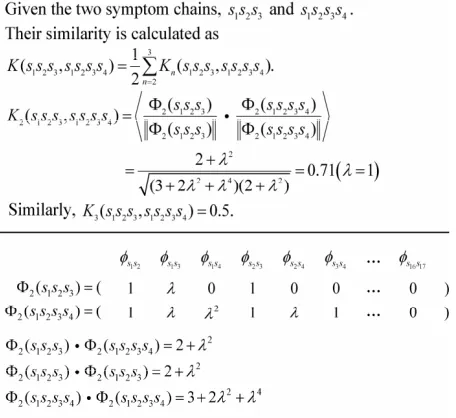
[image:5.612.314.542.73.282.2]λ is determined empirically. Figure 3 presents an example to summarize the computation of the similarity between two symptom chains.
4
Experimental Results
4.1 Experiment setup
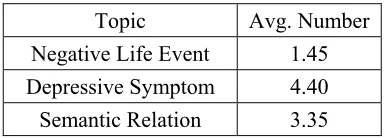
1) Corpus: The consultation documents were collected from the mental health website of the John Tung Foundation (http://www.jtf.org.tw) and the PsychPark (http://www.psychpark.org), a virtual psychiatric clinic, maintained by a group of volunteer professionals of Taiwan Association of Mental Health Informatics (Bai et al. 2001). Both of the web sites provide various kinds of free psychiatric services and update the consultation documents periodically. For privacy consideration, all personal infor-mation has been removed. A total of 3,650 consultation documents were collected for evaluating the retrieval model, of which 20 documents were randomly selected as the test query set, 100 documents were randomly se-lected as the tuning set to obtain the optimal parameter settings of involved retrieval models, and the remaining 3,530 documents were the reference set to be retrieved. Table 1 shows the average number of events, symptoms and rela-tions in the test query set.
2) Baselines: The proposed method, denoted as Topic, was compared to two word-based re-trieval models: the VSM and Okapi BM25 models. The VSM was implemented in terms of the standard TF-IDF weight. The Okapi BM25 model is defined as
(1) 1 3
2 3
( 1)
( 1)
| | ,
t Q
k qtf
k tf avdl dl
w k Q
K tf k qtf avdl dl
∈
+
+ −
+
+ + +
∑
(10)where t denotes a word in a query Q; qtf and tf
denote the word frequencies occurring in a query and a document, respectively, and w(1)
denotes the Robertson-Sparck Jones weight of
t (without relevance feedback), defined as
(1) log 0.5, 0.5
N n w
n
− + =
+ (11)
where N denotes the total number of docu-ments, and n denotes the number of documents containing t. In (10), K is defined as
1((1 ) / ),
K k= − + ⋅b b dl avdl (12)
where dl and avdl denote the length and aver-age length of a document, respectively. The default values of k1, k2, k3 and b are describe in (Robertson et al., 1996), where k1 ranges from 1.0 to 2.0; k2 is set to 0; k3 is set to 8, and b ranges from 0.6 to 0.75. Additionally, BM25 can be considered as BM15 and BM11 when b is set to 1 and 0, respectively.
3) Evaluation metric: To evaluate the retrieval models, a multi-level relevance criterion was adopted. The relevance criterion was divided into four levels, as described below.
z Level 0: No topics are matched between a query and a document.
z Level 1: At least one topic is partially matched between a query and a document.
z Level 2: All of the three topics are partially matched between a query and a document.
z Level 3: All of the three topics are partially matched, and at least one topic is exactly matched between a query and a document. To deal with the multi-level relevance, the dis-counted cumulative gain (DCG) (Jarvelin and Kekalainen, 2000) was adopted as the evalua-tion metric, defined as
[1], 1
[ ]
[ 1] [ ]/ log , otherwisec
G if i
DCG i
DCG i G i i
= ⎧⎪
= ⎨
− + ⎪⎩
(13)
where i denotes the i-th document in the re-trieved list; G[i] denotes the gain value, i.e., relevance levels, of the i-th document, and c
denotes the parameter to penalize a retrieved document in a lower rank. That is, the DCG simultaneously considers the relevance levels, and the ranks in the retrieved list to measure the retrieval precision. For instance, let <3,2,3,0,0> denotes the retrieved list of five documents with their relevance levels. If no penalization is used, then the DCG values for Topic Avg. Number
[image:6.612.87.282.69.138.2]Negative Life Event 1.45 Depressive Symptom 4.40 Semantic Relation 3.35
the retrieved list are <3,5,8,8,8>, and thus DCG[5]=8. Conversely, if c=2, then the docu-ments retrieved at ranks lower than two are pe-nalized. Hence, the DCG values for the re-trieved list are <3,5,6.89,6.89,6.89>, and DCG[5]=6.89.
The relevance judgment was performed by three experienced physicians. First, the pooling
method (Voorhees, 2000) was adopted to gen-erate the candidate relevant documents for each test query by taking the top 50 ranked documents retrieved by each of the involved retrieval models, namely the VSM, BM25 and Topic. Two physicians then judged each can-didate document based on the multilevel rele-vance criterion. Finally, the documents with disagreements between the two physicians were judged by the third physician. Table 2 shows the average number of relevant docu-ments for the test query set.
4) Optimal parameter setting: The parameter settings of BM25 and Topic were evaluated us-ing the tunus-ing set. The optimal settus-ing of BM25 were k1 =1 and b=0.6. The other two
pa-rameters were set to the default values, i.e.,
2 0
k = and k3 =8. For the Topic model, the parameters required to be evaluated include the combination factors, α and β , described in
(1); the constant const. described in (2), and the decay factor, λ, described in (9). The op-timal settings were α =0.3 ; 0.5β = ;
const.=0.6 and λ=0.8. 4.2 Retrieval results
The results are divided into two groups: the preci-sion and efficiency. The retrieval precision was measured by DCG values. Additionally, a paired, two-tailed t-test was used to determine whether the performance difference was statistically significant. The retrieval efficiency was measure by the query processing time, i.e., the time for processing all the queries in the test query set.
Table 3 shows the comparative results of re-trieval precision. The two variants of BM25, namely BM11 and BM15, are also considered in comparison. For the word-based retrieval models, both BM25 and BM11 outperformed the VSM, and BM15 performed worst. The Topic model achieved higher DCG values than both the BM-series models and VSM. The reasons are three-fold. First, a negative life event and a symptom can each be expressed by different words with the same or similar meaning. Therefore, the word-based mod-els often failed to retrieve the relevant documents when different words were used in the input query. Second, a word may relate to different events and symptoms. For instance, the term "worry about" is Relevance Level Avg. Number
[image:7.612.328.522.70.140.2]Level 1 18.50 Level 2 9.15 Level 3 2.20
Table 2. Average number of relevant documents for the test query set.
DCG(5) DCG(10) DCG(20) DCG(50) DCG(100) Topic 4.7516* 6.9298 7.6040* 8.3606* 9.3974* BM25 4.4624 6.7023 7.1156 7.8129 8.6597 BM11 3.8877 4.9328 5.9589 6.9703 7.7057 VSM 2.3454 3.3195 4.4609 5.8179 6.6945 BM15 2.1362 2.6120 3.4487 4.5452 5.7020
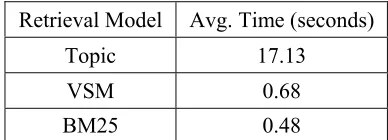
Table 3. DCG values of different retrieval models. *Topic vs BM25 significantly different (p<0.05) Retrieval Model Avg. Time (seconds)
[image:7.612.91.278.70.139.2]Topic 17.13 VSM 0.68 BM25 0.48
a good indicator for both the symptoms <Anxiety> and <Hypochondriasis>. This may result in ambi-guity for the based models. Third, the word-based models cannot capture semantic relations between symptoms. The Topic model incorporates not only the word-level information, but also more useful topic information about depressive problems, thus improving the retrieval results.
The query processing time was measured using a personal computer with Windows XP operating system, a 2.4GHz Pentium IV processor and 512MB RAM. Table 4 shows the results. The topic model required more processing time than both VSM and BM25, since identification of topics in-volves more detailed analysis, such as semantic parsing of sentences and symptom chain construc-tion. This finding indicates that although the topic information can improve the retrieval precision, incorporating such high-precision features reduces the retrieval efficiency.
5
Conclusion
This work has presented the use of topic informa-tion for retrieving psychiatric consultainforma-tion docu-ments. The topic information can provide more precise information about users' depressive prob-lems, thus improving the retrieval precision. The proposed framework can also be applied to differ-ent domains as long as the domain-specific topic information is identified. Future work will focus on more detailed experiments, including the contribu-tion of each topic to retrieval precision, the effect of using different methods to combine topic infor-mation, and the evaluation on real users.
References
Baeza-Yates, R. and B. Ribeiro-Neto. 1999. Modern
Information Retrieval. Addison-Wesley, Reading, MA.
Cancedda, N., E. Gaussier, C. Goutte, and J. M. Renders.
2003. Word-Sequence Kernels. Journal of Machine
Learning Research, 3(6):1059-1082.
Fellbaum, C. 1998. WordNet: An Electronic Lexical
Database. MIT Press, Cambridge, MA.
Hamilton, M. 1960. A Rating Scale for Depression.
Journal of Neurology, Neurosurgery and Psychiatry, 23:56-62
Jarvelin, K. and J. Kekalainen. 2000. IR Evaluation Methods for Retrieving Highly Relevant Documents.
In Proc. of the 23rd Annual International ACM SIGIR Conference on Research and Development in Information Retrieval, pages 41-48.
Lodhi, H., C. Saunders, J. Shawe-Taylor, N. Cristianini, and C. Watkins. 2002. Text Classification Using
String Kernels. Journal of Machine Learning
Re-search, 2(3):419-444.
Okabe, M., K. Umemura and S. Yamada. 2005. Query Expansion with the Minimum User Feedback by
Transductive Learning. In Proc. of HLT/EMNLP,
Vancouver, Canada, pages 963-970.
Pagano, M.E., A.E. Skodol, R.L. Stout, M.T. Shea, S. Yen, C.M. Grilo, C.A. Sanislow, D.S. Bender, T.H. McGlashan, M.C. Zanarini, and J.G. Gunderson. 2004. Stressful Life Events as Predictors of Function-ing: Findings from the Collaborative Longitudinal
Personality Disorders Study. Acta Psychiatrica
Scan-dinavica, 110: 421-429.
Robertson, S. E., S. Walker, S. Jones, M. M. Hancock-Beaulieu, and M.Gatford. 1995. Okapi at TREC-3. In
Proc. of the Third Text REtrieval Conference (TREC-3), NIST.
Robertson, S. E., S. Walker, M. M. Beaulieu, and
M.Gatford. 1996. Okapi at TREC-4. In Proc. of the
fourth Text REtrieval Conference (TREC-4), NIST. Voorhees, E. M. and D. K. Harman. 2000. Overview of
the Sixth Text REtrieval Conference (TREC-6).
In-formation Processing and Management, 36(1):3-35. Wu, C. H., L. C. Yu, and F. L. Jang. 2005a. Using
Se-mantic Dependencies to Mine Depressive Symptoms
from Consultation Records. IEEE Intelligent System,
20(6):50-58.
Wu, C. H., J. F. Yeh, and M. J. Chen. 2005b. Domain-Specific FAQ Retrieval Using Independent Aspects.
ACM Trans. Asian Language Information Processing, 4(1):1-17.
Wu, C. H., J. F. Yeh, and Y. S. Lai. 2006. Semantic Segment Extraction and Matching for Internet FAQ
Retrieval. IEEE Trans. Knowledge and Data
Engi-neering, 18(7):930-940.
Yeh, J. F., C. H. Wu, M. J. Chen, and L. C. Yu. 2004. Automated Alignment and Extraction of Bilingual Domain Ontology for Cross-Language
Domain-Specific Applications. In Proc. of the 20th COLING,
Geneva, Switzerland, pages 1140-1146.
Yu, L. C., C. H. Wu, Yeh, J. F., and F. L. Jang. 2007. HAL-based Evolutionary Inference for Pattern Induc-tion from Psychiatry Web Resources. Accepted by