Proceedings of the 2012 Student Research Workshop, pages 67–72,
Towards Automatic Construction of Knowledge Bases from Chinese Online
Resources
Liwei Chen, Yansong Feng, Yidong Chen, Lei Zou, Dongyan Zhao
Institute of Computer Science and Technology Peking University
Beijing, China
{clwclw88,fengyansong,chenyidong,zoulei,zhaodongyan}@pku.edu.cn
Abstract
Automatically constructing knowledge bases from online resources has become a crucial task in many research areas. Most existing knowledge bases are built from English re-sources, while few efforts have been made for other languages. Building knowledge bases for Chinese is of great importance on its own right. However, simply adapting existing tool-s from Englitool-sh to Chinetool-se yieldtool-s inferior re-sults.In this paper, we propose to create Chi-nese knowledge bases from online resources with less human involvement.This project will be formulated in a self-supervised framework which requires little manual work to extrac-t knowledge facextrac-ts from online encyclopedia resources in a probabilistic view.In addition, this framework will be able to update the con-structed knowledge base with knowledge facts extracted from up-to-date newswire.Currently, we have obtained encouraging results in our pilot experiments that extracting knowledge facts from infoboxes can achieve a high accu-racy of around 95%, which will be then used as training data for the extraction of plain web-pages.
1 Introduction
As the development of world wide web (WWW), the volume of web data is growing exponentially in recent years. Most of the data are unstructured, while a few are manually structured and only a s-mall part of them are machine-readable. How to make these data accessible and useable for end user-s hauser-s become a key topic in many reuser-search areauser-s,
such as information retrieval, natural language pro-cessing, semantic web(Tim et al., 2001) and so on. Among others, constructing knowledge bases (KB) from web data has been considered as a preliminary step. However, it is not trivial to extract knowledge facts from unstructured web data, especially in open domain, and the accuracy is usually not satisfacto-ry. On the other hand, with the development of We-b2.0, there are increasing volume of online encyclo-pedias which are collectively created by active vol-unteers, e.g., Wikipedia1. Surprisingly, experiment evidences show that the confidence of Wikipedia is even comparable with that of British Encyclopedi-a (Giles, 2005). Therefore, mEncyclopedi-any efforts hEncyclopedi-ave been made to distill knowledge facts from Wikipedia or similar resources and further build KBs, for example YAGO(Suchanek et al., 2007), DBpedia(Bizer et al., 2009) and KOG(Wu and Weld, 2008).
In the literature, most KBs constructed recently are in English as it takes up an overwhelming major-ity on the web, while other major languages receives less attention, for example, Chinese features similar amounts of web pages with English yet is less fre-quently studied with regarding to building KBs. Al-though continuous works have been made to process English resources, building Chinese KBs is of great value on its own. To the best of our knowledge, few efforts have been made to construct a KB in Chi-nese until now. Despite of necessary special pre-processings, e.g., word segmentation, for Chinese, building a Chinese KB from web data is quite differ-ent from building English ones, since we have lim-ited resources available in Chinese that are of lower
1http://www.wikipedia.com
quality compared to their English counterparts. This brings more difficulties than that of English. As a result, the approaches used in English may not work well in Chinese.
In this paper, we propose a new framework to build a KB in Chinese from online resources with-out much human involvement. Since the Chinese portion of Wikipedia is much smaller than its En-glish part, we harvest knowledge facts from a Chi-nese online encyclopedia, HudongBaike2. Hudong-Baike is the largest Chinese online encyclopedia and features similar managing rules and writing styles with Wikipedia. We first obtain knowledge facts by parsing the infoboxes of HudongBaike. Then we use these triples as seeds, and adopt the idea of distant supervision(Mintz et al., 2009; Riedel et al., 2010; Yao et al., 2010) to extract more facts from other HudongBaike articles and build a KB accordingly. Moreover, to make the knowledge base more up-to-date, we also propose to propagate the KB with news events.
The rest of this paper is organized as follows: we first introduce the related work, and briefly introduce two online encyclopedias. In Section 4 we describe our framework in detail. Our current work are dis-cussed in Section 5. In Section 6 we conclude this paper.
2 Related Work
KB construction is an important task and has at-tracted many research efforts from artificial intelli-gence, information retrieval, natural language pro-cessing, and so on. Traditional KBs are most-ly manualmost-ly created, including WordNet(Stark and Riesenfeld, 1998), Cyc or OpenCyc(Matuszek et al., 2006), SUMO(Niles and Pease, 2001), and also some domain-specific ontologies such as GeneOn-tology3. These KBs achieve a high accuracy since they are manually built or filtered by domain ex-perts. However, manually creating KB is a time-consuming and labor-intensive work, and continu-ous annotation is required to keep the KB up-to date. Most of them thus suffers from the coverage issue in practice.
In recent years, many researchers turn to
auto-2http://www.hudong.com 3http://www.geneontology.org
matically extract knowledge to construct KBs. One kind of methods extract knowledge facts from gener-al text corpus. These approaches, such as TextRun-ner(Banko et al., 2007) and KnowItAll(Etzioni et al., 2004), use rule based information extraction tech-nologies to extract relations between entity pairs. Recently, TextRunner is expanded by a life long learning strategy, which can acquire new facts. An-other type of approaches aims to automatically de-rive facts from online encyclopedias. Collectively created by many volunteers, online encyclopedias are more reliable than general web pages. They al-so contain semi-structured knowledge such as hand-crafted infoboxes. Therefore, the accuracy of the facts extracted will be higher. Researchers utilize these semi-structured data resources for knowledge extraction, for example, YAGO extract facts from in-foboxes and category names of Wikipedia, and use WordNet as its taxonomy(Suchanek et al., 2007). A similar approach is adopted by DBpedia, which also extract knowledge facts from infoboxes(Bizer et al., 2009). Unlike YAGO and DBpedia, Kylin us-es the infoboxus-es and the Wikipedia pagus-es containing these infoboxes to build a training set, and use ma-chine learning methods to extract facts from plain Wikipedia articles(Wu and Weld, 2007). Although Kylin achieves a high precision, it is corpus-specific, which means it can only be used in Wikipedia-like corpora. It is noticed that all the above works fo-cus on building an English KB, and few efforts have been made in building a Chinese one until now.
3 Online Encyclopedia
Wikipedia is known as an accurate online encyclo-pedia whose accuracy is comparable with Encyclo-pedia Britannica(Giles, 2005). It’s created by thou-sands of volunteers around the whole world. Until now, the English version of Wikipedia has 3,878,200 content pages, making it the largest English on-line encyclopedia. The Chinese version contains 402,781 content pages, which is much smaller than the English version.
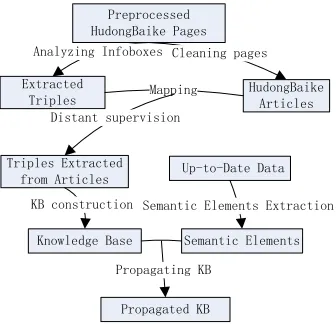
Preprocessed HudongBaike Pages
Extracted
Triples HudongBaike Articles
Triples Extracted from Articles
Knowledge Base
Up-to-Date Data
Semantic Elements
Propagated KB Analyzing Infoboxes Cleaning pages
Mapping
Distant supervision
KB construction Semantic Elements Extraction
[image:3.612.95.263.63.225.2]Propagating KB
Figure 2: The framework of Our project
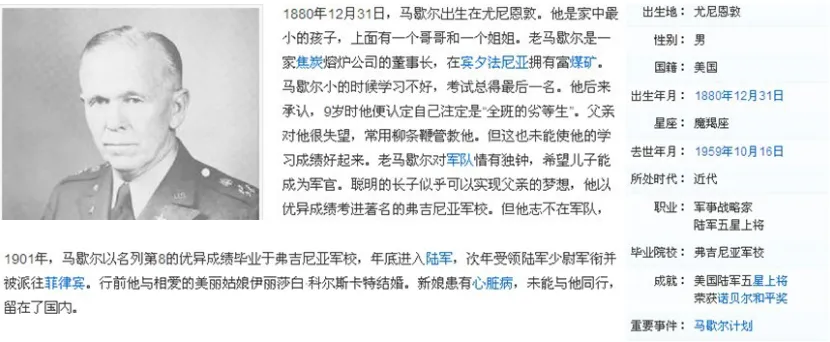
a hand-crafted summary box,infobox. An infobox summarizes the knowledge of the corresponding en-tity. The information in the infobox is reliable since these are collaboratively crafted by many volunteer-s. Figure 1 is an example page with an infobox from HudongBaike, introducing a US general
(George Marshall).
4 The Framework
In this paper, we formulated the KB construction task in a semi-supervised learning fashion which re-quires little manual annotation and supports knowl-edge propagation by up-to-date feeds. Because the Chinese part of Wikipedia is relatively smal-l and may suffer from the coverage probsmal-lem, we use HudongBaike to build our KB in this project. In fu-ture we may merge the Wikipedia part into our KB. After necessary preprocessings including word seg-mentation and named entity extraction, we are able to apply our framework shown in Figure 2.
In general, our framework contains the follow-ing steps: (1)Extractfollow-ing knowledge from online encyclopedia; (2)Linking triples and building KB; (3)Propagating KB with up-to-date data.
4.1 Entity Relation Extraction
Compared to other resources on the Web, online encyclopedias contain less noises and feature more regular structures, thus are considered easier for us to extract knowledge facts.
Analyzing Infoboxes As mentioned before, many HudongBaike pages contains an infobox, which has high accuracy and can be used directly for relation extraction. We can conveniently parse these infoboxes into < S, P, O > triples. For example, from the first entry of this infobox, we can derive the following triple: <
, , >(<
GeorgeM arshall, BirthP lace, U niontown >). The precision of the extraction is over 95%, and these triples can form a valuable knowledge source.
Extracting relations with Distant Supervision
Extracting knowledge from infoboxes is efficien-t and can achieve a high precision. However, many web pages in HudongBaike do not have infoboxes. There is much richer knowledge in the main arti-cles of HudongBaike, which we should also take in-to consideration.
Extracting knowledge from unstructured articles is a challenging task. Traditionally, researchers use manually created templates to extract relation-s. These templates need lots of human efforts and are domain-specific. Recent methods trend to re-ly on machine learning models, which need a large amount of labeled data. One idea is to utilize the infoboxes to form the training data set, and train an extractor to extract relations from the pages with-out an infobox(Wu and Weld, 2007). However, the relations extracted from a page are restricted to the infobox template used by the current page catego-ry, and their subject must be the entity that this page describes. For example, when we extract relation-s from the page of (Charles Yeager, Ace of US in WWII) which does not contain an in-fobox, the subject of these relations must be Charles Yeager, and we can only extract the relation types listed in infobox template for a military person. As a result, this method can only be used in online en-cyclopedias in a Wikipedia style, and the recall will be relatively low.
en-Figure 1: A HudongBaike page about a US general George Marshall
tities should express the relation between them more or less. It only needs a reliable seed KB (in the form of relation triples) and a corpus. Here, we can use the knowledge facts extracted from infoboxes previ-ously as the seed KB, and the articles of Hudong-Baike as text corpus. For each triple in the seed K-B, we generate positive training data by finding sen-tences containing both its subject and object in the corpus. For example, we can map the first entry in Figure 1 to the sentence 18801231 (On December 31th, 1880, Mar-shall was born in Uniontown). The negative training data can be generated by randomly select some sen-tences which contain neither of the subject and the object. A predictive model such as logistic regres-sion model is trained with the training data. We can use the model to give predictions for the relations in a textual knowledge source. For a HudongBaike page, we should decide the entity pairs we are in-terested in. A simple strategy is to select all entity pairs. But it will be time-consuming, and may suffer from weak-related entity pairs. So we extract top-ic entities whtop-ich have high tfidf weights from this page, and generate entity pairs under the restriction that they must contain at least one topic entity. For each entity pair, we find the sentences which contain both the subject and object and use the predictive model to give the possible relations between them and the confidence of the relations.
However, the predictions of distant supervision is less accurate than those of supervised method-s. So we should adopt some heuristics to filter the
relations extracted. An easy strategy is to set up a threshold for relation confidences to avoid uncertain relations and improve the precision. We adopt this method in our project. Furthermore, we can also use the strategies of Riedel et al. (2010) or Yao et al. (2010).
4.2 Knowledge Base Construction
After the relation extraction, we must link the ex-tracted knowledge triples in order to construct the knowledge base. In our scenario this linking task can be formulated as: given a base KB, a bunch of newly extracted knowledge triples with the sentences de-scribing them and their contexts, the task of entity linking aims to link each of the entity mentions in the plain texts (these sentences mentioned above) to its corresponding entity in the base KB. At the very beginning, we initiate a base KB by using the taxon-omy of HudongBaike thus are able to map relations between entities into the KB through entity linking.
In online encyclopedias, the synonyms of an en-tity are represented by redirect links. Synonyms are important in entity linking because they provide al-ternative names for entities, and we may miss some mappings without them. For example, we have an entity (United States of America)
in the KB, and an mention (USA) in a piece
[image:4.612.98.513.59.230.2]fuzzy matching since a mention may not match ex-actly with its referent entity in KB.
Now we need to solve the entity linking task. Tra-ditional methods did not exploit global interdepen-dence between entity linking decisions. We thus adopt the collective entity linking approach of Han et al. (2011) to solve this problem. This method cap-tures the rich semantic relatedness knowledge be-tween entities, and take the interdependence of link-ing decisions into consideration. They construct a graph by linking name mentions and candidate enti-ties in pairwise using the semantic relatedness be-tween them. Then they use a random walk algo-rithm on the graph to solve the problem. However, they did not take the NIL problem into considera-tion. That is, in entity linking, if the referent enti-ty of an name mention is not in our KB, it should be linked to a pseudo entity NIL. In our case, we should abandon the mapping of the current triple by deciding whether this entity has been listed in the KB(Zheng et al., 2010).
4.3 Knowledge base Propagation
Although we can extract millions of relations and built a KB in previous subsections, it has the same shortage as most existing KBs: the knowledge ex-tracted are mostly statical attributes of entities (such as birthdate or occupation of a person) and can not describe the latest updates of an entity (such as a politician is currently visiting a country).
In order to settle this problem, we use the dy-namical knowledge extracted from up-to-date data to expand our KB. One possible solution is extract-ing semantic event elements from online news. In this project, we will synchronies our KB with a Chi-nese newspaper, RenMinRiBao (People’s Daily).
5 Current Work
Currently, we have extracted triples from the in-foboxes of HudongBaike and built the base KB. Manual evaluation shows that the precision of struc-tured content extraction is over 95%. Most errors are caused by the web page’s own mistakes or edit-ing errors in infoboxes.
To assess the quality of HudongBaike data, in our preliminary experiments(Yidong et al., 2012), we extract relation facts from plain HudongBaike
arti-cles without infoboxes in a way similar to Kylin. We focus on three categories, including (Nation), (Person) and (Actor or Actress). In each
category we select several representative attributes from its infobox template. We manually annotated more than 200 testing examples for evaluation: 100 in Person, 33 in Nation and 91 in Actor or Actress. The results shows that the HudongBaike data can be used to extract knowledge facts with a high precision in all three categories: in the average precision is 79.43%, in it is 78.9%, and in it even
goes up to 90.8%.
Distant Supervision We further adopt the ap-proach of distant supervision(Mintz et al., 2009) in a Chinese dataset. We generate a dataset from Ren-MinRiBao with 10000 sentences, and each sentence contains at least a pair of entities which correspond to a knowledge triple in HudongBaike’s infobox ex-traction. We use 60% of the sentences as training set and 40% as the testing set. Our experiments show that when the recall is 10%, we can obtain a high precision of 87%, which indicates the feasibili-ty of our model. However, as the recall raises, the precision drops dramatically. For example, when the recall is 29% the precision is about 65%. This can be remedied by adopting more encyclopedia-specific filtering strategies and assumptions during the distant supervision modeling.
6 Conclusions
In this project, we proposed a framework to build KBs in Chinese. It uses the infoboxes of Hudong-Baike as a seed knowledge base, the articles of HudongBaike as extra textual resources, adopts the idea of distant supervision to extract knowledge fact-s from unfact-structured data and link the triplefact-s to build a knowledge base. This framework requires lit-tle manual work, and can be used in other reliable knowledge resources. Our preliminary experimental results are encouraging, showing that the Hudong-Baike provides reasonable resources for building knowledge bases and the distant supervision fashion can be adapted to work well in Chinese.
is high enough for bootstrapping. Then we put the extracted knowledge facts into the seed KB, and the framework will repeat iteratively. On the other hand, we can extract knowledge facts from other reliable knowledge resource, such as Wikipedia, academic literature, and merge knowledge from different re-sources into one KB. Moreover, we can also make our KB multilingual by adopting our framework in other languages.
References
Banko, M., Cafarella, M. J., Soderland, S., Broad-head, M., and Etzioni, O. (2007). Open informa-tion extracinforma-tion from the web. InProceedings of IJCAI, IJCAI’07, pages 2670–2676.
Bizer, C., Lehmann, J., Kobilarov, G., Auer, S., Becker, C., Cyganiak, R., and Hellmann, S. (2009). Dbpedia - a crystallization point for the web of data.Web Semant., 7:154–165.
Etzioni, O., Cafarella, M., Downey, D., Kok, S., Popescu, A.-M., Shaked, T., Soderland, S., Weld, D. S., and Yates, A. (2004). Web-scale informa-tion extracinforma-tion in knowitall. InProceedings of the 13th WWW, WWW ’04, pages 100–110.
Giles, J. (2005). Internet encyclopaedias go head to head.Nature, 438:900–901.
Han, X., Sun, L., and Zhao, J. (2011). Collective entity linking in web text: a graph-based method. InSIGIR, SIGIR ’11, pages 765–774, New York, NY, USA. ACM.
Matuszek, C., Cabral, J., Witbrock, M., and DeO-liveira, J. (2006). An introduction to the syntax and content of cyc. InProceedings of the 2006 AAAI Spring Symposium.
Mintz, M., Bills, S., Snow, R., and Jurafsky, D. (2009). Distant supervision for relation extraction without labeled data. InProceedings of the Joint Conference of the 47th Annual Meeting of the A-CL and the 4th IJCNLP of the AFNLP: Volume 2 - Volume 2, ACL ’09, pages 1003–1011.
Niles, I. and Pease, A. (2001). Towards a standard upper ontology. InProceedings of FIOS - Volume 2001, pages 2–9. ACM Press, New York.
Riedel, S., Yao, L., and McCallum, A. (2010). Modeling relations and their mentions without la-beled text. InMachine Learning and Knowledge
Discovery in Databases, volume 6323 of Lec-ture Notes in Computer Science, pages 148–163. Springer Berlin / Heidelberg.
Stark, M. M. and Riesenfeld, R. F. (1998). Wordnet: An electronic lexical database. InProceedings of 11th Eurographics Workshop on Rendering. MIT Press.
Suchanek, F. M., Kasneci, G., and Weikum, G. (2007). Yago: a core of semantic knowledge. InProceedings of WWW, WWW ’07, pages 697– 706, New York, NY, USA. ACM.
Tim, B.-L., J., H., and O., L. (2001). The semantic web. Scientific American.
Wu, F. and Weld, D. S. (2007). Autonomously semantifying wikipedia. In CIKM, CIKM ’07, pages 41–50, New York, NY, USA. ACM. Wu, F. and Weld, D. S. (2008). Automatically
re-fining the wikipedia infobox ontology. InWWW, WWW ’08, pages 635–644, New York, NY, USA. ACM.
Yao, L., Riedel, S., and McCallum, A. (2010). Col-lective cross-document relation extraction with-out labelled data. In Proceedings of EMNLP, EMNLP ’10, pages 1013–1023, Stroudsburg, PA, USA. Association for Computational Linguistics. Yidong, C., Liwei, C., and Kun, X. (2012). Learning chinese entity attributes from online encyclopedi-a. In Proceedings of IEKB workshop in APWeb 2012.