Towards a Computational History of the ACL: 1980–2008
Ashton Anderson
Stanford University [email protected]
Dan McFarland
Stanford University [email protected]
Dan Jurafsky
Stanford University [email protected]
Abstract
We develop a people-centered computational history of science that tracks authors over top-ics and apply it to the history of computa-tional linguistics. We present four findings in this paper. First, we identify the topical subfields authors work on by assigning auto-matically generated topics to each paper in the ACL Anthology from 1980 to 2008. Next, we identify four distinct research epochs where the pattern of topical overlaps are stable and different from other eras: an early NLP pe-riod from 1980 to 1988, the pepe-riod of US government-sponsored MUC and ATIS eval-uations from 1989 to 1994, a transitory period until 2001, and a modern integration period from 2002 onwards. Third, we analyze the flow of authors across topics to discern how some subfields flow into the next, forming dif-ferent stages of ACL research. We find that the government-sponsored bakeoffs brought new researchers to the field, and bridged early top-ics to modern probabilistic approaches. Last, we identify steep increases in author retention during the bakeoff era and the modern era, suggesting two points at which the field be-came more integrated.
1 Introduction
The rise of vast on-line collections of scholarly pa-pers has made it possible to develop a computational history of science. Methods from natural language processing and other areas of computer science can be naturally applied to study the ways a field and its ideas develop and expand (Au Yeung and Jatowt, 2011; Gerrish and Blei, 2010; Tu et al., 2010; Aris et al., 2009). One particular direction in computational
history has been the use of topic models (Blei et al., 2003) to analyze the rise and fall of research top-ics to study the progress of science, both in general (Griffiths and Steyvers, 2004) and more specifically in the ACL Anthology (Hall et al., 2008).
We extend this work with a more people-centered view of computational history. In this framework, we examine the trajectories of individual authors across research topics in the field of computational linguistics. By examining a single author’s paper topics over time, we can trace the evolution of her academic efforts; by superimposing these individual traces over each other, we can learn how the entire field progressed over time. One goal is to investi-gate the use of these techniques for computational history in general. A second goal is to use the ACL Anthology Network Corpus (Radev et al., 2009) and the incorporated ACL Anthology Reference Corpus (Bird et al., 2008) to answer specific questions about the history of computational linguistics. What is the path that the ACL has taken throughout its 50-year history? What roles did various research topics play in the ACL’s development? What have been the piv-otal turning points?
Our method consists of four steps. We first run topic models over the corpus to classify papers into topics and identify the topics that people author in.
We then use these topics to identify epochs by cor-relating over time the number of persons that topics share in common. From this, we identify epochs as sustained patterns of topical overlap.
Our third step is to look at the flow of authors be-tween topics over time to detect patterns in how au-thors move between areas in the different epochs. We group topics into clusters based on when au-thors move in and out of them, and visualize the flow
of people across these clusters to identify how one topic leads to another.
Finally, in order to understand how the field grows and declines, we examine patterns of entry and exit within each epoch, studying how author retention (the extent to which authors keep publishing in the ACL) varies across epochs.
2 Identifying Topics
Our first task is to identify research topics within computational linguistics. We use the ACL Anthol-ogy Network Corpus and the incorporated ACL An-thology Reference Corpus, with around 13,000 pa-pers by approximately 11,000 distinct authors from 1965 to 2008. Due to data sparsity in early years, we drop all papers published prior to 1980.
We ran LDA on the corpus to produce 100 genera-tive topics (Blei et al., 2003). Two senior researchers in the field (the third author and Chris Manning) then collaboratively assigned a label to each of the 100 topics, which included marking those topics which were non-substantive (lists of function words or af-fixes) to be eliminated. They produced a consensus labeling with 73 final topics, shown in Table 1 (27 non-substantive topics were eliminated, e.g. a pro-noun topic, a suffix topic, etc.).
Each paper is associated with a probability distri-bution over the 100 original topics describing how much of the paper is generated from each topic. All of this information is represented by a matrix P, where the entry Pij is simply the loading of topic j on paperi(since each row is a probability distri-bution,P
jPij = 1). For ease of interpretation, we
sparsify the matrixP by assigning papers to topics and thus set all entries to either 0 or 1. We do this by choosing a thresholdT and setting entries to 1 if they exceed this threshold. If we call the new ma-trixQ, Qij = 1 ⇐⇒ Pij ≥ T. Throughout all
our analyses we useT = 0.1. This value is approx-imately two standard deviations aboveP, the mean of the entries inP. Most papers are assigned to 1 or 2 topics; some are assigned to none and some are assigned to more.
This assignment of papers to topics also induces an assignment of authors to topics: an author is as-signed to a topic if she authored a paper asas-signed to that topic. Furthermore, this assignment is
natu-rally dynamic: since every paper is published in a particular year, authors’ topic memberships change over time. This fact is at the heart of our methodol-ogy — by assigning authors to topics in this princi-pled way, we can track the topics that authors move through. Analyzing the flow of authors through ics enables us to learn which topics beget other top-ics, and which topics are related to others by the peo-ple that author across them.
3 Identifying Epochs
What are the major epochs of the ACL’s history? In this section, we seek to partition the years spanned by the ACL’s history into clear, distinct periods of topical cohesion, which we refer to as epochs. If the dominant research topics people are working on suddenly change from one set of topics to another, we view this as a transition between epochs.
To identify epochs that satisfy this definition, we generate a set of matrices (one for each year) de-scribing the number of people that author in every pair of topics during that year. For year y, let Ny
be a matrix such that Nijy is the number of people that author in both topics iandj in year y (where authoring in topicjmeans being an author on a pa-perp such that Qpj = 1). We don’t normalize by
the total number of people in each topic, thus pro-portionally representing bigger topics since they ac-count for more research effort than smaller topics. Each matrix is a signature of which topic pairs have overlapping author sets in that year.
From these matrices, we compute a final matrix
Cof year-year correlations. Cij is the Pearson
cor-relation coefficient betweenNi andNj.Ccaptures the degree to which years have similar patterns of topic authorship overlap, or the extent to which a consistent pattern of topical research is formed. We visualizeCas a thermal in Figure 1.
Number Name Topics
1 Big Data
NLP
Statistical Machine Translation (Phrase-Based): bleu, statistical, source, target, phrases, smt, reordering Dependency Parsing: dependency/ies, head, czech, depen, dependent, treebank
MultiLingual Resources: languages, spanish, russian, multilingual, lan, hindi, swedish Relation Extraction: pattern/s, relation, extraction, instances, pairs, seed
Collocations/Compounds: compound/s, collocation/s, adjectives, nouns, entailment, expressions, MWEs Graph Theory + BioNLP: graph/s, medical, edge/s, patient, clinical, vertex, text, report, disease Sentiment Analysis: question/s, answer/s, answering, opinion, sentiment, negative, positive, polarity 2 Probabilistic
Methods
Discriminative Sequence Models: label/s, conditional, sequence, random, discriminative, inference
Metrics + Human Evaluation: human, measure/s, metric/s, score/s, quality, reference, automatic, correlation, judges Statistical Parsing: parse/s, treebank, trees, Penn, Collins, parsers, Charniak, accuracy, WSJ
ngram Language Models: n-gram/s, bigram/s, prediction, trigram/s, unigram/s, trigger, show, baseline Algorithmic Efficiency: search, length, size, space, cost, algorithms, large, complexity, pruning Bilingual Word Alignment: alignment/s, align/ed, pair/s, statistical, source, target, links, Brown
ReRanking: score/s, candidate/s, list, best, correct, hypothesis, selection, rank/ranking, scoring, top, confidence Evaluation Metrics: precision, recall, extraction, threshold, methods, filtering, extract, high, phrases, filter, f-measure Methods (Experimental/Evaluation): experiments, accuracy, experiment, average, size, 100, baseline, better, per, sets Machine Learning Optimization: function, value/s, parameter/s, local, weight, optimal, solution, criterion, variables
3 Linguistic
Supervision
Biomedical Named Entity Recognition: biomedical, gene, term, protein, abstracts, extraction, biological Word Segmentation: segment/ation, character/s, segment/s, boundary/ies, token/ization
Document Retrieval: document/s, retrieval, query/ies, term, relevant/ance, collection, indexing, search SRL/Framenet: argument/s, role/s, predicate, frame, FrameNet, predicates, labeling, PropBank Wordnet/Multilingual Ontologies: ontology/ies, italian, domain/s, resource/s, i.e, ontological, concepts WebSearch + Wikipedia: web, search, page, xml, http, engine, document, wikipedia, content, html, query, Google Clustering + Distributional Similarity: similar/ity, cluster/s/ing, vector/s, distance, matrix, measure, pair, cosine, LSA Word Sense Disambiguation: WordNet, senses, disambiguation, WSD, nouns, target, synsets, Yarowsky
Machine Learning Classification: classification, classifier/s, examples, kernel, class, SVM, accuracy, decision Linguistic Annotation: annotation/s/ed, agreement, scheme/s, annotators, corpora, tools, guidelines Tutoring Systems: student/s, reading, course, computer, tutoring, teaching, writing, essay Chunking/Memory Based Models: chunk/s/ing, pos, accuracy, best, memory-based, Daelemans
Named Entity Recognition: entity/ies, name/s/d, person, proper, recognition, location, organization, mention Dialog: dialogue, utterance/s, spoken, dialog/ues, act, interaction, conversation, initiative, meeting, state, agent Summarization: topic/s, summarization, summary/ies, document/s, news, articles, content, automatic, stories 4 Discourse Multimodal (Mainly Generation): object/s, multimodal, image, referring, visual, spatial, gesture, reference, description
Text Categorization: category/ies, group/s, classification, texts, categorization, style, genre, author Morphology: morphological, arabic, morphology, forms, stem, morpheme/s, root, suffix, lexicon Coherence Relations: relation, rhetorical, unit/s, coherence, texts, chains
Spell Correction: error/s, correct/ion, spelling, detection, rate
Anaphora Resolution: resolution, pronoun, anaphora, antecedent, pronouns, coreference, anaphoric Question Answering Dialog System: response/s, you, expert, request, yes, users, query, question, call, database UI/Natural Language Interface: users, database, interface, a71, message/s, interactive, access, display Computational Phonology: phonological, vowel, syllable, stress, phonetic, phoneme, pronunciation Neural Networks/Human Cognition: network/s, memory, acquisition, neural, cognitive, units, activation, layer Temporal IE/Aspect: event/s, temporal, tense, aspect, past, reference, before, state
Prosody: prosody/ic, pitch, boundary/ies, accent, cues, repairs, phrases, spoken, intonation, tone, duration
5 Early
Probability
Lexical Acquisition Of Verb Subcategorization: class/es, verb/s, paraphrase/s, subcategorization, frames
Probability Theory: probability/ies, distribution, probabilistic, estimate/tion, entropy, statistical, likelihood, parameters Collocations Measures: frequency/ies, corpora, statistical, distribution, association, statistics, mutual, co-occurrences POS Tagging: tag/ging, POS, tags, tagger/s, part-of-speech, tagged, accuracy, Brill, corpora, tagset
Machine Translation (Non Statistical + Bitexts): target, source, bilingual, translations, transfer, parallel, corpora 6 Automata Automata Theory: string/s, sequence/s, left, right, transformation, match
Tree Adjoining Grammars: trees, derivation, grammars, TAG, elementary, auxiliary, adjoining Finite State Models (Automata): state/s, finite, finite-state, regular, transition, transducer Classic Parsing: grammars, parse, chart, context-free, edge/s, production, CFG, symbol, terminal Syntactic Trees: node/s, constraints, trees, path/s, root, constraint, label, arcs, graph, leaf, parent
7 Classic
Linguistics
Planning/BDI: plan/s/ning, action/s, goal/s, agent/s, explanation, reasoning Dictionary Lexicons: dictionary/ies, lexicon, entry/ies, definition/s, LDOCE,
Linguistic Example Sentences: John, Mary, man, book, examples, Bill, who, dog, boy, coordination, clause Syntactic Theory: grammatical, theory, functional, constituent/s, constraints, LFG
Formal Computational Semantics: semantics, logic/al, scope, interpretation, meaning, representation, predicate Speech Acts + BDI: speaker, utterance, act/s, hearer, belief, proposition, focus, utterance
PP Attachment: ambiguity/ies/ous, disambiguation, attachment, preference, preposition Natural Language Generation: generation/ing, generator, choice, generated, realization, content Lexical Semantics: meaning/s, semantics, metaphor, interpretation, object, role
Categorial Grammar/Logic: proof, logic, definition, let, formula, theorem, every, iff, calculus Syntax: clause/s, head, subject, phrases, object, verbs, relative, nouns, modifier
Unification Based Grammars: unification, constraints, structures, value, HPSG, default, head Concept Ontologies / Knowledge Rep: concept/s, conceptual, attribute/s, relation, base 8 Government MUC-Era Information Extraction: template/s, message, slot/s, extraction, key, event, MUC, fill/s
Speech Recognition: recognition, acoustic, error, speaker, rate, adaptation, recognizer, phone, ASR ATIS dialog: spoken, atis, flight, darpa, understanding, class, database, workshop, utterances
9 Early NLU 1970s-80s NLU Work: 1975-9, 1980-6, computer, understanding, syntax, semantics, ATN, Winograd, Schank, Wilks, lisp Code Examples: list/s, program/s, item/s, file/s, code/s, computer, line, output, index, field, data, format
[image:3.612.84.528.60.674.2]Speech Parsing And Understanding: frame/s, slot/s, fragment/s, parse, representation, meaning
Figure 1: Year-year correlation in topic authoring patterns. Hotter colors indicate high correlation, colder colors denote low correlation.
state of flux in which authors are constantly chang-ing the topics they are in. As such, we refer to this period as a transitory epoch. Thus our analysis has identified four main epochs in the ACL corpus between 1980 and 2008: three focused periods of work, and one transitory phase.
These epochs correspond to natural eras in the ACL’s history. During the 1980’s, there were co-herent communities of research on natural language understanding and parsing, generation, dialog, uni-fication and other grammar formalizations, and lex-icons and ontologies.
The 1989–1994 era corresponds to a number of important US government initiatives: MUC, ATIS, and the DARPA workshops. The Message Under-standing Conferences (MUC) were an early initia-tive in information extraction, set up by the United States Naval Oceans Systems Center with the sup-port of DARPA, the Defense Advanced Research Projects Agency. A condition of attending the MUC workshops was participation in a required evalua-tion (bakeoff) task of filling slots in templates about events, and began (after an exploratory MUC-1 in 1987) with MUC-2 in 1989, followed by MUC-3 (1991), 4 (1992), 5 (1993) and MUC-6 (1995) (Grishman and Sundheim, 199MUC-6). The Air Travel Information System (ATIS) was a task for measuring progress in spoken language
under-standing, sponsored by DARPA (Hemphill et al., 1990; Price, 1990). Subjects talked with a system to answer questions about flight schedules and air-line fares from a database; there were evaluations in 1990, 1991, 1992, 1993, and 1994 (Dahl et al., 1994). The ATIS systems were described in pa-pers at the DARPA Speech and Natural Language Workshops, a series of DARPA-sponsored worksh-sop held from 1989–1994 to which DARPA grantees were strongly encouraged to participate, with the goal of bringing together the speech and natural lan-guage processing communities.
After the MUC and ATIS bakeoffs and the DARPA workshops ended, the field largely stopped publishing in the bakeoff topics and transitioned to other topics; participation by researchers in speech recognition also dropped off significantly. From 2002 onward, the field settled into the modern era characterized by broad multilingual work and spe-cific areas like dependency parsing, statistical ma-chine translation, information extraction, and senti-ment analysis.
In summary, our methods identify four major epochs in the ACL’s history: an early NLP period, the “government” period, a transitory period, and a modern integration period. The first, second, and fourth epochs are periods of sustained topical co-herence, whereas the third is a transitory phase dur-ing which the field moved from the bakeoff work to modern-day topics.
4 Identifying Participant Flows
In the previous section, we used topic co-membership to identify four coherent epochs in the ACL’s history. Now we turn our attention to a finer-grained question: How do scientific areas or move-ments arise? How does one research area develop out of another as authors transition from a previous research topic to a new one? We address this ques-tion by tracing the paths of authors through topics over time, in aggregate.
4.1 Topic Clustering
the flow across adjacent single years is noisy and of-ten does not accurately reflect shifts in topical fo-cus. For each adjacent pair of time periods (for ex-ample, 1980–1982 and 1983–1985), we construct a matrixS capturing author flow between each topic pair, where the Sij entry is the number of authors
who authored in topiciduring the first time period and authored in topic j during the second time pe-riod. These matrices capture people flow between topics over time.
Next we compute similarity between topics. We represent each topic by its flow profile, which is sim-ply the concatenation of all its in- and out-flows in all of theSmatrices. More formally, letFibe the
re-sulting vector after concatenating thei-th row (trans-posed into a column) and i-th column of every S
matrix. We compute a topic-topic similarity matrix
T where Tij is the Pearson correlation coefficient
between Fi and Fj. Two topics are then similar
if they have similar flow profiles. Note that topics don’t need to share authors to be similar — authors just need to move in and out of them at roughly the same times. Through this approach, we identify top-ics that play similar roles in the ACL’s history.
To find a grouping of topics that play similar roles, we perform hierarchical complete link clustering on the T matrix. The goal is to identify clusters of topics that are highly similar to each other but are dissimilar from those in other clusters. Hierarchi-cal clustering begins with every topic forming a sin-gleton cluster, then iteratively merges the two most similar clusters at every step until there is only one cluster of all topics remaining. Every step gives a different clustering solution, so we assess clus-ter fitness using Krackhard and Sclus-tern’s E-I index, which measures the sum of external ties minus the sum of internal ties divided by the sum of all ties. Given T as an input, the E-I index optimizes iden-tical profiles as clusters (i.e., topic stages), not dis-crete groups. The optimal solution we picked using the E-I index entails 9 clusters (shown in Table 1), numbered roughly backwards from the present to the past. We’ll discuss the names of the clusters in the next section.
4.2 Flows Between Topic Clusters
Now that we have grouped topics into clusters by how authors flow in and out of them, we can
com-pute the flow between topics or between topic clus-ters over time. First we define what a flow between topics is. We use the same flow matrix used in the above topic clustering: the flow between topiciin one time period and topicjin the following time pe-riod is simply the number of authors present in both at the respective times. Again we avoid normaliz-ing because the volume of people movnormaliz-ing between topics is relevant.
Now we can define flow between clusters. LetA be the set of topics in clusterC1and letBbe the set
of topics in clusterC2. We define the flow between
C1 andC2 to be the average flow between topics in AandB:
f(C1, C2) =
P
A∈A,B∈Bf(A, B) |A| · |B|
(where f(A, B) represents the topic-topic flow defined above). We also tried defining cluster-cluster flow as the maximum over all topic-topic flows between the clusters, and the results were qualitatively the same.
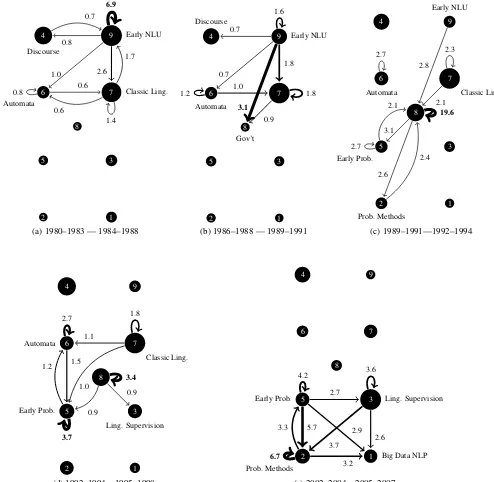
Figure 2 shows the resulting flows between clus-ters. Figure 2a shows the earliest period in our (post-1980) dataset, where we see reflections of ear-lier natural language understanding work by Schank, Woods, Winograd, and others, quickly leading into a predominance of what we’ve called “Classic Lin-guistic Topics”. Research in this period is charac-terized by a more linguistically-oriented focus, in-cluding syntactic topics like unification and catego-rial grammars, formal syntactic theory, and preposi-tional phrase attachments, linguistic semantics (both lexical semantics and formal semantics), and BDI dialog models. Separately we see the beginnings of a movement of people into phonology and discourse and also into the cluster we’ve called “Automata”, which at this stage includes (pre-statistical) Parsing and Tree Adjoining Grammars.
In Figure 2b we see the movement of people into the cluster of government-sponsored topics: the ATIS and MUC bakeoffs, and speech.
Acqui-8
7 Classic Ling.
9 Early NLU
6
Automata
4
Discourse
5
2
3
1 6.9
2.6 0.8
1.0
1.7
1.4 0.6
0.8 0.6
0.7
(a) 1980–1983 — 1984–1988
8
Gov’t
7
9 Early NLU
6
Automata
4
Discourse
5
2
3
1 3.1
1.8 1.6
0.7
0.7
1.2 1.0
0.9
1.8
(b) 1986–1988 — 1989–1991
8
7
Classic Ling.
9
Early NLU
6
Automata
4
5
Early Prob.
2
Prob. Methods
3
1 19.6
3.1
2.6
2.8
2.7
2.1 2.7
2.4 2.3
2.1
(c) 1989–1991—1992–1994
8
7
Classic Ling.
9
6
Automata
4
5
Early Prob.
2
3
Ling. Supervision
1 3.7
1.2 2.7
1.5
1.8
1.1
1.0
3.4
0.9
0.9
(d) 1992–1994—1995–1998
8
7 9
6 4
5
Early Prob.
2
Prob. Methods
3 Ling. Supervision
1 Big Data NLP
6.7
3.3
3.2 3.7
3.6
2.6 5.7
4.2
2.9 2.7
[image:6.612.75.569.109.591.2](e) 2002–2004—2005–2007
sition of Verb Subcategorization. People also begin to move specifically from the MUC Bakeoffs into a second cluster we call Probabilistic Methods, which in this very early stage focused on Evaluations Met-rics and Experimental/Evaluation Methods. People working in the “Automata” cluster (Tree Adjoining Grammar, Parsing, and by this point Finite State Methods) continue working in these topics.
By Figure 2d, the Early Probability topics are very central, and probabilistic terminology and early tasks (tagging, collocations, and verb subcategoriza-tion) are quite popular. People are now moving into a new cluster we call “Linguistic Supervised”, a set of tasks that apply supervised machine learning (usually classification) to tasks for which the gold la-bels are created by linguists. The first task to appear in this area was Named Entity Recognition, popu-lated by authors who had worked on MUC, and the core methods topics of Machine Learning Classifi-cation and Linguistic Annotation. Other tasks like Word Sense Disambiguation soon followed.
By Figure 2e, people are leaving Early Probabil-ity topics like part of speech tagging, collocations, and non-statistical MT and moving into the Linguis-tic Supervised (e.g., SemanLinguis-tic Role Labeling) and Probabilistic Methods topics, which are now very central. In Probabilistic Methods, there are large groups of people in Statistical Parsing and N-grams. By the end of this period, Prob Methods is sending authors to new topics in Big Data NLP, the biggest of which are Statistical Machine Translation and Sen-timent Analysis.
In sum, the patterns of participant flows reveal how sets of topics assume similar roles in the his-tory of the ACL. In the initial period, authors move mostly between early NLP and classic linguistics topics. This period of exchange is then transformed by the arrival of government bakeoffs that draw au-thors into supervised linguistics and probabilistic topics. Only in the 2000’s did the field mature and begin a new period of cohesive exchange across a variety of topics with shared statistical methods.
5 Member Retention and Field Integration
How does the ACL grow or decline? Do authors come and go, or do they stay for long periods? How much churn is there in the author set? How do these
1980 1985 1990 1995 2000 2005
First year of time frame
0.2 0.3 0.4 0.5 0.6 0.7
Au
tho
r r
ete
nti
[image:7.612.321.520.61.258.2]on
Figure 3: Overlap of authors in successive 3-year time periods over time. The x-axis indicates the first year of the 6-year time window being consid-ered. Vertical dotted lines indicate epoch bound-aries, where a year is a boundary if the first time period is entirely in one epoch and the second is en-tirely in the next.
trends align with the epochs we identified? To ad-dress these questions, we examine author retention over time — how many authors stay in the field ver-sus how many enter or exit.
epoch, the field is in its infancy: authors are work-ing in a stable set of topics, but author retention is relatively low. Once the bakeoff epoch starts, au-thor retention jumps significantly — people stay in the field as they continue to work on bakeoff pa-pers. As soon as the bakeoffs end, the overlap in authors drops again. The fact that author retention rocketed upwards during the bakeoff epoch is pre-sumably caused by the strong external funding in-centive attracting external authors to enter and re-peatedly publish in these conferences.
To understand whether this drop in overlap of au-thors was indeed indicative of auau-thors who entered the field mainly for the bakeoffs, we examined au-thors who first published in the database in 1989. Of the 50 most prolific such authors (those with more than 8 publications in the database), 25 (exactly half) were speech recognition researchers. Of those 25 speech researchers, 16 exited (never published again in the ACL conferences) after the bakeoffs. But 9 (36%) of them remained, mainly by adapting their (formerly speech-focused) research areas to-ward natural language processing topics. Together, these facts suggest that the government-sponsored period led to a large influx of speech recognition researchers coming to ACL conferences, and that some fraction of them remained, continuing with natural language processing topics.
Despite the loss of the majority of the speech recognition researchers at the end of the bakeoff period, the author retention curve doesn’t descend to pre-bakeoff levels: it stabilizes at a consistently higher value during the transitory epoch. This may partly be due to these new researchers colonizing and remaining in the field. Or it may be due to the increased number of topics and methods that were developed during the government-sponsored period. Whichever it is, the fact that retention didn’t return to its previous levels suggests that the government sponsorship that dominated the second epoch had a lasting positive effect on the field.
In the final epoch, author retention monotonically increases to its highest-ever levels; every year the rate of authors publishing continuously rises, as does the total number of members, suggesting that the ACL community is coalescing as a field. It is plau-sible that this final uptick is due to funding — gov-ernmental, industrial, or otherwise — and it is an
in-teresting direction for further research to investigate this possibility.
In sum, we observe two epochs where member retention increases: the era of government bakeoffs (1989–1994) and the more recent era where NLP has received significantly increased industry interest as well as government funding (2002–2008). These eras may thus both be ones where greater external demand increased retention and cohesion.
6 Conclusion
We offer a new people-centric methodology for computational history and apply it to the AAN to produce a number of insights about the field of com-putational linguistics.
Our major result is to elucidate the many ways in which the government-sponsored bakeoffs and workshops had a transformative effect on the field in the early 1990’s. It has long been understood that the government played an important role in the field, from the early support of machine translation to the ALPAC report. Our work extends this understand-ing, showing that the government-supported bake-offs and workshops from 1989 to 1994 caused an in-flux of speech scientists, a large percentage of whom remained after the bakeoffs ended. The bakeoffs and workshops acted as a major bridge from early linguistic topics to modern probabilistic topics, and catalyzed a sharp increase in author retention.
The significant recent increase in author overlap also suggests that computational linguistics is in-tegrating into a mature field. This integration has drawn on modern shared methodologies of statistical methods and their application to large scale corpora, and may have been supported by industry demands as well as by government funding. Future work will be needed to see whether the current era is one much like the bakeoff era with an outflux of persons once funding dries up, or if it has reached a level of matu-rity reflective of a well-established discipline.
Acknowledgments
References
A. Aris, B. Shneiderman, V. Qazvinian, and D. Radev. 2009. Visual overviews for discovering key papers and influences across research fronts. Journal of the Amer-ican Society for Information Science and Technology, 60(11):2219–2228.
C. Au Yeung and A. Jatowt. 2011. Studying how the past is remembered: towards computational history through large scale text mining. In Proceedings of the 20th ACM international conference on Information and knowledge management, pages 1231–1240. ACM. S. Bird, R. Dale, B.J. Dorr, B. Gibson, M. Joseph, M.Y. Kan, D. Lee, B. Powley, D.R. Radev, and Y.F. Tan. 2008. The acl anthology reference corpus: A refer-ence dataset for bibliographic research in computa-tional linguistics. In Proc. of the 6th International Conference on Language Resources and Evaluation Conference (LREC’08), pages 1755–1759.
D. M. Blei, A. Y. Ng, and M. I. Jordan. 2003. Latent Dirichlet allocation. Journal of Machine Learning Re-search, 3(5):993–1022.
D.A. Dahl, M. Bates, M. Brown, W. Fisher, K. Hunicke-Smith, D. Pallett, C. Pao, A. Rudnicky, and E. Shriberg. 1994. Expanding the scope of the atis task: The atis-3 corpus. InProceedings of the work-shop on Human Language Technology, pages 43–48. Association for Computational Linguistics.
S. Gerrish and D.M. Blei. 2010. A language-based ap-proach to measuring scholarly impact. In Proceed-ings of the 26th International Conference on Machine Learning.
T.L. Griffiths and M. Steyvers. 2004. Finding scien-tific topics. Proceedings of the National Academy of Sciences of the United States of America, 101(Suppl 1):5228.
R. Grishman and B. Sundheim. 1996. Message under-standing conference-6: A brief history. InProceedings of COLING, volume 96, pages 466–471.
David Hall, Daniel Jurafsky, and Christopher D. Man-ning. 2008. Studying the history of ideas using topic models. InProceedings of EMNLP 2008.
C.T. Hemphill, J.J. Godfrey, and G.R. Doddington. 1990. The atis spoken language systems pilot corpus. In Pro-ceedings of the DARPA speech and natural language workshop, pages 96–101.
P. Price. 1990. Evaluation of spoken language systems: The atis domain. InProceedings of the Third DARPA Speech and Natural Language Workshop, pages 91– 95. Morgan Kaufmann.
D.R. Radev, P. Muthukrishnan, and V. Qazvinian. 2009. The acl anthology network corpus. InProceedings of the 2009 Workshop on Text and Citation Analysis for
Scholarly Digital Libraries, pages 54–61. Association for Computational Linguistics.