Proceedings of the 2012 Student Research Workshop, pages 1–6,
A Broad Evaluation of Techniques for Automatic
Acquisition of Multiword Expressions
Carlos Ramisch
♣,♠, Vitor De Araujo
♣, Aline Villavicencio
♣ ♣Federal University of Rio Grande do Sul (Brazil)
♠
GETALP — LIG, University of Grenoble (France)
{ceramisch, vbuaraujo, avillavicencio}@inf.ufrgs.br
Abstract
Several approaches have been proposed for the au-tomatic acquisition of multiword expressions from corpora. However, there is no agreement about which of them presents the best cost-benefit ratio, as they have been evaluated on distinct datasets and/or languages. To address this issue, we investigate these techniques analysing the following dimen-sions: expression type (compound nouns, phrasal verbs), language (English, French) and corpus size. Results show that these techniques tend to extract similar candidate lists with high recall (∼80%) for nominals and high precision (∼70%) for verbals. The use of association measures for candidate filter-ing is useful but some of them are more onerous and not significantly better than raw counts. We finish with an evaluation of flexibility and an indication of which technique is recommended for each language-type-size context.
1
Introduction
Taking into account multiword expressions (MWEs) is important to confer naturalness to the output of NLP sys-tems. An MT system, for instance, needs to be aware of idiomatic expressions likeraining cats and dogsto avoid literal translations.1Likewise, a parser needs to deal with verb-particle expressions liketake off from Parisand with light verb constructions liketake a walk along the river
in order to avoid PP-attachment errors.
Even though the last decade has seen considerable re-search in the automatic acquisition of MWEs, both in theoretical and in computational linguistics, to date there are few NLP applications integrating explicit MWE treat-ment. This may be partly explained by the complexity of MWEs: as they are heterogeneous and flexible, there is no unique push-button approach to identify all types of MWEs in all languages (Sag et al., 2002). Existing ap-proaches are either generic but present relatively low
pre-1The equivalent expressions in French would beraining ropes, in
Germanraining young dogs, in Portugueseraining Swiss knives, etc.
cision or they require a large amount of language-specific resources to yield good results.
The goal of this paper is to evaluate approaches for the automatic acquisition of MWEs from corpora (§2), exam-ining as parameters of the experimental context the lan-guage (English and French), type of target MWE (verbal and nominal) and size of corpus (small, medium, large). We focus on 4 approaches2and the experimental setup is presented in §3. In §4 we evaluate the following acqui-sition dimensions: quality of extracted candidates and of association measures, use of computational resources and flexibility. Thus, this research presents a comparative in-vestigation of available approaches and indicates the best cost-benefit ratio in a given context (language, type, cor-pus size), pointing out current limitations and suggesting future avenues of research for the field.
2
MWE Acquisition Approaches
Efforts for the evaluation of MWE acquisition approaches usually focus on a single technique or compare the qual-ity of association measures (AMs) used to rank a fixed annotated list of MWEs. For instance, Evert and Krenn (2005) and Seretan (2008) specifically evaluate and anal-yse the lexical AMs used in MWE extraction on small samples of bigram candidates. Pearce (2002), systemat-ically evaluates a set of techniques for MWE extraction on a small test set of English collocations. Analogously, Pecina (2005) and Ramisch et al. (2008) present exten-sive comparisons of individual AMs and of their combi-nation for MWE extraction in Czech, German and En-glish. There have also been efforts for the extrinsic eval-uation of MWEs for NLP applications such as informa-tion retrieval (Xu et al., 2010), word sense disambigua-tion (Finlayson and Kulkarni, 2011) and MT (Carpuat and Diab, 2010).
One recent initiative aiming at more comparable
eval-2We consider only freely available, downloadable and openly
docu-mented tools. Therefore, outside the scope of this work are proprietary tools, terminology and lexicography tools, translation aid tools and pub-lished techniques for which no available implementation is provided.
uations of MWE acquisition approaches was in the form of a shared task (Grégoire et al., 2008). However, the present work differs from the shared task in its aims. The latter considered only the ranking of precompiled MWE lists using AMs or linguistic filters at the end of extrac-tion. However, for many languages and domains, no such lists are available. In addition, the evaluation results pro-duced for the shared task may be difficult to generalise, as some of the evaluations prioritized the precision of the techniques without considering the recall or the novelty of the extracted MWEs. To date little has been said about the practical concerns involving MWE acquisition, like computational resources, flexibility or availability. With this work, we hope to help filling this gap by performing a broad evaluation of theacquisition process as a whole, considering many different parameters.
We focus on 4 approaches for MWE acquisition from corpora, which follow the general trend in the area of us-ing shallow lus-inguistic (lemmas, POS, stopwords) and/or statistical (counts, AMs) information to distinguishing ordinary sequences (e.g.yellow dress, go to a concert) from MWEs (e.g.black box,go by a name). In addition to the brief description below, Section 4.4 underlines the main differences between the approaches.
1. LocalMaxs3 extracts MWEs by generating all
pos-sible n-grams from a sentence and then filtering them based on the local maxima of the AM’s dis-tribution (Silva and Lopes, 1999). It is based purely on word counts and is completely language independent, but it is not possible to directly in-tegrate linguistic information in order to target a specific type of construction.4 The evaluation includes both LocalMaxs Strict which prioritizes high precision (henceforthLocMax-S) and Local-Maxs Relaxedwhich focuses on high recall (hence-forthLocMax-R). A variation of the original algo-rithm, SENTA, has been proposed to deal with non-contiguous expressions (da Silva et al., 1999). How-ever, it is computationally costly5 and there is no freely available implementation.
2. MWE toolkit6 (mwetk) is an environment for
type and language-independent MWE acquisition, integrating linguistic and frequency information (Ramisch et al., 2010). It generates a targeted list of MWE candidates extracted and filtered according to user-defined criteria like POS sequences and a set
3http://hlt.di.fct.unl.pt/luis/multiwords/
index.html
4Although this can be simulated by concatenating words and POS
tags together in order to form a token.
5It is based on the calculation of all possiblen-grams in a
sen-tence, which explode in number when going from contiguous to
non-contiguousn-grams.
6http://mwetoolkit.sourceforge.net
[image:2.612.328.523.67.118.2]Small Medium Large # sentences 5,000 50,000 500,000 #enwords 133,859 1,355,482 13,164,654 #frwords 145,888 1,483,428 14,584,617 Table 1: Number of sentences and of words of each fragment of the Europarl corpus infrand inen.
of statistical AMs. It is an integrated framework for MWE treatment, providing from corpus preprocess-ing facilities to the automatic evaluation of the re-sulting list with respect to a reference. Its input is a corpus annotated with POS, lemmas and depen-dency syntax, or if these are not available, raw text. 3. Ngram Statistics Package7 (NSP) is a traditional
approach for the statistical analysis of n-grams in texts (Pedersen et al., 2011). It provides tools for countingn-grams and calculating AMs, where ann -gram is a sequence ofnwords occurring either con-tiguously or within a window ofwwords in a sen-tence. While most of the measures are only appli-cable to bigrams, some of them are also extended to trigrams and 4-grams. The set of available AMs in-cludes robust and theoretically sound measures such as log-likelihood and Fischer’s exact test. Although there is no direct support to linguistic information such as POS, it is possible to simulate them to some extent using the same workaround as forLocMax. 4. UCS toolkit8 provides a large set of sophisticated
AMs. It focuses on high accuracy calculations for bigram AMs, but unlike the other approaches, it starts from a list of candidates and their respec-tive frequencies, relying on external tools for corpus preprocessing and candidate extraction. Therefore, questions concerning contiguousn-grams and sup-port of linguistic filters are not dealt with byUCS. In our experiments, we will use the list of candidates generated bymwetkas input forUCS.
As the focus of this work is on MWE acquisition (iden-tification and extraction), other tasks related to MWE treatment, namely interpretation, classification and appli-cations (Anastasiou et al., 2009), are not considered in this paper. This is the case, for instance, of approaches for dictionary-based in-context MWE token identification requiring an initial dictionary of valid MWEs, like jMWE (Kulkarni and Finlayson, 2011).
3
Experimental Setup
For comparative purposes, we investigate the acquisition of MWEs in two languages, English (en) and French
7http://search.cpan.org/dist/Text-NSP
(fr), analysing nominal and verbal expressions inenand nominal infr,9obtained with the following rules:
• Nominal expressionsen: a noun preceded by a se-quence of one or more nouns or adjectives, e.g. Eu-ropean Union,clock radio,clown anemone fish.
• Nominal expressionsfr: a noun followed by either an adjective or a prepositional complement (with the prepositions de, à and en) followed by an option-ally determined noun, e.g.algue verte,aliénation de bien,allergie à la poussière.
• Verbal expressionsen: verb-particle constructions formed by a verb (exceptbeandhave) followed by a prepositional particle10 not further than 5 words after it, e.g.give up,switch the old computer off.
To test the influence of corpus size on performance, three fragments of the en and fr parts of the Eu-roparl corpus v311 were used as test corpora: (S)mall, (M)edium and (L)arge, summarised in Table 1.
The extracted MWEs were automatically evaluated against the following gold standards: WordNet 3, the Cambridge Dictionary of Phrasal Verbs, and the VPC (Baldwin, 2008) and CN (Kim and Baldwin, 2008) datasets12foren; the Lexique-Grammaire13forfr. The total number of entries is listed below, along with the number of entries occurring at least twice in each cor-pus (in parentheses), which was the denominator used to calculate recall in § 4.1:
• Nominal expressionsen: 59,683 entries (S: 122,M: 764,L: 2,710);
• Nominal expressionsfr: 69,118 entries (S: 220,M: 1,406,L: 4,747);
• Verbal expressions en: 1,846 entries (S: 699, M: 1,846,L: 1,846).
4
Evaluation Results
The evaluation of MWE acquisition is an open problem. While classical measures like precision and recall assume that a complete (or at least broad-coverage) gold standard exists, manual annotation of top-ncandidates and mean average precision (MAP) are labour-intensive even when applied to a small sample, emphasizing precision regard-less of the number of acquirednewexpressions. As ap-proaches differ in the way they allow the description of extraction criteria, we evaluate candidate extraction sep-arately from AMs.
9Asfrdoes not present many verb-particle constructions and due
to the lack of availability of resource for other types offrverbal
ex-pressions (e.g. light verb constructions), only nominal exex-pressions are considered.
10up, off, down, back, away, in, on.
11http://www.statmt.org/europarl/
12The latter are available fromhttp://multiword.sf.net/
13http://infolingu.univ-mlv.fr/
LocMax-S LocMax-R
mwetk
NSP UCS
LocMax-S LocMax-R
mwetk
NSP UCS
LocMax-S LocMax-R
mwetk
NSP UCS en-noun fr-noun en-verb
0% 10% 20% 30% 40% 50% 60% 70% 80% 90% 100%
[image:3.612.314.534.66.215.2]Precision Recall F-measure
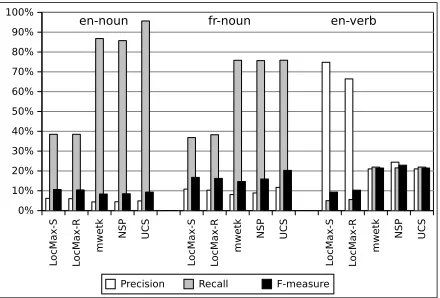
Figure 1: Quality of candidates extracted from medium corpus, comparison across languages/MWE types.
4.1 Extracted Candidates
We consider as MWE candidates the initial set of se-quences before any AM is applied. Candidate extraction is performed through the application of patterns describ-ing the target MWEs in terms of POS sequences, as de-scribed in § 3. To minimise potential cases of noise, can-didates occurring only once in the corpus were discarded. We compare the quality of these candidates in terms of (P)recision, (R)ecall and (F)-measure using the gold stan-dard references described in § 3. These measures are un-derestimations as they assume that candidates not in the gold standard are false MWEs, whereas they may simply be absent due to coverage limitations.
The quality of candidates extracted from the medium-size corpus (M) varies across MWE types/languages, as shown in Figure 1. The candidates forUCSare obtained by keeping only the bigrams in the candidate list returned by themwetk. For nominal MWEs, the approaches have similar patterns of performance in the two languages, with high recall and low precision yielding an F-measure of around 10 to 15%. The variation betweenenandfr
can be partly explained by the differences in size of the gold standards for each of these languages. Further re-search would be needed to determine to what degree the characteristics of these languages and the set of extraction patterns influence these results. For verbal expressions,
LocMaxhas high precision (around 70%) but low recall while the other approaches have more balanced P and R values around 20%. This is partly due to the need for simulating POS filters for extraction of verbal MWE can-didates withLocMax. The filter consists of keeping only contiguousn-grams in which the first and the last words matched verb+particle pattern and removing intervening words.
grep-S M L
LocMax-S
P 7.53% 6.18% 4.50%
R 42.62% 38.48% 37.42%
LocMax-R
P 7.46% 6.02% —
R 42.62% 38.48% —
P-mwetk
P 6.50% 4.40% 2.35%
R 83.61% 86.78% 89.23%
NSP
P 6.61% 4.46% 2.48%
R 83.61% 85.73% 89.41%
UCS
P 6.96% 4.91% 2.77%
R 96.19% 95.65% 96.88%
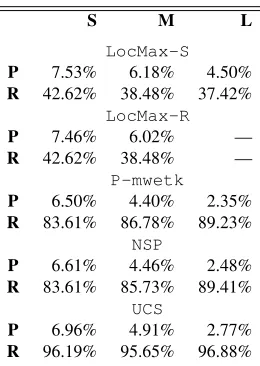
Table 2: (P)recision and (R)ecall of ennominal candidates, comparison across corpus sizes (S)mall, (M)edium and (L)arge. like filters after extraction; (ii) there is no preliminary fil-tering inmwetkandNSP, they simply return all candi-dates matching a pattern, whileLocMaxfilters the candi-dates based on the local maxima criterion; (iii)LocMax
only extracts contiguous candidates while the others al-low discontiguous candidates. The waymwetkandNSP
extract discontiguous candidates differs: the former ex-tracts all verbs with particles no further than 5 positions to the right. NSPextracts bigrams in a window of 5 words, and then filters the list keeping only those in which the first word is a verb and that contain a particle. However, the results are similar, with slightly better values forNSP. The evaluation ofennominal candidates according to corpus size is shown in Table 2.14 For all approaches, precision decreases when the corpus size increases as more noise is returned, while recall increases for all ex-cept LocMax. This may be due to the latter ignoring smallern-grams when larger candidates containing them become sufficiently frequent, as is the case when the cor-pus increases. Table 3 shows that the candidates extracted byLocMaxare almost completely covered by the candi-dates extracted by the other approaches. The relaxed ver-sion extracts slighly more candidates, but still much less thanmwetk,NSP andUCS, which all extract a similar set of candidates. In order to distinguish the performance of the approaches, we need to analyse the AMs they use to rank the candidates.
4.2 Association Measures
Traditionally, to evaluate an AM, the candidates are ranked according to it and a threshold value is applied, below which the candidates are discarded. However, if we average the precision considering all true MWEs as
14It was not possible to evaluateLocMax-Ron the large corpus as
the provided implementation did not support corpora of this magnitude.
LocMax-S LocMax-R mwetk NSP UCS Total
v
erbs
LocMax-S — 124 124 122 124 124
LocMax-R 4747 — 156 153 156 156
mwetk 4738 4862 — 1565 1926 1926
NSP 4756 4879 14611 — 1565 1629
UCS 4377 4364 13407 13045 — 1926 Total nouns 4760 4884 15064 14682 13418
Table 3: Intersection of the candidate lists extracted from medium corpus. Nominal candidatesenin bottom left, verbal candidatesenin top right.
threshold points, we obtain the mean average precision (MAP) of the measure without setting a hard threshold.
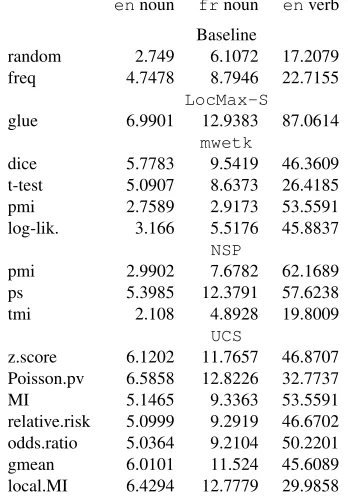
Table 4 presents the MAP values for the tested AMs15 applied to the candidates extracted from the large cor-pus (L), where the larger the value, the better the perfor-mance. We used as baseline the assignment of a random score and the use of the raw frequency for the candidates. Except formwetk:tandmwetk:pmi, all MAP values are significantly different from the two baselines, with a two-tailed t test for difference of means assuming unequal sample sizes and variances (p-value<0.005).
TheLocMax:glueAM performs best for all types of MWEs, suggesting local maxima as a good generic MWE indicator and glue as an efficient AM to generate highly precise results (considering the difficulty of this task). On the other hand this approach returns a small set of candidates and this may be problematic depending on the task (e.g. for building a wide-coverage lexicon). For
mwetk, the best overall AM is the Dice coefficient; the other measures are not consistently better than the base-line, or perform better for one MWE type than for the other. The Poisson-Stirling (ps) measure performed quite well, while the other two measures tested forNSP per-formed below baseline for some cases. Finally, as we ex-pected, the AMs applied byUCSperform all above base-line and, for nominal MWEs, are comparable to the best AM (e.g. Poisson.pv and local.MI). The MAP for verbal expressions varies much forUCS(from 30% to 53% ), but none of the measures comes close to the MAP of the glue (87.06%). None of the approaches provides a straightfor-ward method to choose or combine different AMs.
4.3 Computational resources
In the decision of which AM to adopt, factors like the de-gree of MWE flexibility and computational performance may be taken into account. For instance, the Dice coef-ficient can be applied to any length ofn-gram quite fast
15Due to length limitations, we cannot detail the calculation of the
[image:4.612.122.252.64.247.2] [image:4.612.320.527.64.184.2]ennoun frnoun enverb Baseline
random 2.749 6.1072 17.2079
freq 4.7478 8.7946 22.7155
LocMax-S
glue 6.9901 12.9383 87.0614
mwetk
dice 5.7783 9.5419 46.3609
t-test 5.0907 8.6373 26.4185
pmi 2.7589 2.9173 53.5591
log-lik. 3.166 5.5176 45.8837
NSP
pmi 2.9902 7.6782 62.1689
ps 5.3985 12.3791 57.6238
tmi 2.108 4.8928 19.8009
UCS
z.score 6.1202 11.7657 46.8707 Poisson.pv 6.5858 12.8226 32.7737
MI 5.1465 9.3363 53.5591
relative.risk 5.0999 9.2919 46.6702 odds.ratio 5.0364 9.2104 50.2201
gmean 6.0101 11.524 45.6089
[image:5.612.311.534.65.213.2]local.MI 6.4294 12.7779 29.9858 Table 4: Mean average precision of AMs in large corpus. while more sophisticated measures like Poisson.pv can be applied only to 2-grams and sometimes use much com-putational resources. Even if one could argue that we can be lenient towards a slow offline extraction process, the extra waiting may not be worth a slight quality improve-ment. Moreover, memory limitations are an issue if no large computer clusters are available.
In Figure 2, we plotted in log-scale the time in sec-onds used by each approach to extract nominal and ver-bal expressions inen, using a dedicated 2.4GHz quad-core Linux machine with 4Gb RAM. For nominal expres-sions, time increases linearly with the size of the corpus, whereas for verbal expressions it seems to increase faster than the size of the corpus. UCSis the slowest approach for both MWE types whileNSPandLocMax-Sare the fastest. However, it is important to emphasize thatNSP
consumed more than 3Gb memory to extract 4- and 5-grams from the large corpus andLocMax-Rcould not handle the large corpus at all. In theory, all techniques can be applied to arbitrarily large corpora if we used a map-reduce approach (e.g.NSPprovides tools to split and join the corpus). However, the goal of this evaluation is to dis-cover the performance of the techniques with no manual optimization. In this sense,mwetkseems to provide an average trade-off between quality and resources used.
4.4 Flexibility
Table 5 summarises the characteristics of the approaches. Among them,UCSdoes not extract candidates from cor-pora but takes as input a list of bigrams and their counts.
S M L
Corpus size 10
100 1000 10000
Time (log seconds)
en verb en nou
n LocMax-SLocMax-R mwetk NSP UCS LocMax-S LocMax-R mwetk NSP UCS
Figure 2: Time (seconds, log scale) to extractennouns (bold line) and verbs (dashed line) from corpora.
LocMax mwetk NSP UCS
Candidate extraction Yes Yes Yes No N-grams withn>2 Yes Yes Yes No
Discontiguous MWE No Yes Yes —
Linguistic filter No Yes No No
Robust AMs No No Yes Yes
Large corpora Partly Yes Yes No
Availability Free Free Free Free Table 5: Summary of tools for MWE acquisition. While it only supportsn-grams of size 2, NSP imple-ments some of the AMs for 3 and 4-grams andmwetk
andLocMaxhave no constraint on the number of words.
LocMaxextracts only contiguous MWEs whilemwetk
allows the extraction of unrestrictedly distant words and
NSPallows the specification of a window of maximumw
ignored words between each two words of the candidate. Only mwetkintegrates linguistic filters on the lemma, POS and syntactic annotation, but this was performed us-ing external tools (sed/grep) for the other approaches with similar results. The AMs implemented byLocMaxand
mwetkare conceived for any size ofn-gram and are thus less statistically sound than the clearly designed measures used byUCSand, to some extent, byNSP(Fisher test). The large corpus used in our experiments was not sup-ported byLocMax-Rversion, butLocMax-Shas a ver-sion that deals with large corpora, as well asmwetkand
NSP. Finally, all of these approaches are freely available for download and documented on the web.
5
Conclusions and future work
[image:5.612.100.274.72.322.2]mwetkandNSPreturning more candidates (they cover most of the nominal MWEs in the corpus) but hav-ing lower precision. LocMax-S presented a remark-ably high precision for verbal expressions. However, the choice of an AM may not only take into ac-count its MAP but also its flexibility and the compu-tational resources used. Our results suggest that the approaches could be combined using machine learn-ing (Pecina, 2005). The data used in our experi-ments is available athttp://www.inf.ufrgs.br/ ~ceramisch/?page=downloads/mwecompare.
In the future, we would like to develop this evaluation further by taking into account other characteristics such as the domain and genre of the source corpus. Such eval-uation would be useful to guide future research on spe-cialised multiword terminology extraction, determining differences with respect to generic MWE extraction. We would also like to evaluate other MWE-related tasks (e.g. classification, interpretation) and also dictionary-based identification (Kulkarni and Finlayson, 2011) and bilin-gual MWE acquisition (Carpuat and Diab, 2010). Fi-nally, we believe that an application-based extrinsic eval-uation involving manual validation of candidates would ultimately demonstrate the usefulness of current MWE acquisition techniques.
Acknowledgements
This work was partly funded by the CAMELEON project (CAPES–COFECUB 707-11).
References
Dimitra Anastasiou, Chikara Hashimoto, Preslav Nakov, and Su Nam Kim, editors. 2009. Proc. of the ACL Workshop on MWEs: Identification, Interpretation, Disambiguation, Ap-plications (MWE 2009), Suntec, Singapore, Aug. ACL. Timothy Baldwin. 2008. A resource for evaluating the deep
lexical acquisition of english verb-particle constructions. In Grégoire et al. (Grégoire et al., 2008), pages 1–2.
Marine Carpuat and Mona Diab. 2010. Task-based evaluation of multiword expressions: a pilot study in statistical machine translation. InProc. of HLT: The 2010 Annual Conf. of the NAACL (NAACL 2003), pages 242–245, Los Angeles, Cali-fornia, Jun. ACL.
Joaquim Ferreira da Silva, Gaël Dias, Sylvie Guilloré, and José Gabriel Pereira Lopes. 1999. Using localmaxs algorithm for the extraction of contiguous and non-contiguous multiword lexical units. InProceedings of the 9th Portuguese Confer-ence on Artificial IntelligConfer-ence: Progress in Artificial Intelli-gence, EPIA ’99, pages 113–132, London, UK. Springer. Stefan Evert and Brigitte Krenn. 2005. Using small random
samples for the manual evaluation of statistical association measures. Comp. Speech & Lang. Special issue on MWEs, 19(4):450–466.
Mark Finlayson and Nidhi Kulkarni. 2011. Detecting multi-word expressions improves multi-word sense disambiguation. In Kordoni et al. (Kordoni et al., 2011), pages 20–24.
Nicole Grégoire, Stefan Evert, and Brigitte Krenn, editors. 2008. Proc. of the LREC Workshop Towards a Shared Task for MWEs (MWE 2008), Marrakech, Morocco, Jun. Su Nam Kim and Timothy Baldwin. 2008. Standardised
evalu-ation of english noun compound interpretevalu-ation. In Grégoire et al. (Grégoire et al., 2008), pages 39–42.
Valia Kordoni, Carlos Ramisch, and Aline Villavicencio, edi-tors. 2011.Proc.of the ACL Workshop on MWEs: from Pars-ing and Generation to the Real World (MWE 2011), Portland, OR, USA, Jun. ACL.
Nidhi Kulkarni and Mark Finlayson. 2011. jMWE: A java toolkit for detecting multi-word expressions. In Kordoni et al. (Kordoni et al., 2011), pages 122–124.
Éric Laporte, Preslav Nakov, Carlos Ramisch, and Aline Villav-icencio, editors. 2010. Proc.of the COLING Workshop on MWEs: from Theory to Applications (MWE 2010), Beijing, China, Aug. ACL.
Darren Pearce. 2002. A comparative evaluation of collocation extraction techniques. InProc. of the Third LREC (LREC 2002), Las Palmas, Canary Islands, Spain, May. ELRA. Pavel Pecina. 2005. An extensive empirical study of
collo-cation extraction methods. InProc. of the ACL 2005 SRW, pages 13–18, Ann Arbor, MI, USA, Jun. ACL.
Ted Pedersen, Satanjeev Banerjee, Bridget McInnes, Saiyam Kohli, Mahesh Joshi, and Ying Liu. 2011. The ngram statistics package (text::NSP) : A flexible tool for identify-ing ngrams, collocations, and word associations. In Kordoni et al. (Kordoni et al., 2011), pages 131–133.
Carlos Ramisch, Paulo Schreiner, Marco Idiart, and Aline Villavicencio. 2008. An evaluation of methods for the ex-traction of multiword expressions. In Grégoire et al. (Gré-goire et al., 2008), pages 50–53.
Carlos Ramisch, Aline Villavicencio, and Christian Boitet. 2010. Multiword expressions in the wild? the mwetoolkit comes in handy. In Yang Liu and Ting Liu, editors, Proc. of the 23rd COLING (COLING 2010) — Demonstrations, pages 57–60, Beijing, China, Aug. The Coling 2010 Orga-nizing Committee.
Ivan Sag, Timothy Baldwin, Francis Bond, Ann Copestake, and Dan Flickinger. 2002. Multiword expressions: A pain in the neck for NLP. InProc. of the 3rd CICLing (CICLing-2002), volume 2276/2010 ofLNCS, pages 1–15, Mexico City, Mex-ico, Feb. Springer.
Violeta Seretan. 2008. Collocation extraction based on syn-tactic parsing. Ph.D. thesis, University of Geneva, Geneva, Switzerland.
Joaquim Silva and Gabriel Lopes. 1999. A local maxima method and a fair dispersion normalization for extracting multi-word units from corpora. InProceedings of the Sixth Meeting on Mathematics of Language (MOL6), pages 369– 381, Orlando, FL, USA, Jul.