Deformation and Texture Evolution during High-Speed
Rolling of AZ31 Magnesium Sheets
Hiroaki Koh
*, Tetsuo Sakai, Hiroshi Utsunomiya and Satoshi Minamiguchi
* Division of Materials and Manufacturing Science, Graduate School of Engineering,Osaka University, Suita 565-0871, Japan
Deformation of AZ31 sheets during high-speed rolling at various temperatures was investigated. The thickness of 2.5 mm was reduced 60% by single-pass operation at a speed of 2000 m/min. Textures, microstructures, mechanical properties and bendability of the sheets processed were examined. In the sheets rolled at elevated temperature, equiaxed fine grains (<5mm) having a basal texture with double peaks were formed around the center of the thickness. The surface layer was sheared very severely by friction to form coarse grains having a well-developed basal texture with a single peak. With increasing the rolling temperature, the grain size increases and the texture weakens slightly at the center. The bendability of the sheet improves with increasing the rolling temperature. The cold-rolled sheet having a deformation microstructure with shear bands and twins shows limited ductility. [doi:10.2320/matertrans.L-MRA2007875]
(Received March 6, 2007; Accepted June 13, 2007; Published July 19, 2007)
Keywords: high-speed rolling, grain refinement, basal texture, workability, shear texture
1. Introduction
Although magnesium alloy sheets are now used for laptop computer casings and automotive parts, the amount of rolled sheet is still limited compared with those of castings and extrusions. This is due to the insufficient workability related to thehcpstructure and to limited slip systems in cold and warm deformation. Rolling of magnesium alloy often results in edge cracks or sheet fracture. Magnesium alloy sheets are manufactured by careful multi-pass operation of small draught with intermediate annealing. The rolls are often heated to avoid temperature drop during rolling. Magnesium alloy sheets show reduced productivity and high expense. In addition, the rolled sheets inevitably show a strong basal texture,i.e.,½0001==ND, which deteriorates the formabil-ity. In particular, the basal texture at the surface deteriorates the bendability considerably due to the compression twinning followed by fracture.1,2) If the sheets with high workability are supplied at reasonable prices, applications of magnesium alloys to automotive industries should be expanded.
The authors have reported that the deformability is remarkably improved by high-speed rolling (>200m/min) and that heavy draught (>50%) is applicable without fracture even at room temperature.3–5) The working limits of some magnesium alloy sheets have been reported.3–5)The major reason for this improvement in rollability is the decrease in heat transfer from the sheet to the rolls due to the short contact time. The microstructure of the sheets processed has been mapped as a function of the rolling temperature and the reduction in thickness.6)It is also notable that a sheet with a fine-grained microstructure and excellent mechanical proper-ties is obtained by high-speed rolling at 423–473 K by dynamic recrystallization.5) These effects of high-speed rolling were recently confirmed at Freiburg.7)Though limited textures of the high-speed rolled sheets have been present-ed,8)the evolution mechanism has not been fully understood. In the present study, the deformation of the AZ31B sheet
during high-speed heavy rolling at various temperatures was investigated. The mechanical properties and bendability of the rolled sheets are discussed after revealing the evolutions of texture and microstructure.
2. Experimental Procedures
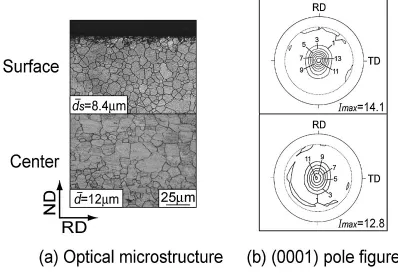
Commercial AZ31B (Mg-3%Al-1%Zn-0.4%Mn) sheets 2.5 mm thick were received. Specimens 30 mm in width and 300 mm in length were cut from the sheets. The optical microstructure and (0001) pole figure at the surface and those at the center of the thickness of the specimen are shown in Fig. 1. The microstructures were covered by equiaxed recrystallized grains, though the grain size is not uniform. The mean grain size at the surface (ds¼8:4mm) is smaller than that at the center (d¼12mm). Both the pole figures at the surface and the center are well-developed½0001==ND,
i.e., basal textures. In order to visualize the deformation introduced by the rolling, an AZ31 pin 1.6 mm in diameter was embedded at the center of the width before rolling so that the pin was perpendicular to the plane.
A two-high laboratory rolling mill9,10)with rolls530mm in diameter was used. Prior to the rolling, the specimen was held for 900 s at either 373, 473 or 623 K in an electric tube furnace. The specimen was supplied to the roll bite through a pinch roller. Alternatively, a specimen was cold-rolled on the mill without prior heat treatment. The thickness was reduced 60% by single-pass operation under unlubricated conditions. The peripheral speed of the rolls was 2000 m/min. The mean equivalent strain rate estimated was1:8103s1. The rolls
were cleaned before each operation but not heated. After rolling, the specimen was immediately (precisely, 6.8 ms) quenched in a water shower closely attached to the exit of the mill.
For optical microscopy, longitudinal sections (TD plane) were polished mechanically and etched for 2 s in a solution of 3 g picric acid, 20 cm3acetic acid, 20 cm3distilled water and 50 cm3 ethanol. The mean intercept length was evaluated as the grain size in this study.
*Graduate Student, Osaka University
Materials Transactions, Vol. 48, No. 8 (2007) pp. 2023 to 2027
Special Issue on Crystallographic Orientation Distribution and Related Properties in Advanced Materials
(0001) incomplete pole figures were measured at the surface and the center of the sheet by the Schulz reflection method using Cu-Kradiation. The intensities were normal-ized by those of the randomly-oriented pure magnesium sample prepared by powder compaction.
The tensile specimens were spark-machined from the rolled sheets so that the angle between the tensile axis and the rolling direction was either 0, 45 or 90. The gauge length
and width were 8 and 5 mm, respectively. The tensile test was conducted at room temperature at a speed of 0.5 mm/min. A right-angle three-point bending test was performed at room temperature at a speed of 15.6 mm/min. Specimens 15 mm in width and 100 mm in length were prepared from the rolled sheet parallel to the rolling direction. The thickness of the specimentwas the as-rolled,i.e., 1 mm. The radiusrof the punch was varied between 1, 2, 3 and 4 mm, while the diameter of the supports was 30 mm. The distance between the supports was controlled atL¼2rþ3t.
3. Results and Discussion
3.1 Deformation
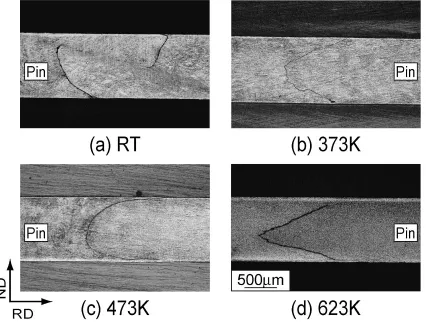
Figure 2 shows the interface of the embedded pin and the sheet after the high-speed rolling. In the sheets rolled above 373 K, the interface, which used to be vertical, was deformed to become U- or V-shaped by the rolling. The interface was then almost parallel to the RD beneath (50mm from) the surface so that the shear strain was greater than 10. The severe shear deformation is due to the frictional force from the rolls. With increasing rolling temperature, the internal shear strain increases. In the sheet rolled at 623 K, the slope of the pin, i.e., shear strain, is almost uniform through the thickness except for the surfaces and center. It is supposed that with increasing rolling temperature, the friction as well
as the temperature gradient in the thickness direction increases. In the sheet rolled at 373 K, serration caused by shear banding is observed on the interface. The pin in the sheet rolled at RT was deformed to become N-shaped by severe shear banding. The pin and the sheet were cut and bonded together after sliding during the rolling. This shear bonding occurred because only basal slip is active at room temperature.
3.2 Microstructure of rolled sheets
Figure 3 shows the microstructures at the surface and at the center of the thickness. The microstructures at the center of the sheets rolled above 373 K are covered by fine equiaxed grains. The mean grain size at the center denoted by d
increases with rolling temperature from 2.9mmto 4.8mm. It is notable that the grain size is smaller than that commercially available, say 6–7mm.11)In the sheets rolled at RT, very fine recrystallized grains are observed in the shear band, while coarse grains with twins are also observed in other region. In the figure, the mean grain size near the surfaceds, which is measured on the plane 15mmaway from the surface, is also indicated. Above 373 K, the grain size at the surface is greater than that at the center. The larger grain size may be due to the heat generated by severe shear deformation. Both grain sizes increase with the rolling temperature, while the difference between surface and center also increases. Boundaries dividing the surface microstructure from the internal micro-structure are distinct. In the sheets rolled at RT, the surface is covered with very fine grains.
3.3 Texture of rolled sheets
Figure 4 shows (0001) pole figures of the rolled sheets. The textures at the center of the thickness of the sheets rolled above 373 K show a basal texture with double peaks. The
[image:2.595.96.494.77.350.2]positions of the peaks are(15 to 20) away from the ND
toward the RD. The textures are known as a typical rolling texture of magnesium alloy sheets.12)The angle between the two peaks denoted by , increases with the rolling temper-ature. The maximum pole intensity decreases with increasing rolling temperature, suggesting that the texture weakens slightly with grain size. The sheet rolled at RT shows a basal texture with a single peak, which is expressed by ½0001==
ND.
Surface textures were measured after chemically removing
the 10mm thick outermost layer from the surface. All the surface textures are also essentially basal. Pole figures of the sheets rolled below 473 K show a basal texture with a single peak on just ND with spreading in the TD. The single-peak texture has been reported as the surface texture of Mg alloys.12)Transition from the single-peak to the double-peak type with increasing distance from the surface was believed to be caused by the variation in the shear strain. With increasing rolling temperature, the peak is split into double peaks. However, the direction of the split is in the TD.
Fig. 2 Deformation of the pin embedded as a function of rolling temperature.
Fig. 3 Microstructure on longitudinal section (TD plane) of sheet as a function of rolling temperature.
[image:3.595.89.515.74.396.2] [image:3.595.63.533.435.631.2]3.4 Mechanical properties
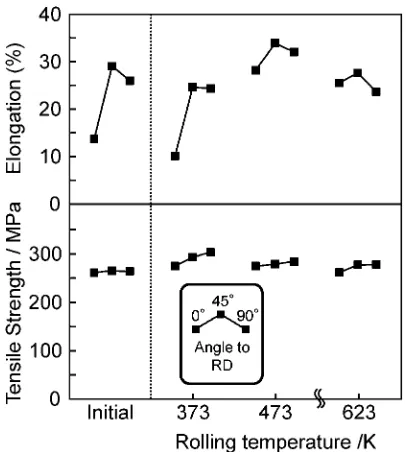
The effects of the rolling temperature on the ultimate tensile strength and the elongation to failure are shown in Fig. 5. The properties of the sheet before rolling are also shown. The mechanical properties show planar anisotropy. Both the strength and the elongation are lowest in the RD. The results at RT are not shown in Fig. 5 due to premature and non-reproducible fracture, probably at shear bands. The tensile strength increases with decreasing rolling temper-ature. The specimen rolled at 473 K shows the highest ductility. The elongation of the specimen rolled at 373 K is low, especially in the RD, likely due to the occurrence of fracture at shear bands, which run in the TD. The lower
ductility at 623 K than at 473 K can be explained by the coarse grain size.
The sheet having a basal texture with a single peak on the ND should exhibit planar isotropic mechanical properties. The tensile strength is highest in the transverse direction (90) and the lowest in the rolling direction (0). This
anisotropy can be explained by the development of a double-peak texture.13) The strength perpendicular to thec axis is high so that if the pole intensity ofcaxis has two peaks on the RD, the strength in the TD should be higher. Decreases in the planar anisotropy of the mechanical properties involving increases in the rolling temperature correspond to the decreases in the sharpness of the texture developed by the dynamic recrystallization.
3.5 Bendability
Table 1 shows the results of the bending test of the rolled sheet. In the case of sheets rolled at RT, sheets are fractured under all conditions of the bend test. The sheet rolled at 473 K was bent at a right angle without defects with an R4 punch. With sharper punches, cracks occurred. Sheets rolled at higher temperature showed better workability.
The results of the bending test well correspond to the intensity of the basal texture rather than the grain size or the ductility of the sheet. It means that the workability of the magnesium alloy is primarily governed by the basal texture.
Fig. 4 (0001) pole figure at the surface and at the midplane as a function of rolling temperature.
[image:4.595.65.534.71.306.2]Fig. 5 Mechanical properties of rolled sheet as a function of rolling temperature.
Table 1 Cold bendability of the sheets. Curvature radius
of punch R4 R3 R2 R1
Rolled at RT
Rolled at 373 K Rolled at 473 K Rolled at 623 K
[image:4.595.67.270.347.573.2] [image:4.595.303.549.362.437.2]If the sheet with a sharp basal texture is compressed in a plane, twins can easily form due to the lack of slip systems, and sheets are easily fractured.1,2)Therefore, a high rolling temperature is preferable to producing a sheet with a weak basal texture with high bendability. On the other hand, the sheet rolled at RT shows significantly low bendability due to the inhomogeneous deformation microstructure and strong basal texture at the surface.
4. Conclusion
The deformation and texture evolution of AZ31 sheets during 60% high-speed (2000 m/min) rolling at RT-623 K have been studied. The mechanical properties and bendabil-ity of the rolled sheets have been studied and discussed, and the following observations have been made.
(1) During the rolling above 373 K, shear deformation is introduced internally by the friction from the roll. Very severe shear strain ( >10) was introduced beneath (50mmfrom) the surface. The severely sheared region is covered with equiaxed grains larger in size than those at the center. The grains show a strong basal texture with a single peak. With increasing the rolling temper-ature, the internal shear strain increases, while the peak of the basal texture at the severely sheared region splits into two peaks in the TD.
(2) The sheets rolled above 373 K show a basal texture with double peaks in the RD. The rolled sheets show planar anisotropy of mechanical properties. The tensile strength in the TD is the highest, as expected from the texture. With increasing the rolling temperature, the basal texture weakens while the angle between the two peaks increases. Accordingly, the anisotropy in tensile
strength decreases and the bendability increases. (3) The cold rolled sheet shows an inhomogeneous
defor-mation microstructure having macroscopic shear bands and twins. The sheet shows a basal texture with a single peak at the center as well as at the surface. The ductility and bendability of the cold-rolled sheets are rather limited.
REFERENCES
1) R. L. Dietrich: Met. Trans.185(1949) 621–626.
2) D. J.-P. Adenis and S. L. Couling: Trans. Metall. AIME230(1964) 554–559.
3) T. Sakai, H. Utsunomiya, S. Minamiguchi and H. Koh:Magnesium Technology in the global Age, ed. by M. O. Pekguleryuz and L. W. F. Mackenzie, (CIM, 2006) pp. 205–215.
4) H. Utsunomiya, T. Sakai, S. Minamiguchi and H. Koh:Magnesium Technology 2006, ed. by A. A. Luo, (TMS, 2006) pp. 201–204. 5) S. Minamiguchi, H. Koh, H. Utsunomiya and T. Sakai:Magnesium
Technology in the global Age, ed. by M. O. Pekguleryuz and L. W. F. Mackenzie, (CIM, 2006) pp. 217–227.
6) T. Sakai, H. Utsunomiya, S. Minamiguchi and H. Koh: Proc. 7th Int. Conf. Magnesium Alloys and Their Applications, ed. by K. U. Kainer, (Wiley-VCH, 2007) pp. 370–376.
7) R. Kawalla, M. Ullmann, M. Oswald and C. Schmidt: Proc. 7th Int. Conf. Magnesium Alloys and Their Applications, ed. by K. U. Kainer, (Wiley-VCH, 2007) pp. 364–369.
8) T. Sakai, H. Utsunomiya, H. Koh and S. Minamiguchi: Mater. Sci. Forum539–543(2007) 3359–3364.
9) Y. Saito, T. Sakai, F. Maeda and K. Kato: Tetsu-to-Hagane72(1986) 799–806.
10) T. Sakai, Y. Saito, K. Hirano and K. Kato: Trans. ISIJ28(1988) 1028– 1035.
11) M. Sato, T. Kajiya and T. Yashiro: J. JILM54(2004) 465–471. 12) A. Hargreaves: J. Inst. Met.71(1945) 73–86.
13) J. C. McDonald and P. W. Bakarian: Trans. Metall. AIME233(1965) 95–103.