Joint Word Alignment and Bilingual Named Entity Recognition
Using Dual Decomposition
Mengqiu Wang Stanford University Stanford, CA 94305 [email protected]
Wanxiang Che
Harbin Institute of Technology Harbin, China, 150001
Christopher D. Manning Stanford University Stanford, CA 94305 [email protected]
Abstract
Translated bi-texts contain complemen-tary language cues, and previous work on Named Entity Recognition (NER) has demonstrated improvements in perfor-mance over monolingual taggers by pro-moting agreement of tagging decisions be-tween the two languages. However, most previous approaches to bilingual tagging assume word alignments are given as fixed input, which can cause cascading errors. We observe that NER label information can be used to correct alignment mis-takes, and present a graphical model that performs bilingual NER tagging jointly with word alignment, by combining two monolingual tagging models with two uni-directional alignment models. We intro-duce additional cross-lingual edge factors that encourage agreements between tag-ging and alignment decisions. We design a dual decomposition inference algorithm to perform joint decoding over the com-bined alignment and NER output space. Experiments on the OntoNotes dataset demonstrate that our method yields signif-icant improvements in both NER and word alignment over state-of-the-art monolin-gual baselines.
1 Introduction
We study the problem of Named Entity Recogni-tion (NER) in a bilingual context, where the goal is to annotate parallel bi-texts with named entity tags. This is a particularly important problem for machine translation (MT) since entities such as person names, locations, organizations, etc. carry much of the information expressed in the source
sentence. Recognizing them provides useful in-formation for phrase detection and word sense dis-ambiguation (e.g., “melody” as in a female name has a different translation from the word “melody” in a musical sense), and can be directly leveraged to improve translation quality (Babych and Hart-ley, 2003). We can also automatically construct a named entity translation lexicon by annotating and extracting entities from bi-texts, and use it to im-prove MT performance (Huang and Vogel, 2002; Al-Onaizan and Knight, 2002). Previous work such as Burkett et al. (2010b), Li et al. (2012) and Kim et al. (2012) have also demonstrated that bi-texts annotated with NER tags can provide useful additional training sources for improving the per-formance of standalone monolingual taggers.
Because human translation in general preserves semantic equivalence, bi-texts represent two per-spectives on the same semantic content (Burkett et al., 2010b). As a result, we can find complemen-tary cues in the two languages that help to dis-ambiguate named entity mentions (Brown et al., 1991). For example, the English word “Jordan” can be either a last name or a country. Without sufficient context it can be difficult to distinguish the two; however, in Chinese, these two senses are disambiguated: “乔丹” as a last name, and “约旦” as a country name.
In this work, we first develop a bilingual NER model (denoted as BI-NER) by embedding two monolingual CRF-based NER models into a larger undirected graphical model, and introduce addi-tional edge factors based on word alignment (WA). Because the new bilingual model contains many cyclic cliques, exact inference is intractable. We employ a dual decomposition (DD) inference al-gorithm (Bertsekas, 1999; Rush et al., 2010) for performing approximate inference. Unlike most
f1 f2 f3 f4 f5 f6
e1 e2 e3 e4 e5 e6
Xinhua News Agency Beijing Feb 16
B-ORG I-ORG I-ORG [O] B-LOC O O
新华社 , 北京 , 二月 十六
[image:2.595.97.496.64.172.2]B-ORG O B-GPE O O O
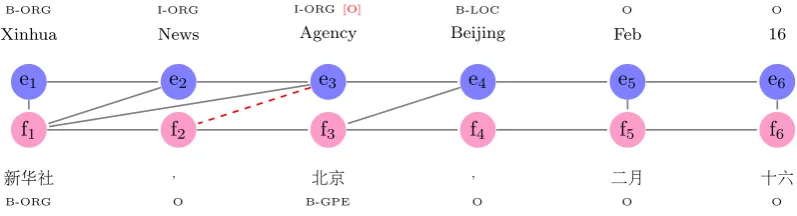
Figure 1: Example of NER labels between two word-aligned bilingual parallel sentences. The[O]tag is an example of a wrong tag assignment. Thedashedalignment link between e3and f2 is an example of
alignment error.
previous applications of the DD method in NLP, where the model typically factors over two com-ponents and agreement is to be sought between the two (Rush et al., 2010; Koo et al., 2010; DeNero and Macherey, 2011; Chieu and Teow, 2012), our method decomposes the larger graphical model into many overlapping components where each alignment edge forms a separate factor. We design clique potentials over the alignment-based edges to encourage entity tag agreements. Our method does not require any manual annotation of word alignments or named entities over the bilingual training data.
The aforementioned BI-NER model assumes fixed alignment input given by an underlying word aligner. But the entity span and type predictions given by the NER models contain complementary information for correcting alignment errors. To capture this source of information, we present a novel extension that combines the BI-NER model with two uni-directional HMM-based alignment models, and perform joint decoding of NER and word alignments. The new model (denoted as BI-NER-WA) factors over five components: one NER model and one word alignment model for each language, plus a joint NER-alignment model which not only enforces NER label agreements but also facilitates message passing among the other four components. An extended DD decoding algo-rithm is again employed to perform approximate inference.
We give a formal definition of the Bi-NER model in Section 2, and then move to present the Bi-NER-WA model in Section 3.
2 Bilingual NER by Agreement
The inputs to our models are parallel sentence pairs (see Figure 1 for an example in English and
Chinese). We denote the sentences as e(for
En-glish) and f (for Chinese). We assume access
to two monolingual linear-chain CRF-based NER models that are already trained. The English-side CRF model assigns the following probability for a tag sequenceye:
PCRFe(y
e|e) =
Q
vi∈Ve
ψ(vi) Q
(vi,vj)∈De
ω(vi, vj)
Ze(e)
where Ve is the set of vertices in the CRF and
De is the set of edges. ψ(vi) and ω(vi, vj) are the node and edge clique potentials, and Ze(e) is the partition function for input sequencee
un-der the English CRF model. We letk(ye) be the un-normalized log-probability of tag sequenceye, defined as:
k(ye) = log
Y
vi∈Ve
ψ(vi)
Y
(vi,vj)∈De
ω(vi, vj)
Similarly, we define model PCRFf and
un-normalized log-probabilityl(yf)for Chinese. We also assume that a set of word alignments (A = {(i, j) : ei ↔ fj}) is given by a word aligner and remain fixed in our model.
For clarity, we assumeyeandyfare binary
vari-ables in the description of our algorithms. The ex-tension to the multi-class case is straight-forward and does not affect the core algorithms.
2.1 Hard Agreement
opti-mization problem:
max
ye,yf log (PCRFe(y
e)) + log P
CRFf y
f
= max
ye,yf k(y
e) +l(yf)
−logZe(e)−logZf(f)
'max
ye,yf k(y
e) +l(yf)
3yei =yjf ∀(i, j)∈ A
We dropped theZe(e)andZf(f)terms because they remain constant at inference time.
The Lagrangian relaxation of this term is:
L ye,yf,U=
k(ye) +l yf+ X
(i,j)∈A
u(i, j)yie−yjf
whereu(i, j)are the Lagrangian multipliers. Instead of solving the Lagrangian directly, we can form the dual of this problem and solve it us-ing dual decomposition (Rush et al., 2010):
min
U maxye
k(ye) + X
(i,j)∈A
u(i, j)yie
+ max yf
l yf− X (i,j)∈A
u(i, j)yjf
!
Similar to previous work, we solve this DD problem by iteratively updating the sub-gradient as depicted in Algorithm 1. T is the maximum number of iterations before early stopping, andαt is the learning rate at timet. We adopt a learning rate update rule from Koo et al. (2010) whereαtis defined as 1
N, whereN is the number of times we observed a consecutive dual value increase from iteration1tot.
A thorough introduction to the theoretical foun-dations of dual decomposition algorithms is be-yond the scope of this paper; we encourage un-familiar readers to read Rush and Collins (2012) for a full tutorial.
2.2 Soft Agreement
The previously discussed hard agreement model rests on the core assumption that aligned words must have identical entity tags. In reality, however, this assumption does not always hold. Firstly, as-suming words are correctly aligned, their entity tags may not agree due to inconsistency in anno-tation standards. In Figure 1, for example, the
Algorithm 1 DD inference algorithm for hard agreement model.
∀(i, j)∈ A: u(i, j) = 0 fort←1toTdo
ye∗←argmaxk(ye) + P
(i,j)∈A
u(i, j)yei
yf∗←argmaxl yf− P (i,j)∈A
u(i, j)yjf
if∀(i, j)∈ A:ye∗
i =yjf∗then
return ye∗,yf∗
end if
for all(i, j)∈ Ado
u(i, j)←u(i, j) +αt
yfj∗−ye∗
i
end for end for return ye∗
(T),yf(T)∗
word “Beijing” can be either a Geo-Political En-tity (GPE) or a location. The Chinese annotation standard may enforce that “Beijing” should always be tagged as GPE when it is mentioned in isola-tion, while the English standard may require the annotator to judge based on word usage context. The assumption in the hard agreement model can also be violated if there are word alignment errors. In order to model this uncertainty, we extend the two previously independent CRF models into a larger undirected graphical model, by introducing a cross-lingual edge factorφ(i, j)for every pair of word positions(i, j) ∈ A. We associate a clique potential functionh(i,j)(yie, yjf)forφ(i, j):
h(i,j)
yie, yjf= pmiyie, yjf
ˆ
P(ei,fj)
where pmi(yie, yjf) is the point-wise mutual in-formation (PMI) of the tag pair, and we raise it to the power of a posterior alignment probability
ˆ
P(ei, fj). For a pair of NEs that are aligned with low probability, we cannot be too sure about the association of the two NEs, therefore the model should not impose too much influence from the bilingual agreement model; instead, we will let the monolingual NE models make their decisions, and trust that those are the best estimates we can come up with when we do not have much confidence in their bilingual association. The use of the poste-rior alignment probability facilitates this purpose.
Simultaneously, the monolingual models will also be encouraged to agree with the cross-lingual edge factors. This way, the various components effec-tively trade penalties indirectly through the cross-lingual edges, until a tag sequence that maximizes the joint probability is achieved.
Since we assume no bilingually annotated NER corpus is available, in order to get an estimate of the PMI scores, we first tag a collection of unan-notated bilingual sentence pairs using the mono-lingual CRF taggers, and collect counts of aligned entity pairs from this auto-generated tagged data.
Each of theφ(i, j) edge factors (e.g., the edge between nodef3ande4in Figure 1) overlaps with
each of the two CRF models over one vertex (e.g., f3 on Chinese side and e4 on English side), and
we seek agreement with the Chinese CRF model over tag assignment offj, and similarly for ei on English side. In other words, no direct agreement between the two CRF models is enforced, but they both need to agree with the bilingual edge factors.
The updated optimization problem becomes:
max
ye(k)yf(l)ye(h)yf(h)
kye(k)+lyf(l)+
X
(i,j)∈A
h(i,j)
yei(h), yjf(h)
3 ∀(i, j)∈ A: yie(k) =yie(h)∧yjf(l) =yjf(h)
where the notationye(k)
i denotes tag assignment to wordeiby the English CRF andye
(h)
i denotes as-signment to word ei by the bilingual factor; yf
(l)
j denotes the tag assignment to wordfj by the Chi-nese CRF and yjf(h) denotes assignment to word fj by the bilingual factor.
The updated DD algorithm is illustrated in Al-gorithm 2 (case 2). We introduce two separate sets of dual constraints we and wf, which range
over the set of vertices on their respective half of the graph. Decoding the edge factor model h(i,j)(yie, y
f
j) simply involves finding the pair of tag assignments that gives the highest PMI score, subject to the dual constraints.
The way DD algorithms work in decomposing undirected graphical models is analogous to other message passing algorithms such as loopy belief propagation, but DD gives a stronger optimality guarantee upon convergence (Rush et al., 2010).
3 Joint Alignment and NER Decoding
In this section we develop an extended model in which NER information can in turn be used to improve alignment accuracy. Although we have seen more than a handful of recent papers that ap-ply the dual decomposition method for joint in-ference problems, all of the past work deals with cases where the various model components have the same inference output space (e.g., dependency parsing (Koo et al., 2010), POS tagging (Rush et al., 2012), etc.). In our case the output space is the much more complex joint alignment and NER tagging space. We propose a novel dual decom-position variant for performing inference over this joint space.
Most commonly used alignment models, such as the IBM models and HMM-based aligner are unsupervised learners, and can only capture sim-ple distortion features and lexical translational fea-tures due to the high complexity of the structure prediction space. On the other hand, the CRF-based NER models are trained on manually anno-tated data, and admit richer sequence and lexical features. The entity label predictions made by the NER model can potentially be leveraged to correct alignment mistakes. For example, in Figure 1, if the tagger knows that the word “Agency” is tagged I-ORG, and if it also knows that the first comma in the Chinese sentence is not part of any entity, then we can infer it is very unlikely that there ex-ists an alignment link between “Agency” and the comma.
To capture this intuition, we extend the BI-NER model to jointly perform word alignment and NER decoding, and call the resulting model BI -NER-WA. As a first step, instead of taking the output from an aligner as fixed input, we incorporate two uni-directional aligners into our model. We name the Chinese-to-English aligner model as m(Be) and the reverse directional model n(Bf). Be is a matrix that holds the output of the Chinese-to-English aligner. Each be(i, j) binary variable in
Beindicates whetherf
j is aligned toei; similarly we define output matrixBf andbf(i, j) for Chi-nese. In our experiments, we used two HMM-based alignment models. But in principle we can adopt any alignment model as long as we can per-form efficient inference over it.
vari-Algorithm 2 DD inference algorithm for joint alignment and NER model. A line marked with (2) means it applies to the BI-NER model; a line marked with (3) means it applies to the BI-NER-WA model.
S ← A (2) S ← {(i, j) :∀i∈ |e|,∀j∈ |f|} (3) ∀i∈ |e|:we
i = 0;∀j∈ |f|:wfj = 0 (2,3)
∀(i, j)∈ S: de(i, j) = 0, df(i, j) = 0 (3)
fort←1toTdo
ye(k)∗
←argmaxkye(k)+ P i∈|e|
we iye
(k)
i (2,3)
yf(l)∗
←argmaxlyf(l)+ P i∈|f|
wjfyfj(l) (2,3)
Be∗←argmaxm(Be) + P (i,j)
de(i, j)be(i, j) (3)
Bf∗←argmaxn Bf+ P
(i,j)
df(i, j)bf(i, j) (3) for all(i, j)∈Sdo
(ye(h)∗ i yf
(h)∗
j )← −weiye (h) i −wjfy
f(h) j
+ argmaxh(i,j)(ye (q) i yf
(q)
j ) (2)
(ye(q)∗ i yf
(q)∗
j a(i, j)∗)← −weiye (q) i −wjfy
f(q) j
+ argmaxq(i,j)(ye (q) i yf
(q) j a(i, j))
−de(i, j)a(i, j)−df(i, j)a(i, j) (3)
end for
Conv =(ye(k)=ye(q)∧yf(l)=yf(q)) (2)
Conv =(Be=A=Bf∧ye(k=)ye(q)∧yf(l)=yf(q)) (3) ifConv=true,then
return ye(k)∗,yf(l)∗ (2)
return ye(k)∗,yf(l)∗,A (3)
else
for alli∈ |e|do
wei←wei+αt
yie(q|h)∗−ye (k)∗ i
(2,3)
end for
for allj∈ |f|do
wfj←wfj+αt
yfj(q|h)∗−yjf(l)∗ (2,3)
end for
for all(i, j)∈Sdo
de(i, j)←de(i, j) +αt(ae∗(i, j)−be∗(i, j)) (3)
df(i, j)←df(i, j) +αt af∗(i, j)−bf∗(i, j) (3)
end for end if end for return ye(k)∗
(T) ,yf (l)∗ (T)
(2)
return ye(T)(k)∗,yf (l)∗ (T) ,A(T)
(3)
ablea(i, j) for an alignment link betweenei and fj. The edge factor also predicts the entity tags for eiandfj.
The new edge potentialqis defined as:
q(i,j)yie, yjf, a(i, j)=
log(P(a(i, j) = 1)) +S(yie, yjf|a(i, j))P(a(i,j)=1)
S(yie, yjf|a(i, j))=
(
pmi(yie, yjf),if a(i, j) = 1 0,else
P(a(i, j) = 1) is the alignment probability as-signed by the bilingual edge factor between node ei andfj. We initialize this value toPˆ(ei, fj) =
1
2(Pm(ei, fj) +Pn(ei, fj)), wherePm(ei, fj)and
Pn(ei, fj)are the posterior probabilities assigned by the HMM-aligners.
The joint optimization problem is defined as:
max
ye(k)yf(l)ye(h)yf(h)BeBfA
k(ye(k)) +l(yf(l))+
m(Be) +n(Bf) + X
(i∈|e|,j∈|f|)
q(i,j)(ye
h
i , yf
(h)
j , a(i, j))
3 ∀(i, j) : be(i, j)=a(i, j)∧ bf(i, j)=a(i, j)
∧ifa(i, j) = 1 then yie(k=) yie(h)∧ yfj(l=) yfj(h)
We include two dual constraints de(i, j) and df(i, j)over alignments for every bilingual edge factorζ(i, j), which are applied to the English and Chinese sides of the alignment space, respectively. The DD algorithm used for this model is given in Algorithm 2 (case 3). One special note is that after each iteration when we consider updates to the dual constraint for entity tags, we only check tag agreements for cross-lingual edge factors that have an alignment assignment value of1. In other words, cross-lingual edges that are not aligned do not affect bilingual NER tagging.
Similar toφ(i, j),ζ(i, j)factors do not provide that much additional information other than some selectional preferences via PMI score. But the real power of these cross-language edge cliques is that they act as a liaison between the NER and alignment models on each language side, and encourage these models to indirectly agree with each other by having them all agree with the edge cliques.
It is also worth noting that since we decode the alignment models with Viterbi inference, ad-ditional constraints such as the neighborhood con-straint proposed by DeNero and Macherey (2011) can be easily integrated into our model. The neighborhood constraint enforces that if fj is aligned toei, then fj can only be aligned toei+1
orei−1 (with a small penalty), but not any other
word position. We report results of adding neigh-borhood constraints to our model in Section 6.
4 Experimental Setup
annotated NER tags for both Chinese and En-glish. Document pairs are sentence aligned us-ing the Champollion Tool Kit (Ma, 2006). Af-ter discarding sentences with no aligned counAf-ter- counter-part, a total of 402 documents and 8,249 paral-lel sentence pairs were used for evaluation. We will refer to this evaluation set asfull-set. We use odd-numbered documents as the dev set and even-numbered documents as the blind test set. We did not perform parameter tuning on the dev set to optimize performance, instead we fix the ini-tial learning rate to0.5and maximum iterations to 1,000 in all DD experiments. We only use the dev set for model development.
The Stanford CRF-based NER tagger was used as the monolingual component in our models (Finkel et al., 2005). It also serves as a state-of-the-art monolingual baseline for both English and Chinese. For English, we use the default tag-ger setting from Finkel et al. (2005). For Chi-nese, we use an improved set of features over the default tagger, which includes distributional sim-ilarity features trained on large amounts of non-overlapping data.1
We train the two CRF models on all portions of the OntoNotes corpus that are annotated with named entity tags, except the parallel-aligned por-tion which we reserve for development and test purposes. In total, there are about 660 train-ing documents (∼16k sentences) for Chinese and 1,400 documents (∼39k sentences) for English.
Out of the 18 named entity types that are an-notated in OntoNotes, which include person, lo-cation, date, money, and so on, we select the four most commonly seen named entity types for evalu-ation. They areperson,location,organizationand
GPE. All entities of these four types are converted to the standard BIO format, and background to-kens and all other entity types are marked with tag O. When we consider label agreements over aligned word pairs in all bilingual agreement mod-els, we ignore the distinction betweenB-and
I-tags.
We report standard NER measures (entity pre-cision (P), recall (R) and F1 score) on the test
set. Statistical significance tests are done using the paired bootstrap resampling method (Efron and Tibshirani, 1993).
For alignment experiments, we train two
uni-1The exact feature set and the CRF implementation can be found here: http://nlp.stanford.edu/ software/CRF-NER.shtml
directional HMM models as our baseline and monolingual alignment models. The parameters of the HMM were initialized by IBM Model 1 us-ing the agreement-based EM trainus-ing algorithms from Liang et al. (2006). Each model is trained for 2 iterations over a parallel corpus of 12 mil-lion English words and Chinese words, almost twice as much data as used in previous work that yields state-of-the-art unsupervised alignment re-sults (DeNero and Klein, 2008; Haghighi et al., 2009; DeNero and Macherey, 2011).
Word alignment evaluation is done over the sections of OntoNotes that have matching gold-standard word alignment annotations from GALE Y1Q4 dataset.2 This subset contains 288 docu-ments and 3,391 sentence pairs. We will refer to this subset as wa-subset. This evaluation set is over 20 times larger than the 150 sentences set used in most past evaluations (DeNero and Klein, 2008; Haghighi et al., 2009; DeNero and Macherey, 2011).
Alignments input to the BI-NER model are produced by thresholding the averaged posterior probability at0.5. In joint NER and alignment ex-periments, instead of posterior thresholding, we take the direct intersection of the Viterbi-best alignment of the two directional models. We re-port the standard P, R, F1 and Alignment Error
Rate (AER) measures for alignment experiments. An important past work to make comparisons with is Burkett et al. (2010b). Their method is similar to ours in that they also model bilin-gual agreement in conjunction with two CRF-based monolingual models. But instead of using just the PMI scores of bilingual NE pairs, as in our work, they employed a feature-rich log-linear model to capture bilingual correlations. Parame-ters in their log-linear model require training with bilingually annotated data, which is not readily available. To counter this problem, they proposed an “up-training” method which simulates a super-vised learning environment by pairing a weak clas-sifier with strong clasclas-sifiers, and train the bilin-gual model to rank the output of the strong classi-fier highly among the N-best outputs of the weak classifier. In order to compare directly with their method, we obtained the code behind Burkett et al. (2010b) and reproduced their experimental set-ting for the OntoNotes data. An extra set of 5,000 unannotated parallel sentence pairs are used for
Chinese English
P R F1 P R F1
[image:7.595.70.295.62.114.2]Mono 76.89 61.64 68.42 81.98 74.59 78.11 Burkett 77.52 65.84 71.20 82.28 76.64 79.36 Bi-soft 79.14 71.55 75.15 82.58 77.96 80.20
Table 1: NER results on bilingual parallel test set. Best numbers on each measure that are statistically significantly better than the monolingual baseline and Burkett et al. (2010b) are highlighted in bold.
training the reranker, and the reranker model se-lection was performed on the development dataset.
5 Bilingual NER Results
The main results on bilingual NER over the test portion of full-set are shown in Table 1. We initially experimented with the hard agreement model, but it performs quite poorly for reasons we discussed in Section 2.2. The BI-NER model with soft agreement constraints, however, significantly outperforms all baselines. In particular, it achieves an absolute F1 improvement of 6.7% in Chinese
and 2.1% in English over the CRF monolingual baselines.
A well-known issue with the DD method is that when the model does not necessarily con-verge, then the procedure could be very sensi-tive to hyper-parameters such as initial step size and early termination criteria. If a model only gives good performance with well-tuned hyper-parameters, then we must have manually anno-tated data for tuning, which would significantly reduce the applicability and portability of this method to other language pairs and tasks. To eval-uate the parameter sensitivity of our model, we run the model from 50 to 3000 iterations before early stopping, and with 6 different initial step sizes from 0.01 to 1. The results are shown in Fig-ure 2. The soft agreement model does not seem to be sensitive to initial step size and almost always converges to a superior solution than the baseline.
6 Joint NER and Alignment Results
We present results for the BI-NER-WA model in Table 2. By jointly decoding NER with word alignment, our model not only maintains signifi-cant improvements in NER performance, but also yields significant improvements to alignment per-formance. Overall, joint decoding with NER alone yields a 10.8% error reduction in AER over the baseline HMM-aligners, and also gives
improve-0 0.01 0.05 0.1
0.2 0.5 1 2
3000 1000 800 500 300 100 50 73 74 75 76 77 78 79 80
initial step size max no. of iterations
F1 score
Figure 2: Performance variance of the soft agree-ment models on the Chinese dev dataset, as a func-tion of step size (x-axis) and maximum number of iterations before early stopping (y-axis).
ment over BI-NER in NER. Adding additional neighborhood constraints gives a further 6% er-ror reduction in AER, at the cost of a small loss in Chinese NER. In terms of word alignment re-sults, we see great increases in F1 and recall, but
precision goes down significantly. This is be-cause the joint decoding algorithm promotes an ef-fect of “soft-union”, by encouraging the two uni-directional aligners to agree more often. Adding the neighborhood constraints further enhances this union effect.
7 Error Analysis and Discussion
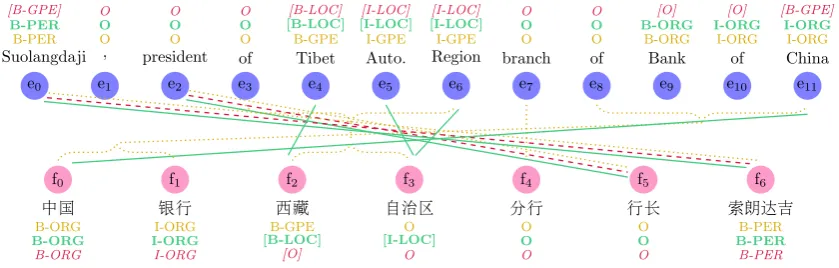
We can examine the example in Figure 3 to gain an understanding of the model’s performance. In this example, a snippet of a longer sentence pair is shown with NER and word alignment results. The monolingual Chinese tagger provides a strong cue that word f6 is a person name because the unique
4-character word pattern is commonly associated with foreign names in Chinese, and also the word is immediately preceded by the word “president”. The English monolingual tagger, however, con-fuses the aligned word e0with a GPE.
Our bilingual NER model is able to correct this error as expected. Similarly, the bilingual model corrects the error over e11. However, the model
also propagates labeling errors from the English side over the entity “Tibet Autonomous Region” to the Chinese side. Nevertheless, the resulting Chi-nese tags are arguably more useful than the origi-nal tags assigned by the baseline model.
[image:7.595.315.518.66.220.2]NER-Chinese NER-English word alignment
P R F1 P R F1 P R F1 AER
HMM-WA - - - 90.43 40.95 56.38 43.62
Mono-CRF 82.50 66.58 73.69 84.24 78.70 81.38 - - -
-Bi-NER 84.87 75.30 79.80 84.47 81.45 82.93 - - -
[image:8.595.96.500.62.134.2]-Bi-NER-WA 84.42 76.34 80.18 84.25 82.20 83.21 77.45 50.43 61.09 38.91 Bi-NER-WA+NC 84.25 75.09 79.41 84.28 82.17 83.21 76.67 54.44 63.67 36.33
Table 2: Joint alignment and NER test results. +NC means incorporating additional neighbor constraints from DeNero and Macherey (2011) to the model. Best number in each column is highlighted in bold.
f0 f1 f2 f3 f4 f5 f6
e0 e1 e2 e3 e4 e5 e6 e7 e8 e9 e10 e11 Suolangdaji , president of Tibet Auto. Region branch of Bank of China
B-PER O O O B-GPE I-GPE I-GPE O O B-ORG I-ORG I-ORG
B-PER O O O [B-LOC] [I-LOC] [I-LOC] O O B-ORG I-ORG I-ORG [B-GPE] O O O [B-LOC] [I-LOC] [I-LOC] O O [O] [O] [B-GPE]
中国 银行 西藏 自治区 分行 行长 索朗达吉
B-ORG I-ORG B-GPE O O O B-PER
B-ORG I-ORG [B-LOC] [I-LOC] O O B-PER
B-ORG I-ORG [O] O O O B-PER
Figure 3: An example output of our BI-NER-WA model. Dottedalignment links are the oracle,dashed links are alignments from HMM baseline, andsolidlinks are outputs of our model. Entity tags in the gold line (closest to nodesei andfj) are the gold-standard tags; in the greenline (second closest to nodes) are output from our model; and in thecrimsonline (furthest from nodes) are baseline output.
distance swapping phenomena. The two unidirec-tional HMMs also have strong disagreements over the alignments, and the resulting baseline aligner output only recovers two links. If we were to take this alignment as fixed input, most likely we would not be able to recover the error over e11, but the
joint decoding method successfully recovered 4 more links, and indirectly resulted in the NER tag-ging improvement discussed above.
8 Related Work
The idea of employing bilingual resources to im-prove over monolingual systems has been ex-plored by much previous work. For example, Huang et al. (2009) improved parsing performance using a bilingual parallel corpus. In the NER domain, Li et al. (2012) presented a cyclic CRF model very similar to our BI-NER model, and performed approximate inference using loopy be-lief propagation. The feature-rich CRF formula-tion of bilingual edge potentials in their model is much more powerful than our simple PMI-based bilingual edge model. Adding a richer bilingual edge model might well further improve our results, and this is a possible direction for further experi-mentation. However, a big drawback of this
[image:8.595.88.508.188.322.2]pair. Martins et al. (2011b) presented a new DD method that combines the power of DD with the augmented Lagrangian method. They showed that their method can achieve faster convergence than traditional sub-gradient methods in models with many overlapping components (Martins et al., 2011a). This method is directly applicable to our work.
Another promising direction for improving NER performance is in enforcing global label consistency across documents, which is an idea that has been greatly explored in the past (Sut-ton and McCallum, 2004; Bunescu and Mooney, 2004; Finkel et al., 2005). More recently, Rush et al. (2012) and Chieu and Teow (2012) have shown that combining local prediction models with global consistency models, and enforcing agreement via DD is very effective. It is straight-forward to incorporate an additional global consis-tency model into our model for further improve-ments.
Our joint alignment and NER decoding ap-proach is inspired by prior work on improving alignment quality through encouraging agreement between bi-directional models (Liang et al., 2006; DeNero and Macherey, 2011). Instead of enforc-ing agreement in the alignment space based on best sequences found by Viterbi, we could opt to encourage agreement between posterior prob-ability distributions, which is related to the pos-terior regularization work by Grac¸a et al. (2008). Cromi`eres and Kurohashi (2009) proposed an ap-proach that takes phrasal bracketing constraints from parsing outputs, and uses them to enforce phrasal alignments. This idea is similar to our joint alignment and NER approach, but in our case the phrasal constraints are indirectly imposed by en-tity spans. We also differ in the implementation details, where in their case belief propagation is used in both training and Viterbi inference.
Burkett et al. (2010a) presented a supervised learning method for performing joint parsing and word alignment using log-linear models over parse trees and an ITG model over alignment. The model demonstrates performance improvements in both parsing and alignment, but shares the com-mon limitations of other supervised work in that it requires manually annotated bilingual joint pars-ing and word alignment data.
Chen et al. (2010) also tackled the problem of joint alignment and NER. Their method employs a
set of heuristic rules to expand a candidate named entity set generated by monolingual taggers, and then rank those candidates using a bilingual named entity dictionary. Our approach differs in that we provide a probabilistic formulation of the problem and do not require pre-existing NE dictionaries.
9 Conclusion
We introduced a graphical model that combines two HMM word aligners and two CRF NER tag-gers into a joint model, and presented a dual de-composition inference method for performing ef-ficient decoding over this model. Results from NER and word alignment experiments suggest that our method gives significant improvements in both NER and word alignment. Our techniques make minimal assumptions about the underlying mono-lingual components, and can be adapted for many other tasks such as parsing.
Acknowledgments
The authors would like to thank Rob Voigt and the three anonymous reviewers for their valuable comments and suggestions. We gratefully ac-knowledge the support of the National Natural Science Foundation of China (NSFC) via grant 61133012, the National “863” Project via grant 2011AA01A207 and 2012AA011102, the Min-istry of Education Research of Social Sciences Youth funded projects via grant 12YJCZH304, and the support of the U.S. Defense Advanced Research Projects Agency (DARPA) Broad Op-erational Language Translation (BOLT) program through IBM.
Any opinions, findings, and conclusion or rec-ommendations expressed in this material are those of the authors and do not necessarily reflect the view of DARPA, or the US government.
References
Yaser Al-Onaizan and Kevin Knight. 2002. Translat-ing named entities usTranslat-ing monolTranslat-ingual and bilTranslat-ingual resources. InProceedings of ACL.
Dimitri P. Bertsekas. 1999. Nonlinear Programming. Athena Scientific, New York.
Peter F. Brown, Stephen A. Della Pietra, Vincent J. Della Pietra, and Robert L. Mercer. 1991. Word-sense disambiguation using statistical methods. In Proceedings of ACL.
Razvan Bunescu and Raymond J. Mooney. 2004. Collective information extraction with relational Markov networks. InProceedings of ACL.
David Burkett, John Blitzer, and Dan Klein. 2010a. Joint parsing and alignment with weakly synchro-nized grammars. InProceedings of NAACL-HLT. David Burkett, Slav Petrov, John Blitzer, and Dan
Klein. 2010b. Learning better monolingual mod-els with unannotated bilingual text. InProceedings of CoNLL.
Yufeng Chen, Chengqing Zong, and Keh-Yih Su. 2010. On jointly recognizing and aligning bilingual named entities. InProceedings of ACL.
Hai Leong Chieu and Loo-Nin Teow. 2012. Com-bining local and non-local information with dual de-composition for named entity recognition from text. InProceedings of 15th International Conference on Information Fusion (FUSION).
Fabien Cromi`eres and Sadao Kurohashi. 2009. An alignment algorithm using belief propagation and a structure-based distortion model. InProceedings of EACL/ IJCNLP.
John DeNero and Dan Klein. 2008. The complexity of phrase alignment problems. InProceedings of ACL. John DeNero and Klaus Macherey. 2011. Model-based aligner combination using dual decomposi-tion. InProceedings of ACL.
Brad Efron and Robert Tibshirani. 1993. An Introduc-tion to the Bootstrap. Chapman & Hall, New York. Jenny Rose Finkel, Trond Grenager, and Christopher
Manning. 2005. Incorporating non-local informa-tion into informainforma-tion extracinforma-tion systems by Gibbs sampling. InProceedings of ACL.
Joao Grac¸a, Kuzman Ganchev, and Ben Taskar. 2008. Expectation maximization and posterior constraints. InProceedings of NIPS.
Aria Haghighi, John Blitzer, John DeNero, and Dan Klein. 2009. Better word alignments with super-vised ITG models. InProceedings of ACL.
Eduard Hovy, Mitchell Marcus, Martha Palmer, Lance Ramshaw, and Ralph Weischedel. 2006. OntoNotes: the 90% solution. In Proceedings of NAACL-HLT.
Fei Huang and Stephan Vogel. 2002. Improved named entity translation and bilingual named entity extrac-tion. InProceedings of the 2002 International Con-ference on Multimodal Interfaces (ICMI).
Liang Huang, Wenbin Jiang, and Qun Liu. 2009. Bilingually-constrained (monolingual) shift-reduce parsing. InProceedings of EMNLP.
Sungchul Kim, Kristina Toutanova, and Hwanjo Yu. 2012. Multilingual named entity recognition using parallel data and metadata from Wikipedia. In Pro-ceedings of ACL.
Terry Koo, Alexander M. Rush, Michael Collins, Tommi Jaakkola, and David Sontag. 2010. Dual decomposition for parsing with non-projective head automata. InProceedings of EMNLP.
Qi Li, Haibo Li, Heng Ji, Wen Wang, Jing Zheng, and Fei Huang. 2012. Joint bilingual name tagging for parallel corpora. InProceedings of CIKM.
Percy Liang, Ben Taskar, and Dan Klein. 2006. Align-ment by agreeAlign-ment. InProceedings of HLT-NAACL.
Xiaoyi Ma. 2006. Champollion: A robust parallel text sentence aligner. InProceedings of LREC.
Andr´e F. T. Martins, Noah A. Smith, Pedro M. Q. Aguiar, and M´ario A. T. Figueiredo. 2011a. Dual decomposition with many overlapping components. InProceedings of EMNLP.
Andre F. T. Martins, Noah A. Smith, Eric P. Xing, Pedro M. Q. Aguiar, and M´ario A. T. Figueiredo. 2011b. Augmenting dual decomposition for map in-ference. InProceedings of the International Work-shop on Optimization for Machine Learning (OPT 2010).
Sebastian Riedel and Andrew McCallum. 2011. Fast and robust joint models for biomedical event extrac-tion. InProceedings of EMNLP.
Alexander M. Rush and Michael Collins. 2012. A tu-torial on dual decomposition and Lagrangian relax-ation for inference in natural language processing. JAIR, 45:305–362.
Alexander M. Rush, David Sontag, Michael Collins, and Tommi Jaakkola. 2010. On dual decomposi-tion and linear programming relaxadecomposi-tions for natural language processing. InProceedings of EMNLP.
Alexander M. Rush, Roi Reichert, Michael Collins, and Amir Globerson. 2012. Improved parsing and POS tagging using inter-sentence consistency constraints. InProceedings of EMNLP.