Word Alignment for Languages with Scarce Resources
Using Bilingual Corpora of Other Language Pairs
Haifeng Wang Hua Wu Zhanyi Liu
Toshiba (China) Research and Development Center
5/F., Tower W2, Oriental Plaza, No.1, East Chang An Ave., Dong Cheng District
Beijing, 100738, China
{wanghaifeng, wuhua, liuzhanyi}@rdc.toshiba.com.cn
Abstract
This paper proposes an approach to im-prove word alignment for languages with scarce resources using bilingual corpora of other language pairs. To perform word alignment between languages L1 and L2, we introduce a third language L3. Al-though only small amounts of bilingual data are available for the desired lan-guage pair L1-L2, large-scale bilingual corpora in L1-L3 and L2-L3 are available. Based on these two additional corpora and with L3 as the pivot language, we build a word alignment model for L1 and L2. This approach can build a word alignment model for two languages even if no bilingual corpus is available in this language pair. In addition, we build an-other word alignment model for L1 and L2 using the small L1-L2 bilingual cor-pus. Then we interpolate the above two models to further improve word align-ment between L1 and L2. Experialign-mental results indicate a relative error rate reduc-tion of 21.30% as compared with the method only using the small bilingual corpus in L1 and L2.
1
Introduction
Word alignment was first proposed as an inter-mediate result of statistical machine translation (Brown et al., 1993). Many researchers build alignment links with bilingual corpora (Wu, 1997; Och and Ney, 2003; Cherry and Lin, 2003; Zhang and Gildea, 2005). In order to achieve satisfactory results, all of these methods require a large-scale bilingual corpus for training. When
the large-scale bilingual corpus is unavailable, some researchers acquired class-based alignment rules with existing dictionaries to improve word alignment (Ker and Chang, 1997). Wu et al. (2005) used a large-scale bilingual corpus in general domain to improve domain-specific word alignment when only a small-scale domain-specific bilingual corpus is available.
This paper proposes an approach to improve word alignment for languages with scarce re-sources using bilingual corpora of other language pairs. To perform word alignment between lan-guages L1 and L2, we introduce a third language L3 as the pivot language. Although only small amounts of bilingual data are available for the desired language pair L1-L2, large-scale bilin-gual corpora in L1-L3 and L2-L3 are available. Using these two additional bilingual corpora, we train two word alignment models for language pairs L1-L3 and L2-L3, respectively. And then, with L3 as a pivot language, we can build a word alignment model for L1 and L2 based on the above two models. Here, we call this model an
induced model. With this induced model, we
per-form word alignment between languages L1 and L2 even if no parallel corpus is available for this language pair. In addition, using the small bilin-gual corpus in L1 and L2, we train another word alignment model for this language pair. Here, we call this model an original model. An
interpo-lated model can be built by interpolating the
in-duced model and the original model.
As a case study, this paper uses English as the pivot language to improve word alignment be-tween Chinese and Japanese. Experimental re-sults show that the induced model performs bet-ter than the original model trained on the small Chinese-Japanese corpus. And the interpolated model further improves the word alignment re-sults, achieving a relative error rate reduction of
21.30% as compared with results produced by the original model.
The remainder of this paper is organized as follows. Section 2 discusses the related work. Section 3 introduces the statistical word align-ment models. Section 4 describes the parameter estimation method using bilingual corpora of other language pairs. Section 5 presents the in-terpolation model. Section 6 reports the experi-mental results. Finally, we conclude and present the future work in section 7.
2
Related Work
A shared task on word alignment was organized as part of the ACL 2005 Workshop on Building and Using Parallel Texts (Martin et al., 2005). The focus of the task was on languages with scarce resources. Two different subtasks were defined: Limited resources and Unlimited
re-sources. The former subtask only allows
partici-pating systems to use the resources provided. The latter subtask allows participating systems to use any resources in addition to those provided.
For the subtask of unlimited resources, As-wani and Gaizauskas (2005) used a multi-feature approach for many-to-many word alignment on English-Hindi parallel corpora. This approach performed local word grouping on Hindi sen-tences and used other methods such as dictionary lookup, transliteration similarity, expected Eng-lish words, and nearest aligned neighbors. Martin et al. (2005) reported that this method resulted in absolute improvements of up to 20% as com-pared with the case of only using limited re-sources. Tufis et al. (2005) combined two word aligners: one is based on the limited resources and the other is based on the unlimited resources. The unlimited resource consists of a translation dictionary extracted from the alignment of Ro-manian and English WordNet. Lopez and Resnik (2005) extended the HMM model by integrating a tree distortion model based on a dependency parser built on the English side of the parallel corpus. The latter two methods produced compa-rable results with those methods using limited resources. All the above three methods use some language dependent resources such as dictionary, thesaurus, and dependency parser. And some methods, such as transliteration similarity, can only be used for very similar language pairs.
In this paper, besides the limited resources for the given language pair, we make use of large amounts of resources available for other lan-guage pairs to address the alignment problem for
languages with scarce resources. Our method does not need language-dependent resources or deep linguistic processing. Thus, it is easy to adapt to any language pair where a pivot lan-guage and corresponding large-scale bilingual corpora are available.
3
Statistical Word Alignment
According to the IBM models (Brown et al., 1993), the statistical word alignment model can be generally represented as in equation (1).
∑
=
a'
c | f , a'
c | f a, c
| f a,
) Pr(
) Pr( ) Pr(
(1)
Where, and represent the source sentence and the target sentence, respectively
c f
1
.
In this paper, we use a simplified IBM model 4 (Al-Onaizan et al., 1999), which is shown in equation (2). This version does not take into ac-count word classes in Brown et al. (1993).
) ))) ( ( )] ( ([
)) (
)] ( ([ (
) | ( ) | (
) Pr(
0 , 1
1 0
, 1
1 1
1 1
1 2 0 0
0 0 0
∏
∏
∏
∏
≠
= >
≠
= −
= =
−
− ⋅ ≠
+ −
⋅ =
⋅ ⋅
⋅ ⎟⎟
⎠ ⎞ ⎜⎜ ⎝ ⎛ − =
m
a j
j m
a j
i j
m
j
a j l
i
i i
m
j j
j
j p j d a h j
j d a h j
c f t c n
p p m
⊙
φ φ
φ φ φ
c | f a,
(2)
m
l, are the lengths of the source sentence and the target sentence respectively.
j is the position index of the target word.
j
a is the position of the source word aligned to
the jth target word.
i
φ is the fertility of ci.
0
p , are the fertility probabilities for , and
1
p c0
1
1 0+p =
p .
) |
j
a j c
t(f is the word translation probability.
) | ( i ci
nφ is the fertility probability. )
( 1
1 j− i−
d ⊙ is the distortion probability for the head word of the cept.
)) ( (
1 j p j
d> − is the distortion probability for the non-head words of the cept.
1
This paper uses c and f to represent a Chinese sentence
and a Japanese sentence, respectively. And e represents an
} : { min )
( k
k k i a
i
h = = is the head of cept i. }
: { max )
( j k
j k
a a k j
p = =
< .
i
⊙ is the center of cept i.
During the training process, IBM model 3 is first trained, and then the parameters in model 3 are employed to train model 4. For convenience, we describe model 3 in equation (3). The main difference between model 3 and model 4 lies in the calculation of distortion probability.
∏
∏
∏
∏
≠ = =
= =
−
⋅ ⋅ ⋅
⋅ ⎟⎟
⎠ ⎞ ⎜⎜ ⎝ ⎛ − =
m
a j
j m
j
a j
l
i i l
i
i i
m
j
j d j a l m c
f t
c n
p p m
0 , 1 1
1 1
1 2 0 0
0
) , , | ( )
| (
! ) | (
)
Pr( 0 0
φ φ
φ
φ φ φ
c | f a,
(3)
4
Parameter Estimation Using Bilingual
Corpora of Other Language Pairs
As shown in section 3, the word alignment model mainly has three kinds of parameters that must be specified, including the translation prob-ability, the fertility probprob-ability, and the distortion probability. The parameters are usually estimated by using bilingual sentence pairs in the desired languages, namely Chinese and Japanese here. In this section, we describe how to estimate the pa-rameters without using the Chinese-Japanese bilingual corpus. We introduce English as the pivot language, and use the Chinese-English and English-Japanese bilingual corpora to estimate the parameters of the Chinese-Japanese word alignment model. With these two corpora, we first build Chinese-English and English-Japanese word alignment models as described in section 3. Then, based on these two models, we estimate the parameters of Chinese-Japanese word align-ment model. The estimated model is named
in-duced model.
The following subsections describe the method to estimate the parameters of Chinese-Japanese alignment model. For reversed Japa-nese-Chinese word alignment, the parameters can be estimated with the same method.
4.1 Translation Probability
Basic Translation Probability
We use the translation probabilities trained with Chinese-English and English-Japanese cor-pora to estimate the Chinese-Japanese
probabil-ity as shown in equation (4). In (4), we assume that the translation probability is
independent of the Chinese word .
) , | (
EJ fj ek ci
t
i
c
) | ( ) | (
) | ( ) , | (
) | (
CE EJ
CE EJ
CJ
i k e
k j
i k e
i k j i j
c e t e f t
c e t c e f t c f t
k k
∑
∑
⋅ =
⋅ =
(4)
Where is the translation probability
for Chinese-Japanese word alignment. is the translation probability trained
using the English-Japanese corpus. is the translation probability trained using the Chi-nese-English corpus.
) | (
CJ fj ci
t
) | (
EJ fj ek
t
) | (
CE ek ci
t
Cross-Language Word Similarity
In any language, there are ambiguous words with more than one sense. Thus, some noise may be introduced by the ambiguous English word when we estimate the Chinese-Japanese transla-tion probability using English as the pivot lan-guage. For example, the English word "bank" has at least two senses, namely:
bank1 - a financial organization bank2 - the border of a river Let us consider the Chinese word:
河岸 - bank2 (the border of a river) And the Japanese word:
銀行 - bank1 (a financial organization) In the Chinese-English corpus, there is high probability that the Chinese word "河岸(bank2)" would be translated into the English word "bank". And in the English-Japanese corpus, there is also high probability that the English word "bank" would be translated into the Japanese word "銀
行(bank1)".
As a result, when we estimate the translation probability using equation (4), the translation probability of "銀 行(bank1)" given "河 岸 (bank2)" is high. Such a result is not what we expect.
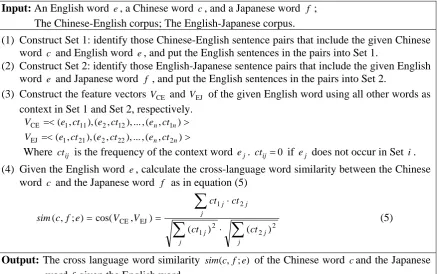
Input: An English word e, a Chinese word , and a Japanese word c f ; The Chinese-English corpus; The English-Japanese corpus.
(1) Construct Set 1: identify those Chinese-English sentence pairs that include the given Chinese word and English word , and put the English sentences in the pairs into Set 1. c e
(2) Construct Set 2: identify those English-Japanese sentence pairs that include the given English word and Japanese word e f , and put the English sentences in the pairs into Set 2.
(3) Construct the feature vectors and of the given English word using all other words as context in Set 1 and Set 2, respectively.
CE
V VEJ
> =<( 1, 11),( 2, 12),...,( , 1 )
CE e ct e ct en ctn
V
> =<( 1, 21),( 2, 22),...,( , 2 )
EJ e ct e ct en ct n
V
Where ctij is the frequency of the context word ej. ctij =0 if ej does not occur in Set i.
(4) Given the English word e, calculate the cross-language word similarity between the Chinese word and the Japanese word c f as in equation (5)
∑
∑
∑
⋅ ⋅ =
=
j j j
j j
j j
ct ct
ct ct
V V e
f c sim
2 2 2
1
2 1
EJ CE
) ( )
( )
, cos( ) ; ,
( (5)
Output: The cross language word similarity of the Chinese word cand the Japanese word given the English word
) ; , (c f e sim
[image:4.595.75.516.70.344.2]f e
Figure 1. Similarity Calculation
English word e. For the ambiguous English word
e, both the Chinese word c and the Japanese word f can be translated into e. The sense of an instance of the ambiguous English word e can be determined by the context in which the instance appears. Thus, the cross-language word similar-ity between the Chinese word c and the Japanese word f can be calculated according to the con-texts of their English translation e. We use the feature vector constructed using the context words in the English sentence to represent the context. So we can calculate the cross-language word similarity using the feature vectors. The detailed algorithm is shown in figure 1. This idea is similar to translation lexicon extraction via a bridge language (Schafer and Yarowsky, 2002).
For example, the Chinese word "河岸" and its English translation "bank" (the border of a river) appears in the following Chinese-English sen-tence pair:
(a)他们沿着河岸走回家。
(b) They walked home along the river bank.
The Japanese word "銀 行" and its English translation "bank" (a financial organization) ap-pears in the following English-Japanese sentence pair:
(c) He has plenty of money in the bank.
(d)彼は銀行預金が相当ある。
The context words of the English word "bank" in sentences (b) and (c) are quite different. The
dif-ference indicates the cross language word simi-larity of the Chinese word "河岸" and the Japa-nese word "銀行" is low. So they tend to have different senses.
Translation Probability Embedded with Cross Language Word Similarity
Based on the cross language word similarity calculation in equation (5), we re-estimate the translation probability as shown in (6). Then we normalize it in equation (7).
The word similarity of the Chinese word "河 岸 (bank2)" and the Japanese word "銀 行 (bank1)" given the word English word "bank" is low. Thus, using the updated estimation method, the translation probability of "銀 行(bank1)" given "河岸(bank2)" becomes low.
)) ; , ( ) | ( ) | ( (
) | ( '
CE EJ
CJ
k j i i
k e
k j i j
e f c sim c e t e f t
c f t
k
⋅ ⋅
=
∑
(6)∑
=
' CJ CJ CJ
) |' ( '
) | ( ' ) | (
f
i i j i
j
c f t
c f t c f t
(7)
4.2 Fertility Probability
probabil-ity nEJ(φi|ek,ci) is independent of the Chinese word ci.
) | ( ) | ( ) | ( ) , | ( ) | ( CE EJ CE EJ CJ i k e k i i k e i k i i i c e t e n c e t c e n c n k k ⋅ = ⋅ =
∑
∑
φ φ φ (8)Where, nCJ(φi|ci) is the fertility probability for the Chinese-Japanese alignment. nEJ(φi|ek) is the trained fertility probability for the English-Japanese alignment.
4.3 Distortion Probability in Model 3
With the English language as a pivot language, we calculate the distortion probability of model 3. For this probability, we introduce two additional parameters: one is the position of English word and the other is the length of English sentence. The distortion probability is estimated as shown in (9). )) , , | Pr( ) , , , | Pr( ) , , , , | (Pr( ) , , | , Pr( ) , , , , | Pr( ) , , | , , Pr( ) , , | ( , , , CJ m l i n m l i n k m l i n k j m l i n k m l i n k j m l i n k j m l i j d n k n k n k ⋅ ⋅ = ⋅ = =
∑
∑
∑
(9)Where, is the estimated distortion
probability. is the introduced position of an English word. n is the introduced length of an English sentence. ) . , | (
CJ j i lm
d
k
In the above equation, we assume that the po-sition probability is independent of the position of the Chinese word and the length of the Chinese sentence. And we assume that the position probability is in-dependent of the length of Japanese sentence. Thus, we rewrite these two probabilities as fol-lows. ) , , , , |
Pr(j k n i l m
) , , , | Pr(k n i l m
) , , | ( ) , , | Pr( ) , , , , |
Pr(j k n il m ≈ j k n m =dEJ j k n m
) , , | ( ) , , | Pr( ) , , , |
Pr(k i l m n ≈ k i l n =dCE k i l n
For the length probability, the English sen-tence length n is independent of the word posi-tions i. And we assume that it is uniformly dis-tributed. Thus, we take it as a constant, and re-write it as follows.
constant ) , | Pr( ) , , |
Pr(n i l m = n l m =
According to the above three assumptions, we ignore the length probability . Equa-tion (9) is rewritten in (10).
) , | Pr(n l m
∑
⋅ = n k n l i k d m n k j d m l i j d , CE EJ CJ ) , , | ( ) , , | ( ) . , | ( (10)4.4 Distortion Probability in Model 4
In model 4, there are two parameters for the dis-tortion probability: one for head words and the other for non-head words.
Distortion Probability for Head Words
The distortion probability for head words represents the relative position of the head word of the i
)
( 1
1 j− i−
d ⊙
th
cept and the center of the (i-1)th cept. Let Δj= j−⊙i−1, then is independent of
the absolute position. Thus, we estimate the dis-tortion probability by introducing another rela-tive position
j
Δ
' j
Δ of English words, which is shown in (11).
∑
Δ − Δ Δ ⋅ Δ = − = Δ ' EJ CE , 1 1 CJ , 1 ) ' | ( Pr ) ' ( ) ( j i j j j d j j d ⊙ (11)Where, d1,CJ(Δj= j−⊙i−1)is the estimated dis-tortion probability for head words in Chinese-Japanese alignment. is the distortion
probability for head word in Chinese-English alignment. ) ' ( CE 1, j d Δ ) ' | (
PrEJ Δj Δj is the translation
prob-ability of relative Japanese position given rela-tive English position.
In order to simplify , we introduce and and let
) ' | ( PrEJ Δj Δj
'
j ⊙i'−1 Δj'= j'−⊙i'−1, where and
are positions of English words. We rewrite ' j 1 '− i ⊙ ) ' | (
PrEJ Δj Δj in (12).
∑
Δ =− =Δ
− − − − − − − − − = − − = Δ Δ ' ' : ,' : , 1 ' 1 EJ 1 ' 1 EJ EJ 1 ' 1 ' 1 1 ) , ' | , ( Pr ) ' | ( Pr ) ' | ( Pr j j j j j j i i i i i i i i j j j j j j ⊙ ⊙ ⊙ ⊙ ⊙ ⊙ ⊙ ⊙ (12)
The English word in position is aligned to the Japanese word in position , and the English word in position is aligned to the Japanese word in position .
' j j 1 '− i ⊙ 1 − i ⊙
We assume that and are independent, only depends on , and only depends
on . Then can be
esti-mated as shown in (13). j ⊙i−1
j j' ⊙i−1
1 '− i
) | ( Pr ) ' | ( Pr ) , ' | , ( Pr 1 ' 1 EJ EJ 1 ' 1 EJ − − − − ⋅
= i i
i i j j j j ⊙ ⊙ ⊙ ⊙ (13)
Both of the two parameters in (13) represent the position translation probabilities. Thus, we can estimate them from the distortion probability in model 3. is estimated as shown in
(14). And can be estimated in
the same way. In (14), we also assume that the sentence length distribution is inde-pendent of the word position and that it is uni-formly distributed.
) ' | ( PrEJ j j
) | (
PrEJ ⊙i−1 ⊙i'−1
) ' | , Pr(l m j
∑
∑
∑
= ⋅ = = m l m l m l m l j j d j m l m l j j d j m l j j j , EJ , EJ , EJ EJ ) , , ' | ( ) ' | , Pr( ) , , ' | ( ) ' | , , ( Pr ) ' | ( Pr (14)Distortion Probability for Non-Head Words
The distortion probability
de-scribes the distribution of the relative position of non-head words. In the same way, we introduce relative position of English words, and model the probability in (15).
)) ( (
1 j p j
d> −
' j Δ
∑
Δ > > Δ Δ ⋅ Δ = − = Δ ' EJ CE , 1 CJ , 1 ) ' | ( Pr ) ' ( )) ( ( j j j j d j p j j d (15) )) ( ( CJ1, j j p j
d> Δ = − is the estimated distortion probability for the non-head words in Chinese-Japanese alignment. is the distortion probability for non-head words in Chinese-English alignment. ) ' ( CE 1, j
d> Δ
) ' | (
PrEJ Δj Δj is the translation probability of the relative Japanese position given the relative English position.
In fact, has the same interpreta-tion as in (12). Thus, we introduce two
parame-ters and and let , where
and are positions of English words. The final distortion probability for non-head words can be estimated as shown in (16).
) ' | ( PrEJ Δj Δj
'
j p(j') Δj'= j'−p(j')
'
j p(j')
) )) ' ( | ) ( ( Pr ) ' | ( Pr ) ' ( ( )) ( ( ' ) ' ( ' : ) ' ( ,' ( ): ( ) , EJ EJ ' CE 1, CJ 1,
∑
∑
Δ = − =Δ − Δ > > ⋅ ⋅ Δ = − = Δ j j p j j pjp j j p j j j j j p j p j j j d j p j j d (16)
5
Interpolation Model
With the Chinese-English and English-Japanese corpora, we can build the induced model for Chi-nese-Japanese word alignment as described in
section 4. If we have small amounts of Chinese-Japanese corpora, we can build another word alignment model using the method described in section 3, which is called the original model here. In order to further improve the performance of Chinese-Japanese word alignment, we build an interpolated model by interpolating the induced model and the original model.
Generally, we can interpolate the induced model and the original model as shown in equa-tion (17). ) ( Pr ) 1 ( ) ( Pr ) Pr( I O a,f|c a,f|c
c | f a, ⋅ − + ⋅
=λ λ (17)
Where is the original model trained from the Chinese-Japanese corpus, and
is the induced model trained from the Chinese-English and English-Japanese corpora.
) ( PrO a,f|c
) ( PrI a,f|c
λ is an interpolation weight. It can be a constant or a function of f and . c
In both model 3 and model 4, there are mainly three kinds of parameters: translation probability, fertility probability and distortion probability. These three kinds of parameters have their own interpretation in these two models. In order to obtain fine-grained interpolation models, we in-terpolate the three kinds of parameters using dif-ferent weights, which are obtained in the same way as described in Wu et al. (2005). λt
repre-sents the weights for translation probability. λn
represents the weights for fertility probability.
d3
λ and λd4 represent the weights for distortion
probability in model 3 and in model 4, respec-tively. λd4 is set as the interpolation weight for
both the head words and the non-head words. The above four weights are obtained using a manually annotated held-out set.
6
Experiments
6.1 Data
There are three training corpora used in this pa-per: Japanese (CJ) corpus, Chinese-English (CE) Corpus, and Chinese-English-Japanese (EJ) Corpus. All of these tree corpora are from gen-eral domain. The Chinese sentences and Japa-nese sentences in the data are automatically seg-mented into words. The statistics of these three corpora are shown in table 1. "# Source Words" and "# Target Words" mean the word number of the source and target sentences, respectively.
Language Pairs
#Sentence Pairs
# Source Words
# Target Words
CJ 21,977 197,072 237,834
[image:7.595.322.521.73.133.2]CE 329,350 4,682,103 4,480,034 EJ 160,535 1,460,043 1,685,204
Table 1. Statistics for Training Data
Besides the training data, we also have held-out data and testing data. The held-held-out data in-cludes 500 Chinese-Japanese sentence pairs, which is used to set the interpolated weights de-scribed in section 5. We use another 1,000 Chi-nese-Japanese sentence pairs as testing data, which is not included in the training data and the held-out data. The alignment links in the held-out data and the testing data are manually annotated. Testing data includes 4,926 alignment links2.
6.2 Evaluation Metrics
We use the same metrics as described in Wu et al. (2005), which is similar to those in (Och and Ney, 2000). The difference lies in that Wu et al. (2005) took all alignment links as sure links.
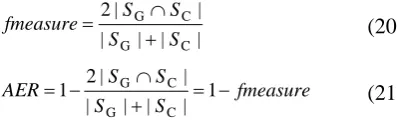
If we use to represent the set of alignment links identified by the proposed methods and to denote the reference alignment set, the meth-ods to calculate the precision, recall, f-measure, and alignment error rate (AER) are shown in equations (18), (19), (20), and (21), respectively. It can be seen that the higher the f-measure is, the lower the alignment error rate is. Thus, we will only show precision, recall and AER scores in the evaluation results.
G
S
C
S
| |
| |
G C G
S S S
precision= ∩ (18)
| |
| |
C C G
S S S
recall= ∩ (19)
2
For a non one-to-one link, if m source words are aligned to
n target words, we take it as one alignment link instead of
m∗n alignment links.
| | | |
| |
2
C G
C G
S S
S S fmeasure
+ ∩
= (20)
fmeasure S
S S S
AER = −
+ ∩ −
= 1
| | | |
| |
2 1
C G
C G
(21)
6.3 Experimental Results
We use the held-out data described in section 6.1 to set the interpolation weights in section 5. λt is
set to 0.3, λn is set to 0.1, λd3 for model 3 is set
to 0.5, and λd4 for model 4 is set to 0.1. With
these parameters, we get the lowest alignment error rate on the held-out data.
For each method described above, we perform bi-directional (source to target and target to source) word alignment and obtain two align-ment results. Based on the two results, we get a result using "refined" combination as described in (Och and Ney, 2000). Thus, all of the results reported here describe the results of the "refined" combination. For model training, we use the GIZA++ toolkit3.
Method Precision Recall AER
Interpolated 0.6955 0.5802 0.3673 Advanced
Induced 0.7382 0.4803 0.4181
Basic
Induced 0.6787 0.4602 0.4515
Original 0.6026 0.4783 0.4667
Table 2. Word Alignment Results
The evaluation results on the testing data are shown in table 2. From the results, it can be seen that both of the two induced models perform bet-ter than the "Original" method that only uses the limited Chinese-Japanese sentence pairs. The "Advanced Induced" method achieves a relative error rate reduction of 10.41% as compared with the "Original" method. Thus, with the Chinese-English corpus and the Chinese-English-Japanese corpus, we can achieve a good word alignment results even if no Chinese-Japanese parallel corpus is available. After introducing the cross-language word similarity into the translation probability, the "Advanced Induced" method achieves a rela-tive error rate reduction of 7.40% as compared with the "Basic Induced" method. It indicates that cross-language word similarity is effective in the calculation of the translation probability. Moreover, the "interpolated" method further im-proves the result, which achieves relative error
3
rate reductions of 12.51% and 21.30% as com-pared with the "Advanced Induced" method and the "Original" method.
7
Conclusion and Future Work
This paper presented a word alignment approach for languages with scarce resources using bilin-gual corpora of other language pairs. To perform word alignment between languages L1 and L2, we introduce a pivot language L3 and bilingual corpora in L1-L3 and L2-L3. Based on these two corpora and with the L3 as a pivot language, we proposed an approach to estimate the parameters of the statistical word alignment model. This ap-proach can build a word alignment model for the desired language pair even if no bilingual corpus is available in this language pair. Experimental results indicate a relative error reduction of 10.41% as compared with the method using the small bilingual corpus.
In addition, we interpolated the above model with the model trained on the small L1-L2 bilin-gual corpus to further improve word alignment between L1 and L2. This interpolated model fur-ther improved the word alignment results by achieving a relative error rate reduction of 12.51% as compared with the method using the two corpora in L1-L3 and L3-L2, and a relative error rate reduction of 21.30% as compared with the method using the small bilingual corpus in L1 and L2.
In future work, we will perform more evalua-tions. First, we will further investigate the effect of the size of corpora on the alignment results. Second, we will investigate different parameter combination of the induced model and the origi-nal model. Third, we will also investigate how simpler IBM models 1 and 2 perform, in com-parison with IBM models 3 and 4. Last, we will evaluate the word alignment results in a real ma-chine translation system, to examine whether lower word alignment error rate will result in higher translation accuracy.
References
Yaser Al-Onaizan, Jan Curin, Michael Jahr, Kevin Knight, John Lafferty, Dan Melamed, Franz-Josef Och, David Purdy, Noah A. Smith, and David Yarowsky. 1999. Statistical Machine Translation Final Report. Johns Hopkins University Workshop.
Niraj Aswani and Robert Gaizauskas. 2005. Aligning Words in English-Hindi Parallel Corpora. In Proc. of the ACL 2005 Workshop on Building and Using Parallel Texts: Data-driven Machine Translation
and Beyond, pages 115-118.
Peter F. Brown, Stephen A. Della Pietra, Vincent J. Della Pietra, and Robert L. Mercer. 1993. The Mathematics of Statistical Machine Translation: Parameter Estimation. Computational Linguistics, 19(2): 263-311.
Colin Cherry and Dekang Lin. 2003. A Probability Model to Improve Word Alignment. In Proc. of the
41st Annual Meeting of the Association for
Compu-tational Linguistics (ACL-2003), pages 88-95.
Sue J. Ker and Jason S. Chang. 1997. A Class-based Approach to Word Alignment. Computational
Lin-guistics, 23(2): 313-343.
Adam Lopez and Philip Resnik. 2005. Improved HMM Alignment Models for Languages with Scarce Resources. In Proc. of the ACL-2005 Work-shop on Building and Using Parallel Texts:
Data-driven Machine Translation and Beyond, pages
83-86.
Joel Martin, Rada Mihalcea, and Ted Pedersen. 2005. Word Alignment for Languages with Scarce Re-sources. In Proc. of the ACL-2005 Workshop on Building and Using Parallel Texts: Data-driven
Machine Translation and Beyond, pages 65-74.
Charles Schafer and David Yarowsky. 2002. Inducing Translation Lexicons via Diverse Similarity Meas-ures and Bridge Languages. In Proc. of the 6th Conference on Natural Language Learning 2002
(CoNLL-2002), pages 1-7.
Dan Tufis, Radu Ion, Alexandru Ceausu, and Dan Stefanescu. 2005. Combined Word Alignments.In
Proc. of the ACL-2005 Workshop on Building and Using Parallel Texts: Data-driven Machine
Trans-lation and Beyond, pages 107-110.
Franz Josef Och and Hermann Ney. 2000. Improved Statistical Alignment Models. In Proc. of the 38th Annual Meeting of the Association for
Computa-tional Linguistics (ACL-2000), pages 440-447.
Franz Josef Och and Hermann Ney. 2003. A System-atic Comparison of Various Statistical Alignment Models. Computational Linguistics, 29(1):19-51.
Dekai Wu. 1997. Stochastic Inversion Transduction Grammars and Bilingual Parsing of Parallel Cor-pora. Computational Linguistics, 23(3):377-403.
Hua Wu, Haifeng Wang, and Zhanyi Liu. 2005. Alignment Model Adaptation for Domain-Specific Word Alignment. In Proc. of the 43rd Annual Meet-ing of the Association for Computational LMeet-inguis-
Linguis-tics (ACL-2005), pages 467-474.
Hao Zhang and Daniel Gildea. 2005. Stochastic Lexi-calized Inversion Transduction Grammar for Alignment. In Proc. of the 43rd Annual Meeting of the Association for Computational Linguistics