Refining Event Extraction through Cross-document Inference
Heng Ji
Ralph Grishman
Computer Science Department New York University New York, NY 10003, USA
(hengji, grishman)@cs.nyu.edu
Abstract
We apply the hypothesis of “One Sense Per Discourse” (Yarowsky, 1995) to information extraction (IE), and extend the scope of “dis-course” from one single document to a cluster of topically-related documents. We employ a similar approach to propagate consistent event arguments across sentences and documents. Combining global evidence from related doc-uments with local decisions, we design a sim-ple scheme to conduct cross-document inference for improving the ACE event ex-traction task1. Without using any additional
labeled data this new approach obtained 7.6% higher F-Measure in trigger labeling and 6% higher F-Measure in argument labeling over a state-of-the-art IE system which extracts events independently for each sentence.
1
Introduction
Identifying events of a particular type within indi-vidual documents – ‘classical’ information extrac-tion – remains a difficult task. Recognizing the different forms in which an event may be ex-pressed, distinguishing events of different types, and finding the arguments of an event are all chal-lenging tasks.
Fortunately, many of these events will be re-ported multiple times, in different forms, both within the same document and within topically- related documents (i.e. a collection of documents sharing participants in potential events). We can
1 http://www.nist.gov/speech/tests/ace/
take advantage of these alternate descriptions to improve event extraction in the original document, by favoring consistency of interpretation across sentences and documents. Several recent studies involving specific event types have stressed the benefits of going beyond traditional single-document extraction; in particular, Yangarber (2006) has emphasized this potential in his work on medical information extraction. In this paper we demonstrate that appreciable improvements are possible over the variety of event types in the ACE (Automatic Content Extraction) evaluation through the use of cross-sentence and cross-document evi-dence.
As we shall describe below, we can make use of consistency at several levels: consistency of word sense across different instances of the same word in related documents, and consistency of argu-ments and roles across different mentions of the same or related events. Such methods allow us to build dynamic background knowledge as required to interpret a document and can compensate for the limited annotated training data which can be pro-vided for each event type.
2
Task and Baseline System
2.1 ACE Event Extraction Task
The event extraction task we are addressing is that of the Automatic Content Extraction (ACE) evalu-ations2. ACE defines the following terminology:
2 In this paper we don’t consider event mention coreference resolution and so don’t distinguish event mentions and events.
entity: an object or a set of objects in one of the semantic categories of interest
mention: a reference to an entity (typically, a noun phrase)
event trigger: the main word which most clearly expresses an event occurrence
event arguments: the mentions that are in-volved in an event (participants)
event mention: a phrase or sentence within which an event is described, including trigger and arguments
The 2005 ACE evaluation had 8 types of events, with 33 subtypes; for the purpose of this paper, we will treat these simply as 33 distinct event types. For example, for a sentence:
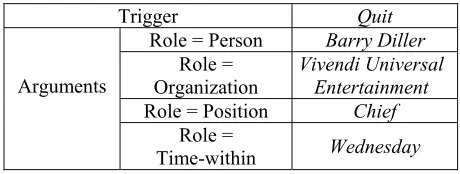
Barry Diller on Wednesday quit as chief of Vivendi Universal Entertainment.
the event extractor should detect a “Person-nel_End-Position” event mention, with the trigger word, the position, the person who quit the posi-tion, the organizaposi-tion, and the time during which the event happened:
Trigger Quit
Arguments
Role = Person Barry Diller
Role =
Organization Vivendi Universal Entertainment
Role = Position Chief
Role =
[image:2.612.70.300.379.466.2]Time-within Wednesday
Table 1. Event Extraction Example
We define the following standards to determine the correctness of an event mention:
• A trigger is correctly labeled if its event type and offsets match a reference trigger.
• An argument is correctly identified if its event type and offsets match any of the reference ar-gument mentions.
• An argument is correctly identified and classi-fied if its event type, offsets, and role match any of the reference argument mentions.
2.2 A Baseline Within-Sentence Event Tagger
We use a state-of-the-art English IE system as our baseline (Grishman et al., 2005). This system ex-tracts events independently for each sentence. Its training and test procedures are as follows.
The system combines pattern matching with sta-tistical models. For every event mention in the ACE training corpus, patterns are constructed based on the sequences of constituent heads sepa-rating the trigger and arguments. In addition, a set of Maximum Entropy based classifiers are trained:
• Trigger Labeling: to distinguish event men-tions from non-event-menmen-tions, to classify event mentions by type;
• Argument Classifier: to distinguish arguments from non-arguments;
• Role Classifier: to classify arguments by ar-gument role.
• Reportable-Event Classifier: Given a trigger, an event type, and a set of arguments, to de-termine whether there is a reportable event mention.
In the test procedure, each document is scanned for instances of triggers from the training corpus. When an instance is found, the system tries to match the environment of the trigger against the set of patterns associated with that trigger. This pat-tern-matching process, if successful, will assign some of the mentions in the sentence as arguments of a potential event mention. The argument clas-sifier is applied to the remaining mentions in the sentence; for any argument passing that classifier, the role classifier is used to assign a role to it. Fi-nally, once all arguments have been assigned, the reportable-event classifier is applied to the poten-tial event mention; if the result is successful, this event mention is reported.
3
Motivations
In this section we shall present our motivations based on error analysis for the baseline event tag-ger.
3.1 One Trigger Sense Per Cluster
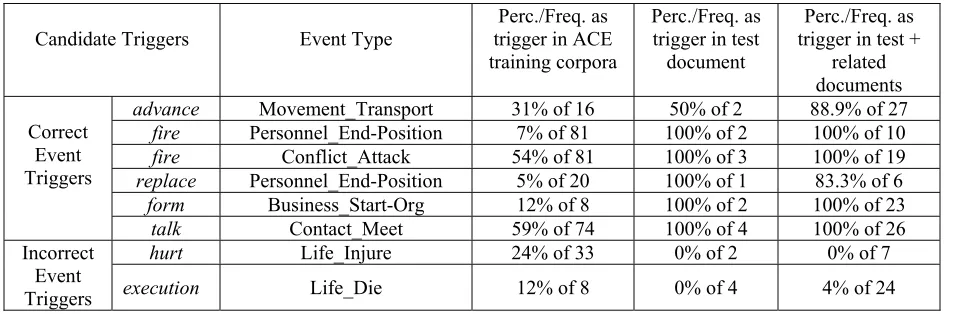
Candidate Triggers Event Type
Perc./Freq. as trigger in ACE training corpora
Perc./Freq. as trigger in test
document
Perc./Freq. as trigger in test +
related documents
Correct Event Triggers
advance Movement_Transport 31% of 16 50% of 2 88.9% of 27
fire Personnel_End-Position 7% of 81 100% of 2 100% of 10
fire Conflict_Attack 54% of 81 100% of 3 100% of 19
replace Personnel_End-Position 5% of 20 100% of 1 83.3% of 6
form Business_Start-Org 12% of 8 100% of 2 100% of 23
talk Contact_Meet 59% of 74 100% of 4 100% of 26
Incorrect Event Triggers
hurt Life_Injure 24% of 33 0% of 2 0% of 7
[image:3.612.70.548.62.219.2]execution Life_Die 12% of 8 0% of 4 4% of 24
Table 2. Examples: Percentage of a Word as Event Trigger in Different Data Collections
As we can see from the table, the likelihood of a candidate word being an event trigger in the test document is closer to its distribution in the collec-tion of related documents than the uniform training corpora. So if we can determine the sense (event type) of a word in the related documents, this will allow us to infer its sense in the test document. In this way related documents can help recover event mentions missed by within-sentence extraction.
For example, in a document about “the advance into Baghdad”:
Example 1:
[Test Sentence]
Most US army commanders believe it is critical to
pause the breakneck advance towards Baghdad to
se-cure the supply lines and make sure weapons are oper-able and troops resupplied….
[Sentences from Related Documents]
British and US forces report gains in the advance on Baghdad and take control of Umm Qasr, despite a fierce sandstorm which slows another flank.
…
The baseline event tagger is not able to detect “advance” as a “Movement_Transport” event trig-ger because there is no pattern “advance towards [Place]” in the ACE training corpora (“advance” by itself is too ambiguous). The training data, however, does include the pattern “advance on [Place]”, which allows the instance of “advance” in the related documents to be successfully identified with high confidence by pattern matching as an event. This provides us much stronger “feedback” confidence in tagging ‘advance’ in the test sen-tence as a correct trigger.
On the other hand, if a word is not tagged as an event trigger in most related documents, then it’s less likely to be correct in the test sentence despite its high local confidence. For example, in a docu-ment about “assessdocu-ment of Russian president Pu-tin”:
Example 2:
[Test Sentence]
But few at the Kremlin forum suggested that Putin's own standing among voters will be hurt by Russia's apparent diplomacy failures.
[Sentences from Related Documents]
Putin boosted ties with the United States by throwing his support behind its war on terrorism after the Sept. 11 attacks, but the Iraq war has hurt the relationship.
…
The word “hurt” in the test sentence is mistaken-ly identified as a “Life_Injure” trigger with high local confidence (because the within-sentence ex-tractor misanalyzes “voters” as the object of “hurt” and so matches the pattern “[Person] be hurt”). Based on the fact that many other instances of “hurt” are not “Life_Injure” triggers in the related documents, we can successfully remove this wrong event mention in the test document.
3.2 One Argument Role Per Cluster
Example 3: [Test Sentence]
Vivendi earlier this week confirmed months of press speculation that it planned to shed its entertainment assets by the end of the year.
[Sentences from Related Documents]
Vivendi has been trying to sell assets to pay off huge debt, estimated at the end of last month at more than $13 billion.
Under the reported plans, Blackstone Group would
buyVivendi's theme park division, including Universal Studios Hollywood, Universal Orlando in Florida...
…
The above test sentence doesn’t include an ex-plicit trigger word to indicate “Vivendi” as a “sel-ler” of a “Transaction_Transfer-Ownership” event mention, but “Vivendi” is correctly identified as “seller” in many other related sentences (by match-ing patterns “[Seller] sell” and “buy [Seller]’s”). So we can incorporate such additional information to enhance the confidence of “Vivendi” as a “sel-ler” in the test sentence.
On the other hand, we can remove spurious ar-guments with low cross-document frequency and confidence. In the following example,
Example 4:
[Test Sentence]
The Davao Medical Center, a regional government hospital, recorded 19 deaths with 50 wounded.
“the Davao Medical Center” is mistakenly tagged as “Place” for a “Life_Die” event mention. But the same annotation for this mention doesn’t appear again in the related documents, so we can determine it’s a spurious argument.
4
System Approach Overview
Based on the above motivations we propose to in-corporate global evidence from a cluster of related documents to refine local decisions. This section gives more details about the baseline within-sentence event tagger, and the information retrieval system we use to obtain related documents. In the next section we shall focus on describing the infe-rence procedure.
4.1 System Pipeline
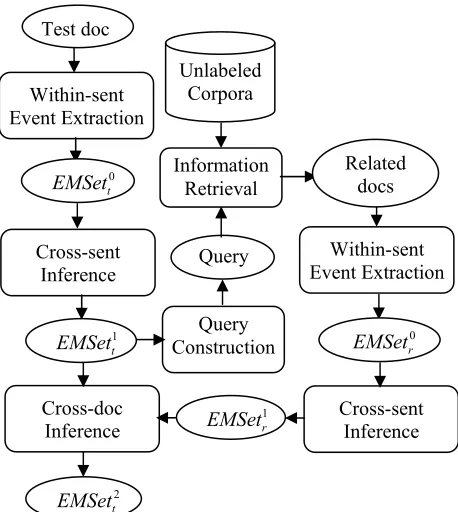
[image:4.612.316.545.66.322.2]Figure 1 depicts the general procedure of our ap-proach. EMSet represents a set of event mentions which is gradually updated.
Figure 1. Cross-doc Inference for Event Extraction
4.2 Within-Sentence Event Extraction
For each event mention in a test document
t
, the baseline Maximum Entropy based classifiers pro-duce three types of confidence values:• LConf(trigger,etype): The probability of a string trigger indicating an event mention with type etype; if the event mention is produced by pattern matching then assign confidence 1.
• LConf(arg, etype): The probability that a men-tion arg is an argument of some particular event type etype.
• LConf(arg, etype, role): If arg is an argument with event type etype, the probability of arg having some particular role.
We apply within-sentence event extraction to get an initial set of event mentions 0
t
EMSet , and
con-duct cross-sentence inference (details will be pre-sented in section 5) to get an updated set of event mentions 1
t
EMSet .
4.3 Information Retrieval
We then use the INDRI retrieval system (Strohman et al., 2005) to obtain the top N (N=25 in this
pa-Test doc
Within-sent Event Extraction
Query Construction Cross-sent
Inference Query Unlabeled
Corpora
Information Retrieval
Related docs
Within-sent Event Extraction
Cross-sent Inference
1 r
EMSet
Cross-doc Inference
0 t
EMSet
0 r
EMSet
1 t
EMSet
2 t
per3) related documents. We construct an INDRI query from the triggers and arguments, each weighted by local confidence and frequency in the test document. For each argument we also add oth-er names corefoth-erential with or bearing some ACE relation to the argument.
For each related document
r
returned by INDRI, we repeat the within-sentence event extraction and cross-sentence inference procedure, and get an ex-panded event mention set 1t r
EMSet+ . Then we apply
cross-document inference to 1 t r
EMSet+ and get the
final event mention output 2 t
EMSet .
5
Global Inference
The central idea of inference is to obtain docu-ment-wide and cluster-wide statistics about the frequency with which triggers and arguments are associated with particular types of events, and then use this information to correct event and argument identification and classification.
For a set of event mentions we tabulate the fol-lowing document-wide and cluster-wide confi-dence-weighted frequencies:
• for each trigger string, the frequency with
which it appears as the trigger of an event of a particular type;
• for each event argument string and the names
coreferential with or related to the argument, the frequency of the event type;
• for each event argument string and the names
coreferential with or related to the argument, the frequency of the event type and role. Besides these frequencies, we also define the following margin metric to compute the confi-dence of the best (most frequent) event type or role:
Margin =
(WeightedFrequency (most frequent value) – WeightedFrequency (second most freq value))/ WeightedFrequency (second most freq value)
A large margin indicates greater confidence in the most frequent value. We summarize the fre-quency and confidence metrics in Table 3.
Based on these confidence metrics, we designed the inference rules in Table 4. These rules are ap-plied in the order (1) to (9) based on the principle of improving ‘local’ information before global
3 We tested different N
∈ [10, 75] on dev set; and N=25 achieved best gains.
propagation. Although the rules may seem com-plex, they basically serve two functions:
• to remove triggers and arguments with low (local or cluster-wide) confidence;
• to adjust trigger and argument identification and classification to achieve (document-wide or cluster-wide) consistency.
6
Experimental Results and Analysis
In this section we present the results of applying this inference method to improve ACE event ex-traction.
6.1 Data
We used 10 newswire texts from ACE 2005 train-ing corpora (from March to May of 2003) as our development set, and then conduct blind test on a separate set of 40 ACE 2005 newswire texts. For each test text we retrieved 25 related texts from English TDT5 corpus which in total consists of 278,108 texts (from April to September of 2003).
6.2 Confidence Metric Thresholding
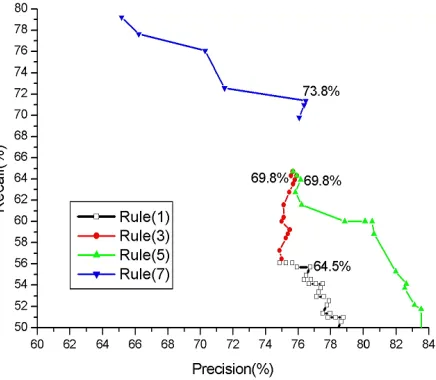
We select the thresholds (δk with k=1~13) for vari-ous confidence metrics by optimizing the F-measure score of each rule on the development set, as shown in Figure 2 and 3 as follows.
[image:5.612.317.535.477.667.2]Each curve in Figure 2 and 3 shows the effect on precision and recall of varying the threshold for an individual rule.
Figure 3. Argument Labeling Performance with Confidence Thresholding on Dev Set
The labeled point on each curve shows the best F-measure that can be obtained on the develop-ment set by adjusting the threshold for that rule. The gain obtained by applying successive rules can be seen in the progression of successive points to-wards higher recall and, for argument labeling, precision4.
6.3 Overall Performance
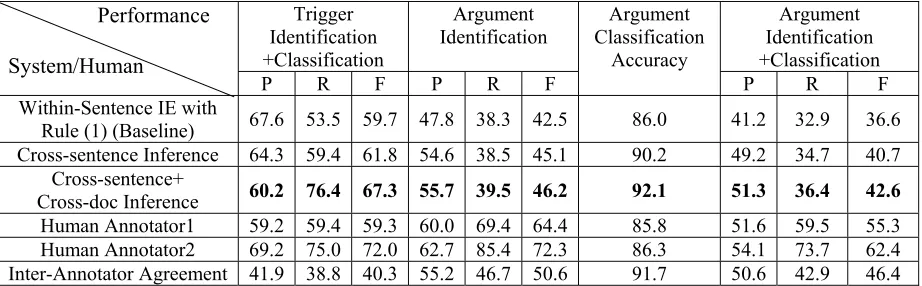
Table 5 shows the overall Precision (P), Recall (R) and F-Measure (F) scores for the blind test set. In addition, we also measured the performance of two human annotators who prepared the ACE 2005 training data on 28 newswire texts (a subset of the blind test set). The final key was produced by re-view and adjudication of the two annotations.
Both cross-sentence and cross-document infe-rences provided significant improvement over the baseline with local confidence thresholds con-trolled.
We conducted the Wilcoxon Matched-Pairs Signed-Ranks Test on a document basis. The re-sults show that the improvement using cross-sentence inference is significant at a 99.9% confi-dence level for both trigger and argument labeling; adding cross-document inference is significant at a 99.9% confidence level for trigger labeling and 93.4% confidence level for argument labeling.
4 We didn’t show the classification adjusting rules (2), (6) and (8) here because of their relatively small impact on dev set.
6.4 Discussion
From table 5 we can see that for trigger labeling our approach dramatically enhanced recall (22.9% improvement) with some loss (7.4%) in precision. This precision loss was much larger than that for the development set (0.3%). This indicates that the trigger propagation thresholds optimized on the development set were too low for the blind test set and thus more spurious triggers got propagated. The improved trigger labeling is better than one human annotator and only 4.7% worse than anoth-er.
For argument labeling we can see that cross-sentence inference improved both identification (3.7% higher F-Measure) and classification (6.1% higher accuracy); and cross-document inference mainly provided further gains (1.9%) in classifica-tion. This shows that identification consistency may be achieved within a narrower context while the classification task favors more global back-ground knowledge in order to solve some difficult cases. This matches the situation of human annota-tion as well: we may decide whether a menannota-tion is involved in some particular event or not by reading and analyzing the target sentence itself; but in or-der to decide the argument’s role we may need to frequently refer to wider discourse in order to infer and confirm our decision. In fact sometimes it re-quires us to check more similar web pages or even wikipedia databases. This was exactly the intuition of our approach. We should also note that human annotators label arguments based on perfect entity mentions, but our system used the output from the IE system. So the gap was also partially due to worse entity detection.
Performance
System/Human
Trigger Identification +Classification
Argument Identification
Argument Classification
Accuracy
Argument Identification +Classification
P R F P R F P R F
Within-Sentence IE with
Rule (1) (Baseline) 67.6 53.5 59.7 47.8 38.3 42.5 86.0 41.2 32.9 36.6 Cross-sentence Inference 64.3 59.4 61.8 54.6 38.5 45.1 90.2 49.2 34.7 40.7
Cross-sentence+
[image:7.612.77.538.63.206.2]Cross-doc Inference 60.2 76.4 67.3 55.7 39.5 46.2 92.1 51.3 36.4 42.6 Human Annotator1 59.2 59.4 59.3 60.0 69.4 64.4 85.8 51.6 59.5 55.3 Human Annotator2 69.2 75.0 72.0 62.7 85.4 72.3 86.3 54.1 73.7 62.4 Inter-Annotator Agreement 41.9 38.8 40.3 55.2 46.7 50.6 91.7 50.6 42.9 46.4
Table 5. Overall Performance on Blind Test Set (%)
In fact, compared to a statistical tagger trained on the corpus after expert adjudication, a human an-notator tends to make more mistakes in trigger classification. For example it’s hard to decide whether “named” represents a “Person-nel_Nominate” or “Personnel_Start-Position” event mention; “hacked to death” represents a “Life_Die” or “Conflict_Attack” event mention without following more specific annotation guide-lines.
7
Related Work
The trigger labeling task described in this paper is in part a task of word sense disambiguation (WSD), so we have used the idea of sense consis-tency introduced in (Yarowsky, 1995), extending it to operate across related documents.
Almost all the current event extraction systems focus on processing single documents and, except for coreference resolution, operate a sentence at a time (Grishman et al., 2005; Ahn, 2006; Hardy et al., 2006).
We share the view of using global inference to improve event extraction with some recent re-search. Yangarber et al. (Yangarber and Jokipii, 2005; Yangarber, 2006; Yangarber et al., 2007) applied cross-document inference to correct local extraction results for disease name, location and start/end time. Mann (2007) encoded specific infe-rence rules to improve extraction of CEO (name, start year, end year) in the MUC management succession task. In addition, Patwardhan and Ri-loff (2007) also demonstrated that selectively ap-plying event patterns to relevant regions can improve MUC event extraction. We expand the idea to more general event types and use
informa-tion retrieval techniques to obtain wider back-ground knowledge from related documents.
8
Conclusion and Future Work
One of the initial goals for IE was to create a da-tabase of relations and events from the entire input corpus, and allow further logical reasoning on the database. The artificial constraint that extraction should be done independently for each document was introduced in part to simplify the task and its evaluation. In this paper we propose a new ap-proach to break down the document boundaries for event extraction. We gather together event ex-traction results from a set of related documents, and then apply inference and constraints to en-hance IE performance.
XSent-Trigger-Freq(trigger, etype) The weighted frequency of string of type etype across all sentences within a document trigger appearing as the trigger of an event
XDoc-Trigger-Freq (trigger, etype) The weighted frequency of string of type etype across all documents in a cluster trigger appearing as the trigger of an event
XDoc-Trigger-BestFreq (trigger) Maximum over all etypes of XDoc-Trigger-Freq (trigger, etype)
XDoc-Arg-Freq(arg, etype) The weighted frequency of etype across all documents in a cluster arg appearing as an argument of an event of type
XDoc-Role-Freq(arg, etype, role) The weighted frequency of etype with role role across all documents in a cluster arg appearing as an argument of an event of type
XDoc-Role-BestFreq(arg) Maximum over all etypes and roles of XDoc-Role-Freq(arg, etype, role)
XSent-Trigger-Margin(trigger) The margin value of trigger in XSent-Trigger-Freq
XDoc-Trigger-Margin(trigger) The margin value of trigger in XDoc-Trigger-Freq
XDoc-Role-Margin(arg) The margin value of arg in XDoc-Role-Freq
Table 3. Global Frequency and Confidence Metrics
Rule (1): Remove Triggers and Arguments with Low Local Confidence
If LConf(trigger, etype) < δ1, then delete the whole event mention EM;
If LConf(arg, etype) < δ2 or LConf(arg, etype, role) < δ3, then delete arg.
Rule (2): Adjust Trigger Classification to Achieve Document-wide Consistency
If XSent-Trigger-Margin(trigger) >δ4, then propagate the most frequent etype to all event mentions with trigger in
the document; and correct roles for corresponding arguments.
Rule (3): Adjust Trigger Identification to Achieve Document-wide Consistency
If LConf(trigger, etype) > δ5, then propagate etype to all unlabeled strings trigger in the document.
Rule (4): Adjust Argument Identification to Achieve Document-wide Consistency
If LConf(arg, etype) > δ6, then in the document, for each sentence containing an event mention EM with etype, add
any unlabeled mention in that sentence with the same head as arg as an argument of EM with role.
Rule (5): Remove Triggers and Arguments with Low Cluster-wide Confidence
If XDoc-Trigger-Freq (trigger, etype) < δ7, then delete EM;
If XDoc-Arg-Freq(arg, etype) < δ8 or XDoc-Role-Freq(arg, etype, role) < δ9, then delete arg.
Rule (6): Adjust Trigger Classification to Achieve Cluster-wide Consistency
If XDoc-Trigger-Margin(trigger) >δ10, then propagate most frequent etype to all event mentions with trigger in the
cluster; and correct roles for corresponding arguments.
Rule (7): Adjust Trigger Identification to Achieve Cluster-wide Consistency
If XDoc-Trigger-BestFreq (trigger) >δ11, then propagate etype to all unlabeled strings trigger in the cluster, override
the results of Rule (3) if conflict.
Rule (8): Adjust Argument Classification to Achieve Cluster-wide Consistency
If XDoc-Role-Margin(arg) >δ12, then propagate the most frequent etype and role to all arguments with the same
head as arg in the entire cluster.
Rule (9): Adjust Argument Identification to Achieve Cluster-wide Consistency
If XDoc-Role-BestFreq(arg) > δ13, then in the cluster, for each sentence containing an event mention EM with etype,
add any unlabeled mention in that sentence with the same head as arg as an argument of EM with role.
Table 4. Probabilistic Inference Rule
Acknowledgments
This material is based upon work supported by the Defense Advanced Research Projects Agency un-der Contract No. HR0011-06-C-0023, and the
References
David Ahn. 2006. The stages of event extraction. Proc. COLING/ACL 2006 Workshop on Annotating and
Reasoning about Time and Events. Sydney,
Aus-tralia.
Ralph Grishman, David Westbrook and Adam Meyers. 2005. NYU’s English ACE 2005 System Descrip-tion. Proc. ACE 2005 Evaluation Workshop. Wash-ington, US.
Hilda Hardy, Vika Kanchakouskaya and Tomek Strzal-kowski. 2006. Automatic Event Classification Us-ing Surface Text Features. Proc. AAAI06 Workshop
on Event Extraction and Synthesis. Boston,
Massa-chusetts. US.
Gideon Mann. 2007. Multi-document Relationship Fu-sion via Constraints on Probabilistic Databases.
Proc. HLT/NAACL 2007. Rochester, NY, US.
Siddharth Patwardhan and Ellen Riloff. 2007. Effective Information Extraction with Semantic Affinity Pat-terns and Relevant Regions. Proc. EMNLP 2007.
Prague, Czech Republic.
Trevor Strohman, Donald Metzler, Howard Turtle and W. Bruce Croft. 2005. Indri: A Language-model based Search Engine for Complex Queries (ex-tended version). Technical Report IR-407, CIIR,
Umass Amherst, US.
Roman Yangarber, Clive Best, Peter von Etter, Flavio Fuart, David Horby and Ralf Steinberger. 2007. Combining Information about Epidemic Threats from Multiple Sources. Proc. RANLP 2007 work-shop on Multi-source, Multilingual Information Ex-traction and Summarization. Borovets, Bulgaria. Roman Yangarber. 2006. Verification of Facts across
Document Boundaries. Proc. International
Work-shop on Intelligent Information Access. Helsinki,
Finland.
Roman Yangarber and Lauri Jokipii. 2005. Redundan-cy-based Correction of Automatically Extracted Facts. Proc. HLT/EMNLP 2005. Vancouver, Cana-da.
David Yarowsky. 1995. Unsupervised Word Sense Dis-ambiguation Rivaling Supervised Methods. Proc.