A Cascaded Linear Model for Joint Chinese Word Segmentation and
Part-of-Speech Tagging
Wenbin Jiang† Liang Huang‡ Qun Liu† Yajuan L ¨u†
†Key Lab. of Intelligent Information Processing ‡Department of Computer & Information Science
Institute of Computing Technology University of Pennsylvania Chinese Academy of Sciences Levine Hall, 3330 Walnut Street P.O. Box 2704, Beijing 100190, China Philadelphia, PA 19104, USA
[email protected] [email protected]
Abstract
We propose a cascaded linear model for joint Chinese word segmentation and part-of-speech tagging. With a character-based perceptron as the core, combined with real-valued features such as language models, the cascaded model is able to efficiently uti-lize knowledge sources that are inconvenient to incorporate into the perceptron directly. Experiments show that the cascaded model achieves improved accuracies on both seg-mentation only and joint segseg-mentation and part-of-speech tagging. On the Penn Chinese Treebank 5.0, we obtain an error reduction of
18.5%on segmentation and12%on joint seg-mentation and part-of-speech tagging over the perceptron-only baseline.
1 Introduction
Word segmentation and part-of-speech (POS) tag-ging are important tasks in computer processing of Chinese and other Asian languages. Several mod-els were introduced for these problems, for example, the Hidden Markov Model (HMM) (Rabiner, 1989), Maximum Entropy Model (ME) (Ratnaparkhi and Adwait, 1996), and Conditional Random Fields (CRFs) (Lafferty et al., 2001). CRFs have the ad-vantage of flexibility in representing features com-pared to generative ones such as HMM, and usually behaves the best in the two tasks. Another widely used discriminative method is the perceptron algo-rithm (Collins, 2002), which achieves comparable performance to CRFs with much faster training, so we base this work on the perceptron.
To segment and tag a character sequence, there are two strategies to choose: performing POS tag-ging following segmentation; or joint segmentation and POS tagging (Joint S&T). Since the typical ap-proach of discriminative models treats segmentation as a labelling problem by assigning each character a boundary tag (Xue and Shen, 2003), Joint S&T can be conducted in a labelling fashion by expand-ing boundary tags to include POS information (Ng and Low, 2004). Compared to performing segmen-tation and POS tagging one at a time, Joint S&T can achieve higher accuracy not only on segmentation but also on POS tagging (Ng and Low, 2004). Be-sides the usual character-based features, additional features dependent on POS’s or words can also be employed to improve the performance. However, as such features are generated dynamically during the decoding procedure, two limitation arise: on the one hand, the amount of parameters increases rapidly, which is apt to overfit on training corpus; on the other hand, exact inference by dynamic program-ming is intractable because the current predication relies on the results of prior predications. As a result, many theoretically useful features such as higher-order word or POS n-grams are difficult to be in-corporated in the model efficiently.
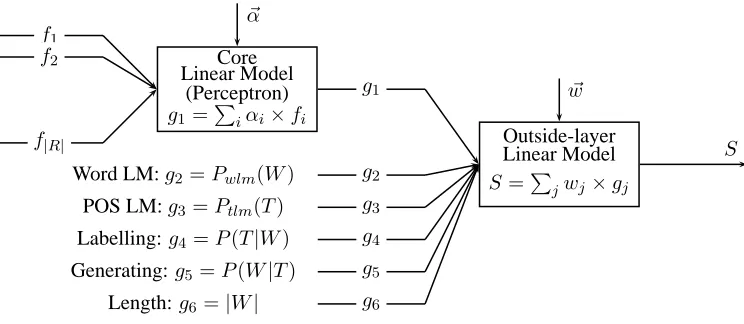
To cope with this problem, we propose a cascaded linear model inspired by the log-linear model (Och and Ney, 2004) widely used in statistical machine translation to incorporate different kinds of knowl-edge sources. Shown in Figure 1, the cascaded model has a two-layer architecture, with a character-based perceptron as the core combined with other real-valued features such as language models. We
Core Linear Model
(Perceptron) g1=Piαi×fi
~ α
Outside-layer Linear Model S =Pjwj×gj
~ w f1
f2
f|R|
g1
Word LM:g2=Pwlm(W) g2
POS LM:g3=Ptlm(T) g3
Labelling:g4=P(T|W) g4
Generating:g5=P(W|T) g5
Length:g6=|W| g6
[image:2.612.119.491.59.221.2]S
Figure 1: Structure of Cascaded Linear Model.|R|denotes the scale of the feature space of the core perceptron.
will describe it in detail in Section 4. In this ar-chitecture, knowledge sources that are intractable to incorporate into the perceptron, can be easily incor-porated into the outside linear model. In addition, as these knowledge sources are regarded as separate features, we can train their corresponding models in-dependently with each other. This is an interesting approach when the training corpus is large as it re-duces the time and space consumption. Experiments show that our cascaded model can utilize different knowledge sources effectively and obtain accuracy improvements on both segmentation and Joint S&T.
2 Segmentation and POS Tagging
Given a Chinese character sequence:
C1:n=C1C2.. Cn
the segmentation result can be depicted as:
C1:e1 Ce1+1:e2 .. Cem−1+1:em
while the segmentation and POS tagging result can be depicted as:
C1:e1/t1Ce1+1:e2/t2 .. Cem−1+1:em/tm
Here, Ci (i = 1..n) denotes Chinese character, ti (i = 1..m) denotes POS tag, and Cl:r (l ≤ r)
denotes character sequence ranges from Cl to Cr.
We can see that segmentation and POS tagging task is to divide a character sequence into several subse-quences and label each of them a POS tag.
It is a better idea to perform segmentation and POS tagging jointly in a uniform framework. Ac-cording to Ng and Low (2004), the segmentation
task can be transformed to a tagging problem by as-signing each character a boundary tag of the follow-ing four types:
• b: the begin of the word
• m: the middle of the word
• e: the end of the word
• s: a single-character word
We can extract segmentation result by splitting the labelled result into subsequences of patternsor
bm∗ewhich denote single-character word and multi-character word respectively. In order to perform POS tagging at the same time, we expand boundary tags to include POS information by attaching a POS to the tail of a boundary tag as a postfix following Ng and Low (2004). As each tag is now composed of a boundary part and a POS part, the joint S&T problem is transformed to a uniform boundary-POS labelling problem. A subsequence of boundary-POS labelling result indicates a word with POStonly if the boundary tag sequence composed of its bound-ary part conforms tos orbm∗e style, and all POS tags in its POS part equal to t. For example, a tag sequenceb N N m N N e N N represents a three-character word with POS tagN N.
3 The Perceptron
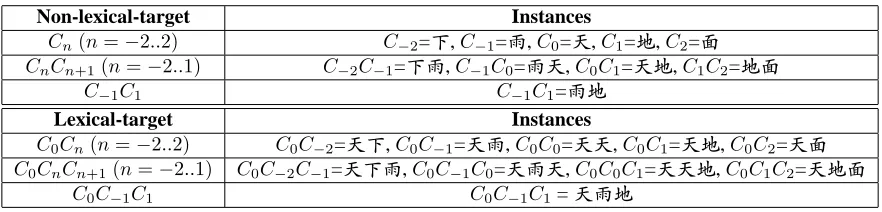
Non-lexical-target Instances
Cn(n=−2..2) C−2=e,C−1= ,C0=U,C1=/,C2=¡ CnCn+1(n=−2..1) C−2C−1=e ,C−1C0= U,C0C1=U/,C1C2=/¡
C−1C1 C−1C1= /
Lexical-target Instances
C0Cn(n=−2..2) C0C−2=Ue,C0C−1=U ,C0C0=UU,C0C1=U/,C0C2=U¡ C0CnCn+1(n=−2..1) C0C−2C−1=Ue ,C0C−1C0=U U,C0C0C1=UU/,C0C1C2=U/¡
[image:3.612.86.527.58.164.2]C0C−1C1 C0C−1C1=U /
Table 1: Feature templates and instances. Suppose we are considering the third character ”U” in ”e U/¡”.
to CRFs, while with much faster training. The per-ceptron has been used in many NLP tasks, such as POS tagging (Collins, 2002), Chinese word seg-mentation (Ng and Low, 2004; Zhang and Clark, 2007) and so on. We trained a character-based per-ceptron for Chinese Joint S&T, and found that the perceptron itself could achieve considerably high ac-curacy on segmentation and Joint S&T. In following subsections, we describe the feature templates and the perceptron training algorithm.
3.1 Feature Templates
The feature templates we adopted are selected from those of Ng and Low (2004). To compare with oth-ers conveniently, we excluded the ones forbidden by the close test regulation of SIGHAN, for example,
P u(C0), indicating whether characterC0is a
punc-tuation.
All feature templates and their instances are shown in Table 1. C represents a Chinese char-acter while the subscript of C indicates its posi-tion in the sentence relative to the current charac-ter (it has the subscript0). Templates immediately borrowed from Ng and Low (2004) are listed in the upper column named non-lexical-target. We called them non-lexical-target because predications derived from them can predicate without consider-ing the current characterC0. Templates in the
col-umn below are expanded from the upper ones. We add a field C0 to each template in the upper
col-umn, so that it can carry out predication according to not only the context but also the current char-acter itself. As predications generated from such templates depend on the current character, we name these templates lexical-target. Note that the tem-plates of Ng and Low (2004) have already con-tained some lexical-target ones. With the two kinds
Algorithm 1 Perceptron training algorithm.
1: Input: Training examples(xi, yi) 2: α~ ←0
3: fort←1.. Tdo
4: fori←1..Ndo
5: zi←argmaxz∈GEN(xi)Φ(xi, z)·~α 6: ifzi6=yithen
7: ~α←~α+Φ(xi, yi)−Φ(xi, zi) 8: Output: Parametersα~
of predications, the perceptron model will do exact predicating to the best of its ability, and can back off to approximately predicating if exact predicating fails.
3.2 Training Algorithm
We adopt the perceptron training algorithm of Collins (2002) to learn a discriminative model map-ping from inputsx∈Xto outputsy∈Y, whereX
is the set of sentences in the training corpus andY
is the set of corresponding labelled results. Follow-ing Collins, we use a functionGEN(x)generating all candidate results of an inputx, a representation Φmapping each training example(x, y) ∈ X×Y to a feature vectorΦ(x, y) ∈ Rd, and a parameter vectorα~ ∈ Rdcorresponding to the feature vector. dmeans the dimension of the vector space, it equals to the amount of features in the model. For an input character sequencex, we aim to find an outputF(x)
satisfying:
F(x) = argmax
y∈GEN(x)
Φ(x, y)·~α (1)
To alleviate overfitting on the training examples, we use the refinement strategy called “averaged pa-rameters” (Collins, 2002) to the algorithm in Algo-rithm 1.
4 Cascaded Linear Model
In theory, any useful knowledge can be incorporated into the perceptron directly, besides the character-based features already adopted. Additional features most widely used are related to word or POS n -grams. However, such features are generated dy-namically during the decoding procedure so that the feature space enlarges much more rapidly. Fig-ure 2 shows the growing tendency of featFig-ure space with the introduction of these features as well as the character-based ones. We noticed that the templates related to word unigrams and bigrams bring to the feature space an enlargement much rapider than the character-base ones, not to mention the higher-order grams such as trigrams or4-grams. In addition, even though these higher grams were managed to be used, there still remains another problem: as the current predication relies on the results of prior ones, the decoding procedure has to resort to approximate in-ference by maintaining a list ofN-best candidates at each predication position, which evokes a potential risk to depress the training.
To alleviate the drawbacks, we propose a cas-caded linear model. It has a two-layer architec-ture, with a perceptron as the core and another linear model as the outside-layer. Instead of incorporat-ing all features into the perceptron directly, we first trained the perceptron using character-based fea-tures, and several other sub-models using additional ones such as word or POSn-grams, then trained the outside-layer linear model using the outputs of these sub-models, including the perceptron. Since the per-ceptron is fixed during the second training step, the whole training procedure need relative small time and memory cost.
The outside-layer linear model, similar to those in SMT, can synthetically utilize different knowl-edge sources to conduct more accurate comparison between candidates. In this layer, each knowledge source is treated as a feature with a corresponding weight denoting its relative importance. Suppose we havenfeaturesgj(j= 1..n)coupled withn
0 300000 600000 900000 1.2e+006 1.5e+006 1.8e+006 2.1e+006 2.4e+006 2.7e+006 3e+006 3.3e+006
0 1 2 3 4 5 6 7 8 9 10 11 12 13 14 15 16 17 18 19 20 21 22
Feature space
[image:4.612.322.532.62.171.2]Introduction of features growing curve
Figure 2: Feature space growing curve. The horizontal scope X[i:j] denotes the introduction of different tem-plates. X[0:5]:Cn (n=−2..2); X[5:9]:CnCn+1(n= −2..1); X[9:10]: C−1C1; X[10:15]: C0Cn (n = −2..2); X[15:19]: C0CnCn+1(n = −2..1); X[19:20]: C0C−1C1; X[20:21]: W0; X[21:22]: W−1W0. W0 de-notes the current considering word, whileW−1denotes the word in front ofW0. All the data are collected from the training procedure on MSR corpus of SIGHAN bake-off 2.
sponding weights wj (j = 1..n), each feature gj
gives a score gj(r) to a candidate r, then the total score ofris given by:
S(r) = X
j=1..n
wj×gj(r) (2)
The decoding procedure aims to find the candidate
r∗with the highest score:
r∗= argmax
r
S(r) (3)
While the mission of the training procedure is to tune the weightswj(j = 1..n)to guarantee that the candidaterwith the highest score happens to be the best result with a high probability.
of the word LM, the POS LM, the co-occurrence model and a word count penalty which is similar to the translation length penalty in SMT.
4.1 Language Model
Language model (LM) provides linguistic probabil-ities of a word sequence. It is an important measure of fluency of the translation in SMT. Formally, an
n-gram word LM approximates the probability of a
word sequenceW =w1:mwith the following
prod-uct:
Pwlm(W) = m Y
i=1
Pr(wi|wmax(0,i−n+1):i−1) (4)
Similarly, the n-gram POS LM of a POS sequence
T =t1:m is:
Ptlm(T) = m Y
i=1
Pr(ti|tmax(0,i−n+1):i−1) (5)
Notice that a bi-gram POS LM functions as the prod-uct of transition probabilities in HMM.
4.2 Word-POS Co-occurrence Model
Given a training corpus with POS tags, we can train a word-POS co-occurrence model to approximate the probability that the word sequence of the la-belled result co-exists with its corresponding POS sequence. UsingW =w1:mto denote the word
se-quence,T =t1:mto denote the corresponding POS
sequence,P(T|W)to denote the probability thatW
is labelled as T, andP(W|T) to denote the prob-ability that T generates W, we can define the co-occurrence model as follows:
Co(W, T) =P(T|W)λwt×P(W|T)λtw
(6)
λwtandλtwdenote the corresponding weights of the
two components.
Suppose the conditional probabilityP r(t|w) de-scribes the probability that the wordwis labelled as the POSt, whileP r(w|t) describes the probability that the POStgenerates the wordw, thenP(T|W)
can be approximated by:
P(T|W)≃
m Y
k=1
Pr(tk|wk) (7)
AndP(W|T)can be approximated by:
P(W|T)≃
m Y
k=1
Pr(wk|tk) (8)
P r(w|t) and P r(t|w) can be easily acquired by Maximum Likelihood Estimates (MLE) over the corpus. For instance, if the wordwappearsN times in training corpus and is labelled as POS t for n
times, the probabilityP r(t|w) can be estimated by the formula below:
P r(t|w)≃ n
N (9)
The probabilityP r(w|t)could be estimated through the same approach.
To facilitate tuning the weights, we use two com-ponents of the co-occurrence model Co(W, T) to represent the co-occurrence probability ofW andT, rather than useCo(W, T) itself. In the rest of the paper, we will call them labelling model and gener-ating model respectively.
5 Decoder
Sequence segmentation and labelling problem can be solved through a viterbi style decoding proce-dure. In Chinese Joint S&T, the mission of the de-coder is to find the boundary-POS labelled sequence with the highest score. Given a Chinese character sequenceC1:n, the decoding procedure can proceed
in a left-right fashion with a dynamic programming approach. By maintaining a stack of sizeN at each positioniof the sequence, we can preserve the topN
best candidate labelled results of subsequenceC1:i
during decoding. At each position i, we enumer-ate all possible word-POS pairs by assigning each POS to each possible word formed from the charac-ter subsequence spanning lengthl = 1..min(i, K)
(Kis assigned 20 in all our experiments) and ending at positioni, then we derive all candidate results by attaching each word-POS pairp(of lengthl) to the tail of each candidate result at the prior position ofp
(positioni−l), and select for positioniaN-best list of candidate results from all these candidates. When we derive a candidate result from a word-POS pair
Algorithm 2 Decoding algorithm.
1: Input: character sequenceC1:n 2: fori←1.. ndo
3: L ← ∅
4: forl←1.. min(i,K) do 5: w←Ci−l+1:i 6: fort∈P OSdo
7: p←labelwast 8: forq∈ V[i−l]do
9: appendD(q,p) toL 10: sortL
11: V[i]← L[1 :N]
12: Output: n-best resultsV[n]
as well as the score of the perceptron model. In ad-dition, we add the score of the word count penalty as another feature to alleviate the tendency of LMs to favor shorter candidates. By equation 2, we can syn-thetically evaluate all these scores to perform more accurately comparing between candidates.
Algorithm 2 shows the decoding algorithm. Lines 3−11 generate a N-best list for each char-acter positioni. Line 4scans words of all possible lengths l (l = 1..min(i, K), whereipoints to the current considering character). Line 6 enumerates all POS’s for the wordwspanning lengthland end-ing at position i. Line 8 considers each candidate result in N-best list at prior position of the current word. FunctionDderives the candidate result from the word-POS pairpand the candidateqat prior po-sition ofp.
6 Experiments
We reported results from two set of experiments. The first was conducted to test the performance of the perceptron on segmentation on the corpus from SIGHAN Bakeoff 2, including the Academia Sinica Corpus (AS), the Hong Kong City University Cor-pus (CityU), the Peking University CorCor-pus (PKU) and the Microsoft Research Corpus (MSR). The sec-ond was csec-onducted on the Penn Chinese Treebank 5.0 (CTB5.0) to test the performance of the cascaded model on segmentation and Joint S&T. In all ex-periments, we use the averaged parameters for the perceptrons, and F-measure as the accuracy mea-sure. With precision P and recall R, the balance F-measure is defined as:F = 2P R/(P +R).
0.966 0.968 0.97 0.972 0.974 0.976 0.978 0.98 0.982 0.984
0 1 2 3 4 5 6 7 8 9 10
F-meassure
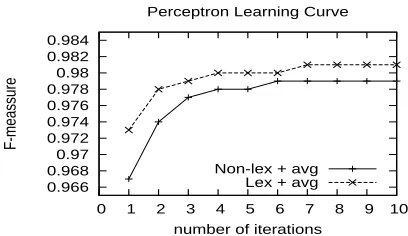
number of iterations Perceptron Learning Curve
[image:6.612.322.526.65.183.2]Non-lex + avg Lex + avg
Figure 3: Averaged perceptron learning curves with Non-lexical-target and Lexical-target feature templates.
AS CityU PKU MSR
SIGHAN best 0.952 0.943 0.950 0.964
Zhang & Clark 0.946 0.951 0.945 0.972
[image:6.612.74.299.65.217.2]our model 0.954 0.958 0.940 0.975
Table 2: F-measure on SIGHAN bakeoff 2. SIGHAN best: best scores SIGHAN reported on the four corpus, cited from Zhang and Clark (2007).
6.1 Experiments on SIGHAN Bakeoff
For convenience of comparing with others, we focus only on the close test, which means that any extra resource is forbidden except the designated train-ing corpus. In order to test the performance of the
lexical-target templates and meanwhile determine
the best iterations over the training corpus, we ran-domly chosen2,000shorter sentences (less than 50 words) as the development set and the rest as the training set (84,294sentences), then trained a per-ceptron model named NON-LEX using only
non-lexical-target features and another named LEX
us-ing both the two kinds of features. Figure 3 shows their learning curves depicting the F-measure on the development set after1to10training iterations. We found that LEX outperforms NON-LEX with a mar-gin of about 0.002 at each iteration, and its learn-ing curve reaches a tableland at iteration 7. Then we trained LEX on each of the four corpora for 7
Training setting Test task F-measure
POS- Segmentation 0.971
POS+ Segmentation 0.973
[image:7.612.320.534.59.160.2]POS+ Joint S&T 0.925
Table 3: F-measure on segmentation and Joint S&T of perceptrons. POS-: perceptron trained without POS, POS+: perceptron trained with POS.
reported, we need to conduct further research on this problem.
6.2 Experiments on CTB5.0
We turned to experiments on CTB 5.0 to test the per-formance of the cascaded model. According to the usual practice in syntactic analysis, we choose chap-ters1−260(18074 sentences) as training set, chap-ter271−300(348 sentences) as test set and chapter
301−325(350 sentences) as development set. At the first step, we conducted a group of contrast-ing experiments on the core perceptron, the first con-centrated on the segmentation regardless of the POS information and reported the F-measure on segmen-tation only, while the second performed Joint S&T using POS information and reported the F-measure both on segmentation and on Joint S&T. Note that the accuracy of Joint S&T means that a word-POS pair is recognized only if both the boundary tags and the POS’s are correctly labelled.
The evaluation results are shown in Table 3. We find that Joint S&T can also improve the segmen-tation accuracy. However, the F-measure on Joint S&T is obvious lower, about a rate of 95% to the F-measure on segmentation. Similar trend appeared in experiments of Ng and Low (2004), where they conducted experiments on CTB 3.0 and achieved F-measure0.919on Joint S&T, a ratio of96%to the F-measure0.952on segmentation.
As the next step, a group of experiments were conducted to investigate how well the cascaded lin-ear model performs. Here the core perceptron was just the POS+ model in experiments above. Be-sides this perceptron, other sub-models are trained and used as additional features of the outside-layer linear model. We used SRI Language Modelling Toolkit (Stolcke and Andreas, 2002) to train a 3 -gram word LM with modified Kneser-Ney smooth-ing (Chen and Goodman, 1998), and a4-gram POS
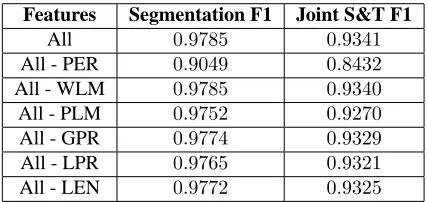
Features Segmentation F1 Joint S&T F1
All 0.9785 0.9341
All - PER 0.9049 0.8432
All - WLM 0.9785 0.9340
All - PLM 0.9752 0.9270
All - GPR 0.9774 0.9329
All - LPR 0.9765 0.9321
[image:7.612.85.288.61.112.2]All - LEN 0.9772 0.9325
Table 4: Contribution of each feture. ALL: all features, PER: perceptron model, WLM: word language model, PLM: POS language model, GPR: generating model, LPR: labelling model, LEN: word count penalty.
LM with Witten-Bell smoothing, and we trained a word-POS co-occurrence model simply by MLE without smoothing. To obtain their corresponding weights, we adapted the minimum-error-rate train-ing algorithm (Och, 2003) to train the outside-layer model. In order to inspect how much improvement each feature brings into the cascaded model, every time we removed a feature while retaining others, then retrained the model and tested its performance on the test set.
Table 4 shows experiments results. We find that the cascaded model achieves a F-measure increment of about0.5 points on segmentation and about0.9
and0.16points on Joint S&T.
In summary, the cascaded model can utilize these knowledge sources effectively, without causing the feature space of the percptron becoming even larger. Experimental results show that, it achieves obvious improvement over the perceptron-only model, about from 0.973 to 0.978 on segmentation, and from
0.925to0.934on Joint S&T, with error reductions of18.5%and12%respectively.
7 Conclusions
We proposed a cascaded linear model for Chinese Joint S&T. Under this model, many knowledge sources that may be intractable to be incorporated into the perceptron directly, can be utilized effec-tively in the outside-layer linear model. This is a substitute method to use both local and non-local features, and it would be especially useful when the training corpus is very large.
However, can the perceptron incorporate all the knowledge used in the outside-layer linear model? If this cascaded linear model were chosen, could more accurate generative models (LMs, word-POS co-occurrence model) be obtained by training on large scale corpus even if the corpus is not correctly labelled entirely, or by self-training on raw corpus in a similar approach to that of McClosky (2006)? In addition, all knowledge sources we used in the core perceptron and the outside-layer linear model come from the training corpus, whereas many open knowl-edge sources (lexicon etc.) can be used to improve performance (Ng and Low, 2004). How can we uti-lize these knowledge sources effectively? We will investigate these problems in the following work.
Acknowledgement
This work was done while L. H. was visiting CAS/ICT. The authors were supported by National Natural Science Foundation of China, Contracts 60736014 and 60573188, and 863 State Key Project No. 2006AA010108 (W. J., Q. L., and Y. L.), and by NSF ITR EIA-0205456 (L. H.). We would also like to Hwee-Tou Ng for sharing his code, and Yang Liu and Yun Huang for suggestions.
References
Stanley F. Chen and Joshua Goodman. 1998. An empir-ical study of smoothing techniques for language mod-eling. Technical Report TR-10-98, Harvard University Center for Research in Computing Technology. Michael Collins. 2002. Discriminative training
meth-ods for hidden markov models: Theory and experi-ments with perceptron algorithms. In Proceedings of EMNLP, pages 1–8, Philadelphia, USA.
John Lafferty, Andrew McCallum, and Fernando Pereira. 2001. Conditional random fields: Probabilistic mod-els for segmenting and labeling sequence data. In Proceedings of the 18th ICML, pages 282–289, Mas-sachusetts, USA.
David McClosky, Eugene Charniak, and Mark Johnson. 2006. Reranking and self-training for parser adapta-tion. In Proceedings of ACL 2006.
Hwee Tou Ng and Jin Kiat Low. 2004. Chinese part-of-speech tagging: One-at-a-time or all-at-once? word-based or character-word-based? In Proceedings of EMNLP. Franz Joseph Och and Hermann Ney. 2004. The align-ment template approach to statistical machine transla-tion. Computational Linguistics, 30:417–449. Franz Joseph Och. 2003. Minimum error rate training in
statistical machine translation. In Proceedings of ACL 2003, pages 160–167.
Lawrence. R. Rabiner. 1989. A tutorial on hidden markov models and selected applications in speech recognition. In Proceedings of IEEE, pages 257–286. Ratnaparkhi and Adwait. 1996. A maximum entropy
part-of-speech tagger. In Proceedings of the Empirical Methods in Natural Language Processing Conference. Stolcke and Andreas. 2002. Srilm - an extensible lan-guage modeling toolkit. In Proceedings of the Inter-national Conference on Spoken Language Processing, pages 311–318.
Nianwen Xue and Libin Shen. 2003. Chinese word seg-mentation as lmr tagging. In Proceedings of SIGHAN Workshop.
![Figure 2: Feature space growing curve. The horizontalscope X[i:j] denotes the introduction of different tem-plates](https://thumb-us.123doks.com/thumbv2/123dok_us/239171.523336/4.612.322.532.62.171/figure-feature-growing-horizontalscope-denotes-introduction-different-plates.webp)