Temporal Signals Help Label Temporal Relations
Leon Derczynski and Robert Gaizauskas
Natural Language Processing Group
Department of Computer Science
University of Sheffield
211 Portobello, S1 4DP, Sheffield, UK
{leon,robertg}@dcs.shef.ac.ukAbstract
Automatically determining the temporal order of events and times in a text is difficult, though humans can readily perform this task. Some-times events and Some-times are related through use of an explicit co-ordination which gives infor-mation about the temporal relation: expres-sions like“before”and“as soon as”. We in-vestigate the rˆole that these co-ordinating tem-poral signals have in determining the type of temporal relations in discourse. Using ma-chine learning, we improve upon prior ap-proaches to the problem, achieving over 80% accuracy at labelling the types of temporal lation between events and times that are re-lated by temporal signals.
1 Introduction
It is important to understand time in language. The ability to express and comprehend expressions of time enables us to plan, to tell stories, and to discuss change in the world around us.
When we automatically extract temporal informa-tion, we are often concerned with events and times – re-ferred to collectively as temporalintervals. We might ask, for example,“Who is the current President of the USA?.”In order to extract an answer to this question from a document collection, we need to identify events related to persons becoming president and the times of those events. Crucially, however, we also need to iden-tify the temporal relations between these events and times, perhaps, for example, by recognizing a tempo-ral relation type from a set such as that of Allen (1983). This last task,temporal relation typing, is challeng-ing, and is the focus of this paper.
Temporal signals are words or phrases that act as discourse markers that co-ordinate a pair of events or times and explicitly state the nature of the temporal re-lation that holds between them. For example, in“The parade reached the town hall before noon”, the word
before is a temporal signal, co-ordinating the event
reached with the time noon. Intuitively, these signal
words act as discourse contain temporal ordering infor-mation that human readers can readily access, and in-deed this hypothesis is borne out empirically (Bestgen and Vonk, 1999). In this paper, we present an in-depth examination into the role temporal signals can play in machine learning for temporal relation typing, within the framework of TimeML (Pustejovsky et al., 2005).
2 Related Work
Temporal relation typing is not a new problem. Clas-sical work using TimeML is that of Boguraev and Ando (2005), Mani et al. (2007) and Yoshikawa et al. (2009). The TempEval challenge series features re-lation typing as a key task (Verhagen et al., 2009). The take-home message from all this work is that tem-poral relation typing is a hard problem, even using advanced techniques and extensive engineering – ap-proaches rarely achieve over 60% on typing relations between two events or over 75% accuracy for those be-tween an event and a time. Recent attempts to include more linguistically sophisticated features representing discourse, syntactic and semantic role information have yielded but marginal improvements, e.g. Llorens et al. (2010); Mirroshandel et al. (2011).
Although we focus solely on determining thetypes
of temporal relations, one must also identify which pairs of temporal intervals should be temporally re-lated. Previous work has covered the tasks of identi-fying and typing temporal relations jointly with some success (Denis and Muller, 2011; Do et al., 2012). The TempEval3 challenge addresses exactly this task (Uz-Zaman et al., 2013).
Investigations into using signals for temporal rela-tion typing have had promising results. Lapata and Lascarides (2006) learn temporal structure according to these explicit signals, then predict temporal order-ings in sentences without signals. As part of an early TempEval system, Min et al. (2007) automatically an-notate signals and associate them with temporal rela-tions. They then include the signal text as a feature for a relation type classifier. Their definition of nals varies somewhat from the traditional TimeML
Event-event relations Event-time relations Non-signalled Signalled Overall Non-signalled Signalled Overall
Baseline most-common-class 41.4% 57.4% 43.0% 49.2% 51.6% 49.6%
Maxent classifier 57.7% 58.6% 57.8% 81.4% 59.6% 77.3%
Error reduction 27.8% 2.74% 25.4% 64.5% 16.4% 55.5%
[image:2.595.84.515.61.124.2]Sample size (number of relations) 3 179 343 3 522 2 299 529 2 828
Table 1: Relation typing performance using the base feature set, for relations with and without a temporal signal.
nal definition, as they include words such asreporting
which would otherwise be annotated as an event. The system achieves a 22% error reduction on a simplified set of temporal relation types.
Later, Derczynski and Gaizauskas (2010) saw a 50% error reduction in assignment of relation types on sig-nalled relation instances from introducing simple fea-tures describing a temporal signal’s interaction with the events or times that it co-ordinates. The features for de-scribing signals included the signal text itself and the signal’s position in the document relative to the inter-vals it co-ordinated. This led to a large increase in re-lation typing accuracy to 82.19% for signalled event-event relations, using a maximum entropy classifier.
Previous work has attempted to linguistically charac-terise temporal signals (Br´ee et al., 1993; Derczynski and Gaizauskas, 2011). Signal phrases typically fall into one of three categories: monosemous as temporal signals (e.g.“during”,“when”); bisemous as temporal or spatial signals (e.g. “before”); or polysemous with the temporal sense a minority class (e.g. “in”, “fol-lowing”). Further, a signal phrase may take two argu-ments, though its arguments need not be in the imme-diate content and may be anaphoric. We leave the task of automatic signal annotation to future work, instead focusing on the impact that signals have on temporal relation typing.
Our work builds on previous work by expanding the study to include relations other than just event-event relations, by extending the feature set, by doing tem-poral relation labelling over a more carefully curated version of the TimeBank corpus (see below), and by providing detailed analysis of the performance of a set of labelling techniques when using temporal signals.
3 Experimental Setup
We only approach the relation typing task, and we use existing signal annotations – that is, we do not attempt to automatically identify temporal signals.
The corpus used is the signal-curated version of TimeBank (Pustejovsky et al., 2003). This corpus, TB-sig,1 adds extra events, times and relations to
Time-Bank, in an effort to correct signal under-annotation in the original corpus (Derczynski and Gaizauskas, 2011). Like the original TimeBank corpus, it comprises 183 documents. In these, we are interested only in the tem-poral relations that use a signal. There are 851 signals annotated in the corpus, co-ordinating 886 temporal
re-1See http://derczynski.com/sheffield/resources/tb sig.tar.bz2
lations (13.7% of all). For comparison, TimeBank has 688 signal annotations which co-ordinate 718 temporal relations (11.2%).
When evaluating classifiers, we performed 10-fold cross-validation, keeping splits at document level. There are only 14 signalled time-time relations in this corpus, which is not enough to support any generaliza-tions, and so we disregard this interval type pairing.
As is common with statistical approaches to tempo-ral relation typing, we also perform relation folding; that is, to reduce the number of possible classes, we sometimes invert argument order and relation type. For example, A BEFORE B and B AFTER A convey the
same temporal relation, and so we can remove allAF
-TER-type relations by swapping their argument order and converting them to BEFORErelations. This loss-less process condenses the labels that our classifier has to distinguish between, though classification remains a multi-class problem.
We adopt the base feature set of Mani et al. (2007), which consists mainly of TimeML event and time annotation surface attributes. These are, for events:
class,aspect,modality,tense,polarity,part of speech; and, for times:value,type,function in document, mod, quant. To these are added same-tenseand same-aspectfeatures, as well as
the string values of events/times. The feature groups we use here are:
• Base– The attributes of TimeML annotations in-volved (includes tense, aspect, polarity and so on as above), as with previous approaches.
• Argument Ordering– Two features: a boolean set if both arguments are in the same sentence (as in Chambers et al. (2007)), and the text order of argument intervals (as in Hepple et al. (2007)).
• Signal Ordering– Textual ordering is important with temporal signals; compare“You walk before you run” and“Before you walk you run”. We add features accounting for relative textual posi-tion of signal and arguments as per Derczynski and Gaizauskas (2010). To these we add a feature reporting whether the signal occurs in first, last, or mid-sentence position, and features to indicate whether each interval is in the same sentence as the signal.
Features Classifier Event-event accuracy Event-time accuracy
N/A Baseline most-common-class 57.4% 51.6%
Base Baseline maximum entropy 58.6% 59.6%
Maximum entropy 72.6% 72.4%
DG2010 Random forest 76.7% 78.6%
All
Adaptive boosting 70.4% 73.0%
Na¨ıve Bayes 73.8% 71.5%
Maximum entropy 75.5% 78.1%
Linear SVC / Crammer-Singer 79.3% 75.6%
Linear SVC 80.7% 77.1%
[image:3.595.122.477.62.174.2]Random forest 80.8% 80.3%
Table 2: Results at temporal relation typing over TB-sig, for relations that use a temporal signal
the signal; following Swampillai and Stevenson (2011), the syntactic path from each argument to the signal, using a top-level ROOT node for
cross-sentence paths; and three features indicat-ing whether there is a temporal function tag (-TMP
between each of the intervals or the signal to the root note. These features are generated using the Stanford parser (Klein and Manning, 2003) and a function tagger (Blaheta and Charniak, 2000).
• Signal Text– We add the signal’s raw string, as well as its lower-case version and its lemma.
• DCT– For event-time relations, whether the time expression also functions as the document’s cre-ation timestamp.
Collectively, these feature groups comprise theAll
feature set. For comparison, the feature set we reported in previous work (Derczynski and Gaizauskas, 2010) is also included, labeledDG2010. This set contains the base and the signal ordering feature groups only, plus a single signal feature for the signal raw string.
Using these feature representations we trained multi-nomial na¨ıve Bayes (Rennie et al., 2003), maximum entropy (Daum´e III, 2008), adaptive boosting (Fre-und and Schapire, 1997; Zhu et al., 2009), multi-class SVM (Crammer and Singer, 2002; Chang and Lin, 2011) and random forest2 (Breiman, 2001) classifiers
via Scikit-learn (Pedregosa et al., 2011).
We use two baselines: most-common-class and a model trained with no signal features. We also in-troduce two measures replicating earlier work: one using the DG2010 features and the classifier used in that work (maximum entropy), and another using the DG2010 features with the best-performing classifier under our All feature set, in order to see if performance changes are due to features or classifier.
Classifiers were evaluated by determining if the class they output matched the relation type in TB-sig. Re-sults are given in Table 2. For comparison with the general case, i.e. for both signalled and non-signalled temporal relation instances, we list performance with a maximum entropy classifier and the base feature set
2Withn
estimators = 200, a minimum of one sample per
node, and no maximum depth.
Figure 1: Effect of training data size on relation typing performance.
on TB-sig’s temporal relations. Results are in Table 1. These are split into those that use a signal and those that do not, though no features relaying signal information are included.
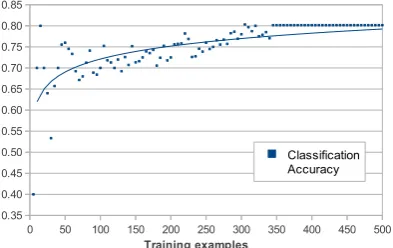
In order to assess the adequacy of the dataset in terms of size, we also examined performance using a maximum entropy classifier learned from varying sub-proportions of the training data. This was measured over event-event relations, using all features. Results are given in Figure 1. That performance appears to sta-bilise and level off indicates that the training set is of sufficient size for these experiments.
4 Analysis
The results in Table 2 echo earlier findings and intu-ition: temporal signals are useful in temporal relation typing. Results support that signals are not only helpful in event-event relation typing but also event-time typ-ing. For comparison, inter-annotator agreement across all temporal relation labels, i.e. signalled and non-signalled relations, in TimeBank is 77%.
[image:3.595.315.512.228.352.2]Feature sets Evt-evt Evt-time
All 80.8% 80.3%
All-argument order 80.8% 78.3% All-signal order 79.0% 77.5%
All-syntax 79.2% 79.6%
All-signal text 70.8% 72.7%
All-DCT 79.9% 79.4%
Base 54.2% 53.9%
Base+argument order 56.8% 60.1% Base+signal order 59.7% 65.0%
Base+syntax 70.0% 71.0%
Base+signal text 75.5% 66.3%
Base+DCT 54.2% 53.9%
[image:4.595.78.287.61.224.2]Base+signal text+signal order 80.4% 76.9% Base+signal text+syntax 79.0% 74.1% Base+arg order+signal order 77.8% 75.2%
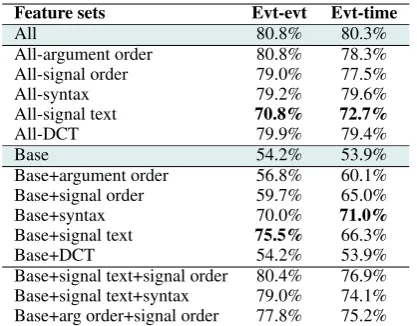
Table 3: Relation typing accuracy based on various fea-ture combinations, using random forests. Bold figures indicate the largest performance change.
offer better performance under both feature sets, with the extended features achieving notable error reduction over DG2010 – 17.6% for event, 7.9% for event-time relations. Linear support vector classification pro-vided rapid labelling and comparable performance for event-event relations but was accuracy was not as good as random forests for event-time relation labelling.
Note, figures reported earlier in Derczynski and Gaizauskas (2010) are not directly comparable to the DG2010 figures reported here, as here we are using the better-annotated TB-sig corpus, which contains a larger and more varied set of temporal signal annotations.
Although we are only examining the 13.7% of tem-poral relations that are co-ordinated with a signal, it is important to note the performance of conventional classification approaches on this subset of temporal relations. Specifically, the error reduction relative to the baseline that is achieved without signal features is much lower on relations that use signals than on non-signalled relations (Table 1). Thus, temporal relations that use a signal appear to be more difficult to clas-sify than other relations, unless signal information is present in the features. This may be due to differences in how signals are used by authors. One explanation is that signals may be used in the stead of temporal or-dering information in surrounding discourse, such as modulations of dominant tense or aspect (Derczynski and Gaizauskas, 2013).
Unlike earlier work using maxent, we experiment with a variety of classifiers, and find a consistent im-provement in temporal relation typing using signal fea-tures. With the notable exception of adaptive boost-ing, classifiers with preference bias (Liu et al., 2002) – AdaBoost, random trees and SVC – performed best in this task. Conversely, those tending toward the in-dependence assumption (na¨ıve Bayes and maxent) did not capitalise as effectively on the training data.
Features Evt-evt Evt-time
All 80.8% 80.3%
All-signal text 70.8% 72.7%
All-signal text-argument order 70.7% 72.2% All-signal text-signal order 69.5% 71.2% All-signal text-syntax 59.5% 69.0% All-signal text-DCT 70.8% 72.8%
Table 4: Feature ablation without signal text features. Bold figures indicate largest performance change.
We also investigated the impact of each feature group on the best-performing classifier (random forests withn = 200) through feature ablation. Results are given in Table 3. Ablation suggested that the signal text features (signal string, lower case string, head word and lemma) had most impact in event-event relation typing, though were second to syntax features in event-time re-lations. Removing other feature groups gave only mi-nor performance decreases.
We also experimented with adding feature groups to the base set one-by-one. All but DCT features gave above-baseline improvement, though argument order-ing features were not very helpful for event-event re-lation typing. Signal text features gave the strongest improvement over baseline for event-event relations, but syntax gave a larger improvement for event-time relations. Accordingly, it may be useful to distinguish between event-event and event-time relations when ex-tracting temporal information using syntax (c.f. the ap-proach of Wang et al. (2010)).
A strong above-baseline performance was still ob-tained even when signal text features were removed, which included the signal text itself. This was interest-ing, as signal phrases can indicate quite different tem-poral orderings (e.g.“Open the box while it rains”vs.
“Open the box before it rains”, and the words used are typically critical to correct interpretation of the tempo-ral relation. Further, the model is able to genetempo-ralise beyond particular signal phrase choices. To investigate further, we examined the performance impact of each group sans “signal text” features (Table 4). In this case, removing the syntactic features had the greatest (neg-ative) impact on performance, though the absolute im-pact on event-event relations (a drop of 11.3%) was far lower than that on event-time relations (3.7%).
[image:4.595.312.519.61.135.2]Weight Feature Value Class
9.346 2-polarity POS ENDS
-8.713 1-2-same-sent True BEGINS
-7.861 2-aspect NONE BEGINS
-7.256 1-aspect NONE INCLUDES
6.564 2-sig-synt-path NN-NP-IN INCLUDES 6.519 signal-lower before ENDS
-6.294 2-tense NONE BEGINS
-5.908 2-modality None ENDS
5.643 2-text took BEGINS
[image:5.595.73.288.62.174.2]-5.580 1-modality None ENDS
Table 5: Top ten largest-weighted feature:value pairs.
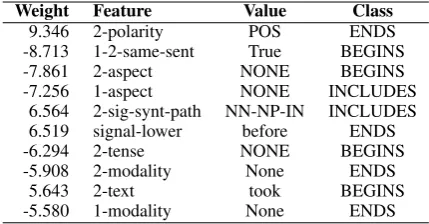
It can be seen that BEGINS and INCLUDES
rela-tionships are not indicated if the arguments have no TimeML aspect assigned; this is what one might ex-pect, given how aspect is used in English, with these temporal relation types corresponding to event starts and the progressive. Also, notice how a particular syn-tactic path, connecting adjacent nominalised event and the wordinacting as a signal, indicate a temporal inclu-sion relationship. Temporal polysemy, where a word has more than one possible temporal interpretation, is also observable here (Derczynski and Gaizauskas (2011) examine this polysemy in depth). This is vis-ible in how the temporal signal phrase“before”is not, as one might expect, a strong indicator of aBEFOREor
evenAFTERrelation, but of anENDSrelationship.
5 Conclusion
This paper set out to investigate the rˆole of temporal signals in predicting the type of temporal relation be-tween two intervals. The paper demonstrated the util-ity of temporal signals in this task, and identified ap-proaches for using the information these signals con-tain, which performed consistently better than the state-of-the-art across a range of machine learning classi-fiers. Further, it identified the impact that signal text, signal order and syntax features had in temporal rela-tion typing of signalled relarela-tions.
Two directions of future work are indicated. Firstly, the utility of signals prompts investigation into detect-ing which words in a given text occur as temporal sig-nals. Secondly, it is intuitive that temporal signals ex-plicitly indicate related pairs of intervals (i.e. events or times). So, the task of deciding which interval pair(s) a temporal signal co-ordinates must be approached.
Although we have found a method for achieving good temporal relation typing performance on a subset of temporal relations, the greater problem of general temporal relation typing remains. A better understand-ing of the semantics of events, times, signals and how they are related together through syntax may provide further insights into the temporal relation typing task.
Finally, Bethard et al. (2007) reached high temporal relation typing performance on one a subset of relations
(events and times in the same sentence); we reach high temporal relation typing performance on another subset of relations – those using a temporal signal. Identify-ing further explicit sources of temporal information ap-plicable to new sets of relations may reveal promising paths for investigation.
Acknowledgements
The first author was supported by UK EPSRC grant EP/K017896/1, uComp (http://www.ucomp.eu/).
References
J. Allen. 1983. Maintaining knowledge about temporal intervals.Communications of the ACM, 26(11):832– 843.
Y. Bestgen and W. Vonk. 1999. Temporal adverbials as segmentation markers in discourse comprehension.
Journal of Memory and Language, 42(1):74–87. S. Bethard, J. Martin, and S. Klingenstein. 2007.
Timelines from text: Identification of syntactic tem-poral relations. InProceedings of the International Conference on Semantic Computing, pages 11–18. D. Blaheta and E. Charniak. 2000. Assigning function
tags to parsed text. InProceedings of the meeting of the North American chapter of the Association for Computational Linguistics, pages 234–240. ACL. B. Boguraev and R. K. Ando. 2005. TimeBank-Driven
TimeML Analysis. In G. Katz, J. Pustejovsky, and F. Schilder, editors,Annotating, Extracting and Rea-soning about Time and Events, number 05151 in Dagstuhl Seminar Proceedings, Dagstuhl, Germany. Internationales Begegnungs- und Forschungszen-trum f¨ur Informatik (IBFI), Schloss Dagstuhl, Ger-many.
D. Br´ee, A. Feddag, and I. Pratt. 1993. Towards a for-malization of the semantics of some temporal prepo-sitions.Time & Society, 2(2):219.
L. Breiman. 2001. Random forests. Machine Learn-ing, 45(1):5–32.
N. Chambers, S. Wang, and D. Jurafsky. 2007. Clas-sifying temporal relations between events. In Pro-ceedings of the 45th meeting of the Association for Computational Linguistics, pages 173–176. ACL. C.-C. Chang and C.-J. Lin. 2011. LIBSVM: a library
for support vector machines. ACM Transactions on Intelligent Systems and Technology, 2(3):27. K. Crammer and Y. Singer. 2002. On the
algorith-mic implementation of multiclass kernel-based vec-tor machines.The Journal of Machine Learning Re-search, 2:265–292.
P. Denis and P. Muller. 2011. Predicting globally-coherent temporal structures from texts via endpoint inference and graph decomposition. InProceedings of the International Joint Conference on Artificial In-telligence, pages 1788–1793. AAAI Press.
L. Derczynski and R. Gaizauskas. 2010. Using Sig-nals to Improve Automatic Classification of Tempo-ral Relations. InProceedings of 15th Student Ses-sion of the European Summer School for Logic, Lan-guage and Information, pages 224–231. FoLLI. L. Derczynski and R. Gaizauskas. 2011. A
Corpus-based Study of Temporal Signals. InProceedings of the Corpus Linguistics Conference.
L. Derczynski and R. Gaizauskas. 2013. Empirical Validation of Reichenbach’s Tense Framework. In
Proceedings of the 10th International Conference on Computational Semantics, pages 71–82. ACL. Q. X. Do, W. Lu, and D. Roth. 2012. Joint
infer-ence for event timeline construction. InProceedings of the Conference on Empirical Methods in Natural Language Processing, pages 677–687. ACL. Y. Freund and R. E. Schapire. 1997. A
decision-theoretic generalization of on-line learning and an application to boosting. Journal of Computer and System Sciences, 55(1):119–139.
M. Hepple, A. Setzer, and R. Gaizauskas. 2007. USFD: preliminary exploration of features and clas-sifiers for the TempEval-2007 tasks. InProceedings of the 4th International Workshop on Semantic Eval-uations, pages 438–441. ACL.
D. Klein and C. D. Manning. 2003. Accurate unlex-icalized parsing. InProceedings of the 41st meet-ing of the Association for Computational Lmeet-inguistics, pages 423–430. ACL.
M. Lapata and A. Lascarides. 2006. Learning sentence-internal temporal relations. Journal of Ar-tificial Intelligence Research, 27(1):85–117. Y. Liu, Y. Yang, and J. Carbonell. 2002. Boosting to
correct inductive bias in text classification. In Pro-ceedings of the 11th international Conference on In-formation and Knowledge Management, pages 348– 355. ACM.
H. Llorens, E. Saquete, and B. Navarro. 2010. TIPSem (English and Spanish): Evaluating CRFs and Se-mantic Roles in TempEval-2. In Proceedings of SemEval-2010. ACL.
I. Mani, B. Wellner, M. Verhagen, and J. Pustejovsky. 2007. Three approaches to learning TLINKS in TimeML. Technical report, CS-07-268, Brandeis University.
C. Min, M. Srikanth, and A. Fowler. 2007. LCC-TE: A hybrid approach to temporal relation identification in news text. InProceedings of the 4th International Workshop on Semantic Evaluations, pages 219–222. ACL.
S. A. Mirroshandel, G. Ghassem-Sani, and M. Khayyamian. 2011. Using syntactic-based kernels for classifying temporal relations. Journal of Computer Science and Technology, 26(1):68–80. F. Pedregosa, G. Varoquaux, A. Gramfort, V. Michel,
B. Thirion, O. Grisel, M. Blondel, P. Prettenhofer, R. Weiss, V. Dubourg, et al. 2011. Scikit-learn: Ma-chine learning in Python. The Journal of Machine Learning Research, 12:2825–2830.
J. Pustejovsky, R. Sauri, R. Gaizauskas, A. Setzer, L. Ferro, et al. 2003. The TimeBank Corpus. In
Proceedings of the Corpus Linguistics Conference, pages 647–656.
J. Pustejovsky, J. Castano, R. Ingria, R. Saur´ı, R. Gaizauskas, A. Setzer, G. Katz, and D. Radev. 2005. TimeML: Robust specification of event and temporal expressions in text. In I. Mani, J. Puste-jovsky, and R. Gaizauskas, editors,The language of time: a reader. Oxford University Press.
J. D. Rennie, L. Shih, J. Teevan, and D. Karger. 2003. Tackling the Poor Assumptions of Naive Bayes Text Classifiers. InProceedings of the International Con-ference on Machine Learning. AAAI Press.
K. Swampillai and M. Stevenson. 2011. Extracting re-lations within and across sentences. InProceedings of the International Conference Recent Advances in Natural Language Processing, pages 25–32. ACL. N. UzZaman, H. Llorens, L. Derczynski, M. Verhagen,
J. F. Allen, and J. Pustejovsky. 2013. SemEval-2013 Task 1: TempEval-3: Evaluating Time Expressions, Events, and Temporal Relations. InProceedings of the 7th International Workshop on Semantic Evalu-ations.
M. Verhagen, R. Gaizauskas, F. Schilder, M. Hep-ple, J. Moszkowicz, and J. Pustejovsky. 2009. The TempEval challenge: identifying temporal re-lations in text. Language Resources and Evaluation, 43(2):161–179.
W. Wang, J. Su, and C. L. Tan. 2010. Kernel based discourse relation recognition with temporal order-ing information. InProceedings of the 48th meet-ing of the Association for Computational Lmeet-inguistics, pages 710–719. ACL.
K. Yoshikawa, S. Riedel, M. Asahara, and Y. Mat-sumoto. 2009. Jointly identifying temporal relations with Markov logic. InProceedings of the Interna-tional Joint Conference on Natural Language Pro-cessing, pages 405–413. ACL.