JOURNAL OF FOREST SCIENCE, 62, 2016 (1): 41–46
doi: 10.17221/71/2015-JFS
Influence of agricultural crops adjacent to forest
on woody species browsing: Is it advantageous
to have a tasty neighbour?
J. Kamler
1, M. Homolka
21Faculty of Forestry and Wood Technology, Mendel University in Brno, Brno, Czech Republic
2Institute of Vertebrate Biology, Academy of Sciences of the Czech Republic, Brno, Czech Republic
ABSTRACT: Preference of biotopes and selection of food by wild herbivores are more complicated in a cultural land-scape used for agriculture than in natural conditions. Agricultural management significantly affects the feeding as well as cover conditions of the environment and changes in quality and accessibility of food sources occur throughout the year. We studied the consumption of agricultural crops and impact on tree shoots by herbivores in a mosaic landscape. Large herbivores utilized the food supply on the lands outside the forest environment during winter and early spring and in summer. In summer the cereal grains were preferred by herbivores and accounted for a significant share in their diet. The intensity of shoot browsing differed between the localities and between the studied woody species but was not lower due to the presence of attractive crops near the forest. The utilization of food outside the forest may help the animals to survive the winter but the potential of this food for reducing tree browsing in the forest is low.
Keywords: browsing; diet selection; impact; large herbivores
Free-living herbivores are natural and important members of ecosystems and due to their good re-productive potential they are among the factors that can significantly affect the habitat develop-ment on the level of biotope, ecosystem and even landscape (Augustine, Decalesta 2003). In natural conditions, their abundance is regulated by predators and insufficiency of food, while in cultur-al landscape these autoregulation mechanisms are disturbed. In some cases this has led to high stocks of species that adapted themselves to the altered conditions successfully. Their high abundance then has negative effects on the economics of agricul-ture and forestry and it may even threaten the eco-logical stability of ecosystems. That is why constant attention is paid to the feeding ecology of large her-bivores, their spatial activity, preference of various food sources and possibilities how to reduce their negative impacts on the environment. Generally, the more intensively the landscape is farmed, the worse the living conditions of game, and the higher
the abundance of game, the greater disharmony has to be expected in the relations between vegetation and consumers.
Movements and feeding ecology of large herbi-vores have been well documented in forest habi-tats; however, little information related to deer movements exists in intensively cultivated areas (Matrai et al. 2004; Brinkman et al. 2005).
Furthermore, large herbivores are able to mi-grate over long distances, search for the best food sources and flexibly change the spectrum of their diet components (Mcshea, Schwede 1993; Thir-good 1995; Szemethy et al. 2003a; Matrai et al. 2004). Besides the quality of the food sources, pref-erence of a biotope is affected also by their quanti-ty, accessibiliquanti-ty, risk of disturbing and other factors.
Preference of biotopes, selection of food and also survival strategy are more complicated in a cultural landscape used for agriculture than in natural con-ditions as agricultural management significantly af-fects the feeding as well as cover conditions of the
environment and marked changes in quality and ac-cessibility of food sources occur throughout the year.
Szemethy et al. (2003b) studied the seasonal home range shift of red deer between agricultural and forested areas in Hungary and did not confirm better nutritional quality in an agricultural area as the main cause of massive migration of the animals into fields. Deer diet was dominated by browse in the forest (65–85%) whilst, in agricultural fields, woody species were as important as grasses (26 to 44% and 39–55%, respectively). Consumption of cultivated plants was low (under 10%) in the agri-cultural area and nutritive quality of the diet was lower at the agricultural site than in the forest. Os-born and Jenks (1998) noticed that white-tailed deer density was twice higher in areas with access to agricultural land, suggesting that these fields are important feeding sites.
Under certain conditions, large herbivores pre-fer agricultural crops in their diet and they are able to migrate to these food sources. The use of fields depends on the crop grown, food supply in the for-est, snow cover (disappearing more quickly in open areas), feeding type of herbivore species, intensity of disturbing human activities in the fields and in forest (field and forest works, proximity of human residenc-es, tourism, hunting) and also the possibility of cover in these two habitats (Rosenzweig 1981; Ford 1983; Welch et al. 1990; Thirgood 1995; Matrai et al. 2004). Palmer and Truscott (2003) confirmed that plants attractive to herbivores received a lower impact if they were associated with patches of highly preferred vegetation (an example of apparent compe-tition). In the present study we analyse the behaviour of red deer (Cervus elaphus) and roe deer (Capreo-lus capreo(Capreo-lus) in the environment of a large forest complex and the surrounding fields with agricultural crops. We have tested the influence of agricultural crops adjacent to forest complexes on the intensity of browsing on woody species in the shrub layer in different distances from the forest edge in vegetation season and in winter. The presumption was that if the animals consume agricultural crops, they use other food sources less intensively, i.e. the utilization of for-est woody species is lower when there are attractive crops present in the vicinity of the forest. However, food sources of high quality could lead to the con-centration of game near these fields and to a stronger impact on other vegetation. For this reason we have examined the impact on the shrub layer in the close proximity of the forest edge and in the centre of the forest complex.
The relief of the study area is quite varied. In its mid-dle there is a low east-west ridge at 425–500 m a.s.l.
This ridge emits numerous lateral and subdividing branches, mutually separated by deep valleys with permanent or periodical streams. Almost all of the study area is limited by the valleys of the Říčka and Hostěnický potok streams, formed by the steep c1iffs of the surrounding ridges and flat1ands. The original woodland was an oak-hornbeam forest and partly beech woods in lowland forests of the stream valleys. At present the study area is covered predom-inantly by coniferous forests (i.e. stands in which co-nifers make up over 75%), occupying 53% of its area. Mixed (coniferous and broadleaved) stands make up 26% and broad leaved ones 21% of the total area. The dominant tree species include Norway spruce (Picea abies) (42%), European beech (Fagus sylvatica) (25%), European larch (Larix decidua) (10%) and Scotch pine (Pinus sylvestris) (7%). Other woody plant spe-cies occur in negligible amounts. All these stands are c1assified as productive, with normal management using a 100–120-year cutting cyc1e. The conifer-ous stands are harvested by c1ear cutting and refor-ested mainly by Norway spruce with an admixture of larch. The broadleaved stands are harvested by shelterwood felling, utiliz ing natural regeneration. The forest consists of a mosaic of patches covered by stands of different ages and species composition. The food supply for large herbivores was mapped in detail in Homolka and Heroldová (1990). Most of the logged sites are rapidly grown over by grass-es of the genus Calamagrostis which predominate. The herb layer in older tree stands depends on the habitat type and the amount of light that penetrates through the canopy of tree crowns. We studied three localities on the forest edge with an adjacent agricul-tural field and one locality in the centre of the forest.
MATERIAL AND METHODS
years we monitored the impact on the shrub layer at two localities: the forest edge and the forest centre. The forest edge was situated in the neighbourhood of agricultural land (0–100 m from the forest edge). The forest centre was situated more than two km from the forest edge. On these two localities we studied the impact of herbivores on several plots where we col-lected data in spring (winter impact) and at the end of vegetation (impact for the vegetation period). Dur-ing the four main seasons of the year (sprDur-ing, summer, autumn and winter) we monitored the occurrence of agricultural crops and their quality in the neighbour-hood of the studied forest area.
Consumption and preference of agricultural crops and tree shoots by herbivores. The intake of agricultural crops and tree shoots was determined by the microscopic analysis of their faeces. One pellet was removed from the faecal samples collected and used to prepare a microscopic slide. The representation of various food components was estimated on the ba-sis of their relative coverage in the microscopic field. When evaluating the overall character of the diet, the components were pooled to form primary forage classes: grasses, Rubus spp., browse, needles, forbs, seeds and others (Homolka, Heroldová 1992). The preference of the food supply was estimated on the basis of its quality. We used the energy content in the plant as the main criterion of quality. Selection of the diet higher in energy but lower in protein was proved by using experimental foods in free living white-tailed deer in Canada. In this experiment nitrogen levels ranged from 1.8 to 2.6% and deer were able to dis-criminate between experimental foods and preferred foods higher in digestible energy or at each given level of digestible energy the foods lower in nitrogen (Berteaux et al. 1998). For this we collected samples from both agricultural crops and spruce and beech. We simulated the natural feeding behaviour of herbi-vores and therefore we picked samples of plants that the deer usually browse (leaves and needles and ter-minal parts of tree shoots at the height of 50–150 cm). The samples were air dried in a ventilated drying chamber at 60°C to constant weight and the nutri-tional quality of the studied plants was monitored by near infrared reflectance spectroscopy (NIRS). We developed a calibration equation that reflects the re-lationship between the content of dietary metaboliz-able energy (ME) and NIR spectral information. We used the Nicolet Antaris spectrometer and collected spectra in the 1,100–2,500 nm wavelength range. De-tails of the procedure were described in Kamler and Homolka (2005).
Impact on shrub layer. We monitored the inten-sity of browsing shoots of spruce, oak and beech.
These tree species are occasionally used in the diet of large herbivores. Spruce and oak in the shrub layer were mostly outplanted on plots after log-ging. Beech is distributed over the whole studied area mostly from natural regeneration. We ran-domly chose plots and checked trees at the height between 50 and 150 cm.
For the studied tree species we recorded their height (individuals threatened by browsing, i.e. under 200 cm), number of browsed and untouched shoots, length of terminal shoots and marks of re-peated browsing. In the browsed shoots damage caused by insects, rodents, hare or ruminants was evaluated separately. At each visit to each plot we examined 50 individuals of each of the studied tree species.
RESULTS
Consumption of agricultural crops and tree shoots by herbivores
Large herbivores utilized the food supply on the areas outside the forest environment in two main seasons. The first one lasted from autumn to spring when they grazed on winter cereal crops. The bio-mass of these plants was relatively small (88 g of dry mass per 1 m2 on average) and it did not rep-resent a significant share in the diet of the studied species. Besides, the fields with winter cereal crops were utilized only in periods without snow cover; for several months that are crucial for the impact of browse on the shrub layer, the agricultural crops were not accessible. The quality of this resource was similar to bramble leaves and was lower than that of other important components of food supply in the studied environment.
Impact on shrub layer
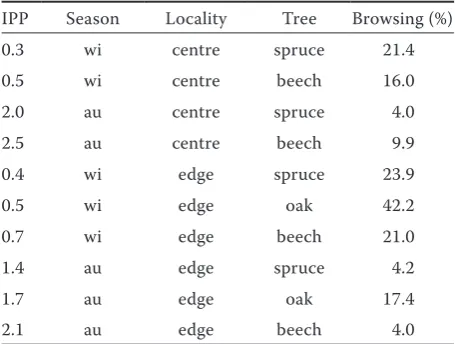
Browsing of beech, oak and spruce shoots was monitored at plots near agricultural lands and in the centre of a forest complex (Table 1). The inten-sity of shoot browsing differed between the locali-ties (P < 0.05) and between the studied woody spe-cies (P < 0.01). Oak was the most browsed spespe-cies in both vegetation and winter season (up to 51% of browsed shoots in winter and 18% in the vegeta-tion season). The presence of attractive agricultural crops did not lower the intensity of shoot utiliza-tion by herbivores in any season in general (P > 0.05 for all cases). The intensity of browsing remained the same, no matter whether there were attractive crops grown near the forest or these areas were not used by herbivores. In one case more intensive browsing near the field with attractive crops was found out.
DISCUSSION
Large herbivores utilized the food supply available on agricultural lands near forest complexes in the pe-riod autumn/spring and in the time of cereal ripen-ing. The most intensive utilization of fields occurred in the summer when these food sources accounted for a significant share in the diet of the studied species (Abbas et al. 2011). This utilization corresponds with the high quality of ripe crops (Bleier 2012). We con-firmed the high quality of agricultural crops in sum-mer and their high consumption by wild herbivores.
Szemethy et al. (2003a, b) conversely found out that cultivated plants were not dominant components of the red deer diet and their presence in the diet was rather negligible. In their study a fundamental part of the red deer population migrated into an agricultural area, but animals both in the forest and in the field consumed mostly browse diet. This case could be ex-plained by the low quality of crops in the time of mi-gration. However, the utilization of alternative food sources did not affect the impact on the shrub layer in any way. Similar intensity of browsing was found regardless of the presence of attractive food sources nearby. This result is caused mainly by the tempo-ral imbalance between the food supply in fields and in the forest environment. It turned out that winter was the main critical period both for the survival of large herbivores and their impact on vegetation. Very similar results of the impact of winter on large herbi-vores were reported in studies by Christianson and Creel (2007). In winter, the animals face a shortage of good-quality food and increased energy expenditure for thermoregulation and movement (Moen 1973; Parker et al. 1996) and so they intensively exploit the shoots of woody species as the most attractive and of-ten the only source of their food (Gill 1992; Heuze et al. 2005; Hodder et al. 2013). The winter supply of green cereal crops on agricultural lands was of higher quality than tree shoots in the forest environment but its quantity was too small to constitute a more signifi-cant component of large herbivore diet. In the period with snow cover, these food sources became totally inaccessible and large herbivores did not search for them either (Homolka, Heroldová 2003).
In the vegetation season, the fields with ripening cereal crops were visited by large herbivores inten-sively. Putman (1986) found that large herbivores used food from agricultural fields to the largest extent in the vegetation period. Both quantity and quality of this food source greatly surpassed the natural sources and the diet of animals consuming a higher share of cereals was of much better qual-ity than that of the individuals exploiting only the natural sources from the forest environment. The presence of attractive lands did not have any effect on the utilization of shoots in the shrub layer in most cases; in one case the browsing intensity in the vicinity of attractive fields even increased. This fact can be explained by a higher concentration of animals near the attractive lands. The impact of the quantity of surrounding cover was proved by Kay (1993) and Roguet et al. (1998).
[image:4.595.63.291.138.310.2]The food supply available on the agricultural lands near the forest complexes was utilized by large her-bivores, but we have not proved its influence on the
Table 1. The average index of potential preference of food supply (IPP) and browsing of tree shoots of beech, oak and spruce on the forest edge near agricultural fields (edge) and in the centre of a forest complex (centre) in autumn (au) and winter (wi) in the Drahanská vrchovina highlands study area
IPP Season Locality Tree Browsing (%)
0.3 wi centre spruce 21.4
0.5 wi centre beech 16.0
2.0 au centre spruce 4.0
2.5 au centre beech 9.9
0.4 wi edge spruce 23.9
0.5 wi edge oak 42.2
0.7 wi edge beech 21.0
1.4 au edge spruce 4.2
1.7 au edge oak 17.4
intensity of utilization of tree shoots. While the field crops were exploited mainly in the vegetation sea-son, winter is the critical period for shoot browsing. In winter, the amount of accessible food on agricul-tural lands was minimal and large herbivores relied mainly on the forest environment. Hence the agri-cultural lands contributed neither to reduction of herbivore impact on the shrub layer nor to the feed-ing conditions of large herbivores in winter.
Nevertheless, the utilization of food outside the forest may help the animals to survive the period of the winter population reduction as their survival depends also on the feeding conditions during the previous vegetation season when the herbivores cumulate the reserves of energy (Mautz 1978; Jiang, Hudson 1994). For this reason, the avail-ability of high-quality food in the vegetation season leads to the survival of more animals (Suttie et al. 1983); however, in winter they use the food sources from the forest environment. If the reduction of game stock is not sufficient, the high-quality food supply on agricultural lands influences the herbi-vore impact on the shrub layer rather negatively.
References
Augustine D.J., Decalesta D. (2003): Defining deer overabun-dance and threats to forest communities: From individual plants to landscape structure. Ecoscience, 10: 472–486. Abbas F., Morellet N., Hewison A.J.M., Merlet J., Cargnelutti
B., Lourtet B., Angibault J.M., Daufresne T., Aulagnier S., Verheyden H. (2011): Landscape fragmentation generates spatial variation of diet composition and quality in a gen-eralist herbivore. Oecologia, 167: 401–411.
Berteaux D., Crete M., Huot J., Maltais J., Ouellet J.P. (1998): Food choice by white-tailed deer in relation to protein and energy content of the diet: a field experiment. Oecologia, 115: 84–92.
Bleier N., Lehoczki R., Ujvary D., Szemethy L., Csanyi S. (2012): Relationships between wild ungulates density and crop dam-age in Hungary. Acta Theriologica, 57: 351–359.
Brinkman T.J., Deperno C.S., Jenks J.A., Haroldson B.S., Os-born R.G. (2005): Movement of female white-tailed deer: Effects of climate and intensive row-crop agriculture. Journal of Wildlife Management, 69: 1099–1111.
Christianson D.A., Creel S. (2007): A review of environmental factors affecting elk winter diets. Journal of Wildlife Manage-ment, 71: 164–176.
Ford G. (1983): Home range in a patchy invironment: Optimal foraging predictions. American Zoologist, 23: 315–326. Gill R.M.A. (1992): A review of damage by mammals in north
temperate forests: 3. Impact on trees and forests. Forestry, 65: 363–388.
Heuze P., Schnitzler A., Klein F. (2005): Consequences of increased deer browsing winter on silver fir and spruce regeneration in the Southern Vosges mountains: Implica-tions for forest management. Annals of Forest Science, 62: 175–181.
Hodder D.P., Rea R.V., Crowley S. (2013): Diet content and overlap of sympatric mule deer (Odocoileus hemionus), moose (Alces alces), and elk (Cervus elaphus) during a deep snow winter in north-central British Columbia, Canada. Canadian Wildlife Biology and Management, 2: 43–50. Homolka M., Heroldová M. (1990): Vegetation as the food
supply for game in a forest near Hostěnice. Acta Scien-tiarum Naturalium Brno, 24: 1–40.
Homolka M., Heroldová M. (1992): Similarity of the results of stomach and fecal contents analyses in studies of the ungulate diet. Folia Zoologica, 41: 193–208.
Homolka M., Heroldová M. (2003): Impact of large herbivores on mountain forest stands in the Beskydy Mountains. For-est Ecology and Management, 181: 119–129.
Jiang Z., Hudson R.J. (1994): Seasonal energy requirements of wapiti (Cervus elaphus) for maintenance and growth. Canadian Journal Animal Science, 74: 97–102.
Johnson C.J., Parker K.L., Heard D.C. (2001): Foraging across a variable landscape: behavioral decisions made by woodland caribou at multiple spatial scales. Oecologia, 127: 590–602. Kamler J., Homolka M. (2005): Faecal nitrogen: a potential
indicator of red and roe deer diet quality in forest habitats. Folia Zoologica, 54: 89–98.
Kay S. (1993): Factors affecting severity of deer browsing dam-age within coppiced woodlands in the south of England. Biological Conservation, 63: 217–222.
Matrai K., Szemethy L., Toth L., Kantona K., Szekely J. (2004): Resource use by red deer in lowland nonnative forests. Hungary Journal of Wildlife Management, 68: 879–888. Mautz W.W. (1978): Sledding on a bushy hillside: the fat cycle
in deer. Wildlife Society Bulletin, 62: 88–90.
McShea W.J., Schwede G. (1993): Variable acorn crops - re-sponses of white-tailed deer and other mast consumers. Journal of Mammalogy, 74: 999–1006.
Moen A.N. (1968): Energy exchange of white-tailed deer, Western Minnesota. Ecology, 49: 676–682.
Osborn R.G., Jenks J.A. (1998): Assessing dietary quality of white-tailed deer using fecal indices: effects of supplemen-tal feeding and area. Journal of Mammalogy, 79: 437–447. Palmer S.C.F., Truscott A.M. (2003): Seasonal habitat use and
browsing by deer in Caledonian pinewoods. Forest Ecology and Management, 174: 149–166.
Parker K.L., Gillingham M.P., Hanley T.A., Robbins C.T. (1996): Foraging efficiency: Energy expenditure versus energy gain in free-ranging black-tailed deer. Canadian Journal of Zoology, 74: 442–450.
Roguet C., Dumont B., Prache S. (1998): Selection and use of feeding sites and feeding stations by herbivores: a review. Annales de Zootechnie, 47: 225–244.
Rosenzweig M.L. (1981): A theory o habitat selection. Ecol-ogy, 62: 327–335.
Suttie J.M., Goodall E.D., Pennie K., Kaya R.N.B. (1983): Winter food restriction and summer compensation in red deer stags (Cervus elaphus). British Journal of Nutrition, 50: 737–747.
Szemethy L., Matrai K., Biro Z., Kantona K. (2003a): Seasonal home range shift of red deer in a forest-agriculture area in southern Hungary. Acta Theriologica, 48: 547–556.
Szemethy L., Matrai K., Kantona K., Orosz S. (2003b): Sea-sonal home range shift of red deer hinds, Cervus elaphus: are there feeding reasons? Folia Zoologica, 52: 249–258. Thirgood S.J. (1995): The effects of sex season and habitat
availability on patterns of habitat use by fallow deer (Dama dama). Journal of Zoology, 235: 645–659.
Welch D., Staines B.W., Catt D.C., Scott D. (1990): Habitat use by red (Cervus elaphus) and roe (Capreolus capreolus) deerin a Scottish Sitka spruce plantation. Journal of Zool-ogy, 221: 453–476.
Received for publication July 31, 2015 Accepted after corrections December 8, 2015
Corresponding author: