The current demand for the insurability of liability
for damage to the natural environment
Současné požadavky na pojistitelnost odpovědnosti za škodu
na životním prostředí
E. Vávrová
Department of Finance, Faculty of Business and Economics, Mendel University
of Agriculture and Forestry Brno, Czech Republic
Abstract: Since 2004, the basic document which has governed liability for damage to the natural environment in the European Union is the Environmental Liability Directive no. 2004/35/Ec, as amended by the subsequent regulation no. 2006/21/Ec. The main purpose of the legislation was to ensure that the entity responsible for the damage pays all costs for rectifying its consequences. if it concerns damage to natural environment, the operator must undertake measures for reha-bilitation, replacement and regeneration of the damaged natural resources. The primary replacement, which returns the damaged natural resources to their original state, may be differentiated from complementary replacement as compensation in the case in which the primary replacement has not provided an adequate reparation, and finally compensatory replace-ment – compensation for the temporary loss of natural conditions. This paper aims at an analysis of the possible means for eliminating risks due to the liability for environmental damage caused by the actions of an operator whose activities potentially threaten natural environment and may cause the biodiversity damage. risks are assessed with regard to the risk insurability criteria for potential damage to the natural environment. The importance of risk management is stressed in the sophisticated form known as the Enterprise risk Management. risk management is becoming increasingly important as a part of the Solvency ii concept, currently in preparation, whose first and second pillars accentuate risk management in financial institutions and the consistent quantification of the obvious, hidden and potential risks.
Key words: insurance market, commercial insurance company, insurance product, environmental insurance, insurability, liability insurance, risk management
Abstrakt: základním dokumentem, kterým se od dubna 2004 řídí odpovědnost za škody na životním prostředí v Evropské unii, je Směrnice o odpovědnosti za škodu na životním prostředí a její nápravě č. 2004/35/Ec (Environmental Liability Directive). Byla doplněna dalším předpisem č. 2006/21/Ec. hlavním účelem legislativy bylo zabezpečit, aby původce ško-dy uhradil veškeré náklaško-dy na odstranění jejích následků. Kško-dyž dojde ke škodě na životním prostředí, provozovatel musí provést opatření k rehabilitaci, náhradě a regeneraci poškozených přírodních zdrojů. rozlišuje se primární náhrada, která vrací poškozené přírodní zdroje do jejich původních podmínek, dále komplementární náhrada jako kompenzace v případě, že primární náhrada neposkytla dostatečné odškodnění, a konečně případná kompenzační náhrada – kompenzace dočasné ztráty přírodních podmínek. cílem příspěvku je provést rozbor možných způsobů eliminace rizik v případě odpovědnosti za škodu na životním prostředí způsobenou činností provozovatele, jehož aktivita potenciálně ohrožuje životní prostředí a může způsobit i ekologickou újmu. rizika jsou posuzována se zřetelem na kritéria pojistitelnosti rizik možných škod na životním prostředí. Je zdůrazněn význam risk managementu, v sofistikovanější podobě označovaného jako Enterprise risk Management. Řízení rizik nabývá na významu právě se v současnosti připravovaným konceptem Solvency ii, jehož první i druhý pilíř akcentují řízení rizik ve finančních institucích a důslednou kvantifikaci zjevných, skrytých i potenciálních rizik. Příspěvek je tematicky zaměřený na analýzu specifických předpokladů pojistitelnosti rizik v případě environmen-tálního pojištění.
Klíčová slova: pojistný trh, komerční pojišťovna, pojistný produkt, environmentální pojištění, pojistitelnost, pojištění odpovědnosti za škodu, řízení rizik
in April 2004, the Environmental Liability Directive and its amendment no. 2004/35/Ec were approved. The European insurance sector took an active part in transposing the Directive to the national legislative context of the European Union member countries. The basic principle of the Directive is the “polluter-pays-principle”. An operator whose activities cause environmental damage or the direct threat of damage is financially liable for that damage. This liability is objective. objective liability is the liability for effects without regard to guilt or innocence, in contradis-tinction to subjective liability. The cEA1 welcomed
the adoption of this Directive. At present, there is not developed an environmental liability insurance market. The insurance industry is able to offer only a part of what the Directive requires for the costs of cleaning soil and water, with the biodiversity damage2
very difficult to quantify reliably.
My scientific paper aims at the analysis of the pos-sible means for eliminating risks due to the liability for environmental damage caused by the actions of an operator whose activities potentially threaten natural environment and may cause the biodiversity damage. risks are assessed with regard to the risk insurability criteria for the potential damage to natural environ-ment. The importance of risk management is stressed in the sophisticated form known as the Enterprise risk Management. risk management is becoming increasingly important as a part of the Solvency ii concept, currently in preparation, the first and sec-ond pillars of which accentuate risk management in financial institutions and the consistent quantification of the obvious, hidden and potential risks.
METHODS
Environmental insurance began to appear in the developed countries at the end of the 1980s. in the European Union, it is available in every member country. The introduction of environmental insurance was one of the implicit conditions for the entry of the czech republic into the European Union. During the years 1999–2004, the support for the develop-ment of environdevelop-mental insurance was introduced as a priority task in the national Policy for the natural Environment of the czech republic. consequently, the needs of the protection of environment con-nected with risk prevention belong to key priorities for the program period of the European Union for
the years 2007–2013 (as indicated in hrabánková, Boháčková 2007).
The liability under the Directive 2004/35/Ec con-sists of two components: first, strict liability for the specific risky activities defined in the iPPc
(Integrated Pollution Prevention and Control) ap-proval procedure, one of the conditions for obtain-ing the permission to operate facilities (details in Viturka 2005). Second, liability linked to particular professional errors.
if the natural environment has not yet been dam-aged but is under a real threat, the operator must take preventive measures determined beforehand without delay. if there is damage to the natural en-vironment, the operator must take measures for its rehabilitation, replacement and the regeneration of the damaged natural resources. Primary replace-ment, which returns the damaged natural resources to their original state, may be differentiated from complementary replacement as compensation in the case in which primary replacement has not provided an adequate reparation, and finally compensatory replacement – compensation for the temporary loss of natural conditions (Janata 2007).
RESULTS AND DISCUSSION
At the present time in the European Union, there exist, in terms of general liability, insurance products which partially cover some elements of the Directive, these being the liability insurance for environmental damage occurring as a result of sudden, unexpected and uncontrollable accidents, for which the damage compensation claims are based in civil law. As soon as the final extent of the legislation is known, the insurance industry will be able to begin preparation of the corresponding insurance products. one of the assumptions of risk insurability is legal clarity, comprehensibility, definiteness and a consistent legal environment. only as a part of such a legal frame-work, insurers can precisely determine under what conditions they will be asked to reimburse the damage claims and in what amount. The European insurance companies use their experience and know-how from the past environmental liability insurance activities to develop products which meet the Directive, including claims for damage reimbursement under public law and the coverage of new types of damage to natural environment itself, so-called biodiversity damage, as
1cEA (Comité Européen des Assurances) – the federation of national insurers associations in 31 European countries. 2Biodiversity damage is defined as the loss or weakening of an ecosystem functioning due to the weakening of some of its
well as the costs for the prevention of this damage and its repair.
The evaluation of risk and its quantification in monetary terms is another of the assumptions of risk insurability. Among the fundamental presup-positions of insurability, there is the random occur-rence of incidents and the willingness of at least one of several insurers in the market to offer the given type of insurance as a financial service, along with other criteria. only the incidents of damage which are random and the risk of which may be quantified can be insured. it is of a fundamental importance to the insurer that he has information about these events, their occurrence, frequency, extent and seriousness in order to calculate the premiums adequate to in-sure these risks. The most serious risks for insur-ance companies are unforeseeable claims for damage arising from changes in the legislative environment with retroactive effects or from the developments in technology and knowledge (zikán 2007).
if insurability in keeping with the demands of the Directive is to be achieved, insurers and reinsurers must be able to gain control over the claims raised for compensation due to the biodiversity damage, over the type of remediation and the course of the remediation costs. Besides the insurers, of course, other potential providers of financial security must also be involved in the process of decision-making regarding the methods used to remedy the biodi-versity damage.
The Directive designates 3 levels of reparation for the biodiversity damage:
– primary – returning the damaged natural resources or their worsened functioning to the basic conditions or towards that condition (baseline conditions)
– complementary – compensatory
compensatory reparation is highly problematic from the insurability standpoint, at present it is practically uninsurable, because basically it entails the compensation for the interim loss of natural resources and functioning pending their renewal. This compensation comprises additional improve-ments to the protected natural habitats and species or waters, either at the location of the damage or at a substitute locality. its problematic nature lies in the fact that it involves improvements which go beyond the baseline conditions in the decisions of public administration bodies. The problem is that insurance companies do not have a primary objective
of improving or capitalizing on the state of affairs after the occurrence of an insured event, but rather of compensating material damages, harm to health or lost utility. compensatory reparation therefore entails a new type of compensation with which there is no experience and for which the reliable statisti-cal data are missing for all parties involved – public administration, operators and insurers.
Another critical point is the cross-border biodi-versity damage, where there are a number of out-standing issues:
– What responsibility regime is to be used for the biodiversity damage which has already occurred? – Which authority will have the responsibility for
dealing with the damage?
– Which body will decide about the choice of remedy for the biodiversity damage?
– What are the norms in the neighbouring countries, or what are the required baseline conditions for the damaged locations?
Answering these questions is important for creat-ing insurance products designed for multinational corporations which also have branches in other mem-ber countries of the European Union. For the czech republic, situated as it is on the watershed of Europe, this is of vital importance.
European insurers now face the task, in close co-operation with the appropriate public authorities, of finding a method to quantify the damage to natural environment in monetary terms, as well as seeking the ways and techniques by which the biodiversity damage can be remedied, while respecting the rules for optimal effects by minimizing costs. A further consideration is that a selective market3 for a narrow
circle of interested parties becomes a standard market in which all operators without regard to their size will have the possibility to select from insurance products which are capable of satisfying their individual needs at a price they find acceptable. To this end, insurers must learn how to calculate premiums in an amount such that the premiums collected from all clients are sufficient to pay the compensation for the damage suffered by the insured, so that their costs are covered and the insurance companies make a profit.
Therefore, each insurer must be able to make a realistic and reliable estimate of the potential damage over the longer term, must be able to determine the probability of damage and also foresee the scope and severity of damage in monetary terms. insurers must learn new ways of evaluating risk from the standpoint
of the biodiversity damage. The risk underwriter must be able to distinguish between environmental risks for deciding about their acceptability for insurance and determining under what conditions it would be acceptable. The underwriter will require a number of details about the operator to be insured, such as the nature of the operations, the quantity and hazard posed by the substances stored, the character of the surrounding of plants, the possible means by which the substances could escape from the operation and the history of past damage. Also important is an as-sessment of the current pollution at the site and its environs, so that the old ecological burdens can be separated from the new ones and the information could be acquired about the baseline conditions.
Therefore, risk management aims to the fore of the operators’ interest, significantly more than in the case of other types of insurance. insurance ex-perts will evaluate external signals which as a rule indicate the quality of the company management, since this guarantees a responsible approach to risk, as indicated in zikán (2007). insurers will especially require information about:
– the quality of the risk management system and the competence of the persons responsible for risk management,
– the accordance with all regulations, norms and laws,
– the risk assessment history and understanding of the special nature of environmental risks, together with plans for their minimization,
– introduction of a risk system like the EMAS or iSo 1400,
– regular risk audits as well as the implementation of remedial measures when insufficiency is identi-fied,
– financial stability of the organization – the enterprise must be profitable, otherwise in distress it might save on the risk management system and limit the investment into safeguards and the prevention of the potential environmental damage,
– regular, systematic employee training,
– crisis plans and approaches, including the determi-nation of detailed responsibilities for the particular persons,
– the adequate maintenance and testing of operational facilities as means of preventing the potential en-vironmental accidents.
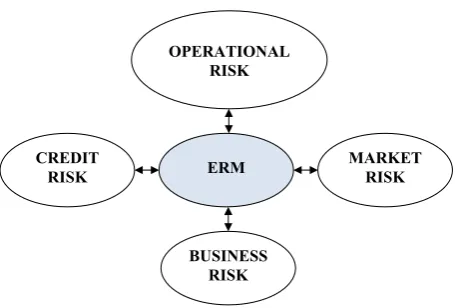
The analysis of the individual components of the overall risk management process is described in detail in a series of publications, e.g., rejda (1995). one of the key sources is described by Pulchart (2005). it is called the risk Management Standard and is generally recognized as a basic guide for the risk management process. This basic process of the corporate risk management is then – for example, in a financial in-stitution – broken down into the individual risk areas with which the particular firm comes into contact. it may be illustrated using the Figure 1.
A good risk management system aims at identify-ing and resolvidentify-ing risks. its goal is to add maximum value to all the activities of the company. it provides documentation of the potential positive and nega-tive effects of all factors which might influence the operator, increasing the probability of success and reducing the probability of failure and uncertainty in achieving the company objectives. The concept of sophisticated risk management and its modelling comes to the fore. The risk management system func-tions with various levels of management, especially with the position of risk manager or the cro (Chief Risk Officer). only in some cases, however, is there a system of risk management for a particular company which truly meets the expectations and is a part of the strategic decision making of senior management.
With that in mind, the risk management system should be integrated into the organization by the means of effective principles and programs backed by senior management. it must be capable of converting strategies into tactical and operational goals and must define the tasks and duties of the individual managers and staff responsible for risk management. A good risk management system supports responsibility, per-formance measurement and remuneration and thereby ensures action readiness at all levels. The result of introducing a system of quality financial controls and monitoring products offered, the internal administra-tive processes and the asset/liability management may then lead to a reduction in requirements for capital and to obtaining the competitive market advantage,
ERM OPERATIONAL
RISK
CREDIT RISK
BUSINESS RISK
[image:4.595.64.292.554.708.2]MARKET RISK
Figure 1. Enterprise risk Management schema in a finan-cial institution
building the quality distribution and strengthening the good reputation of the firm.
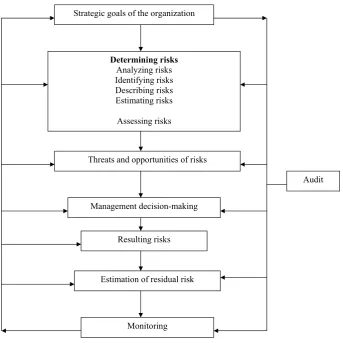
The modelling of risk management is generally benefi-cial if done on the basis of the sophisticated corporate risk management, i.e., the ErM. First, it should be noted that risk management is an ongoing process, part of the management of the company and its strategy. Different authors present the structure of risk management in slightly different ways, but the following elements of the process are fundamental (Figure 2).
Enterprise risk management has gradually become a standard component of the company management, and it is an obligatory component of risk manage-ment, especially for large financial institutions. risk management for insurers and reinsurers has been very well implemented but has lacked the firm-wide coordination and interconnection. it has been aimed primarily at the process of minimizing the impact of the potential realization of risks and has lacked an integral component aimed at taking advantage of opportunities. risk management in its sophisticated ErM form is becoming increasingly important in connection with the first and second pillars of the
Solvency ii concept, where there is a much stronger accent on a systematic and comprehensive approach to risk management (for more, see Kašparovská, Vávrová 2007).
new types of damage and cost compensation will mean finding new approaches and ways of managing loss adjustment, including acquiring experts (Claims Management). in accordance with Schulze, Ursprung (2001), it will be especially necessary to:
– develop the best practices for dealing with insur-ance events in a way beneficial for the natural en-vironment while at the same time eliminating the nonessential costs,
– determine which of the existing techniques for re-pairing biodiversity damage are the most effective and optimal cost-wise,
– in the context of the above, to determine the price of these techniques, the number of organizations offering them with the adequate experience and to judge whether these techniques are usable, – allow insurance companies control over claims for
the environmental damage and the reimbursement of costs for the biodiversity damage reparations,
Strategic goals of the organization
Determining risks Analyzing risks Identifying risks Describing risks Estimating risks
Assessing risks
Threats and opportunities of risks
Management decision-making
Resulting risks
Estimation of residual risk
Monitoring
[image:5.595.124.468.386.729.2]Audit
– discovering the functional relationship between insurance companies and the administrative bodies in claims procedures,
– solve the problem how to deal with the damage reimbursement claims when the amount of damage exceeds the limit of insurance.
The Directive allows member states to seek instru-ments for financial security in cases of insolvency of an operator. The European commission has to provide until 30 April 2010 the information about the accessibility and conditions for financial secu-rity and the possibility for operators to obtain such financial security.
The liability for damage to the natural environment in the czech republic is governed by the provisions of the civil code (Art. 42 and et seq.). Significantly, the liability for environmental damage is affected by the Act no. 353/1999 coll., on the prevention of major accidents, as amended by the Act no. 59/2006 coll., which contains a provision requiring obligatory insurance for damages caused to third parties, includ-ing environmental damage. companies to which this Act applies are either of the class A or class B. By law they must draw up safety documentation in the form of a safety report for the class B and a safety study for the class A. Within the period of 100 days from the date of approval of this document by the relevant regional office, the operator must take out the liability insurance for damage caused to a third party by any potential accident. The operator must present a copy of the documentation to the regional office within 30 days after concluding the insurance contract.
reimbursement by the insurance company concerns only reimbursement for damages caused by serious accidents. it also includes reasonable rescue costs for the limitation or prevention of the damage or mitiga-tion of its consequences. The insurance excludes the risk of war and the exposure to ionizing radiation, as with other insurance liabilities. Biodiversity damage is excluded4 because it cannot be quantified and is
therefore very difficult for the insurer to compen-sate (the quantification of the potential damage is a fundamental condition for the insurability of risk!). Excluded is the damage directly due to the poor tech-nical condition or the neglected maintenance. Also not covered by the insurance is the damage which has occurred due to the gradual, long-term effects of hazardous substances5. The insurance applies only
to a sudden, unexpected damage as e.g., the rupture of vessels or pipes, an explosion or fire.
in the czech republic, the government proposal for the Act dealing with the prevention of the bio-diversity damage and its remedy and on the changes in other legislation, contains in the appropriate §14 postponements concerning the obligatory financial security by 1 January 2013, i.e., only after the planned assessment of accessibility of the appropriate financial security by the European commission.
CONCLUSION
A comparison of the legislative situation before the introduction of the Environmental Liability Directive no. 2004/35/Ec leads to the following conclusions:
in many areas, environmental issues are already adequately regulated. These include the protection of soil, old environmental burdens and their liqui-dation, water resources, the protection of nature, waste management, managing hazardous substances, clean air, genetically modified organisms, agriculture and forestry, fisheries and regional planning. new European legislation is substantially stricter than the past approaches. it enables member countries to introduce more strict criteria exceeding the minimum standards. The implementation in national legisla-tion will mean mixing the laws together with the pan-European approach.
Prudent operators and their risk managers will seek opportunities for the optional insurance as soon as possible, to limit the financial consequences of a potential environmental accident on their business. Finally, their liability for the biodiversity damage and the obligation to reimburse the costs for the prevention of damage and to remedy the biodiversity damage will become effective immediately upon the passage of the Act.
The presentation of offers for insurance products which will be compatible with the requirements of the Directive will take some time. Because of the com-petition in the European insurance market, it may be anticipated that insurers in the individual European countries, in close cooperation with the reinsurance market, will adapt to this challenge depending upon the extent and legal framework the relevant public authorities will use to implement the provisions of the Directive into the national legislation. in my opinion, the free-market process of decision-making
should work without the introduction of the obliga-tory financial security.
This paper is focused on an analysis of the spe-cific presumptions about the insurability of risk as it concerns environmental insurance. The paper was written as a part of the research project MSM 6215648904, carried out by the Faculty of Business and Economics, under the name “The czech republic in the processes of integration and globalization, and the development of the agriculture and service sec-tor in the new conditions of the integrated European market”, following the goals and methodology of the research project.
REFERENCES
hrabánková M., Boháčková i. (2007): conditions of sustainable development in the czech republic in compliance with the recommendation of the European commission. Agricultural Economics – czech, 53 (6): 285–289.
Janata J. (2007): Pojištění škod na životním prostředí v EU (Environmental insurance in the EU). Po-jistný obzor, LXXXiV (10), ČAP, Prague; iSSn 0032-2393.
Kašparovská V., Vávrová E. (2007): Dopady regulace finančních institucí v novém prostředí (impact of
the regulation of Financial institutions under new conditions). in: Firma a konkurenční prostředí 2007, sekce Management v novém prostředí (Pro-ceedings of the international Scientific conference company and the competitive Environment 2007, Management in the new Environment section). MSD, Brno; iSBn 978-80-86633-85-5.
Pulchart V. (2005): Kapitál a risk management v pojišťovně (capital and risk Management in insurance). Pojistný obzor, LXXXiV (10): 12–13, ČAP, Prague; iSSn 0032-2393.
rejda g.E. (1995): Principles of risk Management and insurance. harpercollins, new York; iSBn 0-673-99027-3.
Schulze g.g., Ursprung h.W. (eds.) (2001): interna-tional Environmental Economics. oxford Univer-sity Press, new York; iSBn 0-19-829766-1. Viturka M. (2005): Environmentální ekonomie
(Environmental Economics). ESF MU, Brno; iSBn 80-210-3654-0.
zikán V. (2007): Bílá kniha cEA o pojistitelnosti odpovědnosti za škodu na životním prostředí (cEA White Book on the insurability of Liability for Environmental Damage). Pojistné rozpravy: pojistně-teoretický bulletin, 21, ČAP, Prague; iSSn 0862-6162.
Arrived on 3th June 2008
Contact address: