JOURNAL OF FOREST SCIENCE, 53, 2007 (10): 462–466
Methods of complex evaluation of the necrotic disease
of beech
A. Cicák
1, I. Mihál
1, Ch. Tsakov
2, P. Petkov
21
Institute of Forest Ecology of the Slovak Academy of Sciences, Zvolen, Slovak Republic
2Forest Research Institute of the Bulgarian Academy of Sciences, Sofia, Bulgaria
AbsTrACT: The authors elaborated a new complex methodical approach to the evaluation of necrotic disease of beeches. They used two evaluation scales: a scale for the evaluation of stems and a scale for the evaluation of beech crowns. A four-degree scale for the evaluation of necrotisation of crowns completed the existing five-degree scale for the evaluation of necrotisation of stems. Combination of both these scales into one methodical approach produced the third, complex scale for the evaluation of necrotisation of whole trees. The proposed combined scale is recommended for the monitoring of beech necroses.
Keywords: Fagus sylvatica L.; necroses; crown; stem; evaluation scale
Recently the problem of the tracheomycotic type necrotic disease of European beech has become relatively well known in European countries and dif-ferent attention was paid to its investigation. Most authors dealt with the necrotic disease partially and focused on the phytopathological problems only. At present, however, a more profound and complex investigation of this disease is demanded, especially with regard to an increase in the virulence and ex-tensive epiphytotic of this disease.
One of the ways of expressing the present state of the beech necrotic disease is a complex revision of methodological approaches to its evaluation. The elaboration of various evaluation methods was in the focus of more authors’ attention in the past. In earlier papers, the evaluation of the health condition (defolia-tion) of beeches was often put in connection with the process of the dying off of necrotised branches and foliage yellowing. This process results in the drying of crowns and changes in their transparency. At the same time the authors described the process of the break-ing of dead branches and increased defoliation. Such papers were published for example by Funk (1940),
Heinrich (1970), Lonsdale (1985–1986), Surovec (1990), Surovec and Novotný (1986), Rosnev and Petkov (1996). Later, there appeared papers that related the process of necrotisation of beeches with tree classes (Magasi, Newell 1983) or with the amount of leaf cast (Innes 1992). The frequency of necroses on annual shoots was evaluated by Cicák et al. (1995). Concrete methodical approaches to the evaluation of the degree of stem and crown necroti-sation were elaborated in other papers. For example Cicák and Mihál (1997) published a scale for the evaluation of the degree of stem necrotisation, which was modified by Leontovyč and Zúbrik (1998), who completed it by the evaluation of necroses in crowns and defoliation. Similarly, Jančařík (2000) elaborated a scale for the evaluation of the health state of broadleaved trees, which also included the occur-rence of necrotic damage on branches. The influence of necrotic damage of branches on their breaking and subsequent defoliation was quantified by Cicák and Mihál (1998a, 2000).
The aim of this paper is to contribute to the methodological complexity of evaluation of beech
necrotic diseases. Based on the data cited above and on their own methods of evaluation, the authors propose a new approach which can be used for the parallel evaluation of necrotic damage of crowns, stems and whole trees as well.
MATerIAl And MeThods
For the evaluation of the necrotic disease of beech stems we used the classification scale elaborated by Cicák and Mihál (1997):
Degree Characteristics
0 without any necrotic wounds of bark
1
small necrotic wounds (bark fissures, cracks) occurring either as single ones or in solitary groups, visible only at a closer examination of the stem
2
small necrotic wounds (like degree 1) accom-panied by the occurrence of larger necrotic wounds (larger fissures, rugged bark) visible at an ordinary examination of the stem
3
larger necrotic wounds denuding the xylem and partly deforming the stem, bark cracking and shedding, visible already at a larger distance from the stem
4 large necrotic wounds heavily deforming the stem or leading to “break necrosis”, rugged bark and shedding, visible from a distance
In order to evaluate the necrotic disease of the crown (branches) we elaborated the following four-degree scale:
Degree Characteristics
0 without occurrence of necrotic wounds
1 small, little visible necrotic wounds occurring individually or in clusters
2 like degree 1, but with the occurrence of larger, still not open necrotic wounds
3 like degree 2, but with the occurrence of large open and “break” necrotic wounds
Notes:
(a) the whole crown is evaluated from all four cardinal points with a binocular, the condition of objectivity is the evalu-ation of defoliated crown,
(b) evaluated are all the visible necrotic wounds occurring both on thin branches and on living main branches, (c) the terms “break” necrotic wounds and open wounds
mean the stage of development of the necrotic wounds defined by Cicák and Mihál (1997).
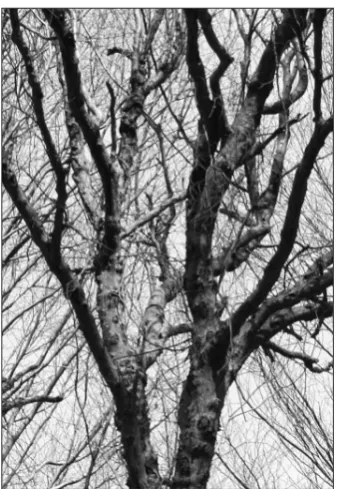
We proposed only four degrees for the scale of crown evaluation. A higher number of degrees would considerably complicate the objectivity of evaluation because the crowns are worse accessible for observation than the stems. The third degree of the necrotic disease of crown is illustrated in Fig. 1.
[image:2.595.335.504.54.299.2] [image:2.595.64.535.652.756.2]For a complex evaluation of the necrotic disease of the whole tree, we elaborated a scale combining the degree of necrotic damage of the stem and of the crown as well (Table 1). For a model example of the calculation of degrees of necrotisation of whole trees we used results obtained in four localities in the Stara Planina Mts. in Bulgaria. The evaluation was carried out in the second half of April 2006 in the monitoring plots of beech stands. A brief characteristic of each locality together with the size of the sets of evaluated trees is given in Table 2. Data on degrees of necroti-sation of beech stems from each plot were evaluated Fig. 1. The third degree of the necrotic disease of beech
Table 1. Combination of the degree of stem and crown necrotisation
Degree of stem
necrotisation 0 Degree of crown necrotisation1 2 3
0 0 0 1 1
1 1 1 2 2
2 2 2 3 3
3 3 3 3 3
by means of the index of stem necrotisation (ISN) for the 1st–3rd tree class. The degrees of necrotisation
of crowns were evaluated in the same way (index of crown necrotisation – ICN) as well as the degrees of necrotisation of whole trees (index of necrotisation of whole trees – INWT). Methodical justification of the use of an index, which is in fact an average of the values of recorded necrotisation degrees, was published by Cicák and Mihál (1998b).
Our main task was to do a complex evaluation of the degree of necrotic damage of whole trees which would be based on a separate evaluation of the stem and crown part of trees. Besides, we wanted to find out whether there was a relation between the necrotic damage of crown and sociological position of beeches in the stand as it was confirmed in the necrotic damage of stems (Cicák, Mihál 2002).
For testing the significance of differences in the necrotic disease of crowns, stems and whole trees, expressed by indices of necrotisation, between in-dividual tree classes we used the Mann-Whitney U test. We chose this test because of the non-para-metric character of the data which resulted from discrete values used in the evaluation scales. We also used this test for testing the differences between individual localities, separately for crowns, stems and whole trees.
resulTs And dIsCussIon
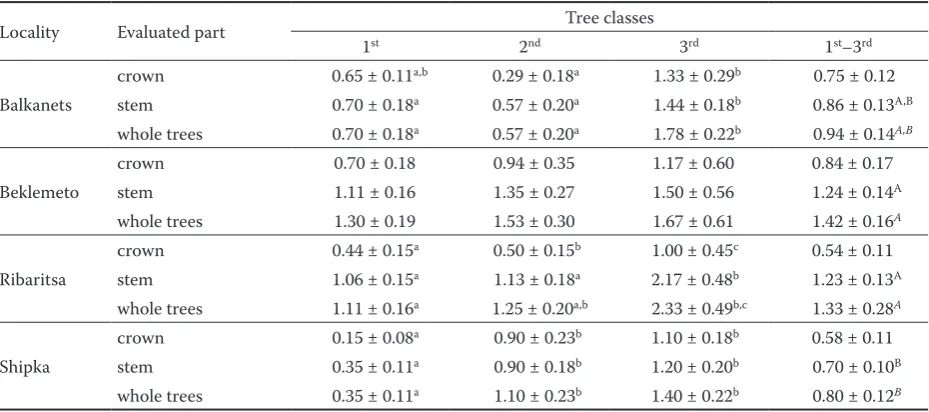
[image:3.595.66.533.72.252.2]Results of necrotic disease evaluation by means of indices of necrotisation of stems (INS), crowns (INC), and whole trees (INWT) in individual tree classes are given in Table 3. In all localities we observed an Table 2. Basic characteristics of the individual localities
Characteristics Balkanets Beklemeto Ribaritsa Shipka Orographic formation Stara Planina Stara Planina Stara Planina Stara Planina
Location 42°46′N 42°47′N 42°51′N 42°44′N 24°38′E 24°37′E 24°28′E 25°19′E
Exposition N NE WNW ENE
Altitude (m a.s.l.) 1,250 1,300 1,100 1,100
Average age (years) 110 60 70 65
Parent rock flysch flysch sandstones sandstones
Stocking 0.5 0.7 0.6 0.7
Slope (°) 25 12 20 20
Tree composition (%) beech 100 beech 100 beech 100 beech 90, hornbeam 10
Sample size (n) 36 50 48 40
Table 3. Index of necrotisation – INC, INS,INWT (mean ± standard error) of the evaluated parts of trees in individual tree classes (INC – index of crown necrotisation, INS – index of stem necrotisation, INWT – index of necrotisation of whole trees)
Locality Evaluated part Tree classes
1st 2nd 3rd 1st–3rd
Balkanets
crown 0.65 ± 0.11a,b 0.29 ± 0.18a 1.33 ± 0.29b 0.75 ± 0.12 stem 0.70 ± 0.18a 0.57 ± 0.20a 1.44 ± 0.18b 0.86 ± 0.13A,B whole trees 0.70 ± 0.18a 0.57 ± 0.20a 1.78 ± 0.22b 0.94 ± 0.14A,B
Beklemeto
crown 0.70 ± 0.18 0.94 ± 0.35 1.17 ± 0.60 0.84 ± 0.17 stem 1.11 ± 0.16 1.35 ± 0.27 1.50 ± 0.56 1.24 ± 0.14A whole trees 1.30 ± 0.19 1.53 ± 0.30 1.67 ± 0.61 1.42 ± 0.16A
Ribaritsa
crown 0.44 ± 0.15a 0.50 ± 0.15b 1.00 ± 0.45c 0.54 ± 0.11 stem 1.06 ± 0.15a 1.13 ± 0.18a 2.17 ± 0.48b 1.23 ± 0.13A whole trees 1.11 ± 0.16a 1.25 ± 0.20a,b 2.33 ± 0.49b,c 1.33 ± 0.28A
Shipka
[image:3.595.67.532.524.730.2]increasing trend of the values of these indices in relation with the worsening sociological position of trees in stands. The only exception was the Balkanets locality, where the values of indices of crowns and stems were lower than the indices of whole trees in the 2nd tree class compared to the 1st tree class.
However, we did not record a significant difference in any case. On the contrary, in the 3rd tree class the
values of indices were significantly higher (P < 0.05) in this locality than in the 1st and 2nd class. In some
other localities (Ribaritsa and Shipka) significant differences were confirmed already between the 1st and 2nd class. In the Beklemeto locality the
dif-ferences were not significant in any case. The results of significance evaluation indicated the existence of a relationship between the degree of necrotic disease and sociological position of trees in stands, and it ap-plied to crowns, stems and whole trees as well. In the case of beech stems this relationship was confirmed by Cicák and Mihál (2002).
The values of the indices of necrotisation of crowns, stems and whole trees in all tree classes evaluated in individual localities are presented in Table 3. We did not find any significant differences in the values of INC in any case. Significant differences in the values of INS were found only between the locality Riba-ritsa and Shipka and between the locality Beklemeto and Shipka. Significance of differences in the values of INWT showed the same pattern.
Separate evaluation of crowns and stems has its grounds and significance. It depends on the purpose for which we intend to use the obtained results of evaluation. If we need to evaluate the quality of timber production, we will use the evalu-ation of stems. In the evaluevalu-ation of stems we often meet with cicatrised wounds which still have an ad-ditional negative influence on timber quality. The remaining traces of cicatrised necroses are visible only on the radial cut of the stem (Cicák, Mihál 2001). According to our opinion, the joint evalu-ation of crowns and stems is significant because together with evaluation of defoliation it gives a more complex image of the health condition. From this viewpoint, the process of deramification is also of great importance because it influences the transparency of crowns. Necrotic disease in beech crowns is a frequent cause of deramifica-tion – breaking of branches at places with necrotic damage (Cicák, Mihál 1998a, 2000). The process of the dying off and breaking of necrotically dama-ged branches in beech crowns and subsequent changes in crown transparency were also observed by Schütt and Summerer (1983) and Wood-cock et al. (1995).
references
CICÁK A., MIHÁL I., 1997. Metodika hodnotenia nekrotizácie kôry kmeňov buka. Lesnictví-Forestry, 43: 104–109. CICÁK A., MIHÁL I., 1998a. Nekrotické ochorenie konárov
buka vo vzťahu k aktuálnej a predpokladanej strate olistenia. In: PAVLÍK M. (ed.), Mykoflóra pod vplyvom zmien životného prostredia. Zborník referátov. Zvolen, TU, LF: 14–18. CICÁK A., MIHÁL I., 1998b. Index nekrotizácie kôry kmeňov
buka. Lesnictví-Forestry, 44: 474–477.
CICÁK A., MIHÁL I., 2000. Influence of necrotic disease of beech branches (Fagus sylvatica L.) on momentary and expected foliage loss. Journal of Forest Science, 46: 145–150.
CICÁK A., MIHÁL I., 2001. T-disease – a little investigated phenomenon of the beech (Fagus sylvatica L.) necrotic damage. Journal of Forest Science, 47: 38–41.
CICÁK A., MIHÁL I.,2002. Relationship of necrotic disease of beech trunks to the sociological position of trees in the stand. Journal of Forest Science, 48: 225–229.
CICÁK A., MIHÁL I., ŠTEFANČÍK I., 1995. Metodický príspevok k hodnoteniu ochorenia tracheomykózneho typu v nezmiešaných bučinách. Zprávy lesnického výzkumu, 40: 26–29.
FUNK G., 1940. Buchenstudien im Apenninen. Mitteilun-gen den Deutschen Dendrologischen Gesellschaft, 53: 236–249.
HEINRICH F., 1970. Príčiny presýchania korún agáta a pro-blémy jeho pestovania. Les, 26: 107–111.
INNES J.L., 1992. Observations on the conditions of beech (Fagus sylvatica L.) in Britain in 1990. Forestry, 65: 35–60.
JANČAŘÍK V., 2000. Ochrana před tracheomykózním onemocněním lesních dřevin. TEI – bulletin technicko-ekonomických informací. Praha, VÚLHM, 6: 1–7. LEONTOVYČ R., ZÚBRIK M., 1998. Výskyt nekróz buka
a červca bukového na Slovensku – prvé výsledky výskumu. In: Zborník Aktuálne problémy ochrany lesa. Zvolen, TU, LF: 81–87.
LONSDALE D., 1985–1986. Beech health study. In: Beech health study 1985–1986. Forestry Commission, Research and Development Paper, 146: 1–22.
MAGASI L.P., NEWELL W.R., 1983. The status of beech bark disease in the Maritime Provinces of Canada in 1980. In: Beech Bark Disease Working Party Conference, I.U.F.R.O. Proceedings, September 26–October 8, 1982, USDA Forest Service, Hamden, Connecticut: 13–17.
ROSNEV B., PETKOV P., 1996. Zdravoslovno sostojanje na buka (Fagus sylvatica L.) v sredna i istočna Stara planina. In: Study, Conservation and Utilisation of Forest Resources. Proceed-ings, Vol. II., 3.–5. June 1996, Sofia, Bulgaria: 156–160. SCHÜTT P., SUMMERER H., 1983. Waldsterben –
SUROVEC D., 1990. Príznaky a príčiny chradnutia mladých bučín na Slovensku. Les, 46: 12–13.
SUROVEC D., NOVOTNÝ J., 1986. Hlavné príčiny zhorše-ného zdravotzhorše-ného stavu bučín na hornej hranici lesa. Zprávy lesnického výzkumu, 31: 26–30.
WOODCOCK H., VOLLENWEIDER P., DUBS R., HOFER R.M., 1995. Crown alterations indiced by decline: a study
of relations between growth rate and crown morphology in beech (Fagus sylvatica L.). Trees, 9: 279–288.
Received for publication May 28, 2007 Accepted after corrections June 21, 2007
Metodika komplexného hodnotenia nekrotického ochorenia buka
AbsTrAKT: Autori vypracovali komplexný metodický postup hodnotenia nekrotizácie buka. Pri hodnotení použili dve hodnotiace stupnice, stupnicu pre hodnotenie kmeňov a stupnicu pre hodnotenie korunových častí bukov. Dote-raz autormi používaná päťbodová stupnica hodnotenia nekrotizácie kmeňov bola doplnená o štvorbodovú stupnicu hodnotenia nekrotizácie korún. Kombináciou týchto dvoch stupníc do jedného metodického postupu vznikla tretia, komplexná stupnica hodnotenia nekrotizácie celých stromov. Navrhovanú kombinovanú stupnicu autori odporúčajú pre monitoring nekróz buka.
Kľúčové slová: Fagus sylvatica L.; nekrózy; koruna; kmeň; hodnotiaca stupnica
Corresponding author: