Impact of Different Tillage Methods on Silty Loam Luvisol
Water Content in Sugar Beet (Beta vulgaris L.) Crop
Kęstutis Romaneckas1, Egidijus Šarauskis2, Laura Masilionytė2,3, Antanas Sakalauskas2,
Vytautas Pilipavičius1
1Institute of Agroecosystems and Soil Sciences, Aleksandras Stulginskis University, Kaunas, Lithuania; 2Institute of Agricultural and
Safety Engineering, Aleksandras Stulginskis University, Kaunas, Lithuania; 3Joniškėlis Experimental Station, Lithuanian Research
Centre of Agriculture and Forestry, Joniškėlis, Lithuania.
Email: [email protected], [email protected], [email protected], [email protected], [email protected]
Received December 15th, 2012; revised January 14th, 2013; accepted February 10th, 2013
ABSTRACT
The regulation of water regime in the soil is the most important task in semi-humid climate with not even precipitation distribution conditions. Reduced or minimum tillage may change soil hydrological properties. The objectives of this study were to investigate the possibilities to manage soil water regime during the whole soil tillage system for sugar beet, which are especially sensitive for water deficit or abundance. Five field experiments were carried out at the Ex-perimental Station of the Lithuanian University of Agriculture (Aleksandras Stulginskis University since 2011) (54˚52'N, 23˚49'E) during 1995-2010. The soil of the experiments was silty loam Luvisol. In this study we highlighted the reduction of primary soil tillage from deep annual soil ploughing to shallow ploughing, deep and shallow cultivation and no till, comparison of soil ploughing and subsoiling, presowing ploughed or unploughed soil tillage with different cultivators—S-tine, complex, rotary and others, soil compressing with Cambridge and spur rollers before and after sugar beet sowing investigations. According to the results of experiments, reduction of primary soil tillage conserved soil water. The highest storage of soil water in spring was observed in non-reversibly tilled or not tilled soil. Subsoiling led higher water infiltration rate, and top layer of subsoiled soil consisted less moisture content than ploughed. Sugar beet seedbed moisture mostly depended on soil tillage intensity and depth. Presowing rotary tilling was the top tillage method in the case of water preservation in ploughed or unploughed soil. Soil compressing with rollers mostly had negative or low influence on light loam Luvisol moisture content. Rolling with Cambridge roller effected on more rapid water transport from deeper to top sugar beet seedbed layers and higher evaporation rate.
Keywords: Soil Tillage Methods; Soil Moisture; Sugar Beet Crop
1. Introduction
Soil moisture content depends on precipitation rate, air temperature, and relief, depth of ground water, soil type, humus content, water infiltration rate and grown plants [1, 2]. Moisture regime (especially deficit) limits the forma- tion of plant productivity, reduces the possibility of rea- lizing the cumulated bio-potential, which cannot be com- pensated in later plant growth stages. Therefore, soil wa- ter resource optimization in order to increase its effi- ciency in reducing environmental degradation processes, is one of the most important objectives in agriculture [3-5].
Soil tillage may influence on soil properties, especially on soil water content [6]. There was established strong relation between soil tillage, soil compaction, bulk den- sity, aeration and water permeability. Reduced soil tillage
lues were recorded at minimum tillage, too. Soil moisture was higher in NT and MT at the time of sowing and at the early stages of vegetation, then the differences di- minished over time. Water dynamics did not show dif- ferences that could affect crop yields.
The influence of soil tillage intensity on soil water content are well documented, however, there is no com- plex evaluation of the whole tillage system for sugar beet, which consist of primary tillage, subsoiling, presowing tillage of different intensity and tillage after sowing. So, the aim of our article is to review and highlight the pos- sibilities to manage soil water regime in all steps of soil tillage system for sugar beet.
2. Materials and Methods
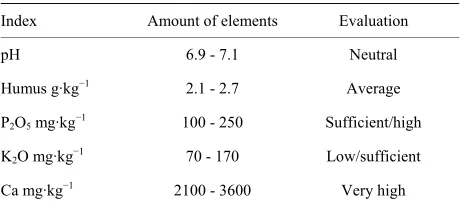
2.1. Site and Soil Description [image:2.595.308.538.100.202.2]Five field experiments were carried out at the Experi- mental Station of the Lithuanian University of Agricul- ture (Aleksandras Stulginskis University since 2011) (54˚52'N, 23˚49'E) [14] during 1995-2010. The soil of the experimental sites was clay loam over moraine clay on a silty loam (Calc(ar)i-Epihypogleyic Luvisol, LVg-p- w-cc(sc)) [15]. Soil chemical properties are presented in Table 1.
2.2. Experimental Design and Agricultural Practice
The number of replications per each experiment was four, plot distribution was randomized. The space between the rows of sugar beets was 0.45 m, the distance between seeds 0.11 - 0.16 cm. Pre-crops of sugar beet were winter wheat, winter triticale and spring barley. Agricultural practice of experiments is presented in Table 2.
2.3. Weather Conditions
The Lithuanian climate lies between maritime and conti- nental, with wet winters and moderate summers. Winter temperatures are usually below freezing. Rainfall is dis- tributed throughout the year, but more rain tends to fall on the coast of the Baltic Sea. Summer is the wettest season. The average annual precipitation is 720 millime- ters on the coast and 490 millimeters in the eastern part of the country.
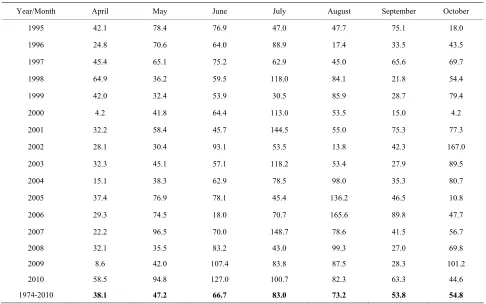
Lithuanian climate is uneven. The variation of pre- cipitation mostly is up to 45% - 50% or more. So, the influence of soil tillage on soil moisture content is not clearly expressed year by year. Different soil tillage methods had stronger influence on soil top layer water content in dry weather conditions. The variation of rain- fall during experiments execution is presented in Table 3.
In Lithuania sowing of summer plants starts at the end of April. In this period the trend of rainfall rate shows
Table 1. Soil chemical properties.
Index Amount of elements Evaluation
pH 6.9 - 7.1 Neutral
Humus g·kg−1 2.1 - 2.7 Average
P2O5 mg·kg−1 100 - 250 Sufficient/high
K2O mg·kg−1 70 - 170 Low/sufficient
Ca mg·kg−1 2100 - 3600 Very high
decrease of precipitation (Figure 1), which negatively influenced on seed germination of agricultural plants. So, the qualitative tillage and possibility to conserve mois-ture in the soil become a very important task.
2.4. Experimental Methods
Gravimetric water content (mass wetness)[16] was de- termined by the cylindrical and weighing methods. Cyl- inder size was 200 cm3. Sampling depth—from 10 to 40
cm. Soil samples were taken in 4 places per each plot. Sugar beet seedbed moisture content was determined by Kritz method [17,18]. Experimental data were analyzed by Anova. The treatment effects were tested by P test.
Each year data were analyzed separately. The trial data were also evaluated using correlation and regression analysis by Sigma Plot 8.0 software.
3. Results and Discussion
3.1. Primary Soil TillageStationary long-term field experiment was performed during 2001-2005. Five types of soil tillage methods were compared—from conventional deep mould-board ploughing to deep or shallow cultivation and no tillage. Different soil tillage was performed in autumn time be-fore wintering. Stubble disking was made 2 weeks bebe-fore primary soil tillage (except no tillage plots).
In conditions of ploughless soil tillage or no-till more plant residues are left on or near the soil surface, which led to lower evapotranspiration and higher content of soil water [19-21]. Marginally cultivated soils in spring con-tain more moisture than in the case of intensive tillage [22-24].
Similarly in our experiment reduction of primary soil tillage intensity increased the amount of moisture in the soil upper layer (0 - 10 cm) (Table 4).
Table 2. The agricultural practice of sugar beet growing in field experiments.
Title of experiment Execution years experiment Status of Tillage treatments Initial size of plot m2 Fertilization rate
I. The reduction of primary soil tillage intensity for sugar beet
2001-2005 Long-term, stationary
1. Conventional ploughing with moldboard plough up to 22 - 25 cm depth;
2. Shallow ploughing with moldboard plough up to 12 - 15 cm depth;
3. Deep cultivation with chisel cultivator up to 25 - 30 cm; 4. Shallow cultivation with disc cultivator up to 12 - 15 cm depth; 5. No tilled.
84.0 NP60+6080 K160
II. The investigations of presowing soil tillage methods for sugar beet in ploughed soil
1995-1999 Short-term
1. Deep extensive (with S-tine cultivator up to 5 - 6 cm depth); 2. Shallow intensive (with complex cultivator RAU Ecomat up to 3 - 4 cm depth);
3. Shallow with rotors (with rotary tiller up to 3 - 4 cm depth).
26.5
N120 P80 K160 B0.9
III. The minimization of presowing tillage methods for sugar beet in unploughed soil (stubble cultivation)
2000-2002 Short-term
1. No tilled straw;
2. Intensive straw tillage with rotary tiller up to 3 - 4 cm depth; 3. Intensive straw tillage with rotovator up to 3 - 4 cm depth; 4. Conventional technology (ploughing with moldboard plough in autumn, presowing soil tillage with S-tine cultivator twice up to 4 - 5 cm depth).
36.0
N55+60 P85 K150 B0.9
IV. Effect of seedbed compressing for sugar beet
1998-1999, 2002, 2004-2005,
2007
Long-term
1. No compressed;
2. Compressed with Cambridge roller before sowing; 3. Compressed with spur roller before sowing; 4. Compressed with Cambridge roller after sowing; 5. Compressed with spur roller after sowing.
12.0 - 16.0 N50+60
P59 K135
V. Subsoiling for sugar
beet 2009-2010
Short-term, on-farm scale
1. Conventional ploughing with moldboard plough up to 20 - 22 cm depth;
2. Deep soil tillage with subsoiler (Agrisem Combiplow) up to 40 - 45 cm depth.
50,000
N48+68 P78 K135
Table 3. The rainfall during sugar beet growing seasons. Kaunas meteorological station.
Year/Month April May June July August September October
1995 42.1 78.4 76.9 47.0 47.7 75.1 18.0
1996 24.8 70.6 64.0 88.9 17.4 33.5 43.5
1997 45.4 65.1 75.2 62.9 45.0 65.6 69.7
1998 64.9 36.2 59.5 118.0 84.1 21.8 54.4
1999 42.0 32.4 53.9 30.5 85.9 28.7 79.4
2000 4.2 41.8 64.4 113.0 53.5 15.0 4.2
2001 32.2 58.4 45.7 144.5 55.0 75.3 77.3
2002 28.1 30.4 93.1 53.5 13.8 42.3 167.0
2003 32.3 45.1 57.1 118.2 53.4 27.9 89.5
2004 15.1 38.3 62.9 78.5 98.0 35.3 80.7
2005 37.4 76.9 78.1 45.4 136.2 46.5 10.8
2006 29.3 74.5 18.0 70.7 165.6 89.8 47.7
2007 22.2 96.5 70.0 148.7 78.6 41.5 56.7
2008 32.1 35.5 83.2 43.0 99.3 27.0 69.8
2009 8.6 42.0 107.4 83.8 87.5 28.3 101.2
2010 58.5 94.8 127.0 100.7 82.3 63.3 44.6
[image:3.595.55.541.432.736.2]Table 4. The influence of primary tillage methods on moi- sture content in top soil layers, 2001-2005.
Soil tillage methods
Sampling depth cm
Before soil tillage in spring %
Till sugar beet germination %
CP 10 - 20 0 - 10 22.8 24.7 20.6 22.6
SP 10 - 20 0 - 10 22.6 25.6 19.8 21.4
DC 10 - 20 0 - 10 24.9 24.9 22.2 *
22.7
SC 10 - 20 0 - 10 24.1 26.3 22.121.2 *
NT 10 - 20 0 - 10 25.823.8 * 22.921.9 *
CP = conventional ploughing with mould-board plough up to 22 - 25 cm depth; SP = shallow ploughing with mould-board plough up to 12 - 15 cm depth; DC = deep cultivation with chisel cultivator up to 25 - 30 cm; SC = shallow cultivation with disc cultivator up to 12 - 15 cm depth; NT = no tilled; *significant difference from control treatment (CP) at P ≤ 0.05.
[image:4.595.56.287.112.267.2]0 20 40 60 80 100mm
Figure 1. The trend of rainfall in April. Kaunas meteoro- logical station, 1974-2007. x = 37.3; Mo = 36.7; V% = 56.4.
3.2. Subsoiling
Subsoiling is the process of deep tilling of the ground (up to 40 - 50 cm depth). It is mainly used to uncompact the soil, but also improves aeration of the soil, water infiltra- tion, soil water capacity and dispersion of nutrients.
Conventional mould-board ploughing was compared with subsoiling in on-farm scale experiment. Soil tillage was performed in autumn time before wintering. Soil water content was measured three times: after subsoiling in autumn 2009, before pre-sowing soil tillage in spring 2010 and before sugar beet harvesting in autumn 2010. Investigation data showed, that mean water content in top 0 - 5 cm depth soil layer was higher in ploughed soil (25.8%), than in subsoiled (23.3%) because of slower water infiltration. Such conditions influenced on disap- pearance of some sugar beet plants, especially in the wettest places.
Deep subsoiling leads to 4 t·ha−1 higher sugar beet root
production and by 0.86% unit higher sucrose content in comparison with ploughed one.
3.3. Pre-Sowing Tillage of Ploughed Soil
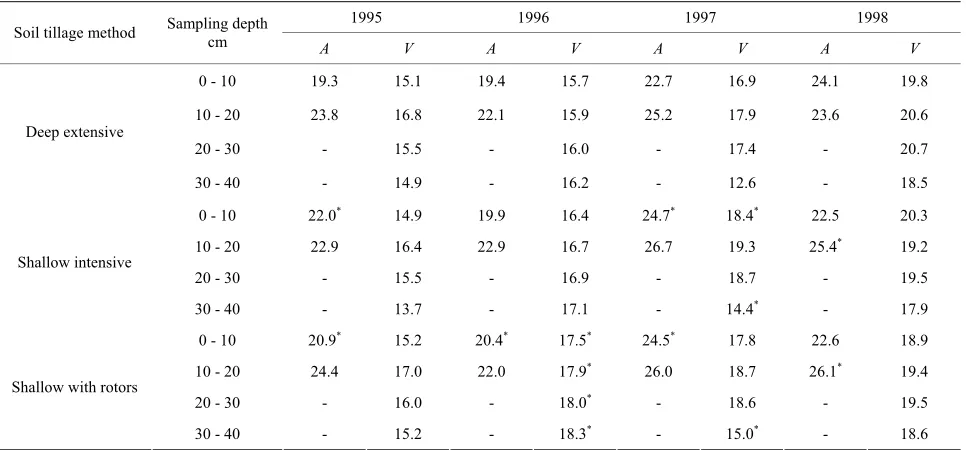
[image:4.595.58.541.480.705.2]Short-term field experiment was carried out during 1995- 1998. In autumn ploughed soil before sowing was culti- vated with three different cultivators: S-tine (deep exten- sive pre-sowing tillage), complex (shallow intensive till- age) and rotary. According to the data of experiment, pre-sowing soil tillage up to 5 - 6 cm depth influenced on faster water evaporation from the top layers of the soil (Table 5). In shallowly tilled soil water content was sig-
Table 5. Impact of ploughed soil presowing tillage methods on soil moisture content.
1995 1996 1997 1998 Soil tillage method Sampling depth cm
A V A V A V A V
0 - 10 19.3 15.1 19.4 15.7 22.7 16.9 24.1 19.8
10 - 20 23.8 16.8 22.1 15.9 25.2 17.9 23.6 20.6
20 - 30 - 15.5 - 16.0 - 17.4 - 20.7
Deep extensive
30 - 40 - 14.9 - 16.2 - 12.6 - 18.5
0 - 10 22.0* 14.9 19.9 16.4 24.7* 18.4* 22.5 20.3
10 - 20 22.9 16.4 22.9 16.7 26.7 19.3 25.4* 19.2
20 - 30 - 15.5 - 16.9 - 18.7 - 19.5
Shallow intensive
30 - 40 - 13.7 - 17.1 - 14.4* - 17.9
0 - 10 20.9* 15.2 20.4* 17.5* 24.5* 17.8 22.6 18.9
10 - 20 24.4 17.0 22.0 17.9* 26.0 18.7 26.1* 19.4
20 - 30 - 16.0 - 18.0* - 18.6 - 19.5
Shallow with rotors
30 - 40 - 15.2 - 18.3* - 15.0* - 18.6
nificantly higher. However, this effect mostly was short and depended on precipitation rate.
Higher differences were observed in dry conditions of 1996. Pre-sowing soil tillage with rotary tiller influenced on higher water content from top to deeper (up to 30 - 40 cm) soil layers.
3.4. Pre-Sowing Tillage of Stubble
Short-term field experiment was performed during 2000- 2002. The main task of experiment was to compare dif- ferent soil tillage methods for stubble cultivation and its influence on sugar beet seedbed moisture content. The comparable control treatment was conventional for Lithuanian technology—deep ploughing in autumn, S- tine cultivation before sowing twice.
The data of experiment showed that stubble tillage with rotary tiller and no tillage (direct sowing) led to significantly higher amount of water in different sugar beet seedbed layers (Table 6). Stubble cultivation with rotovator increased seedbed water content but signifi- cantly—in deeper layer only.
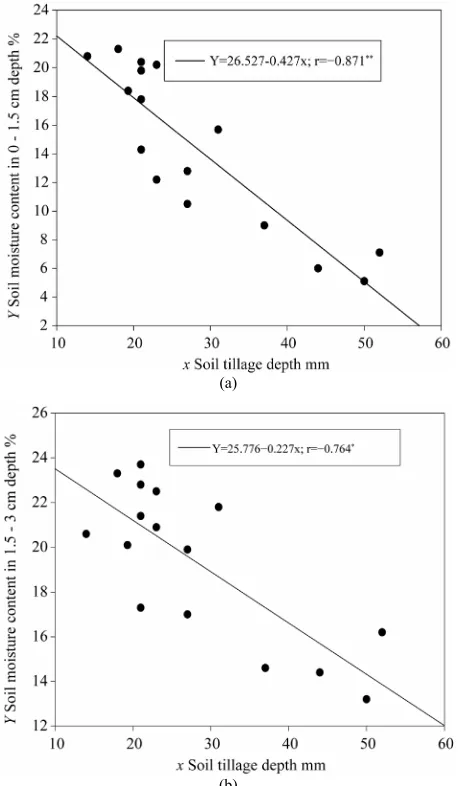
Sugar beet seedbed moisture content depended on depth of tillage (Figure 2).
3.5. Soil Compressing
Long-term field experiment was carried out in 1998, 1999 and 2002 and with modified methodology—in 2004, 2005 and 2007. Before and shortly after sowing the soil was pressed with a complex roller KKN-2.8 (Cambridge roller). The working width of the roller was 2.8 m, mass per meter of working width—256.4 kg. In other plots the soil was pressed with a spur roller 3KKŠ-6, working width—6.0 m (only one section of the three was used; working width 2.0 m) and mass per meter of working width 300.8 kg [25].
[image:5.595.309.538.86.479.2]Soil compressing (rolling) is especially useful in dry spring, while in the dry soil layer sugar beet seeds need more time to swell and their germination is uneven. Compressing improves the consolidation of soil aggre-
Table 6. Impact of reduced primary soil tillage on sugar beet seedbed moisture content till sugar beet germination, 2000-2002.
Sugar beet seedbed layers Soil tillage methods
0 - 1.5 cm 1.5 - 3.0 cm 3.0 - 4.5 cm
Conventional tillage 16.3 14.3 6.5 Stubble tillage with rotary tiller
up to 3 - 4 cm depth 20.7* 17.9* 12.5* Stubble tillage with rotovator
up to 3 - 4 cm depth 18.9 17.1 10.3** No tilled stubble 20.1* 19.4* 15.7**
*significant difference from control treatment (conventional tillage) at P ≤ 0.05; ** - at P ≤ 0.01.
(a)
[image:5.595.57.288.615.716.2](b)
Figure 2. Relation between pre-sowing tillage depth and soil moisture content in sugar beet seedbed.
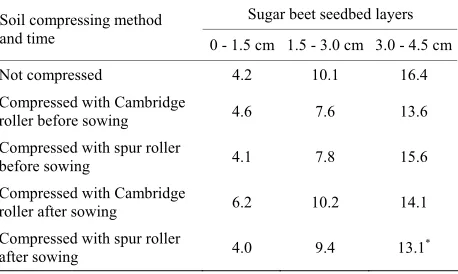
gates and seeds, increases capillary moisture movement which is necessary for sugar beet seed germination (18% - 22%) [18,26]. In the lightest and heaviest soils com- pressing reduces evaporative water losses. Conversely, compressing increases water loses in the intermediate textured soils [18]. Similarly, in our primary experiment soil compressing mostly had negative or low influence on light loam soil moisture content (Table 7). Only ap- plying of heavy spur roller before sugar beet sowing led to some tendencies of water content increase.
Table 7. The influence of soil compressing methods and time on soil moisture content till sugar beet germination, 1998-1999, 2002.
Soil layers Soil compressing method
and time 0 - 10 cm 10 - 20 cm
Not compressed 19.3 21.8
Compressed with Cambridge
roller before sowing 19.0 20.0
Compressed with spur roller
before sowing 19.7 23.6
Compressed with Cambridge
roller after sowing 19.4 22.0
Compressed with spur roller after
sowing 18.9 21.7
P > 0.05.
Table 8. The influence of soil compressing methods and time on sugar beet seedbed moisture content, 2004-2005, 2007.
Sugar beet seedbed layers Soil compressing method
and time 0 - 1.5 cm 1.5 - 3.0 cm 3.0 - 4.5 cm
Not compressed 4.2 10.1 16.4
Compressed with Cambridge
roller before sowing 4.6 7.6 13.6
Compressed with spur roller
before sowing 4.1 7.8 15.6
Compressed with Cambridge
roller after sowing 6.2 10.2 14.1
Compressed with spur roller
after sowing 4.0 9.4 13.1*
*significant difference from control treatment (not compressed) at P ≤ 0.05.
compressing with spur roller after sowing had negative significant impact on moisture content of deeper seedbed layer.
4. Conclusions
Reduction of primary soil tillage intensity from annual deep ploughing to shallow ploughing, deep and shallow cultivation and no tillage conserve soil water. The highest storage of soil water in spring was observed in non-re- versibly tilled or not tilled soil.
Subsoiling led to higher water infiltration rate, and top layer of subsoiled soil consisted less moisture content than ploughed.
Sugar beet seedbed moisture mostly depended on soil tillage intensity and depth. Pre-sowing rotary tilling is the top tillage method in the case of water preservation for ploughed or unploughed soil.
Soil compressing with rollers mostly had negative or low influence on light loam luvisol moisture content. Rolling with Cambridge roller effected on more rapid water transport from deeper to top sugar beet seedbed
layers and higher evaporation rate.
5. Acknowledgements
Paper presents research findings, which have been ob-tained through postdoctoral fellowship (No. 004/38). It was being funded by the European Union Structural Funds project “Postdoctoral Fellowship Implementation in Lithuania”.
We also would like to thank Mrs. Vilma Pilipavičienė for help in English paper correction.
REFERENCES
[1] J. He, H. W. Li, X. Y. Wang, A. D. McHugh, W. Y. Li, H. W. Gao and N. J. Kuhn “The Adoption of Annual Sub-soiling as Conservation Tillage in Dryland Maize and Wheat Cultivation in Northern China,” Soil and Tillage Research, Vol. 94, No. 2, 2007, pp. 493-502.
doi:10.1016/j.still.2006.10.005
[2] I. G. Martínez, C. Ovalle1, A. Del Pozo, H. Uribe, N. V. Valderrama, Ch. Prat, M. Sandoval, F. Fernández and E. Zagal, “Influence of Conservation Tillage and Soil Water Content on Crop Yield in Dryland Compacted Alfisol of Central Chile,” Chilean Journal of Agricultural Research, Vol. 71, No. 4, 2011, pp. 615-622.
doi:10.4067/S0718-58392011000400018
[3] J. Flexas, J. Bota, J. Galmés, H. Medrano and M. Ribas- Carbó, “Keeping a Positive Carbon Balance under Ad-verse Conditions: Responses of Photosynthesis and Res-piration to Water Stress,” Physiologia Plantarum, Vol. 127, No. 3, 2006, pp. 343-352.
doi:10.1111/j.1399-3054.2006.00621.x
[4] P. D. R. Herden, J. W. Swanepoel and G. H. J. Kruger, “Modulation of Photosynthesis by Drought in Two Desert Scrub Species Exhibiting C3—Mode CO2 Assimilation,”
Environmental and Experimental Botany, Vol. 61, No. 2, 2007, pp. 124-136. doi:10.1016/j.envexpbot.2007.05.005 [5] N. Nakayama, H. Saneoka and R. E. A. Moghaieb,
“Re-sponse of Growth, Photosynthetic Gas Exchange, Trans-location of 13C-Labelled Photosynthetic and
Accumula-tion in Two Soybean (Glycine max L. Merrill) Cultivars to Drought Stress,” International Journal of Agriculture and Biology, Vol. 9, No. 5, 2007, pp. 669-674
[6] E. Sarauskis, F. Godlinski, A. Sakalauskas, M. Schlegel, N. Kanswohl, K. Romaneckas, A. Jasinskas and V. Pili-pavicius, “Effects of Soil Tillage and Sowing Systems on Sugarbeet Production under the Climatic Conditions of Lithuania,” Landbauforschung, Vol. 60, No. 2, 2010, pp.101-110.
[7] M. A. Licht and M. Al-Kaisi, “Strip-Tillage Effect on Seedbed Soil Temperature and Other Soil Physical Prop-erties,” Soil and Tillage Research, Vol. 80, No. 1-2, 2005, pp. 233-249. doi:10.1016/j.still.2004.03.017
[8] D. Feizienė, V. Feiza and G. Kadžienė, “The Influence of Meteorological Conditions on Soil Water Vapour Ex-change Rate and CO2 Emission under Different Tillage
[image:6.595.58.287.318.455.2][9] D. Simanskaitė, “The Effect of Ploughing and Ploughless Soil Tillage on Soil Physical Properties and Crop Produc-tivity,” Žemės ūkio Mokslai—Agricultural Sciences, Vol. 14, No. 1, 2007. pp. 9-19.
[10] A. W. Lenssen, G. D. Johnson and G. R. Carlson, “Crop-ping Sequence and Tillage System Influences Annual Crop Production and Water Use in Semiarid Montana” Field Crops Research, Vol. 100, No. 1, 2007, pp. 32-43. doi:10.1016/j.fcr.2006.05.004
[11] E. Sarauskis, K. Romaneckas and S. Buragiene, “Impact of Conventional and Sustainable Soil Tillage and Sowing Technologies on Physical-Mechanical Soil Properties,” Environmental Research, Engineering and Management, Vol. 3, No. 49, 2009, pp. 36-43.
[12] V. Feiza, D. Feiziene, G. Kadziene, S. Lazauskas, I. De-veikyte, A. Slepetiene and V. Seibutis, “Soil State in the 11th Year of Three Tillage Systems Application on a Cambisol,” Journal of Food, Agriculture & Environment. Vol. 9, No. 3-4, 2011, pp. 1088-1095.
[13] P. I. Moraru and T. Rusu, “Effect of Tillage Systems on Soil Moisture, Soil Temperature, Soil Respiration and Production of Wheat, Maize and Soybean Crops,” Jour-nal of Food, Agriculture & Environment, Vol. 10, No. 2, 2012, pp. 445-448.
[14] V. Pilipavicius, R. Romaneckiene and K. Romaneckas, “Crop Stand Density Enhances Competitive Ability of Spring Barley (Hordeum vulgare L.),” Acta Agriculture Scandinavica. Section B: Soil and Plant Science, Vol. 61, No. 7, 2011, pp. 648-660.
[15] IUSS Working Group World Reference Base, “World Reference Base for Soil Resources,” 2nd Edition, World Soil Resources Reports No. 103, FAO, Rome, 2006, pp. 86-87.
[16] D. Hillel, “Introduction to Soil Physics,” Academic Press, Inc., Harcourt Brace Jovanovich Publishers, San Diego, 1982, pp. 58-63.
[17] G. Kritz, “Physical Conditions in Cereals Seedbeds. A Sampling Investigation in Swedish Spring-Sown Fields,” Reports of the Division of Soil Management, Uppsala, 1983.
[18] I. Håkansson, Å. Myrbeck and A. Etana, “A Review of Research on Seedbed Preparation for Small Grains in
Sweden,” Soil and Tillage Research, Vol. 64, No. 1-2, 2002, pp. 23-40. doi:10.1016/S0167-1987(01)00255-0 [19] K. J. Rasmussen, “Impact of Ploughless Soil Tillage on
Yield and Soil Quality: A Scandinavian Review,” Soil & Tillage Research, Vol. 53, No. 1, 1999, pp. 3-14.
doi:10.1016/S0167-1987(99)00072-0
[20] D. J. Lyon, W. W. Stroup and R. E. Brown, “Crop pro-duction And Soil Water Storage in Long-Term Winter Wheat-Fallow Tillage Experiment,” Soil & Tillage Re-search. Vol. 49, No. 1-2, 1998, pp. 19-27.
doi:10.1016/S0167-1987(98)00151-2
[21] K. P. Fabrizzi, F. O. Garcia, J. L. Costa and L. I. Picone, “Soil Water Dynamics, Physical Properties and Corn and Wheat Responses to Minimum and No-Till Systems in the Southern Pampas of Argentina,” Soil & Tillage Re-search, Vol. 81, No. 1, 2005, pp. 57-69.
doi:10.1016/j.still.2004.05.001
[22] R. Q. Cannel and J. D. Hawes, “Trends in Tillage Prac-tices in Relation to Sustainable Crop Production with Special Reference to Temperate Climates,” Soil and Till-age Research, Vol. 30, No. 2-4, 1994, pp. 245-282. doi:10.1016/0167-1987(94)90007-8
[23] H. Tsuji, H. Yamamoto, K. Matsuo and K. Usuki, “The Effect of Long-Term Conservation Tillage, Crop Resi-dues and P Fertilizers on Soil Conditions and Responses of Summer and Winter Crops on Andosol in Japan,” Soil and Tillage Research, Vol. 89, No. 2, 2006, pp. 167-176. doi:10.1016/j.still.2005.07.005
[24] G. P. Lafond, W. E. May, F. C. Stevenson and D. A. Derksen, “Effects of Tillage Systems and Rotations on Crop Production for a Thin Black Chernozem in the Ca-nadian Prairies,” Soil and Tillage Research, Vol. 89, No. 2, 2006, pp. 232-245. doi:10.1016/j.still.2005.07.014 [25] K. Romaneckas, R. Romaneckienė, V. Pilipavičius and E.
Šarauskis, “Effect of Sowing Depth and Seedbed Rolling on Sugar Beet,” Zemdirbyste-Agriculture, Vol. 96, No. 1, 2009, pp. 39-52.