A Comparison of Low Intensity UV-C and High Intensity Pulsed Polychromatic Sources as Elicitors 1
of Hormesis in Tomato Fruit 2
3
Scott1,2*, G., Rupar1, M., Fletcher1, A. G. D., Dickinson1, M. & Shama2, G. 4
1 School of Biosciences, University of Nottingham, Sutton Bonington Campus, Loughborough, LE12 5
5RD, UK 6
2 Department of Chemical Engineering, Loughborough University, Loughborough LE11 3TU, UK 7
8
*Corresponding author: [email protected] 9
10
Abstract 11
Post-harvest hormetic treatment of mature green tomato fruit (Solanum lycopersicum cv. Mecano) 12
with high intensity pulsed polychromatic light (HIPPL) significantly delayed ripening to levels 13
comparable to those achieved using a conventional low intensity UV-C (LIUV) source. A 16 pulse 14
HIPPL treatment reduced the ΔTCI (tomato colour index) by 50.1 % whilst treatment with a LIUV 15
source led to a reduction of 43.1 %. Moreover, the 16 pulse treatment also induced disease 16
resistance in the fruit to Botrytis cinerea with a 41.7 % reduction in disease progression compared to 17
a 38.1 % reduction for the LIUV source. A single 16 pulse HIPPL treatment was found to significantly 18
reduce disease progression on both mature green and ripe fruit with a 28.5 % reduction on ripe fruit 19
in comparison to 13.4 % for the LIUV treatment. It is shown here that delayed ripening and disease 20
resistance are local responses in side treated tomato fruit for both LIUV and HIPPL treatments. 21
Finally, utilising a 16 pulse HIPPL treatment would reduce treatment times from 370 s for LIUV 22
sources to 10 s per fruit - a 97.3 % reduction. 23
Key words: UV-C Hormesis; Solanum lycopersicum; Intense Pulsed light; Induced Resistance; Delayed 25
Ripening; Polychromatic Light 26
27
1 Introduction 28
29
The portion of the electromagnetic spectrum between 10 and 400 nm is referred to as the 30
ultraviolet light region (UV). Within this region, wavelengths between 100 and 315 nm are known as 31
‘germicidal UV’. Germicidal UV is used extensively to directly inactivate a range of micro-organisms 32
in a number of different media including both solids and liquids (Shama, 2014). Some three decades 33
ago research began to be undertaken in inducing UV-C hormesis (Lu et al., 1987). Since then UV-C 34
treatment has been performed on a wide range of fresh produce, as reviewed by Shama and 35
Alderson (2005), Ribeiro et al. (2012) and Turtoi (2013). Hormesis is a phenomenon in which low 36
doses of a potentially damaging agent bring about a beneficial response in the organism receiving 37
the treatment. The beneficial effects of UV-C hormesis have been demonstrated for numerous types 38
of fresh produce including both climacteric and non-climacteric fruit, tubers, salads and brassicas 39
(Ranganna et al., 1997, D’Hallewin et al., 1999, Costa et al., 2006, Pongprasert et al., 2011, Kasim & 40
Kasim, 2012). Such effects include, but are not limited to, pathogen resistance, delayed ripening and 41
improved nutritional content (Shama & Alderson, 2005, Ribeiro et al., 2012, Turtoi, 2013). 42
It has been estimated that in the UK, 45 % of all purchased salad and 26 % of fruit is disposed of 43
post retail (WRAP, 2012). Losses in storage, however, can be attributed to spoilage pathogens, 44
senescence and transpiration (Maharaj et al., 1999). Crop-dependant pre and postharvest losses of 8 45
- 15 % occur annually due to spoilage pathogens (Oerke, 2006). Losses of tomato fruit (Solanum 46
lycopersicum), the tenth most economically important non-meat food commodity, however, are 47
exacerbated as fruits are particularly prone to chilling injury (Morris, 1982, FAO, 2015). 48
UV-C hormesis has been shown to induce disease resistance against a wide range of pathogens, 49
1992, D’Hallewin 1999, D’Hallewin et al., 2000, Mercier et al., 2000, Romanazzi et al., 2006, Charles 51
et al., 2008a). Many phytoalexins are phenolic compounds that act both as light quenchers, 52
absorbing damaging wavelengths of light, and antioxidants that prevent reactive oxygen species 53
(ROS) mediated cellular damage (Pietta, 2000, Sourivong et al., 2007, Lev-Yadun & Gould, 2009). It 54
would appear, therefore, that it is their dual function which allows the build-up of resistance against 55
plant pathogens in response to UV-C stress. Furthermore, specific pathogenesis related (PR) proteins 56
have also been shown to increase in concentration following hormetic UV-C treatment; these 57
include chitinases and β-1,3-glucanases which interact directly with pathogens to reduce their 58
viability (Charles et al., 2009). 59
The vast majority of previous studies on UV-C hormesis have been conducted with low pressure 60
mercury sources that emit UV light with a peak emission at 254 nm at relatively low intensities, 61
henceforth referred to as low intensity UV-C (LIUV). The long treatment times required by LIUV 62
sources explains in part why there has been reluctance by the horticulture sector to adopt this form 63
of treatment. To take a specific example, there is consensus on the average UV-C dose (3.7 kJ/m2) 64
necessary to induce hormetic effects in tomato fruit, (Liu, et al., 1993 & Maharaj et al., 1999). Using 65
low pressure mercury sources at an intensity of 20 W m-2 would require an exposure time of 66
approximately six min per fruit. Furthermore, the requirement for complete surface irradiation to 67
induce the beneficial effects on certain types of produce both complicates the treatment procedure 68
and extends the treatment time (Mercier et al., 2000). The recent advent of high intensity pulsed 69
polychromatic sources (HIPPS) with considerable emission in the UV-C region could result in a 70
substantial reduction in treatment times from minutes to seconds. 71
Treatment of fresh produce with HIPPL has been shown to increase the concentration of 72
anthocyanins and total phenolics along with improving colour in nethouse grown fig, Fiscus carica 73
(Rodov et al., 2012). Both LIUV and HIPPL treatments have been shown to significantly increase the 74
total lycopene, carotenoid and phenolic content as well as antioxidant activities of tomato fruit (Liu 75
anthocyanin and Vitamin D2 levels in mushrooms, Agaricus bisporus (Oms-Oliu et al., 2010, 77
Koyyalamudi et al., 2011). 78
The aim of this study was to investigate whether HIPPL sources were able to delay colour change 79
during ripening and induce resistance against B. cinerea on mature green tomato. Treatments were 80
also conducted with a LIUV source as a basis for comparison. Experiments were also undertaken to 81
establish whether it was necessary to irradiate the entire fruit surface for successful elicitation of 82
delayed colour change and disease resistance. Additionally, treatments using both types of source, 83
HIPPL and LIUV, were conducted to assess their ability to induce disease resistance on red ripe fruit, 84
as an increasing number of tomato growers are harvesting at this stage due high consumer demand. 85
86
2. Materials and Methods 87
88
2.1 Plant Material 89
Mature green and red ripe tomato fruit, cv. Mecano, were grown in the glasshouse at APS Salads 90
(UK) and delivered at ambient temperature to the University of Nottingham within 24 h of 91
harvesting. Fruit were then sorted to remove fruit showing deviation from the desired 92
developmental stage or uniformity of size. Fruit showing any surface damage were also discarded. 93
94
2.2 UV Treatment 95
Upon arrival tomatoes were randomly assigned to treatment groups and treated at room 96
temperature on the same day. LIUV treatments were carried out using a U-shaped amalgam UV 97
source (UVI 12OU2G11 CP15/469) obtained from Dr Hőnle AG, Gräfelfing, Germany, with peak 98
emission at 254 nm and housed within an anodised aluminium parabolic reflector. Doses of 3.7 99
kJ/m2 were delivered at an intensity of 20 W m-2 following the procedures of Charles et al. (2008a). 100
Intensity was measured with a portable radiometer (Model UVX, UVP Instruments, Cambridge) fitted 101
HIPPL treatments were carried out with a XENON LH-840 16” ozone free B lamp powered and 103
controlled by RT-847 cabinet and RC-802 controller, supplied by Lambda Photometrics (Harpenden, 104
Herts). The source produced 505 J of energy per pulse with a pulse width of 360 µs at 3.2 pulses per 105
second. Spectral emissions of the source were between 240 nm and 1050 nm. Fruit were placed at a 106
distance of 10 cm from the window of the lamp housing. Though extrapolation of the 107
manufacturer’s data an estimated 4.6 kJ/m2/pulse was delivered at fruit level. 108
Fruit received exposure on two sides through 180 ° axial rotation. For experiments aimed at 109
determining whether full tissue exposure was necessary for inducing disease resistance, fruit were 110
treated from only one side. Following treatment fruit were immediately stored in the dark until 111
sterilisation. For sterilisation tomatoes were immersed in 2 % Sodium hypochlorite (Sigma-Aldrich) 112
for approximately 5 – 10 seconds; to prevent growth of naturally occurring microorganisms during 113
the incubation period. Fruit were then rinsed three times in sterile distilled water (SDW), dried and 114
immediately incubated in the dark at 13 °C to prevent photoreversal. Fruit were stored for 10 d in 115
high humidity boxes with relative humidity > 98 %. 116
117
2.3 Colour measurement 118
Tomato colour was monitored to determine ripening progression (Lopez Camelo & Gomez, 2004, 119
Corcuff et al., 2012). Measurements were conducted using a calibrated CR-200 Chroma meter 120
(Konica Minolta) in L*a*b* mode. Readings were taken at a single point directly facing the source 121
and at a 90 ° axial rotation from that point. A second colour measurement was taken using the same 122
reference points at 10 d post treatment (DPT). Tomato colour index (TCI, Eq.1) was then calculated 123
(Hobson, 1987). The two measurements were then used to calculate the change in TCI over 10 d. 124
TCI = 2000(𝑎)
√𝐿(𝑎2+ 𝑏2 )
127
Equation 1. Tomato colour index (TCI) formula where L= lightness, a= red-green and b = blue-yellow 125
2.4 Pathogen Maintenance and Inoculum Preparation 128
A Botrytis cinerea culture, originally isolated from a plant of the genus Rosa, was supplied from 129
The University of Nottingham’s collection. Cultures were grown at room temperature on potato 130
dextrose agar (Sigma-Aldrich) supplemented with Penicillin G sodium salt (Sigma-Aldrich) at 33 mg/L 131
and Streptomycin sulphate salt (Sigma-Aldrich) at 133 mg/L. A calibrated spore solution was made 132
from 10-14 d old cultures. Briefly, Petri dishes were flooded with 15 mL of SDW supplemented with 133
0.03 % Tween 20. Spores were released by gentle agitation and then filtered through a double layer 134
of muslin cloth and vortexed vigorously to release conidia from conidiophores. The spore solution 135
was then centrifuged at 184 g in a Centaur 2 (MSE) for 10 min and the supernatant discarded. The 136
pellet was re-suspended in SDW, vortexed and centrifuged again at 184 g for a further 10 min, the 137
supernatant was discarded. The pellet was re-suspended in SDW and a haemocytometer was used 138
to obtain the desired spore concentration. 139
140
2.5 Inoculation and Lesion Measurement 141
At 10 DPT fruit were inoculated with B. cinerea. This interval was selected on the basis of the 142
work of Charles et al. (2008) who showed near optimal induction of resistance occurred at 10 DPT. 143
Fruit were wounded with a sterile hypodermic needle to a depth of 3 mm. Ripe fruits were then 144
inoculated with 5 µL of spores at 1 x 10⁵ per mL. Green fruits, however, were inoculated with 5 µL of 145
1 x 10⁶ spores per mL due to decreased levels of susceptibility shown in preliminary work. For direct 146
tissue exposure experiments fruit were either inoculated on a treated or untreated side with one 147
inoculation point per fruit. 148
Total lesion diameter, including all sunken lesions, splitting and tissue maceration, were then 149
measured with digital Vernier callipers at 3 and 4 d post inoculation. Measurements were used to 150
calculate the area under the disease progression curve (AUDPC, Equation 2) (Jeger and Viljanen-151
AUDPC = ∑𝑦𝑖+ 𝑦𝑖+1
2 (𝑡𝑖+1− 𝑡𝑖) 𝑛−1
𝑖=1
153
Equation 2. Area Underneath the Disease Progression Curve formula where n= total number of 154
observations, i= observation, y= disease score and t= time (Jeger and Viljanen-Rollinson, 2001). 155
156
2.6 Experimental Design and Statistical Analysis 157
All data presented here was collected from two independent replicate experiments. For the 158
experiments concerning delayed ripening and disease resistance 15 fruit were used in each 159
treatment group, per experiment (n = 30). Ten fruit per group, per experiment (n=20) were used for 160
experiments on the necessity for direct tissue exposure. 161
Analysis was performed using statistical software package SPSS 22 (IBM). One-way ANOVA with 162
Tukey’s post-hoc testing was performed. Where the homogeneity of variances assumption could not 163
be met Welch’s robust ANOVA was performed followed by the Games-Howell post-hoc test. 164
Statistical significance is here defined as p ≤ 0.05. 165
166
3 Results and Discussion 167
168
3.1 Delayed Ripening 169
The induction of delayed ripening in mature green tomatoes is an established beneficial effect 170
following hormetic LIUV treatment (Stevens et al., 1998a, Corcuff et al., 2012). Furthermore, colour 171
is the key external indicator for ripening progression on tomato fruit (Lopez Camelo and Gomez, 172
2004). Changes in TCI were, therefore, used to monitor the progression in ripening; with lower TCI 173
values indicating a greener tomato. 174
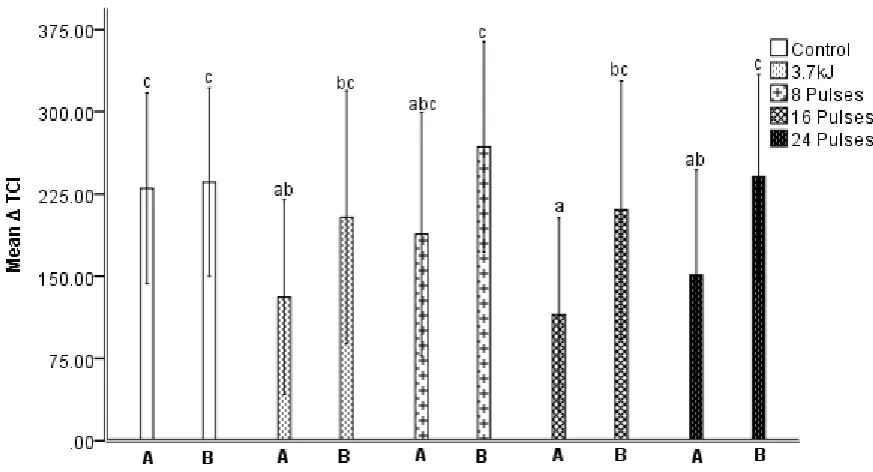
The 3.7 kJ/m2 LIUV, 16 and 24 pulse treatments showed significantly lower ripening progression, 175
Δ TCI, in comparison to the control (Figure 1). Fruit treated with 8 pulses did not ripen at a rate 176
2. All of the data here supports the successful induction of delayed ripening with either HIPPL or 178
LIUV. This data contradicts recently published work by Pataro et al. (2015) who observed no effect 179
for either LIUV or HIPPL treatments on the ripening of tomato fruit of cv. San Marzano. The HIPPL 180
source used by Pataro et al. (2015) gave comparable pulse length (360 µs) and spectral emission 181
(200 to 1100 nm) to that produced by the source used here. The spectral irradiance, i.e. intensity of 182
specific wavelengths, however, may have differed to the source used in this study. Furthermore, 183
different experimental protocols used by Pataro et al., (2015) may have led to the failure to detect a 184
significant difference in colour change for LIUV and HIPPL treated fruits. Specifically, the use of a 14 / 185
10 h day and night light cycle during fruit storage may have affected the induction of delayed 186
[image:8.595.81.518.357.593.2]ripening. 187
Figure 1. The Δ TCI (tomato colour index) from day 0 - 10 of mature green fruit from cv. Mecano. 188
Fruit were treated with a hormetic LIUV treatment of 3.7 kJ/m2 from a low intensity source with 189
peak emissions at 254 nm and three high intensity pulsed polychromatic light (HIPPL) treatments of 190
8, 16 and 24 pulses. TCI measurements were taken from tissue directly facing the light source (A) 191
and at 90 ⁰ from the source (B). Error bars show ± 1 standard deviation; n = 30. Labelling indicates 192
at p < 0.05. 194
195
196
197
198
199
200
201
202
[image:9.595.52.505.99.331.2]203
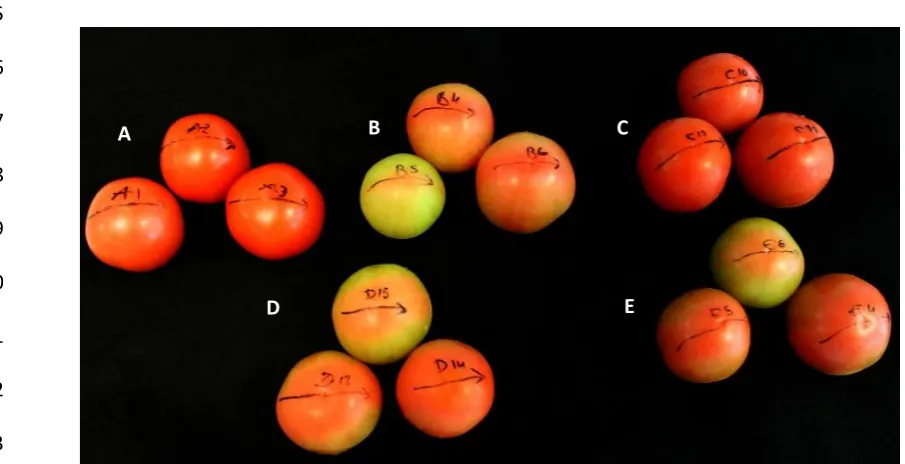
Figure 2. Representative samples of tomato fruit of the cultivar Mecano at 10 d post treatment. 204
Groups show the control fruit (A), the 3.7 kJ/m2 LIUV treatment with peak emissions at 254 nm (B) 205
and fruit treated with the high intensity pulsed polychromatic light (HIPPL) light source at 8 (C), 16 206
(D) and 24 (E) pulses. 207
208
209
Allowing the fruit to become exposed to visible wavelengths of light following treatment may 210
have led to photoreversal - a phenomenon in which the effects of UV-C induced responses are 211
negated by subsequent exposure to visible light (Kelner, 1949). It had previously been shown by 212
Stevens et al. (1998b) that peaches, Prunus persica, exposed to 48 h of visible light following UV-C 213
treatment no longer exhibited a reduction in brown rot lesions caused by Monilinia fructicola. The 214
influence of photoreversal on the ripening progression of tomato fruit, has not been investigated. 215
216
3.2 Direct Tissue Exposure and Delayed Ripening 217
During preliminary work it was noted that the effects of delayed ripening were more 218
pronounced on tissue directly facing the HIPPL and UV-C sources. To establish whether LIUV and 219
A B C
HIPPL delayed ripening is a local response, Δ TCI was also calculated for tissue at 90 ⁰ from that 220
directly exposed to the source. For all groups the tissue at 90 ⁰ from the source showed no 221
significant difference in ripening progression. When compared with directly exposed tissue, 222
however, tissue at 90 ⁰ from the 16 and 24 pulse treatments showed a significantly greater 223
progression in ripening to that of the directly exposed tissue (Figure 1). Tissue at 90 ⁰ for the LIUV 224
treatment ripened faster than directly exposed tissue but was not statistically significant from 225
directly exposed tissue or the control. The data presented here indicate that direct exposure to both 226
LIUV and HIPPL is required for the induction of delayed ripening. This is in line with observations by 227
Mercier et al. (2000) who showed the local accumulation of phytoalexin 6-methoxymellein in carrot, 228
Daucus carota, following LIUV treatment. 229
It has, however, been shown by Stevens et al., (2005) that alterations in treatment orientation 230
may facilitate systemic signal translocation utilising the fruit’s vasculature. Stevens et al., (2005) 231
showed that treatment at the calyx resulted in systemic disease resistance on apples (Malus 232
domestica), peaches (Prunus persica) and tangerines (Citrus reticulate). Alternative treatment 233
orientations were, therefore, performed to establish whether directing treatments at either the 234
blossom end or calyx would allow the translocation of a systemic signal to delay ripening. All 235
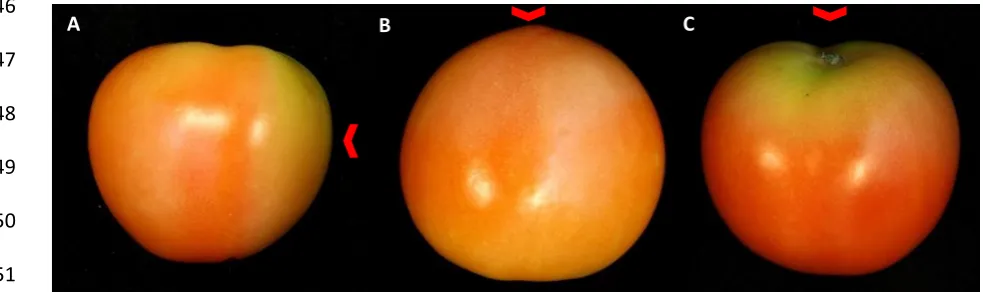
treatment orientations, however, produced uneven ripening progression, Figure 3. 236
237
238
239
240
241
242
243
244
246
247
248
249
250
[image:11.595.46.538.76.222.2]251
Figure 3. Representative samples of tomato fruit exposed to polychromatic light from different 252
orientations. Fruit, cv. Mecano, were treated with 16 pulses of high intensity pulsed polychromatic 253
light (HIPPL) and photographed at 10 d post treatment. Red arrows indicate the positioning of the 254
HIPPL source. A) Treatment from the side. B) Treatment from the blossom end. C) Treatment from 255
the calyx. 256
257
3.3 Disease Resistance on Mature Green Fruit 258
LIUV has previously been shown to induce disease resistance against B. cinerea on tomato fruit 259
(Charles et al., 2008a). The possibility of inducing resistance with HIPPL was, therefore, investigated. 260
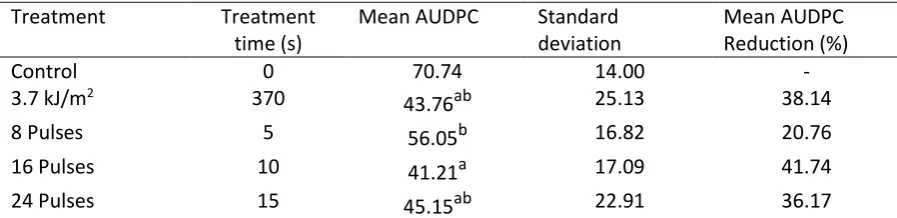
HIPPL and LIUV treated fruit showed reductions in mean AUDPCs indicating reduced disease 261
progression (Table 1). Welch’s ANOVA showed that disease progression for all treated groups was 262
significantly lower than the control. No significant differences were observed between HIPPL 263
treatments and the LIUV treatment. However, a significant difference between the AUDPCs of the 8 264
and 16 pulse treatments was observed showing increased disease resistance for the 16 pulse 265
treatment. 266
267
268
269
270
271
B C
Table 1. Area underneath the disease progression curve (AUDPC) from mature green fruit cv. 272
Mecano treated with a conventional low intensity UV-C (LIUV) source, with peak emissions at 254 273
nm, and an high intensity pulsed polychromatic light (HIPPL) source. Inoculations were performed 274
with B. cinerea at 10 d post treatment; n = 30. 275
Superscript labelling indicates statistical significance. Means sharing the same superscript are not 276
significantly different from each other at p< 0.05. 277
278
279
These results show that HIPPL can induce resistance to B. cinerea on mature green tomatoes to 280
similar levels to that of LIUV treatment. This is in contrast to the results obtained by Marquenie et al. 281
(2003) who reported no effect of pulsed light on the disease progression of B. cinerea on 282
strawberries, Fragaria ananassa. This could be due to the employment of a different plant species or 283
to differences in the spectral emission of the HIPPL sources. The HIPPL source used by Marquenie et 284
al. (2003) produced 30 µs pulses at 15 pulses per second (15 Hz). The source in this study, however, 285
produces 360 µs pulses at 3.2 pulses per second. Furthermore, the authors reported that the 286
percentage of light falling within the UV region was 50 % of a 7 J pulse in contrast to the output 287
obtained here (1 % of a 505 J pulse). 288
The 16 pulse treatment, here, provides comparable levels of disease resistance to the 3.7 kJ/m2 289
LIUV treatment with 41.5 % and 38.1 % reductions in AUDPC, respectively. The total duration of the 290
treatment times for both the HIPPL and LIUV sources are 10 s and 370 s, respectively. This equates 291
to a 97.3 % reduction in exposure time or a 37-fold increase in the number of tomatoes that could 292
Treatment Treatment
time (s)
Mean AUDPC Standard deviation
Mean AUDPC Reduction (%)
Control 0 70.74 14.00 -
3.7 kJ/m2 370
43.76ab 25.13 38.14
8 Pulses 5 56.05b 16.82 20.76
16 Pulses 10 41.21a 17.09 41.74
be treated with HIPPL compared to a LIUV treatment. Such a reduction could help overcome one of 293
the factors - lengthy treatment times - that has militated against the adoption of LIU hormesis in 294
commercial horticulture. 295
296
3.4 Direct Tissue Exposure and Disease Resistance 297
Following the observation that delayed ripening was a local response for both HIPPL and LIUV, 298
section 3.2, tests were conducted to establish whether disease resistance was also a local response. 299
To date, no data concerning this has been published for either LIUV or HIPPL induced resistance on 300
tomato. Further investigation was performed to ascertain whether full tissue exposure is required to 301
induce resistance in tomato fruit. Inoculations were performed on directly exposed and un-exposed 302
tissue; the latter is henceforth referred to as ‘systemic’. 303
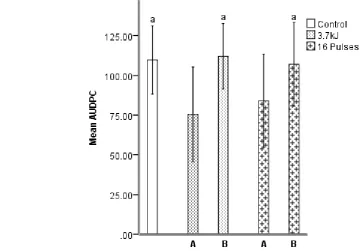
Systemic tissue inoculations showed no reduction in AUDPC and similar levels of disease 304
progression to that of the control (Figure 4). The directly exposed tissue, however, showed 305
significant reductions following both HIPPL and LIU treatment as previously shown (section 3.3). It 306
can therefore be stated that HIPPL and LIUV sources require direct tissue exposure to successfully 307
induce resistance to B. cinerea. This is in agreement with previous findings (Stevens et al., 1998a, 308
Charles et al., 2008, Liu et al., 2011) who routinely rotated the fruit during LIUV treatment to ensure 309
that the entire surface area of the fruit was irradiated, although they but did not specifically set out 310
to show that failure to do so would not result in systemic resistance. The results presented here are 311
therefore the first to confirm that side focused treatments require full surface exposure for LIUV 312
induced disease resistance on tomato fruit. Similarly, it was reported by Mercier et al. (2000) that 313
LIUV treatment leads to a local response in carrot. HIPPL-induced disease resistance is also a local 314
response, and therefore cannot overcome the requirement for fruit rotation during treatment or an 315
alternative arrangement of light sources. 316
317
319
320
321
322
323
324
325
326
[image:14.595.63.425.76.327.2]327
Figure 4. Area underneath the disease progression curve (AUDPC) of tomatoes, cv. Mecano, treated 328
on a single side and inoculated with B. cinerea at 10 d post treatment (DPT). Fruit were treated with 329
an established low intensity UV-C (LIUV) treatment of 3.7 kJ/m2,peak emissions at 254 nm, and a 330
high intensity pulsed polychromatic light (HIPPL) treatment of 16 pulses. Exposed tissue (A) or 331
systemic tissue (B). Error bars show ± 1 standard deviation; n = 20. Labelling indicates statistical 332
significance. Means sharing the same label are not significantly different from each other at p < 0.05. 333
334
335
An alternative means of inducing hormetic responses in produce may be to conduct treatments 336
pre-harvest. Obande et al. (2011) showed the systemic induction of delayed ripening while treating 337
tomato fruit on the plant. The response to LIUV has been shown to be both tissue and 338
developmental stage-specific in grapevine, Vitis vinifera, where biomarkers of LIUV treatment were 339
analysed by RT Q-PCR (Petit et al., 2009). It could, therefore, be hypothesised that the exposure of 340
alternative tissue such as the truss stems may allow the propagation of a systemic response. Further 341
investigation is required to ascertain whether disease resistance is also spread systemically after pre-342
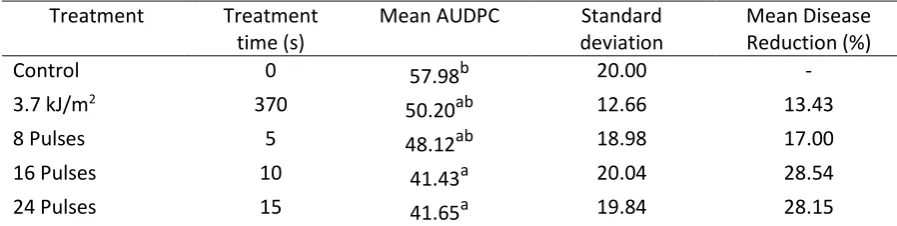
3.5 Disease Resistance of Ripe Fruit 344
The majority of studies on LIUV induced disease resistance have been carried out postharvest on 345
mature green tomatoes. Treatment at this stage is not entirely relevant for the UK tomato industry 346
where tomatoes are picked when at the red ripe stage to meet consumer preferences. Induced 347
resistance against B. cinerea on red ripe tomatoes was, therefore, investigated. 348
LIUV treated fruit did not show significantly reduced disease progression (Table 2). Moreover, 349
an 8 pulse treatment did result in a slight reduction of disease progression but was not statistically 350
significant. Both 16 and 24 pulse HIPPL treatments, however, did significantly reduce the AUDPC in 351
comparison to the control. The failure of the LIUV treatment to induce significant levels of disease 352
resistance, here, is in accordance with the results shown by Obande et al. (2011) who found that 353
pre-harvest treatments of 3 kJ/m2 did not effectively reduce the disease progression of Penicillium 354
digitatum on ripe tomatoes, cv. Mecano. An 8 kJ/m2 dose, however, effectively reduced disease. 355
Variation in the induction of hormetic responses for the HIPPL and conventional UV-C sources is not 356
unexpected due to the differences in spectral emission, the intensity of dose delivery and 357
[image:15.595.71.520.598.711.2]fractionation of the dose with HIPPL sources. 358
Table 2. Area Underneath the Disease Progression Curve (AUDPC) for ripe fruit cv. Mecano treated 359
with a conventional low intensity UV-C (LIUV) source with peak emissions at 254 nm and a high 360
intensity pulsed polychromatic light (HIPPL) source, followed by inoculation with B. cinerea at 10 d 361
post treatment; n = 30. 362
Treatment Treatment time (s)
Mean AUDPC Standard deviation
Mean Disease Reduction (%)
Control 0 57.98b 20.00 -
3.7 kJ/m2 370
50.20ab 12.66 13.43
8 Pulses 5 48.12ab 18.98 17.00
16 Pulses 10 41.43a 20.04 28.54
24 Pulses 15 41.65a 19.84 28.15
Superscript labelling indicates statistical significance. Means sharing the same superscript are not 363
4. Conclusions 365
The data presented here shows that HIPPL can induce both delayed ripening and disease 366
resistance against B. cinerea to a level comparable to that of LIUV sources, but with a significant 367
reduction in treatment time of 97.3 %. Furthermore, the work presented here demonstrates 368
categorically that LIUV treatments, focused on the side of fruit, induce only local responses on 369
tomato fruit. This was shown also to be the case for HIPPL sources. In addition, a 16 pulse HIPPL 370
treatment significantly reduced disease on both red ripe and mature green tomatoes, a feature not 371
exhibited by the established LIUV treatment. 372
No studies have yet been undertaken to establish the optimum wavelengths for inducing 373
hormetic effects in fresh produce. The spectral emission of the two types of sources used here are 374
quite different. The HIPPL source, although rich in UV-C, has a much broader spectral output; 375
emitting wavelengths between 180 – 1050 nm, and it should not be assumed that HIPPL will elicit 376
the same pathways or responses as hormesis induced by conventional LIUV sources that emit over a 377
much narrower spectral range. Future work could ascertain the importance of germicidal UV and 378
other wavelengths in the HIPPL source. Furthermore, optimum wavelengths for inducing hormetic 379
effects could turn out to be species-related and establishing what these are would make hormetic 380
treatment more commercially attractive. 381
382
Acknowledgements 383
The study was financed by the Agriculture and Horticulture Development Board’s Horticulture 384
Department (AHDB Horticulture) Project Code- PE 023 and Loughborough University. Tomato fruit 385
were provided by APS Salads (UK) to whom thanks are extended. All experimental studies were 386
carried out at The University of Nottingham’s Plant Science department. 387
388
5. References 390
391
Ben-Yehoshua, S., Rodov, V., Kim, J.J. & Carmeli, S., 1992. Preformed and Induced Antifungal 392
Materials of Citrus Fruits in Relation to the Enhancement of Decay Resistance by Heat and 393
Ultraviolet Treatments. Journal of Agricultural and Food Chemistry, 40, pp.1217–1221. 394
395
Charles, M.T., Goulet, A. & Arul, J., 2008c. Physiological basis of UV-C induced resistance to Botrytis 396
cinerea in tomato fruit. IV. Biochemical modification of structural barriers. Postharvest Biology and 397
Technology, 47, pp.41–53. 398
399
Charles, M.T., Makhlouf, J., & Arul, J., 2008b. Physiological Basis of UV-C Induced Resistance to 400
Botrytis cinerea in Tomato Fruit. II. Modification of Fruit Surface and Changes in Fungal Colonization. 401
Postharvest Biology and Technology, 47, pp.21–26. 402
403
Charles, M.T., Mercier, J., Makhlouf, J., & Arul, J., 2008a. Physiological Basis of UV-C Induced 404
Resistance to Botrytis cinerea in Tomato Fruit. I. Role of Pre- and Post-Challenge Accumulation of the 405
Phytoalexin-Rishitin. Postharvest Biology and Technology, 47, pp.10–20. 406
407
Charles, M.T., Tano, K., Asselin, A., & Arul, J., 2009. Physiological Basis of UV-C Induced Resistance to 408
Botrytis cinerea in Tomato Fruit. V. Constitutive Defence Enzymes and Inducible Pathogenesis-409
Related Proteins. Postharvest Biology and Technology, 5, pp.414–424. 410
Corcuff, R., Muvunyi, R., Bourget, S. & Arul, J., 2012. UV-C Induced Disease Resistance and Delayed 412
Ripening in Tomato Fruit with Prior Exposure to Selected Storage Stresses. Acta Horticulture: 413
International symposium on Postharvest Technology in the Global Market, 934 pp. 1235-1238. 414
415
Costa, L., Vicente, A.R., Civello, P.M., Chaves, A.R. & Martinez, G.A., 2006. UV-C treatment delays 416
postharvest senescence in broccoli florets. Postharvest Biology and Technology, 39, pp.204–210. 417
418
D’Hallewin, G., Schirra, M., Manueddu, E., Piga, A. & Ben-Yehoshua, 1999. Scoparone and Scopoletin 419
Accumulation and Ultraviolet-C Induced Resistance to Postharvest Decay in Oranges as Influences by 420
Harvest Date. Journal of the American Society for Horticultural Science, 124, pp.702-707. 421
422
D’Hallewin, G., Schirra, M., Pala, M. & Ben-Yehoshua, 2000. Ultraviolet C Irradiation at 0.5 kJ/m-2 423
Reduces Decay without Causing Damage or Affecting Postharvest Quality of Star Ruby Grapefruit (C. 424
paradisi Macf.). Journal of Agricultural and Food Chemistry, 48, pp.4571–4575. 425
FAOSTAT, 2015. Production Database. The Food and Agriculture Organisation of the United Nations 426
Statistics Division. 427
428
Hobson, G.E., 1987. Low Temperature Injury and the Storage of Ripening Tomatoes. Journal of 429
Horticultural Science, 62, pp.55-62 430
431
Jeger, M.J. & Viljanen-Rollinson, S.L.H., 2001. The Use of the Area Under the Disease-Progression 432
Curve (AUDPC) to Assess Quantitative Disease Resistance in Crop Cultivars. Theoretical and Applied 433
435
Kasim, R. & Kasim, M.U., 2012. UV-C Treatments on Fresh-Cut Garden Cress (Lepidum sativum L.) 436
Enhanced Chlorophyll Content and Prevent Leaf Yellowing. World Applied Sciences Journal. 17, 509-437
515. 438
439
Kelner, A., 1949. Effect of visible light on the recovery of Streptomyces griseus conidia from 440
ultraviolet irradiation injury. Proceedings of the National Academy of Sciences, 35, pp. 73–79. 441
442
Koyyalamudi, S.R., Jeong, S.C., Pang, G., Teal, A., & Biggs, T., 2011. Concentration of Vitamin D2 in 443
White button Mushrooms (Agaricus bisporus ) Exposed to Pulsed UV Light. Journal of Food 444
Composition and Analysis, 24, pp.976-979 445
446
Lev-Yadun, S. & Gould, K.S., 2009. Role of Anthocyanins in Plant Defence. Anthocyanins: 447
Biosynthesis, Functions and Applications. (Winefield, C., Davies, K., Gould, K. Eds) Springer; New 448
York, USA. 449
450
Liu, J., Stevens, C., Khan, V.A., Lu, J.Y., Wilson, C.L., Adeyeye, O., Kabwe, M.K., Pusey, P.l., Chalutz, E., 451
Sultana, T., Droby, S., 1993. Application of Ultraviolet-C Light on Storage Rots and Ripening of 452
Tomatoes. Journal of Food Protection, 56, pp.868-872 453
454
Liu, C., Cai, L., Han, X. & Ying, T., 2011. Temporary Effect of Postharvest UV-C Irradiation on Gene 455
457
Liu, C-H., Cai, L-Y., Lu, X-Y., Han, X-X. & Ying, T-J., 2012. Effect of Postharvest UV-C Irradiation on 458
Phenolic Compound Content and Antioxidant Activity of Tomato Fruit During Storage. Journal of 459
Integrative Agriculture, 11, pp.159-165 460
461
Liu, L.H., Zabaras, D., Bennett, L.E., Aguas, P. & Woonton, B.W., 2009. Effects of UV-C, Red Light and 462
Sun Light on the Carotenoid Content and Physical Qualities of Tomatoes During Post-Harvest 463
Storage. Food Chemistry, 115, pp. 495-500 464
465
Lopez Camelo, A.F. & Gomez, P.A., 2004. Comparison of colour Indexes for Tomato Ripening. 466
Horticultura Brasileira, 22, pp.534-537. 467
Lu, J., Stevens, C., Yakabu, P., Loretan, P., Eakin, D., 1987. Gamma, Electron Beam and Ultraviolet 468
Radiation on Control of Storage Rots and Quality of Walla Onions. Journal of Food Processing and 469
Preservation, 12, pp. 53-62 470
471
Maharaj, R., Arul, J. & Nadeau, P., 1999. Effect of Photochemical Treatment in the Preservation of 472
Fresh Tomato (Lycopersicon esculatum cv. Capello) by Delaying Senescence. Postharvest Biology and 473
Biotechnology, 15, pp.13-23 474
475
Marquenie, D., Michiels, C.W., van Impe, J.F., Schrevens, E., Nicolai, B.B., 2003. Pulsed White Light in 476
Combination with UV-C and Heat to Reduce Storage Rot of Strawberry. Postharvest Biology and 477
Technology, 28, pp.455–461. 478
Mercier, J., Roussel, D., Charles, M-T. & Arul, J., 2000. Systemic and Local Responses Associated with 480
UV-C and Pathogen-Induced Resistance to Botrytis cinerea in Stored Carrot. Phytopathology, 90, 481
pp.981–986. 482
483
Morris, L.L., 1982. Chilling Injury of Horticultural Crops: An Overview. Hortscience, 17, pp.73-77. 484
485
Obande, M.A., Tucker, G.A., Shama, G., 2011. Effect of Preharvest UV-C Treatment of Tomatoes 486
(Solanum lycopersicon Mill) on Ripening and Pathogen Resistance. Postharvest Biology and 487
Technology, 62, pp.188-192. 488
489
Oerke, E.-C., 2006. Crop Losses to Pests. The Journal of Agricultural Science, 114, pp.31-43. 490
491
Oms-Oliu, G., Aguilo-Aguayo, I., Martin-Belloso, O., & Soliva-Fortuny, R. 2010. Effects of Pulsed Light 492
Treatments on Quality and Antioxidant Properties of Fresh-Cut Mushrooms (Agaricus bisporus). 493
Postharvest Biology and Technology, 56, pp.216-222 494
495
Pataro, G., Sinik, M., Capitoli, M.M., Donsi, G. & Ferrari, G., 2015. The Influence of Post-Harvest UV-C 496
and Pulsed Light Treatments on Quality and Anitoxidant Properties of Tomato Fruits During Storage. 497
Innovative Food Science and Emerging Technologies, 30, pp.103-11 498
Petit, A.N., Bailieul, F., Vaillant-Gaveau, N., Jacquencs, L., Conreux, A., et al., 2009. Low 500
Responsiveness of Grapevine Flowers and Berries at Fruit Set to UV-C Irradiation. Journal of 501
Experimental Botany, 60, pp.1155–1162. 502
503
Pietta, P.G., 2000. Flavonoids as Antioxidants. Journal of Natural Products, 63, pp.1035-1042. 504
505
Pongprasert, N., Sekozawa, Y., Sugaya, S. & Gemma, H., 2011. The Role and Mode of Action of UV-C 506
Hormesis in Reducing Cellular Oxidative Stress and the Consequential Chilling Injury of Banana Fruit 507
Peel. International Food Research Journal, 18, pp.741–749. 508
509
Ranganna, B., Kushalappa, a. C. & Raghavan, G.S.V., 1997. Ultraviolet irradiance to control dry rot 510
and soft rot of potato in storage. Canadian Journal of Plant Pathology, 19, pp.30–35. 511
Ribeiro, C., Canada, J., & Alvarenga, B., 2012. Prospects of UV Radiation for Application in 512
Postharvest Technology. Emirates Journal of Food and Agriculture, 24, pp.586-597 513
514
Rodov, V., Vinokur, Y. & Horev, B., 2012. Brief Postharvest Exposure to Pulsed Light Stimulates 515
Colouration and Anthocyanin Accumulation in Fig Fruit (Ficus carica L.). Postharvest Biology and 516
Technology. 68, pp.43-46 517
518
Romanazzi, G., Gabler, F.M. & Smilanick, J.L., 2006. Preharvest Chitosan and Postharvest UV 519
Irradiation Treatments Suppress Gray Mold of Table Grapes. Plant Disease, 9, pp.445–450. 520
Shama, G., 2014. Ultraviolet Light. Encyclopaedia of Food Microbiology (Second Edition). Eds. 522
Robinson, R.K., Batt C.A., Patel, P.D. Academic Press. 523
524
Shama, G. & Alderson, P., 2005. UV Hormesis in Fruits: A Concept Ripe for Commercialisation. Trends 525
in Food Science and Technology, 16, pp.128–136. 526
527
Sourivong, P., Schronerova, K. & Babincova, M., 2007. Scoparone Inhibits Ultraviolet Radiation-528
Induced Lipid Peroxidation. Naturforsch, 62, pp.61-64. 529
530
Stevens, C., Liu, J., Khan, V.A., Lu, J.Y., Wilson, C.L., et al., 1998a. Application of Hormetic UV-C for 531
Delayed Ripening and Reduction of Rhizopus Soft Rot in Tomatoes: The Effect of Tomatine on 532
Storage Rot Development. Journal of Phytopathology, 146, pp.211–221. 533
Stevens, C., Khan, V.A., Lu, J.Y., Wilson, C.L., Pusey, P.L., Kabwe, M.K., Igwegbe, E.C.K., Chaluts, E. & 534
Droby., 1998b. The Germicidal and Hormetic Effects of UV-C Light on Reducing Brown Rot Disease 535
and Yeast Microflora of Peaches. Crop Protection, 17, pp.75-84. 536
537
Stevens, C., Liu, J., Khan, V.A., Lu, J.Y., Kabwe, M.K., Wilson, C.L., Igwegbe, E.C.K., Chaluts, E., Droby, 538
S., 2004. The Effects of Low-Dose Ultraviolet Light-C Treatment on Polygalacturonase Activity, 539
Delayed Ripening and Rhizopus Soft Rot Development of Tomatoes. Crop Protection, 23, pp.551-554. 540
541
Stevens, C., Khan, V.A., Wilson, C.L., Lu, J.Y., Chalutz, E. & Droby, S. 2005. The Effect of Fruit 542
Orientation of Postharvest Commodities Following Low Dose Ultraviolet Light-C Treatment on Host 543
545
Turtoi, M., 2013. Ultraviolet Light Treatment of Fresh Fruits and Vegetables Surface: A Review. 546
Journal of Agroalimentary Processes and Technologies, 19, pp.325-337 547
548
WRAP., 2012. Household Food and Drink Waste in the United Kingdom. [Online] 549
<http://www.wrap.org.uk/sites/files/wrap/hhfdw-2012-main.pdf.pdf> [Accessed 06/07/2015]. 550