Q U A L I T A T I V E
A case study exploring the experience of graduate entry nursing
students when learning in practice
Gemma Stacey, Kristian Pollock & Paul Crawford
Accepted for publication 3 March 2015
Correspondence to G. Stacey:
e-mail: [email protected]
Gemma Stacey PhD PGCHE RN (Mental Health)
Assistant Professor
School of Health Sciences, Derby Royal Hospital, University of Nottingham, UK
Kristian Pollock MA PhD PGCHE Principle Research Fellow University of Nottingham, UK
Paul Crawford PhD DPSN RN (Mental Health)
Professor of Health Humanities University of Nottingham, UK
S T A C E Y G . , P O L L O C K K . & C R A W F O R D P . ( 2 0 1 5 ) A case study exploring the experience of graduate entry nursing students when learning in practice. Journal of Advanced Nursing71(9), 2084–2095.doi: 10.1111/jan.12673
Abstract
Aim. To explore how Graduate Entry Nursing students present and position themselves in practice in response to anti-intellectualist stereotypes and assessment structures.
Background. A complex background turbulence exists in nurse education which incorporates both pro- and anti-intellectualist positions. This represents a potentially challenging learning environment for students who are recruited onto pre-registration programmes designed to attract graduates into the nursing profession on the basis of the specific attributes they bring known as ‘graduateness’.
Design. A longitudinal qualitative case study conducted over 2 years.
Methods. Data were collected from eight Graduate Entry Nursing students at 6 monthly points between 2009–2011 via diaries, clinical assessment documentation and interviews. Forty interviews took place over 2 years. Additionally, three focus groups involving 12 practice assessors were conducted at the end of the study period. Data were analysed through a social constructivist lens and compared with a set of suppositions informed by existing empirical and theoretical debates.
Findings. Demonstrated the interplay of performance strategies adopted by Graduate Entry Nursing students to challenge or pre-empt actual or perceived negative stereotypes held by established practitioners to gain acceptance, reduce threat and be judged as appropriately competent.
Conclusion. Students interpreted and responded to, perceived stereotypes of nursing practice they encountered in ways which facilitated the most advantageous outcome for themselves as individuals. The data present the creative and self-affirming strategies which students adopted in response to the expectations generated by these stereotypes. They also depict how such strategies commonly involved suppression of the attributes associated with ‘graduateness’.
Keywords: anti-intellectualism, graduate entry nursing, practice assessment, prac-tice learning, pre-registration nurse education
Introduction
Due to the relatively recent decision to make nursing a graduate only profession in the UK (Nursing & Midwifery Council 2010) there has been much debate in both profes-sional and public circles around the optimal academic level for nurse registration. This has created a contested climate where both pro- and anti-intellectualist positions are held by practitioners, educationalists and current students. Using a case study design, this research followed a cohort of grad-uate entry nursing (GEN) students through their 2-year
pre-registration nurse education programme in a UK higher education institution and explored the ways they grappled with diverse attitudes and perceived prejudices towards them. The GEN programme was designed for people who already held a degree to complete their nurse education in 2 years and study at post-graduate level. Therefore, whilst the commentary surrounding a graduate only profession did not directly relate to the study group, it was seen as very likely that the conflicting discourse surrounding the aca-demic development of nursing would be highly relevant to them.
Background
Historical context of nurse education in England
A review of the literature relating to the development of nurse education in England revealed long-standing contro-versy concerning the methods adopted to educate nurses. Historically, apprenticeship models of learning were the accepted mode of preparation, whereby students were viewed as part of the workforce and learnt through observ-ing and imitatobserv-ing those around them (Robinson 1991). The apprenticeship approach was limited as a result of the low priority given to learning in the clinical environment and the lack of contact students had with qualified nurses, a fact that was highlighted in empirical research and recog-nized in policy (United Kingdom Central Council for Nurs-ing, Midwifery & Health Visiting 1986, Jacka & Lewin 1987, Reid et al. 1987). Furthermore, an apprenticeship model of learning was viewed as limiting the opportunity for student nurses to develop critical thought or to consider wider determinants influencing the healthcare arena that would affect the decisions they made in their day to day practice (Watson 2011). Awareness of concerns arising from the apprenticeship approach initiated a series of reforms to nurse education, which attempted to distance the needs of the student as a learner from the needs of the clinical environment to provide a service. These reforms ultimately resulted in students being given a supernumerary status in the practice setting and also resulted in the move of nurse education into a university environment leading to the formal academic accreditation of a nursing qualification (Robinson 1991).
Such curriculum reforms divided opinion attracting sup-port and considerable criticism and resistance. They were viewed externally as being fuelled by the self-interest of the profession (McNamara 2005, Watson 2006) and blamed in the media for decreased standards of care and a lack of compassion in the current nursing workforce (Chapman & Martin 2013), despite empirical research evidence that
Why is this research needed?
There is a lack of qualitative research exploring the experi-ence of Graduate Entry Nursing students despite the increasing popularity of GEN courses internationally.
The implications of the co-existence of pro- and anti-intel-lectualistic representations of nurse education on the stu-dent nurse have not been considered despite long-standing and widespread media and political debate.
What are the key findings?
The hostility experienced by students from established practitioners was not internalized or taken personally, demonstrating resilience and a reflective stance.
Fundamental care was used by students as currency to achieve acceptance and to exchange for access to more val-ued learning opportunities.
The demonstration of competence was viewed by students to require a performance of appropriate confidence which aimed to foster a relationship of trust between student and assessor whilst avoiding being perceived as threatening or being judged as arrogant.
How should the findings be used to influence policy/ practice/research/education?
To contribute to debate regarding the limitations of com-petency-based practice assessment and the implications of inequity of power in the practice assessor/student relation-ship.
To emphasize the need for a more consistent, nurturing and progressive environment for learning in practice sup-ported by nurses who demonstrate enthusiasm and com-mitment to student learning.
demonstrates there is no validity to these claims (Aiken
et al. 2014). Furthermore, critics made reference to argu-ments that have been applied to academic developargu-ments in nurse education internationally since the 1940s. These criti-cisms included the assumption that those who are academi-cally able are less skilled and less interested in the fundamental aspects of the provision of nursing care. The statements ‘too posh to wash’ and ‘too clever to care’ had become familiar themes in the public and the professional press as a linguistic representation of the polar positioning of the intellectual from the practical.
Adaptations to nursing curricula have since been made to appease the anti-intellectualist discourse. This has resulted in a competency framework of assessment being the guiding structure influencing the content and learning approaches adopted in all nursing education programmes in the UK. A group of critical commentators have discussed the negative impact of this on the progression of the profession and its ability to respond to the changing role, responsibilities and demands placed on nurses currently working in an increas-ingly burdened NHS system. This commentary suggests that current nurse education is failing to promote capability, criticality and flexibility amongst the nursing workforce (Ashworth et al. 1999, Clark 2000, Norman et al. 2000, Watson & Thompson 2000, Kenny 2004, Watson 2006).
It has been suggested that historical feminine gender asso-ciations remain relevant to current representations of nurs-ing and it is this that largely underpins anti-intellectualist attitudes observed in the media and amongst the profession itself (Davis 1995, Meerabeau 2001). The feminist argu-ment positions nursing as an oppressed profession that maintains its own subordinate status by failing to articulate its identity in terms that are valued by society (Roberts
et al.2009). It is argued that this subordinate position has created a workforce which is resistant to change and there-fore hostile to those who represent a challenge to their lim-ited power (McKenna 2003). This oppression and its consequences have been the subject of research in relation to the profession’s response to university-educated students which demonstrates how entry into the profession can be fraught with hostility, moral distress and subsequent disillu-sionment (Mabenet al.2006, Curtiset al.2012). However, it has not been considered specifically in relation to GEN. It is possible that these students may experience similar or worse resistance when entering the programme, as a result of their academic status.
Identity and professional socialization
The debates relating to identity formation in nursing largely present a deterministic process whereby an individual is
exposed to a range of powerful discourses and external value systems and, through a process of professional sociali-zation, emerges from their education with an internalized professional identity (Davis 1968, Simpson & Back 1979, Du Toit 1995). This deterministic position recognizes the need to change personal values or ideals, which may or may not entail some degree of moral distress (Kelly 1998, Maben et al. 2006, 2007). However, exploration of the research evidence concerning this process in other profes-sions identifies a more complex dynamic of compromise, as a result of the individual’s recognition of their position as a newcomer and the requirement or their desire to gain acceptance in the group where they are seeking membership (Becker et al. 1961, Bucher & Strauss 1961, Clouder 2003). This compromise involves a level of performance management where individuals move between a range of positions and presentations of their selves to encourage a mutually satisfying and acceptable persona. This argument suggests professional socialization involves a process of compliance as opposed to conformity which can entail a degree of internal conflict where personal values are com-promised. Furthermore, identity is viewed as a transient set of performances comprising the individual’s interpretative response to role expectations, moral obligations and inter-action with others (Goffman 1959, Blumer 1969, Brown & Levinson 1987).
Graduateness and graduate entry nursing
Consideration of the literature relating to GEN programmes internationally highlighted the lack of empirical research evidence specifically exploring the experiences of GEN stu-dents and also the high level of anecdotal or predictive commentary supporting the value of graduate attributes in nursing (Neil 2011). This literature describes a set of attri-butes that are associated with graduates. These relate to motivation and commitment (Meachin & Webb 1996) alongside the specific study skills and thinking styles that they bring with them as a result of prior education and experience (Carter & Peile 2007). However, it is evident that these findings are either based on the opinion of those who have been involved in educating students belonging to these groups, or on speculative views which attempt to explain quantitative comparative data documenting their success (Youssef & Goodrich 1996, Bently 2006, Aktan
et al.2009).
the future role of the nurse (Department of Health 2006, Longley et al. 2007) and the expectations that this would place on new registrants. In light of the positive commen-tary surrounding the benefits of attracting graduates into the nursing profession (Neil 2012), coupled with the design of the programme, it was hoped that students completing the GEN course would aspire to act as change agents in the healthcare system and possess the desire to apply criticality both to their practice and that of others. This paper will report on a research study which took advantage of the unique opportunity to explore the experience of the first cohort of students studying on this program when learning in practice.
The study
Aim
To explore how GEN students present and position them-selves in practice in response to anti-intellectualist stereo-types and assessment structures.
Design
A case study approach was adopted for this study. This approach is defined as ‘the exploration of a contemporary phenomenon in a real-life context when the boundaries between phenomenon and context are not clearly evident’ (Yin 1994, p. 23). It is amenable to the study of phenom-ena where many variables are of interest and there is no potential or desire to control variables for research. The research questions identified as relevant to this case repre-sent ‘how’ questions and there is no control over the events under investigation. Furthermore, existing theory and research predominantly refer to an alternative student group (undergraduate students studying on traditional pre-registration programmes). Therefore, an explanatory case study design is necessary, which will require a process of comparison and association with existing theory rather than elaboration of current theory through description of similar events over time, or initial exploration of an area that lacks prior investigation (Yin 1994). The explanatory case study will aim to offer explanations for events that have already been studied in a different context and from the perspective of a different demographic, namely, the inception of GEN in a practice area that has not previously encountered this student group. The current study represents a unique and critical case that can offer a significant contribution to well-formulated but widely debated existing theory. Further-more, the theory has numerous suppositions that are
long-standing and currently topical in both the political and media discourse. Therefore, the case study has potential to challenge, confirm or extend existing theory and help to refocus future investigations into this field.
The study commenced with the development of a series of suppositions that had arisen from assimilation of what had already been studied and theorized in relation to the topic. These were:
1 Current nurse education is failing to promote capability, criticality and flexibility amongst the nursing workforce (Watson 2006, Robertset al.2009)
2 GEN students possess a range of specific attributes which are beneficial to nursing (Graduateness) (Hackett & McLafferty 2006, Raines 2009, Neil 2012, Stacey et al.
2014)
3 GEN students are likely to feel hostility from established nurses in practice due to their academic qualifications (Brookfield 1993, McKennaet al.2006)
4 GEN students are perceived as unwilling or unable to engage in ‘caring’ activity as a result of intellectual ability (Watson & Thompson 2000, McKennaet al.2006, Wat-son 2006)
Participants
A theoretical sampling strategy was adopted to recruit information-rich participants with the required experience to meet the objectives of the study (Denzin & Lincoln 2000, Yin 2014). All 36 students of the 2009 cohort of GEN students were invited to be included in the study from one School of Health Sciences at a UK University. An email was sent to the students by the Course Director inviting them to attend a voluntary verbal information session deliv-ered by the lead researcher. They were given written infor-mation sheets to take away and asked to email the lead researcher following the session if they were interested in taking part. Twenty eight students attended the information session and eight students chose to take part and engaged in the study for the full 2 year duration of the data collec-tion period (September 2009–2011) indicating a 100% retention rate.
Twenty were eligible and twelve practice assessors chose to take part and represented a variety of adult and mental health practice areas.
Data collection
Diary-interview
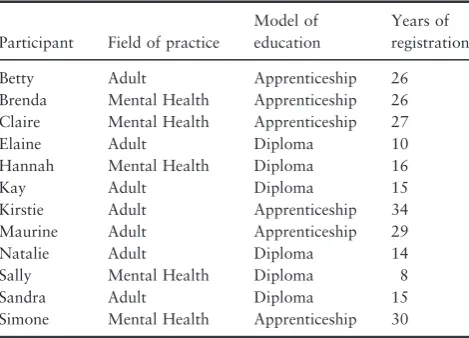
The student participants’ experiences were captured and explored through a diary-interview method (Zimmerman & Wieder 1977, Elliott 1997). Students were asked to record events and experiences in their diaries which were signifi-cant to them at specific points in the placement (Tables 1 and 2). They were aware that their entries would be reviewed before each interview to inform the questions and
topics included in the discussion. The diary entries were intended to prompt reflection on significant events and how students had responded during placement. The quantity and depth of diary data generated varied greatly amongst partic-ipants. For this reason entries were used to prompt the focus of the interviews and as components in the construc-tion of each case study but not subject to analysis as a sepa-rate sub set of the data.
Individual interviews were conducted with all student participants at 6 monthly intervals throughout the program. Five interviews were digitally recorded with each partici-pant in total (n =40) and lasted between 60 and 90 min-utes. Interviews were semi-structured and prompts were based on the specific content of the diary entries which related to the suppositions. For example students were asked to reflect on events which referred to the way they had been received by established practitioners, their response to events involving fundamental care and situa-tions whereby they had privately or publically questioned practice. The lead researcher (GS) undertook analysis of the diary entries and conducted all interviews. Interview topics and analysis of the findings were reviewed and discussed regularly by all authors throughout the duration of the study.
Focus groups
Practice assessors participated in a single focus group dis-cussion that was between 45–90 minutes in duration and digitally recorded. There were 3 separate groups with four participants in each. A topic guide was used to structure the discussion and ensure consistency in the core topics considered across the groups.
Practice documentation
Student participants and practice assessors gave permission to share the content of their practice assessment document at the end of the study period. The document is a written account of the student performance in each practice area and is co-constructed by the practice assessor and student. Data gleaned from this source were used to compare claims made by student and mentor participants regarding achieve-ment of competence, professional conduct and each asses-sor’s impression of the student’s attitude.
Ethical considerations
[image:5.595.63.300.284.474.2]Ethical approval was sought and granted from the host institution’s Faculty Medical Research Ethics Committee. The researcher’s dual role as a lecturer on the programme which was the focus of this study raised ethical Table 1 Demographic details of student participants
(pseud-onyms).
Participant Age
Previous education
Previous health care related experience
Cara 20-24 Foreign language degree
None
Chloe 20-24 Science degree None
Gwen 35-40 Science degree Criminal justice services Learning disability charitable organization Janine 20-24 Science degree None Jenny 20-24 Science degree None Rachel 20-24 Science degree None Richard 35-40 Arts degree/MSc
in a therapeutic intervention
Youth work Counselling
Samantha 25-30 Arts degree None
Table 2 Demographic details of practice assessor participants (pseudonyms).
Participant Field of practice
Model of education
Years of registration
Betty Adult Apprenticeship 26
Brenda Mental Health Apprenticeship 26 Claire Mental Health Apprenticeship 27
Elaine Adult Diploma 10
Hannah Mental Health Diploma 16
Kay Adult Diploma 15
Kirstie Adult Apprenticeship 34
Maurine Adult Apprenticeship 29
Natalie Adult Diploma 14
Sally Mental Health Diploma 8
Sandra Adult Diploma 15
[image:5.595.64.299.531.700.2]considerations relating to the potential risk of coercion in the recruitment phase of the study. At all stages of the recruitment process students were made aware that their decision to take part or not would have no implications on other aspects of the programme in both verbal and written information. The number of people who attended the infor-mation session (28) and did not go on to take part in the study provides some reassurance that students felt comfort-able to decline. Additionally, the varied level of participa-tion in completing the diary entries indicated that participants were not overly concerned with disappointing the researcher and felt justified in prioritizing other require-ments over the research during periods of high stress. Fur-thermore, students were aware of the escalation process identified should they experience any concern relating to practice or their learning. This involved the researcher noti-fying the academic tutor who was linked with the clinical area with the student’s full knowledge and involvement.
A further ethical issue relates to the confidentiality of stu-dent participants. There were inevitably features of the par-ticipants which would make them identifiable in written outputs of the study. This was discussed with the individual participants and the offer to remove data which would have enabled them to be identified locally was given. However, no participants chose this option.
Data analysis
Yin (2014) proposes that analysis of case study data should initially rely on the theoretical suppositions that informed the case study objectives and design. This enables analytic generalization to be generated through a process of ‘pattern matching’, whereby an empirically based pattern is com-pared with a predicted one or several competing ones.
Data relating to each individual student participant were initially considered as a whole. A narrative summary of the data for each student participant was produced, which identified aspects of the data that specifically related to the research aims and noted how these progressed over time. These were created by the lead researcher in regular discus-sion with the co-authors. The narrative summaries were then compared with other student participants to identify any patterns amongst them. Patterns included similarities in the temporal sequencing of experiences and common ways of responding or coping with events. This enabled the iden-tification of both recurring and deviant accounts. Finally, the data generated from the practice assessor focus groups were compared with the themes emerging from the student participant data. These patterns were then scrutinized against the initial theoretical suppositions (Yin 2014).
Validity and rigour
The consideration of researcher influence is relevant to this study, due to the researcher’s/first author’s involvement with the case itself. She views herself as an insider because of the shared cultural membership she holds with the phenomenon under investigation. To account for this the researcher began the process by identifying her own expectations of the research phenomenon based on her current experience of being involved in the design, development and promotion of the GEN course amongst established practitioners and pro-spective students. This attempted to ensure the fruitful preju-dices described by Gadamer (1989) are used to facilitate understanding and are detached from prejudices that obstruct insight. Adopting a reflexive stance enabled the researcher to turn back on herself and examine how her presence or stance functioned in relation to her subject of study. This position ensured that she was ethically and politically self-aware and acknowledged herself as part of the inquiry (Pelias 2011).
Findings
Supposition 1: Current nurse education is failing to promote capability, criticality and flexibility amongst the nursing workforce
Students’ accounts suggest educational compromises are still made which mirror those reported historically concern-ing the low priority of teachconcern-ing in the clinical environment. Students perceived practitioners as too busy to prioritize their learning. Students initially said that this was justified and were intent on not being perceived as a burden. As a result they engaged in tasks they viewed as useful to the ward environment but not necessarily valuable to their learning.
Scepticism surrounding the student’s ability to achieve competence was the most frequently encountered type of resistance directed towards student participants. It was attributed to the limited learning that could be achieved in the two-year duration of the programme. This preconcep-tion was confirmed by accounts given by both students and practice assessors:
How are they going to fit it all in, because, obviously, there is lots of knowledge they’re going to have to gain, lot of skills they’re going to have to gain, if they come in with an art degree or, you know, a drama degree or whatever I think, how they going to fit all that in when ours have to do three years?
(Simone, Mental Health Mentor)
would be assessed positively. It was perceived that assess-ment of competence was a subjective process and highly dependent on being accepted and approved of in the clinical environment. To achieve this, students engaged in several performance strategies that ensured their competency was not questioned. This involved developing a high standard of evidence for their portfolio, refraining from expressing criti-cism of poor practice and imitating the practice of their assessor. It also involved sometimes engaging in clinical tasks that they did not necessarily feel confident in carrying out. Students recognized that this performance was essential to engender trust from their practice assessor and enable them to access further learning opportunities. The portrayal of confidence was approached with caution as they were also aware of the potential to be judged as over-confident, which would imply arrogance and have an equally detri-mental effect on the way their competence was perceived:
I always received good feedback on the way I asked questions and gave my opinion but this one nurse fed back to my mentor that she thought I was arrogant and overconfident for the stage I was at in my training. I did think that I needed to reign it in a bit but then I thought I do think my confidence is justified and if I’m going to reach the levels I need by the end of the course I’m going to need to be confident, but no one is going to pass me if they don’t like me or think I’m arrogant. I know from experience that not every-one will like you at work so I will need to suss a person out and decide how confident I need to be. (Samantha: Interview 5)
Moral distress documented as a part of the professional socialization process was evident in situations where stu-dents observed negative attitudes, nonperson-centred care and a lack of willingness to improve poor practice. Despite critically discussing these issues during interviews, students felt unable to challenge them directly due to the potential repercussions of being viewed negatively by the team. There was a clear awareness of their subordinate status and the need to gain acceptance and approval to ensure they received a positive assessment.
Students appeared to find a means of justifying their lack of willingness to directly challenge perceived shortcomings in professional practice which limited self-blame and the negative impact on their perception of themselves. For some, this involved adopting a process of compartmentali-zation, whereby distinctions were made between what is taught and what is real, allowing the student to view the former as idealistic and therefore unachievable. Alterna-tively, practice that was not consistent with policy or evi-dence-based procedure was rationalized as being in the patient’s best interests, as it protected dignity, or was accepted as being a consequence of resource constraints.
Such reasoning diverted the responsibility to challenge away from the student.
Supposition 2: GEN students possess a range of specific attributes which are beneficial to nursing (Graduateness)
The students’ pro-active approach to learning was valued by practice assessors and students themselves validated this as they appeared to perceive their learning as their own responsibility. The belief that ‘life experience’ is a valuable asset for nursing was widely accepted amongst students and practitioners and it was this that the students openly acknowledged as the key benefit of commencing nurse edu-cation as a graduate. Students tended to publicly emphasize the relevance of this to established practitioners by discuss-ing prior work experience and family responsibilities as opposed to their educational background. In the interviews, however, students openly valued their prior education, despite purposefully concealing knowledge or skills associ-ated with their degree in the practice setting. It was pre-sumed that awareness of the students’ prior education would lead to defensiveness amongst practice assessors or the perception that students would view themselves as superior:
When nurses on the ward have been doing some learning and they’ve generally asked about, something like referencing. Some-thing fairly simple but because they haven’t got the same kind of academic background, It’s not something that they can do natu-rally. I haven’t put myself forward as someone to help them, because I think it was rude of me if I did that. Not rude but, seem like a know-it-all or something. People, like having their status and their power and I don’t want to impinge on that.
(Janine: Interview 2)
This represents a public performance strategy that aimed to promote acceptance and attempted to pre-empt the nega-tive stereotypes associated with anti-intellectualism whilst also suggesting the students maintained a private view of themselves as intellectuals. This is an example of the incon-sistencies that were apparent in the participants’ accounts and reflects the difference between the public and private positions expressed by the same individual in different con-texts and frames of reference.
Supposition 3: GEN students are likely to feel hostility from established nurses in practice due to their academic qualifications
2-year timeframe was initially a significant source of uncer-tainty as students were concerned about the validity of this viewpoint and the implications it may have on how they would be viewed by future employers. As the course pro-gressed and students became more secure in their position, such scepticism became a source of frustration.
The students’ response to these sceptical encounters var-ied and appeared to change over time. Passive approaches included: concealing their identity as a GEN student or graduate, beginning the placement by identifying their def-icits to the established practitioners, downplaying the value of their previous degree, reinforcing their willingness to learn from the clinical team, and expressing admiration for their expertise. As the course progressed, some stu-dents became more assertive in their response and used a script which discredited arguments around competency levels and explained the intensity of the programme. There was a sense that they had a duty to do this to improve the experience of subsequent GEN students and began referring to themselves as ‘the GENs’ indicating how they were now outwardly positioning themselves as different:
I feel like it’s important that people know we are GENs as the posi-tive feedback we have had will make it easier for the next groups. Hopefully soon they won’t be able to question if we are good enough because enough of us will have proved that we are.
(Chloe: Interview 3)
It is notable that the students did not appear to internal-ize the scepticism expressed by established practitioners or respond passively to those who expressed it in a negative way. This may be as a result of their reflective skills, which enabled them to detach themselves from the hostility and look for explanations for the response they encountered, as discussed in supposition 2. This process of reflection was often demonstrated during the interview itself.
Supposition 4: GEN students are perceived as unwilling or unable to engage in ‘caring’ activity as a result of intellectual ability
Participants consistently demonstrated their commitment to the nursing role and an affiliation with the person-centred philosophy promoted in the programme. This was further endorsed through the accounts of practice assessor partici-pants who were extremely complimentary about the stan-dard of care they had observed being delivered by GEN students. The practice documentation analysed in this study was predominately positive, with the majority of students achieving more highly than required in the assessment of
their competence. This was despite reservations expressed by practice assessors about the ability of students in the GEN programme to reach the required competency levels within the 2-year time frame. This offers an example of how opinions which were voiced in the focus groups in a generalized manner differed significantly from the accounts of the personal experience of the individual GEN students they had encountered directly in their working environ-ment.
Participants were well aware of media attitudes to ‘intel-lectual’ nurses and conscious of the implications that this may have on the way they were received by the established healthcare workforce. The result of this was a further per-formance strategy which initially involved willingly engag-ing in essential care. This strategy had the purpose of challenging this stereotype, gaining acceptance amongst the team or as a form of currency to request more advanced learning opportunities:
I think I’d do it (essential care) anyway, but that’s what makes me even more want to get involved. Because I don’t want people to say, ‘Oh no, she won’t do it, she’s graduate entry,’ I don’t want people to say that. I would do anything that anyone tells me. Because I don’t want people just believing those articles that they read?
(Rachel: Interview 2)
This response was short-lived and students quickly became frustrated and in some cases resentful of the per-ceived need to engage in this type of work. In these instances, students implied that they did not view this type of work as part of their role and saw time spent on these tasks as detracting from relevant learning opportunities.
This provides a more complex picture than that reported in the media which portrays university-educated nurses as ‘too clever to care’. On the surface it appears that students are confirming this representation, because they were increasingly resentful and reluctant to engage in this type of work as the course progressed. However, privately they were expressing a desire to work alongside nurses as opposed to HCAs and eager to realize opportunities to engage in clinical activity which would enable them to meet the increasing competency levels.
Discussion
mutual role taking described by Blumer (1969). In these cir-cumstances the GEN students were attempting to engage imaginatively with the role of the established practitioner to see themselves from their position. This allowed them to mediate their actions to fit with the expectations of the established practitioner. It was evident from the students’ accounts that this was a conscious process in the majority of cases and required the student to adopt a range of posi-tions and performance strategies.
Goffman (1959) acknowledges how experience from pre-vious encounters or untested stereotypes are applied during an initial process of gaining specific information about the audience. This requires the individual to make assumptions to pre-empt the behaviour of the audience. The key precon-ceptions here related to the shortened duration of the pro-gramme and the implications of this on competence and stereotypes regarding the polarization of intellect and essen-tial care. It appears that students were aware of these precon-ceptions from the outset of the programme, as performance strategies were adopted which purposefully attempted to challenge or pre-empt the application of these preconceptions to them as individuals. Awareness appeared to be informed predominantly by media representations. The examples given in the findings demonstrate how performances changed over time and in some cases continued in parallel as students oscil-lated between ideal and pragmatic stances.
It is evident that a complex process of positioning and per-formance of self is demonstrated which further draws into question accepted models of socialization in nursing (Simpson & Back 1979, Davis 1995, Du Toit 1995). Most notably the consequences of inequalities of power in the student/practice assessor relationship have been explored. This has highlighted how it is not perceived by GEN students as beneficial to position themselves as possessing the cogni-tive attributes promoted in the pro-intellectualist agenda and University setting when learning in practice. Students empha-size instead the need to appear to be useful, assume confi-dence and adopt the practice that is consistent with those around them. Therefore, the ability to critically reflect on practice and give an account of the rationale for actions is mostly only evident in the private domain which is described by Goffman (1959) as the ‘back stage of the performance’. Cornwell (1984) supports this position and suggests that the private view is captured when the performer gives an account that springs directly from their personal experience and reflects the thoughts and feeling that accompany it.
This accepted position suggests that conformity is inevita-ble, as GEN students who have been conceptualized as crit-ically minded and encouraged to view themselves as potential change agents, appeared unable or unwilling to
risk experiencing the detrimental consequences of challeng-ing others. However, it is encouragchalleng-ing to note that the experience of moral distress did not appear to subside and students continued to express their criticality throughout the programme, suggesting that they were not becoming desensitized to questionable practice. Some students did attempt to express their criticality in non-confrontational ways which enabled them to mitigate their moral distress whilst maintaining a positive relationship with those assess-ing them. This could be viewed as a pragmatic mechanism of expressing critical thought that is more realistic and sophisticated than the expectation that students would openly challenge those in a more powerful and established position.
This research has provided additional evidence to support debates on the limitations that current competency-based assessment structures are placing on the progression of nurse education (Watson 2011). The necessity students felt to present themselves as being appropriately confident, whilst not appearing arrogant, is an indication of how the assessment of competence involves an interpersonally nego-tiated and subjective judgment. For the students, this depended more on their popularity and acceptance amongst their assessors, than their knowledge, ability or personal perception of competence.
In relation to the specific qualities of GEN students, it appears that their ability to pre-empt potential resistance and alter their actions accordingly is a particular attribute that has not been covered in the literature about traditional nursing students. The GEN students’ ability to reflect on challenging encounters and depersonalize or divert personal responsibility enabled them to maintain a secure sense of self. The students attributed the ability to cope with hostil-ity and resistance to the resilience they had developed as a result of prior life experience. They saw this as the crucial attribute that enabled them to navigate the challenges of nurse education, which primarily involved managing the practice assessor/student relationship.
accurate reflection of the components of graduateness than those rehearsed in the literature (Youssef & Goodrich 1996, Bently 2006, Aktanet al.2009). However, additional comparison-based studies with students from undergraduate courses would be required to confirm this.
Limitations
The limitation of this research relates to the general criti-cism of case studies. This includes the lack of relevance of a single case due to poor generalizability and the potential for researcher bias. The tactics proposed by Yin (2014) to ensure quality in the application of case study research were applied to the design and analysis of this study. These included the triangulation of data, the proposition of ana-lytical suppositions to guide the analysis of research data and extrapolate generalizations made from the study.
The findings discussed here relate only to one GEN stu-dent cohort. It is not possible to claim that these are unique features of this student group and that if other cohorts of students were studied in a similar way that the performance and positioning strategies would not also be present. Fur-ther research is required to establish if they can be repli-cated in other GEN students, and they extent to which they may or may not be present in the wider population of undergraduate nursing students.
Conclusion
Previous reforms to nurse education have not addressed the limitations of the approaches they have attempted to replace. This is perhaps due to the responsibility to chal-lenge being placed with the novice student, who is depen-dent on the system and perceived to lack experience, knowledge and subsequent power. This represents an impossible task in the current structures and norms of inter-personal relationships in nursing education. In this situation students are confrounting perceived negative stereotypes of ‘educated’ nurses and, understandably, responding in a way which facilitates the most advantageous outcome for them as individuals. The data demonstrate how talented these students are in reading and responding to these stereotypes and resulting expectations and also how this involves refraining from demonstrating the attributes associated with ‘graduateness’ in many situations.
It appears, therefore, that true reform will require the types of fora promoted by Roberts et al. (2009), which encourage critical dialogue in the classroom to be trans-ferred to practice. In these fora the opportunity to debate, reflect and hypothesize on practice should be actively
pro-moted amongst students and facilitated by practice asses-sors who have an enthusiasm for learning at a transformational level.
Funding
This research received no specific grant from any funding agency in the public, commercial, or not-for-profit sectors.
Conflict of interest
No conflict of interest has been declared by the authors.
Author contributions
All authors have agreed on the final version and meet at least one of the following criteria [recommended by the IC-MJE (http://www.icmje.org/recommendations/)]:
•
substantial contributions to conception and design, acquisition of data, or analysis and interpretation of data;•
drafting the article or revising it critically for important intellectual content.References
Aiken L., Sloane D.M., Bruyneel L., Van den Heede K., Griffiths P., Busse R., Diomidous M., Kinnunen J., Kozka M., Lesaffre E.,
McHugh M.D., Moreno-Casbas M.T., Rafferty A.M., Schwendimann R., Scott P.A., Tishelman C., van Achterberg T. & Sermeus W. (2014) Nurse staffing and education and hospital mortality in nine European countries: a retrospective observational study. The Lancet 24(13), 62631–62638 doi: 10.1016/S0140-6736.
Aktan N.M., Bareford C.G., Bliss J.B., Connolly K., DeYoung S., Lancellotti Sullivan K. & Tracy J. (2009) Comparison of outcomes in a traditional versus accelerated nursing curriculum.
International Journal of Nursing Education Scholarship6(1), 1. doi:10.2202/1548-923X.1639.
Ashworth P.D., Gerrish K., Hargreaves J. & McManus M. (1999) ‘Levels’ of attainment in nursing practice: reality or illusion?
Journal of Advanced Nursing30, 159–168. doi/10.1046/j.1365-2648.
Becker H.S., Geer B., Hughes E.C. & Strauss A.L. (1961)Boys in White. University of Chicago, Chicago, IL.
Bently R. (2006) Comparison of traditional and accelerated baccalaureate nursing graduates. Nurse Educator 31, 79–83. doi:10.1097/00006223200603000-00010.
Blumer H. (1969) Collective behaviour. In Principles of Sociology
(McClung-Lee A., ed.), Barnes and Noble, New York, pp. 10. Brookfield S. (1993) On impostership, cultural suicide and other
Brown P. & Levinson S. (1987) Politeness: Some Universals in Language Usage. Cambridge University Press, Cambridge. Bucher R. & Strauss A. (1961) Professions in process. American
Journal of Sociology66, 325–334.
Carter Y.H. & Peile E. (2007) Graduate entry medicine: high aspirations at birth.Medical Education7, 143–147. doi:10.1111/ j.1365-2923.
Chapman J. & Martin D. (2013) Nurses told, ‘you’re not too posh to wash a patient’: Minister orders student nurses back to basics to improve compassion in NHS. Retrieved from http:// www.dailymail.co.uk/news/article-2299085/Youre-posh-wash- patient-Minister-orders-student-nurses-basics-improve-compassion-NHS.html#ixzz2PxW06Piy on 09 April 2013. Clark J. (2000) Should nursing become an all graduate-entry
profession?Nursing Times96(12), 18.
Clouder L. (2003) Becoming Professional: exploring the complexities of professional socialization in health and social care. Learning in Health and Social Care 2(4), 213–222. doi:10.1046/j.1473-6861.2003.00052.x.
Cornwell J. (1984) Hard-Earned Lives: Accounts of Health and Illness from East London. Tavistock, London.
Curtis K., Horton K. & Smith P. (2012) Student nurse socialization in compassionate practice: a grounded theory study. Nurse Education Today 32(7), 790–795. doi:doi.org/10.1016/ j.nedt.2012.04.012.
Davis F. (1968) Professional Socialization as Subjective Experience: the Process of Doctrinal Conversion among Student Nurses. In
Institutions and the Person(Becker H.S., Geer B., Reisman D. & Weiss R., eds), Aldine, Chicago, IL, pp. 235–251.
Davis C. (1995) Gender and the Professional Predicament in Nursing. Open University Press, London.
Denzin N. & Lincoln Y., eds (2000) Handbook of Qualitative Research, 2nd edn. Sage Publications, Thousand Oaks, CA. Department of Health (2006)Modernising Nursing Careers-Setting
the Direction. Department of Health, London.
Du Toit D. (1995) A sociological analysis of the extent and influence of professional socialization on the development of a nursing identity among nursing students at two universities in Brisbane. Australia. Journal of Advanced Nursing 21(1), 164– 171. doi:10.1046/j.1365-2648.1995.21010164.x.
Elliott H. (1997) The son health experience.Sociological Research Online2(2). Retrieved from http://www.socresonline.org.uk/9/2/ 7.html on 04 March 2009.
Gadamer H.-G. (1989) Hermeneutical understanding. In
Philosophies of Social Science: The Classic and Contemporary Readings(Delanty G. & Stydom P., eds), Open University Press, Philadelphia, PA, pp. 158–164.
Goffman E. (1959) The Presentation of Self in Everyday Life. Penguin, London.
Hackett A. & McLafferty E. (2006) Graduate entrants into nursing –are we meeting their needs?Nurse Education Today26, 162– 168. doi:10.1016/j.nedt.2005.08.009.
Jacka K. & Lewin D. (1987) The Clinical Learning of Student Nurses NERU Report No 6. King’s College, London.
Kelly B. (1998) Preserving moral integrity: a follow-up study with new graduate nurses.Journal of Advanced Nursing28(5), 1134– 1145. doi:10.1046/j.1365-2648.1998.00810.x.
Kenny G. (2004) The origins of current nurse education policy and its implications for nurse educators.Nurse Education Today24, 84–90. doi:doi.org/10.1016/j.nedt.2003.09.001.
Longley M., Sgaw C. & Dolan G. (2007)Nursing: Towards 2015 Alternative Scenarios for Healthcare, Nursing and Nurse Education in the UK in 2015. A review paper commissioned by the Nursing and Midwifery Council Nursing. Nursing and Midwifery Council, London.
Maben J., Latter S. & Macleod Clark J. (2006) The theory-practice gap: impact of professional-bureaucratic work conflict on newly-qualified nurses. Journal of Advanced Nursing55(4), 465–477. doi:10.1111/j.1365-2648.2006.03939.x.
Maben J., Latter S. & Macleod Clark J. (2007) The sustainability of ideals, values and the nursing mandate: evidence from a longitudinal qualitative study. Nursing Inquiry 14(2), 99–113. doi:10.1111/j.1365-2648.2006.03939.x.
McKenna B. (2003) Horizontal Violence: experiences of nurses in their first year of practice.Journal of Advanced Nursing.42, 90– 96.
McKenna H., Thompson D., Watson R. & Norman I. (2006) The good old days of nurse training: rose-tinted or jaundiced view? Editorial.International Journal of Nursing Studies43, 135–137. doi:10.1016/j.ijnurstu.2005.09.007.
McNamara M. (2005) ‘Dr Nightingale, I presume?’: irish nursing education enters the academy. In Care to Remember: Nursing and Midwifery in Ireland(Fealy G.M., ed.), Mercier Press, Cork, pp. 54–68.
Meachin K. & Webb C. (1996) Training to do women’s work in a man’s world.Nurse Education Today16, 180–188.
Meerabeau E. (2001) Back to the bedpans: the debates over preregistration nursing education in England. Journal of Advanced Nursing 34(4), 427–435. doi:10.1046/j.1365-2648.2001.01771.x.
Neil M.A. (2011) Graduate-entry nursing students’ experiences of an accelerated nursing degree: a literature review. Nurse Education in Practice 11, 81–85. doi:10.1016/ j.nepr.2010.11.015.
Neil M.A. (2012) Graduate-entry nursing students’ journeys to registered nursing. Nurse Education in Practice 12, 89–94. doi:10.1016/j.nepr.2011.08.002.
Norman I., Watson R., Calman L., Redfern S. & Murrells T. (2000) Evaluation of the Validity and Reliability of Methods to Assess the Competence to Practise of Pre-registration Nursing and Midwifery Students in Scotland. National Board for Nursing, Midwifery and Health Visiting Scotland, Edinburgh.
Nursing and Midwifery Council (2010) Standards for Pre-registration Nursing Education. Nursing and Midwifery Council, London.
Pelias R.J. (2011) Writing into position: strategies for composition and evaluation. InThe Sage Handbook of Qualitative Research, 4th edn (Denzin N.K. & Lincoln Y.S., eds), Sage Publications, Thousand Oaks, CA, pp. 659–668.
Reid N.G., Nellis P. & Boore J. (1987) Graduate nurses in Northern Ireland their career paths, aspirations and problems.
International Journal of Nursing Studies 24(3), 215–225. doi:10.1016/0020-7489(87)90004-6.
Roberts S.J., Demarco R. & Griffin M. (2009) The effect of oppressed group behaviors on the culture of the nursing workplace: a review of the evidence and interventions for change. Journal of Nursing Management 17, 288–293. doi:10.1111/j.1365-2834.2008.00959.x.
Robinson J. (1991) Project 2000: the role of resistance in the process of professional growth.Journal of Advanced Nursing16, 820–824. doi:10.1111/j.1365-2648.1991.tb01762.x.
Simpson I.H. & Back K.W. (1979) From Student to Nurse: A Longitudinal Study of Socialisation. Cambridge University Press, New York.
Stacey G., McGarry J., Aubeeluck A., Bull H., Simpson C., Shepard F. & Thompson S. (2014) An integrated educational model for graduate entry nursing curriculum. Design Nurse Education Today 34(1), 145–149. doi:10.1016/ j.nedt.2012.08.014.
United Kingdom Central Council for Nursing, Midwifery and Health Visiting (1986) Project 2000: A New Preparation for Practice. UKCC, London.
Watson R. (2006) Is there a role for higher education in preparing nurses? Nurse Education Today 26, 622–626. doi:10.1016/ j.nedt.2006.07.008.
Watson R. (2011) We need the IV leaguers. The Times Higher Education Supplement 28 July, Retrieved from http://www. timeshighereducation.co.uk/ on 09 April 2013.
Watson R. & Thompson D.R. (2000) Recent developments in UK nurse education: horses for courses or courses for horses?
Journal of Advanced Nursing 32(5), 1041–1043. doi:10.1046/ j.1365-2648.2000.1147a.x.
Yin R. (1994)Case Study Research Design and Methods, 2nd edn. Sage Publications, London.
Yin R. (2014)Case Study Research Design and Methods, 5th edn. Sage Publications, London.
Youssef F.A. & Goodrich N. (1996) Accelerated versus traditional nursing students: a comparison of stress, critical thinking ability and performance.International Journal of Nursing Studies33(1), 76–82. doi:doi.org/10.1043/1536-5026-030.004.0226.
Zimmerman D.H. & Wieder D. (1977) The diary-interview method.Urban Life5(4), 479–498.
TheJournal of Advanced Nursing (JAN)is an international, peer-reviewed, scientific journal.JANcontributes to the advancement of evidence-based nursing, midwifery and health care by disseminating high quality research and scholarship of contemporary relevance and with potential to advance knowledge for practice, education, management or policy.JANpublishes research reviews, original research reports and methodological and theoretical papers.
For further information, please visitJANon the Wiley Online Library website: www.wileyonlinelibrary.com/journal/jan
Reasons to publish your work inJAN:
• High-impact forum:the world’s most cited nursing journal, with an Impact Factor of 1·527–ranked 14/101 in the 2012 ISI Jour-nal Citation Reports©(Nursing (Social Science)).
• Most read nursing journal in the world:over 3 million articles downloaded online per year and accessible in over 10,000 libraries worldwide (including over 3,500 in developing countries with free or low cost access).
• Fast and easy online submission:online submission at http://mc.manuscriptcentral.com/jan.
• Positive publishing experience:rapid double-blind peer review with constructive feedback.
•Rapid online publication in five weeks:average time from final manuscript arriving in production to online publication.