The structure and evolution of a forming galaxy cluster at
z
=
1.62
N. A. Hatch,
1‹S. I. Muldrew,
2E. A. Cooke,
1W. G. Hartley,
3O. Almaini,
1C. J. Simpson
1and C. J. Conselice
11School of Physics and Astronomy, University of Nottingham, University Park, Nottingham NG7 2RD, UK 2Department of Physics and Astronomy, University of Leicester, University Road, Leicester LE1 7RH, UK 3ETH Z¨urich, Institut f¨ur Astronomie, HIT J 11.3, Wolfgang-Pauli-Str. 27, CH-8093, Z¨urich, Switzerland
Accepted 2016 March 10. Received 2016 February 11; in original form 2015 December 10
A B S T R A C T
We present a comprehensive picture of the Cl 0218.3−0510 protocluster atz=1.623 across 10 comoving Mpc. Using filters that tightly bracket the Balmer and 4000 Å breaks of the protocluster galaxies we obtain precise photometric redshifts resulting in a protocluster galaxy sample that is 89±5 per cent complete and has a contamination of only 12±5 per cent. Both star-forming and quiescent protocluster galaxies are located, which allows us to map the structure of the forming cluster for the first time. The protocluster contains six galaxy groups, the largest of which is the nascent cluster. Only a small minority of the protocluster galaxies are in the nascent cluster (11 per cent) or in the other galaxy groups (22 per cent), as most protocluster galaxies reside between the groups. Unobscured star-forming galaxies predominantly reside between the protocluster’s groups, whereas red galaxies make up a large fraction of the groups’ galactic content, so observing the protocluster through only one of these types of galaxies results in a biased view of the protocluster’s structure. The structure of the protocluster reveals how much mass is available for the future growth of the cluster and we use the Millennium Simulation, scaled to aPlanckcosmology, to predict that Cl 0218.3−0510 will evolve into a 2.7+3.9
−1.7×10¹⁴Mcluster by the present day.
Key words: galaxies: clusters: individual: Cl 0218.3-0510 – galaxies: high-redshift.
1 I N T R O D U C T I O N
Galaxy clusters are unique laboratories to study galaxy formation. Distant clusters are the statistical ancestors of present-day clus-ters, so we can study the processes that drive galaxy evolution by comparing the galaxies within clusters at low and high red-shifts. Distant clusters contain more blue, spiral galaxies with higher star formation rates (SFR) than cluster members today (Poggianti et al.2009b), as well as a large fraction of post-starburst galaxies (Poggianti et al.2009a; Muzzin et al.2012) and a lack of low-mass red galaxies (e.g. De Lucia et al.2004; Rudnick et al.2012), all of which implies strong galaxy evolution.
The progenitors of present-day clusters are called ‘protoclusters’. These are agglomerations of galaxies and groups that will merge to form a cluster by the present day. These bound structures are very extended, stretching up to 50 comoving Mpc in diameter (Muldrew, Hatch & Cooke2015). Following the definition of a cluster as a collapsed structure, we therefore refer to the most massive halo of the protocluster as the high-redshift cluster. These nascent clusters are relatively compact objects, typicallyR500∼ 0.5 Mpc or less
E-mail:[email protected]
(e.g. Fassbender et al. 2014), and contain only a small fraction of the galaxies that will eventually form the present-day cluster. Cosmological simulations reveal that the majority of galaxies in clusters atz=0 did not reside in the main halo atz >1, but rather in the extended protocluster (Muldrew et al.2015). It is therefore essential to study the protocluster, and not simply the main halo, to trace the evolution of cluster galaxies to the highest redshifts.
By tracing the evolution of all protocluster galaxies, we take into account the variety of environments that a galaxy experiences as the cluster collapses. Galaxies that end up in clusters start in low-density filaments and migrate to dense groups due to gravity. Each environment imprints itself on the properties of the galaxies, so the final result is the sum of all the environments in which the galaxy has ever lived. To trace the evolution of galaxies that end up in the cluster core, we must identify all of their ancestors – those that reside in dense environments at high redshift, and those that migrate there at later times.
Tens of protoclusters andz >1.5 clusters have been spectroscopi-cally confirmed to date and hundreds of protocluster candidates are known (e.g. Wylezalek et al. 2013; Planck Collaboration XXVII et al.2015). The handful ofz >1.5 protoclusters that have been studied in detail reveal a strongly star-forming galaxy population, and accelerated mass growth compared to field galaxies (Steidel
at University of Nottingham on July 7, 2016
http://mnras.oxfordjournals.org/
et al. 2005; Hatch et al.2011b; Cooke et al.2014), which sup-ports a picture of accelerated galaxy formation before the cluster has assembled. But in comparison to lower-redshift clusters, our understanding of z > 1.5 clusters and protoclusters is woefully poor. The intrinsic variety of galaxy protoclusters means that full census has not been reached on many issues. For example, it is not clear whether star formation is enhanced in protoclusters (Tran et al. 2010) or suppressed (Quadri et al.2012); whether galaxies are larger in size within protoclusters or not (Papovich et al.2012
versus Newman et al.2014); or whether the member galaxies are metal deficient (Valentino et al.2015), metal enriched (Shimakawa et al.2015), or no different to the field (Kacprzak et al.2015; Tran et al.2015).
The primary challenge to studying protoclusters is obtaining a sample of protocluster galaxies that is clean from field galaxy con-taminants and yet complete enough that all types of protocluster galaxies are detected to sufficiently low masses. Clean samples of protocluster galaxies are essential to isolate weak environmental trends and robustly compare properties of galaxies at different red-shifts. A complete sample is required to trace galaxies as they evolve from star-forming to quiescent objects.
The drive to ensure clean samples has led to the rise of narrow-band imaging surveys that isolate protocluster Hαemitters (e.g. MAHALO; Hayashi et al. 2012) and near-infrared spectro-scopic surveys (e.g. ZFIRE; Yuan et al.2014). These surveys are remarkably clean, but they miss galaxies without AGN and those with low SFRs. By contrast, photometric redshifts are able to iden-tify all types of protocluster galaxies, but redshifts from broad-band photometry are imprecise, with a typical accuracy no better than
z/(1+z)∼0.03 atz >1, so the contamination by field galaxies is high. For example, the broad-band photometric redshift cata-logue of the XMM–LSS J02182−05102 protocluster atz=1.6233 by Papovich et al. (2012) has a 32 per cent contamination rate when compared with the spectroscopic survey of Tran et al. (2015).
In addition to the problem of identifying protocluster members, there is the challenge of interpreting observations of protoclus-ters. To use protoclusters to study galaxy evolution we must place them into evolutionary sequences of statistical ancestors and de-scendants. But we currently lack the tools to convert observations of protoclusters into meaningful parameters that characterize their present evolutionary state and predict their future growth andz= 0 mass. We must therefore derive tools that enable us to accurately estimate a protocluster’sz=0 mass and rate of growth from an observation at a single snapshot in time.
Progress towards this has been made recently by Chiang, Overzier & Gebhardt (2013) who demonstrate there is a strong correlation between the descendantz=0 cluster mass and the mass overden-sity of a protocluster over large volumes (15–25 comoving Mpc [cMpc] diameter). The uncertainty of the descendantz=0 clus-ter mass for each protoclusclus-ter is very large, due to both intrinsic scatter in the relation and the inherent problems in converting the observed projected galaxy overdensity into the true 3D mass over-density (Shattow et al.2013), but such methods can be successful in estimating the statistically likely mass of a large sample of pro-toclusters.
Here we present a study on the XMM–LSS J02182−05102 proto-cluster atz=1.6233 (referred to as Cl 0218.3−0510 from now on) that demonstrates how we can solve these issues and use protoclus-ters as laboratories to study how galaxies evolve over cosmological times.
The redshift of Cl 0218.3−0510 is known, so we use special fil-ters that span the Balmer and 4000 Å breaks to obtain high-precision
photometric redshifts. Using this precision we select a ‘Goldilocks’ sample of protocluster galaxies: a sample that is both clean enough and complete enough that we can robustly study the properties of the protocluster galaxies and trace the wide-field structure of the pro-tocluster. Using cosmological simulations to identify protoclusters with the same wide-field structure we demonstrate that we can accu-rately determine its ultimate mass, and its likely growth rate across time. As such we demonstrate that we can place the protocluster in cosmological context, and with similar data on (proto)clusters at other redshifts we can locate its statistical progenitor protocluster and descendant cluster.
In this paper we present the method for selecting a clean and complete sample of protocluster galaxies (Section 2). We estimate the completeness and contamination of this method, map the struc-ture of the protocluster and investigate how observing only one type of galaxy can bias our view of the protocluster (Section 3). Finally we explore what the structure of the protocluster can re-veal about its future growth (Section 4). In the accompanying paper we present properties of the protocluster galaxies as a function of their environment (Hatch et al., in preparation). We use AB magni-tudes throughout and aCDM flat cosmology withM=0.315,
=0.685 andH0=67.3 km s−1Mpc−1 (Planck Collaboration XVI2014). In this cosmology, Cl 0218.3−0510 atz=1.6233 has a scale of 8.71 kpc arcsec−1.
2 M E T H O D
2.1 Data
2.1.1 Broad-band photometry
Cl 0218.3−0510 is covered by several deep optical and infrared sur-veys: the near-infrared UKIDSS Ultra Deep Survey (UDS; Almaini et al., in preparation), the opticalSubaru/XMM–NewtonDeep Sur-vey (SXDS; Furusawa2008) and theSpitzerUltra Deep Survey data (SpUDS; PID 40021, P.I. J. Dunlop). We use photometry from these surveys compiled by Simpson et al. (2012) and Hartley et al. (2013) (hereafter referred to as H13), who combinedU-band data from the Canada–France–Hawaii Telescope withBVRizoptical photometry from the SXDS,JHKphotometry from the eighth data release of the UDS, and SpUDS to create aK-selectedUBVRizJHK[3.6][4.5] catalogue (see Table1for details of each image). Photometry was measured in 2 arcsec diameter apertures because the protocluster galaxies are often very close to one another. Aperture corrections were applied to theU, [3.6] and [4.5] data to account for the large difference in the point spread function (PSF) between these images and the rest of the optical and infrared data.
Additional deep broad-bandY,J, andKsimages were obtained as part of ESO programme 386.A-0514 (P.I. Tran) using HAWK-I (Kissler-Patig et al.2008) on the ESO Very Large Telescope (VLT). HAWK-I is a near-IR camera comprising four Hawaii-2 2048× 2048 pixel detectors separated by a gap of∼15 arcsec. The camera spans 7.5×7.5 arcmin with a pixel scale of 0.106 arcsec pixel−1. The data were reduced using standard near-infrared reduction tech-niques with the ESOMVMsoftware (Vandame 2004). Flux cali-bration was achieved using the UDS and WFCAM to HAWK-I conversions derived for VIRCAM,1which has almost identical fil-ters to HAWK-I. TheK-selected catalogue of H13 was used for the
1
http://casu.ast.cam.ac.uk/surveys-projects/vista/technical/photometric-properties
at University of Nottingham on July 7, 2016
http://mnras.oxfordjournals.org/
Table 1. Image data used to obtain photometry of Cl 0218.3−0510.
Filter Central wavelength Instrument/ Reference Exposure time Depth (2 arcsec aperture) PSF FWHM
(Å) telescope (min) (5σ) (arcsec)
U 3835 Megacam/CFHT H13 350 25.76 1.03
B 4435 Suprime-Cam/SUBARU Furusawa (2008) 345 27.6 0.80
V 5462 Suprime-Cam/SUBARU Furusawa (2008) 319 27.2 0.72
R 6515 Suprime-Cam/SUBARU Furusawa (2008) 248 27.0 0.76
i 7666 Suprime-Cam/SUBARU Furusawa (2008) 647 27.0 0.78
z 9052 Suprime-Cam/SUBARU Furusawa (2008) 217 26.0 0.70
[SIII]+65 9527 FORS /VLT This paper 588 23.8 0.81
Y 10212 HAWK-I/VLT This paper 162 24.9 0.52
NB1.06 10619 HAWK-I/VLT This paper 150 23.9 0.81
J 12511 WFCAM/UKIRT H13 11 190 24.9 0.79
J 12582 HAWK-I/VLT This paper 104 24.5 0.60
H 16383 WFCAM/UKIRT H13 6000 24.2 0.84
Ks 21545 HAWK-I/VLT This paper 74 23.8 0.43
K 22085 WFCAM/UKIRT H13 12 450 24.6 0.78
IRAC1 35573 IRAC/Spitzer SpUDS; P.I. J.S. Dunlop – 24.2 1.7
IRAC2 45049 IRAC/Spitzer SpUDS; P.I. J.S. Dunlop – 24.0 1.7
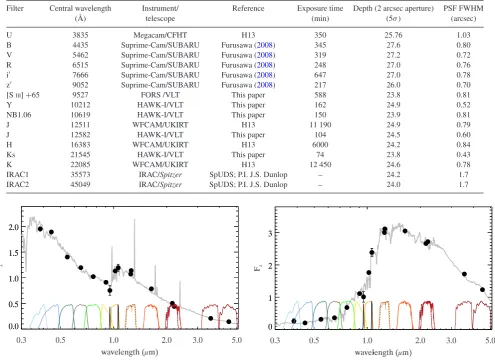
Figure 1. Examples of the SED coverage of a star-forming (left) and passive (right) protocluster galaxy. The solid black circles plot the measured photometry with 1σ uncertainties. On the bottom are the filter transmission curves of all bands used to derive photometric redshifts and galaxy properties. From left to right:U,B,V,R,i,z, [SIII]+65,Y, NB1.06,JWFCAM,JHAWK−I, H,Ks,K, IRAC1, IRAC2. The grey line shows the best-fitting galaxy template assigned to
the photometry by the SED fitting codeFAST. Multiple wavelength coverage around 1µm means the Balmer and 4000 Å breaks can be differentiated in the protocluster galaxies allowing precise photometric redshifts and accurate SED fitting.
basis of the astrometry, so the resulting images are matched to the H13 catalogue to within 0.1 pixel (0.01 arcsec). See Table1for details regarding final exposure time, seeing and image depth.
2.1.2 Narrow-band images bracketing the Balmer and 4000 Å breaks
The strongest spectral features for most of the protocluster galaxies are the Balmer (3686 Å) and 4000 Å breaks. The Balmer break is strongest for galaxies which are still forming some stars, whilst the 4000 Å break is most prominent in passively evolving galaxies (see Fig.1). High-precision photometric redshifts can be achieved if these features are well-sampled. We therefore obtained narrow-band images of the protocluster at 9530 Å and 10600 Å using the ESO/VLT FORS [SIII]+65 and HAWK-I 1.06µm (NB1.06) filters, which cover rest-frame 3630 Å and 4040 Å, respectively, for galaxies in the protocluster atz∼1.623. The Balmer break is tightly bracketed by the FORS [SIII]+65 andYfilters, whilst the 4000 Å break is sampled by theY, NB1.06 andJfilters (see Fig.1). The images were reduced using the publicly availableTHELIsoftware (Erben et al.2005; Schirmer2013). Flux calibration was achieved by
linearly interpolating the photometry of the H13 catalogue, and this catalogue was again used as the basis for the astrometric calibration. See Table 1for details regarding the exposure time, seeing and image depth.
2.1.3 Photometric catalogue
The higher resolution HAWK-IY,J,Ksimages were convolved to match the 0.81 arcsec PSF of the HAWK-I NB1.06 and FORS [SIII]+65 images. To do this we identified 12 bright, unsaturated and isolated stars in the images and created growth curves in each of the bands with apertures between 0.2 and 8 arcsec. The HAWK-I
Y,J,Ksimages were then convolved with a series of 16 Gaussians of
σ ranging from 1.5 to 3 pixels, and the growth curves remeasured in each of these smoothed images. For each band the Gaussian-smoothed image which resulted in the minimum-χ2when compared to the HAWK-I NB1.06 growth curves was identified as the best PSF-matched image. We tested the PSF-matching algorithm by comparing the growth curves of stars in the convolved images. We found that the growth curves of the PSF-matched images for all
at University of Nottingham on July 7, 2016
http://mnras.oxfordjournals.org/
[image:3.595.52.548.73.433.2]bands are within 1.5 per cent for apertures of 2-arcsec-diameter or larger.
Fluxes were then measured in the HAWK-I and FORS images within 2 arcsec diameter circular apertures on each position of the
K-selected catalogue of H13 using the IDLfunctionAPER. Uncer-tainties were taken to be the square root of the photon counts in the apertures plus the standard deviation of the total photon counts within 2-arcsec-diameter apertures placed in regions with no ob-ject detections. Obob-jects that fell within regions of the narrow-band images for which the exposure time was less than 30 per cent of maximum exposure were removed from the catalogues to obtain data of approximately the same quality across the field of view.
To concatenate the new photometry with the H13 catalogue we first applied aperture corrections to the new photometry to account for the different PSFs. Fluxes were measured in 2-arcsec-diameter apertures in the newJ-band HAWK-I image (smoothed to a PSF of 0.81 arcsec) and compared to theJ-band fluxes from 2-arcsec-diameter apertures in the H13 catalogue. TheJ-band filters of the HAWK-I and WFCAM instruments have very similar response curves (see Fig.1), so the flux of an object in both images should be the same. A linear fit to theJ-band fluxes showed that the new photometry was a factor of 1.06 times brighter than theJband of the H13 catalogue due to the sharper PSF, hence an aperture cor-rection of 0.94 was applied to the new photometry before it was concatenated with the H13 catalogue to form a complete photomet-ric catalogue. All photometry was corrected for Galactic extinction using the maps of Schlegel, Finkbeiner & Davis (1998), and we rejected bright stars. The final catalogue consists of 3019 galaxies.
2.1.4 Spectroscopic redshifts
At the time the protocluster catalogue was created spectroscopic redshifts had been obtained for 62 galaxies in the 50 arcmin2area that is covered by the above images. These redshifts were taken from Papovich et al. (2010), Tanaka, Finoguenov & Ueda (2010), Tadaki et al. (2012) and Santos et al. (2014). In addition to these published redshifts, there exists a collection of unpublished redshifts from the UDSz (Almaini et al., in preparation) and others (Simpson et al.
2012; Akiyama et al., in preparation, and Smail et al.2008), which are collated and available through the UDS website.2Sixteen of the 62 galaxies have spectroscopic redshifts that indicate they are part of the protocluster.
After the protocluster galaxies were selected, two new catalogues of this region were published. Tran et al. (2015) provide spectra for 69 galaxies in the overlapping area, some of which had previous spectroscopic redshifts. 3D-HSTis a slit-less grism spectroscopic survey which covers a ninth of the protocluster region that we imaged (Momcheva et al.2015). We did not use these catalogues to select the protocluster members, instead we use them to estimate the completeness and contamination of the derived protocluster sample in Section 3.1.
2.2 Identifying protocluster and field galaxies
2.2.1 Photometric redshifts
Photometric redshift probability distribution functions,P(z), were determined for each source by fitting spectral energy distribu-tion (SED) templates to the photometric data points using EAZY
[image:4.595.305.545.52.293.2]2http://www.nottingham.ac.uk/astronomy/UDS/data/data.html
Figure 2. A comparison of the derived photometric redshifts with the spec-troscopic redshifts for 62 galaxies (black points) from the original UDS spectroscopic sample. The red circles are spectroscopic redshifts from the targeted survey of Tran et al. (2015). Photometric redshifts are the mean after prior redshifts (parameter z_m2 outputted from theEAZYphotometric
redshift fitting code).
(Brammer, van Dokkum & Coppi2008). We applied the apparent
K-band magnitude prior that is distributed with theEAZYpackage. In addition to the six templates supplied with theEAZYpackage, we also add the seventh template created by H13 by applying a small amount of Small Magellanic Cloud-like extinction to the bluest template from theEAZYset. Given the broader PSF and the effects of confusion the IRAC photometry is very uncertain, so photo-metric redshifts were determined both with and without the IRAC data points, and no significant difference was seen in the redshift probability distribution functions.
Using the 62 spectroscopic redshifts as guides we made minor adjustments to the photometric zero-points to ensure we obtained the most accurate photometric redshifts. We show a comparison ofzphotversuszspecfor all 62 spectroscopically confirmed galaxies in Fig.2. The biggest outlier atzspec =1.75 is an X-ray source, hence it is likely that AGN emission is responsible for the poor template fit.
The accuracy of the photometric redshifts atz∼1.6 is twice as good compared to galaxies at other redshifts. The dispersion ofzphot
−zspecfor the 16 galaxies in the protocluster isz/(1+z)=0.013, which is half of that of the full sample. This is because the FORS [SIII]+65, HAWK-I 1.06µm andY-band images sample the Balmer and 4000 Å breaks at multiple points for galaxies at the protoclus-ter’s redshift (see Fig.1). This precision is similar to that achieved by the NEWFIRM Medium-Band Survey (NMBS; Whitaker et al.
2011) which augmented the optical and near-infrared photometry on the COSMOS and AEGIS fields with five medium-band images that ranged across the wavelength range typically spanned byY,J
andH. Here we show that a similar precision can be achieved for the galaxies in the protocluster with a smaller number of images be-cause the filters were optimally chosen to span across the important Balmer and 4000 Å breaks.
at University of Nottingham on July 7, 2016
http://mnras.oxfordjournals.org/
2.2.2 Selecting potential protocluster galaxies
We use the full redshift probability distribution function to deter-mine the likelihood of a particular galaxy being at the redshift of the protocluster. We determine the probability,P, of an object lying within a redshift range ofz±δzby integrating the redshift proba-bility distribution functions,P(z)dz, over the intervalzpc+δzto
zpc−δz. We first define two probabilities: (i)P2σis the probability
of the galaxy lying withinzpc±0.068 (i.e. within the 95 per cent confidence interval on the photometric redshifts), and (ii)P5σ = zpc ± 0.17. Then we use the spectroscopic redshifts to identify the best combination of these probabilities to select the potential protocluster members.
Selecting thebestsample of protocluster galaxies depends on the purpose of the sample. For example, a clean sample of protocluster galaxies with few contaminants will likely miss many of the proto-cluster galaxies, but a complete sample of protoproto-cluster galaxies will likely contain a large number of contaminants.
The compromise between a clean and complete protocluster galaxy catalogue is the ‘Goldilocks’ sample, comprising 143 galax-ies that match the criterionP5σ>90 per cent andP2σ>50 per cent. This Goldilocks sample was chosen to maximize the number of spectroscopically confirmed cluster members and minimize the number of interlopers. 15 out of 16 of the spectroscopically con-firmed cluster members are selected by this criterion, and only two spectroscopic interlopers (atz=1.536 andz=1.703) are included in the sample. We explore how the contamination and completeness of the selected protocluster candidates vary as a function ofP5σand P2σ in Section 3.1. Additionally, not all of the Goldilocks sample
will fall into the cluster byz =0, so this sample contains some non-protocluster members. The identification of these outliers is explored in Section 4.5.
Selecting protocluster members by integratingP(z) means that our galaxy sample will be biased against objects that have a broad
P(z). Due to the multiple sampling of the Balmer and 4000 Å breaks the broadness ofP(z) is approximately the same for both blue and red galaxies of a given magnitude. However, the broadness ofP(z) is correlated with the signal-to-noise ratio of the photometry. Since passive galaxies have lower mass-to-light ratios than star-forming galaxies, this biases our protocluster galaxy selection against low-mass passive galaxies because they are faint.
2.2.3 Selecting control field galaxies
The protocluster extends across the entire field of view covered by the narrow-band data, therefore we cannot select a sample of field galaxies at the same redshift as the protocluster using the sample criteria as defined above. Instead, we define a field sample which contains galaxies at redshifts slightly below and above the protocluster’s redshift.
The field sample is selected following the same criterion as the Goldilocks cluster sample, except that galaxies are selected around the redshiftszfield=1.45 and 1.81, rather than centred on the
clus-ter redshift. These redshifts are chosen as they are close to the protocluster but avoid contamination by the protocluster galaxies themselves. The narrow andYbands lie nearby to the Balmer and 4000 Å breaks at these redshifts, and so help constrain theP(z) dis-tribution, but the dispersion is approximately twice the dispersion of galaxies atz=1.62.
The effect of having a greater dispersion is that fewer control field galaxies are selected by the strictP(z)dzcriteria in comparison to the protocluster galaxies. Therefore, the control field is likely to have
a lower completeness than the protocluster field. The contamination level is likely to be similar as the interlopers in both samples have a similarP(z) dispersion.
The ideal control sample is selected from the same volume as the protocluster sample, and has similar levels of completeness and contamination, i.e. 89 per cent and 12 per cent, respectively (see Section 3.1). We use nine spectroscopic redshifts in the redshift range of the control field (1.4< z <1.5 and 1.76< z <1.86) to es-timate the completeness and contamination. Control field galaxies selected withP5σ>90 per cent andP2σ>50 per cent have a
com-pleteness of 67±27 per cent with no contamination. However, it is highly likely the contamination is at least the same as in the proto-cluster sample, but we do not have sufficient spectroscopic redshifts to measure this accurately. Thus, within uncertainties this criterion selects a control sample that has similar levels of completeness and contamination as the protocluster sample. It is therefore appropriate to use the sameP(z)dzcriteria to select the control sample.
To obtain a high completeness of 88 per cent we must relax the selection criteria toP5σ>70 per cent andP2σ >50 per cent. The
contamination of this sample is 43 per cent, which is far too high to robustly identify group structure, and even some spectroscopically confirmed protocluster members are selected in the ‘control field’ sample. For these reasons it is not appropriate to select a control sample using such relaxed parameters.
We therefore use the sameP(z)dzcriteria, which select a control sample with a similar level of contamination, and only slightly lower completeness. Comparing the different completeness rates we estimate that approximately 22 per cent of the galaxies are missing in the control field in comparison to the protocluster field. This missing fraction is highly speculative because we have so few spectra in the control field. However, we have examined each of our results in Sections 3 and 4 taking this into account and find that none of our conclusions is compromised if the completeness is reduced by 22 per cent.
The control field sample contains 88 galaxies in total, 78 of which lie atz∼1.45 and 10 lie atz∼1.81. The difference between the number of galaxies at the lower and higher redshift intervals is due to both cosmic variance and cosmic dimming, which results in a
m=0.6 mag difference between galaxies atz∼1.45 and 1.81. This field sample lies within a volume that is approximately twice the size of the Goldilocks protocluster sample.
The control field is selected from a comparatively small area and thus is subject to cosmic variance. Atz∼1.45 and∼1.81 the control field is 17 per cent denser than the UDS as a whole. All of the enhanced density is due to a larger density of galaxies atz
∼ 1.81 in the small field of view. In the entire UDS there is an underdensity of galaxies atz∼1.8 (H13), so the larger density in the small field of view used in this work may be more typical of the Universe.
2.3 Galaxy properties
We derived stellar masses of the galaxies by fitting theUto 4.5µm photometry with stellar population models using the SED fitting codeFAST(Kriek et al.2009). The photometric catalogue was first scaled by theK-band ratio of flux measured using theSEXTRACTOR BEST aperture to that measured in a 2 arcsec aperture. The BEST flux is taken as the SEXTRACTOR AUTO flux when no neighbour biases the results by more than 10 per cent, otherwise it is taken as the ISOCOR flux (Bertin & Arnouts1996). To fit the photometry we use Bruzual & Charlot (2003) stellar population templates with solar metallicity, exponentially declining star formation histories
at University of Nottingham on July 7, 2016
http://mnras.oxfordjournals.org/
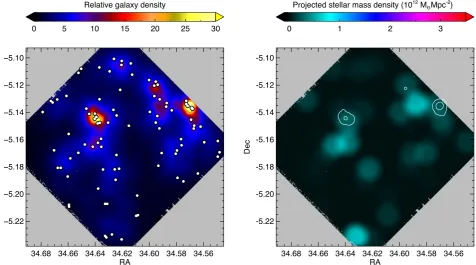
Figure 3. Left: the 2D distribution of the galaxy density in the control field. The white circles mark the location of the galaxies and the background colour scale indicates the relative galaxy density determined by the cumulative distance to the five nearest neighbours. Right: the projected stellar mass distribution in units of 1012 M
Mpc−2. The white contours mark the galaxy density as shown in the left panel. The control field is twice the volume of the protocluster.
(SFR=exp(−t/τ)), the Kriek & Conroy (2013) average dust law (withEb=1 andδ=0.1) and we assume stars are formed with
the initial mass function of Chabrier (2003). Throughout the fitting process the redshifts of the protocluster members were fixed toz
=1.6233 whilst the redshifts of the field galaxies were fixed to the mean after prior redshifts output fromEAZY.
The observed SFRs were measured from rest-frame UV luminosities using the Kennicutt (1998) conversion from 2800 Å (assuming a Chabrier IMF): SFR( M yr−1)=8.24× 10⁻²⁹L
2800( erg s−1Hz−1). To measureL2800we use the mean after prior redshifts (for field galaxies) or fixed z= 1.6233 (for clus-ter members) to declus-termine the filclus-ter that has the closest central wavelength to 2800 Å and then add ak-correction based on linear interpolation taking into account the UV slope. In this work we are only interested in the distribution of galaxies of a certain observed SFR, so we make no correction for dust extinction.
2.4 Identifying substructure
2.4.1 Measuring local environment
Muldrew et al. (2012) showed that the best measures of internal halo properties were nearest neighbour and Voronoi tessellation methods. Although the protocluster studied here does not consist of only one halo, the same principle applies as we wish to identify groups within a large high-density region.
We calculated the local environment of each location in the field of view using several methods: projected Voronoi tessellation; third, fifth and eighth projected nearest neighbour; cumulative distance from the first to fifth and tenth nearest neighbours. We adapted the original definition of the cumulative distance to thennearest
neighbours (Cowan & Ivezi´c2008) to be a measure of the projected environment:
φn= 1
ρn
i=0r 2 i
, (1)
whereriis the projected distance to neighbouriandρis the total
number of galaxies divided by the total area of the field-of-view. All of these methods are affected by edge effects, which means galaxies close to masked regions and the edge of the detector have unreliable environment measurements. We found there were strong correlations between all of these environmental measurements.
The best measure was the cumulative projected distance to the five nearest neighbours,φ5, since this method improves the robustness of the nearest neighbour measures by minimizing distortions by interlopers. Appendix B of Ivezi´c et al. (2005) describes in detail the improvement gained from using the distances to allnnearest neighbours compared to only the distance to thenth neighbour. The choice of fifth nearest neighbour was regulated by survey depth;n
was chosen to be the largest possible number that is small enough so we can still identify structure on the scale of a few hundred kpc.
2.4.2 Maps of galaxy and stellar mass density
Maps of the projected galaxy density of the protocluster and control field were created by measuringφ5for each 0.25 arcsec pixel of 7.5×7.5 arcmin2field of view. Maps of the projected stellar mass density were created by measuring the stellar mass density within 30 arcsec of each 0.25 arcsec pixel centre, and then smoothed with a boxcar average of 100 pixels (25 arcsec) width. Stellar mass density maps were scaled to display the stellar mass per Mpc2(Figs3,5 and6).
The galaxy formation models of Henriques et al. (2015) show us that stellar mass is a good tracer of the underlying dark matter, so
at University of Nottingham on July 7, 2016
http://mnras.oxfordjournals.org/
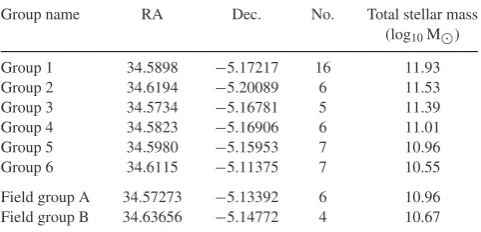
Table 2. A list of the groups within the Cl 0218.3−0510 protocluster and control field. Columns 2 and 3 list the RA and Dec of the group. Columns 4 and 5 lists the number and total log10stellar mass of galaxies in each group.
The field groups are similar to groups 4, 5 and 6 in the protocluster which are compact and have relatively low masses.
Group name RA Dec. No. Total stellar mass
(log10M)
Group 1 34.5898 −5.17217 16 11.93
Group 2 34.6194 −5.20089 6 11.53
Group 3 34.5734 −5.16781 5 11.39
Group 4 34.5823 −5.16906 6 11.01
Group 5 34.5980 −5.15953 7 10.96
Group 6 34.6115 −5.11375 7 10.55
Field group A 34.57273 −5.13392 6 10.96 Field group B 34.63656 −5.14772 4 10.67
the stellar mass maps give the most accurate representation of the distribution of dark matter in the protocluster. However, the reso-lution of the maps we can create is poor (approximately 20 arcsec or∼0.17 Mpc) and only very massive groups can be identified in these maps. The filaments that surround the groups of a protocluster may be narrow and will be missed in our stellar mass density maps. The galaxy density maps are more useful for locating the lower mass groups and to visualize the relatively low-density filaments. In addition to this complication, we must remember that the stellar mass of a halo does not linearly correlate with dark matter mass. Atz=1.62, models predict that the stellar mass of a central galaxy increases approximately linearly with halo mass until the mass of the galaxy reaches 1010.5M
(e.g. Wang et al.2013). Galaxies with higher stellar masses have a higher total-to-stellar mass ratio. So, a small group of low-mass galaxies may trace a lower dark matter halo mass than a single massive galaxy of the same total stellar mass.
In Fig.3we show the projected galaxy and stellar mass density maps of the control field to provide a comparison for the protoclus-ter distribution shown in the following section. The control field comprises a region with twice the volume of the protocluster (a redshift interval both in front and behind the protocluster), so we have halved the projected stellar mass density to allow for a direct comparison with the protocluster.
The control field galaxy density map reveals two dense galaxy groups (see Fig.3and Table2). One of the groups lies very close to the edge of the field of view, which illustrates that using the
φ5allows us to identify galaxy groups up to 13 arcsec from the edge of the 7.5 arcmin field of view. The projected stellar mass density map shows a very different picture: the map is smooth which implies there is no significant structure in the projected dark matter distribution. The dense groups in the field therefore trace relatively low dark matter mass haloes, or are line-of-sight projections of galaxies masquerading as groups. The regions of highest stellar mass density are not co-spatial with the location of the galaxy groups, but rather near regions that host the most massive galaxies that are not obviously in groups.
2.4.3 Defining groups
Since the environmental parameter we define is a relative mea-surement that depends on the redshift and survey depth, we use the control field sample to define the value ofφ5that best defines which galaxies belong to groups and which lie in between the groups. We visually inspect theφ5maps and define separate groups as regions
where the galaxy density peaks. Through trial-and-error we find the best divide of field and group galaxies for the control field sample occurs atφ5=13. This boundary selects groups on the scale of a few hundred kpc, which is the scale of small collapsed galaxy groups expected at this redshift.
Approximately 90 per cent of the field galaxies haveφ5<13. The 10 control field galaxies withφ5>13 lie within two highly concentrated groups of four and six galaxies within 30 arcsec di-ameter apertures. We then apply the sameφ5>13 cut to define group galaxies within the protocluster sample. The difference in lu-minosity completeness due to the different redshifts does not matter becauseφ5is defined as the relative density within a particular sam-ple. The dividing line of overlapping groups is taken to be where
φ5is a minimum between the groups.
The selection of galaxies defined as group members does not strongly depend on the choice of density estimator, or the choice of the number of nearest neighbours. This is because the relative density of each galaxy is very similar fornbetween 3 and 10. Since the boundary between group and intergroup galaxies is not absolute, but rather is defined as the density that selects the two groups in the control field, we select approximately the same galaxies as group galaxies regardless of the choice ofn. We tested our results for
nranging between 3 and 8 and found no significant difference in the number, size or total stellar masses of the groups identified in the protocluster. Therefore our results and conclusions are robust against changes in the choice ofn. However, forn>10 the spatial resolution of the density map is not sufficient to pick out groups on the scale of a few hundred kpc in either the control field or the protocluster.
3 R E S U LT S
3.1 Completeness and contamination level of the protocluster galaxy sample
We use the spectroscopic cluster sample of Tran et al. (2015), and the grism sample of Momcheva et al. (2015) to determine the com-pleteness and contamination level of the protocluster sample. Tran et al. (2015) present data on 109 good quality spectra of galaxies in and near Cl 0218.3−0510. The targeted galaxies were bright and priority was given to galaxies with photometric redshifts that lay close to the cluster’s redshift. The images presented in this work only cover part of the region from which the spectra of Tran et al. (2015) were obtained, so only 69 spectroscopically observed galaxies are covered by our images. All redshifts are determined through line emission so all spectroscopically measured objects host an active galactic nucleus or significant star formation.
Tran et al. (2015) defineclustermembers as those which have a redshift within 1.612< z <1.635. The cluster is defined as the main halo of the protocluster, whereas protocluster galaxies may lie tens of cMpc beyond the main protocluster halo and can have relative velocities up to 2000 km s−1 (Contini et al.2016). We therefore define protocluster galaxies as those with redshifts in the interval 1.59< z <1.67. There are 35 spectroscopically confirmed galaxies in this redshift interval and in the area we survey. We identify 31 of these 35 galaxies as protocluster candidates using our photometric redshift method, resulting in a completeness of 89±5 per cent.
We selected 35 out of 69 spectroscopic galaxies in the Tran et al. (2015) sample as protocluster candidates using our method. One of these has an ambiguous spectroscopic redshift as it is defined as a cluster member withz=1.634 by Tanaka et al. (2010), but defined as an interloper by Tran et al. (2015) (although no redshift is
at University of Nottingham on July 7, 2016
http://mnras.oxfordjournals.org/
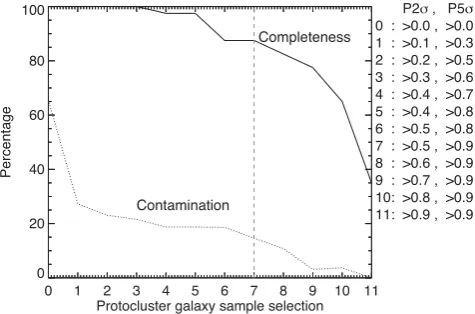
Figure 4. The completeness and contamination of the selected protocluster galaxy sample for variousP5σandP2σselection parameters. The optimal values for identifying protocluster structure occur when contamination is 15 per cent and completeness is80 per cent. This occurs when 0.8
<P5σ<0.9 and 0.5<P2σ<0.6. The ‘Golilocks’ sample (marked by the dashed vertical line) lies in the middle of this range.
published). From the rest of the 34 galaxies, four have spectroscopic redshifts outside 1.59< z <1.67 and are therefore contaminants. Therefore the contamination rate of our protocluster catalogue is only 12±5 per cent.
The galaxies with spectra span a similar range of stellar mass and i magnitude as the bulk of the photometric-redshift selected protocluster sample (9.2<log M/M<10.7 and 23<i<25.5) so the contamination rate of 12 per cent is likely to be correct for most mass and luminosity bins in our protocluster catalogue. The completeness, however, is a strong function of galaxy luminosity and type (Hatch et al., in preparation). The spectroscopic success rate is strongly biased towards emission line sources, so the com-pletion rate of 89±5 per cent should be considered the percentage of star-forming or active galaxies with log M/M>9.2 that can be detected.
There is a bias in comparing our catalogue to the Tran et al. (2015) sample because their sample was selected for spectroscopic followup based on photometric redshifts. Neither our sample nor the Tran et al. (2015) sample would locate galaxies whose SEDs result in erroneous photometric redshifts. So our completeness may be overestimated. We therefore compare our sample to the grism survey of 3D-HST(Momcheva et al.2015), who make no preselec-tion based on photometric redshifts. 40 of our protocluster galaxy candidates have redshifts derived from a fit to both the photometric and grism data, of which only five do not have 68 per cent confi-dence intervals that spanz=1.6233 and are thus interlopers. So the contamination rate is 13±5 per cent.
We can select protocluster candidates from the 3D-HST cata-logues using the maximum likelihood redshift parameter as those which satisfy 1.59< z max grism <1.67. Using this method we find 24 protocluster candidates which are bright enough to be se-lected by our photometric redshift method and data. 21 of these are selected as protocluster members. So the completeness is 88± 7 per cent. It is reassuring that the completeness and contamination rates derived from two different data sets are in perfect agreement. In Fig.4we use all spectroscopically confirmed galaxies to show how the completeness and contamination change as the protoclus-ter galaxy selection parameprotoclus-ters (P5σ andP2σ) are varied. Neither
the completeness and contamination vary greatly when the param-eters range from P5σ > 0.8 andP2σ > 0.5 to P5σ > 0.9 and
P2σ > 0.6. Within this range, the number of protocluster
galax-ies selected vargalax-ies only by±25, and all of the following results and conclusions are robust to this small change in the protocluster galaxy sample.
By choosing stricter or more relaxed selection criteria one can select either a cleaner sample or more complete sample of protoclus-ter galaxies. Both of these samples are not appropriate for mapping the protocluster structure. Large numbers of interlopers smooth out the protocluster structure, so the groups are no longer pronounced when the selection parameters are less stringent thanP5σ>0.8 and P2σ>0.4. On the other hand, there are too few galaxies to identify
groups when the parameters are more stringent thanP5σ>0.9 and P2σ >0.7. The optimal values for identifying protocluster struc-ture occurs when the interloper fraction is less than approximately 15 per cent and the completeness (for bright star-forming galaxies) is more than 80 per cent. For our data this occurs when 0.8<P5σ <0.9 and 0.5<P2σ<0.6.
3.2 The structure of the Cl 0218.3−0510 protocluster
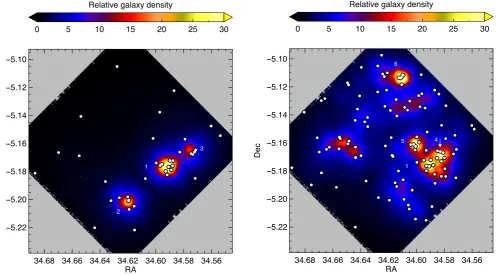
The structure of Cl 0218.3−0510 is displayed in Fig.5. The struc-ture of this protocluster differs from the control field in two dis-tinct ways. First, the protocluster contains a greater number of galaxy groups, which generally contain much more stellar mass than the control field groups. Secondly, the galaxy density between the groups is much higher. Both of these structural features signify the presence of the protocluster.
3.2.1 Protocluster galaxy groups
A key feature of the structure of this protocluster is the presence of several galaxy groups that are significantly more massive than those found in the control field. The galaxy density of each of the groups is not much greater than the control groups, but the stellar mass density is significantly larger, and they appear prominent in maps of projected stellar mass density. The galaxies in the protocluster groups are, on average, more massive than those in control field groups.
The largest and most massive group (group 1) lies at the location of the tentative 4.5σdetection of X-ray emission reported by Tanaka et al. (2010). The total mass of this group is estimated from the X-ray luminosity to be 5.7[±1.4]×1013M
, which is consistent with the mass estimated from the velocity dispersion ofσgroup 1= 254±50 km s−1 (Tran et al.2015). This dense core is surrounded by five additional galaxy groups, which are listed in Table2. The separate groups can be more easily identified in Fig.6. Group 2 also has a weak 1.5σX-ray detection reported by Tanaka et al. (2010).
Groups 5 and 6 are compact groups with very high galaxy densi-ties, but they contain relatively little stellar mass and are similar to groups A and B found in the control field. As this type of low-mass group is found in both environments it is unlikely that these struc-tures are unique signastruc-tures of the protocluster. By contrast, groups 1–4 are very different types of structures to the low-mass groups in the control field. These groups contain more stellar mass than is found in either of the control field groups, and they are prominent features in the stellar mass density maps. Since the ratio of stellar to dark matter mass is expected to change once galaxies exceed 1010.5M
, it is likely that the dark matter mass distribution in this protocluster is even more skewed towards these four groups than the stellar mass density map suggests.
Many algorithms for finding protoclusters concentrate on lo-cating large galaxy overdensities. Such overdensities are prone to
at University of Nottingham on July 7, 2016
http://mnras.oxfordjournals.org/
Figure 5. Left: the distribution of galaxies within Cl 0218.3−0510. The background colour indicates the relative galaxy density,φ5. The protocluster structure
consists of six galaxy groups, the largest of which is the nascent cluster (group 1), surrounded by a dense sea of intergroup galaxies. The properties of groups 1–6 are given in Table2. Right: the distribution of stellar mass within the protocluster. The colour indicates the projected stellar mass density in units of 1012M
Mpc−2. The white contours mark the galaxy density as shown in the left panel. The protocluster is dominated by the largest group and the two flanking
high-mass groups (2 and 3). The total stellar mass in the groups (5 and 6) is relatively low and does not appear to be denser than the typical intergroup density within the protocluster.
Figure 6. The galaxy density of red (left) protocluster galaxies withz−J>1.3, and galaxies with directly observed SFR>5 Myr−1 (right). The
background colour scale indicates theφ5density measurement and the white circles pinpoint the location of protocluster galaxies with red colours or high
SFRs.
at University of Nottingham on July 7, 2016
http://mnras.oxfordjournals.org/
[image:9.595.53.551.403.678.2]detrimental line of sight projection effects and so protocluster can-didate catalogues are plagued with contaminants. The maps pre-sented here suggest that protoclusters may be more prominent as stellar mass overdensities rather than galaxy overdensities.
3.2.2 Protocluster intergroup galaxies
A distinct feature of the protocluster is the high galaxy and stellar mass density in between the groups. We refer to these galaxies as the ‘intergroup’ galaxies. The projected density of intergroup galaxies is 2.5 times greater than in the control field.3Unlike the overdensity in the groups, there is no enhancement of the stellar mass density over the galaxy density: the projected stellar mass density of the protocluster as a whole is only a factor of 2 greater than the control field. These results are robust against changes to the choice of the density estimator, or the value ofnnearest neighbours. The enhancement in galaxy density does not lie immediately outside the groups, but rather is evenly spread across all of the intergroup region.
Most of the protocluster galaxies lie between the groups. Within the limited field-of-view 11 per cent of the protocluster galaxies are in the most massive group, 22 per cent in the additional groups and the remaining 67 per cent reside between the groups. The fraction of galaxies in the most massive group is an upper limit as there are likely to be additional protocluster galaxies beyond the observed window. Protoclusters extend over several Mpc so the observations presented here are not likely to encompass the entire protocluster structure (Muldrew et al.2015).
3.3 Biased views of protoclusters from observing only galaxy subsets
Protoclusters are commonly observed by selecting only one type of member galaxy such as line-emitting galaxies (Hayashi et al.
2012; Koyama et al.2013) or red galaxies (Kajisawa et al.2006; Hatch et al. 2011a). In Fig.6we explore what the structure of Cl 0218.3−0510 looks like when we limit our observations to only red protocluster members (z−J>1.3), or star-forming members with an observed SFR>5 Myr−1. The red population includes passive galaxies and star-forming galaxies with significant amounts of dust obscuration (AV > 1 mag). The star-forming population
is akin to unobscured populations such as Lyman break galaxies, and Lyα, [OII] or Hαemitters. The structures of the protocluster revealed by the two types of galaxies are disparate.
The most massive group appears in both maps, and both types of galaxies identify some of the other galaxy groups. The red galaxies locate the massive groups (1, 2 and 3), but do not find the lower-mass groups 4, 5 and 6. The converse is true for the star-forming galaxies, which locate groups 1, 4, 5 and 6 but do not identify the massive groups 2 and 3. It is therefore possible that emission line maps of protoclusters are unable to locate some of the most massive groups in the protocluster. Red galaxies do a poor job of tracing the intergroup galaxies, whereas the structure of the intergroup filaments is well-traced by star-forming protocluster galaxies.
Comparing the maps of Fig.5to Fig.6illustrates that studying the protocluster with only one type of galaxy can severely bias our view of the protocluster. It is likely that galaxy groups would be
3If the control field sample is 22 per cent less complete than the protocluster
(see discussion in Section 2.2.3) then the projected intergroup density in the protocluster is two times that of the control field.
entirely missed by studying the protocluster in either red or star-forming galaxies, and the red galaxies do a poor job at locating the enhanced density of intergroup galaxies. Protoclusters are there-fore far more complex structures than their lower-redshift cluster descendants, whose structure can be traced well by galaxies that lie on a red sequence in colour–magnitude space. Galaxies are still rapidly forming in protoclusters and galaxy formation appears to be unevenly distributed. To view the complete structure and see the full complexity of the protocluster we must identify all types of protocluster galaxies.
4 D I S C U S S I O N
Comparing observations of protoclusters and clusters at different redshifts can reveal how clusters form and galaxies evolve, but only if we can statistically link protocluster ancestors and cluster descen-dants that follow the same evolutionary paths. Clusters in the local Universe come in a variety of sizes, so to trace cluster formation it is imperative that we are able to distinguish the progenitors of different types of clusters in their protocluster state.
The crux of the problem is determining what the end product of a protocluster will be and how it will evolve to get there. Clusters form by the accumulation of galaxies from the field and by merging with smaller groups. This process is stochastic so the most massive clusters at any observed redshift will not necessarily become the most massive clusters by the present day (although they are statis-tically more likely to do so). By observing a large fraction of the Cl 0218.3−0510 protocluster we have determined what material is available to grow the cluster, and where that material is located. The structure of the protocluster gives us additional information to constrain the future evolution of the forming cluster. In this section we show how largeN-body cosmological simulations can be used to determine a protocluster’s evolution and present-day mass from observations of the protocluster structure.
4.1 Millennium Simulation counterparts to Cl 0218.3−0510
We construct a sample of simulated galaxy protoclusters that have similar structural properties to Cl 0218.3−0510 using the Henriques et al. (2015) semi-analytic model applied to the Millennium Simula-tion (Springel et al.2005) scaled to thePlanckCosmology (Planck Collaboration XVI2014). The simulated box is periodic of side length 480 Mpch−1whereh=0.673. The closest snapshot to the observations of Cl 0218.3−0510 wasz=1.613. We first select main haloes with the same mass as the X-ray-derived mass of the main halo of Cl 0218.3−0510 by identifying 652 dark matter haloes, in this snapshot, with masses in the range 4.3<M/1013M
<7.1 that were the main haloes of their cluster formation tree. We then selected a 10.2×10.2×34.0 cMpc box around these haloes and identified 40 Cl 0218.3−0510-like protoclusters as the subset whose dark matter haloes within this box have mass ratios similar to the stellar mass ratio of the groups in Cl 0218.3−0510, i.e. 1 : 0.40 : 0.29 : 0.12 : 0.11: 0.04, with a range of±0.1 in each of these ra-tios. We chose the 10.2×10.2×34.0 cMpc box size because the observed field of view is 10.2 cMpc at the protocluster’s redshift, and we chose a 34 cMpc depth because the simulated galaxy over-density in this volume is similar to the observed galaxy overover-density of Cl 0218.3−0510. It is reasonable to use the ratio of the stellar masses as a proxy for the total mass ratios since the total stellar mass of galaxy groups is proportional to the virial mass in the model of Henriques et al. (2015).
at University of Nottingham on July 7, 2016
http://mnras.oxfordjournals.org/
Figure 7. Distribution of 109M
galaxies within the 10.2×10.2×34.0 cMpc box around one of the 40 Millennium Simulation protoclusters that have similar structural properties to Cl 0218.3−0510. The left plot shows the distribution in the X–Y plane, whilst the right plot shows the Z–Y plane distribution. Group galaxies are pink whilst intergroup galaxies are black. Filled circles are galaxies that will merge to form the cluster byz=0 and the open circles are those that do not fall in by the present day and are therefore contaminants to the protocluster sample atz∼1.6.
Fig.7shows the galaxy distribution of one of the 40 simulated protoclusters with a similar structure to Cl 0218.3−0510. Similar to the real 2D distribution of Cl 0218.3−0510, the protocluster consists of a small number of groups enveloped by intergroup galaxies which appear to have a random distribution across the whole field. Viewing the intergroup galaxies in the Z-Y plane allows us to see the wider structure. Large numbers of galaxies surround the groups and the protocluster core is characterized by a high density of these galaxies. Protoclusters in simulations are large structures, with the most massive having galaxies spread across 50 cMpc (∼32 arcmin) at
z∼2. However, the groups are very centrally concentrated with 77 per cent of groups residing within±5 cMpc of the most massive halo. The intergroup galaxies are still centrally concentrated, but less so than the groups, with 52 per cent of intergroup galaxies residing within the central 10 cMpc. To determine the structure of the protocluster it is important to observe all of the galaxy groups that make up the protocluster, whereas the intergroup galaxies are of less importance. So to measure the protocluster structure it is sufficient to obtain precise photometric redshifts over a small field of view of approximately 5–10 arcmin radius centred on the most massive protocluster group.
Throughout the rest of this article we refer to ‘Cl 0218.3− 0510-like protoclusters’ and ‘protoclusters with a similar structure to Cl 0218.3−0510’ as protoclusters in the simulations which contain dark matter haloes with the ratio 1 : 0.40 : 0.29 : 0.12 : 0.11: 0.04 within a 10.2×10.2×34.0 cMpc box.
In Section 2.2.3 we discussed the possibility that the control field sample may be less complete than the protocluster by∼22 per cent due to the higher photometric redshift errors at redshifts away from
z = 1.62. If the control field has an additional incompleteness to this level the depth of the protocluster increases from 34 to 41 cMpc. This does not affect the following analysis since our selection of Cl 0218.3−0510-like protoclusters depends only on the galaxy groups, and most of the groups lie within the central
±5 cMpc of the protocluster. We obtain almost identical results in the following discussion whether the protocluster depth is 41.0 or 34.0 cMpc.
Observations only provide estimates of galaxy properties, such as stellar mass. Therefore, in any observational survey the ob-served stellar mass distribution may be systematically biased, or have a wider distribution than the simulated stellar mass distribu-tion. Our method for identifying Cl 0218.3−0510-like protoclusters removes much of this bias by using the ratio of total stellar masses of the groups to determine the ratio of dark matter halo masses.
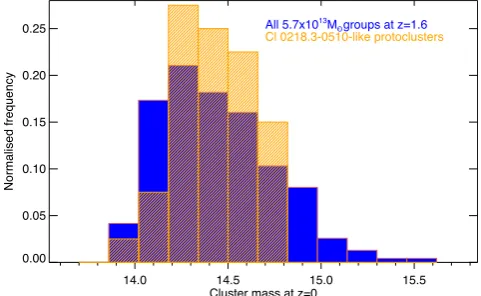
Figure 8. The blue histogram shows the range ofz=0 cluster masses from all 652 main haloes withM∼1013.6M
atz=1.61. The orange hatched histogram shows the range of present-day masses from the 40 simulated clusters with the same group distribution as in Cl 0218.3−0510.
Our method therefore crucially relies on the assumption that stel-lar mass directly traces dark matter, and that the total mass of group 1 is well constrained, but our method is not affected by the bias between observed and simulated galaxy properties.
4.2 Thez=0 mass of Cl 0218.3−0510
By mapping the structure of the protocluster we have constrained the allowed growth rate of the cluster and therefore limited the allowed range of present-day cluster mass (Mz=0). In Fig.8we show the distribution ofMz=0for all 652 dark matter main haloes in the Millennium Simulation atz=1.61 with masses in the range 4.3<M/1013M
<7.1 in blue, and those 40 protoclusters with the same structure as Cl 0218.3−0510 in orange. Without taking into account the protocluster structureMz=0is poorly constrained and the present-day cluster mass may be anything in the range of 1013.9−15.5M
.
The 40 simulated Cl 0218.3−0510-like protoclusters have a nar-rower range ofMz=0. All of the Cl 0218.3−0510-like protoclusters become clusters with masses in the range 1.0<M/1014M
<6.6. The median present-day mass of Cl 0218.3−0510-like descendants is 2.7×10¹⁴M
, therefore it is likely that Cl 0218.3−0510 will become a cluster with a slightly lower mass than the Virgo cluster (4.4<M/1014M
<7.4; Hoffman, Olson & Salpeter1980) by the present day.
at University of Nottingham on July 7, 2016
http://mnras.oxfordjournals.org/
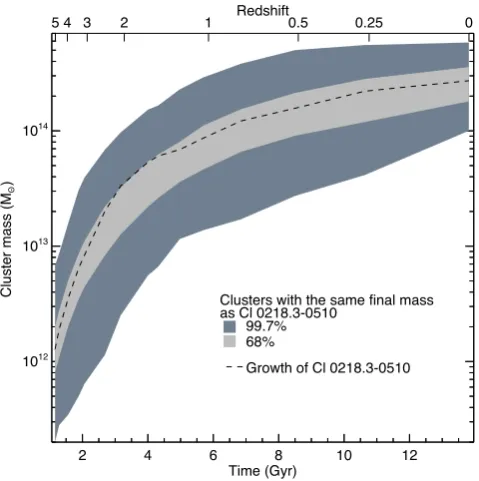
[image:11.595.308.549.255.403.2]Figure 9. The range of evolutionary paths taken by Cl 0218.3−0510-like protoclusters (orange), and all dark matter main haloes with masses in the range of 4.3<M/1013M<7.1 (blue). The shaded region encompasses 99 per cent of all possible evolutionary sequences. The structure of the Cl 0218.3−0510 protocluster allows us to estimate the future growth of the cluster.
This result relies on a number of assumptions: (i) that the initial mass of Cl 0218.3−0510 is 4.3<M/1013M
<7.1; (ii) that our method unambiguously locates galaxy groups; and (iii) that stellar mass exactly traces dark matter mass in the groups. Of these three assumptions, the present-day mass of Cl 0218.3−0510 most criti-cally depends on whether we know the mass of the main halo atz= 1.62. Independent analyses of X-ray data from bothChandraand
XMM–Newton(Tanaka et al.2010; Finoguenov et al.2010; Pierre et al.2012) and dynamical velocity dispersion estimates (Tran et al.
2015) are all consistent with our assumed initial mass; however we caution that estimates for group and cluster masses at this redshift are highly uncertain.
4.3 Tracing ancestor protoclusters and descendant clusters
Mapping the structure of the protocluster atz∼1.6 allows us to estimate its state at all redshifts. In Fig.9we show the evolution of the 652 main dark matter haloes in the Millennium Simulation with 4.3<M/1013M
<7.1 in blue, and for the Cl 0218.3−0510-like simulated protoclusters in orange. Based on this, the most rapid period of growth for Cl 0218.3−0510 occurs atz >2. In 2.5 billion years the main halo of the protocluster grows by a factor of 20–100. Its growth from the observed epoch ofz=1.6 to the present is more muted, with only a factor of 2–8 increase in mass. The clusters that grow more atz < 1 than Cl 0218.3−0510 are either surrounded by more massive haloes or have a larger number of nearby haloes. Approximately 60 per cent of the faster growing clusters have more massive second-ranked haloes, and 50 per cent have more mass in their six most massive haloes compared to Cl 0218.3−0510.
[image:12.595.44.285.59.296.2]The structure of Cl 0218.3−0510 allows us to improve our esti-mates for its descendant mass at all redshifts, in particular it strongly constrains the upper limit of its mass at all redshifts. However very
Figure 10. A comparison of the evolutionary growth of Cl 0218.3−0510 (dashed line) with that of typical Virgo-like clusters that have final masses in the range 1<M/1014M<6 (dark grey region). The light grey region marks the evolutionary growth of the most typical 68 per cent of protoclus-ters. Cl 0218.3−0510 is typical of Virgo-like clusters, but contains slightly more mass in its main halo than is usual.
little improvement is made in constraining the mass of its ancestor protoclusters. The future growth of Cl 0218.3−0510 is constrained because we are able to estimate how much material is available for future consumption. But the wide-field protocluster structure does not relay any information about its main halo mass prior to the epoch of observation, so we are unable to constrain the ancestor protoclusters that will form Cl 0218.3−0510.
These results demonstrate that the structure of a protocluster can help constrain its evolutionary path. By mapping the structures of a large sample of protoclusters and clusters across 5> z >0 we can place the (proto)clusters in evolutionary sequences that describe how clusters form. If we can reliably determine which galaxies in each observation will become cluster members, then the sequences of evolving clusters also provide samples of galaxy ancestors and descendants for a closed system of galaxies. Such sequences are powerful tools for studying the evolution of galaxies.
4.4 Is Cl 0218.3−0510 a typical ancestor of Virgo-mass clusters?
In Section 4.2 we found that Cl 0218.3−0510 is likely to become a cluster of similar mass to Virgo by the present day. We can therefore ask the question, ‘do the progenitors of Virgo-like clusters all look like Cl 0218.3−0510?’ To answer this question we extracted from thePlanck-scaled Millennium catalogue all dark matter haloes at
z= 0 with virial masses in the range 1<M/1014M
<6. We selected from this a subsample that matched thez=0 mass distri-bution of Cl 0218.3−0510 as shown in Fig.8and constructed their evolutionary paths, which we display in Fig.10.
The evolutionary growth of Cl 0218.3−0510 is not atypical of Virgo-like clusters: its most likely evolutionary path is consistent with many clusters that end up with similarz=0 masses. However,
at University of Nottingham on July 7, 2016
http://mnras.oxfordjournals.org/
Figure 11. The probability of galaxies within Cl 0218.3−0510-like protoclusters in the Millennium Simulation becoming cluster members byz=0.
the main group atz=1.62 is larger than average, with 77 per cent of clusters having lower masses at this redshift. This means that a larger fraction of the galaxies in Cl 0218.3−0510 will spend a longer time in the dense group environment than is typical for such clusters, and environmental quenching of star formation would have started early for a larger fraction of its members. A signature of this early assembly may be visible in the stellar populations of its descendant clusters as we would expect the mean stellar age of its member galaxies to be older than most clusters of similar mass.
4.5 Which of the Cl 0218.3−0510 galaxies will become cluster galaxies
A major issue in photometric redshift surveys of galaxy clusters or protoclusters is the contamination level by line-of-sight interlopers. By sampling the Balmer and 4000 Å breaks of the protocluster galaxies, we were able to obtain precise photometric redshifts, and the contamination level due to photometric redshift uncertainty is only 12 per cent. However some galaxies within the volume of the protocluster do not fall into the cluster byz=0 (Contini et al.2016; Muldrew et al.2015). Therefore not all galaxies that have similar redshifts as the main halo will fall into the cluster, and some of the ‘protocluster galaxies’ selected in Section 2.2.3 will not be true cluster progenitors.
We use thePlanck-scaled Millennium Simulation with the semi-analytic model of Henriques et al. (2015) to determine which of Cl 0218.3−0510’s galaxies will become cluster members byz=0. Using the 40 Cl 0218.3−0510-like protoclusters atz=1.61 in the Millennium Simulation we select all galaxies within boxes of 10.2
×10.2×34 cMpc volume around the main haloes, and then follow their evolution to determine if they become cluster members.
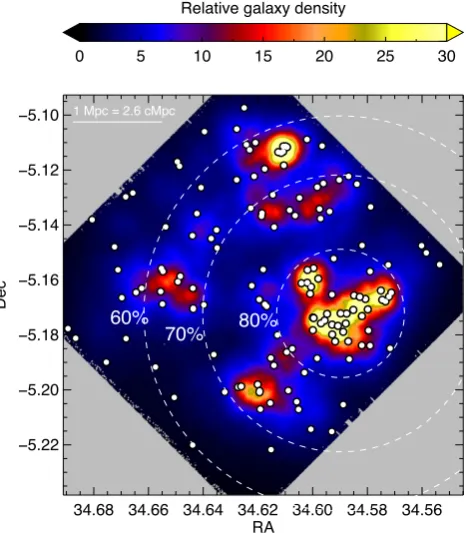
In Fig.11we show the probability a galaxy will become a cluster member if it lies at a certain projected radius from the main halo. Although there is a large dispersion between radius and projected radius, there is still a strong correlation between projected radius and the probability a galaxy will fall into the cluster. Galaxies within 2 cMpc of the main halo have more than 80 per cent chance of becoming cluster galaxies, whereas those that lie more than 6 cMpc away have only a 60 per cent chance of making it into the cluster.4
4If the control field sample is 22 per cent more incomplete than the
[image:13.595.313.548.57.324.2]proto-cluster sample (see Section 2.2.3) then the observations probe a protoproto-cluster
Figure 12. A map of Cl 0218.3−0510 with dashed circles marking where 80, 70 and 60 per cent of the galaxies are likely to become cluster members byz=0. White circles mark galaxies, and the background colour scale indicates the relative galaxy density determined as the cumulative distance to the five nearest neighbours.
The chance of becoming a cluster member also depends on whether the galaxy lies within a group or between the groups. In Fig.11we divide the galaxies into those which lie in groups more massive than the smallest group of Cl 0218.3−0510, and those which lie in smaller groups or between the groups (labelled as in-tergroup galaxies). At all radii group galaxies are approximately 10 per cent more likely to become cluster galaxies than intergroup galaxies, but for both subsets the probability of becoming a cluster member diminishes with increasing projected distance.
In Fig.12 we mark the probability that the Cl 0218.3−0510 galaxies will become cluster members byz=0. Galaxies in group 1 are already cluster members. Galaxies in groups 3, 4 and 5 have more than 85 per cent chance of becoming cluster members, whilst members of the massive group 2 have an 80 per cent probability, and even members of group 6, which lies 5.7 cMpc from the main halo, have a high (>70 per cent) chance of falling into the cluster.
A large fraction of the observed intergroup galaxies are also likely to fall into the cluster. Although most potential cluster members of Cl 0218.3−0510 are intergroup galaxies atz∼1.6, Fig.12shows that the intergroup sample contains a higher level of contamination than the groups. The cleanest sample of true protocluster galaxies consists of those that reside in the groups surrounding a protocluster, but this sample is highly incomplete, and possibly biased due to environmental galaxy evolution processes occurring in the dense groups.
depth of 41cMpc rather than 34cMpc. This results in the probabilities of Figs11and12decreasing by∼5 per cent.
at University of Nottingham on July 7, 2016
http://mnras.oxfordjournals.org/