MODELLING RECOVERY IN DATABASE SYSTEMS
Stephan J. G. Scheuerl
A Thesis Submitted for the Degree of PhD
at the
University of St Andrews
1998
Full metadata for this item is available in
St Andrews Research Repository
at:
http://research-repository.st-andrews.ac.uk/
Please use this identifier to cite or link to this item:
http://hdl.handle.net/10023/13482
Modelling Recovery in Database Systems
A thesis submitted to the
UNIVERSITY OF ST ANDREWS
for the degree of
DOCTOR OF PHILOSOPHY
By
Stephan J.G. Scheuerl
School of Mathematical and Computational Sciences
University of St Andrews
August 1997
ProQuest Number: 10167230
All rights reserved
INFORMATION TO ALL USERS
The quality of this reproduction is dependent upon the quality of the copy submitted.
In the unlikely event that the author did not send a com plete manuscript and there are missing pages, these will be noted. Also, if material had to be removed,
a note will indicate the deletion.
uest
ProQuest 10167230
Published by ProQuest LLO (2017). Copyright of the Dissertation is held by the Author.
All rights reserved.
This work is protected against unauthorized copying under Title 17, United States C ode Microform Edition © ProQuest LLO.
ProQuest LLO.
789 East Eisenhower Parkway P.Q. Box 1346
-(i) I, Stephan J.G. Scheuerl, hereby certify that this thesis, which is approximately 45000 words in length, has been written by me, that it is the record of work carried out by me and that it has not been submitted in any previous application for a higher degree.
date ... signature of candidate ...
(ii) I was admitted as a research student in October 1993 and as a candidate for the degree of Doctor of Philosophy in October 1994; the higher study for which this is a record was carried out in the University of St Andrews between 1993 and
1997.
date ... signature of candidate ...
(iii) I hereby certify that the candidate has fulfilled the conditions of the Resolution and Regulations appropriate for the degree of Doctor of Philosophy in the University of St Andrews and that the candidate is qualified to submit this thesis in application for that degree.
date ... signature of supervisor ...
In submitting this thesis to the University of St Andrews I understand that I am giving permission for it to be made available for use in accordance with the regulations of the University Library for the time being in force, subject to any copyright vested in the work not being affected thereby. I also understand that the title and abstract will be published, and that a copy of the work may be made and supplied to any bona fide library or research worker.
Acknowledgements
I would like to thank my supervisor Ron Morrison for all the advice and support he has offered towards this research.
Dave Munro must also be thanked for his enthusiastic discussions on all aspects of this work.
Thanks to Eliot Moss for his suggestions and contributions that have lead to the work presented. Equally I thank Richard Connor for his contributions and encouragement.
Thanks also go to Graham Kirby, Malcolm Atkinson, Robin Stanton, Fred Brown, Steve Blackburn, and Dave Hulse for their advice and motivation.
Abstract
The execution of modem database applications requires the co-ordination of a number of components such as; the application itself, the DBMS, the operating system, the network and the platform. The interaction of these components makes understanding the overall behaviour of the application a complex task. As a result the effectiveness of optimisations are often difficult to predict. Three techniques commonly available to analyse system behaviour are empirical measurement, simulation-based analysis and analytical modelling.
The ideal technique is one that provides accurate results at low cost. This thesis investigates the hypothesis that analytical modelling can be used to study the behaviour of DBMSs with sufficient accuracy. In particular the work focuses on a new model for costing recovery mechanisms called MaStA and determines if the model can be used effectively to guide the selection of mechanisms.
To verify the effectiveness of the model a validation framework is developed. Database workloads are executed on the flexible Flask architecture on different platforms. Flask is designed to minimise the dependencies between DBMS components and is used in the framework to allow the same workloads to be executed on a various recovery mechanisms. Empirical analysis of executing the workloads is used to validate the assumptions about CPU, I/O and workload that underly MaStA. Once validated, the utility of the model is illustrated by using it to select the mechanisms that provide optimum performance for given database applications.
Contents
1 Introduction... 1
1.1 Components of DBMSs...1
1.2 Configuring DBMSs... 2
1.3 Contribution... 4
1.4 Thesis Structure...5
2 Background...7
2.1 Introduction...7
2.2 Recovery Management ... 7
2.2.1 Introduction... 7
2.2.2 Classification of Recovery Mechanisms...9
2.2.3 Write-ahead Logging... 11
2.2.3.1 Logging with Deferred Updates...12
2.2.3.2 Logging with Immediate Updates... 13
2.2.3.3 Undo/Redo Logging...14
2.2.3.4 Optimising Logging... 15
2.2.3.5 The Database Cache...15
2.2.4 Shadow Paging... 17
2.2.4.1 After-Image Shadow Paging...17
2.2.4.2 Before-Image Shadow Paging... 18
2.2.4.3 Optimising Shadow Paging...19
2.2.5 Log-Structured Databases...20
2.2.5.1 Log-Structuring Using Compaction...20
2.2.5.2 Log-Structuring Using Threading...21
2.2.6 Com m ents...22
2.3 Concurrency Control...23
2.4 The Rask Architecture... 26
2.4.1 Introduction... 26
2.4.2 The Flask Framework... 26
2.4.3 Flexible Recovery in Flask...28
2.4.4 Concurrent After-Image Shadow Paging...29
2.5 Analytical and Empirical Modelling... 31
2.5.1 Analytical Modelling... 31
2.5.2 Empirical Analysis... 34
2.5.3 Benchmarking... 34
2.5.3.1 OOl... 34
2.5.3.2 0 0 7... 35
2.6 Conclusions...36
3 Flexible Recovery...37
3.1 Introduction... 37
3.2 The Flexible Recovery Manager...38
3.3 The DataSafe Recovery Mechanism... 39
3.3.1 Introduction... 39
3.3.2 The Safe...41
3.3.3 The Cache...42
3.3.4 Action Meld and Abort... 43
3.3.5 Restart... 44
3.3.6 Safe Purge...44
3.3.7 Cache Overflow... 46
3.3.8 Opportunistic Write Back...46
3.4 After-Image Shadow Paging... 47
3.5 Log-StracturedDatabase... 47
3.6 Conclusions...48
4 An Analytical Model for Recovery Mechanisms... 49
4.1 Introduction... 49
4.2 Overview of the MaStA Model... 49
4.3 Developing the MaStA Cost Model...51
4.3.1 Recovery M echanisms...51
4.3.2 Categorisation of Recovery Mechanisms... 52
4.3.3 I/O Access Patterns...54
4.3.4 Assigning I/O Access Patterns...55
4.3.5 Application Workload...57
4.4.1 I/O Access Pattern Calibration...60
4.4.2 Applications of the Model...62
4.4.2.1 Application 1...62
4.4.2.2 Application 2...64
4.4.2.3 Application 3...66
4.5 Conclusions... 67
5 Validation Strategy of MaStA... 69
5.1 Introduction...69
5.2 A ssum ptions...69
5.2.1 Recovery Mechanism Abstraction... 69
5.2.2 Disk Performance Abstraction...70
5.2.3 Workload Abstraction... 70
5.3 Overview of the Validation Strategy... 70
5.4 Validation Framework Design... 72
5.4.1 Napier88 and Workload Traces... 72
5.4.2 Benchm arks...73
5.4.2.1 OOl...73
5.4.2.2 0 0 1 b ...74
5.4.2.3 0 0 7 ...75
5.4.2.4 MaStA Object Benchmark...75
5.4.3 Platforms... 76
5.4.4 I/O Trace Format...77
5.5 Conclusions... 78
6 Validation Procedures... 79
6.1 Introduction...79
6.2 Avoiding Interference...79
6.2.1 Platform Interference... 79
6.2.2 Expeiimental Interference...80
6.3 Validation of the I/O Assumption... 81
6.3.1 R esults... 82
6.4 Validation of the Cost Category Interaction Assumption... 82
6.4.1 R esults... 83
6.5.1 R esults...86
6.6 Validation of the Workload Assumption... 87
6.6.1 Characterising Workload... 88
6.6.2 Synthetic Workload Generator...89
6.6.3 R esults...90
6.7 Accuracy of MaStA... 90
6.7.1 R esults...91
6.7.2 Comparison with Uniform Cost Models ... 92
6.7.3 Conclusions...92
6.8 Conclusions... 92
7 Worked Example of the Flexible Architecture...94
7.1 Introduction... 94
7.2 Scenario... 94
7.3 Database Design...95
7.4 Characterising Workloads... 97
7.4.1 The Building Society’s Workload...97
7.4.2 The Bank’s Workload... 99
7.5 Utilising MaStA... 100
7.6 Verification of Cost Predictions... 101
7.7 Conclusions...102
8 Conclusions... 104
8.1 Cost Prediction... 104
8.2 Flexible Architecture...105
8.3 Validation...106
8.4 Future Work...107
Glossary...109
Appendix A Recovery and Benchmark Configurations...I l l Appendix B Calibrating MaStA I/O Patterns...115
Appendix C Validation Results... 116
Appendix D Scenario Code... 127
1 Introduction
The work presented makes a contribution towards realising a flexible database architecture that may be configured to obtain the optimum performance for any particular application. To optimise such a system effectively a technique is required that allows the behaviours of different system configurations to be compared. This thesis investigates the hypothesis that analytical modelling of the database system and the application may be employed to make accurate comparisons. In particular the work develops and validates a new cost model,'Called MaStA, to show that analytical techniques can be used to guide the choice of recovery mechanisms for optimum performance.
1.1 Components of DBMSs
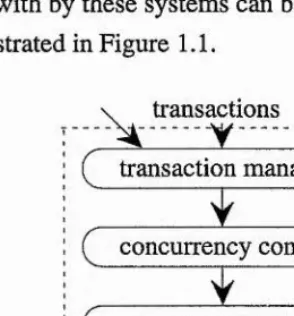
To aid in the design and implementation of database management systems (DBMSs), the major tasks dealt with by these systems can be logically partitioned into a number of components as illustrated in Figure 1.1.
transactions
\ uauNacuuiis y
transaction manager ^
Ç concurrency control j
T
[image:13.613.211.358.352.510.2]C
memory manager Ç recovery manager ^Figure 1.1: Logical Components of a DBMS
Transactions access the database through a transaction manager. The transaction manager receives operations from transactions and forwards them to other components of the DBMS.
Concurrency control is responsible for the correct concurrent execution of transactions. This is achieved by controlling the execution of operations on the database in such a manner that ensures transactions adhere to the constraints of the particular concurrency model employed.
controlling the movement of data between main memory and high speed caches, and clustering strategies within the database.
• Recovery management is responsible for ensuring that the database is fault tolerant - the data is not corrupted even in the event of software, system or media failure.
Although there are many documented mechanisms for each of these components the convention is that only one implementation of each component is embedded into a particular database system. Furthermore, implementations of DBMSs often deviate from the logical partitioning of the systems (Figure 1.1) by combining the implementations of various components. One justification for such vertical structuring may be the perceived performance gains obtained over layered implementations. On the other hand integrating implementations of DBMS components may introduce dependencies between the layers that may in turn increase the complexity of altering the implementation of any single component. The next section proposes a flexible architecture that reflects the logical view of DBMSs in a layered implementation.
1.2 Configuring DBMSs
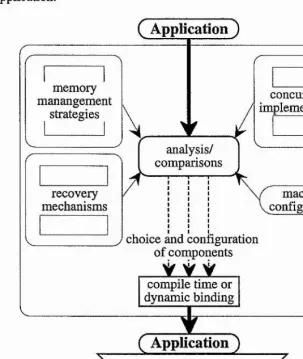
In many conventional DBMSs the particular styles of memory management, recovery mechanism and concurrency model employed are designed to provide good average performance for applications executed on the systems. However it is no longer clear if the analysis on which the designs of these systems are based is still valid. Current trends in application styles, hardware configurations and operating systems weaken many of the assumptions made by early studies. Furthermore recent research [WJN+95, SCM+95a] suggests that the models of computation, memory management, CPU and I/O have been too simple, thus casting doubt on their accuracy. Due to this, it may be argued that a new approach to maximising the performance of DBMSs must be taken - one that takes into account the current state of technology and considers application style and workload in the configuration of each component of the system.
changes to individual components and provides the potential to optimise performance for an application.
( Application }
memory manangement
strategies
\
recovery mechanisms
analysis/ comparisons
r
concurrency implementations
V )
_j choice and configuration of components
y y y
machine configuration
compile time or dynamic binding
( Application )
concurrency jnemory management^
recovery
[image:15.612.132.435.97.456.2]Configured DBMS
Figure 1.2: Conceptual View of the Flexible DBMS Architecture
To make policy decisions regarding how each component should be configured, a technique is required that allows the different implementations of each component to be compared. Three commonly used techniques are available. These are analytical, simulation and empirical based analysis:
• Empirical measurement involves running applications or benchmarks on implemented DBMSs taking measurements using hardware or software monitoring.
• Simulation based analysis comprises of a number of programs that capture the characteristics of a component. By running these programs the behaviour of the component is approximated and so its performance may be studied. The simulations are based on a number of assumptions to reduce the complexity of each component.
• Analytical modelling allows the performance characteristics of each DBMS component to be derived mathematically. This involves the construction of a number of parameterised equations that approximate the attributes of the components in terms of workload characteristics. As with simulations a number of simplifying assumptions are made about behaviour.
In analytical modelling and simulations a number of assumptions are required to make the analysis tractable [Leu88]. These assumptions must be sufficiently understandable to allow the analytical model or simulations to be constructed. Generally simulations permit more details of a system to be incorporated - details that are often difficult to include in analytical models. A drawback of simulation models is that they tend to be more expensive in terms of programming, debugging and validation to develop, and more expensive to use than analytical models. The fine grained analysis that can be performed using empirical measurement, the most expensive form of analysis, ensures that the results obtained are normally the most accurate of the three techniques available. Measurement of systems using empirical analysis is often performed using synthetic application workloads produced by benchmark suites such as OOl [CS92] and 0 0 7 [CDN93].
1.3 Contribution
number of I/O operations incurred by each recovery mechanism available and analyses the platform to ensure that cost predictions are platform specific. Comparisons of the resulting cost predictions can then be used to select the recovery mechanism that incurs the lowest cost.
To promote confidence in the MaStA model a validation framework is developed. The framework involves running workloads typical of database applications on various recovery mechanisms on different platforms. Empirical analysis of the executing workloads is used to validate assumptions about CPU, I/O and workload that underly MaStA. The flexible recovery management required in the framework to execute workloads on various mechanisms is provided by the Flask architecture [MCM+94]. Flask goes some way to realising the flexible architecture proposed. An attraction of Flask is that the responsibility of recovery management and concurrency control are separated thereby enabling the implementations of recovery schemes to be developed and altered independently of concurrency control. The flexibility in the recovery component of Flask is achieved through an interface that places few constraints on the mechanism used.
A wide variety of recovery schemes have been documented [AS82, Grâ78, Lor77, R091] any of which may be used in architecture. In the original instantiation of Flask, concurrent shadow paging [Mun93] is employed. This thesis develops two other schemes: a log-structured mechanism and a log-based mechanism called DataSafe [SCM+96]. By providing a choice, the work provides a means to execute the same database workloads over different recovery mechanisms in the framework used to validate the MaStA cost model. Furthermore, incorporating different recovery mechanisms provides opportunities to perform empirical analysis on Flask to illustrate the necessity for the proposed flexible architecture. Once MaStA is validated the utility of the model is illustrated by using it guide the choice of recovery mechanism in Flask to provide optimum performance for given database applications
1.4 Thesis Structure
Chapter 3 provides an overview of the flexible recovery manager used in Flask and includes a description of two mechanisms developed to provide alternatives to the scheme used in the first instantiation of Flask.
2 Background
2.1 Introduction
The Flask architecture provides the potential to engineer recovery management independently from other DBMS components in order to obtain the optimum performance for a particular application. Early attempts to increase the performance of database systems have resulted in numerous designs for recovery mechanisms. This chapter introduces the requirement for these schemes and discusses the trade offs between various recovery mechanism designs, any of which may be adopted in the Flask architecture.
Previous analysis of DBMSs develop analytical models to compare the systems mathematically or use benchmarks to provide workloads for empirical measurement. These studies along with summaries of commonly used benchmarks are discussed to provide the background for a new analytical model used to drive the Flask architecture.
2.2 Recovery Management
2.2.1 Introduction
Traditionally, recovery management is tightly coupled to the implementation of transactions in DBMSs. Transactions [Dav73, EGL+76, Dav78] were introduced into database systems to allow activities to execute concurrently, thus increasing database resource utilisation. Each transaction is a unit of work consisting of reads and possibly updates to a database. A transaction completes by either committing or aborting as a unit. When a transaction commits, all updates performed by the transaction are made permanent in the database and visible to other transactions. In contrast, when a transaction aborts, all updates are discarded and the database is left in a state it would have been in if the transaction had never executed. This is known as the atomicity or all-or-nothing property of transactions - either all or none of a transaction’s updates are reflected in the database. Durability is the property that a successfully committed transaction’s updates survive failures. Recovery management is the DBMS component responsible for providing the durability properties of transactions in the presence of failures. The three types of failure that the recoveiy manager must deal with are media failure, system failure and transaction abort.
such an event the data may be restored from a mirrored disk [BT85] or from an archived version.
• system failure: These failures occur due to the loss of data from volatile storage only and potentially cause inconsistencies in the materialised database [HR83]. The term materialised database is used to describe the state of the database only, i.e. taking no account of additional data that may be recorded during normal processing to recover the database to a consistent state. The recovery manager ensures that on restart all updates made by committed transactions are durable and that all updates of non-committed transactions are removed. Since system failures may also occur during restart the recovery process must be idempotent. That is, restart may begin and fail a number of times, eventually succeeding, resulting in the same state as if the initial restait had succeeded.
• transaction abort: A transaction is said to abort if it is terminated before it commits. All updates made by the transaction to the materialised database must be removed by the recovery manager. This is known as transaction rollback. This thesis concentrates on the provision for recovery after system failure and transaction abort. Recovery from media failure requires additional mechanisms such as disk mirroring [BT85, S091, OS93] or RAID [PGK88] which are beyond the scope of this thesis, but may be included in future work as a separate DBMS component in the flexible architecture outlined in Figure 1.1.
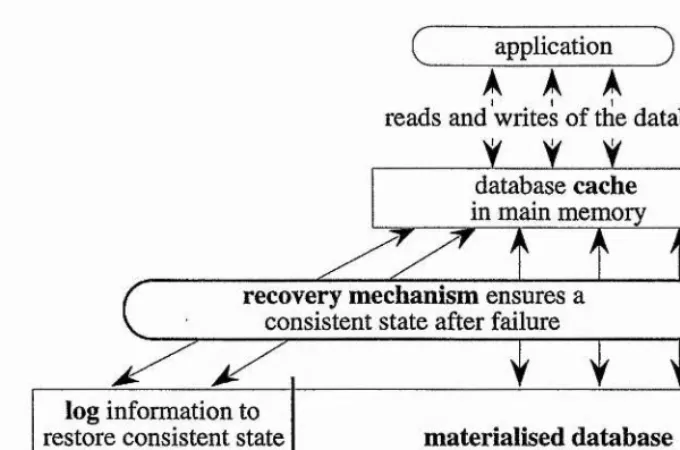
Figure 2.1 illustrates the principle behind all recovery mechanisms designed to deal with soft failure. The database is held on non-volatile storage such as disk. Read operations cause data to be faulted into a cache held in main memory where the data may be updated. During a commit, or in some cases during the transaction, the updated data is transferred back to non-volatile storage.
Ç application ^
A A A
reads and writes of the database
y y y
database cache
in main memory
^_________ . t t t,
f
recovery mechanism ensures a A\ ___ ______consistent state after failure_________ y
^
i i i
log information to
restore consistent state materialised database
on failure
[image:21.614.112.452.58.283.2]non-volatile storage
Figure 2.1: The General Structure of a Recovery Mechanism
2.2.2 Classification of Recovery Mechanisms
To understand the trade-offs between recovery mechanisms and to provide a technique for distinguishing between these schemes it may be helpful to develop classifications of the properties of recovery mechanisms. Haerder and Reuter [HR83] stratify recovery into a hierarchy of propagation, page replacement, end-of- transaction processing and checkpointing strategies adopted by page-based recovery mechanisms in transactional database systems. Haerder and Reuter’s classification subsumes another classification, sometimes referred to as the undo I redo categorisation [BGH83, HR83]. The undo/redo scheme describes mechanisms in terms of the operations performed on restart to bring the materialised database to a consistent state after system failure.
A recovery mechanism’s page replacement strategy is steal if cache pages updated by a transaction may be written in place to the database before the transaction commit completes. Mechanisms exhibiting steal strategies require that information is recorded in the log to remove non-committed updates during transaction rollback or if a system failure occurs before the transaction successfully commits. Such mechanisms may be classified as requiring undo operations on restart after system failures. A mechanism is steal if the pages updated by a transaction are held in main memory or in the log until after the transaction commits. The materialised database therefore never contains non-committed updates and so no undo operations are required after a crash.
A mechanism is force if updated pages are propagated to the database during a transaction commit and force if propagation is deferred until after commit time. A -iforce strategy must write updated pages to the log to ensure propagation can be performed at a later time, and hence may be classified as redo. Mechanisms exhibiting/orce end-of-transaction processing are no-redo since all committed updates are present in the materialised database after a system failure.
In redo recovery mechanisms the amount of recovery information required in the log is conceptually unbounded. Checkpointing schemes are used to limit the amount of this information. A checkpoint involves writing to the database, updates held in the log and writing a checkpoint record to the log to indicate the fact. The checkpointing strategy adopted by a recovery mechanism determines the frequency of .checkpoints and the amount of work performed during each checkpoint:
• Transaction-oriented checkpoints (TOC): these occur each time a transaction commits and are associated with b. force propagation strategy.
• Transaction-consistent checkpoints (TCC): in-progress update transactions are allowed to terminate and new update transactions are blocked. All updates are then propagated to the database after which normal execution is resumed.
• Action-consistent checkpoints (ACC): These are generated in a similar manner to transaction-consistent checkpoints but at an operational level instead of at the level of transactions. All update operations are finished and new update operations are blocked until after the checkpoint completes. Changes are then propagated to the database.
ATOMIC ATOMIC
STEAL STEAL STEAL
FORCE-.FORCE FORCE -.FORCE FORCE-.FORCE FORCE -.FORCE
been propagated since the last checkpoint are propagated to the database. The number of pages propagated and the nature of the checkpoint trigger are determined by the particular fuzzy checkpointing scheme employed.
The classification depicted in Figure 2.2, taken from [HR83], stresses the possible combinations of strategies that may be used by recovery mechanisms. The fact that there are numerous strategies makes the comparison of recovery schemes a complex task.
Propagation Strategy
Page Replacement
EOT Processing
Check-TOC TCC ACC fuzzy Check-TOC TCC fuzzy Check-TOC TCC ACC Check-TOC TCC pointing
Scheme Figure 2.2; Classification Scheme for Recovery Concepts
The following sections give examples of how some of these categorisations may be realised in implementations.
2.2.3 Write-ahead Logging
Write-ahead logging mechanisms [Dav73] are the most common recovery schemes used in database systems. These mechanisms use a log file or partition to record information required to bring the database to a consistent state in the event of system failure. The term write-ahead is often used to emphasise that a record of a database update is written to the log before the update is performed.
Examples of systems that make use of logging schemes are System R [GMB+82], ARIES [MHL+92], Ingres [Sto86], Sybase, Oracle, O2 [VDD+91], Mneme [MS88],
2.2.3.1 Logging with Deferred Updates
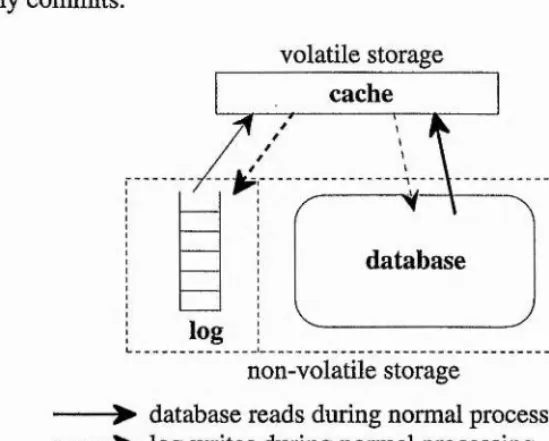
In deferred update logging (Figure 2.3), a transaction’s updates are written the to log and update propagation to the database is deferred until after the transaction successfully commits.
volatile storage
cache
database
non-volatile storage
>• database reads during normal processing >" log writes during normal processing
[image:24.614.145.420.148.368.2]> checkpoint and swap writes of committed data >“ log reads during recovery
Figure 2.3: Write-ahead Logging with Deferred Updates
Each database update causes a record to be written to a log buffer. A record is composed of the updated data, the data’s location in the database and the identifier of the transaction that performed the update. When a transaction commits, all update records are flushed to the log. The transaction is committed by writing a commit entry to the log. The transaction’s updates are propagated to the database any time after the transaction commits.
Using Haerder and Reuter’s classification logging with deferred updates is [^atomic, steal, -yforce, TOC/TCC/fuzzy}. Since non-committed updates are never written to the materialised database a deferred update log can be either steal or -i steal. Checkpointing involves updating the database with committed updates buffered in the cache and writing a checkpoint record to the log. This record indicates that committed updates held in the log are redundant. An action-consistent checkpointing scheme (ACC) cannot be used since it would involve updating the database with non- committed data that would require undo information in the event of a crash.
2.2.3.2 Logging with Immediate Updates .
In a log with immediate updates (Figure 2.4) before-images are written to the log prior to writing updates (after-images) to the database. The before-images (the original values) may be required after a system crash to undo non-committed updates from the materialised database.
Before data is updated in the cache, the before-image of the data is written to the log buffer. The before-images must be flushed to the log before updating the database. When a transaction commits, the required before-images are flushed to the log and then the transaction’s updates are written to the database. The transaction is committed by logging a commit entry to signify that the transaction’s before-images should be ignored on restart.
volatile storage
cache
database
non-volatile storage
[image:25.612.147.427.429.648.2]database reads during normal processing database writes during normal processing writing before-images during normal processing removing inconsistencies during recovery
Figure 2.4; Write-ahead Logging with Immediate Updates
copied to the database to remove {undo) potential updates made by non-committed transactions. Recovery is idempotent since undo operations to the database may be performed any number of times with the same result. Once all undo operations are complete, the log is marked as being empty to avoid performing the same operations again if another system failure occurs.
Transaction abort involves performing undo operations to remove any of the transaction’s updates from the materialised database and writing a transaction abort record to the log. This ensures that the transaction’s before-images in the log are ignored on restart. No redooperations are required since all committed updates are present in the materialised database. As a consequence, no checkpoints are required in immediate update logs. Using Haerder and Reuter’s classification logging with immediate updates is classified as {^atomic, steal, force,
2.2.3.3 Undo/Redo Logging
Under some workloads, the above logging schemes may be too restrictive. For example, in immediate update logging, the overhead of writing before-images to the log during a commit, in addition to writing updates to the database, may be high. In deferred update logging, updates should ideally fit into the cache. If not, the log may be used to hold updated data swapped out of the cache, introducing the possibility of read operations on the log during normal processing to obtain the most recent version of data. A drawback is that these reads may increase the cost of seeking to the end of the log during a commit. An alternative is to use an additional area of non-volatile storage for swapping updated data, with the overhead of performing reads during a commit to copy these updates to the log.
!
A more flexible logging technique exists which encompasses the characteristics of j
both mechanisms described above. This form is known as an undolredolog. In such a j
log, updates are written either to the log or to the database. Swap writes are normally
I
directed to the database and before-images are written to the log for recovery. During 1a commit, updates are written to the log. This mechanism ensures that workloads that j fill the cache with updates may be accommodated and that commit writes (to the log) i
are fast. If a crash occurs, inconsistencies in the materialised database are removed by i
overwriting them with the before-images held in the log, and committed updates held j
in the log are written to the database. Unlike deferred update logging undo/redologs j
may also employ ACC checkpointing schemes since the undo information required I
!
for ACC strategies is available on restart. This mechanism is {-yatomic, steal, --yforce, |
2.2,3A Optimising Logging
One of the distinguishing characteristics of logging mechanisms is that log writes are performed sequentially. An optimisation is to buffer log records and to perform fewer, larger writes to increase write throughput to the log. The buffer need only to be flushed to the log when the cache becomes full or if it is necessary for recovery. In deferred update logging a transaction’s updates must be present in the log when the transaction commits. Hence it is possible to defer flushing the buffer to the log until the transaction commits. In immediate update logging, pinning updates in the cache enables flushing the buffer of before-images to the log to be deferred until the transaction begins to propagate its updates to the database. By writing committed updates to the database opportunistically, the cost of propagating to the database in deferred logging may be reduced.
Deferred update logs may be classified according to the type of information recorded in the log: they are either physical or logical (also called operational). The term physical logging indicates that data values are recorded in the log. The granularity of the data is normally pages or objects. Difference logging is an optimisation that may be employed in either deferred or immediate update logging. It consists of recording only the byte by byte differences between the before and after-images of data and can reduce the amount of information written to the log when compared to writing whole pages or objects. Logical logging is designed to further reduce the amount of information written to the log in deferred update logging. Instead of writing data values, high level operations performed on the database are logged. For example, inserting a tuple into a relation may cause a number of physical changes, such as updating the index and the reorganisation of data. In a physical log many records are needed to reflect these changes. In contrast, logical logging needs only record that the update takes place and to record the value of the tuple.
A further optimisation may be achieved in logging by taking advantage of the data rate mismatch between CPU and disk to perform compression on data written to the log. This may reduce the amount of log data written and hence may reduce I/O costs with the penalty of a marginal increase in CPU cost.
2.2.3.S The Database Cache
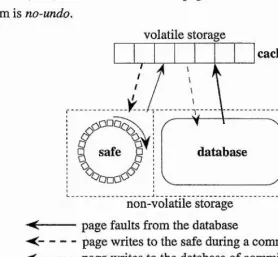
Figure 2.5 illustrates the layout of the DB Cache. The safe is a non-volatile storage device that permits fast sequential access and is at least as large as the cache. Pages are read from the database into the cache. Updated pages remain in the cache until the transaction commits at which time they are written sequentially to the safe. Committed pages may remain in the cache for use by other transactions, may be written opportunistically to the database, or chosen for replacement and written on demand. During the recovery process the only action required is to read the safe pages into the cache (redo). Since non-committed pages are never written to the database the mechanism is no-undo,
volatile storage __ cache
o
database^
--- -<---^
---non-voiatiie storage page faults from the database
page writes to the safe during a commit
[image:28.614.142.421.223.480.2]page writes to the database of committed pages page reads from the safe during recovery
Figure 2.5: The DB Cache
Whenever the safe becomes full, pages in the safe required for recovery are flushed to the database. One of the problems therefore is determining which pages are required in the safe during normal processing and finding the pages to read into the cache during restart. During normal processing the mechanism maintains a volatile bitmap, with one bit for each page in the safe, to indicate which safe pages are required for recovery. Whenever the safe becomes full a safe-begin-pointer is advanced to indicate the bit corresponding to the first page required for recovery. If more free pages are required, committed pages may be flushed from the cache to the database rendering these pages in the safe restart-free.
materialised database, since at any point in time the database consists of the contents of the materialised database and the contents of the cache. If a system crash occurs during restart the safe is simply re-read. Hence recovery is idempotent.
The DB Cache does not write pages to the safe until transaction commit to avoid the possibility of reading pages from the safe during normal processing, and hence minimises the costs of safe write seeks during normal processing. This imposes a limitation on the number of pages that may be updated (limited to the size of the cache). Elhardt and Bayer suggest swapping updated pages to an additional area of non-volatile storage to accommodate workloads consisting of large and/or long lived transactions. The checkpointing scheme in the DB Cache is fuzzy since checkpoints are generated whenever the safe becomes full, and since only a fraction of the committed pages are propagated to the database. The DB Cache is {-^atomic, -^steal,
force, fuzzy}.
2.2.4 Shadow Paging
Instead of using a physically separate log file, shadow paging mechanisms maintain a logical log within the database. Page replacement algorithms are used to control the movement of pages between the cache, the database and the logical log such that a consistent state is always recoverable, A page map is maintained to record the disk locations of database and log pages. The first time a database page is written to disk a shadow copy of the page is made in the log so that a before-image is always available after a system failure. A new consistent state is obtained during a transaction commit using a mechanism that atomically updates the page map so that the logical log is empty and all committed updates are visible in the materialised database. Two variations of shadow paging are discussed.
2.2.4.1 After-Image Shadow Paging
After-image shadow paging [Cha78, Lor77] ensures that updated pages never overwrite their before-images on disk - an updated page is written to a shadow copy in the logical log. A page map on disk maintains the mappings between the database pages and disk blocks. The mechanism maintains a mirrored root page from which the last consistent mappings are found. Figure 2.6 illustrates a database in which two pages are modified in the cache, one of which is shadowed in the log.
technique such as Challis’ algorithm [Cha78] to reflect the new locations of updated database pages. Using Challis’ algorithm the page map is described by a mirrored, timestamped root block on non-volatile storage. During a commit the older block is updated to record the new state of the page map. Using this technique the after images of pages in the log are in effect atomically propagated to the database during a commit. The blocks holding the before-images of committed pages become redundant and may be overwritten.
cache I I unused page unmodified page H I modified page
database/log
read from the database write to the log
Figure 2.6: After-Image Shadow Paging
Since propagation is performed atomically, the page map on disk constitutes the state of the database at the last successful commit and so the materialised database is never in an inconsistent state after a system crash. This eliminates the need for undo and redo operations on restart, and hence by definition recovery is idempotent. Transaction abort involves discarding the appropriate updated cache pages and reverting any corresponding page mappings to their original values. Checkpointing in after-image shadow paging is transaction-oriented since propagation occurs each time a transaction commits. Using Haerder and Reuter’s classification, after-image shadow paging is {atomic, steal, force, TOC}.
Implementations of after-image shadow paging schemes are used in Napier88 [MBC+89, Mun93], CASPER [VKD+92, Vau94] and Gemstone [BOP+89]. Shadow paging is also used along with logging in System R [GMB+82].
2.2.4.2 Before-Image Shadow Paging
In contrast to the previous mechanism, before-image shadow paging [Bro89, BR91] always writes pages back to their original blocks. The mechanism ensures that before images of the updated pages are available for recovery in a log appended to the end of the database. The page map on disk is used to record the locations of these shadow pages.
illustrates a database in which two pages are modified and shadowed. One page is updated in the cache but has not yet been shadowed.
cache
I I unused page unmodified page H modified page
shadow page
reads and writes
copying before-images to different blocks undo writes during restart
database/log
Figure 2.7: Before-Image Shadow Paging
The mechanism ensures that by the time a transaction commits, each page updated by the transaction has been shadowed and that the page map on disk has been updated to record the locations of these shadows. On commit, the updated pages are written to the database. The page map on disk is atomically updated to remove the locations of the before-images. This effectively sets the database to a new consistent state. Since updated pages are written in place, the materialised database may contain inconsistencies after a crash due to page swapping or an interrupted commit. If a crash occurs, the page map contains the locations in the log of the before-images of potentially inconsistent database pages. These pages are copied to their original locations in the database (undo), returning the database to the state at the last successful commit. Recovery is idempotent since before-images may be copied to the database any number of times with the same result. The mechanism is no-redo since all committed transactions’ updates are reflected in the materialised database. Transaction abort involves discarding any cache pages updated by the transaction and overwriting any updated pages written to the database with the appropriate before images. The page map is atomically updated to discard the transaction’s before images from the log.
Using Haerder and Reuter’s classification, before-image shadow paging is {-^atomic, steal, force, TOC}. The mechanism is -^atomic since propagation can be interrupted by system failures.
2.2.4.3 Optimising Shadow Paging
seek times under workloads that access these two pages consecutively. Clustering schemes such as preallocating shadow pages in the same cylinder as the original pages [Lor77] may be employed to reduce these costs. On the other hand, since pages may be relocated on disk, dynamic reclustering of pages may be employed, thus potentially reducing read costs. For example, data may have been originally created on non-adjacent pages. If they are subsequently updated and committed together, they may be written to contiguous blocks on disk, thus potentially reducing the cost of reading these pages consecutively.
Optimisations in before-image shadow paging are similar to those which may be employed in immediate update logging. When a page is first updated a shadow copy of the page is made in the cache. This before-image need not be written to the log until the updated page is about to be written to the database. This provides opportunities for optimisations, such as flushing before-images to the log in batches or opportunistically, and reducing the frequency with which the page map is atomically updated.
2.2.5 Log-Structured Databases
Log-structured databases (LSD’s) are based on the design of the Sprite Log- Structured File System [R091]. In a LSD, the log itself acts as a repository for database pages. In other words the database is a logical collection of pages within the log. The mapping of the database address space onto the log is recorded by writing modified pages to the end of the log along with metadata to describe the database addresses of those pages. An atomic commit is achieved by writing a commit record to the log to specify that a new consistent state has been established. On restart, the last consistent state is found by reading all the metadata up to the last commit record in the log. These records are used to construct a transient page map in main memory to cache the locations of database pages in the log during normal processing. Log- structured databases employ either threading or compaction to manage free space on disk for new updates. Like AISP, log-structured mechanisms are {atomic, steal, force, TOC}.
2.2.5.1 Log-Structuring Using Compaction
location on disk. Atomicity of commits is attained through the atomic update of the record holding the root’s location.
The locations of free blocks in the log are recorded by a bitmap generated on restart from the page map. This is searched when free blocks are required for writing updated pages. If the degree of fragmentation in the log becomes sufficiently high to degrade write performance the log may be compacted. The bitmap allows the compactor to determine which pages are live and which are free. Any one of a number of garbage collection techniques may be employed to free contiguous areas of the log.
This recovery mechanism may be viewed as a merger of logging and after-image shadow paging: updated pages are written to contiguous free blocks in the log in a similar fashion to deferred update logging and, like after-image shadow paging, metadata is used to record the locations of the latest versions of database pages.
2.2.S.2 Log-Structuring Using Threading
The potentially high cost of compacting the log may be reduced by performing incremental compaction. This may be achieved by partitioning the log into threaded fixed sized segments and performing compaction on a per segment basis. Each segment contains a number of pages and corresponding metadata to describe the database addresses of the pages. If segments become internally fragmented they may be cleaned for reuse by copying live pages into new segments.
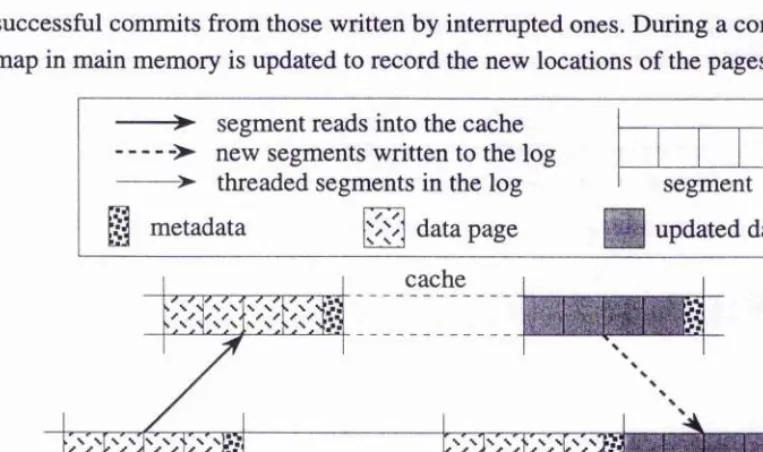
An example of a threaded log-structuring is presented by Hulse and Dearie [HD96], and is used to provide resilient persistent processes within the Grasshopper persistent operating system [DBF+94]. The layout of a store is illustrated in Figure 2.8. The segments are threaded using next segment pointers and time stamps are used during recovery to find the last segment successfully written to the log. During normal processing, a tree-structured page map is maintained in virtual memory to record the log segment and the offset within the segment of the latest version of each database page.
successful commits from those written by interrupted ones. During a commit the page map in main memory is updated to record the new locations of the pages in the log.
segment reads into the cache -> new segments written to the log -> threaded segments in the log metadata data page
segment
updated data page i cache j
% % !
[image:34.614.92.474.64.290.2]log/database
Figure 2.8: Segments in a Log-Structured Database
On restart, after a crash or after an orderly shutdown, the log is scanned forwards. The metadata in the segments are used to reconstruct the page map in main memory. Since the log may be large, this process may be optimised by occasionally writing the page map to the log during normal processing and on restart reading the latest page map from the log. Since the page map may be written lazily several commits may have occurred after the page map was last written. Therefore on restart the latest page map in the log may not constitute the latest consistent state of the database. The page map is brought up to date by reading the metadata in the segments following the last page map. The address of the latest version of the map is recorded in a known location on disk. Hulse and Dearie employ Challis’ algorithm to atomically update this record.
If the log becomes full, cleaning is performed on internally fragmented segments in the log. This consists of reading segments into the cache and copying live pages into new segments. The mechanism discriminates between live and obsolete pages by consulting the page maps. The new segments are appended to the end of the log and the old segments are freed for reuse.
Since no operations are required to remove inconsistencies during recovery, LSD’s are no-undo, and are no-redo since no operations are required to propagate committed updates to the materialised database.
2.2.6 Comments
recovery. In order that the strategy with the lowest cost may be chosen for a particular application it is necessary to understand the trade-offs between each scheme and to be able to make accurate predictions of the costs involved within each mechanism. Such comparisons may be simplified by describing each mechanism in terms of the movement of data between a cache, a database and a logical log used to hold recovery information. For example, AISP can be described as logging in which the log is a collection of pages held on free blocks in the database. By describing each mechanism as variations of logging, the main issues concerning performance that must be addressed when comparing difference schemes for a particular application and platform are:
• How much data is read and written to the database during normal processing and checkpoints?
• How much data is transferred to and from the log during normal processing and checkpoints?
• On restart, how much data is read from the log and how much is written to the database?
• What I/O access patterns are performed?
• What are the effects on subsequent reads of the writes performed?
• Finally, what are the CPU costs incurred by the recovery manager?
This break-down of recovery costs is the basis for the new analytical cost model for recovery schemes described in Chapter 4.
2,3 Concurrency Control
Concurrent access to databases by multiple users was introduced to increase database resource utilisation. DBMSs employ concurrency control schemes to avoid inconsistencies that may result from interference among multiple users.
aborted if conflicts have occurred. Atomic transactions are often described as adhering to the ACID properties [GraSl, HR83]: atomicity, consistency, isolation and durability,
• Atomicity, or the all-or-nothing property, refers to the organisation of the operations of a program into an atomic unit; either all the effects of the operations are visible in the materialised database or none are.
• Consistency refers to the correctness property of transactions. If a transaction is executed alone the transaction, should bring the database from one consistent state to another. The system is responsible for ensuring that when correct transactions are executed concurrently, database consistency is preserved.
• Isolation refers to the fact that a transaction should perceive a consistent view of the data. For example, a transaction should not commit after having read the non-committed updates of an aborted transaction.
• Durability refers to the system’s responsibility for ensuring the permanence of committed updates, in the presence of failures.
A number of attempts have been made to extend the atomic transaction model in order to increase concurrent throughput. Garcia-Molina in [Gar83], for example, proposed using semantic knowledge of operations to reduce conflicts between transactions. By studying the semantics of operations to identify which operations commute, concurrency may be improved by increasing the number of correct interleavings of transactions.
Open nested transactions proposed in [Wei86] are extensions to the nested transaction model. These models permit partial results to be viewed outside the transaction hierarchy. This is achieved by permitting a sub-transaction to commit changes to the database. If an ancestor of a committed sub-transaction subsequently aborts, a compensating transaction associated with the sub-transaction is executed to reverse its effects in the database.
For some database applications the ACID properties can be too restrictive. In modem CAD/CAM applications, for example, users may wish to co-operate to update a shared design before coming to a mutual agreement to commit the changes. This is not possible using an atomic transaction model due to the isolation property. Another drawback of atomic transactions is that they may restrict potential concurrency in systems executing long-lived transactions. These transactions involve either access to large amounts of data or involve long delays in their execution. The serialisability constraint of atomic transactions may cause long delays for other transactions wishing to access the same data. Furthermore the isolation property may lead to an increase in the probability of conflicts occurring between transactions, thus increasing the frequency of transaction aborts.
The saga model [GS87] is an attempt to increase concurrency in systems that execute long-lived transactions. Transactions are broken down into a number of atomic transactions {Ti, T2, ..., Tn), the first n-1 of which are associated with compensating
transactions {Ci, C2, ..., Cn-i}. The successful completion of a saga depends on the success of the serial execution of each component transaction. The failure of a saga, caused either by system crash or by the failure of a component transaction (Tk), requires that the compensating transactions {Ck-i, Ck_2, . Ci} are executed to reverse the globally visible effects of the committed component transactions. The model relies on the programmer being able to break the long-lived transaction down into a number of components for which compensating transactions must be constructed.
that are forbidden. Similarly to nested transactions a member obtains copies of objects from its parent and updated objects are inherited by the transaction group.
2.4 The Flask Architecture
2.4.1 Introduction
Traditionally database systems use one model of concurrency. This may be restrictive since it does not permit concurrency to be designed to provide optimum performance for a particular application. Furthermore such a system cannot accommodate applications that require different models of concurrency. The Flask architecture [MCM+94] uses a more flexible approach to provide the appropriate model of concurrency for the application. This is achieved by separating out the issues of concurrency from other DBMS components thus allowing a number of models to be implemented.
2.4.2 The Flask Framework
The framework of the Flask architecture is shown in Figure 2.9 as a “V-shaped” layered architecture to signify that minimal functionality is built-in at the lower layers. No assumptions are made by the lower layers about concurrency control and hence this leaves the implementor freedom to choose any desired concurrency scheme and implementation. For example, a particular specification may translate into an optimistic algorithm or alternatively a pessimistic one. Furthermore such an approach can accommodate different models of concurrency, such as atomic transactions or sagas.
Specifications
Programs
Data Visibility
Resilience
Atomicity
Figure 2.9: V-Shaped Layered Architecture
architecture (Figure 2.10) in which visibility is defined and controlled by the movement of data between a globally visible database and conceptual stores called access sets. Each action is associated with a local access set that isolates its view of data from all others. Actions may also use shared access sets when the concurrency model permits co-operative work between actions. Movement of data from a local access set or a shared access set to the database is through an atomic meld operation provided by the resilience layer of Flask. The term meld is used to describe the operation of making updates permanent on non-volatile storage and visible to other actions rather than terms like commit or stabilise since they imply specific meanings in particular models. The semantics of a meld may differ according to the concurrency model. For example, a shared concurrency model may require a number of access sets to be melded as an atomic action. Since the visibility and resilience layers make no assumptions about the higher layers the implementor is free to choose any desired scheme and implementation for the lower layers.
actions
database
Local and Shared access sets
Figure 2.10: Concurrency in the Flask Architecture
The Flask architecture is designed to work with processes or actions that maintain consistency under concurrency control schemes. In general, melded changes to data do not conflict except where this happens under the control of a co-operative concurrency model. Significant events defined by a particular concurrency scheme are reported to the higher layers enabling these schemes to undertake conflict detection. This assumption frees the lower layers from the onus of interference management.
an extension to the standard PS-algol system [PS87] that includes language constructs to support and manage concurrent processes. The concurrency model is essentially co-operative with procedures executing as separate threads and synchronising through conditional critical regions. Using these primitives and the higher-order functions of PS-algol, Krablin shows that a range of concurrency models can be constructed.
2.4.3 Flexible Recovery in Flask
The Flask approach to providing flexible recovery independent of concurrency control involves associating each action with a local access set that isolates its non melded updates from other actions and from the previously melded state of the database. Actions may also use shared access sets when the concurrency model permits co-operative work between actions. Movement of data from a local access set or a shared access set to the database is through an atomic meld operation provided by the recovery manager. By assuming that object conflicts are detected by the concurrency control layer the recovery manager in Flask is free to provide these access sets using any suitable implementation.
In page-based recovery mechanisms these access sets may be provided by associating each action with an action page map. When an action updates a database page the action receives a copy of the page and an entry is inserted into the action’s page map to record the fact. If another action updates the same database page, it receives a different copy of the most recently melded version of the page thus ensuring that the non-melded updates of the two actions are isolated. During a meld the action’s page map is accessed to determine which pages must be melded. A recovery mechanism is responsible for writing these pages to non-volatile storage.
In an atomic transaction model, changes may be propagated by performing page xor operations. Suppose two transactions A and B have changed different objects on the same page P and transaction A melds (Figure 2.11). The changes made by A to page P can be calculated by performing an xor of transaction A’s version of page P onto the original version of the page, i.e. as it was at the last meld. This derives a page of changes made by A to page P. These changes are propagated onto transaction B’s copy of P using a page xor operation. The meld propagation formula can be written as:
PB := ( Pa xor Pq ) xor Pb
Pa
xor)
Pa,changes
O
o
Figure 2.11: Change Propagation Using Page Xor Operations
where Pa is transaction A’s copy of page P, Pq is the original version of page P and
Pb is transaction B’s copy of page P. Thus B’s version of page P now includes the changes made by A.
Change propagation can be performed eagerly, or lazily on demand. Eager propagation is performed immediately after each action melds based on the assumption that all transactions eventually commit. Lazy propagation takes advantage of the fact that propagation is not be required until a transaction accesses the melded updates of another transaction. Lazy propagation therefore involves only performing change propagation when required. In the case above, this means that if transaction B aborts, the unnecessary propagation is avoided.
2.4.4 Concurrent After-Image Shadow Paging
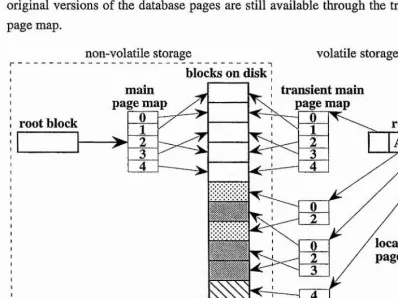
mappings between database pages and disk blocks, and on restart constitutes the last consistent state of the database. Each action is associated with an action page map. When an action updates a page, it receives its own copy of the page which is mapped to a free block on disk using the action’s page map.
When an action melds, updated pages are written to their new blocks and the transient main page map is updated with the mappings recorded in the action’s page map. The transient main page map then atomically replaces the page map on disk using Challis’ algorithm [Cha78] thereby atomically propagating updates to the database. The changes made by the action must then be propagated to the pages of other actions. This is achieved using the change propagation technique described in Section 2.4.3. An action abort involves freeing all pages updated by the action and discarding the action’s page map. No undo operations are required to abort an action since the original versions of the database pages are still available through the transient main page map.
non-volatile storage volatile storage
blocks on disk main
page map transient mainpage map
root block root page
local & shared page maps
[image:42.618.81.480.320.618.2]ED
shadow pagesaction A shadow pagesaction B E3shadow pagesA/B sharedFigure 2.12: Concurrent After-image Shadow Paging
2.4.5 Summary
Flask goes some way to providing the flexible architecture used in this thesis. The responsibility of recovery management and concurrency control are separated, thereby enabling implementations of recovery schemes to be developed and altered independently of concurrency control. The flexibility in the recovery component of Flask is achieved through an interface that places few constraints on the recovery manager and that makes no assumption about concurrency control. Hence any one of a number of recovery mechanisms may be adopted. The work presented takes advantage of this flexibility by developing two new recovery schemes to allow experimentation with different mechanisms executing the same workloads over the same data.
2.5 Analytical and Empirical Modelling
In designing and building DBMSs it is often an advantage to compare the efficiency of various designs before implementing them. One method of comparing designs is to build prototypes and to perform empirical measurement on their execution. Since this is often an unrealistic option due to the high time and labour costs required to build such prototypes, an alternative approach is to model them analytically.
2.5.1 Analytical Modelling
Analytical modelling of database systems involves developing mathematical functions to describe the behaviour of the components of DBMSs and to derive the performance of each system. The models are based on analysis of the components’ designs from which a number of assumptions can be made to make the models tractable. These simplifying assumptions are required to reduce complex interactions between the many issues that must be considered when comparing DBMSs:
• the style and workload of the applications run on the DBMS;
• frequency of system failure and transaction abort;
• the platform configuration;
• interactions among other DBMS components.
that may be performed in the mean time between failures. The model takes into account various aspects of the workload, recovery mechanism and platform:
Workload:
• number of I/O operations performed to process each transaction;
• ratio of update transactions to read-only transactions;
• inter-transaction temporal locality, i.e. probability that an accessed page is still in the cache after being accessed by a recent transaction;
• probability of transaction abort;
Recovery Mechanism:
• frequency of checkpoints required by mechanisms;
• overheads of transaction rollback and recovery;
• overheads of maintaining page tables;
Platform:
• size of the cache.
For each mechanism, mathematical models are developed to calculate the average number of I/O operations required to process a transaction. Models are also produced for each recovery mechanism to calculate the proportion of the availability interval required for transaction rollback, checkpointing and recovery. The remaining I/O operations in the availability interval are divided by the average I/O operations required for a transaction. This results in the average transaction throughput between failures of each mechanism. Altogether ten recovery mechanisms are analysed and compared. The mechanisms are split into three groups with the following properties:
page-level logging
object-level logging
-■atomic steal -■force TCC (only at system shutdown) -■atomic steal -■force ACC (at regular intervals) -■atomic steal force TOC
miscellaneous
-■atomic steal -■force fuzzy atomic steal -■force ACC atomic steal force TOC -■atomic -■steal -■force fuzzy
From evaluations of the cost models using different transaction workloads, Reuter concludes that page-logging is generally more costly than object-level logging, that an increase in shared pages makes slW force algorithms drastically worse than others
and that schemes that use indirect mapping, such as after-image shadow paging, impose extra overheads unless the page-table costs can be reduced.
Agrawal and DeWitt [AD85] introduce an analytical model used to investigate the relative costs of object logging, shadow paging and differential files, and their interactions with locking, time-stamp ordering and optimistic concurrency control schemes. Rather than produce costs based on transaction throughput their model uses a performance metric that describes the burden imposed on a transaction by a recovery mechanism and a concurrency control scheme. The model incorporates CPU costs and the impact that the concurrency control schemes may have on the probability that a transaction will run to completion. Burden ratios for the different integrated concurrency control and recovery mechanisms are calculated and compared using sample evaluations from varying transaction workloads and database characteristics. The conclusions from these tests suggest that there is no overall best integrated mechanism but that a load that comprises of a mix of transaction sizes favours logging with a locking approach. Shadow paging performs rather poorly in their tests. However their model takes no account of synchronous costs, such as checkpointing in logging.