Environmental Dimensions of Additive
Manufacturing
Mapping Application Domains and Their Environmental
Implications
Karel Kellens,1Martin Baumers,2Timothy G. Gutowski,3William Flanagan,4Reid Lifset,5 and Joost R. Duflou1
1Life Cycle Engineering Research Group, Department of Mechanical Engineering of the KU Leuven, Leuven, Belgium
23D Printing Research Group, Faculty of Engineering, University of Nottingham, Nottingham, United Kingdom 3Environmentally Benign Manufacturing (EBM) research group, Laboratory for Manufacturing and Productivity and Mechanical Engineering Department, Massachusetts Institute of Technology (MIT), Cambridge, MA, USA 4Eco-assessment Center of Excellence, General Electric Company, Albany, NY, USA
5Center for Industrial Ecology, Yale School of Forestry & Environmental Studies, New Haven, CT, USA
Summary
Additive manufacturing (AM) proposes a novel paradigm for engineering design and man-ufacturing, which has profound economic, environmental, and security implications. The design freedom offered by this category of manufacturing processes and its ability to locally print almost each designable object will have important repercussions across society. While AM applications are progressing from rapid prototyping to the production of end-use prod-ucts, the environmental dimensions and related impacts of these evolving manufacturing processes have yet to be extensively examined. Only limited quantitative data are avail-able on how AM manufactured products compare to conventionally manufactured ones in terms of energy and material consumption, transportation costs, pollution and waste, health and safety issues, as well as other environmental impacts over their full lifetime. Reported research indicates that the specific energy of current AM systems is 1 to 2 orders of magnitude higher compared to that of conventional manufacturing processes. However, only part of the AM process taxonomy is yet documented in terms of its envi-ronmental performance, and most life cycle inventory (LCI) efforts mainly focus on energy consumption. From an environmental perspective, AM manufactured parts can be benefi-cial for very small batches, or in cases where AM-based redesigns offer substantial functional advantages during the product use phase (e.g., lightweight part designs and part remanufac-turing). Important pending research questions include the LCI of AM feedstock production, supply-chain consequences, and health and safety issues relating to AM.
Keywords:
additive manufacturing energy efficiency industrial ecology resource efficiency sustainability 3D printing
Supporting information is linked to this article on theJIEwebsite
Conflict of interest statement:Reid Lifset is the editor-in-chief of theJournal of Industrial Ecology. He was recused from his role as editor during the review process for this article.
Address correspondence to:Dr. Ing Karel Kellens, Life Cycle Engineering Research Group, Department of Mechanical Engineering of the KU Leuven, Celestijnenlaan 300, 3000 Leuven, Belgium.Email:[email protected];Web:www.kuleuven.be/wieiswie/en/person/00060036
© 2017 The Authors.Journal of Industrial Ecology, published by Wiley Periodicals, Inc., on behalf of Yale University. This is an open access article under the terms of the Creative Commons Attribution License, which permits use, distribution and reproduction in any medium, provided the original work is properly cited.
DOI: 10.1111/jiec.12629 Editor managing review: Michael Hauschild
Introduction
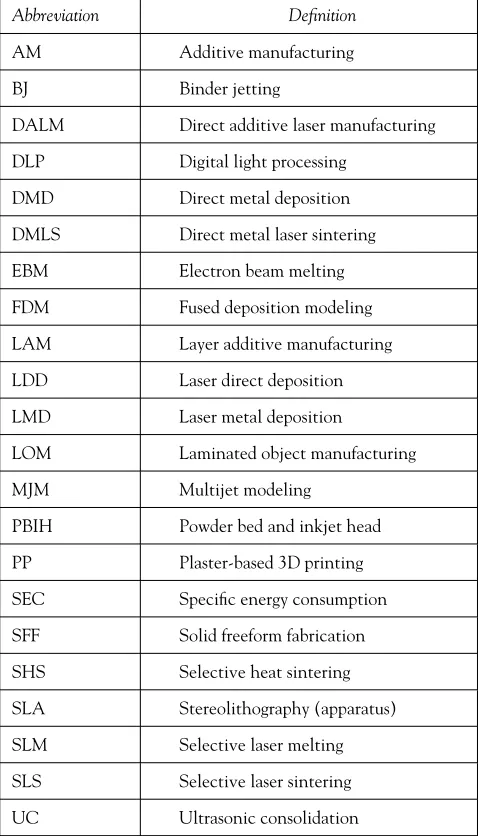
Additive manufacturing (AM) is the process of producing objects from a three-dimensional (3D) model by joining mate-rials layer by layer, directly from raw material in powder, liquid, sheet, or filament form without the need for molds, tools, or dies. It is typically contrasted with subtractive or deformation-based manufacturing methodologies, such as conventional machining or forming processes. The term AM encompasses a broad variety of manufacturing technologies, which are used in a wide range of industries: from consumer electronics to aerospace and nu-merous examples of medical applications, such as, for example, dental implants and hearing aids (Wohlers 2016; Materialise 2016). (See table 1 for definitions of all abbreviated terms used throughout this article.)
[image:2.594.41.280.298.716.2]Kruth and colleagues (1998, 2007) and Levy and colleagues (2003) provide overviews of the classification of AM processes,
Table 1 Definitions of abbreviations used throughout the article
Abbreviation Definition
AM Additive manufacturing
BJ Binder jetting
DALM Direct additive laser manufacturing
DLP Digital light processing
DMD Direct metal deposition
DMLS Direct metal laser sintering
EBM Electron beam melting
FDM Fused deposition modeling
LAM Layer additive manufacturing
LDD Laser direct deposition
LMD Laser metal deposition
LOM Laminated object manufacturing
MJM Multijet modeling
PBIH Powder bed and inkjet head
PP Plaster-based 3D printing
SEC Specific energy consumption
SFF Solid freeform fabrication
SHS Selective heat sintering
SLA Stereolithography (apparatus)
SLM Selective laser melting
SLS Selective laser sintering
UC Ultrasonic consolidation
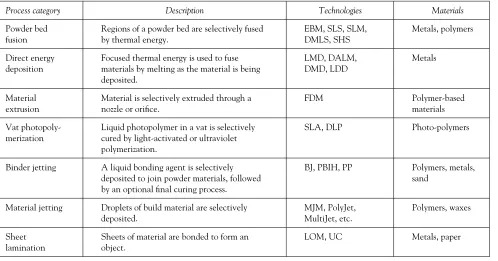
and in 2012, the American Society for Testing and Materials (ASTM) has formulated a set of standards (ASTM 2012) organizing the range of available AM processes into seven categories. An overview of these categories is provided in table 2. Selective laser sintering (SLS), selective laser melting (SLM), electron beam melting (EBM), fused deposition mod-eling (FDM), and stereolithography (SLA) are among the most commonly applied AM technologies (Wohlers 2016). Figure 3 provides a schematic overview of the available literature on the environmental analysis of the different AM process categories and related technologies.
Combining advantages of previous production approaches, such as craft and large-scale manufacturing, as well as mass cus-tomization production, AM has the potential to change con-temporary manufacturing process chains, business models, as well as product-user relationships while producing unique, per-sonalized products (Abel et al. 2011). However, the sustain-ability and environmental performance of AM compared to the former production methodologies remains to be thoroughly investigated.
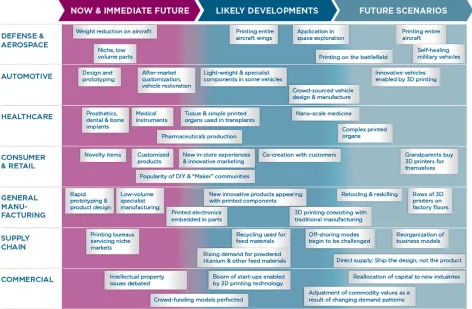
Over the last decade, AM has started evolving from a rapid prototyping technology toward a fully fledged manufacturing process, offering capabilities for functional part production. Among others, Petrovic and colleagues (2011), Computer Sci-ence Corporation (CSC) (CSC 2012), and Wohlers (2016) provide detailed overviews (see figure 1) of current and future AM application domains and related industrial sectors. The main focus of the paper is on AM in industrial settings; how-ever, where relevant, implications for hobby/craft/community AM use are provided.
AM processes have two main advantages compared to other manufacturing processes such as conventional machining: (1) AM has very limited geometric constraints and allows the pro-duction of complex part designs, and (2) AM enables the man-ufacturing of small batch series at a relatively low average cost (Tuck et al. 2008). Generic process limitations include a lim-ited range of materials appropriate for use in AM, low process productivity, rough surface finish and low dimensional accu-racy, and a relatively high cost for medium and large batches (Ruffo and Hague 2007).
Figure 2 presents an overview of the most frequently cited benefits and weaknesses of AM processes compared to tradi-tional manufacturing at product design, manufacturing process, and supply-chain levels (e.g., Ruffo and Hague 2007; Tuck et al. 2007; Hao et al. 2010; Campbell et al. 2011; Petrovic et al. 2011; CSC 2012; Reeves 2012; Grunbaum 2012; Huang et al. 2013; Thomas and Gilbert 2014; Mani et al. 2014; US DOE 2015; Chen et al. 2015; Wohlers 2016). The authors want to underline that the exact position and related impact of the listed benefits and weaknesses strongly depend on the specific application. A detailed discussion of the most relevant boxes is provided further in this paper.
Table 2 The seven AM process categories (ASTM 2012)
Process category Description Technologies Materials
Powder bed fusion
Regions of a powder bed are selectively fused by thermal energy.
EBM, SLS, SLM, DMLS, SHS
Metals, polymers
Direct energy deposition
Focused thermal energy is used to fuse materials by melting as the material is being deposited.
LMD, DALM, DMD, LDD
Metals
Material extrusion
Material is selectively extruded through a nozzle or orifice.
FDM Polymer-based materials
Vat photopoly-merization
Liquid photopolymer in a vat is selectively cured by light-activated or ultraviolet polymerization.
SLA, DLP Photo-polymers
Binder jetting A liquid bonding agent is selectively deposited to join powder materials, followed by an optional final curing process.
BJ, PBIH, PP Polymers, metals, sand
Material jetting Droplets of build material are selectively deposited.
MJM, PolyJet, MultiJet, etc.
Polymers, waxes
Sheet lamination
Sheets of material are bonded to form an object.
LOM, UC Metals, paper
Note:AM=additive manufacturing; EBM=electron beam melting; SLS=selective laser sintering; SLM=selective laser melting; DMLS=direct metal laser sintering; SHS=selective heat sintering; LMD=laser metal deposition; DALM=direct additive laser manufacturing; DMD=direct metal deposition; LDD=laser direct deposition; FDM=fused deposition modeling; SLA=stereolithography; DLP=digital light processing; BJ=binder jetting; PBIH=powder bed and inkjet head; PP=plaster-based 3D printing; MJM=multijet modeling; LOM=laminated object manufacturing; UC
=ultrasonic consolidation.
sustainability perspective. However, both articles provide es-timates based on preliminary findings. For markets with the ar-guably highest AM potential (aerospace, medical components, and tooling), cost reductions ranging from US$170 to US$593 billion are estimated by 2025. The total life cycle primary en-ergy supply and avoided carbon dioxide (CO2) emissions are estimated to 2.54 to 9.30 exajoules and 130.5 to 525.5 million tonnes (Mt), respectively (Gebler et al. 2014). Taking into account a yearly global CO2emissions from manufacturing in the order of 12 gigatonnes (Gt) per year (108 Gt by 2025),1 the CO2savings estimated by Gebler and colleagues represent around 0.5% of the total CO2emissions due to manufacturing. Large additional savings can be obtained if AM technologies evolve appropriately and will become applicable to large-scale production markets. Increasing the AM process speed as well as broadening the applicable materials are listed as key enablers in this perspective. With respect to the economic dimension of AM, Thomas and Gilbert (2014) provide an extensive liter-ature review and discussion on the cost and cost effectiveness of AM. The authors indicate that, due to the complexities of measuring AM costs, available studies are limited in scope. Thomas and Gilbert conclude that current AM technology is only cost-effective for production of small batches with contin-ued centralized manufacturing.
Despite a growing attention to the sustainability aspects of part manufacturing over the last decade (Duflou et al. 2012b), few studies are available analyzing and comparing, in
quantitative terms, the environmental performance of AM manufacturing processes with one another or with conventional manufacturing processes.
This review article provides an overview of currently avail-able studies analyzing the environmental dimensions of AM, encompassing life cycle stages from material production to the part manufacturing and use phase up to the waste treatment of the AM production waste. The review includes, among others, articles of the most relevant research journals (e.g.,Journal of Industrial Ecology,Rapid Prototyping,Journal of Cleaner Produc-tion,International Journal of Life Cycle Assessment,CIRP Annals, andJournal of Manufacturing Science and Technology) as well as proceedings of relevant conference series (e.g., Solid Freeform Fabrication Symposium, CIRP Procedia, and ASME) and all references cited in these research papers.
Figure 1 Current (as of 2012) and future application domains of AM. Image source: CSC (2012), used with permission by the Computer Sciences Corporation, now known as DXC Technology. 3D=three-dimensional; AM=additive manufacturing; DIY=do it yourself.
caused by AM is highlighted and the application domains of AM are discussed from an environmental perspective.
Environmental Analysis of Additive
Manufacturing Technologies
This section provides an overview of available environmen-tal analyses of the entire AM process chain, encompassing ma-terial production, AM systems, as well as post-treatment tech-nologies. While most of the available reports focus mainly on the energy usage, some studies assess material resource con-sumption and direct process emissions where relevant data are available.
Additive Manufacturing Feedstock Production
This section provides an overview of available research on the energy and resource consumption and corresponding en-vironmental impact related to the production of AM feed-stock materials. In contrast to the available LCI data on semifabricated material shapes, such as, for example, cylin-ders, pipes, or sheet metal plates (e.g., ecoinvent Database 3.0; Weidema et al. [2013]), raw materials for AM processes are less well documented in terms of their environmental performance.
The supply chain for powder materials used in AM is cur-rently experiencing exponential growth leading to new powder suppliers, new powder manufacturing methods, and increased competition. Although new metal powder production methods are under development, atomization processes, separating input materials into fine particles, are likely to remain the dominant powder production methods for a number of years. An in-depth introduction to the AM powder metallurgy supply chain is pro-vided by Dawes and colleagues (2015). The authors provide a detailed description of different atomization processes (figure 3) as well as methods to measure the shape, porosity, size, as well as size distribution of the produced powders. Finally, Dawes and colleagues (2015) indicate a need for further investigation and standardization of AM-specific powder specifications. Support-ing information S1 available on the Journal’s website provides a graphic flow chart of metal powder production via atomization and a table summarizing the powder characteristics obtained by the different processes.
Figure 2 Benefits (++) and weaknesses (–) of additive manufacturing processes compared to conventional manufacturing processes.
Figure 3 Schematic overview of available environmental analyses of AM unit processes. AM=additive manufacturing; BJ=binder jetting; DALM=direct additive laser manufacturing; DMD=direct metal deposition; DMLS=direct metal laser sintering; E=energy demand; EBM=electron beam melting; FDM=fused deposition modeling; LDD=laser direct deposition; LS=laser sintering; MIP-SLA= mask-image-projection–based stereolithography; MJM=multijet modeling; R=resource consumption; SLA=stereolithography; SLM= selective laser melting; SLS=selective laser sintering; W=process waste.
environmental track record. However, some researchers have estimated the environmental impacts related to the powder production phase on the grounds of theoretical process perfor-mance calculations as well as datasets gathered in laboratory environments.
Morrow and colleagues (2007) investigated and compared the specific energy consumption (SEC), the energy required to produce 1 unit (e.g., 1 kilogram [kg]) of input material, for the
production of H13 tool steel plates and powder materials for direct metal deposition (DMD) processes. The estimated SEC for atomized tool steel powders varies between 15 and 26 mega-joules per kilogram (MJ/kg) for direct or indirect atomization routes respectively.
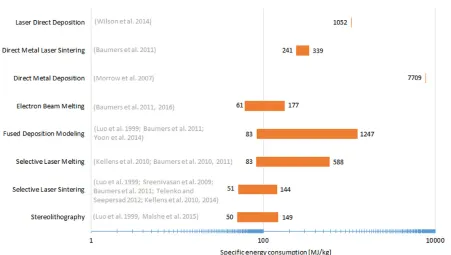
[image:5.594.70.545.309.550.2]Figure 4 Specific energy consumption (logarithmic scale) for AM systems. The energy values represent the electrical energy demand of the AM systems. AM=additive manufacturing; MJ/kg=megajoules per kilogram.
manufacturing (DALM) processes at 7.02 MJ and 0.18 cubic meters (m³), respectively. The energy requirement to produce Ti6Al4V powders for EBM processes has been quantified by Baumers and colleagues (2016). Using data from Granta Design and assuming a mixture of virgin material with 22% recycled titanium, Baumers and colleagues estimated a total embedded energy of 528.90 MJ/kg for titanium plate material. The addi-tional gas atomization process to form spherical particles with a diameter between 15 and 45 micrometers (µm) has an estimated specific energy demand of 31.7 MJ/kg resulting in a total energy requirement of 560.60 MJ/kg for the production of Ti-6Al-4V powder. Similarly, Faludi and colleagues (2016) estimated an embodied energy of 8.1 MJ/kg for the atomization of AlSi 10 megagrams.
Le Bourhis and colleagues (2014) experimentally investi-gated the electricity, water, and gas (argon) consumption for metallic glass atomization. For 1 kg of metallic glass powder, the consumption rates were quantified to 7 m³of argon, 14.4 MJ of electricity, and 155 liters of water. Wilson and colleagues (2014) reported an SEC of 55.6 MJ/kg for the atomization of a nickel-based super alloy (Nistelle 625 from Deloro StelliteR).
Even though specific energy consumption (MJ/kg) values are available for a broad set of polymer granulates (PlasticsEurope 2016), LCI data on the required precipitation step are lacking due to the combination of the niche nature of the involved industry as well as the strategic character of the data for the powder material manufacturers.
Among others, Short and colleagues (2014), Oskui and colleagues (2016), and Macdonald and colleagues (2016) dis-cuss the toxic nature of photopolymers used in AM processes such as FDM and SLA. However, LCI data on the production
phase of these materials could not be identified in the research literature.
Additive Manufacturing Unit Processes
Figures 3 and 4 respectively provide a schematic overview of the available environmental analysis of AM unit processes and the reported SEC values. A detailed chronological overview and description of the available LCI studies on AM unit processes is provided in supporting information S2 on the Web. The men-tioned energy values represent the electrical energy demand of the AM systems. Next to the analyzed AM unit process and the first author name, the colored labels in figure 3 indicate the coverage of energy demand (E), resource consumption (R), and process waste (W) including direct process emissions. Com-pared to CM processes such as machining (e.g., turning, and milling), casting, and injection molding (e.g., Gutowski and Sekulic 2011; Duflou et al. 2012a and 2012b; Yoon et al. 2015), the reported SEC values for AM are 1 to 2 orders of magnitude higher. The main reason for these higher values can be found in the typical low process rates for AM. The rather extreme SEC value for DMD processes, compared to the reported SEC values for other AM processes, can be explained by the very low deposition rate (0.01 grams per second) used during the lab-scale analysis performed by Morrow and colleagues (2007).
Additive Manufacturing Post-Treatment Processes
section provides a brief overview of reported environmental analysis of AM post-treatment processes.
Baumers and colleagues (2012) reported a constant energy demand of 142.46 MJ/build for a wire erosion process (CUT20) for separating parts from the build platform of a laser-based powder bed fusion system. A detailed environmental analysis of wire electrical discharge machining (EDM) is provided by Kellens and colleagues (Kellens et al. 2011b; Kellens 2013).
Mognol and colleagues (2006) reported the power consump-tion for the ultrasonic removal of FDM support structures in a hot water (70°C) container equal to be 500 watts (W). For an 8-hour immersing period, the cleaning energy will be 14.4 MJ. In order to quantify the required energy per part, this energy consumption should be divided over the jointly treated parts. Balogun and colleagues (2015) measured the electrical energy demand of an ultra-wave precision ultrasonic cleaning machine used to wash, clean, and remove all support materials of an FDM build. The analyzed post-treatment process took 1 hour and had an average power level of approximately 250 W.
The need for postprocessing of AM manufactured parts in order to obtain the required geometrical and surfaces tolerances is often underestimated or neglected. However, the environ-mental burdens resulting from postprocessing are important to be taken into account when assessing the environmental impact of AM.
Environmental Process Modeling of
Additive Manufacturing Processes
Based on the LCI data presented in the previous section, various authors developed (parametric) AM process models to estimate the environmental impact of AM operations and re-lated environmental footprint of AM manufactured products.
Baumers and colleagues (2012) developed a tool for an ac-curate (±10% range) estimation of process energy flows and costs occurring while printing stainless steel powder (grade 17-4 PH) on an EOSINT M270 DMLS system. Furthermore, the au-thors demonstrated the influence of fully utilizing the available system capacity on the overall process efficiency and related energy consumption as well as costs for eight different demand profiles. The authors concluded that cost minimization in AM leads to the minimization of energy consumption.
Paul and Anand (2012) presented a mathematical analysis of the necessary laser energy for manufacturing simple com-ponents using SLS. The overall energy demand is determined as a function of the total area of sintering applying a convex hull-based approach and is correlated to the geometry, slice thickness, and build orientation of the component. Assuming that the required laser power is constant, irrespective of the slice thickness, the authors concluded that the slice thickness is inversely proportional to the total laser energy and the effect of part orientation on the laser energy depends on the geometry of the part.
[image:7.594.314.554.86.219.2]Le Bourhis and colleagues (2013) proposed a method to quantify the environmental impact of a DALM process based
Table 3 Parametric impact process models for selective laser sin-tering (Kellens et al. 2014)
Material Layer thickness Parametric process model
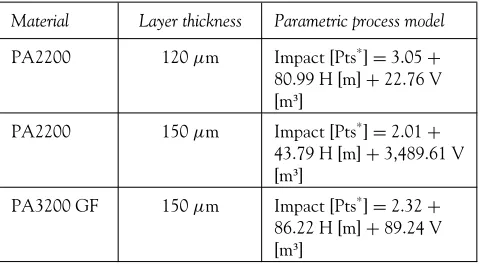
PA2200 120µm Impact [Pts*]=3.05+ 80.99 H [m]+22.76 V [m³]
PA2200 150µm Impact [Pts*]=2.01+ 43.79 H [m]+3,489.61 V [m³]
PA3200 GF 150µm Impact [Pts*]=2.32+ 86.22 H [m]+89.24 V [m³]
*Eco-points quantified using the ReCiPe Europe Endpoint H/A method
(Goedkoop et al. 2013).
µm=micrometers; m=meters; m3=cubic meters.
on the computer-added design (CAD) model of the part, en-compassing energy, resource, and material consumption. The methodology is based on both analytic and experimental mod-els and allows comparison of different manufacturing strategies and their related environmental footprints.
Xu and colleagues (2014) developed a modeling method to calculate the total printing energy consumption of binder jet-ting (BJ) technology correlajet-ting the consumed energy with part geometry, layer thickness, and part orientation. However, the model only estimates the energy consumption of the printing phase and needs to be updated to include the energy demand of the curing and sintering steps as well as the resource demands and process emissions in order to quantify the total environ-mental footprint of the complete process chain.
Nimbalkar and colleagues (2014) developed a generic im-pact assessment tool, covering material preparation, manufac-turing, transport, use phase, and disposal life cycle stages, which can be used to analyze and compare the impacts caused by AM manufacturing processes. Despite the tool having been suc-cessfully applied in some case studies, the authors observed significant inconsistencies in the available LCI data for AM technologies.
Kellens and colleagues (Kellens 2013; Kellens et al. 2014) developed a parametric process model to estimate the envi-ronmental footprint of selective laser sintering of PA2200 and PA3200GF polymer materials. The process model includes en-ergy and resource consumption as well as direct process emis-sions and quantifies the environmental impact based on the total build height (H) and volume (V). Table 3 provides the proposed parametric models for a selected powder refresh rate of 50%.
Environmental Improvement Potential
of Additive Manufacturing Processes
environmental impact caused by a manufacturing process can be quantified. Based on this information, potential improvement measures can be investigated. In general, three main categories of improvement measures can be distinguished: (1) appropriate process and machine tool selection; (2) optimized machine tool design; and (3) optimized process parameters (Kellens 2013). This section provides an overview of potential environmental improvement measures for AM processes structured according to these three categories.
Proper Process and Additive Manufacturing System Selection
Gutowski and Sekulic (2011) showed the trend, driven by the need to machine more precise, complex, and high-quality components toward more energy-intensive processes, process-ing less material while consumprocess-ing more energy per unit volume processed. Within the boundaries of technological (geometric capabilities, dimensional and surface quality tolerances) and economic (cost, productivity/throughput time) constraints, en-vironmental impact minimization can be pursued through op-timized process selection.
Figure 4 provides an overview of the SEC values for different AM processes. However, in order to select the most appropriate manufacturing process (whether or not AM), the total envi-ronmental impact caused, including resource and waste flows, should be taken into account. A detailed overview of efforts in comparing the environmental impact caused by AM as well as conventional manufacturing processes is provided further in this article.
Kerbrat and colleagues (2010a, 2010b) proposed a method-ology to estimate the manufacturing complexity for machining and AM, and the manufacturing of tooling (dies and molds) via a hybrid route combining high-speed machining and SLS processes. Starting from a CAD file, manufacturability indices are set and quantified according to geometric, material, and specification data. The indices provide a detailed view of which regions of the dies and molds may advantageously be machined or manufactured by SLS.
In addition to the process selection, the AM system used is likely to exert an influence on the environmental impact caused. Since energy and inert gas consumption and the rate of waste generation in powder bed fusion processes, such as SLS and SLM, are strongly influenced by the size of the process chamber, a well-considered choice of the allocated equipment can reduce the environmental impact of the produced build (Kellens et al. 2014).
Optimized Additive Manufacturing System Design
AM systems designed to operate with lower energy and re-source demands will result in products exhibiting a lower envi-ronmental footprint and thus system design is important. Poten-tial improvements at system design level are described below.
Powder heaters in process chambers, frames, and build-ing platforms often consume between 20% and 40% of the
total energy consumption of AM systems (Kellens et al. 2014). Niino and colleagues (2011) proposed an SLS variant with-out powder bed preheating by using support structures (scaf-folds allowing the production of complex parts and which are removed afterward), instead of powder bed preheating. After-ward, an annealing treatment process is used to relieve residual stresses.
Pinkerton (2015) described the potential environmental benefits of more energy-friendly laser sources in AM. High-power lasers, with increased wall plug efficiency and improved overall process control, can contribute to the reduction of some of the existing AM process weaknesses, such as layer thickness, deposition rate, and high energy demand. Furthermore, lasers can facilitate the use of combinations of different technologies (e.g., additive-subtractive) as well as to improving the surface quality of AM manufactured products.
Another potential AM system design improvement can be found in better sealed process chambers leading to the reduc-tion of consumed process gasses required to create the inert pro-cess atmosphere. Other such improvements include selectively switching on and off subsystems depending on the requirements of the different production modes. Finally, the development of flexible adaptable process chambers (height, width, and depth) and build containers will allow the production of a wide variety of products (or complete build existing of multiple parts) on the same AM system while limiting the energy, resource, and waste flows and related environmental impact (Kellens et al. 2014).
Optimized Build Design and Process Parameters
Another way to limit the environmental impact of manu-facturing can be found in the selection of the most appropriate build design and applied AM process parameters.
Taking into account the approximately constant power con-sumption of AM processes, Mognol and colleagues (2006) ar-gues that the total manufacturing time should be minimized in order to minimize the electrical energy demand. For multi-jet modeling (MJM) and SLS, this means that the height of the part must be minimized. For FDM, the volume of support structures should be minimized.
After performing an electrical energy analysis of SLS of polyamide powders, Franco and colleagues (Franco et al. 2010; Franco and Romoli 2012) concluded that the best results could be obtained operating with an energy density range of 0.02 to 0.08 joules per square millimeter (J/mm²) in which all laser en-ergy is useful for the process. Enen-ergy densities of 0.06 to 0.08 J/mm²can lead to a reconsideration of the SLS process as part of an effort to eliminate the preheating phase.
Baumers and colleagues (2010, 2011) analyzed the SEC val-ues for a range of AM systems and concluded that the total build volume should be maximized in order to increase the pro-cess efficiency of AM propro-cesses and minimize the related energy consumption.
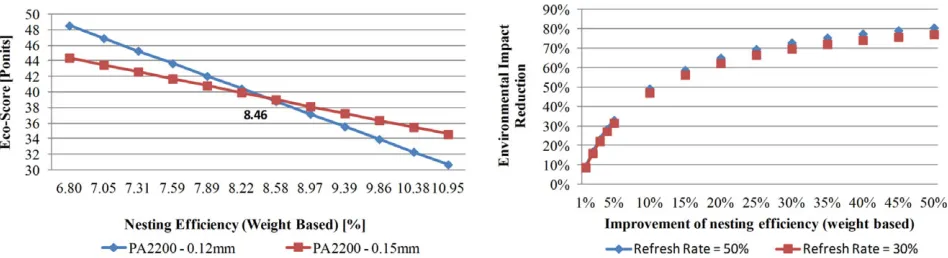
Figure 5 Environmental impact and reduction potential for SLS in function of layer thickness, nesting efficiency and powder refresh rates. PA2200=fine polyamide. Image source: Kellens and colleagues (2014). SLS=selective laser sintering.
used a Pareto analysis to determine the optimal trade-off be-tween both parameters.
Paul and Anand (2012, 2015) developed a model to calcu-late the optimal values for layer thickness and part orientation resulting in minimized process energy, lower part form errors (cylindricity and flatness), as well as higher part strength.
An energy and waste optimization MATLAB model con-sisting of a part-level and layer-level optimizer has been devel-oped by Verma and Rai (2013). While the first defines the best part orientation, the latter determines the most suitable layer thickness. Achieving acceptable surface quality as well control-ling volumetric errors within the produced parts, the authors quantified the potential energy and waste savings for a series of polycarbonate products produced on a SLS Vanguard HiQ Sinterstation.
Kellens and colleagues (2014) analyzed the influence of the nesting efficiency, the ratio between the useful AM part volume, and the volume of the total build container for SLS processes on the optimal layer thickness selection and environmental impact caused. They quantified the potential impact reduction as a function of the nesting efficiency improvement and ap-plied powder refresh rates, which represent the percentage of remainder powder which is wasted and replaced by fresh powder material (figure 5). Among others, Hur and colleagues (2001), Mognol and colleagues (2006), Gogate and Pande (2008), and Ara´ujo and colleagues (2015) presented possible strategies to improve the nesting efficiency.
As shown in figure S2-1 of supporting information S2 on the Web, for SLS processing of polymer powders, more than 50% of the generated impact is caused by the powder production and treatment of the resulting production waste material. In conse-quence, higher powder recycling rates can provide significant impact reductions. While Kellens and colleagues (2014) quan-tified the potential reduction in impact as a function of the increased powder recycling rate, Dotchev and Yussof (2009) provide a method to gather and separate unsintered powder. To control the input material quality and increase the fresh powder efficiency, the authors suggest using different grades according to the melt flow rate of the recycled powder. Unfortunately, the effect of repeatedly recycling of the unsintered powder on the actual powder properties, and hence subsequent component
properties, has not yet been intensively studied (Dawes et al. 2015). Caroll and colleagues (2006) and Seyda and colleagues (2012) observed that thermal effects in SLM cause physical and chemical changes to the recycled powder, leading to an in-creased powder particle size distribution after powder recycling in powder bed AM. Furthermore, powder contamination can occur due to pre- or postprocessing steps.
Further reduction in wasted material can be obtained by optimizing the volume of the required support structures. Diaz Lantada and colleagues (2017) present a methodology to gener-ate bioinspired fractal or tree-like support structures within the photopolymerization process and validate their approach by six case-study examples. Compared to support structures generated with conventional software, the bioinspired alternatives save 40% to 80% of the support material.
Comparison of the Environmental
Performance of Additive Manufacturing
Processes with Conventional Production
Processes
This section provides an overview of comparisons between the environmental performance of CM routes and their AM alternatives. However, it should be noted that current AM technologies do not produce parts of equivalent dimensional tolerances and surface quality, and therefore often need post-processing, typically performed by CM processes (see above). In consequence, AM is not a standalone technology, as is often assumed in the available case studies, and AM is not so much a substitute for CM technologies, but, in fact, a complement. Fur-thermore, the design constraints (e.g., cost versus performance, and minimum weight) can differ between alternative AM and conventional part designs. Unless specifically mentioned, the comparisons listed below assume equivalent product function-ality and qufunction-ality, which can be questioned in some cases.
solid-to-cavity volume ratio, the authors concluded that DMD offers great potential for updating, repairing, and remanufac-turing of tooling (see below) leading to significant savings in energy consumption and related environmental emissions and economic costs over the tool life.
Benatmane (2010) compared, in the framework of the ATKINS project, the environmental impact of a Delphi diesel pump housing manufactured via gravity die casting and SLM. The SLM manufacturing route allowed Delphi to make the housing as a single part while avoiding a number of subsequent manufacturing steps, such as machining, drilling, and chemical deburring. The buy-to-fly ratios, that is, the weight ratio be-tween the raw material used for a component and the weight of the component itself, were 2:1 and 1.4:1 for the casting and SLM routes, respectively. Table S3-1 of supporting information S3 on the Web provides an overview of the life cycle energy and material consumption of the different housings. The obtained energy savings (up to 75%) result primarily from the reduced material demand as well as use phase savings due to lighter part weight (discussed further below).
Kerbrat and colleagues (2010a, 2010b) developed a set of manufacturing complexity indices (e.g., maximum dimensions, volume, height, skin surface, distance from center of the plat-form, blank volume, quantity of chips, and cutting tool flexibil-ity) applicable to CNC machining and SLS in order to facilitate process selection and design modularization approaches for im-proved manufacturability and lower cost.
Serres and colleagues (2011) underlined the importance of the environmental impact caused during the upstream processes generating the required raw materials (e.g., ingots and powders) by comparing the environmental performance of the DALM process with conventional machining and casting techniques.
Senyana (2011) studied the difference in environmental im-pact between a centralized manufacturing scenario (forging and machining) versus a distributed manufacturing scenario using EBM with minimal finish machining for titanium parts. Two transportation scenarios were analyzed transporting the finished parts from central China to Kansas USA: (1) 11,000 kilometers (km) by airplane and 1,900 km by truck and (2) 1,700 km by truck, 9,900 km by ship, and 2,100 km by truck. The author found that, at high production volumes, the distributed manu-facturing scenario produced approximately 1 order of magnitude fewer eco-points (1,000 eco-points represent the average yearly impact of a European inhabitant) than the centralized man-ufacturing alternative. This disparity is even greater at small production volumes where the eco-points associated with tool-ing production are spread over fewer parts.
Elaborating on the approach presented by Telenko and Conner Seepersad (2012), Chen and colleagues (2015) compared the environmental impact of SLS as typical AM process and injection molding processes as a conventional mass production process. The authors indicated the importance of the process productivity for the total energy demand. As shown in figure S3-1 of the supporting information on the Web, the impact of the process time demand (factor 10 to 100 higher for SLS) dominates and leads to significantly higher energy
intensities for SLS, although the power demand is clearly lower (up to factor 10) than for injection molding. Taking into account the energy demand for the mold manufacturing as well as the SEC of both processes, the break-even analysis (shown in figure S3-2 of supporting information S3 on the Web) illustrates the total energy demand of manufacturing as a function of the processed production volume (total weight of the production batch). The tipping point from SLS to injection molding lies around 42 kg of processed final product.
A comprehensive comparison of bulk-forming (injection molding), subtractive (milling), and AM (FDM) processing of an ABS P400 test part (see figure S3-3 of Supporting Information S3 on the Web) has been presented by Yoon and colleagues (2015). Because of the considerable mold-making and warm-up energy, injection molding shows the highest en-ergy consumption for the production of a single part. The SEC values for injection molding and machining (due to a rather high estimated set-up energy demand) decreased significantly for an increasing number of parts produced.
Faludi and colleagues (2015) performed a cradle-to-grave life cycle assessment (LCA) and compared the environmental impact (shown in figure S3-4 of Supporting Information S3 on the Web) of two AM systems (FDM Dimension 1200BST and Object Connex 350 inkjet) to a traditional CNC milling machine tool (Haas VF0) for the production of two specific acrylonitrile butadiene styrene (ABS) polymer parts. Assum-ing a similar surface quality and tolerances (and thus neglect-ing eventually required postprocessneglect-ing), the authors indicate that the FDM process had the lowest environmental impacts (ReCiPe endpoint H method; Goedkoop et al. [2013]) per part. The performance of the inkjet versus CNC milling machine tool depends on the machine tool employment and the applied process parameters. Therefore, the authors concluded that it cannot be categorically stated that 3D printing is more envi-ronmental friendly than machining or vice versa.
Watson and Taminger (2015) present a simple computa-tional model for the selection of AM or subtractive processes for metallic parts on the basis of energy consumption. The key discriminating variable is the volume fraction (fraction of the bounding envelope that contains material) of the part.
Plunge milling and laser cladding processes are compared via an LCA by Peng and colleagues (2017) for the production of an impeller. The environmental burden of the AM manufacturing is approximately double that of the conventional machining route via plunge milling.
Using a combined indicator for environmental impact ra-tio and volume of material removal rate, Paris and colleagues (2016) concluded that, from an environmental perspective, the choice between conventional milling or EBM depends on the complexity and related volume of material removal rate.
Figure 6 Cradle to gate primary energy savings for 5 case study parts. Image source: Huang and colleagues (2015); reprinted with permission from Elsevier. AM=additive manufacturing; CM=conventional manufacturing; GJ/kg=gigajoules per kilogram; kg=kilograms; MJ=megajoules.
high material removal demands, the conventional machining route remains preferably for lower removal rates.
Potential Life Cycle Benefits of Additive
Manufacturing Manufactured
Components
This section provides an overview of research on potential environmental benefits of AM-produced components during their use stage or service life.
Burkhart and Aurich (2015) presented a framework to identify vehicle components with potential for environmental improvement in terms of weight reduction or efficiency im-provement. While their article does not include quantitatively explored case studies, the following subsections of this review article provide some specific case studies on the most relevant potential benefits AM-manufactured products can offer during their life span.
Weight Reduction
Among others, Diegel and colleagues (2010), Brackett and colleagues (2011), Ponche and colleagues (2012), Zegard and Paulino (2016), as well as Gardan and colleagues (2016) present design for AM approaches and link topology optimization with AM. The authors describe the required adaptations of avail-able tools and couple topology optimization with both AM de-sign requirements as well as manufacturing constraints. Adam and Zimmer (2014) describe a comprehensive list of design
rules for SLS, SLM, and FDM processes developed within the “Direct Manufacturing Design Rules” project (University of Paderborn).
The research literature includes several “design for AM” case studies in which parts have been redesigned (e.g., use of lattice or spatial structures) to reduce weight while still satisfying the original functional design requirements (i.e., strength, stiffness, etc.). As described in the following paragraphs, from environ-mental perspective, weight reduction in transport systems (e.g., automotive and aerospace components) can lead to significant reductions in energy consumption and carbon emissions over the life of the transport system.
gas emission reductions were estimated at 92.1 to 215.0 million metric tonnes (Mt).2Finally, thousands of tonnes of aluminum, titanium, and nickel alloys could also be saved annually by 2050 due to the decrease in material requirements.
One of the most well-known examples of lightweight com-ponents is the fuel nozzle implemented in the LEAP jet engine by GE Aviation (GE Aviation 2016). The AM manufactured nozzle is 25% lighter, offers a cost reduction of 75%, and con-tributes to the aircraft’s fuel efficiency. Furthermore, the nozzle has a simpler design (one component instead of 18 beforehand) and more intricate cooling pathways and support ligaments re-sult in a 5 times higher durability.
While a DMD pathway consumed approximately 3 GJ more than the conventional machining pathway for the produc-tion of an injecproduc-tion mold insert, a thin-walled structure for a lightweight mirror designed for an application in outer space produced by DMD was found to reduce the part volume with 66%, the manufacturing time with 96%, and the related energy consumption with 20% compared to the original mirror design produced by CNC milling (Morrow et al. 2007).
Nimbalkar and colleagues (2014) compared the produc-tion of an aircraft ventilaproduc-tion assembly produced via FDM (0.040 kg) and injection molding (0.043 kg) as well as a topo-logically optimized aerospace bracket manufactured by EBM (0.38 kg) and conventional machining (1.09 kg). The main benefits shown in both case studies are achieved during the use phase (± 15 million miles in a short-haul aircraft and 19 million miles in a long-haul aircraft, respectively) of the lightweight components. The total energy savings are quanti-fied to be around 233 MJ/part and 70 GJ/part, respectively.
Supply-Chain Management: Centralized versus Decentralized Production
Suppliers of spare parts suffer from high inventory and distri-bution costs in many industries. Walter and colleagues (2004) and P´er`es and Noyes (2006) were among the first to address the potential of AM technologies to become the basis for new solutions in the supply-chain management of spare parts. Whereas centralized AM could reduce inventory holding re-quirements because small numbers of parts could be produced on demand economically, decentralized AM could overcome inventory holding as well as conventional distribution prob-lems (Holmstr¨om et al. 2010; Holmstr¨om and Gutowski 2017). Industries producing expensive equipment in small volumes and intended for a long service life (e.g., aerospace) are examples of potential application domains using AM as production strategy for spare parts (Walter et al. 2004).
In a follow-up of the research by the previous authors, Khajavi and colleagues (2014) investigated the provision of spare parts for the F-18 Super Hornet environmental control system. Using current AM technology, centralized production is clearly the preferable supply-chain configuration in the case example. The acquisition price of AM systems, personnel intensiveness, and slow production rate are major barriers to a distributed deployment of AM systems in the supply chain
of spare parts. If these obstacles can be tackled, Khajavi and his colleagues listed following potential advantages of dis-tributed AM production of spare parts: lower overall operation costs; reduced down time; increased potential for customer satisfaction; lower capacity utilization; greater flexibility; greater robustness to supply-chain disruptions; reduced need for inventory management and logistics information systems; and potential for sustainability improvements. However, the required adjustments/improvements of AM systems seem rather unrealistic on the short term.
Tuck and colleagues (2007) discussed the way AM will change supply-chain management thinking considering the principles of lean, agile, and leagile (hybrid of lean and ag-ile) supply as well as the potential for mass customization. The authors indicated the available opportunities for AM to reduce production cost through the rationalization of logistics, labor, stock holding, and the ability to deal with unstable demand patterns. Hasan and Rennie (2008) explored the application of AM in the spare parts industry and proposed an e-business enabled model for remanufacturing (RM) products.
While the main focus of the above-mentioned research was on the economic perspective, Kohtala (2015) presents a com-prehensive review of the sustainability issues of distributed pro-duction. The review summarizes the potential opportunities for more environmental-friendly manufacturing as well as existing threats. However, Kohtala indicated that most of the consulted studies are still conceptual explorations with lack of experi-mental analysis and related quantitative data. Figure 7 provides a graphical overview of the listed environmental benefits and concerns as identified by Kohtala.
Since raw materials need to be transported as well, the au-thors of this paper would like to underline the need for fur-ther assessment of the reduction of transportation requirements due to decentralized production. The potential benefits will be strongly influenced by the distance between product manufac-turer and feedstock producer (for AM, this is currently a rather limited number) and the material efficiency of the applied pro-duction process chain. Furthermore, various LCA studies of commercial products indicate that the environmental impact of the transportation phase represents only a few percent of their total lifetime impact (e.g., Hanssen 1998; Apple 2014). In consequence, the potential environmental benefits are rather limited.
Repair and Remanufacturing of Components
Figure 7 Environmental benefits and concerns regarding distributed production identified by Kohtala. Image source: Kohtala (2015); reprinted with permission from Elsevier. MP=mass production; MC=mass customization.
Wang and colleagues (2007) and Pinkerton and colleagues (2008) investigated the use of laser direct metal deposition as repairing technique for deep or internal cracks and defects in metallic components (after milling a slot down to the affected area). Despite the high-quality repairs that can be obtained, ac-cording to Wang and colleagues (2007), porosity at the bound-aries between the original part and the added material could be a problem.
Turbine blades are well known as an example of RM using AM. Jones and colleagues (2012) and Wilson and colleagues (2014) described the remanufacturing of such turbine blades by laser cladding and laser direct deposition (LDD) processes, respectively. While the first study mainly focused on techno-logical issues, the latter includes an energy and environmental impact analysis. A comparative LCA (using the Intergovern-mental Panel on Climate Change [IPCC] 2007 global warming potential [GWP] 100a V1.01 and Cumulative Energy Demand V1.05 method) covering energy and resource consumption was conducted of RM of a damaged turbine blade by the LDD pro-cess versus producing a new blade by means of casting. LDD is most beneficial for relatively small defects. For a repair volume of 10%, the estimated energy and carbon footprint savings are 36% and 45%, respectively.
Wits and colleagues (2016) discussed how maintenance, re-pair, and overhaul (MRO) strategies can be optimized to the specific needs of end users using AM technologies. The au-thors presented four strategies optimizing the MRO process flow: (1) adaptation of parts to end-user needs; (2) merging parts to avoid unnecessary assemblies; (3) updating parts for new applications; and (4) a combination of the aforementioned strategies.
The environmental benefit of remanufacturing impellers via AM compared to conventional production by plunge milling is assessed by Peng and colleagues (2017). Their analysis indicates that remanufacturing will reduce the GWP, Chinese resource
depletion potential, and water eutrophication potential with 64.7%, 66.1%, and 75.4%, respectively.
Functional Improvements Obtained via Additive Manufacturing
AM technologies can produce radically alternative designs that perform a required function with significantly better energy or material efficiencies, such as, for example, more efficient turbine blades or fuel injections.
Morrow and colleagues (2007) quantified a potential reduc-tion of cycle time (i.e., the time required to produce a part) of an injection molding process to 40%. This was done by re-placing the conventional cooling channels by conformal chan-nels produced via DMD resulting in energy savings during the molding process. However, the DMD production of the insert consumed approximately 3 GJ more compared to conventional CNC milling. In the same field, Wu and colleagues (2015) proposed a framework for the thermal-mechanical topology op-timization of injection molds with conformal cooling via AM.
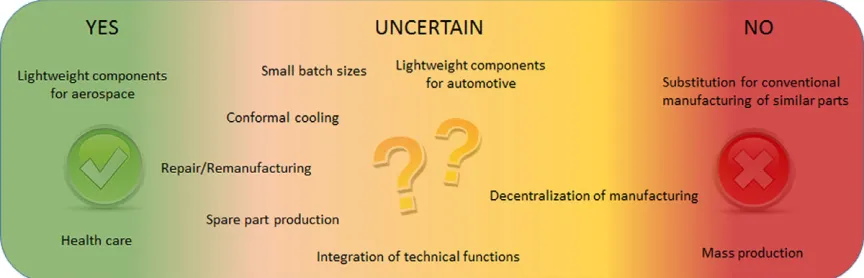
Figure 8 Potential benefits of AM application fields from an environmental perspective. AM=additive manufacturing.
Health and Safety Issues Related
to Additive Manufacturing
The toxicological and environmental hazards of AM are not sufficiently understood at present. In order to prevent health and ecosystem damages caused by handling, using, and disposal of AM materials and products, further investigations in this field are required. In this respect, Drizo and Pegna (2006) pointed out that one of the most pressing areas of research is the inves-tigation of toxicity and harmful effects of materials used in AM. For most epoxy resins and powder materials, health/material safety data sheets, including a discrete hazard scoring system, are available. The majority of these recognize that severe eye and skin irritation and possible allergic skin reactions might occur as a result of handling or inhaling vapor from those ma-terials. It has also been recognized that prolonged or repeated exposure could cause allergic reactions and accidental release measures and thus handling precautions are provided. The po-tential environmental effects are even less known (Drizo and Pegna 2006).
Short and colleagues (2014) indicated that photopolymers used for AM contain large amounts of antimony, a toxic heavy metal, which is used as a photoinitiator in the polymerization reaction. The epoxy resins used for SLA contain up to 10% by weight antimony compounds. Tests indicated that up to 3% of the total antimony contained in the material may be leached over the standard test duration of 20 hours. Oskui and col-leagues (2016) and Macdonald and colcol-leagues (2016) analyzed the toxicity of FDM and SLA photopolymers using zebrafish embryo toxicity assays. All assessed commercial available poly-mers (VisiJetCrystal EX200, Watershed 11122XC, Fototec SLA 7150 Clear, and ABSplus P-430) were found to be highly toxic to the embryos, resulting in fatality. A simple post-treatment (exposure to ultraviolet [UV] light) could largely mitigate the toxicity of SLA printed parts (Oskui et al. 2016). The authors concluded that special attention is needed for strategies for safe disposal of AM production waste streams as well as AM manu-factured parts.
Stephens and colleagues (2013), Merlo and Mazzoni (2015), and Deng and colleagues (2016) investigated the ultrafine
particle emissions from desktop 3D printers. With total ul-trafine particle emission rates per minute up to 1.9 × 10¹¹ (ABS) and 2.0 × 10¹⁰ (polylactic acid), the analyzed AM systems can be categorized as high emitters. However, the authors indicated that more controlled experiments need to be conducted to more fundamentally evaluate aerosol emis-sions by AM. Deng and colleagues (2016) concluded that the emissions are mainly caused by the heating process, and for ABS a particles emission reduction up to 75% can be ob-tained by externally preheating both the extruder and building platform.
While Deak (1996, 1999) was among the first to address the importance of a health and safety plan of action (e.g., ad-equate working space, proper air ventilation, proper dust col-lection, and use of protective gloves and safety glasses) as well as plan of follow up (e.g., written procedures), the impact of AM processes on the health and safety of operators and the environment has been investigated more in detail by Short and colleagues (2015). The authors provided a “best practices” guide for rapid prototyping laboratories. Reviewing all chemical tox-icity, flammability/explosion as well as UV and laser radiation hazards, two critical areas are identified: ventilation and waste management.
Conclusions and Future Outlook
This review article provides an extensive overview of doc-umented, quantified efforts to analyze the environmental di-mensions of AM technologies. First, environmental analysis, process modeling, and improvement measures were discussed at AM unit process level. Second, a summary of research compar-ing the environmental performance of AM processes and CM strategies and a structured overview of potential benefits arising during the use phase of AM manufactured parts are provided. Third, potential health and safety issues related to AM were briefly discussed.
Environmental Analysis and Modeling of Additive Manufacturing Technologies
◦ The environmental impact caused during the AM feed-stock production stage is not well documented and quantified yet and needs to be addressed in future research.
◦ While multiple authors provide partial or complete, quantitative LCI data/environmental process models for SLS, SLM, EBM, and FDM processes, LCI data for other AM unit processes are limited or nonexistent.
◦ The reported SEC values for AM systems are 1 to 2 orders of magnitude higher than those for CM processes such as casting, machining, or injection molding.
◦ Most described LCI efforts focus mainly on energy con-sumption. In order to assess the full environmental impact of manufacturing, also the material resource consumption and direct as well as indirect process emissions should be documented and analyzed.
◦ The number of full LCA studies is very limited.
Environmental Improvement Potential of Additive Manufacturing Processes
Potential improvement measures for AM processes can be divided in three categories:
◦ Appropriate process and AM system selection can lead to significant savings in energy and resource consumption. For powder bed fusion processes, the size of the process chamber and related nesting efficiency plays an important role.
◦ From the AM system design perspective, better sealed process chambers, more efficient laser sources, and adapt-able process chambers are potential improvements.
◦ Finally, the operational setup (e.g., part orientation and nesting efficiency) and applied process parameters (e.g., layer thickness and scanning speed) have an impor-tant influence on the environmental impact caused. Effi-ciently nested builds instead of single part production can lower the impact of AM processes significantly. Powder bed processing of polymers causes large amounts of waste (up to 50% of the build volume), which cannot be reused in AM. Better powder recycling strategies and standard-ized AM feedstock requirements can significantly reduce the environmental impacts of these processes.
Comparison of Environmental Performance of Additive Manufacturing Processes with Conventional
Production Processes
◦ The impact caused during material production and AM processing of identical parts is typically much higher com-pared to CM.
◦ Exceptions can be found for very small batch sizes where AM can be beneficial due to the absence of the adverse environmental impact of dedicated process tooling.
◦ From the perspective of the full product life cycle, AM strategies can offer environmental benefits where part redesigns can offer substantial functional advantages for the use phase (see below).
◦ Most of the present comparison studies assume a simi-lar part functionality and quality for AM and CM routes. The need for postprocessing of AM manufactured parts in order to obtain the required geometrical and surfaces tol-erances and their related environmental impact is often underestimated or neglected.
Potential Life Cycle Benefits of Additive Manufacturing Manufactured Components
Taking into account the higher unit material and manu-facturing impact of AM, the additional impacts needs to be compensated by efficiency gains due to design changes leading to functional benefits during the use stage of the AM manufac-tured parts.
◦ A first example of such functional benefits can be found in lightweight components for transport systems (e.g., automotive and aerospace applications).
◦ While centralized AM can reduce inventory holding re-quirements, decentralized AM can obviate the need for inventory holding as well as distribution problems and reduce transportation impacts. However, the required raw materials require transportation, potentially offset-ting some benefits. Taking into account the acquisition price, personnel intensiveness, and slow production rate of current AM systems, centralized AM tends to remain the preferably strategy on the short term.
◦ AM can be used to repair/remanufacture damaged compo-nents and thus avoid the production of new compocompo-nents. Savings up to 50% are reported for a stamping tool as well as turbine blades.
◦ Further functional improvements obtained by AM can be found in designs providing more efficient coolant flows (e.g., conformal cooling of injection molding dies), the integration of additional technical functionality (e.g., springs and hinged joints), as well as the consolidation of the number of components within an assembly.
Health and Safety Issues Related to Additive Manufacturing
◦ The toxicological and environmental hazards as well as safety issues of AM are not well known at present and should be the focus of further research.
inhalation risks. Therefore, proper dust collection and air ventilation as well as the use of protective gloves and safety glasses and masks is highly recommended.
Summarizing the environmental performance of AM, figure 8 positions the discussed AM application fields relative to their environmental implications. While, for some domains, AM has clear environmental benefits or disadvantages com-pared to traditional manufacturing, the environmental benefits of most application domains remain a rather open question. Of course, the environmental perspective is not the only one to be taken into account for process allocation. For example, within healthcare, AM can provide great social benefits by offering the potential to save lives or dramatically improve life quality. Early developments to create tissue, organs, bones, and prosthetic de-vices/implants provide examples of how lives may be saved or improved.
In general, the authors conclude that, from an environmen-tal perspective, AM can be a good alternative for producing customized parts or small production runs as well as complex part designs creating substantial functional advantages during the part-use phase.
Taking into account the lack of detailed LCI data and high data uncertainties, which may alter the conclusions from the performed analysis, the need and value for further LCI data collection efforts and related LCA studies on AM applications is evident. Special attention should be placed on LCI efforts of AM feedstock production, supply-chain consequences, and health and safety issues relating to AM.
Funding Information
Karel Kellens and Joost Duflou thank the KU Leuven for the financial support via the GOA SUMMA (Sustainable Materials processing in Manufacturing–3E140361) project.
Notes
1. One gigatonne (Gt)=1 petagram (Pg)=109 tonnes (t)=1012 kilograms (kg, SI)1.102×10⁹short tons.
2. One million metric tonne (MMT)=106tonnes (t)=109kilograms (kg, SI)1.102×10⁶short tons.
References
Abel, B. V., L. Evers, R. Klaasen, and P. Troxler. 2011.Open design now—Why design cannot remain exclusive. Amsterdam: Bis. Adam, G. A. O. and D. Zimmer. 2014. Design for Additive
manufacturing—Element transitions and aggregated structures.
CIRP Journal of Manufacturing Science and Technology7(1): 20– 28.
Apple. 2014. iPhone 6 environmental report. Apple Computer. www. apple.com/environment/reports/docs/iPhone6_PER_Sept2014. pdf. Accessed October 2016.
Ara´ujo, L. J. P., E. ¨Ozcan, J. A. D. Atkin, M. Baumers, C. Tuck, and R. Hague. 2015. Toward better build volume packing in additive manufacturing: Classification of existing problems and
benchmarks. In Proceedings of the 26th Annual International Solid Freeform Fabrication Symposium, 10–12 August, Austin, TX, USA, 401–410.
ASTM (American Society for Testing and Materials). 2012. F2792-12: Standard Terminology for Additive Manufacturing Technologies 2012. www.astm.org/Standards/F2792.htm. Accessed May 2017. Balogun, V. A., N. Kirkwood, and P. T. Mativenga. 2015. Energy consumption and carbon footprint analysis of fused deposition modelling: A case study of RP Stratasys Dimension SST FDM.
International Journal of Scientific & Engineering Research6(8): 442– 447.
Baumers, M., C. Tuck, R. Hague, I. Ashcroft, and R. Wildman. 2010. A comparative study of metallic additive manufacturing power con-sumption. In Proceedings of the 21st Solid Freeform Fabrication Symposium, 9–11 August, Austin, TX, USA, 278–288. Baumers, M., C. Tuck, R. Wildman, I. Ashcroft, and R. Hague. 2011.
Energy inputs to additive manufacturing: Does capacity utilization matter? In Proceedings of the 22nd Solid Freeform Fabrication Symposium, 8–10 August, Austin, TX, USA, 30–40.
Baumers, M., C. Tuck, R. Wildman, I. Ashcroft, E. Rosamond, and R. Hague. 2012. Transparency built-in. Energy consumption and cost estimation for additive manufacturing.Journal of Industrial Ecology17(3): 418–431.
Baumers, M., C. Tuck, R. Wildman, I. Ashcroft, and R. Hague. 2016. Shape complexity and process energy consumption in electron beam melting: A case of something for noth-ing in additive manufacturnoth-ing? Journal of Industrial Ecology. https://doi.org/10.1111/jiec.12397.
Brackett, D., I. Ashcroft, and R. Hague. 2011. Topology optimiza-tion for additive manufacturing. Proceedings of the 22nd Solid Freeform Fabrication Symposium, 8–10 August, Austin, TX, USA, 348–362.
Benatmane, J. 2010. Environmental report pump housing.Econolyst— Atkins—Report 4. www.enlighten-toolkit.com/App_Themes/ Enlighten/Documents/PumpHousing-processes.pdf. Accessed February 2016.
Burkhart, M. and J. C. Aurich. 2015. Framework to predict the envi-ronmental impact if additive manufacturing in the life cycle of a commercial vehicle.Procedia CIRP29: 408–413.
Campbell, T., C. Williams, O. Ivanova, and B. Garrett. 2011. Could 3D printing change the world? Technologies, potential, and im-plications of additive manufacturing. Strategic Foresight Report of the Atlantic Council of the United States. Washington, DC: Atlantic Council of the United States.
Carroll, P. A., P. Brown, G. Ng, R. Scudamore, A. J. Pinkerton, W. Syed, H. Sezer, L. Li, and J. Allen. 2006. The effect of powder recycling in direct metal laser deposition on powder and manufac-tured part characteristics. In Proceedings of AVT-139 Specialists Meeting on Cost Effective ManufactureviaNet Shape Processing. http://eprints.lancs.ac.uk/id/eprint/59645. Accessed June 2016. Chen, D., S. Heyer, S. Ibbotson, K. Salonitis, J. G. Steingrimsson, and
S. Thiede. 2015. Direct digital manufacturing: Definition, evolu-tion, and sustainability implications.Journal of Cleaner Production
107: 615–625.
CSC (Computer Sciences Corporation). 2012. 3D printing and the future of manufacturing. Report by CSC (now known as DXC Technology). http://assets1.csc.com/innovation/downloads/LEF_ 20123DPrinting.pdf. Accessed November 2015.