Article
Online Uniformly Inserting Points on the Sphere
†
Rong Zhou1,2, Chun Chen1, Liqun Sun1, Francis C. M. Lau3 and Sheung-Hung Poon4
and Yong Zhang1,*
1 Research Center for High Performance Computing, Joint Engineering Research Center for Health Big Data
Intelligent Analysis Technology, Shenzhen Institutes of Advanced Technology, Chinese Academy of Sciences, 1068 Xueyuan Avenue, Shenzhen University Town, Shenzhen 518055, China; [email protected] (R.Z.); [email protected] (C.C.); [email protected] (L.S.)
2 University of Chinese Academy of Sciences, 19(A) Yuquan Road, Shijingshan District, Beijing 100049, China
3 Department of Computer Science, The University of Hong Kong, Pokfulam, Hong Kong, China;
4 School of Computer Science, University of Nottingham Ningbo China, 199 Taikang East Road,
Ningbo 315100, China; [email protected] * Correspondence: [email protected];Tel.: +86-755-86392366
† This paper is an extended version of our paper published in the 11th International Conference and Workshops on Algorithms and Computation (WALCOM 2017).
Received: 11 August 2018; Accepted: 11 October 2018; Published: 16 October 2018
Abstract: Uniformly inserting points on the sphere has been found useful in many scientific and engineering fields. Different from the offline version where the number of points is known in advance, we consider the online version of this problem. The requests for point insertion arrive one by one and the target is to insert points as uniformly as possible. To measure the uniformity we use gap ratio which is defined as the ratio of the maximal gap to the minimal gap of two arbitrary inserted points. We propose a two-phase online insertion strategy with gap ratio of at most 3.69. Moreover, the lower bound of the gap ratio is proved to be at least 1.78.
Keywords:online algorithms; uniform insertion; gap ratio
1. Introduction
Uniformly distributing points over a specific domain has many applications in digital halftoning, numerical integration, computer graphics, etc. For the offline version, the number of points is known in advance, which is to configureNpoints as evenly as possible on a metric space, and attention is paid to the final uniformity of thisN-point configuration rather than the uniformity in the process. Different from the offline version, the online version of this problem considers the situation of point insertion requests arriving one by one. Because the total number of points is unknown, points are required to be inserted as uniformly as possible in each insertion step.
According to known online algorithms, there are several ways to estimate the uniformity of the distribution of the points. To measure the uniformity of points, there are several metrics. Some studies use the minimum pairwise distance [1,2] to measure the uniformity. Some other studies take the uniformity problem as minimal energy problems [3]. In discrepancy theory [4,5], uniformity can be defined by the spherical cap discrepancy, which is the supremum of the local discrepancy over all spherical caps. Ref. [6] showed that the spherical cap discrepancy of random point sets, of spherical digital nets and of spherical Fibonacci lattices converges with orderN−1/2. Ref. [7] established connections to spherical cap discrepancy and showed some general discrepancy bounds. Uniformity can also be defined by the ratio between the maximal and minimal number of points in a fixed shape within the area.
1.1. Related Works
For the case of uniformly inserting points in a 2-dimensional plane, Teramoto et al. [8]
and Asano et al. [9] proposed a greedy algorithm using the Voronoi insertion strategy, which works well and the gap ratio is proved to be at most 2. They also studied insertion onto a 1-dimensional line. If the numbernof the points is known in advance, an insertion strategy with the gap ratio 2bn/2c/(bn/2c+1) can be achieved. If the points can only be inserted at the fixed grid, Asano [10] gave an insertion strategy with uniformity 2 for 1-dimensional case. For the case of uniformly inserting points into a square, Zhang et al. [11] proved the lower bound to be at least 2.5 and gave an insertion algorithm with the maximal gap ratio 2.828. Recently, Bishnu et al. [12] attempted to generalize an approximation algorithm framework over all metric spaces. It generates different gap ratios for different metric spaces and the lower bounds for several specific metric spaces are calculated.
1.2. Our Contribution
We consider a special case of the point insertion problem, that is, how to insert points on a sphere as uniformly as possible. To solve the above problem, we proposed an insertion algorithm based on a regular dodecahedron with gap ratio no more than 5.99 in our previous work [13]. In this paper, by a more detailed analysis on specific cases, the upper bound of the maximal gap ratio is improved to 3.69. Moreover, the lower bound of the maximal gap ratio is proved to be at least 1.78.
2. Materials and Methods
2.1. Problem Description
The problem of inserting points on a sphere dates back to J.J. Thomson in 1904 [14]. It aimed to find a configuration ofnelectrons on a sphere so as to minimize the electrostatic potential energy. It played an important role in many scientific and engineering applications [15–17], such as 3D projection reconstruction of Computed Tomography (CT) or Magnetic Resonance Images (MRI).
Formally speaking, there is a point sequence{p1,p2, . . . ,pi, . . .}to be inserted on a sphereS.
When inserting thei-th point,pidenotes its position andSi =p1, . . . ,pidenotes the configuration after
inserting this point. In configurationSi, define the maximal gap to be
Gi =max p∈S minq∈Si
2_d (p,q) (1)
and the minimal gap to be
gi = min p,q∈Si,p6=q
_
d (p,q) (2)
where_d (p,q)is the spherical distance between pandq. Note thatGican also be regarded as the
length of arc corresponding to the maximal empty spherical area. The gap ratio is defined as
ri= Gi
gi
= maxp∈Sminq∈Si2 _
d (p,q)
minp,q∈Si,p6=q _
d (p,q)
(3)
The objective is to minimize the maximal gap ratio ( min maxiri) for each insertion.
2.2. The Insertion Strategy
empty spherical surface area and then computing its center may become prohibitive. Observe that once some points have been inserted, the sphere is partitioned into local structures and the next point insertion within the area of some local structure will only affect the local configuration there, i.e., the spherical distances (including the max gap and min gap) outside this area do not change. Based on this observation, a two-phase strategy can be devised.
Let us consider a regular dodecahedron instead of the sphere. A regular dodecahedron has 12 identical regular pentagonal faces and 20 vertices, as shown in Figure1a. For the convenience of computation, we can assume that the radius of the sphere is√3 and thus the length of each edge of the corresponding regular dodecahedron is 4/(√5+1).
In the first phase, handling the insertion of 20 points on the sphere is quite straightforward: First insert eight orange points at vertices with coordinates(±1,±1,±1). Two arbitrary opposite vertices, for example,A,C1, of the orange cube are inserted first, followed by the remaining 6 points in any arbitrary order. Then insert the remaining 12 points in any arbitrary order, as 6 structures of the same shape for every 2 points on the plane of the cube. The maximal gap ratio in this phase is proved to be 2.618 [13].
In the second phase, since the projection of the regular dodecahedron’s edges divides the sphere into 12 identical curved surface areas, as shown in Figure1b, we can consider point insertion in each local structure.
[image:3.595.184.488.344.484.2](a) (b)
Figure 1. (a) The vertex distribution of the dodecahedron, with 8 orange vertices at(±1,±1,±1), and 12 blue vertices at(0,±φ,±1φ),(±1φ, 0,±φ), and(±φ,±1φ, 0)(Ois the center of the sphere and φ = √4
5+1 ≈ 1.618.); (b) the projection of all the dodecahedron’s edges divides the sphere into 12 identical sections.
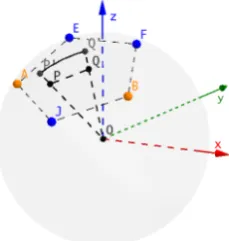
In the previous work [13], we proved that for any two points(P,Q)inside a pentagon (for example, as shown in Figure2,(P,Q)∈PentagonAJBFE, with(P0,Q0)denoting their projection on the sphere), the gap ratio on the plane (pentagon) is smaller than that on the sphere, and we proved the difference can be reduced to 1.34 [13]. Therefore, the comparison between two spherical distances can be reduced to the comparison between two direct distances and the ratio would not change much.
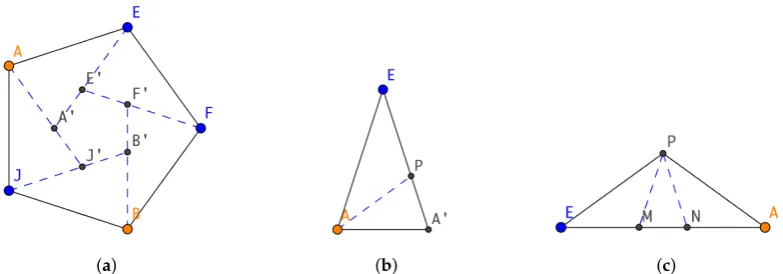
[image:3.595.239.354.629.750.2]We also proposed an insertion strategy in a pentagon in the previous work [13] as shown in Figure3a, each pentagon can be partitioned into 1 smaller pentagon and 5 acute isosceles triangles
with vertex angle of π
5. An acute isosceles triangle can be further partitioned into 1 smaller acute isosceles triangle with vertex angle ofπ
5, as shown in Figure3b and 1 obtuse isosceles triangle with vertex angle of 3π
5, as shown in Figure3c. An obtuse isosceles triangle can be partitioned into 1 acute isosceles triangle and 2 obtuse isosceles triangles. In this way, the pentagon is recursively partitioned into 3 types of shapes, which will be stored in 3 queues respectively.
[image:4.595.104.496.195.332.2](a) (b) (c)
Figure 3.Recursive partitions of a pentagon. (a) Point insertion in a pentagon and partitions; (b) point insertion in an acute isosceles triangle and partitions; (c) point insertion in an obtuse isosceles triangle and partitions.
When a new point comes in, we first compare the insertions on the heads of these three queues and select the one with the largest minimal gaprif the point is inserted at an appropriate position. The incoming point is inserted on the corresponding shape, and the head of the queue is removed, and smaller shapes generated after point insertion are added to the tail of the corresponding queues. Finally, the projected position on the sphere of the inserted point is calculated.
3. Results
By analyzing point insertions step by step, the upper bound of the gap ratio is proved to be at most 3.69. Moreover, the lower bound of the gap ratio is proved to be at least 1.78. Below is the detailed description.
3.1. Analysis of the Upper Bound
We prove that the maximal gap ratio in the first phase is 2.618, and the maximal gap ratio in the second phase is 5.99. However, by analyzing point insertions in a pentagon step by step, the upper bound can be improved to 3.69.
3.1.1. Inserting Points in a Pentagon
For point insertions in each pentagon, there are 5 positions for consideration. Here we compute the gap ratio step by step.
Consider the pentagon AJBFEin Figure3a, assuming that the edge of pentagon AJBFEisl,
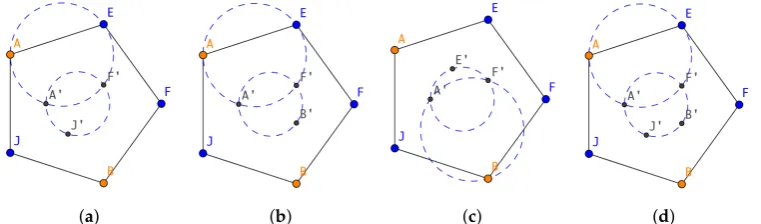
and w.l.o.g., pointA0is inserted first. According to the definition, the maximal gap is the diameter of the circumcircle of∆A0EF, as shown in Figure4a. By the law of sines, we haveGA0= |A
0E| sin∠A0FE =
l
sin(π−25π)/2 =1.236l, and the minimal gap isgA
0 = |AA0| = q
2l2(1−cosπ
5) = 0.618l. Therefore, the gap ratio after the first point insertion on the pentagon isrA0=1.34·GgA0
A0 =2.68.
For the second point F0 on the pentagon, as shown in Figure 4b, the maximal gap is the
diameter of the circumcircle of∆A0BF0,GF0 = |A 0B|
sin∠A0F0B = sinl2π 5
gF0=|A0F0|=|AA0|=0.618l. Thus, the gap ratio after the second point insertion on the pentagon is
rF0=1.34· GgF0
F0 =2.28.
[image:5.595.130.465.132.250.2](a) (b)
Figure 4. Analysis of the first 2 point insertions into the pentagon. (a) Insert the 1st point into the pentagon; (b) insert the 2nd points into the pentagon.
After the insertion of the two pointsA0,F0, the insertion order will not affect the gap ratio. For the third point and the fourth point, see Figure5, the maximal gap will be the diameter of the circumcircle of quadrangleAA0F0Eor the circumcircle of∆A0F0B, which is equal to 1.051l, and the minimal gap equals to the edge of the internal pentagonA0J0B0F0E0, which is 0.382l. So the gap ratio after the third and forth point insertion on the pentagon isr3,4=1.34·Gg =3.69.
(a) (b) (c) (d)
Figure 5.Insertion of the next 2 points into the pentagon. (a) insertJ0as the 3rd point; (b) insertF0as the 3rd point; (c) insertE0as the 3rd point; (d) insert the 4th point.
For the fifth point, the maximal gap will be the diameter of the circumcircle of pentagonA0J0B0F0E0, which is equal to 0.382sinπl
5 = 0.650l, and the minimal gap equals to the edge of pentagonA
0J0B0F0E0,
which is 0.382l. So the gap ratio after the fifth point insertion on the pentagon isr5=1.34· Gg =2.28.
Therefore, the gap ratio for points insertion inside the pentagonr≤3.69.
3.1.2. Inserting Points in an Acute Isosceles Triangle
As shown in Figure3b, the maximal gap equals the diameter of the circumcircle of∆APA0,
i.e., GP = |AA
0|
sin2π 5
= 1.051|AA0|, and the minimal gap is |PA0|, i.e., gP =
q
2|AA0|2(1−cosπ
5) =
0.618|AA0|. So the gap ratio is at mostrP =1.34· GgPP =2.28.
3.1.3. Inserting Points in an Obtuse Isosceles Triangle
For the point insertion in an obtuse isosceles triangle, the computation is similar to the previous case.
For the first point insertion, for example, inserting N, the maximal gap is the diameter of
circumcircle of∆PEN, i.e.,GN = sin|PEπ| 5
= 1.051|PE|. The minimal gap is|PN|, i.e., gN = |PN| =
q
2|PE|2(1−cosπ
5) =0.618|PE|. The gap ratio at this stage isrN =1.34·
GN
[image:5.595.109.490.371.483.2]For the second point insertion, after inserting M, the maximal gap is the diameter of the circumcircle of∆PMN, i.e.,GM = |sinMNπ|
5 = 1.701|MN|. The minimal gap is|MN|, i.e.,gM = |MN|. The gap ratio at this stage isrM=1.34·GgMM =2.28.
Thus, the gap ratio of inserting points in an obtuse isosceles triangle is at most 2.28. Combining all the above cases, we have the following concluding theorem.
Theorem 1. The maximal gap ratio of the insertion strategy is at most3.69.
3.2. Analysis of the Lower Bound
We estimate lower bound for inserting a point sequence on the sphere ofP= (p1,p2, . . . ,pi, . . .)
on the sphere. In this section, we compare the gap ratio after each point insertion and pick out the minimal one, which can be described as:rlb=inf max{r1,r2, . . . ,ri, . . .}.
3.2.1. 2-Point Sequence Insertion
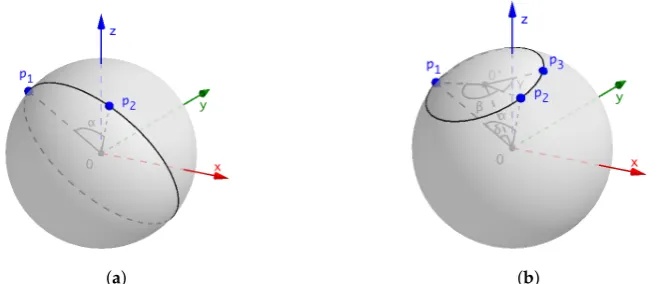
For the 2-point sequence case, the first point is placed arbitrarily, and then the second point should be on the same orthodrome. Let the central angle betweenp1andp2beα, as shown in Figure6a,
and the gap ratio is
r2= G2 g2
= 2π−α
α (4)
Obviously, the minimal gap ratio is 1 whenα=π.
[image:6.595.136.465.382.524.2](a) (b)
Figure 6. Analysis of 2- and 3-point sequence insertion. (a) 2-point sequence insertion; (b) 3-point sequence insertion.
3.2.2. 3-Point Sequence Insertion
Lemma 1. For3-point sequence insertions, the gap ratio is no less than1.78.
Proof of Lemma1. Insert points p1,p2,p3 one after another. After inserting p1 and p2, we have Equation (4) according to the previous case.
After inserting pointp3, these 3 points determine a plane which intersects the sphere. LetRdenote the radius of the sphere,O0denote the center of the circumcircle of∆p1p2p3, andrdenote the radius of the circumcircle; and let∠p1O0p2 = β,∠p2O0p3 = γ,∠O0Op1 = δ. Obviously,G3 = 2R(π−δ).
W.l.o.g., assuming that 0<γ ≤2π−β−γ≤ β< πand 0<δ ≤π/2, we haveg3= _
d (p2,p3) = R·∠p2Op3. Thus,
r3= G3 g3
= 2(π−δ)
∠p2Op3 (5)
In the same way, we can get the value ofα,α=∠p1Op2=arccos(1−sin2δ(1−cosβ)).
So we have
r2= 2
π−arccos(1−sin2δ(1−cosβ))
arccos(1−sin2δ(1−cosβ))
r3=
2(π−δ)
arccos(1−sin2δ(1−cosγ))
In order to get to lower bound, we should find the minimum gap ratio for the worst case of
{r2,r3}. In this way, the lower bound must exist in the case wherer2 = r3. Asδ is independent
to other parameters, we first compute the partial derivative to δ: ddrδ3 = − sin 2δ(1−cosβ)
arccos2χ√1−χ2 < 0, whereχ=1−sin2δ(1−cosβ). In the same way,ddrδ2 <0. So the gap ratio ofr3andr2is a decrement function w.r.t.δ. Thus, the minimal gap is achieved whenδ=π/2 where all the three points are on
the spherical large arc.
So we setδ = π/2 and let r2=r3, and we getγ = 2ππβ−β. By the assumption that 0 < γ ≤
2π−β−γ≤β<π, we can finally get:
γ= 2ππβ−β
γ≤ 2π2−β
γ≥2(π−β)
(6)
By solving (6), we can get 0.719π≤β≤0.764π. Considering that withδfixed, the gap ratio is
a decreasing function w.r.t.β. In this case, the minimal gap ratio is 1.78.
3.2.3. More Point Sequence Insertion
Lemma 2. For more than three points, the gap ratio is no less than1.78.
Proof of Lemma2. In each step of the online insertion, we compute the gap ratio and hope it to be the lowest. After inserting the first three points, the gap ratio can be expressed asr= desa
dmin, wheredesa
is the arc corresponding to the maximal empty spherical area, anddminis the minimum arc. We use
sequenceδ3,δ4,· · ·,δn−1,δn to denote the center angle for the largest spherical area and sequence
_
d3, _
d4,· · ·, _
dn−1,
_
dnto denote the distance for the minimum arc at each step.
Similarly, the minimum gap ratio will exist on the condition thatr2=r3=r4=· · ·=rn−1=rn,
which is equal to Rδ3 _
d3 = Rδ4
_
d4
=· · ·= Rδn−1 _
dn−1 = Rδn
_
dn
. Since we insert the point in order to ensure the gap
ratio is the lowest in each step, we haveδ3= δ4. Moreover, as 0≤ dn ≤dn−1 ≤ · · · ≤d3, we have 0≤ γn ≤ γn−1≤ · · · ≤ γ4 ≤(π−γ4). Thus, we haveγ3 ≤π/2. Sincer3is a decreasing function aboutγ3, the minimum gap ratio will not be less than 1.78 regardless of the values ofαandβ.
Theorem 2. The minimal gap ratio of inserting points on the sphere is no less than1.78.
3.3. Analysis of Computational Complexity
In the first phase of the proposed algorithm, 20 vertices are inserted and a queue of 12 regular pentagons are added to the pentagon-queue. In the second phase, the algorithm focuses on 3 local structures: Pentagons, acute triangles, and obtuse triangles. When a new point arrives, we first determine which queue the new point is to be added to:
2. If the acute triangle queue is selected, insertion of 1 point will lead to removing the head of the queue. Meanwhile, a smaller acute triangle and a smaller obtuse triangle will be added to the tail of the corresponding queues respectively.
3. If the obtuse triangle queue is selected, insertion of 2 points will lead to removing the head of the queue. Meanwhile, a smaller acute triangle and 2 smaller obtuse triangles will be added to the tail of the corresponding queues respectively.
For each point insertion, the comparison and growth of the queues, and the projection calculation of inserted point onto the sphere are constant, and so the computational cost isO(1). Afternpoints have been inserted, the computational complexity isO(n).
4. Discussion
Is it possible to further reduce the gap ratio by using other structures? How about some simpler regular structures, e.g., isocahedron? If we split the isocahedron into four congruent sub-triangles regularly, the gap ratio will be larger since the newly inserted points are on the side of the isocahedron. From the definition, the maximal gap is the spherical diameter of the largest empty circle while the minimal gap is the minimal spherical distance between two inserted points. So, if points are inserted on the side of some configuration, the ratio is not going to be good.
5. Conclusions
Uniform insertion of points is an interesting problem in computer science. In this paper, we use the gap ratio to measure the uniformity of online insertion. We first give a two-phase online insertion strategy with the help of the regular dodecahedron, and then prove that the gap ratio is at most 3.69 and at least 1.78.
Author Contributions:Conceptualization, S.-H.P. and Y.Z.; Methodology, R.Z., C.C.and Y.Z.; Formal Analysis, R.Z. and C.C.; Writing—Original Draft Preparation, R.Z. and C.C.; Writing—Review & Editing, F.C.M.L. and Y.Z.; Visualization, R.Z.; Supervision, F.C.M.L. and Y.Z.; Funding Acquisition, L.S., F.C.M.L. and Y.Z.
Funding:This research is supported by China’s NSFC grants (No. 61433012, U1435215), Hong Kong GRF grant (17210017), and Shenzhen research grant JCYJ20160229195940462 and GGFW2017073114031767.
Conflicts of Interest:The authors declare no conflict of interest.
References
1. Nurmela, K.J.; Ostergard, P.R.J. More Optimal Packings of Equal Circles in a Square.Discret. Comput. Geom.
1999,22, 439–457. [CrossRef]
2. Collins, C.R.; Stephenson, K. A circle packing algorithm. Comput. Geom. Theory Appl.2003,25, 233–256. [CrossRef]
3. García, A.; Saff, E. Asymptotics of greedy energy points.Math. Comput.2010,79, 2287–2316. [CrossRef] 4. Matousek, J.Geometric Discrepancy: An Illustrated Guide; Springer: Berlin/Heidelberg, Germany, 1999. 5. Chazelle, B.The Discrepancy Method: Randomness and Complexity; Cambridge University Press: New York,
NY, USA, 2000.
6. Aistleitner, C.; Brauchart, J.S.; Dick, J. Point sets on the sphereS2with small spherical cap discrepancy.
Discret. Comput. Geom.2012,48, 990–1024.
7. Grabner, P.J.; Tichy, R.F. Spherical designs, discrepancy and numerical integration. Math. Comput.1993,
60, 327–336. [CrossRef]
8. Teramoto, S.; Asano, T.; Katoh, N.; Doerr, B. Inserting points uniformly at every instance. IEICE Trans. Inf. Syst.2006,89, 2348–2356. [CrossRef]
9. Asano, T.; Teramoto, S. On-line uniformity of points. In Proceedings of the Book of Abstracts for 8th Hellenic-European Conference on Computer Mathematics and its Applications, Athens, Greece, 8–11 July 2007; pp. 21–22.
11. Zhang, Y.; Chang, Z.; Chin, F.Y.; Ting, H.F.; Tsin, Y.H. Uniformly inserting points on square grid.Inf. Proc. Lett.
2011,111, 773–779. [CrossRef]
12. Bishnu, A.; Desai, S.; Ghosh, A.; Goswami, M.; Paul, S. Uniformity of point samples in metric spaces using gap ratio.SIAM J. Discret. Math.2017,31, 2138–2171. [CrossRef]
13. Chen, C.; Lau, F.C.; Poon, S.H.; Zhang, Y.; Zhou, R. Online Inserting Points Uniformly on the Sphere. In Proceedings of the International Workshop on Algorithms and Computation, Hsinchu, Taiwan, 29–31 March 2017; pp. 243–253.
14. Thomson, J.J. On the structure of the atom: An investigation of the stability and periods of oscillation of a number of corpuscles arranged at equal intervals around the circumference of a circle; with application of the results to the theory of atomic structure. Lond. Edinb. Dublin Philos. Mag. J. Sci.1904,7, 237–265. [CrossRef]
15. Hicks, J.S.; Wheeling, R.F. An efficient method for generating uniformly distributed points on the surface of an n-dimensional sphere. Commun. ACM1959,2, 17–19. [CrossRef]
16. Koay, C.G. Analytically exact spiral scheme for generating uniformly distributed points on the unit sphere.
J. Comput. Sci.2011,2, 88–91. [CrossRef] [PubMed]
17. Koay, C.G. Distributing points uniformly on the unit sphere under a mirror reflection symmetry constraint.
J. Comput. Sci.2014,5, 696–700. [CrossRef] c