Open Peer Review
Discuss this article (0)
Comments RESEARCH ARTICLE
Commit* to change? A call to end the publication of the phrase
‘commit* suicide’
[version 1; referees: 2 approved]
Emma Nielsen ,
Prianka Padmanathan , Duleeka Knipe
2
Self-Harm Research Group, School of Psychology, University of Nottingham, Nottingham, UK School of Social and Community Medicine, University of Bristol, Bristol, UK
Abstract
Countering stigma is a fundamental facet of suicide prevention
Background.
efforts. Integral to this is the promotion of accurate and sensitive language. The phrase ‘commit* suicide’ has prompted marked opposition primarily due to the connotations of immorality and illegality. Methods. The study investigated the frequency of the use of the wordstem ‘commit’, in relation to self-harm and suicidal behaviours, in the three leading suicide-specific academic journals between 2000 and 2015. Results. One third (34%) of articles published since the year 2000 used the word ‘commit*’ when describing an act of self-harm or suicide. Over half of these articles (57%) used the phrase on more than one occasion, with 6% using it more than 10 times in the same manuscript. The percentage of papers utilising the word ‘commit*’ has fluctuated over time, but there is a promising downward trend in the use of this phrase from 33% in 2000 to 13% in 2015 ( < 0.001). p Discussion. We advocate for the implementation of publication requirements regarding the language used when discussing suicide. Whilst we call for collective responsibility amongst academics and clinicians, editors hold a unique position in ensuring that outdated, inaccurate and stigma-laden terms are expunged from the scientific literature.
Emma Nielsen ( )
Corresponding author: [email protected]
Nielsen E, Padmanathan P and Knipe D.
How to cite this article: Commit* to change? A call to end the publication of the phrase ‘commit*
Wellcome Open Research 2016, :21 (doi: )
suicide’ [version 1; referees: 2 approved] 1 10.12688/wellcomeopenres.10333.1
© 2016 Nielsen E . This is an open access article distributed under the terms of the , which
Copyright: et al Creative Commons Attribution Licence
permits unrestricted use, distribution, and reproduction in any medium, provided the original work is properly cited.
This work is supported by the Wellcome Trust [099874]; and the Economic and Social Research Council [ES/J500100/1]. Grant information:
The funders had no role in study design, data collection and analysis, decision to publish, or preparation of the manuscript.
Competing interests:No competing interests were disclosed.
06 Dec 2016, :21 (doi: )
First published: 1 10.12688/wellcomeopenres.10333.1
1
2
2
1
2
Referee Status:
Invited Referees
version 1 published 06 Dec 2016
1 2
report report
, Leeds Beckett University Katie Dhingra
UK
1
, King's College London UK Sarah Rowe
2
06 Dec 2016, :21 (doi: )
First published: 1 10.12688/wellcomeopenres.10333.1
06 Dec 2016, :21 (doi: )
Latest published: 1 10.12688/wellcomeopenres.10333.1
Introduction
Suicide is a complex, multifaceted behaviour indicative of psycho-logical distress (Williams & Pollock, 2001), which is also highly stigmatised (Cvinar, 2005). This is of concern, given that mental health stigma impacts negatively upon both help-seeking behav-iours and help-provision (Corrigan et al., 2003; Reynders et al., 2014). Consequently, a fundamental facet of suicide prevention efforts must be the eradication of stigma. Integral to this is the promotion of sensitive language that is accurate, non-divisive and does not propagate unhelpful connotations.
Implications of language - immorality and illegality?
“We now live in a time when we seek to understand people who experience suicidal ideation, behaviours and attempts, and to treat them with compassion rather than condemn them.” (Beaton et al., 2013).
While a range of potentially unhelpful terminology has been identified (e.g., Silverman, 2006), the phrase ‘commit* suicide’ has perhaps prompted the most publicised opposition (to aid readability, ‘commit* suicide’ will be noted as ‘commit suicide’ from here on in. The comments made, however, extend to all suffixes of the stemword when used to discuss suicide). Although ‘commit’ has a number of meanings, the phrase is most commonly associated with negativity and wrong-doing (Beaton et al., 2013;
Silverman, 2006); people commit crimes, people commit moral atrocities.
A recent global review of the legal status of suicide indicated that in the majority of countries (and states) suicide is not a crime; of the 192 criminal codes obtained, suicide was illegal in only 25 countries (with a further 20 countries adhering to Sharia or Islamic law) (Mishara & Weisstub, 2016). Most nations have updated their legislation to decriminalise suicidal behaviour. However, commonly employed nomenclature does not always reflect this. As well as carrying connotations of illegality, the phrase ‘commit suicide’ can also suggest immorality or dishonour (Silverman, 2006). While opinions regarding suicide vary, it is unusual to associate the term ‘commit’ with a public health concern, or indeed a mental health tragedy. Further, this phraseology does not acknowledge the psychological distress associated with suicidality (Silverman, 2006).
The impact of language
“So, to say that someone “committed” suicide feels offensive to me, and I’m not easily offended. The offense is in the inaccuracy.” (Kyle Freeman, 2015).
Arguably our language should reflect the needs and experiences of those directly affected by suicide. Indeed for many it can be insensitive language that amplifies the distress of an already difficult situation, increasing feelings of blame, guilt and rejection (Kyle Freeman, 2015, https://themighty.com/2015/07/why-you- shouldnt-say-committed-suicide/; Maple et al., 2010; Silverman, 2006; Sommer-Rotenberg, 1998); the negative connotations inherent in stigmatised language may inadvertently exacerbate vulnerabilities (Cvinar, 2005).
Committed to change? Publication guidelines
In academic literatures there is a precedent for demanding con-sidered language and the eradication of stigmatised phraseology from published parlance. For example, the American Psychologi-cal Association editorial guidelines caution against referring to people in diagnostic terms, advocating instead for the adoption of ‘people first’ language (e.g., ‘people who self-harm’, rather than ‘self-harmers’; ‘200 people who took their lives by hanging’, rather than ‘200 suicides by hanging’) (American Psychological Association, 2010). Subject specific guidelines have also been published by some journals, highlighting problematic terms and favoured alternatives (e.g., terms to avoid or reconsider in the eating disorders field; Weissman et al., 2016).
Considering suicide, outside of academia there are a number of guidelines for the reporting and discussion of suicide (e.g., Hunter Institute of Mental Health, 2014; Samaritans, 2013; World Health Organization, 2008). Many of these media frameworks explic-itly highlight the difficulties of the phrase ‘commit suicide’ (e.g.,
World Health Organization, 2008). While some researchers have highlighted that the term ‘commit suicide’ should be considered within “possible terms to be removed from the lexicon” (Silverman, 2006), to the best of our knowledge, there are currently no explicit guidelines, or indeed requirements, in place regarding phraseology in academic publication.
Current study
The phrase ‘commit suicide’ is a pervasive term. As researchers, clinicians and suicidologists, we arguably hold a collective responsibility to lead by example, to take heed of the extant literature and to listen to the voices of those with lived experi-ence and expertise. The current study seeks to explore whether the marked opposition to the term ‘commit suicide’ is reflected in a decrease or indeed abolition of its publication. Specifically, the study aims to investigate whether:
(i) The phrase ‘commit suicide’ is still being published in the three leading suicide-specific academic journals;
(ii) There have been reductions in the use of the stemword ‘commit’ in relation to acts of self-harm and/or suicide.
Methods
We investigated the frequency of use of the wordstem ‘commit’, in relation to self-harm and suicidal behaviours, in three high impact suicide-specific academic journals between 2000 and 2015. We assessed the trend during this time period, as well as differences in the frequency of use between the journals.
Inclusion and exclusion criteria
2000 and 2015. Journal issues prior to 2000 were inaccessible online and therefore excluded. Archives of Suicide Research did not publish issues in 2000 and 2001.
Data collection
Each author collected data from a single journal using a stand-ardised data extraction form. For each article within an issue, we collected data on the number of times the word stem ‘commit’ was used outside quotation marks or inverted commas in the title, abstract and main text. Data for all article types were extracted, including editorials, letters, book reviews (etc.), as well as empirical papers, reviews and meta-analyses.
Statistical analysis
To adjust for the number of articles per journal each year, we tabulated and graphed the frequency of the word stem ‘commit’ as a percentage of the total papers in each year. All analysis was conducted in Stata 14 (StataCorp, College Station, TX). We also tested to see whether there was evidence of a linear reduction, with a Chi-squared test for linear trend, in the use of the phrase ‘commit suicide’ overall.
Results
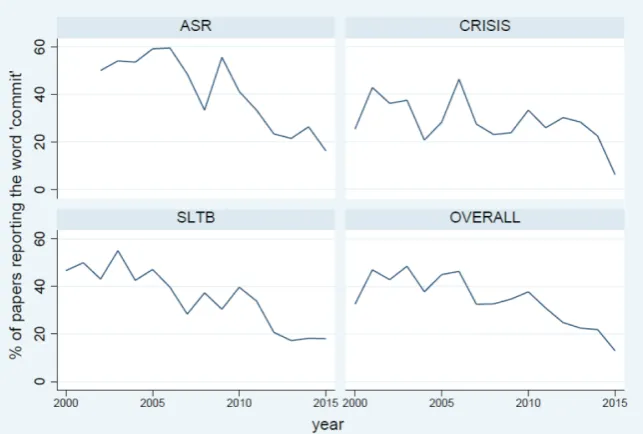
There were 2298 articles published in the three main suicide related journals since the start of the millennium (2000–2015). Of these, 781 (34%) articles used the word ‘commit’ when describing an act of self-harm or suicide. Over half of these articles (57%) used the word ‘commit’ in more than one instance in the same paper, with 6% using it more than 10 times in the same manuscript.
The percentage of papers utilising the word ‘commit’ has fluctu-ated over time, but in all journals included in this review there has
been a reduction in the use of this word (Figure 1; p-value for trend < 0.001). In the most recent year (2015) across all three journals, 13% of articles use the word ‘commit’ (SLTB, 18%; CRISIS, 6%; and ASR, 16%).
Discussion
In all three of the leading suicide-specific academic journals, the phrase ‘commit suicide’ continues to be published. Reassuringly there have been reductions in the use of this term in relation to acts of self-harm or suicide. However, in 2015 one in eight articles still used this outdated, largely inaccurate and stigmatised phrase.
The International Association for Suicide Prevention (IASP) collaborated with the World Health Organization (WHO) to produce the 2008 revision of the ‘preventing suicide’ framework for media professionals (World Health Organization, 2008). This resource specifies that “the phrase ‘committed suicide’ should not be used because it implies criminality, thereby contributing to the stigma experienced by those who have lost a loved one to suicide and discouraging suicidal individuals from seeking help” (p. 8). It is therefore perhaps particularly surprising to note the continued publication of the phrase ‘commit suicide’ since 2008 in Crisis, the journal of IASP.
[image:3.612.146.468.476.693.2]As individuals we each hold a position of power and responsibility. As researchers, clinicians and suicidologists we hold a collective responsibility for the language we propagate and the messages this imparts. Therefore, we believe that the phrase ‘commit suicide’ should be avoided in all arenas, including clinical and professional practice, teaching, when interacting with peers, colleagues and the general public, in our everyday lives and, importantly, in our academic writing. While it is noted that in the 25 countries in
which suicide remains illegal, the use of phrase is perhaps more understandable, it is of paramount importance that we hold ourselves to the standards to which we seek to hold others (e.g., journalists, politicians, opinions leaders). Much as suicide-specific media guidelines advocate for the consideration of appropriate language choices, we believe that: i) journals should include in their author guidelines a note necessitating appropriate language; and ii) journal reviewers should take responsibility in insisting that language is amended if inappropriate.
Suicide is a cause of death and our language should reflect this; people die by suicide. Guidelines necessitating the abolition of the phrase ‘commit suicide’ (in non-quoted prose) may be one step towards facilitating this goal. Indeed, editors hold a unique position in ensuring that outdated, inaccurate and stigma-laden terms with criminal overtones are expunged from the scientific literature. Addressing the language we use affords an important opportunity to meaningfully contribute to the eradication of the stigma surrounding suicidality.
This study considered only instances in which the phrase ‘commit suicide’ was used outside of quotation marks or inverted commas. This inclusion criteria was imposed for two primary reasons: i) we believe that individuals have the right to describe their own experiences in their own terms; therefore, particularly in qualita-tive or mixed methods papers, the stemword ‘commit’ may appear appropriately within a verbatim quotation from a participant; and ii) the phrase ‘commit suicide’ may be included within quota-tion marks in papers highlighting the problematic nature of this language (e.g., Silverman, 2006). Indeed the phrase ‘commit suicide’ frequently appears within inverted commas throughout this article. Future research may seek to explore trends in the frequency and nature of use of the stemword ‘commit’, in relation to self-harm and suicide, within quoted prose.
We hope that the current study will act as a catalyst for discussion and prompt further consideration of: i) the inherent connotations of the language frequently employed within in the field; ii) how we may inadvertently perpetrate stigma; and iii) how we might work to eradicate this stigma. This will only be achieved by working collaboratively with those with lived experience.
Limitations
The study must be interpreted within the context of its limitation. Herein, it is important to note that ‘commit’ is not the only poten-tially difficult language propagated in the literature. For example, in the United Kingdom the Royal College of Psychiatrists have recently updated their language around harm (‘deliberate self-harm’ to ‘self-self-harm’) in light of concerns highlighted by mental health service consumers and those with lived experience of self-harm (Silverman, 2006). A number of other potentially difficult phrases persist within academic communications (e.g., labelling
language such as ‘self-harmers’, ‘ideators’, ‘jumpers’, phrases such as ‘copy-cat’) against a backdrop of standardised and non-agreed nomenclature. Indeed determining appropriate and unhelp-ful terms will require review and augmentation over time.
The current study examined trends since the start of the millen-nium in the three leading suicide-specific academic journals. The study examined all online material published within this 15 year period. However, it is important to note that suicide is covered across a range of journals and fields (e.g., psychology, sociology, psychiatry, epidemiology, public health), each of which will have established traditions. While we argue for the role of dedicated suicidology journals, researchers and clinicians leading by example, to make meaningful and lasting change further work must consider how guidelines could translate across disciplines and platforms (e.g., consideration must be given to the language propagated in academic proceedings, press releases and at conferences).
Notwithstanding these limitations, the present study offers novel insight into recent trends in the publication of the stemword ‘commit’ used in relation to self-harm and suicide. Given the marked opposition expressed in regards to this phraseology, it is perhaps surprising to see the continuation of its publication across the three leading suicide-specific academic journals and indeed propa-gated in academic proceedings and conferences. Our results sug-gest that the introduction of author guidelines surrounding language use may be necessary to ensure the abolition of outdated, inaccurate and stigma-laden terms and the adoption of preferred phraseology.
Data availability
Available online via the Open Science Framework: https://osf.io/ br8jd/; DOI, 10.17605/OSF.IO/BR8JD (Knipe, 2016).
Author contributions
Study conception: DK; Study design: EN & DK; Acquisition of data: all authors; Analysis: DK; Interpretation of data: all authors; Drafting of manuscript: EN; Critical revision: all authors.
Competing interests
No competing interests were disclosed.
Grant information
This work is supported by the Wellcome Trust [099874]; and the Economic and Social Research Council [ES/J500100/1].
The funders had no role in study design, data collection and analysis, decision to publish, or preparation of the manuscript.
Acknowledgements
References
American Psychological Association: Publication manual of the American Psychological Association (6th ed.). Washington, DC: American Psychological Association. 2010.
Reference Source
Beaton S, Forster P, Maple M: Suicide and language: Why we shouldn’t use the “C” word.InPsych. 2013; 35(1): 30–31.
Reference Source
Corrigan P, Markowitz FE, Watson A, et al.: An attribution model of public discrimination towards persons with mental illness.J Health Soc Behav. 2003;
44(2): 162–179.
PubMed Abstract |Publisher Full Text
Cvinar JG: Do suicide survivors suffer social stigma: a review of the literature. Perspect Psychiatr Care. 2005; 41(1): 14–21.
PubMed Abstract |Publisher Full Text
Hunter Institute of Mental Health: Reporting suicide and mental illness: A mindframe resource for media professionals. Newcastle. 2014. Reference Source
Knipe D: Commit to Change. Open Science Framework. 2016. Data Source
Maple M, Edwards H, Plummer D, et al.: Silenced voices: hearing the stories of parents bereaved through the suicide death of a young adult child.Health Soc Care Community. 2010; 18(3): 241–248.
PubMed Abstract |Publisher Full Text
Mishara BL, Weisstub DN: The legal status of suicide: A global review.Int J Law
Psychiatry. 2016; 44: 54–74. PubMed Abstract |Publisher Full Text
Reynders A, Kerkhof AJ, Molenberghs G, et al.: Attitudes and stigma in relation to help-seeking intentions for psychological problems in low and high suicide rate regions.Soc Psychiatry Psychiatr Epidemiol. 2014; 49(2): 231–239. PubMed Abstract |Publisher Full Text
Samaritans: Media guidelines for reporting suicide. Surrey. 2013. Reference Source
Silverman MM: The language of suicidology.Suicide Life Threat Behav. 2006;
36(5): 519–532. PubMed Abstract
Sommer-Rotenberg D: Suicide and language.CMAJ. 1998; 159(3): 239–240. PubMed Abstract |Free Full Text
Weissman RS, Becker AE, Bulik CM, et al.: Speaking of That: Terms to Avoid or Reconsider in the Eating Disorders Field.Int J Eat Disord. 2016; 49(4): 349–353.
PubMed Abstract |Publisher Full Text
Williams J, Pollock L: Psychological aspects of the suicidal process. In K. van Heeringen (Ed.), Understanding suicidal behaviour. Chicester, WS: Wiley, 2001; 76–93.
Open Peer Review
Current Referee Status:
Version 1
23 February 2017 Referee Report
doi:
10.21956/wellcomeopenres.11132.r20483
Sarah Rowe
Institute of Psychiatry, Psychology & Neuroscience, King's College London, London, UK
The title and abstract are appropriate and accurately reflect the work that has been conducted. The
design and methods are suitable and the results adequately discussed. The implications of the study are
reasonable and balanced. I would like to see a sentence or two in the discussion which proposes
alternatives to the phrase ‘commit suicide’ as suggested by people with lived experience and
clinicians/researchers. Overall, this paper is interesting and highlights an important issue in need of
progression.
I have read this submission. I believe that I have an appropriate level of expertise to confirm that
it is of an acceptable scientific standard.
No competing interests were disclosed.
Competing Interests:
01 February 2017 Referee Report