Streamlined Constraint Models via Monte Carlo
Search on a Model Lattice
Patrick Spracklen, ¨Ozg¨ur Akg¨un, Ian Miguel
School of Computer Science, University of St Andrews, St Andrews, UK
{jlps, ozgur.akgun, ijm}@st-andrews.ac.uk
Abstract. Streamlined constraint reasoning is the addition of unin-ferred constraints to a constraint model to reduce the search space, while retaining at least one solution. Previously it has been established that it is possible to generate streamliners automatically from abstract constraint
specifications inEssenceand that effective combinations of streamliners
can allow instances of much larger scale to be solved. A shortcoming of the previous approach was the crude exploration of the power set of all combinations using depth and breadth first search. We present a new approach based on Monte Carlo search over the lattice of streamlined models, which efficiently identifies effective streamliner combinations.
1
Introduction and Background
If the performance of a constraint model is found to be inadequate, a natural step is to consider adding constraints to the model in order to assist the constraint solver in detecting dead ends in search and therefore reducing overall search effort. One approach is to addimplied constraints, which can be inferred from the initial model and are therefore guaranteed to be sound. Effective implied constraints have been found both by hand [16, 17] and via automated methods [9, 10, 18]. If implied constraints cannot be found, or improve performance insuf-ficiently, for satisfiable problems1 a more aggressive step is to add streamliner
constraints [21], which are not guaranteed to be sound but are designed to reduce significantly the search space while permitting at least one solution. For several problem classes, effective streamliners have been found by hand by looking for patterns in the solutions of small instances of those classes [21, 23, 25, 26].
Wetter et al. [39] demonstrated how to generate effective streamliners au-tomatically from the specification of a constraint problem class in the abstract constraint specification language Essence[13–15]. This method, which we ex-pand upon, exploits the structure apparent in an Essence specification, such as that of the Progressive Party Problem (Fig. 1), to produce candidate stream-liners via a set of streamliner generation rules. An effective streamliner that we
1 Streamlining is unsuitable for unsatisfiable problems: streamliners are not necessarily
1 language Essence 1.3
2 given n_boats, n_periods : int(1..)
3 letting Boat be domain int(1..n_boats)
4
5 find hosts : set (minSize 1) of Boat,
6 sched : set (size n_periods) of function (total) Boat --> Boat
7 minimising |hosts|
8
9 such that
10 $ Hosts remain the same throughout the schedule
11 forAll p in sched . range(p) = hosts,
12 $ Hosts stay on their own boat
13 forAll p in sched . forAll h in hosts . p(h) = h,
14 $ Hosts have the capacity to support the visiting crews
15 forAll p in sched . forAll h in hosts .
16 (sum b in preImage(p,h) . crew(b)) <= capacity(h),
17 $ No two crews are at the same party more than once
18 forAll b1,b2 : Boat .
[image:2.612.120.486.100.332.2]19 b1 < b2 -> (sum p in sched . toInt(p(b1) = p(b2))) <= 1
Fig. 1.The Progressive Party Problem [35] inEssence. There are two abstract decision variables, a set of host boats, and a set of functions from boats to boats representing the assignment of guests to hosts in each period. From this very concise, structured statement of the problem, 160 candidate streamliners can be generated by our system.
automatically generate for this problem class constrains approximately half of the entries in theschedset variable to be monotonically increasing functions.
Using training instances drawn from the problem class under consideration, streamliner candidates are evaluated via a toolchain consisting of the automated constraint modelling tools Conjure [1–4] and Savile Row [30–32], and the constraint solver Minion[20]. Promising candidates, which retain at least one solution to the training instances while significantly reducing search, are used to solve more difficult instances from the same problem class. Candidate stream-liners are often most effectively used in combination. For example, Wetter et al. presented an effective combination of three streamliners for the Van der Waer-den numbers problem. Hence, the space of streamlined models forms a lattice where the root is the originalEssencespecification and an edge represents the addition of a streamliner to the combination associated with the parent node.
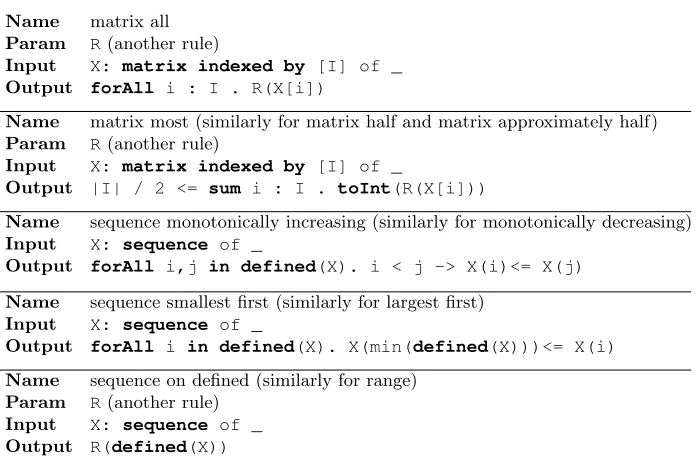
Name matrix all
Param R(another rule)
Input X: matrix indexed by [I] of _ Output forAll i : I . R(X[i])
Name matrix most (similarly for matrix half and matrix approximately half)
Param R(another rule)
Input X: matrix indexed by [I] of _
Output |I| / 2 <= sum i : I . toInt(R(X[i]))
Name sequence monotonically increasing (similarly for monotonically decreasing)
Input X: sequence of _
Output forAll i,j in defined(X). i < j -> X(i)<= X(j)
Name sequence smallest first (similarly for largest first)
Input X: sequence of _
Output forAll i in defined(X). X(min(defined(X)))<= X(i)
Name sequence on defined (similarly for range)
Param R(another rule)
[image:3.612.135.483.110.338.2]Input X: sequence of _ Output R(defined(X))
Fig. 2.Streamliner generators for sequence and matrix domains.
2
Essence Specifications and Streamliner Generators
AnEssence specification such as that presented in Fig. 1 identifies: the input parameters of the problem class (given), whose values define an instance; the combinatorial objects to be found (find); the constraints the objects must sat-isfy (such that); identifiers declared (letting); and an (optional) objective function (min/maximising). The key feature of the language is its support for abstract decision variables, such as set, multiset, relation and function, as well asnested types, such as the set of functions found in Fig. 1.
A concise, structured specification of a problem class directly supports the generation of powerful candidate streamliners: in the example, it is readily ap-parent that the problem requires us to find a set of boats and a set of functions assigning guest boat crews to hosts. Hence, streamliners related to sets and functions, such as that given in the introduction, can be generated straightfor-wardly. In contrast an equivalent constraint model in, for example, MiniZinc [29] or Essence Prime[31] has to represent these abstract decision variables with constrained collections of more primitive (e.g. integer domain) variables, such as the matrix model [11, 12] proposed by Smith et al. [35]. In this context, it is significantly more difficult to recognise the structure (i.e. the set and set of functions) in the problem and generate the equivalent streamliners.
type constructors. These are summarised in Figure 2. For decision variables with matrix domains, one generator (matrix all) takes another streamliner generator as a parameter (R, as a simple example: constrain an integer variable to take an even value) and lifts it to operate on all entries in a matrix. This rule can be applied to higher dimensional matrix domains as well, in which case the multi-dimensional matrix domain is interpreted in the same way as a series of nested one-dimensional matrix domains. The generators matrix most (and matrix half and matrix approximately half) operate in a similar way. In contrast to the matrix all streamliner generator, these generators first reify the result of applyingR, and then restrict the number of places the constraint must hold.
For sequence domains, we present two sets of first-order streamliner gen-erators: monotonically increasing(or decreasing) and smallest (or largest) first. These do not take another generator as a parameter but directly post constraints on the sequence decision variable. The sequence on range and sequence on de-fined generators take an existing streamliner generator as a parameter and lift it to work on the range or the defined set of the sequence domain respectively.
3
Monte Carlo Search for Streamliner Combinations
Le Bras et al. [24] and Wetter et al. [39] both observed that by applying several streamlining constraints to a model simultaneously the search required for find-ing the first solution can be reduced further than by applyfind-ing the streamliners in isolation. Finding an effective streamliner combination involves searching the streamliner lattice, the size of which is determined by the power set of all can-didate streamliners for a given problem class. Table 1 presents the number of candidate streamliners our current set of generation rules produces for a number of problem classes. In some cases the number of candidates generated is small. However, the cost of evaluating each combination on a set of test instances means that it is typically not feasible to evaluate all possible streamliner combinations. Wetter et al. employed breadth-first and depth-first search to explore the streamliner lattice in an uninformed manner. The motivation for our work is the hypothesis that a best-first search can allow more effective streamliner combi-nations to be discovered within a given time budget. Our approach is to focus the search onto areas of the lattice where the streamliners combine to give the greatest reduction in search while retaining at least one solution.
For a given problem class, we have no prior knowledge of the performance of the set of candidate streamliners, either individually or in combination. This raises the issue of the exploration/exploitation problem: if we can identify a combination of streamliners that performs well, should we try and exploit that combination further by evaluating the addition of further streamliners, or should we explore other parts of the lattice that may at present seem less promising?
The multi-armed bandit can be seen as a set of real distributions, each distribu-tion being associated with the rewards delivered by one of the K levers. Since the multi-armed bandit problem assumes that each lever corresponds to an in-dependent action, in order to use it directly we would have to associate a lever with each point in the streamliner lattice, which is infeasible in general. Instead, we use the bandit algorithm to guide the exploration of the lattice in a process reminiscent of Monte Carlo Tree Search (MCTS) [7], as described below.
3.1 Algorithm Outline
Our algorithm has the same four basic steps as MCTS. It uses Upper Confidence bound applied to Trees (UCT) [7] to balance exploration and exploitation.
1. Selection: Starting at the root node, the UCT policy is recursively applied to traverse the explored part of the lattice until an unexpanded, but expand-able node is reached. A node is expandexpand-able if it has at least one child that is not marked as pruned (§3.5). A child node is selected to maximise:
U CT =Xj+ 2Cp
s 2 lnn
nj
wherenis the number of times the current (parent) node in the lattice has been visited,nj the number of times childjhas been visited,Xj is the mean
reward associated with childj andCp>0 is a constant [7].
2. Expansion: Enumerate the children of the Selected node and choose one to expand according to the heuristic explained in Section 3.4.
3. Simulation: The collection of streamliners associated with the expanded node are evaluated using theConjure,Savile Row, andMiniontoolchain. 4. BackPropagation: The result of the evaluation is propagated back up
through the lattice to update reward values, as explained below.
3.2 Back Propagation
Since our search is operating over a lattice, a node may have multiple parents. This requires an alteration to the back propagation employed in MCTS: when we perform back propagation that reward value is back propagated up all paths from that node to the root. To illustrate consider a problem with two streamliners
ensure that a node that lies on more than one such path is rewarded only once. The cost of back propagation thus grows exponentially with depth. However, since each level of the lattice represents an additional constraint it is unlikely that satisfiability is maintained at great enough depths for this to become an issue. Empirically, the cost is insignificant relative to solving the training instances.
We must also consider the situation where a node in a path back to the root has not yet been expanded. If we ignore such nodes, their true reward is not reflected in their reward values because all reward values back propagated from child nodes prior to their creation are lost. Our approach is that when a node is expanded, it absorbs the reward value and visit count of its immediate children that have already been expanded. This avoids caching a potentially large set of values while maintaining reward values for nodes around the focus of our search.
3.3 Simulation Reward
The performance of our best first search algorithm is heavily reliant on how the reward is produced from the simulation step. Initially we assigned rewards as follows: if the majority of the instances evaluated are unsatisfiable a reward of -1 is back-propagated, otherwise a reward of one minus the average reduction in search space (expressed in search nodes) is returned. While this is valid, our initial experiments revealed that its effect was to produce a search strategy similar to breadth-first search - i.e. too strong a bias towards exploration.
The reason for this is that the penalty value is too punitive when evaluating larger streamliner combinations. Intuitively, the penalty should be sensitive to the depth we have travelled into the lattice: as we add streamliners we reduce the search space and we expect the probability of such failure to rise. Therefore we divide the penalty value by the depth of the node being evaluated, allowing the prolonged exploration of promising paths.
3.4 Expansion Heuristic
The order of expansion of child nodes is an important factor in performance. An expanded child consumes time to perform simulation and, because the simulation reward is back propagated, if a penalty is awarded it can affect the likelihood of the parent node being selected on the next iteration. During the expansion phase of our algorithm child nodes are expanded in descending likelihood of the application of the associated streamliner combination resulting in a satisfiable problem. In order to facilitate this, when a successful simulation is performed, for a representative instance the solution found is stored, along with the approximate size of its search space (via the product of the domains of the decision variables in the model) and the proportion of the space explored to find the solution.
reduce search. If the solution is invalidated then the search space explored by the child is smaller than the expanding parent. We use the proportion of search space explored to find the solution associated with the expanding parent to estimate the likelihood of a solution existing in that subspace. Intuitively, if the parent explored a large fraction of the space then it is less likely that a solution will be found when adding the streamliner associated with the child node.
3.5 Pruning the Streamliner Lattice
As per §3.2, when a simulation for a streamliner combination reveals that the majority of training instances are unsatisfiable, a penalty is back propagated up the lattice. We also mark the node associated with the simulation as pruned and never consider any of its children for expansion. In addition, we prune nodes whose additional streamliner is determined to beredundantin combination with those inherited from the expanding parent, in the sense that it causes no further reduction in search on the evaluated instances. Pruning the lattice by these two methods typically reduces the number of nodes to be expanded very significantly.
4
Empirical Evaluation
We evaluate two hypotheses empirically. First, that the best-first search is more effective in exploring the streamliner lattice than the simpler depth- and breadth-first search methods employed in [39]. Second, that our method is able to auto-matically find streamliner combinations that drastically reduce the search space across a variety of problem classes.
We experiment with thirteen problem classes, eight from Wetter et al. and the remainder selected for variety, particularly problem classes requiring significantly more instance data such as SONET [27]. Streamlining can aid in the search for feasible solutions of optimisation problems, but not the proof of optimality. Hence, in our experiments we transformed optimisation into decision problems by the standard method of bounding the objective and searching for a satisfying solution. The results we obtain are very positive, as presented in Table 1.
5
Conclusion
We have presented a new method for the automated generation of streamlined constraint models from a large set of candidates via Monte Carlo search. Our method is efficient in searching the space of candidates, producing more effective streamlined models in less time than less informed approaches. Our empirical results demonstrate a vast reduction in search across a variety of benchmarks.
As part of future work we plan to explore the generation of streamlined versions of alternative models generated by Conjure. We expect the utility of particular streamlining constraints to vary depending on the model.
DFS BFS Mon te Carlo Problem Class Num b er of Candidate Streamliners Mean
Instance Time (Seconds)
References
1. Akg¨un, ¨O.: Extensible automated constraint modelling via refinement of abstract
problem specifications. Ph.D. thesis, University of St Andrews (2014)
2. Akg¨un, ¨O., Frisch, A.M., Gent, I.P., Hussain, B.S., Jefferson, C., Kotthoff, L.,
Miguel, I., Nightingale, P.: Automated symmetry breaking and model selection in Conjure. In: International Conference on Principles and Practice of Constraint Programming. pp. 107–116. Springer (2013)
3. Akg¨un, ¨O., Gent, I.P., Jefferson, C., Miguel, I., Nightingale, P.: Breaking
con-ditional symmetry in automated constraint modelling with Conjure. In: ECAI. pp. 3–8 (2014)
4. Akg¨un, ¨O., Miguel, I., Jefferson, C., Frisch, A.M., Hnich, B.: Extensible automated
constraint modelling. In: Proceedings of the Twenty-Fifth AAAI Conference on Artificial Intelligence. pp. 4–11. AAAI Press (2011)
5. Auer, P., Cesa-Bianchi, N., Fischer, P.: Finite-time analysis of the
mul-tiarmed bandit problem. Machine Learning 47(2), 235–256 (May 2002).
https://doi.org/10.1023/A:1013689704352
6. Ayel, J., Favaron, O.: Helms are graceful. Progress in Graph Theory (Waterloo, Ont., 1982), Academic Press, Toronto, Ont pp. 89–92 (1984)
7. Browne, C., Powley, E., Whitehouse, D., Lucas, S., Cowling, P.I., Tavener, S., Perez, D., Samothrakis, S., Colton, S., et al.: A survey of monte carlo tree search methods. IEEE Transactions on Computational Intelligence and AI (2012)
8. ˇCagalj, M., Hubaux, J.P., Enz, C.: Minimum-energy broadcast in all-wireless
net-works: Np-completeness and distribution issues. In: Proceedings of the 8th annual international conference on Mobile computing and networking. pp. 172–182. ACM (2002)
9. Charnley, J., Colton, S., Miguel, I.: Automatic generation of implied constraints. In: ECAI. vol. 141, pp. 73–77 (2006)
10. Colton, S., Miguel, I.: Constraint generation via automated theory formation. In: International Conference on Principles and Practice of Constraint Programming. pp. 575–579. Springer (2001)
11. Flener, P., Frisch, A., Hnich, B., Kiziltan, Z., Miguel, I., Walsh, T.: Matrix mod-elling. In: Proc. of the CP-01 Workshop on Modelling and Problem Formulation. p. 223 (2001)
12. Flener, P., Frisch, A.M., Hnich, B., Kiziltan, Z., Miguel, I., Walsh, T.: Matrix mod-elling: Exploiting common patterns in constraint programming. In: Proceedings of the International Workshop on Reformulating Constraint Satisfaction Problems. pp. 27–41 (2002)
13. Frisch, A.M., Grum, M., Jefferson, C., Hern´andez, B.M., Miguel, I.: The essence
of essence. Modelling and Reformulating Constraint Satisfaction Problems p. 73 (2005)
14. Frisch, A.M., Grum, M., Jefferson, C., Hern´andez, B.M., Miguel, I.: The design of
essence: A constraint language for specifying combinatorial problems. In: IJCAI. vol. 7, pp. 80–87 (2007)
15. Frisch, A.M., Harvey, W., Jefferson, C., Mart´ınez-Hern´andez, B., Miguel, I.:
Essence: A constraint language for specifying combinatorial problems. Constraints
13(3), 268–306 (2008)
17. Frisch, A.M., Miguel, I., Walsh, T.: Symmetry and implied constraints in the steel mill slab design problem. In: Proc. CP01 Workshop on Modelling and Problem Formulation (2001)
18. Frisch, A.M., Miguel, I., Walsh, T.: Cgrass: A system for transforming constraint satisfaction problems. In: Recent Advances in Constraints, pp. 15–30. Springer (2003)
19. Frucht, R.: Graceful numbering of wheels and related graphs. Annals of the New
York Academy of Sciences319(1), 219–229 (1979)
20. Gent, I.P., Jefferson, C., Miguel, I.: Minion: A fast scalable constraint solver. In: ECAI. vol. 141, pp. 98–102 (2006)
21. Gomes, C., Sellmann, M.: Streamlined constraint reasoning. In: International Conference on Principles and Practice of Constraint Programming. pp. 274–289. Springer (2004)
22. Huczynska, S., McKay, P., Miguel, I., Nightingale, P.: Modelling equidistant fre-quency permutation arrays: An application of constraints to mathematics. In: In-ternational Conference on Principles and Practice of Constraint Programming. pp. 50–64. Springer (2009)
23. Kouril, M., Franco, J.: Resolution tunnels for improved sat solver performance. In: International Conference on Theory and Applications of Satisfiability Testing. pp. 143–157. Springer (2005)
24. Le Bras, R., Gomes, C.P., Selman, B.: Double-wheel graphs are grace-ful. In: Proceedings of the Twenty-Third International Joint Conference
on Artificial Intelligence. pp. 587–593. IJCAI ’13, AAAI Press (2013),
http://dl.acm.org/citation.cfm?id=2540128.2540214
25. Le Bras, R., Gomes, C.P., Selman, B.: On the erd˝os discrepancy problem. In:
International Conference on Principles and Practice of Constraint Programming. pp. 440–448. Springer (2014)
26. LeBras, R., Gomes, C.P., Selman, B.: Double-wheel graphs are graceful. In: IJCAI. pp. 587–593 (2013)
27. Lee, Y., Sherali, H.D., Han, J., Kim, S.i.: A branch-and-cut algorithm for solving
an intraring synchronous optical network design problem. Networks35(3), 223–232
(2000)
28. Ma, K., Feng, C.: On the gracefulness of gear graphs. Math. Practice Theory 4,
72–73 (1984)
29. Nethercote, N., Stuckey, P.J., Becket, R., Brand, S., Duck, G.J., Tack, G.: Miniz-inc: Towards a standard cp modelling language. In: International Conference on Principles and Practice of Constraint Programming. pp. 529–543. Springer (2007)
30. Nightingale, P., Akg¨un, ¨O., Gent, I.P., Jefferson, C., Miguel, I.: Automatically
improving constraint models in Savile Row through associative-commutative com-mon subexpression elimination. In: 20th International Conference on Principles and Practice of Constraint Programming (CP 2014). pp. 590–605. Springer (2014)
31. Nightingale, P., Akg¨un, O., Gent, I.P., Jefferson, C., Miguel, I., Spracklen, P.:
Automatically improving constraint models in Savile Row. Artificial Intelligence
251, 35–61 (2017). https://doi.org/10.1016/j.artint.2017.07.001
32. Nightingale, P., Spracklen, P., Miguel, I.: Automatically improving SAT encoding of constraint problems through common subexpression elimination in Savile Row. In: Proceedings of the 21st International Conference on Principles and Practice of Constraint Programming (CP 2015). pp. 330–340. Springer (2015)
33. Parrello, B.D., Kabat, W.C., Wos, L.: Job-shop scheduling using automated reason-ing: A case study of the car-sequencing problem. Journal of Automated reasoning
34. Slaney, J., Fujita, M., Stickel, M.: Automated reasoning and exhaustive search: Quasigroup existence problems. Computers & mathematics with applications
29(2), 115–132 (1995)
35. Smith, B.M., Brailsford, S.C., Hubbard, P.M., Williams, H.P.: The progressive party problem: Integer linear programming and constraint programming compared.
Constraints1(1-2), 119–138 (1996)
36. Toth, P., Vigo, D.: The vehicle routing problem. SIAM (2002)
37. van der Waerden, B.: Beweis einer Baudetschen Vermutung. Nieuw Arch. Wisk.
19, 212–216 (1927)
38. Walsh, T.: CSPLib problem 015: Schur’s lemma .
http://www.csplib.org/Problems/prob015
39. Wetter, J., Akg¨un, ¨O., Miguel, I.: Automatically generating streamlined constraint
![Fig. 1. The Progressive Party Problem [35] in Essence. There are two abstract decisionvariables, a set of host boats, and a set of functions from boats to boats representingthe assignment of guests to hosts in each period](https://thumb-us.123doks.com/thumbv2/123dok_us/8566024.367075/2.612.120.486.100.332/progressive-problem-essence-abstract-decisionvariables-functions-representingthe-assignment.webp)