Quantification of differences in germination behaviour of pelleted and coated sugar beet
1
seeds using X-ray Computed Tomography (X-ray CT)
2
Sebastian Blunk1, Ali Hafeez Malik2, Martine I de Heer3, Tobias Ekblad2, Kenneth Fredlund2, Sacha J Mooney1,
3
Craig J Sturrock1
4
1 Division of Agriculture and Environmental Science – University of Nottingham, Nottingham, UK
5
2 Syngenta Seeds AB, Landskrona, Sweden
6
3 Syngenta Crop Protection, Bracknell, UK
7
Abstract
8
Seed enhancement technologies i.e. priming, pelleting and coating have been extensively 9
used throughout the last century to improve crop yield and to reduce losses associated with 10
pest infestation. However, until recently, it has not been possible to non-destructively assess 11
the effect of seed enhancement technologies belowground due to the opacity of soil. Using X-12
ray Computed Tomography (X-ray CT) we undertook a 4D visualisation of the germination 13
process of four different sugar beet seed enhancement treatments (untreated / naked, coated, 14
pelleted and pelleted + coated) in soil. The aim of this study was to improve the understanding 15
of the germination process in the natural environment of the seed to inform future soil 16
management and seed enhancement processes. Using X-ray CT we were able to quantify the 17
germination and establishment process of different seed enhancement technologies in soil 18
non-destructively for the first time. We observed a delay in seedling growth posed by the 19
addition of a physical barrier, i.e. the seed coating. However, an enhanced radicle growth rate 20
was observed in pelleted, as well as pelleted and coated seeds, after overcoming the physical 21
barrier. The disadvantage posed by the addition of seed coating was overcome after four days 22
of seedling growth. Further work should focus on refinements to the type and composition of 23
Introduction
25
With an increasing global population (ca. 9.2 billion in 2050) and demand for food necessitates 26
there is need to increase crop yield and efficiency across a wide range of plants (Lal, 2013) 27
however, deterioration of suitable agricultural land for crop production is a significant 28
problem (Monneveux et al., 2013). Therefore, it is particularly important to identify crops that 29
have a reduced need for nutrients and enhanced ability to overcome stress (Chapuis et al., 30
2012) and to maximise yield. Crop seeds require certain soil properties (especially moisture 31
and temperature) to initiate germination, a crucial stage which influences the success of 32
establishment into full grown plants. The seeding material consists of a seed containing the 33
perisperm and the embryo, as well as the surrounding fruitwall material. Both the seed and 34
the fruitwall are referred to as the fruit. From this point the term ‘seed’ is not used in a 35
botanically strict sense and includes both the fruitwall and the seed. Water absorption 36
(imbibition) is the first and fundamental step in germination process (William et al., 1995). 37
During imbibition, the dry seed hydrates and swells which increases seed volume. Additionally, 38
the fruit wall starts to soften which allows the radicle to penetrate the fruit wall and emerge 39
into the soil (Lundgren, 2009). To enable the water absorption process from the soil, close 40
seed-soil contact is important (Brown et al., 1996). Germination occurs when embryo growth 41
overcomes the constraints of the fruit wall surrounding the seed (Bewley et al., 2013; Smykal 42
et al., 2014). Seed technology aims to sustain and improve the health and yield of crops as
43
well as emergence and germination (Taylor et al, 1998; Ehsanfar and Modarres-Sanvay, 2005). 44
Originally, seed enhancement technology i.e. seed pelleting was used to ensure successful 45
precision sowing or to synchronise male and female inbred seeds (Vyn and Murua, 2001; 46
Gorim, 2014). In addition to this, different enhancement technologies aim to improve 47
performance to overcome growth restricting influences of the soil caused by temperature or 48
Smith, 1982; Mašauskas et al., 2008), hormones (Powell and Mathew, 1988), peroxides for 50
oxygen provision or polymer coatings with hydrophilic abilities (Vyn and Murua, 2001; Gorim, 51
2014). Seed coating processes can be divided into two groups: seed pelleting and film coating. 52
Pelleting consists of the addition of a relatively thick layer of material (often wood fibre) which 53
is typically intended to increase the total volume and roundness of the seed to enhance the 54
accuracy of planting. The added material may also contribute to increased water uptake and 55
maintain sufficient moisture content during germination. Film coatings do not change the 56
shape of the seed and are used to apply pesticides and fungicides (Hill, 1999). 57
Besides crop enhancement, our understanding of seed germination and seed-soil interaction 58
is limited. Field trials provide information concerning how the plumule grows after 59
germination (Chang, 2004). These field trials are limited to aboveground observations and 60
hence do not provide insight into the germination process as the initial step of plant 61
establishment. A Rhizotron enables a single slice 2D view of a root system facilitated by a glass 62
window (Klepper and Kaspar, 1994). The resulting root structure however, is influenced by the 63
boundaries posed by the glass windows which influences the growth behaviour and eventually 64
the root architecture. Observation of seed germination is impeded as it is unlikely that radicle 65
growth is observed through the glass window. If the seed would be placed next to the glass 66
layer, the seed opening and therefore the germination process, would be influenced. X-ray CT 67
as a non-invasive and non-destructive 3D imaging technique, has been increasingly used to 68
visualise soil properties like porosity (Vogel, 2010) and in situ root systems (Tracy et al., 2013; 69
Mairhofer et al., 2013). Magnetic Resonance Imaging (MRI) and X-ray CT have previously been 70
used for 3D root quantifications and it has been reported that X-ray CT is better suited for 71
smaller pot diameters (Metzner et al., 2015). However, only few studies have been 72
coatings. Most previous work on seed germination have been conducted on seeds grown 74
without soil (Gagliardi, 2011; Galhaut, 2014; Devarrewaere et al., 2015). These studies have 75
shown that it is possible to visualise structural changes within the seed during germination. 76
Gregory et al. (2003) was the first to use X-ray CT to image wheat seedling growth in soil with 77
a resolution of 100 µm verifying the suitability of this technology to monitor seedling 78
establishment in situ. Soil generally has an opaque and heterogeneous structure which has 79
limited our ability to observe germination in situ (Brown et al., 1996). Galhaut et al. (2014) 80
previously showed tissue detachment between radicle and cotyledons contributing to 81
hydration which was not previously observed in unprimed seeds using X-ray CT (however, 82
crucially not in soil). 83
Here we report the application of X-ray CT to quantify the impact of four seed enhancement 84
technologies (naked (N), film coated (FC), pelleted (P) and pelleted and film coated (P+FC)) on 85
the spatiotemporal germination of sugar beet seeds grown in soil. The aim of this study was 86
to assess differences in performance of different seed enhancement technologies to illustrate 87
the viability of X-ray CT for future germination studies in soil. Treatments were chosen based 88
on commercial interest (pelleted + coated) divided into their basic components (coating and 89
pelleting) compared to the untreated seed (naked). It was hypothesised that the enhanced 90
seeds with an applied pelleting would have a germination advantage over the naked seeds 91
whereas coated seeds might show a disadvantage due to the effect of the pesticide 92
components. 93
Materials & Methods
94
A Dunnington Heath series sandy loam soil (66.4% sand, 18.0% silt, 15.6% clay and 4.53% 95
organic matter) was collected from The University of Nottingham farm at Bunny, 96
supplied by Syngenta Seeds AB, Sweden. Four different treatment types have been chosen 98
based on commercial availability using naked (uncoated) (N), film coated (FC), pelleted (P) as 99
well as pelleted and film coated seeds (P+FC). The pelleted treatment is a Syngenta in-house 100
development mainly consisting of woodmeal and clay. Seeds are coated with a standard 101
fungicide and insecticide treatment. The precise coating and pelleting compositions are 102
treated confidentially. All used seed treatments can be ordered at Syngenta Seeds AB, Sweden, 103
by referring to this study. 104
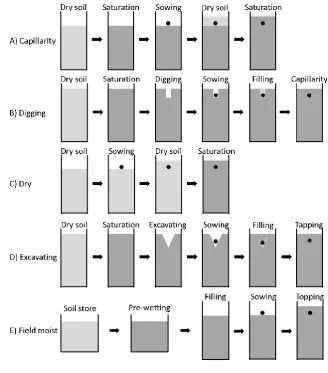
It was imperative that different column packing methods had to be first pre-tested to ensure 105
maximum comparability of field conditions as well as accurate reproducibility. Method A 106
displayed in Figure 1 facilitates wetting via capillary action. An initial amount of dry soil was 107
poured into the column and saturated with water from the bottom. The seed was placed 108
centrally placed on the bottom layer and covered with dry soil. Capillary action saturated the 109
top layer after a few minutes. In method B, the entire column was filled with dry soil and 110
saturated with water. Then, a hole of the size of the seed was created, the seed placed into 111
the hole and filled with dry soil. Method C was similar to method A but conducted only with 112
dry soil. Therefore, the column was filled with dry soil, the seed placed centrally on this layer 113
and covered with dry soil. The column was then saturated afterwards. To simulate a seed drill, 114
in method D the column was prepared in a similar way than method B. After saturating the 115
filled column, a hole was excavated and the seed dropped into it. The hole was then topped 116
up with the same soil and compacted slightly. In method E, the soil stock was wetted to a set 117
moisture content. This pre-wetted soil was used to fill the column to the sowing height. After 118
placing the seed centrally on the bottom layer, the seed was covered with more pre-wetted 119
soil. Further details are provided in the method development section of the results. The 120
column with a height of 70 mm and 22 mm inner diameter which was previously filled with 122
22.8 g of soil to a height of 55 mm with four replications. After placement of the seed, another 123
6.8 g of soil was poured on top of the first layer to final height of 65 mm resulting in a bulk 124
density of 1.2 g cm-3. The column was saturated for 5 minutes using 30 ml water and drained
125
for 30 minutes to achieve a gravimetric water content of 20%. The soil columns were 126
incubated in a growth chamber with a day temperature of 20°C and a night temperature of 127
15°C applying 16 hours of daylight (dusk and dawn times were set to 1 hour). Moisture 128
contents were monitored daily and maintained at 20% w/w. The size of the polypropylene 129
columns were chosen to maximise the imaging resolution while not influencing the 130
germination and establishment of the sugar beet seeds, a trade-off well known in CT. The 131
radicle angle was very close to 90° in all samples and therefore the radicle was not touching 132
the column wall and the radicle lengths did not at any point exceed the length of the column. 133
Columns were scanned daily using a Phoenix v|tome|x m 240 kV (GE Measurement & Control 134
Solutions, Wunstorf, Germany). A potential energy of 130 kV with a current of 100 µA and a 135
timing of 250 ms was applied collecting 2878 angular projection images in constant rotation 136
mode (FAST SCAN), where image average and skip values were set to 1 and 0, respectively. 137
Scans were performed at a spatial resolution of 20 µm with an acquisition time of 12 minutes 138
each in a multi scan acquiring two sections. Acquisition images were reconstructed using the 139
phoenix datos|x 2rec reconstruction tool (beam hardening was set to 8, region of interest and
140
scan optimization has been automatically calculated) resulting in 16 bit data. The soil columns 141
were scanned in the same order every day to reduce the impact of temporal influences and 142
create a 24 hour difference between each scan. However, the germination was initiated at the 143
same time for the whole sample set to raise the seedlings in the same day and night rhythm. 144
however this had a negligible effect on the data interpretation as the shift in radicle length 146
between replicate 1 and replicate 4 of each treatment was minimal and was mostly accounted 147
for by natural variation which can be extrapolated to the 6 hour time difference. 148
Data processing was performed using VGStudio Max® 2.2. Seedlings were segmented using 149
the 3D region growing tool and root lengths determined using the polyline tool as described 150
by Tracy et al. (2012). The average thickness of the coating and pelleting was manually 151
determined by using the distance tool on multiple sections of the seed in different 2D view 152
orientations. The soil to air ratio for the different packing methods was determined by 153
segmenting the seed as a solid object without inner air space and dilating the segmented area 154
by 1 voxel (20 µm). The segmented seed was subtracted from the dilated seed so that a ring 155
of 1 voxel thickness remained. A surface determination based on air space as background and 156
several areas of soil as material was used to determine soil and air space volume which was 157
used to calculate a percentage. 158
An additional destructive screening experiment was conducted to support the work with 159
increased replication (20 per treatment). Half of the corresponding seedlings were excavated 160
after two days of growth, the other half after four days. The excavated roots were washed and 161
the root lengths determined using graph paper. All error calculations have been conducted 162
using the standard error of the mean. 163
Results
164
Method development
165
Preliminary investigations were undertaken to assess the appropriate soil packing method 166
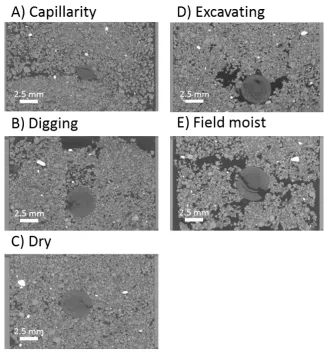
(five in total) to create realistic field conditions (Figure 1). Figure 2A shows the capillary 167
method was responsible for the formation of two distinct layers. The bottom layer consisted 168
a higher amount of coarser particles which resulted in a hydraulic disconnection causing the 170
developing root and stem to push the top soil layer upwards. A ratio of 55.76% (±4.56) soil to 171
44.24% (±4.56) air was calculated within a distance of 1 voxel (20 µm) around the seed. 172
Method B led to a higher seed-soil contact around the seed. Nevertheless, the filled region 173
featured more pore space than the surrounding soil than would be considered ideal (Figure 174
2B). Method B showed the highest surrounding soil mass with a ratio of 68.86% (±2.09) soil to 175
31.14% (±2.09) air. Method C exhibited a high seed-soil contact throughout the whole region 176
with the most uniform distribution of the fine soil particles with a ratio of 63.01% (±0.83) soil 177
to 36.99% (±0.83) air (Figure 2C). Excavation of soil to insert the seed resulted in large air space 178
pockets around the seed although the top layer was tapped downwards (Figure 2D). These air 179
pockets resulted in a higher amount of air space around the seed (38.49% (±5.94) soil to 180
61.51% (±5.94) air). A similar appearance was observed in method E with a ratio of 32.86% 181
(±12.31) soil to 67.14% (±12.31) air (Figure 2E). Method D and E had a significantly higher air 182
space around the seed as well as a high variability within the replicates which was non-183
preferable. Method C was chosen for subsequent studies as it ensured greater reproducibility 184
of packing and from field observations appeared to reflect a structural arrangement most 185
similar to the field situation. However, one might expect a higher degree of heterogeneity in 186
the field over large distances which would potentially increase variation in germination 187
behaviour between seeds. 188
Comparison of seed enhancement technologies
189
X-ray CT scanning of a seed in air enables the distinction of different components (Figure 3). 190
The scan of the bare seed ex situ enabled measurements of the thickness of the seed coating 191
and pelleting. The seed coating had an average thickness of 0.03 mm evenly distributed over 192
the seed surface with a volume of approximately 1.04 mm3 (P+FC) and 1.09 mm3 (FC). Applied
on the surface of a pelleted seed, the thickness varied between 0.03 mm and 0.06 mm with a 194
size of approximately 20.30 mm3 (P) or 20.72 mm3 (P+FC). The thickness of the pelleting varied
195
highly between 0.05 mm and 1.10 mm due to the shape of the seed. The applied pelleting had 196
a porosity of 18.03% for P and 15.82% for P+FC. Figure 4A shows an exemplar 2D image slice 197
of an X-ray CT scan of a 3 days old seedling in soil. The 20 µm resolution enabled a 198
differentiation of the fruit wall, the perisperm and the embryo for the first time in soil. The 199
shoot can be observed growing towards the soil surface and thereby pushing the soil particles 200
aside. Figure 4B shows a similar appearance for treatment P+FC. The formation of the apical 201
hook results in a region of higher compaction in comparison to the soil particles around the 202
seed. It appears that the number of small soil particles in immediate contact with the seed is 203
much higher in comparison to larger particles which can be precisely observed using X-ray CT. 204
The grey value intensity differences observed in the pelleting highlight the layers consisting of 205
materials with different X-ray attenuation coefficients where the lightest parts represent 206
mineral based components. On the outermost layer is a fine white line (high X-ray absorption) 207
which is due to the mineral content of the pesticide coating. 208
Quantitative assessment of X-ray CT data
209
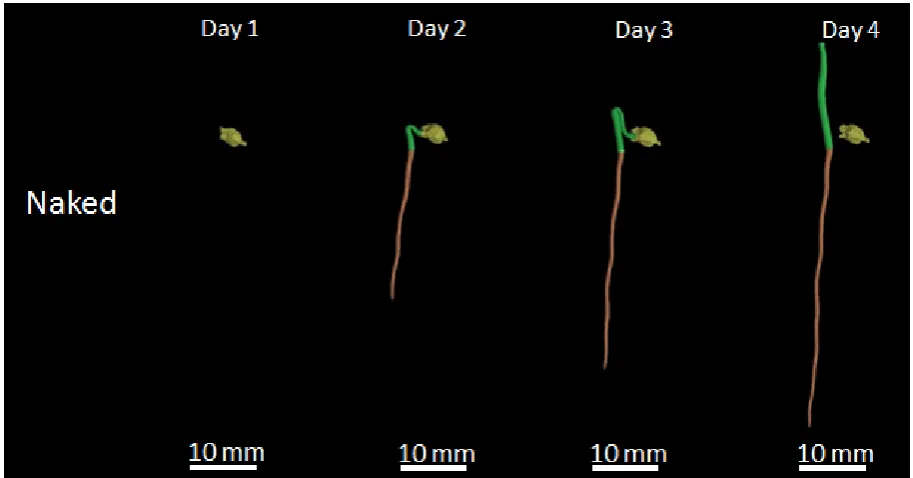
Sugar beet radical growth characteristics for each seed treatment were measured daily for 4 210
days (Figure 5). Treatment N was shown to display a rapid growth response followed by 2 days 211
of steady growth (Figure 6A) whereas P+FC and P had an initial slower growth that increased 212
over the 4 days resulting in longer radicle length of P compared to N after 4 days of growth. 213
Specifically, the radicle lengths of P+FC were ca. 50% less in comparison to N on day 2 but 214
showed a similar length at day 4. FC displayed a delay in root growth of ca. one day and a 215
between day 3 and 4 but it did not subsequently achieve the same growth as the other 217
treatments. The effect on the growth per day can be seen in Figure 6B. 218
Comparison of daily radicle growth (Figure 6B) showed a rapid growth at day 2 for N and P 219
which decreased the following day. The P+FC seeds showed a continuous increase in radicle 220
growth, whereas N and P decreased after the initial rapid growth. For FC almost no radicle 221
growth was visible at day 2 but a rapid increase in growth occurred on the subsequent days. 222
A similar pattern was observed for the radicle volume between all treatments (Figure 6C). The 223
volume determination suffers from an intrinsic potential error of up to 18-20% for a dilation 224
by 1 voxel (addition of a one voxel layer) and up to 16-18% for an erosion of 1 voxel 225
(subtraction of a one voxel layer) for the majority of the segmentations. N and P treatments 226
showed a rapid increase in volume at day 2. The growth rate extenuated at day 2 but 227
accelerated again at day 4. P+FC treatments showed an almost linear increase in radicle 228
volume. A delay was observed for FC with a rapid acceleration on the last day. Figure 7 displays 229
the ratio of radicle volume and radicle length to visualise the differences between the seed 230
enhancement methods. There was a significant relationship interaction between sampling day 231
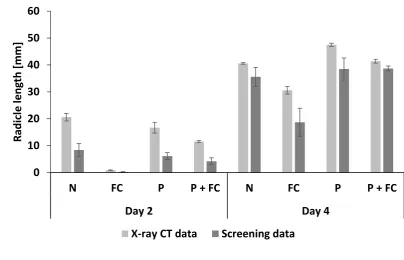
and seed treatment (p = 0.004). A screening test was conducted to observe the variability 232
within each treatment type (displayed in brackets is standard error): Day 2: N 8.4 mm 233
(±2.4 mm), FC 0.2 mm (±0.2 mm), P 6.1 mm (±1.3 mm), P+FC 4.2 mm (±1.3 mm); Day 4: N 234
35.6 mm (3.5 mm), FC 18.7 mm (±5.2 mm), P 38.5 mm (±4.1 mm), P+FC 38.7 mm (±0.9 m). A 235
comparison of the X-ray CT data and the screening data was conducted (Figure ). The radicle 236
lengths measured using the X-ray CT data were higher compared to the screening data in all 237
Discussion
239
This study successfully highlighted subtle temporal differences in growth between different 240
seed enhancement treatments using X-ray CT and hence verifying X-ray CT as a suitable tool 241
for the quantification of the establishment process of plants i.e. our work was undertaken on 242
sugar beet but is transferable to most seed types. Due to the nature of the in situ environment, 243
the contrast of the collected images suffers in comparison to a scan of a seed outside of soil 244
which is a limiting factor for observing the germination process in the seed, though we believe 245
this is offset by the advantages of observing behaviour in soil. The results show for the first 246
time in soil clear treatment differences in radicle growth characteristics over the first four days 247
after sowing. Although the results generally showed low within treatment variability, an 248
additional screening test of ten replicates was used to further understand the inherent 249
variability of seedling establishment. Results indicated that the radicle length of all seed 250
enhancement types have a high variability. It was noticed, however, that radicle lengths were 251
higher when measured by X-ray CT compared to excavation measurement. It has previously 252
been reported that radicle lengths can be underestimated using X-ray CT which contradicts 253
these findings (Mooney et al., 2012). However, in this study different plants were used for the 254
X-ray CT and the destructive analysis so we attribute natural variation as the main reason for 255
the difference. As the length differences were significant throughout all treatments, it may be 256
possible that X-ray radiation had a small but beneficial effect in the small doses that are able 257
to penetrate the soil (Shull and Mitchell, 1933). A further beneficial effect might be due to an 258
inhibitory effect on pests that could be present in the soil or the seed itself (Ikram et al., 2015) 259
although this is less likely in the timescales of this study. 260
The use of FC seeds verified the assumption that the chemical coating, at least when applied 261
pelleting serves to increase the spatial distance to the coating besides its original purpose to 263
increase the ease of planting (Kaufmann, 1991; Hill, 1999; Taylor et al. 2001). The application 264
of pelleting resulted in a higher germination rate compared to other treatments based on root 265
length growth per day which might be due to the increased water uptake rate as a beneficial 266
side effect of the pelleting material consisting mainly of wood fibre and clay. The growth over 267
time showed a very rapid development of the radicle on day 2 for all treatments except for FC. 268
The fast radicle growth for the FC treatment started with a day delay which is likely due to the 269
proximity to the insecticides and fungicides. Standard pesticides used for sugar beet 270
protection include fungicides like Thiram or Tachigaren (active ingredient: Hymexazol) as well 271
as insecticides like thiamethoxan, imidacloprid or chlothianidin (KWS, 2017; Syngenta, 2016a; 272
Syngenta, 2016b). Redfearn and Osborne (1997) showed a quicker emergence using Thiram 273
compared to previous seed coating treatments with similar effectiveness. Hymexazol has been 274
reported to affect fungal RNA and DNA synthesis and should the transformed into glucosides 275
with fungi toxic effects as well as plant growth promoting effects rapidly after entering a plant 276
organism (Ypema, 2003). Since the 1990s, neonicotinoids (e.g. thiamethoxan) have been 277
widely used to reduce the risk of virus yellows and to control foliar and soil pests (Bayer, 2011; 278
KWS, 2017; Syngenta, 2016c). Though neonicotinoids, in particular, are controversial due to 279
the reported effects on bee populations (Rundlöf, 2015; BBRO, 2016). The addition of a 280
coating reduces the ability of the seed to open as quickly as a naked seed. The delay for FC 281
could therefore be due to the physical shell that was created during the coating process or the 282
resulting phytotoxicity posed by its proximity to the seed surface. Similar effects have been 283
reported for oil seed rape as imidacloprid and thiamethoxam supressed root system 284
development in the cotyledon stage (Huang et al., 2015). Vyn and Murua (2001) found 285
growth was observed only in FC and not in P+FC which may be due to the composition of the 287
pelleting material or to the swelling of the pellet during water uptake which might help to 288
overcome the physical shell of the coating by weakening the structure of the shell. It is likely 289
that the slower germination could be the influence of the coating material, which is not as 290
high for P+FC because the applied insecticides and fungicides are not directly in contact with 291
the fruit (the fruit includes both the seed and the fruitwall surrounding the seed) and therefore 292
the phytotoxicity impacting the seed is lower. Furthermore, a seed establishment delay was 293
observed in different coated turfgrass species using different irrigation techniques (Serena et 294
al., 2012). Karnataka et al. (2008), however, described a higher germination rate, a higher
295
vigour index (vigour index = (root length + shoot length) x germination percentage) and an 296
increased field emergence in coated seeds after three months of growth. Therefore, FC 297
seedlings may overcome this delay later during their growth and give higher field emergence 298
compared to naked seeds based on the protection provided against negative effects like fungi 299
or insects. The growth rate comparison showed that P and P+FC radicle growth rates increased 300
after the initial rapid growth whereas the growth rate for N was constant. This may be due to 301
the enhanced water uptake during the first days of growth that would have increased water 302
storage inside the seedling in both P and P+FC, as well as an increased vigour caused by 303
increased water uptake (Gorim and Asch, 2015). A positive effect for different kind of 304
pelletings was previously shown during early establishment especially near moisture limiting 305
periods supporting this assumption (Scott, 1975). 306
Figure 7 showed that there are slight differences in volume per millimetre radicle length for P 307
and N in comparison to FC and P+FC but these were not significant. Also, the radicle volume 308
was almost the same at day 4 which suggests seed enhancement technologies like P+FC do 309
length. The four growth stages (seed cracking; rapid radicle growth; formation of apical hook; 311
unfolding of apical hook) were visible in all four treatments although they were slightly 312
delayed for the FC. This observation confirms that physical seed enhancement using pelleting 313
or coating might not have altered the mechanism of emergence but rather the rate. 314
Conclusions
315
Seed enhancement technologies enable the alteration of the growth behaviour of the early 316
seedling. Although it appeared N has the highest growth rate over the first two days, the 317
addition of pelleting allowed a more rapid increase in root growth per day. The addition of a 318
coating is essential to ensure a consistent yield in the field due to the addition of protection 319
by applying insecticide and fungicide (FC). However, applying a coating reduced the seedling 320
emergence rate which is why a pelleting in addition to the coating is used to balance this 321
negative effect (P+FC). The positive effect of the pelleting as hypothesised was verified as was 322
the negative effect of the close proximity of the pesticide containing coating to the seed. This 323
study shows the benefits of X-ray imaging as a tool to compare different seed enhancement 324
technologies in soil supporting efforts of seed breeding companies to optimise their seed 325
enhancement compositions according to the seeds in situ performance. 326
The physical mitigation of a pesticide coating might be overcome by priming the seed prior to 327
pelleting which could be assessed in future studies. During priming, the germination process 328
is initiated and stopped before the seed starts to crack. This effect is hypothesised to 329
overcome the disadvantage of the coating delay. Future work is needed to evaluate the effects 330
of priming in comparison to the data presented here. Additionally, the effect of different 331
growth conditions (e.g. drought and compaction) could be monitored to gain a greater 332
such as these have important consequences in understanding seedling germination in a 334
changing environment and may support sustainable agricultural practices. 335
Acknowledgements
336
This work was financially supported by Syngenta. 337
References
338
Bayer. (2011). Establishment pests. Expert Guide: Sugar Beet, 6–7. 339
BBRO. (2016). Opinion: The benefits of Neonicotinoid seed treatments in the sugar beet industry. British Sugar 340
Beet Review, 84(2). 341
Bewley, J. D.; Bradford, K., Hilhorst, H., Nonogaki, H. (2013). Seeds. 342
Brown, A. D., Dexter, A. R., Chamen, W. C. T., & Spoor, G. (1996). Effect of soil macroporosity and aggregate size 343
on seed-soil contact. Soil and Tillage Research, 38(3–4), 203–216. http://doi.org/10.1016/S0167-344
1987(96)01030-6 345
Chang, K. F., Hwang, S. F., Gossen, B. D., Turnbull, G. D., Howard, R. J., & Blade, S. F. (2004). Effects of soil 346
temperature, seeding depth, and seeding date on rhizoctonia seedling blight and root rot of chickpea. 347
Canadian Journal of Plant Science, 84(3), 901–907. http://doi.org/10.4141/P03-024 348
Chapuis, R., Delluc, C., Debeuf, R., Tardieu, F., & Welcker, C. (2012). Resiliences to water deficit in a phenotyping 349
platform and in the field : How related are they in maize ? European Journal of Agronomy, 42, 59–67. 350
http://doi.org/10.1016/j.eja.2011.12.006 351
Devarrewaere, W., Foqué, D., Heimbach, U., Cantre, D., Nicolai, B., Nuyttens, D., & Verboven, P. (2015). 352
Quantitative 3D Shape Description of Dust Particles from Treated Seeds by Means of X-ray Micro-CT. 353
Environmental Science & Technology, 49(12), 7310–7318. http://doi.org/10.1021/acs.est.5b02250 354
Ehsanfar, S., & Modarres-Sanavy, S. (2005). Crop protection by seed coating. Commun. Agric. Appl. Biol. Sci., 355
70(3), 225–229. 356
Gagliardi, B., & Marcos-Filho, J. (2011). Relationship between germination and bell pepper seed structure 357
assessed by the X-ray test. Scientia Agricola, 68(4), 411–416. http://doi.org/10.1590/S0103-358
90162011000400004 359
Galhaut, L., de Lespinay, A., Walker, D. J., Bernal, M. P., Correal, E., & Lutts, S. (2014). Seed Priming of Trifolium 360
repens L. Improved Germination and Early Seedling Growth on Heavy Metal-Contaminated Soil. Water, Air, 361
& Soil Pollution, 225(4), 1905. http://doi.org/10.1007/s11270-014-1905-1 362
Gorim, L. (2014). Effects of seed coating on germination and early seedling growth in cereals. Dissertation, 1– 363
132. 364
Gregory, P. J., Hutchison, D. J., Read, D. B., Jenneson, P. M., Gilboy, W. B., & Morton, E. J. (2003). Non-invasive 365
imaging of roots with high resolution X-ray micro-tomography. Plant and Soil, 255(1), 351–359. 366
Hill, H. J. (1999). Recent Developments In Seed Technology. Journal of New Seeds. 368
http://doi.org/10.1300/J153v01n01_09 369
Huang, L., Zhao, C. I., Huang, F., Bai, Fang, H., Run-e, B. A. I., & Feng-ming, Y. A. N. (2015). Effects of imidacloprid 370
and thiamethoxam as seed treatments on the early seedling characteristics and aphid-resistance of oilseed 371
rape. Journal of Integrative Agriculture, 14(12), 2581–2589. http://doi.org/10.1016/S2095-3119(15)61140-6 372
Karnataka (2008). Effect of Seed Coating with Polymer Fungicide and Insecticide on Seed Quality in Cotton During 373
Storage, 21(2), 137–139. 374
Kaufman, G. (n.d.). Tool for Stand Stimulus to Seed, 98–102. 375
Klepper, B., Kaspar T. C. (1994). Rhizotrons: Their development and use in agricultural research. Agron. J. 86, 745-376
753 377
KWS. (2017). Structure of pelleted KWS Sugar Beet Seed, accessed 12/06/2017, 11.00 a.m. https://www.kws-378
uk.com/aw/Seed-Production/Seed-Processing2121/Copy-of-Opbygning-af-et-f-rdigt-roefr-/~cfbn/ 379
Lal, R. (2013). Ecohydrology & Hydrobiology Food security in a changing climate §. Integrative Medicine Research, 380
13(1), 8–21. http://doi.org/10.1016/j.ecohyd.2013.03.006 381
Lipiec, J., & Hatano, R. (2003). Quantification of compaction effects on soil physical properties and crop growth. 382
Geoderma, 116(1–2), 107–136. http://doi.org/10.1016/S0016-7061(03)00097-1 383
Lundgren, J. (2009). Relationships of Natural Enemies and Non-prey Foods. 384
Mairhofer, S., Zappala, S., Tracy, S., Sturrock, C., Bennett, M. J., Mooney, S. J., & Pridmore, T. P. (2013). Recovering 385
complete plant root system architectures from soil via X-ray μ -Computed Tomography, 1–7. 386
Masauskas, V., Masauskiene, A., Repsiene, R., Skuodiene, R., Braziene, Z., & Peltonen, J. (2008). Phosphorus seed 387
coating as starter fertilization for spring malting barley. Acta Agriculturae Scandinavica, 582, 124–131. 388
Metzner, R., Eggert, A., van Dusschoten, D., Pflugfelder, D., Gerth, S., Schurr, U., … Jahnke, S. (2015). Direct 389
comparison of MRI and X-ray CT technologies for 3D imaging of root systems in soil: potential and challenges 390
for root trait quantification. Plant Methods, 11, 17. http://doi.org/10.1186/s13007-015-0060-z 391
Monneveux, P., Ramírez, D. A., & Pino, M. (2013). Plant Science Drought tolerance in potato ( S . tuberosum L .) 392
Can we learn from drought tolerance research in cereals ? Plant Science, 205–206, 76–86. 393
http://doi.org/10.1016/j.plantsci.2013.01.011 394
Mooney, S. J., Pridmore, T. P., Helliwell, J., & Bennett, M. J. (2012). Developing X-ray Computed Tomography to 395
non-invasively image 3-D root systems architecture in soil. Plant and Soil, 352(1–2), 1–22. 396
http://doi.org/10.1007/s11104-011-1039-9 397
Redfearn, M., & Osborne, D. J. (1997). Effects of advancement on nucleic acids in sugarbeet ( Beta vulgaris ) seeds. 398
Seed Science Research, 7, 261–267. 399
Rundlöf, M., Andersson, G. K. S., Bommarco, R., Fries, I., Hederström, V., Herbertsson, L., … Smith, H. G. (2015). 400
Seed coating with a neonicotinoid insecticide negatively affects wild bees. Nature, 521, 77–80. 401
http://doi.org/10.1038/nature14420 402
Scott, D. (1975). Effects of seed coating on establishment. New Zealand Journal of Agricultural Research, 18(1), 403
59–67. http://doi.org/10.1080/00288233.1975.10430388 404
Silcock, R., & Smith, F. (1982). Seed coating and localized application of phosphate for improving seedling growth 406
of grasses on acid, sandy red earth. Australian Journal of Agricultural Research, 33, 785–802. 407
Smýkal, P., Vernoud, V., Blair, M. W., Soukup, A., & Thompson, R. D. (2014). The role of the testa during 408
development and in establishment of dormancy of the legume seed. Frontiers in Plant Science, 5(July), 351. 409
http://doi.org/10.3389/fpls.2014.00351 410
Syngenta. (2016a). Force ST Seed treatment, last updated 23/03/2016. Accessed on 12/06/2017, 11.00 a.m. 411
https://www.syngenta.co.uk/product/crop-protection/seed-treatment/force-st 412
Syngenta. (2016b). Armure Seed treatment, last updated 01/06/2016. Accessed on 12/06/2017, 11.00 a.m. 413
https://www.syngenta.co.uk/product/crop-protection/fungicide/armure 414
Syngenta. (2016c). Cruiser SB Seed treatment, last updated 23/03/2016. Accessed on 12/06/2017, 11.00 a.m. 415
https://www.syngenta.co.uk/product/crop-protection/seed-treatment/cruiser-sb 416
Taylor, A. (1999). Seed enhancement. Journal of New Seeds1, 1(1), 103. 417
Tracy, S. R., Black, C. R., Roberts, J. A., & Mooney, S. J. (2013). Exploring the interacting effect of soil texture and 418
bulk density on root system development in tomato ( Solanum lycopersicum L .). Environmental and 419
Experimental Botany, 91, 38–47. http://doi.org/10.1016/j.envexpbot.2013.03.003 420
Vogel, H.-J., Weller, U., & Schlüter, S. (2010). Quantification of soil structure based on Minkowski functions. 421
Computers & Geosciences, 36(10), 1236–1245. http://doi.org/10.1016/j.cageo.2010.03.007 422
Vyn, T. J., & Murua, M. (2001). Polymer Seed Coatings : Sufficient Risk Reduction for Early Plant Corn ? 56th 423
Annual Corn and Sorghum Research Conference., 1–11. 424
William, R. W., Lawnb, R. J., C, B., & Bythd, D. E. (1995). Studies on Water Damage in Mungbean . I . Effect of 425
Weathering on Seed Quality and Viability, 887–899. 426
Ypema, H. (2003). Fungicides, Hymexazol. In Encyclopedia of Agrochemicals. http://doi.org/ 427
10.1002/047126363X.agr110
430
Figure 1: Packing methods used for the determination of a realistic field condition. Each method was set up using 3 replicates 431
of a pelleted and coated seed. A) The column is filled with dry soil, saturated and the seed placed centrally on the layer. A 432
second layer is poured onto the seed and the capillarity force saturates the second layer. B) The column is filled completely 433
with dry soil and saturated. A hole in the size of the seed is dug and the seed placed into the hole. The hole is filled with dry 434
soil and capillarity force saturates the filling. C) A first layer is packed dry, the seed sown on top the layer and a second layer 435
applied dry as well. The whole column is saturated as the last step. D) The column is filled with dry soil and saturated. A larger 436
portion is excavated and the seed placed into the hole. The hole is filled again with the previously excavated soil and 437
compressed by tapping. E) The soil storage is pre-wetted and the column packed with this soil in two layers placing the seed 438
440
Figure 2: Results of the packing studies. The labelling of different methods refers to the previously explained methods of 441
Figure 1. The images have been taken from the top 2 cm of the column using the front orientation and the same scale. A) 442
The capillarity method resulted in the formation of a transition zone which forms a hydraulic disconnection between both 443
layers. B) The digging method results in a loose soil portion above the seed which is poorly connected to the surrounding soil. 444
C) The dry method results in uniform distribution of soil particles around the seed. D) The excavation method results in the 445
appearance of air pockets around the seed. E) The field moist method results in highly disconnected soil portions in the 446
448
Figure 3: 2D images of non-germinated sugar beet seeds. A) Naked seed. B) Coated seed. C) Pelleted seed. D) Pelleted and 449
Figure 4: Exemplary 2D slices of day 3 scans. A) A 2D image of a naked seed on day 3. This scan was taken with a resolution 451
of 20 µm. B) A 2D image of a pelleted and coated seed on day 3. This scan was taken with a resolution of 20 µm. 452
A
453
Figure 5: Exemplar temporal representation of 3D reconstructions of a naked sugar beet seed. The scans were taken at a 454
Figure 6: Analysis of radicle growth based on a growth period of four days. A) Radicle length comparison over 4 days. B)
Radicle growth per day. Radicle growth per day is calculated as the subtraction of two consecutive days. C) Radicle volume
change over time. Radicle volume is calculated automatically using VGStudio Max 2.2. N = 3, error bars are calculated using
standard error of the mean.
0 10 20 30 40 50 60
Day 1 Day 2 Day 3 Day 4
R ad icl e le n gth [ m m ] N FC P
P + FC
0 5 10 15 20 25 30
Day 1 Day 2 Day 3 Day 4
R ad icl e g row th p e r d ay [m m ] N FC P
P + FC
0 5 10 15 20
Day 1 Day 2 Day 3 Day 4
R ad icl e v ol u m e [ m m 3 ] N FC P
P + FC A
B
456
Figure 7: Ratio of radicle volume and radicle length. N= 3, error bars are calculated using standard error of the mean. 457
0 0.1 0.2 0.3 0.4 0.5 0.6
Day 1 Day 2 Day 3 Day 4
ra
d
icl
e
v
ol
u
m
e
/
ra
d
icl
e
le
n
gth
[
m
m
2 ]
N
FC
P
458
Figure 8: Comparison of X-ray CT data and screening data after two and after four days of growth. The screening data was 459
gathered by excavating the seedling so that the seedlings for the day 2 and day 4 measurements for the screening data are 460
not based on the same plant like for the X-ray CT data. X-ray CT data N = 4; Screening data N = 10. Error bars are calculated 461
as standard error of the mean. 462
0 10 20 30 40 50 60
N FC P P + FC N FC P P + FC
Day 2 Day 4
R
ad
icl
e
le
n
gth
[
m
m
]