14
Introduction to inheritance
I
nteresting systems are seldom born into an empty world.Almost always, new software expands on previous developments; the best way to create it is by imitation, refinement and combination. Traditional design methods largely ignored this aspect of system development. In object technology it is an essential concern. The techniques studied so far are not enough. Classes do provide a good modular decomposition technique and possess many of the qualities expected of reusable components: they are homogeneous, coherent modules; you may clearly separate their interface from their implementation according to the principle of information hiding; genericity gives them some flexibility; and you may specify their semantics precisely thanks to assertions. But more is needed to achieve the full goals of reusability and extendibility.
For reusability, any comprehensive approach must face the problem of repetition and variation, analyzed in an earlier chapter. To avoid rewriting the same code over and over again, wasting time, introducing inconsistencies and risking errors, we need techniques to capture the striking commonalities that exist within groups of similar structures — all text editors, all tables, all file handlers — while accounting for the many differences that characterize individual cases.
For extendibility, the type system described so far has the advantage of guaranteeing type consistency at compile time, but prohibits combination of elements of diverse forms even in legitimate cases. For example, we cannot yet define an array containing geometrical objects of different but compatible types such as POINT and SEGMENT.
Progress in either reusability or extendibility demands that we take advantage of the strong conceptual relations that hold between classes: a class may be an extension, specialization or combination of others. We need support from the method and the language to record and use these relations. Inheritance provides this support.
14.1 POLYGONS AND RECTANGLES
To master the basic concepts we will use a simple example. The example is sketched rather than complete, but it shows the essential ideas well.
Polygons
Assume we want to build a graphics library. Classes in this library will describe geometrical abstractions: points, segments, vectors, circles, ellipses, general polygons, triangles, rectangles, squares and so on.
Consider first the class describing general polygons. Operations will include computation of the perimeter, translation, rotation. The class may look like this:
indexing
description: "Polygons with an arbitrary number of vertices"
class POLYGON creation
…
feature -- Access
count: INTEGER
-- Number of vertices
perimeter: REAL is
-- Length of perimeter
do … end
feature -- Transformation
display is
-- Display polygon on screen.
do … end
rotate (center: POINT; angle: REAL) is
-- Rotate by angle around center.
do
… See next …
end
translate (a, b: REAL) is
-- Move by a horizontally, b vertically.
do … end
… Other feature declarations …
feature {NONE} -- Implementation
vertices: LINKED_LIST [POINT]
-- Successive points making up polygon
invariant
same_count_as_implementation: count = vertices●count
at_least_three: count >= 3
-- A polygon has at least three vertices (see exercise 14.2)
end
The attribute vertices yields the list of vertices; the choice of a linked list is only one possible implementation. (An array might be better.)
Here is a possible implementation for a typical procedure, rotate. The procedure performs a rotation by a certain angle around a certain rotation center. To rotate a polygon, it suffices to rotate every vertex in turn:
rotate (center: POINT; angle: REAL) is
-- Rotate around center by angle.
do
from
vertices●start until
vertices●after loop
vertices●item●rotate (center, angle)
vertices●forth end
end
To understand this procedure, note that feature item from LINKED_LIST yields the value of the currently active list element (where the cursor is). Since vertices is of type
LINKED_LIST [POINT], vertices●item denotes a point, to which we may apply procedure
rotate defined for class POINT in an earlier chapter. It is valid — and common — to give the same name, here rotate, to features of different classes, as the target of any feature always has a clearly defined type. (This is the O-O form of overloading.)
Another routine, more important for our immediate purposes, is the function to compute the perimeter of a polygon. Since our polygons have no special properties, the only way to compute their perimeter is to loop through their vertices and sum the edge lengths. Here is an implementation of perimeter:
perimeter: REAL is
-- Sum of edge lengths
local
this, previous: POINT
do from
vertices●start; this := vertices●item
check not vertices●after end -- A consequence of at_least_three until
vertices●is_last loop
previous := this vertices●forth
this := vertices●item
Result := Result + this●distance (previous) end
Result := Result + this●distance (vertices●first) end
The text of class POINT appeared on page 176.
this
previous
(start) (is_last)
The loop simply adds the successive distances between adjacent vertices. Function
distance was defined in class POINT. Result, representing the value to be returned by the function, is automatically initialized to 0 on routine entry. From class LINKED_LIST we use features first to get the first element, start to move the cursor to that first element,
forth to advance it to the next, item to get the value of the element at cursor position, is_ last to know whether the current element is the last one, after to know if the cursor is past the last element. As recalled by the check instruction the invariant clause at_least_three
will guarantee that the loop starts and terminates properly: since it starts in a not after
state, vertices●item is defined, and applying forth one or more time is correct and will
eventually yield a state satisfying is_last, the loop’s exit condition.
Rectangles
Now assume we need a new class representing rectangles. We could start from scratch. But rectangles are a special kind of polygon and many of the features are the same: a rectangle will probably be translated, rotated or displayed in the same way as a general polygon. Rectangles, on the other hand, also have special features (such as a diagonal), special properties (the number of vertices is four, the angles are right angles), and special versions of some operations (to compute the perimeter of a rectangle, we can do better than the above general polygon algorithm).
We can take advantage of this mix of commonality and specificity by defining class
RECTANGLE as an heir to class POLYGON. This makes all the features of POLYGON
— called a parent of RECTANGLE — by default applicable to the heir class as well. It suffices to give RECTANGLE an inheritance clause:
class RECTANGLE inherit
POLYGON
feature
… Features specific to rectangles …
end
The feature clause of the heir class does not repeat the features of the parent: they are automatically available because of the inheritance clause. It will only list features that are specific to the heir. These may be new features, such as diagonal; but they may also be redefinitions of inherited features.
The second possibility is useful for a feature that was already meaningful for the parent but requires a different form in the heir. Consider perimeter. It has a better implementation for rectangles: no need to compute four vertex-to-vertex distances; the result is simply twice the sum of the two side lengths. An heir that redefines a feature for the parent must announce it in the inheritance clause through a redefine subclause:
class RECTANGLE inherit
POLYGON
redefine perimeter end feature
…
end
This allows the feature clause of RECTANGLE to contain a new version of
perimeter, which will supersede the POLYGON version for rectangles. If the redefine subclause were not present, a new declaration of perimeter among the features of
RECTANGLE would be an error: since RECTANGLE already has a perimeter feature inherited from POLYGON, this would amount to declaring a feature twice.
The RECTANGLE class looks like the following: indexing
description: "Rectangles, viewed as a special case of general polygons"
class RECTANGLE inherit
POLYGON
redefine perimeter end creation
make
feature -- Initialization
make (center: POINT; s1, s2, angle: REAL) is
-- Set up rectangle centered at center, with side lengths -- s1 and s2 and orientation angle.
do … end
feature -- Access
side1, side2: REAL
-- The two side lengths
diagonal: REAL
-- Length of the diagonal
perimeter: REAL is
-- Sum of edge lengths
-- (Redefinition of the POLYGON version)
do
Result := 2 ✳ (side1 + side2)
end invariant
four_sides: count = 4
first_side: (vertices●i_th (1))●distance (vertices●i_th (2)) = side1
second_side: (vertices●i_th (2))●distance (vertices●i_th (3)) = side2
third_side: (vertices●i_th (3))●distance (vertices●i_th (4)) = side1
fourth_side: (vertices●i_th (4))●distance (vertices●i_th (1)) = side2
end
Because RECTANGLE is an heir of POLYGON, all features of the parent class are still applicable to the new class: vertices, rotate, translate, perimeter (in redefined form) and any others. They do not need to be repeated in the new class.
This process is transitive: any class that inherits from RECTANGLE, say SQUARE, also has the POLYGON features.
1 2
3 4
side1
side2
Basic conventions and terminology
The following terms will be useful in addition to “heir” and “parent”.
In the literature you will also encounter the terms “subclass” and “superclass”, but we will stay away from them because they are ambiguous; sometimes “subclass” means heir (immediate descendant), sometimes it is used in the more general sense of proper descendant, and it is not always clear which. In addition, we will see that the “subset” connotation of this word is not always justified.
Associated terminology applies to the features of a class: a feature is either inherited (coming from a proper ancestors) or immediate (introduced in the class itself).
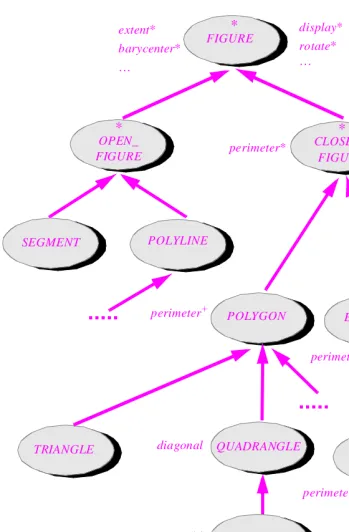
In graphical representations of object-oriented software structures, where classes are represented by ellipses (“bubbles”), inheritance links will appear as single arrows. This distinguishes them from links for the other basic inter-class relation, client, which as you will recall uses a double arrow. (For further distinction this book uses black for client and color for inheritance.)
A redefined feature is marked ++, a convention from the Business Object Notation (B.O.N.).
The arrow points upward, from the heir to the parent; the convention, easy to remember, is that it represents the relation “inherits from”. In some of the literature you will find the reverse practice; although in general such choices of graphical convention are partly a matter of taste, in this case one convention appears definitely better than the other — in the sense that one suggests the proper relationship and the other may lead to confusion. An arrow is not just an arbitrary pictogram but indicates a unidirectional link, between the two ends of the arrow. Here:
Inheritance terminology
A descendant of a class C is any class that inherits directly or indirectly from
C, including C itself. (Formally: either C or, recursively, a descendant of an heir of C.)
A proper descendant of C is a descendant other than C itself.
An ancestor of C is a class A such that C is a descendant of A. A proper ancestor of C is a class A such that C is a proper descendant of A.
An inheritance link
POLYGON
RECTANGLE
perimeter
diagonal
• Any instance of the heir may be viewed (as we shall see in more detail) as an instance of the parent, but not conversely.
• The text of the heir will always mention the parent (as in the inherit clause above), but not conversely; it is in fact an important property of the method, resulting among others from the Open-Closed principle, that a class does not “know” the list of its heirs and other proper descendants.
Mathematically, the direction of the relationship is reflected in algebraic models for inheritance, which use a morphism (a generalization of the notion of function) from the heir’s model to the parent’s model — not the other way around. One more reason for drawing the arrow from the heir to the parent.
Although with complex systems we cannot have an absolute rule for class placement in inheritance diagrams, we should try whenever possible to position a class above its heirs.
Invariant inheritance
You will have noticed the invariant of class RECTANGLE, which expresses that the number of sides is four and that the successive edge lengths are side1, side2, side1 and
side2.
Class POLYGON also had an invariant, which still applies to its heir:
Because the parents may themselves have parents, this rule is recursive: in the end the full invariant of a class is obtained by anding the invariant clauses of all its ancestors. The rule reflects one of the basic characteristics of inheritance: to say that B inherits from A is to state that one may view any instance of B also as an instance of A (more on this property later). As a result, any consistency constraint applying to instances of A, as expressed by the invariant, also applies to instances of B.
In the example, the second clause (at_least_three) invariant of POLYGON stated that the number of sides must be at least three; this is subsumed by the four_sides subclausein
RECTANGLE’s invariant clause, which requires it to be exactly four.
You may wonder what would happen if the heir’s clause, instead of making the parent’s redundant as here (since count = 4 implies count >= 3), were incompatible with it, as with an heir of POLYGON that would introduce the invariant clause count = 2. The result is simply an inconsistent invariant, not different from what you get if you include, in the invariant of a single class, two separate subclauses that read count >= 3 and count = 2.
Inheritance and creation
Although it was not shown, a creation procedure for POLYGON might be of the form
Invariant inheritance rule
make_ polygon (vl: LINKED_LIST [POINT]) is
-- Set up with vertices taken from vl.
require
vl●count >= 3 do
… Initialize polygon representation from the items of vl …
ensure
-- vertices and vl have the same items (can be expressed formally)
end
This procedure takes a list of points, containing at least three elements, and uses it to set up the polygon.
The procedure has been given a special name make_ polygon to avoid any name conflict when RECTANGLE inherits it and introduces its own creation procedure make. This is not the recommended style; in the next chapter we will learn how to give the standard name make to the creation procedure in POLYGON, and use renaming in the inheritance clause of RECTANGLE to remove any name clash.
The creation procedure of class RECTANGLE, shown earlier, took four arguments: a point to serve as center, the two side lengths and an orientation. Note that feature vertices
is still applicable to rectangles; as a consequence, the creation procedure of RECTANGLE
should set up the vertices list with the appropriate point values (the four corners, to be computed from the center, side lengths and orientation given as arguments).
The creation procedure for general polygons is awkward for rectangles, since only lists of four elements satisfying the invariant of class RECTANGLE would be acceptable. Conversely, the creation procedure for rectangles is not appropriate for arbitrary polygons. This is a common case: a parent’s creation procedure is not necessarily right as creation procedure for the heir. The precise reason is easy to spot; it follows from the observation that a creation procedure’s formal role is to establish the class invariant. The parent’s creation procedure was required to establish the parent’s invariant; but, as we have seen, the heir’s invariant may be stronger (and usually is); we cannot then expect that the original procedure will guarantee the new invariant.
In the case of an heir adding new attributes, the creation procedures might need to initialize these attributes and so require extra arguments. Hence the general rule:
An inherited creation procedure is still available to the heir as a normal feature of the class (although, as we shall see, the heir may prefer to make it secret); but it does not by default retain its status as a creation procedure. Only the procedures listed in the heir’s own creation clause have that status.
Creation Inheritance rule
An inherited feature’s creation status in the parent class (that is to say, whether or not it is a creation procedure) has no bearing on its creation status in the heir.
In some cases, of course, a parent’s creation procedure may still be applicable as a creation procedure; then you will simply list it in the creation clause:
class B inherit
A
creation
make
feature
…
where make is inherited — without modification — from A, which also listed it in its own creation clause.
An example hierarchy
For the rest of the discussion it will be useful to consider the POLYGON-RECTANGLE
example in the context of a more general inheritance hierarchy of geometrical figure types, such as the one shown on the next page.
Figures have been classified into open and closed variants. Along with polygons, an example of closed figure is the ellipse; a special case of the ellipse is the circle.
Various features appear next to the applicable classes. The symbol ++, as noted, means “redefined”; the symbols + and * will be explained later.
In the original example, for simplicity, RECTANGLE was directly an heir of
POLYGON. Since the sketched classification of polygons is based on the number of vertices, it seems preferable to introduce an intermediate class QUADRANGLE, at the same level as TRIANGLE, PENTAGON and similar classes. Feature diagonal can be moved up to the level of QUADRANGLE.
Note the presence of SQUARE, an heir to RECTANGLE, characterized by the invariant side1 = side2. Similarly, an ellipse has two focuses (or foci), which for a circle are the same point, giving CIRCLE an invariant property of the form
equal (focus1 = focus2).
14.2 POLYMORPHISM
Inheritance hierarchies will give us considerable flexibility for the manipulation of objects, while retaining the safety of static typing. The supporting techniques, polymorphism and dynamic binding, address some of the fundamental issues of software architecture discussed in part B of this book. Let us begin with polymorphism.
Polymorphic attachment
OPEN_ FIGURE
SEGMENT POLYLINE
POLYGON ELLIPSE
QUADRANGLE
[image:10.612.29.379.47.580.2]CIRCLE TRIANGLE
display* rotate* extent*
… barycenter*
…
perimeter*
perimeter+
diagonal
SQUARE perimeter++
perimeter++ perimeter+ CLOSED_ FIGURE FIGURE
RECTANGLE perimeter++
side1, side2
∗
∗
∗
Assume, with the inheritance structure shown in the figure, the following declarations using short but mnemonic entity names:
p: POLYGON; r: RECTANGLE; t: TRIANGLE
Then the following assignments are valid:
p := r p := t
These instructions assign to an entity denoting a polygon the value of an entity denoting a rectangle in the first case, a triangle in the second.
Such assignments, in which the type of the source (the right-hand side) is different from the type of the target (the left-hand side), are called polymorphic assignments. An entity such as p which appears in some polymorphic assignment is a polymorphic entity. Before the introduction of inheritance, all our assignments were monomorphic (non-polymorphic): we could assign — in the various examples of earlier chapters — a point to a point, a book to a book, an account to an account. With polymorphism, we are starting to see more action on the attachment scene.
The polymorphic assignments taken as example are legitimate: the inheritance structure permits us to view an instance of RECTANGLE or TRIANGLE as an instance of
POLYGON. We say that the type of the source conforms to the type of the target. In the reverse direction, as with r := p, the assignment would not be valid. This fundamental type rule will be discussed in more detail shortly.
Instead of an assignment, you may achieve polymorphism through argument passing, as with a call of the form f (r) or f (t) and a feature declaration of the form
f ( p: POLYGON) is do … end
As you will remember, assignment and argument passing have the same semantics, and are together called attachment; we can talk of polymorphic attachment when the source and target have different types.
What exactly happens during a polymorphic attachment?
All the entities appearing in the preceding cases of polymorphic attachment are of reference types: the possible values for p, r and t are not objects but references to objects. So the effect of an assignment such as p := r is simply to reattach a reference:
Polymorphic reference reattachment
(POLYGON) O1
p
r
(RECTANGLE) O2
(after) (before)
So in spite of the name you should not imagine, when thinking of polymorphism, some run-time transmutation of objects. Once created, an object never changes its type. Only references do so by getting reattached to objects of different types. This also means that polymorphism does not carry any efficiency penalty; a reference reattachment — a very fast operation — costs the same regardless of the objects involved.
Polymorphic attachments will only be permitted for targets of a reference type — not for the other case, expanded types. Since a descendant class may introduce new attributes, the corresponding instances may have more fields; the last figure suggested this by showing the RECTANGLE object bigger than the POLYGON object. Such differences in object size do not cause any problem if all we are reattaching is a reference. But if instead of a reference p is of an expanded type (being for example declared as expanded
POLYGON), then the value of p is directly an object, and any assignment to p would overwrite the contents of that object. No polymorphism is possible in that case.
Polymorphic data structures
Consider an array of polygons:
poly_arr: ARRAY [POLYGON]
When you assign a value x to an element of the array, as in
poly_arr●put (x, some_index)
(for some valid integer index value some_index), the specification of class ARRAY
indicates that the assigned value’s type must conform to the actual generic parameter: class ARRAY [G] creation
…
feature -- Element change
put (v: G; i: INTEGER) is
-- Assign v to the entry of index i
…
end -- class ARRAY
Because v, the formal argument corresponding to x, is declared of type G in the class, and the actual generic parameter corresponding to G is POLYGON in the case of poly_arr, the type of x must conform to POLYGON. As we have seen, this does not require x to be of type POLYGON: any descendant of POLYGON is acceptable.
So assuming that the array has bounds 1 and 4, that we have declared some entities as
p: POLYGON; r: RECTANGLE; s: SQUARE; t: TRIANGLE
and created the corresponding objects, we may execute
poly_arr●put (p, 1)
poly_arr●put (r, 2)
poly_arr●put (s, 3)
poly_arr●put (t, 4)
yielding an array of references to objects of different types:
See “COMPOSITE OBJECTS AND EXPANDED TYPES”, 8.7, page 254.
The graphical objects have been represented by the corresponding geometrical shapes rather than the usual multi-field object diagrams.
Such a data structure, containing objects of different types (all of them descendants of a common type), are called polymorphic data structures. We will encounter many examples in later discussions. The use of arrays is just one possibility; any other container structure, such as a list or stack, can be polymorphic in the same way.
The introduction of polymorphic data structures achieves the aim, stated at the beginning of chapter 10, of combining genericity and inheritance for maximum flexibility and safety. It is worth recalling the figure that illustrated the idea:
Types that were informally called SET_OF_BOOKS and the like on the earlier figure have been replaced with generically derived types, such as SET [BOOK].
This combination of genericity and inheritance is powerful. It enables you to describe object structures that are as general as you like, but no more. For example:
(POLYGON) (RECTANGLE)
(SQUARE)
(TRIANGLE)
1 3 4
2
A polymorphic array
LIST [PERSON] LIST [BOOK] LIST [JOURNAL] SET [BOOK]
LINKED_LIST [BOOK]
Abstraction
Specialization
Type parameterization Type parameterization
Dimensions of generalization
• LIST [RECTANGLE]: may contain squares, but not triangles.
• LIST [POLYGON]: may contain squares, rectangles, triangles, but not circles. • LIST [FIGURE]: may contain instances of any of the classes in the FIGURE
hierarchy, but not books or bank accounts.
• LIST [ANY]: may contain objects of arbitrary types.
The last case uses class ANY, which by convention is an ancestor to all classes. By choosing as actual generic parameter a class at a varying place in the hierarchy, you can set the limits of what your container will accept.
14.3 TYPING FOR INHERITANCE
That the remarkable flexibility provided by inheritance does not come at the expense of reliability follows from the use of a statically typed approach, in which we guarantee at compile time that no incorrect run-time type combination can occur.
Type consistency
Inheritance is consistent with the type system. The basic rules are easy to explain on the above example. Assume the following declarations:
p: POLYGON r: RECTANGLE
referring to the earlier inheritance hierarchy, of which the relevant extract is this:
We will study ANY in “Universal classes”, page 580.
POLYGON
QUADRANGLE perimeter+
diagonal
RECTANGLE perimeter++
side1, side2
display* rotate* extent*
… barycenter*
…
FIGURE
Then the following are valid:
• p●perimeter: no problem, since perimeter is defined for polygons. • p●vertices, p●translate (…), p●rotate (…) with valid arguments.
• r●diagonal, r●side1, r●side2: the three features considered are declared at the
RECTANGLE or QUADRANGLE level.
• r●vertices, r●translate (…), r●rotate (…): the features considered are declared at the
POLYGON level or above, and so are applicable to rectangles, which inherit all polygon features.
• r●perimeter: same case as the previous one. The version of the function to be called here is the redefinition given in RECTANGLE, not the original in POLYGON. The following feature calls, however, are illegal since the features considered are not available at the polygon level:
p●side1
p●side2
p●diagonal
These cases all result from the first fundamental typing rule:
Recall that the ancestors of C include C itself. The phrasing “where the type of x is based on a class C” is a reminder that a type may involve more than just a class name if the class is generic: LINKED_LIST [INTEGER] is a class type “based on” the class name
LINKED_LIST; the generic parameters play no part in this rule.
Like all other validity rules reviewed in this book, the Feature Call rule is static; this means that it can be checked on the sole basis of a system’s text, rather than through run-time controls. The compiler (which typically is the tool performing such checking) will reject classes containing invalid feature calls. If we succeed in defining a set of tight-proof type rules, there will be no risk, once a system has been compiled, that its execution will ever apply a feature to an object that is not equipped to handle it.
Static typing is one of object technology’s main resources for achieving the goal of software reliability, introduced in the first chapter of this book.
It has already been mentioned that not all approaches to object-oriented software construction are statically typed; the best-known representative of dynamically typed languages is Smalltalk, which has no static Feature Call rule but will let an execution terminate abnormally in the case of a “message not understood” run-time error. The chapter on typing will compare the various approaches further.
Feature Call rule
In a feature call x●f, where the type of x is based on a class C, feature f must be defined in one of the ancestors of C.
Limits to polymorphism
Unrestrained polymorphism would be incompatible with a static notion of type. Inheritance governs which polymorphic attachments are permissible.
The polymorphic attachments used as examples, such as p := r and p := t, all had as source type a descendant of the target’s class. We say that the source type conforms to the target class; for example SQUARE conforms to RECTANGLE and to POLYGON but not to
TRIANGLE. This notion has already been used informally but we need a precise definition:
Why is the notion of descendant not sufficient? The reason is again that since we encountered genericity we have had to make a technical distinction between types and classes. Every type has a base class, which in the absence of genericity is the type itself (for example POLYGON is its own base class), but for a generically derived type is the class from which the type is built; for example the base class of LIST [POLYGON] is LIST. The second part of the definition indicates that B [Y] will conform to A [X] if B is a descendant of A and Y a descendant of X.
Note that, as every class is a descendant of itself, so does every type conform to itself.
With this generalization of the notion of descendant we get the second fundamental typing rule:
The Type Conformance rule expresses that you can assign from the more specific to the more general, but not conversely. So p := r is valid but r := p is invalid.
The rule may be illustrated like this. Assume I am absent-minded enough to write just “Animal” in the order form I send to the Mail-A-Pet company. Then, whether I receive a dog, a ladybug or a killer whale, I have no right to complain. (The hypothesis is that classes DOG etc. are all descendants of ANIMAL.) If, on the other hand, I specifically request a dog, and the mailman brings me one morning a box with a label that reads
ANIMAL, or perhaps MAMMAL (an intermediate ancestor), I am entitled to return it to the sender — even if from the box come unmistakable sounds of yelping and barking. Since my order was not fulfilled as specified, I shall owe nothing to Mail-A-Pet.
Definition: conformance
A type U conforms to a type T only if the base class of U is a descendant of the base class of T; also, for generically derived types, every actual parameter of U must (recursively) conform to the corresponding formal parameter in T.
Type Conformance rule
An attachment of target x and source y (that is to say, an assignment x := y, or the use of y as an actual argument to a routine call where the corresponding formal argument is x) is only valid if the type of y conforms to the type of x.
Instances
With the introduction of polymorphism we need a more specific terminology to talk about instances. Informally, the instances of a class are the run-time objects built according to the definition of a class. But now we must also consider the objects built from the definition of its proper descendants. Hence the more precise definition:
The last part of this definition implies, since the descendants of a class include the class itself, that a direct instance of C is also an instance of C.
So the execution of
p1, p2: POLYGON; r: RECTANGLE …
!! p1 …; !! r …; p2 := r
will create two instances of POLYGON but only one direct instance (the one attached to
p1). The other object, to which the extract attaches both p2 and r, is a direct instance of
RECTANGLE — and so an instance of both POLYGON and RECTANGLE.
Although the notions of instance and direct instance are defined above for a class, they immediately extend to any type (with a base class and possible generic parameters). Polymorphism means that an entity of a certain type may become attached not only to direct instances of that type, but to arbitrary instances. We may indeed consider that the role of the type conformance rule is to ensure the following property:
Static type, dynamic type
The name of the last property suggests the concepts of “static type” and “dynamic type”. The type used to declare an entity is the static type of the corresponding reference. If, at run time, the reference gets attached to an object of a certain type, this type becomes the dynamic type of the reference.
So with the declaration p: POLYGON, the static type of the reference that p denotes is POLYGON; after the execution of !! p, the dynamic type of that reference is also
POLYGON; after the assignment p := r, with r of type RECTANGLE and non-void, the dynamic type is RECTANGLE.
Definition: direct instance, instance
A direct instance of a class C is an object produced according to the exact definition of C, through a creation instruction !! x… where the target x is of type C (or, recursively, by cloning a direct instance of C).
An instance of C is a direct instance of a descendant of C.
Static-dynamic type consistency
An entity declared of a type T may at run time only become attached to instances of T.
The Type Conformance rule states that the dynamic type must always conform to the static type.
To avoid any confusion remember that we are dealing with three levels: an entity is an identifier in the class text; at run time its value is a reference (except in the expanded case); the reference may get attached to an object. Then:
• An object only has a dynamic type, the type with which it has been created. That type will never change during the object’s lifetime.
• At any time during execution, a reference has a dynamic type, the type of the object to which it is currently attached (or the special type NONE if the reference is void). The dynamic type may change as a result of reattachment operations.
• Only an entity has both a static type and dynamic types. Its static type is the type with which it was declared: T if the declaration was x: T. Its dynamic type at some execution-time instant is the type of its reference value, meaning the type of the attached object.
In the expanded case there is no reference; the value of x is an object of type T, and x has
T as both its static type and as its only possible dynamic type.
Are the restrictions justified?
The two typing rules may sometimes seem too restrictive. For example, the second instruction in both of the following sequences will be statically rejected:
R1 • p:= r; r := p
R2 • p := r; x := p●diagonal
In R1, we refuse to assign a polygon to a rectangle entity even though that polygon happens at run time to be a rectangle (like refusing to accept a dog because it comes in a box marked “animal”). In R2, we decide that diagonal is not applicable to p even though at run time it would in fact be — as it were by accident.
But closer examination of these examples confirms that the rules are justified. If you attach a reference to an object, better avoid later problems by making sure that they are of compatible types. And if you want to apply a rectangle operation, why not declare the target as a rectangle?
In practice, cases of the form R1 and R2 are unlikely. Assignments such as p := r
will normally occur as part of some control structure that depends on run-time conditions, such as user input. A more realistic polymorphic scheme may look like this:
!! r●make (…); …
screen●display_icons -- Display icons representing various polygons
screen●wait_for_mouse_click -- Wait for the user to click the mouse button
x := screen●mouse_ position -- Find out at what position
-- the mouse was clicked
chosen_icon := screen●icon_where_is (x) -- Find out what icon appears at the
-- mouse’s position
See “States of a ref-erence”, page 240.
if chosen_icon = rectangle_icon then
p := r
elseif …
p := “Some other type of polygon” …
º
end
… Uses of p, for example p●display, p●rotate, …
On the last line, p can denote arbitrary polygons, so you should only apply general
POLYGON features. Clearly, operations valid for rectangles only, such as diagonal, should be applied to r only (for example in the first clause of the if). Where p as such is going to be used, in the instructions following the if instruction, only operations defined for all variants of polygons are applicable to it.
In another typical case, p could just be a formal routine argument:
some_routine (p: POLYGON) is…
and you execute a call some_routine (r), valid as per the Type Conformance rule; but when you write the routine you do not know about this call. In fact a call some_routine (t) for t
or type TRIANGLE, or any other descendant of POLYGON for that matter, would be equally valid, so all you can assume is that p represents some kind of polygon — any kind of polygon. It is quite appropriate, then, that you should be restricted to applying
POLYGON features to p.
It is in this kind of situation — where you cannot predict the exact type of the attached object — that polymorphic entities such as p are useful.
Can ignorance be bliss?
It is worthwhile reinforcing the last few points a bit since the concepts now being introduced will be so important in the rest of our discussion. (There will be nothing really new in this short section, but it should help you understand the basic concepts better, preparing you for the more advanced ones which follow.)
If you are still uneasy at the impossibility of writing p●diagonal even after a call
p :=r — case R2 — you are not alone; this is a shock to many people when they start grappling with these concepts. We know that p is a rectangle because of the assignment, so why may we not access its diagonal? For one thing, that would be useless. After the polymorphic assignment, as shown in the following extract from an earlier figure, the same RECTANGLE object now has two names, a polygon name p and a rectangle name r:
After a polymorphic attachment
p
r
In such a case, since you do know that the object O2 is a rectangle and have access to it through its rectangle name r, why would you write a diagonal access operation in the form p●diagonal? This is uninteresting since you can just write it as r●diagonal; using the object’s official rectangle name removes any doubt as to the validity of applying a rectangle operation. Using the polygon name p, which could just as well denote a triangle object, brings nothing and introduces uncertainty.
Polymorphism, in fact, loses information: when as a result of the assignment p := r
you are able to refer to the rectangle object O2 under its polygon name p, you have lost something precious: the ability to use rectangle-specific features. What then is the purpose? In this case, there is none. The only interesting application, as noted, arises when you do not know for sure what kind of polygon p is, as a result of a conditional instruction if some_condition then p:= r else p := something_else …, or because p is a formal routine argument and you do not know what the actual argument will be. But then in such cases it would be incorrect and dangerous to apply to p anything else than POLYGON features.
To continue with the animal theme, imagine that someone asks “do you have a pet?” and you answer “yes, a cat!”. This is similar to a polymorphic assignment, making a single object known through two names of different types: “my_ pet” and “my_cat” now denote the same animal. But they do not serve the same purpose; the first has less information than the second. You can use either name if you call the post-sales division of Mail-A-Pet, Absentee Owner Department (“I am going on holiday; what’s your
price for keeping my_ pet [or: my_cat] for two weeks”); but if you phone their
Destructive Control Department to ask “Can I bring my_ pet for a de-clawing
Tuesday?”, you probably will not get an appointment until the employee has made you
confirm that you really mean my_cat.
When you want to force a type
In some special cases there may be a need to try an assignment going against the grain of inheritance, and accept that the result is not guaranteed to yield an object. This does not normally occur, when you are properly applying the object-oriented method, with objects that are internal to a certain software element. But you might for example receive over the network an object advertized to be of a certain type; since you have no control over the origin of the object, static type declarations will guarantee nothing, and you must test the type before accepting it.
When we receive that box marked “Animal” rather than the expected “Dog”, we might be tempted to open the “Animal” box anyway and take our chances, knowing that if its content is not the expected dog we will have forfeited our right to return the package, and depending on what comes out of it we may not even live to tell the story.
Such cases require a new mechanism, assignment attempt, which will enable us to write instructions of the form r ?= p (where?= is the symbol for assignment attempt, versus := for assignment), meaning “do the assignment if the object type is the expected one for r, otherwise make r void”. But we are not equipped yet to understand how this instruction fits in the proper use of the object-oriented method, so we will have to return to it in a subsequent chapter. (Until then, you did not read about it here.)
Polymorphic creation
The introduction of inheritance and polymorphism suggests a small extension to the mechanism for creating objects, allowing direct creation of objects of a descendant type.
The basic creation instruction, as you will recall, is of one of the forms
!! x
!! x●make (…)
where the second form both assumes and requires that the base class of x’s type T contain a creation clause listing make as one of the creation procedures. (A creation procedure may of course have any name; make is the recommended default.) The effect of the instruction is to create a new object of type T, initialize it to the default values, and attach it to x. In addition, the second form will apply make, with the arguments given, to the just created and initialized object.
Assume that T has a proper descendant U. We may want to use x polymorphically and, in some cases, make it denote a newly created direct instance of U rather than T. A possible solution uses a local entity of type U:
some_routine (…) is
local
u_temp: U
do
…; !! u_temp●make (…); x := u_temp; … end
This works but is cumbersome, especially in a multi-choice context where we may want to attach x to an instance of one of several possible descendant types. The local entities, u_temp above, play only a temporary part; their declarations and assignments clutter up the software text. Hence the need for a variant of the creation instruction:
! U ! x
! U ! x●make (…)
The effect is the same as with the !! forms, except that the created object is a direct instance of U rather than T. The constraint on using this variant is obvious: type U must conform to type T and, in the second form, make must be defined as a creation procedure in the base class of U; if that class indeed has one or more creation procedures, only the second form is valid. Note that whether T’s own base class has creation procedures is irrelevant here; all that counts is what U requires.
A typical use involves creation of an instance of one of several possible types: See “The creation
instruction”, page 232,
f: FIGURE …
“Display a set of figure icons”
if chosen_icon = rectangle_icon then
! RECTANGLE ! f
else if chosen_icon = circle_icon then
! CIRCLE ! f
else
…
end
This new form of creation instruction suggests introducing the notion of creation type of a creation instruction, denoting the type of the object that will be created:
• For the implicit-type form !! x …, the creation type is the type of x. • For the explicit-type form ! U ! x …, the creation type is U.
14.4 DYNAMIC BINDING
Dynamic binding will complement redefinition, polymorphism and static typing to make up the basic tetralogy of inheritance.
Using the right variant
Operations defined for all polygons need not be implemented identically for all variants. For example, perimeter has different versions for general polygons and for rectangles; let us call them perimeterPOL and perimeterRECT. Class SQUARE will also have its own variant (yielding four times the side length). You may imagine further variants for other special kinds of polygon. This immediately raises a fundamental question: what happens when a routine with more than one version is applied to a polymorphic entity?
In a fragment such as
!! p●make (…); x := p●perimeter
it is clear that perimeterPOL will be applied. It is just as clear that in
!! r●make (…); x := r●perimeter
perimeterRECT will be applied. But what if the polymorphic entity p, statically declared as a polygon, dynamically refers to a rectangle? Assume you have executed
!! r●make (…)
p := r
x := p●perimeter
As noted, of course, the more interesting case arises when we cannot deduce from a mere reading of the software text what exact dynamic type p will have at run time, as in
-- Compute perimeter of figure built according to user choice
p: POLYGON …
if chosen_icon = rectangle_icon then
! RECTANGLE ! p●make (…) elseif chosen_icon = triangle_icon then
! TRIANGLE ! p●make (…) elseif
…
end
…
x := p●perimeter
or after a conditional polymorphic assignment if … then p := r elseif… then p := t…; or if p is an element of a polymorphic array of polygons; or simply if p is a formal argument, declared of type POLYGON, of the enclosing routine — to which callers can pass actual arguments of any conforming type.
Then depending on what happens in any particular execution, the dynamic type of p
will be RECTANGLE, or TRIANGLE, and so on. You have no way to know which of these cases will hold. But thanks to dynamic binding you do not need to know: whatever p
happens to be, the call will execute the proper variant of perimeter.
This ability of operations to adapt automatically to the objects to which they are applied is one of the most important properties of object-oriented systems, directly addressing some of the principal quality issues discussed at the beginning of this book. We will examine its consequences in detail later in this chapter.
Dynamic binding also gives the full story about the information-loss aspects of polymorphism discussed earlier. Now we really understand why it is not absurd to lose information about an object: after an assignment p := q, or a call some_routine (q) where
p is the formal argument, we have lost the type information specific to q but we can rest assured that if we apply an operation p●polygon_feature where polygon_feature has a special version applicable to q, that version will be the one selected.
It is all right to send your pets to an Absentee Owner Department that caters to all kinds — provided you know that when meal time comes your cat will get cat food and your dog will get dog food.
Redefinition and assertions
This is contrary to the spirit of redefinition. Redefinition should change the implementation of a routine, not its semantics. Fortunately we have a way to constrain the semantics of a routine — assertions. The basic rule for controlling the power of redefinition and dynamic binding is simple: the precondition and postcondition of a routine will apply (informally speaking) to any redefinition; and, as we have already seen, the class invariant automatically carries over to all the descendants.
The exact rules will be given in chapter 16. But you should already note that redefinition is not arbitrary: only semantics-preserving redefinitions are permitted. It is up to the routine writer to express the semantics precisely enough to express his intent, while leaving enough freedom to future reimplementers.
On the implementation of dynamic binding
One might fear that dynamic binding could be a costly mechanism, requiring a run-time search of the inheritance graph and hence an overhead that grows with the depth of that graph and becomes unacceptable with multiple inheritance (studied in the next chapter). Fortunately this is not the case with a properly designed (and statically typed) O-O language. This issue will be discussed in more detail at the end of this chapter, but we can already reassure ourselves that efficiency consequences of dynamic binding should not be a concern for developers working with a decent environment.
14.5 DEFERRED FEATURES AND CLASSES
Polymorphism and dynamic binding mean that we can rely on abstractions as we design our software, and rest assured that execution will choose the proper implementations. But so far everything was fully implemented.
We do not always need everything to be fully implemented. Abstract software elements, partially implemented or not implemented at all, help us for many tasks: analyzing the problem and designing the architecture (in which case we may keep them in the final product to remind ourselves of the analysis and design); capturing commonalities between implementations; describing the intermediate nodes in a classification.
Deferred features and classes provide the needed abstraction mechanism.
Moving arbitrary figures
To understand the need for deferred routines and classes, consider again the FIGURE
hierarchy, reproduced for convenience on the facing page.
transform (f: FIGURE) is
-- Apply a specific transformation to f.
do
f●rotate (…)
f●translate (…) end
with appropriate values for the missing arguments. Then all the following calls are valid:
transform (r) -- with r: RECTANGLE
transform (c) -- with c: CIRCLE
transform (figarray●item (i)) -- with figarray: ARRAY [POLYGON]
In other words, you want to apply rotate and translate to a figure f, and let the underlying dynamic binding mechanism pick the appropriate version (different for classes
RECTANGLE and CIRCLE) depending on the actual form of f, known only at run time.
OPEN_ FIGURE
SEGMENT POLYLINE
POLYGON ELLIPSE
QUADRANGLE
CIRCLE TRIANGLE
display* rotate* extent*
…
barycenter*
…
perimeter*
perimeter+
diagonal
SQUARE perimeter++
perimeter++ perimeter+ CLOSED_
FIGURE FIGURE
RECTANGLE
perimeter++ side1, side2
∗
∗
∗
* deferred + effected ++redefined The FIGURE
This should work, and is a typical example of the elegant style made possible by polymorphism and dynamic binding, applying the Single Choice principle. You should simply have to redefine rotate and translate for the various classes involved.
But there is nothing to redefine! FIGURE is a very general notion, covering all kinds of two-dimensional figure. You have no way of writing a general-purpose version of
rotate and translate without more information on the figures involved.
So here is a situation where routine transform would execute correctly thanks to dynamic binding, but is statically illegal since rotate and translate are not valid features of FIGURE. Type checking will catch f●rotate and f●translate as invalid operations.
You could, of course, introduce at the FIGURE level a rotate procedure which would do nothing. But this is a dangerous road to follow; rotate (center, angle) has a well-defined intuitive semantics, and “do nothing” is not a proper implementation of it.
Deferring a feature
What we need is a way to specify rotate and translate at the FIGURE level, while making it incumbent on descendants to provide actual implementations. This is achieved by declaring the features as “deferred”. We replace the whole instruction part of the body (do Instructions) by the keyword deferred. Class FIGURE will declare:
rotate (center: POINT; angle: REAL) is
-- Rotate by angle around center.
deferred end
and similarly for translate. This means that the feature is known in the class where this declaration appears, but implemented only in proper descendants. Then a call such as catch
f●rotate in procedure transform becomes valid.
With such a declaration, rotate is said to be a deferred feature. A non-deferred feature — one which has an implementation, such as all the features that we had encountered up to this one — is said to be effective.
Effecting a feature
In some proper descendants of FIGURE you will want to replace the deferred version by an effective one. For example:
class POLYGON inherit
CLOSED_FIGURE
feature
rotate (center: POINT; angle: REAL) is
-- Rotate by angle around center.
do
… Instructions to rotate all vertices (see page 461) …
end
…
Note that POLYGON inherits the features of FIGURE not directly but through
CLOSED_FIGURE; procedure rotate remains deferred in CLOSED_FIGURE.
This process of providing an effective version of a feature that is deferred in a parent is called effecting. (The term takes some getting used to, but is consistent: to effect a feature is to make it effective.)
A class that effects one or more inherited features does not need to list them in its redefine subclause, since there was no true definition (in the sense of an implementation) in the first place. It simply provides an effective declaration of the features, which must be type-compatible with the original, as in the rotate example.
Effecting is of course close to redefinition, and apart from the listing in the redefine subclause will be governed by the same rules. Hence the need for a common term:
The examples used to introduce redefinition and effecting illustrate the difference between these two forms of redeclaration:
• When we go from POLYGON to RECTANGLE, we already had an implementation of perimeter in the parent; we want to offer a new implementation in RECTANGLE. This is a redefinition. Note that the feature gets redefined again in SQUARE. • When we go from FIGURE to POLYGON, we had no implementation of rotate in
the parent; we want to offer an implementation in POLYGON. This is an effecting. Proper descendants of POLYGON may of course redefine the effected version. There may be a need to change some properties of an inherited deferred feature, while leaving it deferred. These properties may not include the feature’s implementation (since it has none), but they may include the signature of the feature — the type of its arguments and result — and its assertions; the precise constraints will be reviewed in the next chapter. In contrast with a redeclaration from deferred to effective, such a redeclaration from deferred to deferred is considered to be a redefinition and requires the redefine clause. Here is a summary of the four possible cases of redeclaration:
This shows one case that we have not seen yet: undefinition, or redeclaration from effective to deferred — forgetting one’s original implementation to start a new life.
Definition: redeclaration
To redeclare a feature is to redefine or effect it.
Redeclaring from
→
to
↓
Deferred
Effective
Deferred
Redefinition UndefinitionEffective
Effecting RedefinitionDeferred classes
A feature, as we have seen, is either deferred or effective. This distinction extends to classes:
So for a class to be effective, all of its features must be effective. One or more deferred features make the class deferred. In the latter case you must mark the class:
So FIGURE will be declared (ignoring the indexing clause) as: deferred class FIGURE feature
rotate (…) is
… Deferred feature declaration as shown earlier …
… Other feature declarations …
end -- class FIGURE
Conversely, if a class is marked as deferred it must have at least one deferred feature. But a class may be deferred even if it does not declare any deferred feature of its own: it might have a deferred parent, from which it inherits a deferred feature that it does not effect. In our example, the class OPEN_FIGURE most likely does not effect display,
rotate and other deferred features that it inherits from FIGURE, since the notion of open figure is still not concrete enough to support default implementations of these operations. So the class is deferred, and will be declared as
deferred class OPEN_FIGURE inherit
FIGURE …
even if it does not itself introduce any deferred feature.
A descendant of a deferred class is an effective class if it provides effective definitions for all features still deferred in its parents, and does not introduce any deferred feature of its own. Effective classes such as POLYGON and ELLIPSE must provide implementations of display, rotate and any other routines that they inherit deferred.
For convenience we will say that a type is deferred if its base class is deferred. So
FIGURE, viewed as a type, is deferred; and if the generic class LIST is deferred — as it should be if it represents general lists regardless of the implementation — the type
LIST [INTEGER] is deferred. Only the base class counts here: C [X] is effective if class C
is effective and deferred if C if is deferred, regardless of the status of X.
Definition: deferred, effective class
A class is deferred if it has a deferred feature. A class is effective if it is not deferred.
Deferred class declaration rule
Graphical conventions
The graphical symbols that have illustrated inheritance figures can now be fully explained. An asterisk marks a deferred feature or class:
FIGURE* display*
perimeter* -- At the level of OPEN_FIGURE in the illustration of page 483
A plus sign means “effective” and marks the effecting of a feature:
perimeter+ -- At the level of POLYGON in the illustration of page 483
You may mark a class with a plus sign + to indicate that it is effective. This is only used for special emphasis; an unmarked class is by default understood as effective, like a class declared as just class C …, without the deferred keyword, in the textual notation.
You may also attach a single plus sign to a feature, to indicate that it is being effected. For example perimeter appears, deferred and hence in the form perimeter*, as early as class CLOSED_FIGURE, since every closed figure has a perimeter; then at the level of POLYGON the feature is effected to indicate the polygon algorithm for computing a perimeter, and so appears next to POLYGON as perimeter+.
Finally, two plus signs (informally suggesting double effecting) mark redefinition:
perimeter++ -- At the level of RECTANGLE and SQUARE in the figure of page 483
What to do with deferred classes
The presence of deferred elements in a system prompts the question “what happens if we apply rotate to an object of type FIGURE?”; more generally, if we apply a deferred routine to a direct instance of a deferred class. The answer is draconian: there is no such thing as an object of type FIGURE — no such thing as a direct instance of a deferred class.
Recall that the creation type of a creation instruction is the type of x in the form !! x, and is U in the explicit-type form ! U ! x. A type is deferred if its base class is.
So the creation instruction !! f…is invalid, and will be rejected by the compiler, if the type of f is one of FIGURE, OPEN_FIGURE, CLOSED_FIGURE, all deferred. This rule removes any danger of causing erroneous feature calls.
Note, however, that even though f’s type is deferred you can still use f as target in the type-explicit form of the creation instruction, as in ! RECTANGLE ! f, as long as the creation type, here RECTANGLE, is one of the effective descendants of FIGURE. We saw how to use this technique in a multi-branch instruction to create a FIGURE object which, depending on the context, will be a direct instance of RECTANGLE, or of
CIRCLE, etc.
Deferred Class No-Instantiation rule
At first the rule may appear to limit the usefulness of deferred classes to little more than a syntactic device to fool the static type system. This would be true but for polymorphism and dynamic binding. You cannot create an object of type FIGURE, but you can declare a polymorphic entity of that type, and use it without knowing the type (necessarily based on an effective class) of the attached object in a particular execution:
f: FIGURE …
f := “Some expression of an effective type, such as CIRCLE or POLYGON” …
f●rotate (some_ point, some_angle)
f●display …
Such examples are the combination and culmination of the O-O method’s unique abstraction facilities: classes, information hiding, Single Choice, inheritance, polymorphism, dynamic binding, deferred classes (and, as seen next, assertions). You manipulate objects without knowing their exact types, specifying only the minimum information necessary to ensure the availability of the operations that you require (here, that these objects are figures, so that they can be rotated and displayed). Having secured the type checker’s stamp of approval, certifying that these operations are consistent with your declarations, you rely on a benevolent power — dynamic binding — to apply the correct version of each operation, without having to find out what that version will be.
Specifying the semantics of deferred features and classes
Although a deferred feature has no implementation, and a deferred class has either no implementation or a partial implementation only, you will often need to express their abstract semantic properties. You can use assertions for that purpose.
Like any other class, a deferred class can have a class invariant; and a deferred feature can have a precondition, a postcondition or both.
Consider the example of sequential lists, described independently of any particular implementation. As with many other such structures, it is convenient to associate with each list a cursor, indicating a currently active position:
See also exercise E14.5, page 518.
f could also be a for-mal argument, as in some_routine
(f: FIGURE) is …
List with cursor
before
after
item
index
count
1
The class is deferred: indexing
description: "Sequentially traversable lists"
deferred class
LIST [G]
feature -- Access
count: INTEGER is
-- Number of items
deferred end
index: INTEGER is
-- Cursor position
deferred end
item: G is
-- Item at cursor position
deferred end
feature -- Status report
after: BOOLEAN is
--Is cursor past last item?
deferred end
before: BOOLEAN is
--Is cursor before first item?
deferred end
feature -- Cursor movement
forth is
--Advance cursor by one position.
require not after deferred ensure
index = old index + 1
end
… Other features …
invariant
non_negative_count: count >= 0 offleft_by_at_most_one: index >= 0
offright_by_at_most_one: index <= count + 1 after_definition: after = (index = count + 1) before_definition: before = (index = 0)
The invariant expresses the relations between the various queries. The first two clauses state that the cursor may only get off the set of items by one position left or right:
The last two clauses of the invariant could also be expressed as postconditions:
ensure Result = (index = count + 1) in after and ensure Result = (index = 0) in before. This choice always arises for a property involving argumentless queries only. In such a case I prefer to use an invariant clause, treating the property as applying globally to the class, rather than attaching it to any particular feature.
The assertions of forth express precisely what this procedure must do: advance the cursor by one position. Since we want to maintain the cursor within the range of list elements, plus two “sentinel” positions as shown on the last figure, application of forth
requires not after; the result, as stated by the postcondition, is to increase index by one. Here is another example, our old friend the stack. Our library will need a general
STACK [G] class, which we now know will be deferred since it should cover all possible implementations; prope