OPTIMIZATION OF TETRABENAZINE TABLET FORMULATION BY
USING OF PARTIAL FACTORIAL DESIGN
Santanu Roy1*, P. K. Manna2 and Amol Choulwar3
1
Glenmark Pharmaceutical Limited, Mumbai, India.
2
Professor and Head of Department of Pharmacy, Annamalai University, Chidambaram,
India.
3
Sanofi India Pvt. Ltd., Mumbai, India.
ABSTRACT
A two level four factor partial factorial design was adopted for
enhancement of the Dissolution of a Biopharmaceutics Classification
(BCS) Class IV drug.[1,2,5,8,12,13,14,17] Design of experiment (DOE) was applied to optimize a tablet formulation of Tetrabenazine (TBZ)
Tablets 25mg containing high percentage of Lactose Anhydrous,
Sodium starch Glycolate, Magnesium Stearate and Strach/Lactose
Ratio. The particle size distribution of Lactose Anhydrous is used as
dependent variable and Sodium starch Glycolate, Magnesium Stearate
and Starch/Lactose Ratio were used as independent variables for optimizing some tablets
response parameters.[1,2,8,12,13] Response parameters for final TBZ Tablets were percentage of TBZ dissolve at thirty minutes. The data were analyzed by means of Pareto chart, interaction
of variables and quadratic response surface model. Response surfaces were generated for
tablet percentage of dissolution and content uniformity required disintegration time and
frability as a function of independent variables. The models were validated for accurate
prediction of response characteristics and used to used to identify the optimum formulation.
The results that an optimum TBZ 25mg tablets having a volume similar to commercial
products can be produced by dry granulation process utilizing Lactose
Anhydrous.[1,2,3,9,12,13,15]
KEYWORDS: Acceptance Value (AV), Biopharmaceutics Classification (BCS), Critical
Quality Attributes (CQA), Content Uniformity (CU), Design of Experiment (DOE), Gama
Amino Butyric Acid (GABA), Tetrabenazine (TBZ).
Volume 6, Issue 16, 1224-1237. Research Article ISSN 2277–7105
*Corresponding Author
Santanu Roy
Glenmark Pharmaceutical
Limited, Mumbai, India.
Article Received on 14 Oct. 2017,
Revised on 05 Nov. 2017, Accepted on 27 Nov. 2017,
INTRODUCTION
The absolute aqueous solubility for the Tetrabenazine (TBZ) in water is approximately
0.025mg/ml. The aqueous solubility of TBZ was found low and having impact on the in-vitro
dissolution. Dissolution slow down upon stability and develop control strategies for a drug
product during formulation and process development. A partial factorial design was carried
out to evaluate the interaction and effects of the design factors on critical quality attributes
(CQA) of dissolution upon stability. The design space was studied by design of experiment
(DOE) and multivariate analysis to ensure desire dissolution profile.[1,2,9,12,13,15]
Further the level of two or more processing parameters may interact to produce an
unanticipated result. This is sometimes refered to as synergism or potentiation, in which the
effect of supposedly independent factors is many fold the sum of effects of the factors taken
separately.
Thus, some factors may be discovered to be interdependent.Utilizing the tool of factorial
design for redeveloped and marketed a tablet formulation containing 25mg of TBZ. This
made possible the manufacture of a tablet of acceptable dissolution
performance.[1,2,5,8,12,13,14,17]
MATERIALS AND METHOD
Drug Substance
Chemical Names: Tetrabenzine
IUPAC name: (SS, RR)-3-Isobutyl-9, 10-dimethoxy-1, 3, 4, 6, 7,11b-hexahydro-pyrido
[2, 1-a] isoquinolin-2-one
Molecular Formula: C19 H27 NO3
Molecular Weight: 317.42258g/mol
Chirality: Racemic mixture
Clinical data
Route of administration: Oral (tablets, 25mg)
Pharmacokinetic data
Bioavailability: Low, extensive first pass effect
Protein binding: 82%-85%
Metabolism: Hepatic
Excretion: Renal (~75%) and fecal (7-16%)
Pharmacology: The precise mechanism of action of Tetrabenazine is unknown. Its
anti-chorea effect is believed to be due to a reversibile depletion of monoamines such as
dopamine’s, serotonin, norepinephrine and histamine from nerve terminals. Tetrabenazine
reversibly inhibits vesicular monoamine transporter 2, resulting in decreased uptake of
monoamines into synaptic vesicles, as well as depletion of monoamine storage.
Therapeutic of use
A drug formerly used as an antipsychotic but now used primarily in the symptomatic
treatment of various hyperkinetic disorders. It is a monoamine depletor and used as
symptomatic treatment of chorea associated with Huntington's disease.
Aqueous Solubility as Function of pH
The solubility of Tetrabenazine in aqueous media as a function of pH was measured and is
presented in Table 1. The calculated dose solubility volume of Tetrabenazine is less than
250ml at pH 1.2 to 4.5 and graeter than 250 ml at pH 6.0 to 7.8. Tetrabenazine is considered
as Biopharmaceutical Classification System (BCS) Class IV drug (Low Soluble and low
Table 1: Quantitative solubility of Tetrabenazine at different pH aqueous system.
Dose solubility volume for Tetrabenazine at pH 1.2-7.8 demonstrated that Tetrabenazine
were soluble at low pH and solubility decreased siginificantly between pH 2.8-4.5. The
solubility remained relatively constant between pH 6.0-7.8 (Poorly Soluble).The absolute
aqueous solubility for the Tetrabenazine in water is approximately 0.02mg/ml and was
having impact on the in-vitro dissolution.
Density (Bulk and Tapped) and Flowability
The bulk, tapped and true density as well as the flowability of Tetrabenazine (SH-7-48876)
were measured.
Bulk density: 0.416g/cc
Tapped density: 0.675g/cc
The observed compressibility index and Hausner ratio was 33.231 and 1.634 respectively.
Compressibility index>37 and Hausner ratio> 1.50 indicates very poor flow characteristics.
Materials: Anhydrous Lactose/Lactose Anhydrous, Pregelatinised Starch, Sodium Starch
Glycolate, Iron oxide yellow, Talc, Colloidal silicon dioxide, Magenesium Sterate all slected
ingradients are pharmaceopial grade.
Experimentation: Tetrabenazine (TBZ), Lactose anhydrous, corn starch and sodium strach
glycolate were sifted through sieve 40 and blended in Octagonal blender (Bectochem, India)
for 45 minutes. Iron oxide yellow along with purified talc were sifted through sieve100 and
colloidal silicon dioxide was sifted through sieve 40. These sifted excipient were added to the
sterate was sifted through sieve 60 and trasferred to blender and Lubricated for 5 minutes.
The slug was prepared from the blend by using roll compactor (Alexanderwerk AG,
Germany) to get the granules (Bultmann JM et al., 2002). Slugs was milled and passed
through 10.0 mm S.S Screen, slow speed, knives forward using comminuting mill (M/s
Ganson Ltd., India).
Talc was sifted through sieve 60 and mixed with the above granules in octagonal blender for
10minutes. Magnesium sterate was sifted through sieve 60 and lubricated in the same blender
for 5minutes. Finally lubricated blend was compressed in single roratory compression
machine (Cadmac, India).
Evaluation of Tablets
Content Uniformity: Uniformity of Dosage the content uniformity test was carried out by
using analytical grade reagent, by HPLC (Water make), C18 column, flow rate 2.0 min, and
gradient method at 275nm used UV detector.
Dissolution studies: The release rate of TBZ 25mg was determined according to USFDA
web site, dissolution data base (ref) using the Dissolution testing Apparatus II (model
TDT-60T, Electrolab, India) fitted with paddles. The dissolution test was performed by using
900ml of 0.1N HCL kept at 37±0.5ºC and 50 rpm. A 5ml sample was withdrawn from the
dissolution apparatus at predetermine time interval, and the dissolution media was replaced
with fresh dissolution medium. The samples were filtered through a 0.45μm membrane filter
and dilute to a suitable concentration with 0.1N HCl. Absorbance of these soultion was
measured at 275nm using UV spectrophotometer (JascoV350, Japan). Drug release was
calculated using the equation of Beer Lamber’s calibration curve.
Experimental Design
The selected independent variables are
1) Lactose Anhydrous
2) Sodium Starch Glycolate (TypeA, pH 5.5-7.5)
3) Magnesium Stearate
The ranges selected for dry granulation process are summarized in Table 2. The weight of
tablets was kept constant at 125mg, by adjusting the quantity of Lactose Anhydrous. Require
particle size distribution of Lactose Anhydrous were generated by sieving in Table 3.
Table. 2: Selected levels of excipients.
Table. 3: Particle size Distribution of Lactose Anhydrous.
All other processing and formulation variables were kept constant throughout the study. As
shown in Table 4, the eight experiments represent a design for four factors at two levels,
these are represented by +1 and -1 and two level partial factorial design.
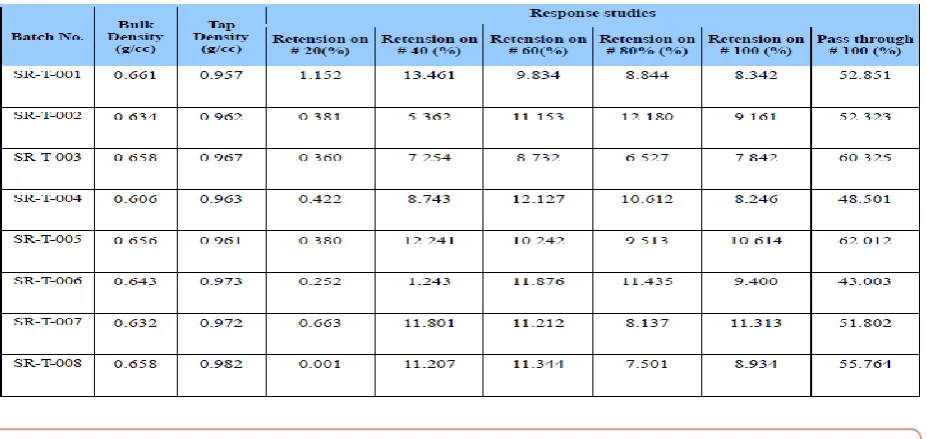
Table 5 summarizes the value of response parameters obtained from the studies. These
parameters are percentage of drug dissolved at thirty minutes sampling point, content
uniformity, weight variation, disintegration time and hardness.
The experimental plan and responses observed in a screening phase were carried out in
randomized order according to eight run matrix provided for by the Factorial design strategy.
Our full study addressed all response namely granules characteristics are illustrated in Table
6.
Mathematical model was developed correlating the selected process variables and the
Table 4: Design matrix for formula of optimization.
RESULT AND DISCUSSION
Table. 5: Summary of response studies.
[image:7.595.75.539.567.786.2]Statistical Analysis of Data: All the statistical and regression analysis procedure on the
response parameters were performed using the DOE methodology. The sets of data obtaining
from the statistical analysis were then subjected to computerized regression models including
an intercept and main effect terms of each independent variable. Two way interaction terms
and a stepwise regression procedure was used to assess all main effects, some two way
interactions and quadratic terms for usefulness in the model to obtain a more adequate
regression model for each response parameter. A full model is a model that is having all
possible terms Table-7, figure-1.
Table. 7: Model Evaluation.
The p-value for all the formulation varibles is greater than 0.05 indicates insignificant for
tablet content uniformity. The tablet content uniformity Acceptance value (AV) is less than
10.0 at studied range of variables observed. Hence, the range selected will not have any
impact on critical quality attribute of drug product.
The p-value for all the formulation varibles is greater than 0.05 indicates insignificant for
tablet % Dissolution at 30 minutes. The % Dissolution at 30 minutes greater than 95.0 at
studied range of variables observed. Hence, the range selected will not have any impact on
critical quality attribute of drug product.
The optimum values obtained from the contour plots for the independent variables in order to
obtain the best values for each of the four response variables are given in Table 8. In vitro
dissolution data may provide an indication of in-vivo bioavailability, therefore the percentage
of drug dissolve at 30 minutes was indentified as the response parameter. The optimumized
formulation satisfied all constraints simultaneously.
Statistical Analysis of Design of Experiments
(1) Effect of Variables
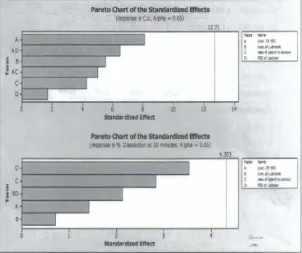
A Pareto chart showing the effect of core tablet formulation process variables on Tablet
Content Uniformity (%) and % dissolution at 30 minutes Pereto Chart of Formulation
variables on Tablets Content Uniformity and % Dissolution at 30 minutes. The estimated
effect for each individual terms are presented in table 7 & 8 and figre-1.
Table 9 summarizes the response tablets properties obtained from the eight formulations in
experimental degisn. The impact of concentration of excipient information was the variable
[image:9.595.146.449.331.584.2]Table. 9: Effects of Formulation Variables.
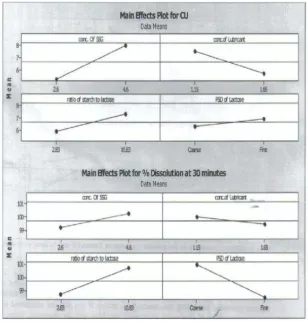
Main Effect
Content uniformity and % Dissolution at 30 minutes is given figure-2.
Main effect of Formulation process variables on Tables CU and (%) Dissolution at 30
Minutes: The absolute effect of selected variables within studied range are less than the
standardized effect and the Tablet Content Uniformity Acceptance value (AV) is less than
Hence, it can be concluded that there is no siginificant impact of selected variables within the
studied range on Tablet Content Uniformity and % dissolution at 30 minutes.
(3) Surface Plot: Surface Plot of Formulation variables on Tablets Content Uniformity
(4) Design Space: Design space for formulation variables on Tablet CU and%
Dissolution.
The white area shown overlaid contour plot is the formulation design space. Any of the
combination of variables within the formulation design space will show acceptable CU and
%Dissolution of the drug product. The intersecting straight line indicates that the optimized
formula is within the formulation design space.
The data of Design of Experiment studies revealed that experimental run within selected
range of all the independent variables did not show any impact on Critical Quality Attributes
(CQA) and other in process test results. Hence, the selected range can be consideredas a
design space with in which any change will not have any impact on CQA of drug product.
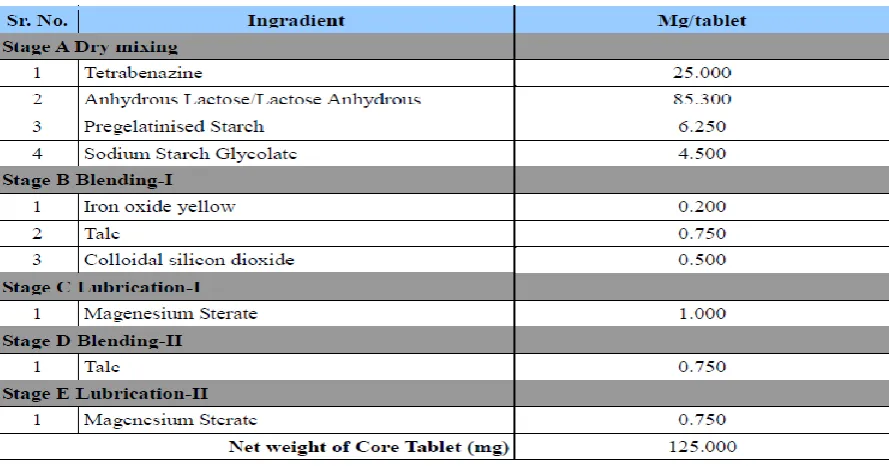
The formulation composition was finalized based on formulation optimization. In the
formulation optimization studies, impact of Lactose anhydrous PSD, level of sodium strach
glycolate ranges for these excipients selected did not have any impact on the in vitro
Table 10: Composition of Tetrabenazine Tablets.
CONCLUSIONS
In this TBZ tablet formulation was optimized using 24 partial factorial designs. Mathematical
model can be utilized to produce accurate representation of the relationship between the
independent variables and optimised a suitable tablet formulation. The optimization
technique can help us to further define and control the whole system. The dry granulation
process selection as well as propotion of excipient could be optimised succesfully. By
implementation of eight experiments the effect of two level four factors and their interactions
were determined. A Design space which guaranties a product having specified quality
attributes has been found. Design of Experiments (DOE) is an applicable method for
optimisation of BCS class IV drug.
REFERANCES
1. Yu S, Gururajan B, Reynolds G, Roberts R, Adams MJ, Wu CY. A comparative study of
roll compaction of free-flowing and cohesive pharmaceutical powders. Int J Pharm, 2012;
428: 39-47.
2. Herting MG, Kleinebudde P. Studies on the reduction of tensile strength of tablets after
roll compaction/dry granulation. Eur J Pharm Biopharm, 2008; 70: 372-379.
3. Sinka IC, Motazedian F, Cocks ACF, Pitt KG. The effect of processing parameters on
pharmaceutical tablet properties. Powder Technol, 2009; 189: 276-284.
4. Yu L. Amorphous pharmaceutical solids: preparation, characterization and stabilization.
5. Singhal D, Curatolo W. Drug polymorphism and dosage form design: a practical
perspective. Adv Drug Del Rev., 2004; 56: 335-347.
6. Carr RL. Classifying flow properties of solids. Chem Engg, 1965; 72: 69-70.
7. Grey RO, Beddow JK. On the Hausner Ratio and its relationship to some properties of
metal powders. Powder Technol, 1969; 2: 323-326.
8. Michoel A, Rambout P, Verhoye A. Comparative evaluation of co-processed lactose and
microcrystalline cellulose with their physical mixtures in the formulation of folic acid
tablets. Pharm Dev Technol, 2002; 7: 79-87.
9. Heng PWS, Chan LW, Liew CV, Chee SN, Soh JLP, Ooi SM. Roller compaction of
crude plant material: Influence of process variables, polyvinylpyrrolidone, and comilling.
Pharm Dev Technol, 2004; 9: 135-144.
10.Ohmori S, Makino T. Sustained-release phenylpropanolamine hydrochloride bilayer
caplets containing the hydroxypropylmethylcellulose 2208 matrix. I. Formulation and
dissolution characteristics. Chem Pharm Bull, 2000a; 48: 673-677.
11.Ohmori S, Makino T. Sustained-release phenylpropanolamine hydrochloride bilayer
caplets containing the hydroxypropylmethylcellulose 2208 matrix. II. Effects of filling
order in bilayer compression and manufacturing method of the prolonged-release layer on
compactibility of bilayer caplets. Chem Pharm Bull, 2000b; 48: 678-682.
12.Rambali B, Baert L, Jans E, Massart DL. Influence of the roll compactor parameter
settings and the compression pressure on the buccal bio-adhesive tablet properties. Int J
Pharm, 2001; 220: 129-140.
13.Habib WA, Takka S, Sakr A. Effect of roller compaction on nisin raw material lot-to-lot
variations. Pharmazeutische Ind, 2000; 62: 914-918.
14.Bultmann JM. Multiple compaction of microcrystalline cellulose in a roller compactor.
Eur J Pharm Biopharm, 2002; 54: 59-64.
15.Fernandes NC, Jagdale SC, Chabukswar AR, Kuchekar BS. Superdisintegrants effect on
three model drugs from different BCS classes. Res J Pharm Tech, 2009; 2: 335-337.
16.Preetha B, Pandit JK, Rao VU, Bindu K, Rajesh YV, Balasubramaniam J. Comparative
evaluation of mode of incorporation of superdisintegrants on dissolution of model drugs
from wet granulated tablets. Acta Pharma Sci., 2008; 50: 229-236.
17.Gupta A, Hunt RL, Shah RB, Sayeed VA, Khan MA. Disintegration of highly soluble
immediate release tablets: A surrogate for dissolution. AAPS PharmSciTech, 2009;