DESIGN AND DEVELOPMENT OF CONTROLLED RELEASE
TABLETS OF BOSENTAN
Ch. Taraka Ramarao1* and 2Kagupati Sridevi
Department of Pharmaceutical Technology, Sri Venkateswara College of Pharmacy, Etcherla,
Srikakulam, Andhra Pradesh, India-532410.
ABSTRACT
The present investigation attempt has been made to formulate
controlled release matrix tablets of Bosentan using HPMC K15M,
HPMC E-15 and Xanthan gum are rate controlling polymer, PVP K-30
used as binder, microcrystalline cellulose as filler. The prepared tablets
were prepared by conventional wet granulation method and evaluated
for pre compression and post compression parameters with different
ratios. All the evaluated parameters of the formulations showed
compliance with pharmacopoeial standards. The effect of polymer
loading in in-vitro drug release and the mechanism of release was
studied by different mathematical models. This could be retarded or
maintained by the proper choice of controlling agent in order to
achieve the desired release profile. The o p t i m i z e d formulation
(F5) were subjected to stability studies as per ICH guidelines at different temperature and
humidity conditions. It can be concluded that among all the formulations and the
combinations of HPMC K15M, HEC & Metolose SR considered as the optimized
formulations in the present research work. The optimized formulations follow zero order
release kinetics and super case II transport release mechanism.
KEYWORDS: Bosentan, HPMC K15M, HPMC E-15, Xanthan gum, Avicel PH102, PVP
K-30 and Magnesium stearate.
INTRODUCTION
Bosentan is a competitive antagonist of endothelin-1 at the endothelin-A (ET-A) and
endothelin-B (ET-B) receptors. Under normal conditions, endothelin-1 binding of ET-A or
ET-B receptors causes constriction of the pulmonary blood vessels by blocking this
Volume 6, Issue 16, 464-474. Research Article ISSN 2277– 7105
Article Received on 14 October 2017,
Revised on 05 Nov. 2017, Accepted on 25 Nov. 2017
DOI: 10.20959/wjpr201716-10002
*Corresponding Author
Ch. Taraka Ramarao
Department of
Pharmaceutical Technology,
Sri Venkateswara College of
Pharmacy, Etcherla,
Srikakulam, Andhra
interaction, bosentan decreases pulmonary vascular resistance. Bosentan has a slightly higher
affinity for ET-A than ET-B.[1] Bosentan is used to treat pulmonary arterial hypertension
(PAH). Matrix technologies have often proven popular among the oral controlled drug
delivery technologies because of their simplicity easy in manufacturing, high level of
reproducibility and easy of scale up and process validation. It improves your ability to
exercise and prevents your condition from getting worse. It was chosen as a model drug
with an aim to develop a controlled release matrix tablet. Different formulations were
prepared by using different polymers like HPMC K15M, HPMC E-15, Xanthan gum, Avicel
PH102, PVP K-30 and Talc etc. with different ratios were used in the development of
formulations.
MATERIALS AND METHODS
MATERIALS
Bosentan (A Gift sample from Dr reddys, Hyderabad).
HPMC K15M, A Gift sample from Orchid health care, Chennai.
HPMC E15, A Gift sample from Orchid health care, Chennai.
Xanthan gum, A Gift sample from Orchid health care, Chennai.
PVP K30 A Gift sample from Orchid health care, Chennai.
Micro crystalline cellulose, A Gift sample from Moly chemicals.
Hydroxy Ethyl cellulose (Moly chemicals).
Metolose SR (Moly chemicals).
Mg stearate (Cheminova private limited).
Talc (Cheminova private limited).
METHODS
PREPARATION OF BOSENTAN MATRIX TABLETS
Controlled release tablets of Bosentan were prepared by conventional wet granulation
technique using different concentrations of polymers like HPMC K15M, HPMC E15 and
xanthan gum.[2,20] The Required quantity of all materials was weighed and then active
ingredient (Bosentan) and polymers were mixed. A liquid binder solution of PVP K30 is
added to the mixture to facilitate adhesion. A damp mass resembling dough is formed and
used to prepare the granulation. The wet mass was pressed through a 10 number sieve to
prepare the granules. The resultant granules are spread evenly on large pieces of paper in
were passed through sieve number 20. Sizing of the granules is necessary so that the die
cavity for tablet compression may be completely and rapid filled by the free flowing
granulation. After completion of dry screening the granules were mixed with magnesium
stearate and talc which acts as lubricants which prevents the adhesion of the tablet
formulation to the punches and dies during compression. After blending with the polymers
the granules were subjected to the compression using 10 stations tablet punching machine
(Rimek mini press-1 Karnavati Engineering Ltd, Mehsana, Gujarat.).
Evaluation of Tablets
Thickness: Thickness Control of physical dimension of the tablet such as thickness and
diameter is essential for consumer acceptance and tablet uniformity. The thickness and
diameter of the tablet was measured using Vernier calipers. It is measured in mm.
Hardness: The Mansanto hardness tester was used to determine the tablet hardness.
Friability: The loss was tested by Friabilator USP EF-2.
Dissolution Rate Study
The release rate of Bosentan from tablets was determined using United States Pharmacopoeia
(USP) XXIV dissolution testing apparatus II (paddle). The dissolution test was performed
using 900 ml of pH 1.2, for first 2 hours then in phosphate buffer pH 6.8 for rest of the hours
at 37 ± 0.5 C and 50 rpm. A sample (5 ml) of the solution was withdrawn upto 12 hours. The
samples were replaced with fresh dissolution medium. The samples diluted to a suitable
concentration with respected dissolution medium. Absorbance of these solutions was
measured using a UV-Visible Spectrophotometer (UV-1800) at 276 nm.
Data Analysis: The data analysed as per Zero order kinetic model (Cumulative % drug
released versus time), First order kinetic model (Log cumulative percent drug remaining
versus time), Higuchi model ( Cumulative percent drug released versus square root of
time) and Korsmeyer equation / Peppa’s model (Log cumulative percent drug released
versus log time).
Stability Studies
Stability studies of optimized formula (F5) were done as per ICH guide lines. These studies
are designed to increase the rate of chemical or physical degradation of the drug substance
at different storage conditions at elevated temperatures such as 250C± 20C / 60% ± 5% RH,
300C ± 20C / 65% ±5% RH and 400C ± 20 / 75% ± 5% RH for 90 days. The samples were
withdrawn at intervals of fifteen days and checked for physical appearance and percentage
drug release.
RESULTS AND DISCUSSIONS
Each tablet containing 16 mg of bosentan could be preparared by conventional wet
granulation method employing Xanthan gum, HPMC K 15M, HPMC-E15. The weight loss
in the friability was less than 1% in all the cases. All the matrix tablets prepared contained
drug in the range of 98 to 102% of the labeled claims. The punches used to compress the
tablets were 9mm, spherical shaped. The shape and size of the tablets were found to be
within the limit. The hardness of the tablets was found to be in the range of 4.02 to 4.25
Kg/cm2. It was within the range of monograph specification. Thicknesses of the tablets were
found to be in the range of 3.42 to 3.87 mm. Weight variation test helps to check whether
the tablet contain proper quantity of the drug. From each of the formulations ten tablets were
randomly selected and weighed. The results are given in detail. The average weights of the
tablets were found to be within the prescribed official limits (IP). The drug content for all the
batches were found to be in the range of 96.48 to 99.59%. Xanthan gum, HPMC K 15M,
HPMC-E15 was chosen for the formulations.
HPMC-E15 is a non toxic, biocompatible, cost effective and also reduces the risk of systemic
toxicity due to dose dumping. HPMC K 15M also non toxic, non allergic, non irritating,
biocompatible, soluble at pH higher than 6.5. So it was used to control the release of the drug
according to specification given in USP. Xanthan gum is as a controlled-release carrier. The
release of the drug in stomach was prevented by using acid resistance polymers. Hence by
using the property of polymer, the drug was made to release in the intestine (pH 6-7) by
escaping acidic environment of stomach without degradation of drug.
In-Vitro Release Study
All the 13 formulation of prepared tablets of Bosentan were subjected to in vitro release
studies, these studies were carried out using dissolution medium, (pH 1.2 and Phosphate
buffer pH 6.8). by using USP-2 (paddle type) dissolution apparatus. The results were
evaluated for 12 hours. Among all the formulation, F5 showed 96.04%, release
Kinetics
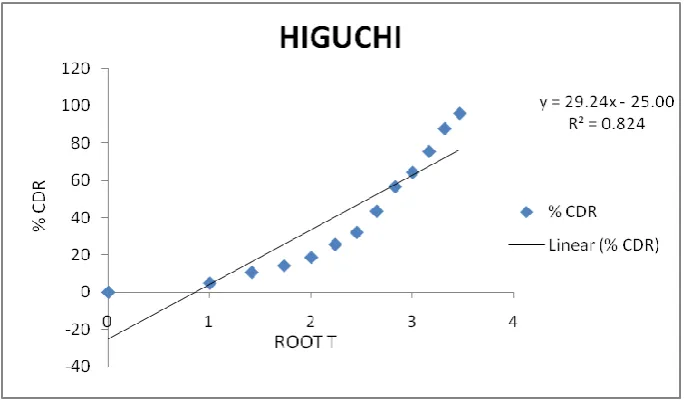
Different models like Zero order, First order, Higuchi’s, and Krosmeyers-peppas plots were
drawn. The regression coefficient (R2) value for Zero order, First order, Higuchi’s and
Krosmeyers-peppas plots for formulation F5 were found to be 0.970, 0.763, 0.824,0.927. The
optimized formulations F-5 follow Zero order and super case 2 transport mechanism.[21]
Stability Study
Stability studies were carried out on selected formulations (F-5) as per ICH guidelines. There
was not much variation in matrix integrity of the tablets at all the temperature conditions.
There was no significant changes in physical appearance, drug release for the selected
formulation F-5 after 90 days at 250C± 20C / 60% ± 5% RH, 300C ± 20C / 65% ±5% RH
and 400C ± 20 / 75% ± 5% RH.[22]
Table 1: Tablet composition of different formulations of Bosentan matrix tablets containing controlled release polymers.
Ingredients (mg) Formulation Code
F1 F2 F3 F4 F5 F6 F7 F8 F9 F10 F11 F12 F13
Bosentan 16 16 16 16 16 16 16 16 16 16 16 16 16
HPMC K15M 61 56 51 46 41 36
HPMC E15 51 46 41 36
Xanthan gum 15 20 35
PVP K30 10 10 10 10 10 10 10 10 10 10 10 10 10
Micro crystalline cellulose 35 35 35 35 35 35 35 35 35 35 35 35 35
Hydroxy Ethyl cellulose 15 15 15 15 15 15 15 15 15 15 15 15 15
Metolose SR - 5 10 15 20 25 51 46 41 36 51 41 31
Mg stearate 8 8 8 8 8 8 8 8 8 8 8 8 8
Talc 5 5 5 5 5 5 5 5 5 5 5 5 5
Total weight (mg) 150 150 150 150 150 150 150 150 150 150 150 150 150
Table 2: Cumulative Percent of Drug Dissolution of Prepared Tablets (F1 to F6).
Time (hr) Cumulative percent drug release
F1 F2 F3 F4 F5 F6
0 0.0 0.0 0.0 0.0 0.0 0.0
1 7.85 6.69 6.41 5.02 4.87 4.23
2 14.02 13.80 12.58 11.64 10.66 9.52
3 17.45 16.78 16.12 15.54 14.26 12.11
4 21.02 20.56 19.74 18.75 18.70 15.25
5 30.45 29.30 28.79 26.97 25.64 23.64
6 39.85 37.74 36.63 34.47 32.11 30.08
7 51.26 49.46 47.85 45.20 43.49 41.36
8 68.79 66.37 62.02 57.89 56.68 53.38
9 76.63 74.48 70.59 68.87 64.32 62.25
10 87.96 85.52 83.37 80.81 75.57 72.20
11 92.50 90.10 90.10 90.39 87.84 81.89
Fig 1: Cumulative Percent of Dissolution Date of Prepared tablets (F1 to F6).
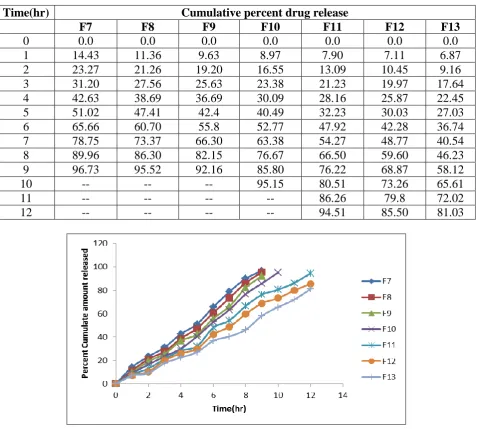
Table 3: Cumulative Percent of Drug Dissolution of Prepared tablets (F7 to F13).
Time(hr) Cumulative percent drug release
F7 F8 F9 F10 F11 F12 F13
0 0.0 0.0 0.0 0.0 0.0 0.0 0.0
1 14.43 11.36 9.63 8.97 7.90 7.11 6.87
2 23.27 21.26 19.20 16.55 13.09 10.45 9.16
3 31.20 27.56 25.63 23.38 21.23 19.97 17.64 4 42.63 38.69 36.69 30.09 28.16 25.87 22.45
5 51.02 47.41 42.4 40.49 32.23 30.03 27.03
6 65.66 60.70 55.8 52.77 47.92 42.28 36.74
7 78.75 73.37 66.30 63.38 54.27 48.77 40.54 8 89.96 86.30 82.15 76.67 66.50 59.60 46.23 9 96.73 95.52 92.16 85.80 76.22 68.87 58.12
10 -- -- -- 95.15 80.51 73.26 65.61
11 -- -- -- -- 86.26 79.8 72.02
12 -- -- -- -- 94.51 85.50 81.03
[image:6.595.61.540.318.747.2]Fig 3: First order Drug Dissolution profile of Optimized Formulation (F5).
Fig 4: Pappas Model- Dissolution profile of Optimized Formulation (F5).
[image:7.595.127.470.531.731.2]Table 4: Stability Studies of Optimized Formulation (F5).
Temp. and relative humidity
Parameters Days
0 30 60 90
250C± 20C / 60% ± 5% RH
No change Physical appearance 300C± 20C / 65% ± 5% RH
400C± 20C / 75% ± 5% RH
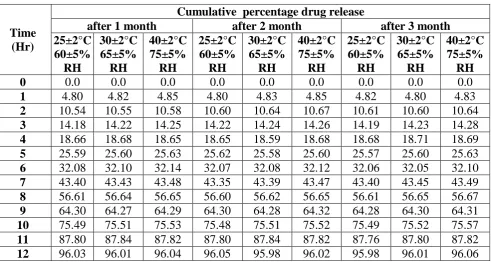
Table 5: Dissolution Study for Optimized Formulation After storage.
Time (Hr)
Cumulative percentage drug release
after 1 month after 2 month after 3 month
25±2°C 60±5% RH 30±2°C 65±5% RH 40±2°C 75±5% RH 25±2°C 60±5% RH 30±2°C 65±5% RH 40±2°C 75±5% RH 25±2°C 60±5% RH 30±2°C 65±5% RH 40±2°C 75±5% RH
0 0.0 0.0 0.0 0.0 0.0 0.0 0.0 0.0 0.0
1 4.80 4.82 4.85 4.80 4.83 4.85 4.82 4.80 4.83 2 10.54 10.55 10.58 10.60 10.64 10.67 10.61 10.60 10.64 3 14.18 14.22 14.25 14.22 14.24 14.26 14.19 14.23 14.28 4 18.66 18.68 18.65 18.65 18.59 18.68 18.68 18.71 18.69 5 25.59 25.60 25.63 25.62 25.58 25.60 25.57 25.60 25.63 6 32.08 32.10 32.14 32.07 32.08 32.12 32.06 32.05 32.10 7 43.40 43.43 43.48 43.35 43.39 43.47 43.40 43.45 43.49 8 56.61 56.64 56.65 56.60 56.62 56.65 56.61 56.65 56.67 9 64.30 64.27 64.29 64.30 64.28 64.32 64.28 64.30 64.31 10 75.49 75.51 75.53 75.48 75.51 75.52 75.49 75.52 75.57 11 87.80 87.84 87.82 87.80 87.84 87.82 87.76 87.80 87.82 12 96.03 96.01 96.04 96.05 95.98 96.02 95.98 96.01 96.06
CONCLUSION
1. Different parameters like hardness, friability, weight variation, drug content uniformity,
in-vitro drug release were evaluated.
2. The bosentan were prepared by including analytic control of the production process and
preparation using HPMC K15M, HPMC E15 and xanthan gum, polymers as retardant.
3. The drug-polymer ratio was found to influence the release of drug from the formulations.
It was found that increase in the concentration of HPMC K15M in polymeric ratio
decreases the drug release.
4. The formulations F5 showed good drug release with good matrix integrity release of
96.04% at the end of 12hr so the formulation F5 selected as the optimized formula.
5. The formulation F5 showed good drug release with good matrix integrity.
6. Based on these results formulation F5was found to be the most promising
formulations. The regression coefficient (R2) values of zero order of the optimized
[image:8.595.55.547.210.472.2]follows zero order release kinetics and super case 2 transport.
7. Stability studies were conducted for the optimized formulations as per ICH guidelines for
a period of 3 months which revealed the stability of the formulations. The results suggest
that the developed controlled-release matrix tablets of B o s e n t a n could perform
better than conventional dosage forms, leading to improve efficacy and better patient
compliance.
8. Further preclinical and clinical studies are required to evaluate the efficacy of these
formulations of Bosentan in the management of hypertensive. Bosentan with all evident
advantages proved to be suitable candidates for development of a controlled release
dosage form.
REFERENCE
1. Funke C, Farr M, Werner B, Dittmann S, Uberla K, Piper C, Niehaus K, Horstkotte D
(Apr 2010). "Antiviral effect of Bosentan and Valsartan during coxsackievirus B3
infection of human endothelial cells.". Journal of General Virology. 91(8): 1959–1570.
2. Sallsa T. Veiga F, Pina ME. oral controlled – release dosage forms Cellulose ether
polymers in hydrophilic – matrices. Drug Dev Ind Pharm, 1997; 23: 929– 938.
3. Alderman DA. A review of cellulose ethers in hydrophilic matrices for oral controlled
– release dosage forms. Int. S. Pharm. Tech,. Prod. Manuf, 1984; 5: 1-9.
4. Gohel MC, Patel TP, BarigyaSH. Studies in preparation and evaluation of pH
independent sustained – release matrix tablets of Verapamil Hcl using directly
compressible Eudragits. Pharam Dev Technol, 2003; 8: 323 – 333. Pubmed Dol : 10.
1081 / PDT – 120024686.
5. Liv J, Zhang F, Mc GinityJw. Properties of lipophilic matrix tablets containing
phenylpropanolamine hydrochloride prepared by hot – met extrusion. Eur J pharm
Biopharm, 2001l; 42: 181–190. Pubmed Dol: 10. 1016/ S0939 – 6411 (01) 00162-x.
6. Robinson Joseph R, Lee Vincent HL. Design and fabrication of oral controlled release
drug delivery system. In: Controlled drug delivery - Fundamentals and applications.
Marcel Dekker, Inc., New York, 1987; 2nd edition: 24-36.
7. Anroop B. Nair, Hiral vyas and Ashok Kumar. Controlled release matrix uncoated tablets
of enalapril maleate using HPMC alone, Journal of Basic and Clinical Pharmacy Vol-001
Issue-002 March 2010 – May 2010
8. Shantveer V. Salger, Lingaraj S. Danki, Abdul Sayeed, Shivanand Hiremath. Formulation
propranolol hydrochloride, Scholars Research Library, Der Pharmacia Lettre, 2010; 2(5):
12-22.
9. Amit.S. Yadav, Ashok Kumar P, Vinod R, Someshwara Rao B, Suresh V Kulkarni.
Design and Evaluation of Guar Gum Based Controlled Release Matrix Tablets of
Zidovudine, Journal of Pharmaceutical Science and Technology, 2010; 2(3): 156-162.
10.GanesanV, Jayachandran DL Design and Evaluation of Matrix Tablets of Ambroxol
Hydrochloride using Guargum Research J. Pharm. and Tech., 2008; 1(4): 507-12.
11.AbdelbaryGA, TadrosMI. Design and in vitro/in vivo evaluation of novel nicorandil
extended release matrix tablets based on hydrophilic interpolymer complexes and a
hydrophobic waxy polymer. Eur J Pharm Biopharm. 2008; 69(3): 1019-28.
12.Kulkarni R V, Shah A, Boppana R. Development and evaluation of xyloglucan matrix
tablets containing naproxen. Asian J of pharmaceutics, 2008; 2(2): 102-5.
13.Amelia avachat, Vikram kotwal. Design and evaluation of matrix based controlled release
tablets of Diclofenac Sodium and chondrotin Sulphate. AAPS Pharm Sci Tech. 2007;
8(4): E1-E6.
14.Emami J, Tavakoli N, Movahedian A. Formulation of sustained-release lithium carbonate
matrix tablets: influence of hydrophilic materials on the release rate and in vitro-in vivo
evaluation. J Pharm Pharmaceut Sci., 2004; 7(3): 338-44.
15.Reddy KR, Mutalik S, Reddy S. Once-Daily Sustained-Release Matrix Tablets of
Nicorandil: Formulation and In Vitro Evaluation. AAPS Pharm Sci Tech., 2003; 4(4):
article 61.
16.NerkurJ, JunHW, ParkJC, ParkMO. Controlled-release matrix tablets of ibuprofen using
cellulose ethers and carrageenans: effect of formulation factors on dissolution rates. Eur J
Pharm Biopharm, 2005; 61(1-2): 56-68.
17.J. Ashtamkar, S. Nangude et al., Formulation and evaluation of controlled release tablets
of miglitol using combination of hydrophilic polymers., International Journal of
Pharmaceutical sciences and Research., 2013; 4(5): 1833-1837.
18.Y. Ganesh Kumar, J. Sreekanth, et al; Preparation and Evaluation of Sustained Release
Matrix Tablets of Bosentan by Using Wet Granulation Technique., International Journal
of Pharmaceutical Sciences Review and Research., Rev. Res., March – April 2015; 31(2):
Article No. 26, Pages: 155-161.
19.P. Ganga Jyothi, K. Gnanaprakash et al; Development and characterization of matrix
20.Y. Ganesh kumar, J. Sreekanth., et al., formulation development and in vitroevaluation of
sustained release matrix tablets of bosentan by using synthetic polymers International
Journal of Pharmacy and Pharmaceutical Sciences., 2014; 6: 11.
21.Korsemeyer RW, PeppasNA. Macromolecular and modeling aspects of swelling –
controlled Systems. In: Mansdrofsz, Roseman TJ, ad, Controlled Release Delivery
systems. New – York, NY: Marcel Dekker, 1983: 77.
22.ICH Q1A (R2) stability testing guidelines: stability testing of new drug substances and
products. [Online]. 2003 [cited 2008 Nov 10]; Available from: